
Turn the most ignored space in your home into a stunning first impression — step by step, no design degree required.
Let’s be real. Most people decorate their hallway last — if at all. You spend hours choosing the perfect sofa, the right dining table, the exact shade of paint for the living room, and then your hallway gets a sad coat of magnolia and a forgotten coat rack from five years ago. But here is the thing: your hallway is the first room anyone sees when they walk into your home, and it is the last thing you look at before you leave. It sets the tone for everything. It is basically the cover of the book that is your home. And yes, people do judge books by their covers.
This guide is going to walk you through every single part of styling a hallway interior — from the floor under your feet to the ceiling above your head, from the lighting that makes everything glow to the furniture that actually fits without blocking the door. Whether your hallway is a narrow corridor in a city flat, a long stretch in a suburban home, or a wide open entrance in a house that was clearly designed by someone who liked space, this article has something useful for you. We will cover layout, colour, lighting, storage, furniture, wall treatments, flooring, accessories, and more. By the end, you will know exactly how to style your hallway interior, and you might even enjoy the process.
No jargon, no complicated techniques, no need to hire an interior designer (although they are great, of course). Just clear, practical, honest advice with a bit of fun along the way. Let us get started.
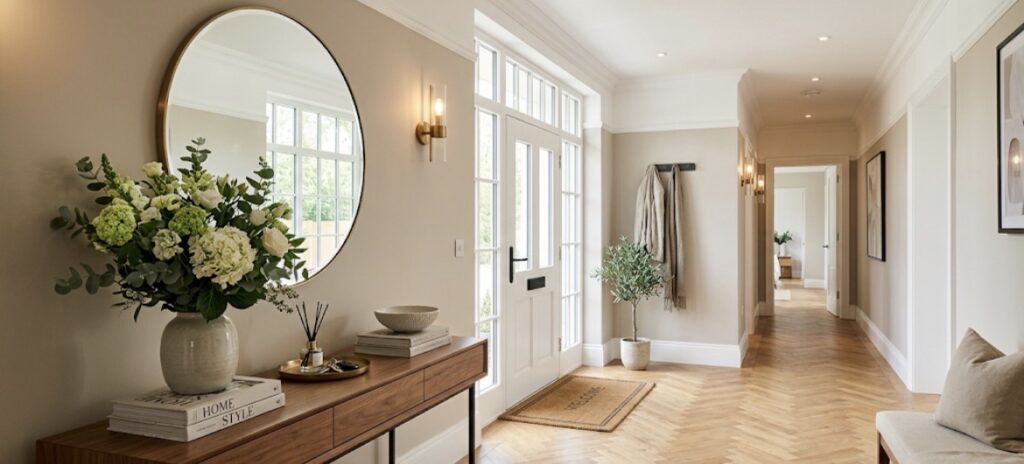
1. Understanding Your Hallway: Size, Shape and What You Are Working With
Before you buy a single item or choose a single colour, you need to understand the space you are working with. This sounds obvious, but the number of people who order a stunning console table only to discover it does not fit through the front door — or worse, fits through the door but blocks it from opening — is genuinely impressive. So let us start with a proper look at what you have.
Measure your hallway. All of it. The length, the width at its narrowest point, the height of the ceiling, and the distance between the front door and the first doorway or staircase. Write these numbers down. Take photos from both ends of the hallway, from the sides, and from standing height. These photos will become incredibly useful when you are trying to imagine how furniture will look or how a colour will feel in the space.
Think about what your hallway needs to do. Does it need to store shoes, coats, bags, and umbrellas for a busy family? Does it mainly serve as a quiet passageway between rooms? Do guests come through the front door, or do most people use a back or side entrance? All of these questions will shape your design decisions. A hallway that needs to handle the chaos of four people leaving the house every morning has very different needs from a hallway that mainly acts as an elegant corridor in a quiet home.
The shape matters too. A straight hallway is the most common and the most forgiving. An L-shaped hallway has that awkward corner to deal with, which can either be a problem or a wonderful opportunity for a built-in storage solution or a cosy reading nook. A hallway with lots of doors opening onto it needs careful planning to make sure nothing blocks anything. And if your hallway has a staircase, that creates a whole extra layer of visual interest and practical challenge to work with.
Once you know what you are working with, you can start making decisions with confidence instead of guessing. A designer once said that a room is just a problem waiting to be solved beautifully. Your hallway is no different.
2. Choosing the Right Colour Palette for Your Hallway
Colour is one of the most powerful tools in interior design, and in a hallway it matters more than almost anywhere else in the house. Because hallways are often narrow and sometimes quite dark, the colours you choose will have a huge impact on how the space feels. The wrong colour can make a small hallway feel like a tunnel. The right colour can make it feel airy, warm, welcoming, or dramatic — depending entirely on what you want.
Light colours are the classic choice for smaller hallways because they reflect light and push the walls back visually. Soft whites, warm creams, pale greys, and light sage greens all work brilliantly in tight spaces. But here is a little secret that many people overlook: pure bright white can actually make a hallway feel cold and clinical, especially in a home that does not get much natural light. Warmer whites and creamy off-whites tend to feel much more inviting and liveable. Think of shades like linen, parchment, warm stone, or antique white rather than brilliant white.
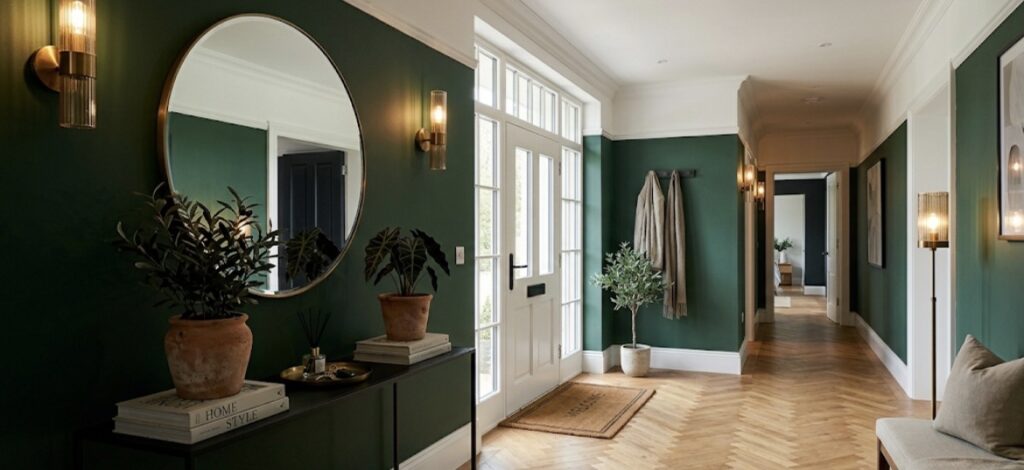
Dark colours are having a real moment in hallway design, and with good reason. A deep forest green, a rich navy blue, a moody charcoal, or an earthy terracotta on the walls of a hallway creates a sense of drama and intention that can feel incredibly sophisticated. This works best when you have good lighting and when the hallway is not extremely narrow — but even in small spaces, a dark hallway done well feels like a statement. It says: we know what we are doing in here. The trick with dark hallways is to make sure the ceiling and floor are balanced. A dark wall with a pale ceiling and a light-coloured floor feels intentional. Dark walls, dark ceiling, and a dark floor with no light sources feels like a different kind of statement altogether.
Colour zoning is a great technique for hallways that connect to an open-plan space or have multiple areas within them. You can use a slightly different shade of the same colour family on the lower half of the wall with a dado rail or picture rail as a dividing line, or you can use a feature wall at the end of the hallway to create a focal point that draws the eye down the corridor. This is a simple technique that adds depth and visual interest without any complicated work.
Do not forget that the colours of your floors and ceiling count as part of your palette too. A warm honey-toned wooden floor pairs beautifully with sage green or warm white walls. A cool grey tile floor works well with navy, charcoal, or crisp white. Thinking about all the surfaces together rather than just the walls will give your hallway a finished, pulled-together look. (And if your carpet is beige and nothing can change that right now, warm terracotta walls are your best friend.)
3. Flooring That Works Hard and Looks Great
Your hallway floor takes more punishment than almost any other floor in your house. It is the first thing to meet muddy shoes, wet boots, dragged suitcases, and the paws of a dog who has not read any interior design guides. So when you are choosing flooring for your hallway, you need something that can handle daily life while still looking the part. Fortunately, the options are genuinely excellent.
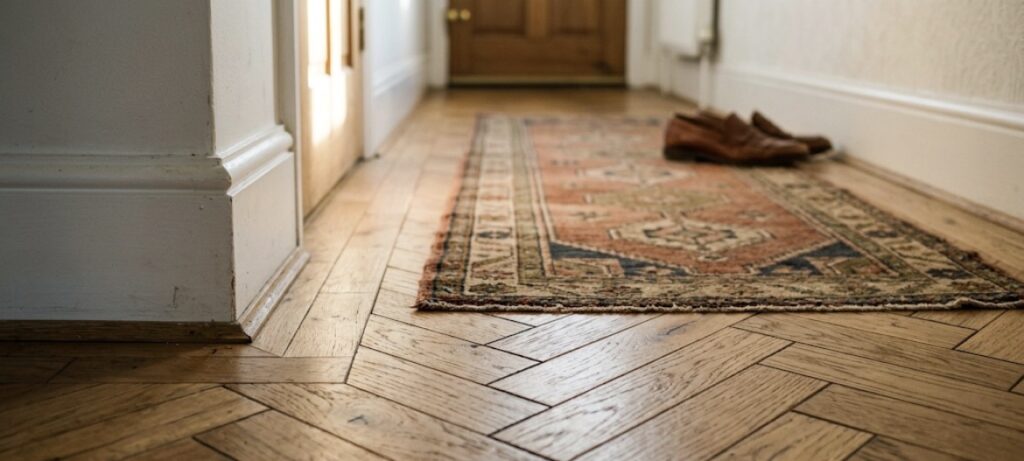
Hardwood and engineered wood flooring is a popular choice for hallways because it is warm, beautiful, and relatively durable when properly sealed and maintained. Herringbone and chevron patterns in particular have become hugely popular in hallways because the angled pattern creates a sense of movement and length that makes a narrow corridor feel wider. The pattern also gives the floor an intentional, crafted feel that elevates the whole space without doing anything else. If you already have wood floors in adjacent rooms, choosing a matching or complementary wood for the hallway creates a wonderful sense of flow through the home.
Tiles are another excellent hallway option, especially in homes where outdoor footwear comes inside or where the hallway connects to a garden or muddy utility area. Large format tiles in neutral tones like concrete grey, warm stone, or soft terracotta are both practical and beautiful. Smaller mosaic tiles or encaustic cement tiles with geometric patterns can turn the floor into a genuine design feature — a patterned floor in a hallway is one of those things that looks expensive without necessarily being so. If you go for patterned tiles, keep the walls simpler to let the floor do the talking.
Luxury vinyl tile, often called LVT, has become enormously popular in recent years and for good reason. Modern LVT looks incredibly realistic, is waterproof, extremely hard-wearing, comfortable underfoot, and available in an enormous range of styles from wood-effect to stone-effect to geometric patterns. It is also easier to install than real wood or ceramic tile, which means lower installation costs. For a busy family hallway or a rental property, LVT is arguably the most practical choice available right now.
Whatever flooring you choose, think about the transition between your hallway floor and the floors of the rooms that lead off it. A hard metal threshold strip is functional but can look clunky. A smooth, invisible transition between the same material or a carefully chosen complementary one feels more considered. And if your hallway has a step or level change, make sure it is clearly visible and safe — beauty and safety are not mutually exclusive, but safety should always come first.
4. Lighting Your Hallway: From Dark Corridor to Glowing Welcome
Lighting might be the single most transformative thing you can do in a hallway, and it is often the most underestimated. A beautifully painted, well-furnished hallway with poor lighting looks flat and uninviting. A simply decorated hallway with excellent lighting looks curated and warm. Light literally changes everything. The good news is that hallway lighting does not have to be complicated or expensive — it just needs to be thoughtful.
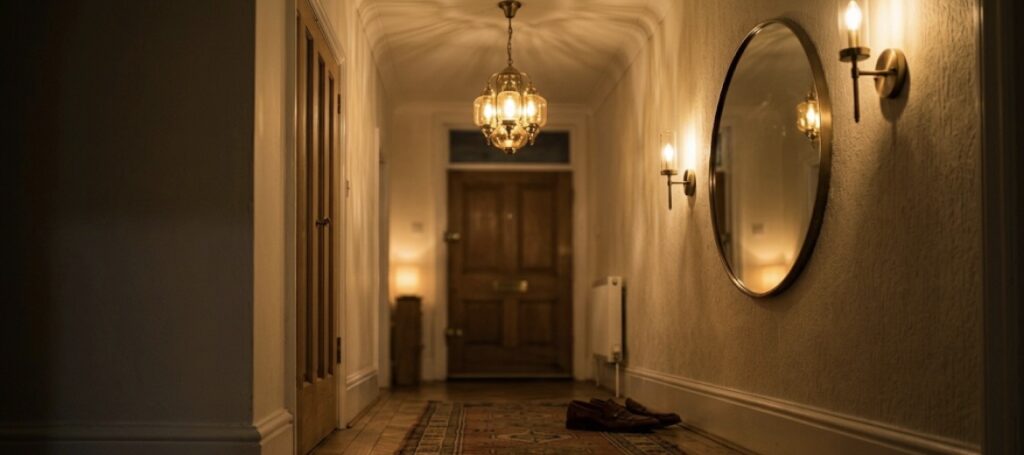
Start with your main overhead light. In most hallways, this is a ceiling-mounted fixture of some kind. If yours is a basic white plastic fitting with a single bulb pointing straight down, that is the first thing to change. A pendant light, a semi-flush ceiling fixture with a beautiful shade, a cluster of small pendants, or a statement chandelier — depending on your ceiling height and the scale of the space — will immediately make the hallway feel more designed. The rule for ceiling height and pendant lights is simple: if your ceiling is below 2.4 metres, stick to flush or semi-flush fixtures. If you have height to play with, a pendant hanging at eye level or slightly above creates a much more human and intimate atmosphere.
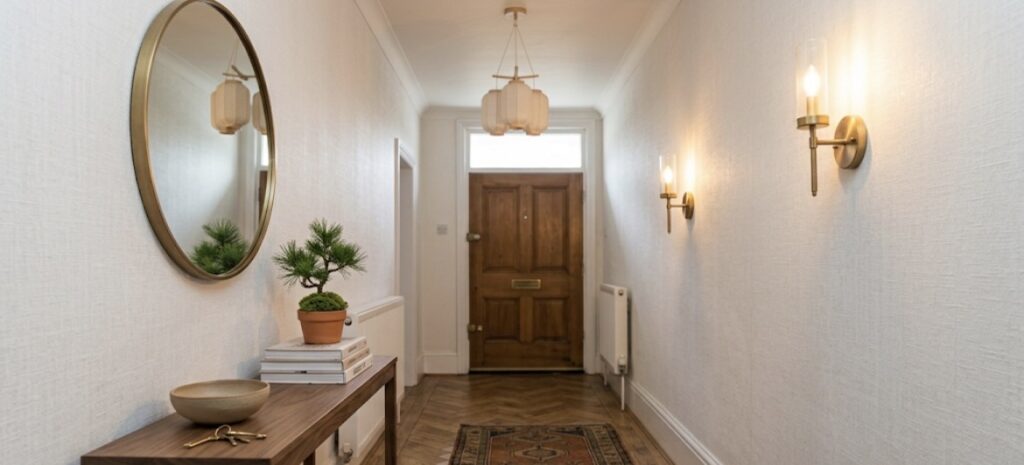
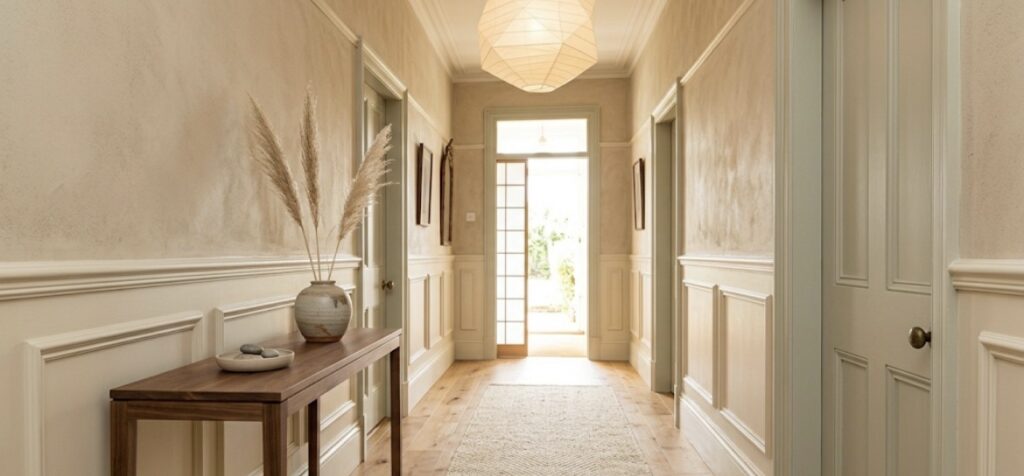
Wall lights, also called sconces, are a wonderful addition to a hallway and serve both a practical and decorative purpose. Placed at regular intervals along a longer hallway, they break up the wall surface, add layers of light, and create a rhythm that guides the eye through the space. Paired with a mirror or a piece of art, a single wall light on each side of a focal point looks genuinely elegant. Choose bulbs with a warm colour temperature — around 2700K to 3000K — for that welcoming glow rather than the slightly cold, clinical feel of cooler daylight bulbs.
If your hallway is dark due to a lack of windows, you have a few options beyond just adding more ceiling lights. A large mirror positioned to reflect any available light from a window elsewhere in the home can do remarkable things. Recessed downlights installed at regular intervals are a clean, modern solution for a low-ceilinged hallway where a pendant would be impractical. LED strip lighting along the base of a console table or beneath a floating shelf creates a soft ambient glow that adds depth without taking up any visual space. Even a well-placed lamp on a console table can transform the feel of a dark hallway.
Consider installing dimmer switches in your hallway so you can adjust the light for different times of day and different moods. Bright light is useful in the morning rush; soft, warm light in the evening makes coming home feel like a genuine pleasure. It is a small detail with a big daily impact. And while you are thinking about switches, make sure they are easy to reach from both ends of the hallway if you have them at either end — nothing is more annoying than having to walk through a dark corridor to turn the light on at the other end.
5. Furniture for Your Hallway: What You Need and What Actually Fits
Choosing furniture for a hallway requires a different approach to choosing furniture for any other room, mainly because the space constraints are real. In a living room you can afford to be generous — a large sofa, a coffee table, a bookcase. In a hallway you are working with a limited number of centimetres between one wall and the other, and you need everything in that space to earn its place. Anything that does not serve a purpose or add beauty has to go.
The console table is the cornerstone of most hallway designs. It is slim enough to fit without blocking passage, tall enough to be at a useful height, and versatile enough to act as both storage and display. When choosing a console table, look for one that is proportionate to your wall and corridor width. A table that is too long will dominate and make the space feel cramped; one that is too short will look like it is hiding. As a general guide, aim for the table to be no more than half the width of the wall it sits against, with enough clearance on either side to feel balanced. The height should be somewhere around 80 to 90 centimetres — roughly the same as a standard kitchen worktop — so it is useful for dropping keys, picking up bags, and placing decorative items at a comfortable height.
Storage is often the most pressing need in a hallway, especially in homes with children, pets, or anyone who owns more than one coat. A built-in storage bench at the end of a hallway, or under a window if one exists, solves the problem of shoes and bags with a clean, custom look. Wall-mounted hooks are endlessly practical and, when chosen well, can look genuinely beautiful rather than purely functional. Shaker-style hooks, matte black hooks on a wooden rail, or individual ceramic hooks are all options that feel considered rather than afterthought. A slim cabinet with doors hides clutter efficiently and gives you a clean surface on top for styling.
A mirror is arguably the single most useful piece you can add to a hallway. Beyond the practical value of being able to check your face before you leave the house (which is always worthwhile), a mirror reflects light and makes a space feel larger. The shape and frame of the mirror you choose contributes enormously to the overall style of the hallway. A large round mirror with a thin brass frame feels modern and soft. An ornate carved wooden mirror leans into a more traditional or eclectic style. An arched mirror has become enormously popular because its shape adds architectural interest and works with almost any interior style. If in doubt, go bigger than you think you should — a large mirror always looks more intentional than a small one.
A hall bench or seat is a practical addition that many people overlook. Whether it is a slim upholstered bench for sitting while you put on shoes, a vintage wooden settle, or a pair of small stools that can be pushed under a console table, having somewhere to sit in a hallway is genuinely useful. Choose a height that is comfortable for sitting — around 45 to 50 centimetres — and, if space is very tight, opt for something that slides neatly under the console table or folds flat against the wall when not in use.
6. Wall Treatments That Add Character Without Shrinking the Space
Walls make up a huge proportion of the visible surface area in a hallway, so what you do with them matters enormously. Beyond paint — which we covered in the colour section — there are a number of wall treatments that can add texture, depth, interest, and personality to a hallway without making it feel smaller or heavier.
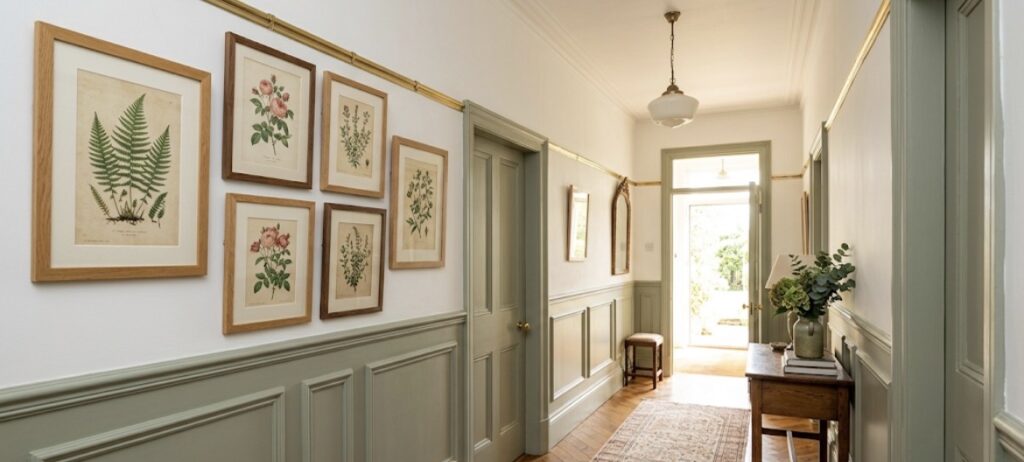
Panelling is one of the most effective and popular wall treatments for hallways right now, and it has been popular for a very good reason: it adds architectural detail that makes a plain, featureless hallway feel like it was designed rather than just built. Classic tongue and groove panelling running vertically up the lower half of the wall, topped with a simple dado rail, gives a hallway a traditional cottage or farmhouse feel when painted in a soft neutral. The same panelling painted in a deep, rich colour — forest green, navy, dusty rose — looks far more contemporary and dramatic. Vertical shiplap gives a similar effect with a slightly more modern aesthetic. Horizontal ribbed panelling or fluted wood panelling has become very popular in recent years and adds a beautifully tactile quality to a wall.
Wallpaper in a hallway can be absolutely stunning when chosen well. Because hallways are relatively small spaces in terms of total wall area, they are a great place to use a bolder, more pattern-heavy wallpaper than you might feel comfortable with in a larger room. A botanical print, a geometric repeat, a hand-painted effect, or a rich textured grasscloth can make a hallway feel genuinely special. The key is to choose a wallpaper that either complements or intentionally contrasts with the style of the rooms it connects to, so there is a sense of dialogue between the spaces rather than a jarring jump from one look to another.
Gallery walls are another wonderful option for hallway walls, and they serve the double purpose of adding visual interest and telling the story of the people who live in the home. A well-curated gallery wall of framed artwork, photography, prints, and personal images feels personal in a way that a single large piece of art cannot. The trick to a gallery wall that looks intentional rather than chaotic is to use a consistent frame style — either all the same colour, or all the same material — and to vary the sizes of the pieces within that. Laying the arrangement out on the floor before you start hammering nails into the wall will save you considerable frustration.
Do not neglect the ceiling and the skirting boards. A hallway with well-painted skirting boards, a clean cornice or coving where the wall meets the ceiling, and a ceiling painted in a shade that works with the walls feels finished in a way that nothing else replicates. If you want to try something a little adventurous, a ceiling painted in a deeper shade than the walls — what is sometimes called a ‘fifth wall’ treatment — creates a surprising and cosy sense of enclosure that works particularly well in smaller hallways.
7. Storage Solutions That Actually Keep Your Hallway Tidy
Here is the uncomfortable truth about hallways: they are storage zones whether you want them to be or not. Shoes accumulate. Coats pile up. Bags get dropped. Post stacks on every available surface. Umbrellas appear from nowhere. Children exist. The question is not whether your hallway needs storage — it definitely does — but how you make that storage look and work as well as possible so the hallway functions smoothly and still looks good.
Shoe storage is usually the biggest challenge. A family of four generates an astonishing number of shoes, and leaving them in a heap by the door is both unsightly and a genuine trip hazard (sometimes literally). A dedicated shoe cabinet — either a tall narrow unit with multiple shelves behind closed doors, or a bench with lift-up storage inside — keeps shoes out of sight and off the floor. If a full cabinet is too large for your space, a simple low shoe rack placed neatly against the wall is far better than nothing, and a basket or deep tray for shoes near the door catches the ones that never quite make it to the rack.
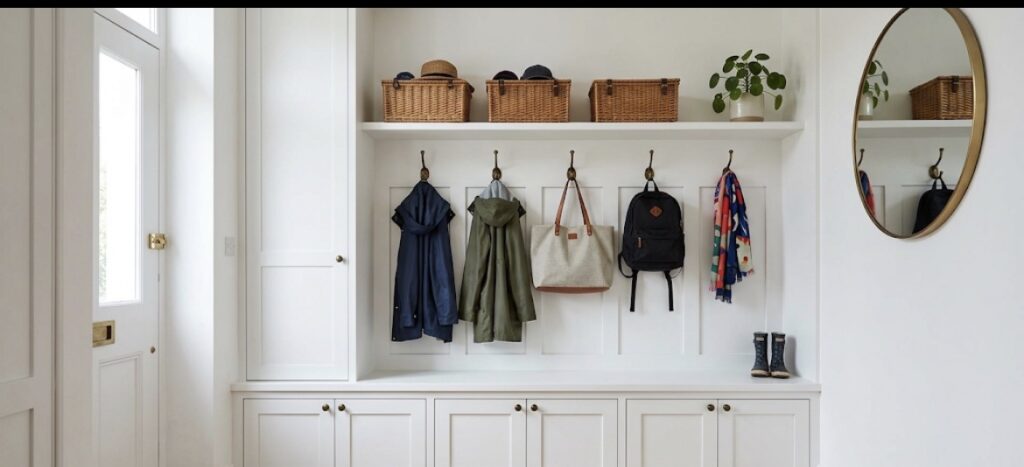
Coat hooks are an absolute essential, but placement matters. Hooks that are too close together mean coats overlap and everything looks messy even when it is technically tidy. Give each hook at least 15 to 20 centimetres of horizontal space, and think about different heights for different people in the household — lower hooks for children, higher ones for adults. A row of hooks on a wall-mounted rail with a shelf above it is a very efficient combination: the shelf holds bags, helmets, and other bulky items while the hooks take care of coats and scarves. If you want to go a step further, a fitted hall cupboard with full-height doors gives you maximum storage capacity with a completely clean exterior.
Think about the small things that always clutter a hallway: keys, post, sunglasses, phone chargers, dog leads, loyalty cards, and the general detritus of modern life. A small tray or bowl on the console table for keys is both practical and can be a lovely decorative object. A narrow wall-mounted letterbox shelf or a small row of hooks inside a cupboard door for various leads and items keeps things organised without creating visual noise. Even a small ceramic pot or a woven basket in a visible spot can act as a collection point for items that would otherwise be scattered across every surface.
If your hallway includes a staircase, the space under the stairs is one of the most valuable storage opportunities in the whole house. Whether this is a built-in cupboard, a series of bespoke drawers, open shelving for books and display, or even a small home office nook, using this space properly can transform the storage capacity of your entire home. It is worth investing in a professional joiner for a custom solution here — it will add value to the home and solve a real practical problem at the same time.
8. Rugs and Runners
A runner rug in a hallway is one of the easiest and most effective ways to add warmth, colour, texture, and personality to the space. It also serves a very practical purpose — it protects the floor from the daily punishment of foot traffic, reduces noise (especially useful in homes with hard floors throughout), and makes the hallway more comfortable underfoot. And yet, the hallway runner is persistently underrated. People agonise over the rug in the living room and then put nothing in the hallway at all. Do not be that person.
Choosing the right runner involves thinking about length, width, material, and pattern. The length should ideally extend most of the way down the hallway, leaving a consistent border of floor visible on each side — typically around 15 to 20 centimetres of floor showing on either side looks intentional and balanced. The width should be in proportion to the hallway: in a very narrow corridor, a slim runner of around 60 centimetres works well; in a wider hallway, you can go up to 80 or even 90 centimetres before it starts to look more like a full-width mat.
Material matters especially in a hallway. Wool runners are warm, beautiful, and surprisingly durable, but they can be more difficult to clean after muddy boots. A flatweave cotton or jute runner is easier to clean and works well in a hallway that gets heavy use — jute in particular has a beautiful natural texture and earthy colour that works with almost any interior palette. Synthetic fibres like polypropylene are the most practical choice for high-traffic areas and are extremely easy to clean, and modern versions of these materials look far better than their predecessors. If you want the look of a Persian or traditional patterned rug without the cost or the cleaning anxiety, a flatweave reproduction is a perfectly respectable solution.
The pattern and colour of your runner should either complement or intentionally contrast with the wall colour and floor. A neutral runner on a patterned floor lets the floor speak. A patterned runner on a plain floor becomes the focal point. A runner in a colour that picks up an accent from an adjacent room creates a sense of connected flow through the house. Bold geometric patterns, traditional Persian designs, simple stripes, and abstract modern prints all work in hallways — the key is to choose something you genuinely like, because you will see it every single day.
9. Plants and Accessories
Once the main elements of your hallway are in place — the flooring, the paint, the lighting, the key furniture — it is the accessories and living elements that transform it from a well-decorated corridor into a space with genuine soul. This is the part of the process where your personality gets to show up, and where most of the joy in interior design lives. It is also where people sometimes go overboard. A hallway is not a junk shop. Every single item should be there for a reason, whether that reason is beauty, function, or both.
Plants bring life, colour, and natural energy to a hallway in a way that nothing else quite replicates. The challenge is that hallways are often not the best-lit spaces for plants, so you need to choose your varieties wisely. Tough, low-light tolerant plants like snake plants, ZZ plants, peace lilies, and cast iron plants can handle the darker conditions that many hallways offer. If your hallway has a window or gets reasonable indirect light, you have more options: a fiddle-leaf fig, a monstera, a trailing pothos, or a lush peace lily all add drama and greenery beautifully. A single large dramatic plant in a beautiful pot can be the most impactful and least expensive thing you do in a hallway. If a real plant feels like too much commitment, a high-quality faux plant is a perfectly reasonable choice — just make sure it is genuinely convincing, because a very fake-looking fake plant defeats the purpose entirely.
Artwork in a hallway performs a very specific job: it gives people something beautiful to look at during the brief moments they pass through, and it signals something about the taste and character of the people who live there. A single large-scale print or painting at the end of a hallway creates a focal point that draws the eye and makes the space feel purposeful. A cluster of smaller pieces builds a more personal and collected feeling. Black and white photography, abstract prints, botanical illustrations, architectural drawings — any of these can work depending on the overall style of your home. The frame matters as much as the piece itself: a beautiful print in a cheap frame is a missed opportunity.
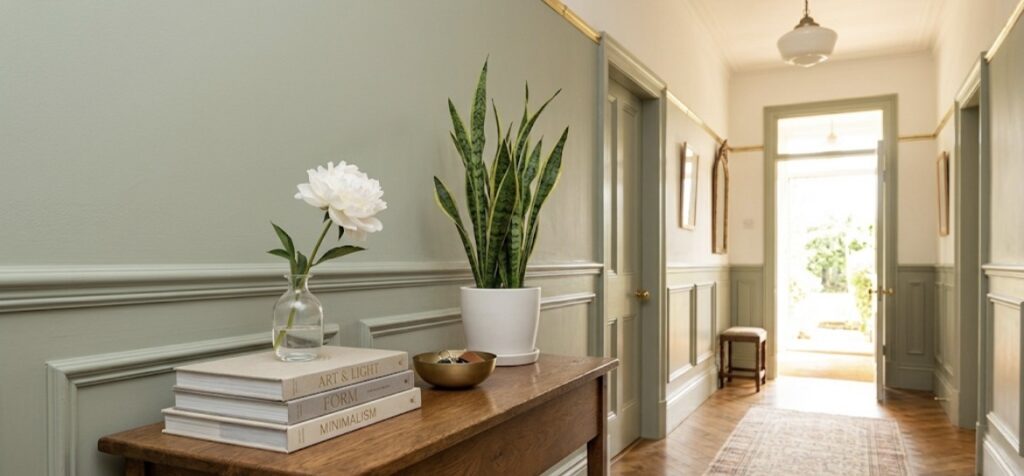
Small accessories — a beautiful ceramic bowl for keys, a vase of fresh flowers or dried stems, a sculptural object, a scented candle or diffuser — are the finishing notes that make a space feel truly styled. In a hallway, restraint is the word. Two or three well-chosen objects on a console table look considered and intentional. Seven objects of varying sizes look like the table is waiting to be cleared. The old styling rule of odd numbers — groups of one, three, or five objects — works well in hallways because there is never quite enough room to go overboard.
10. Styling for Different Hallway Sizes: Narrow, Medium, and Large
The advice above applies broadly to hallways of all sizes, but it is worth addressing the specific challenges and opportunities that come with different hallway sizes, because the approaches can differ quite significantly. A narrow flat hallway needs to be treated very differently from a wide Victorian entrance hall, and what works in one will absolutely not work in the other.
Narrow Hallways
A narrow hallway — anything under about 90 centimetres of clear width — requires strict discipline. Every piece of furniture must be genuinely slim. A console table that projects more than 25 centimetres from the wall is going to make the space feel claustrophobic. Wall-mounted storage solutions are your best friend here because they take up zero floor space. Floating shelves, wall-mounted hooks, a wall-mounted mirror — these all add function and style without encroaching on the walkway. Keep the colour palette lighter to maximise the sense of space, use vertical elements like tall narrow mirrors and vertical wall panels to emphasise height rather than width, and make sure the lighting is good. A narrow hallway with good lighting feels intimate; a narrow hallway with poor lighting feels like a service corridor.
Medium Hallways
A medium hallway — between 90 centimetres and around 1.5 metres wide — is the most common type and the most versatile. You have enough room for a slim console table, a bench or stool, a floor lamp, and a decent-sized rug without everything feeling cramped. This is the sweet spot where most hallway design ideas work well. The key here is proportion — choosing furniture that fits the scale of the space without overcrowding it or leaving it feeling empty and under-furnished. A medium hallway can handle a bold wall colour, a patterned floor, a gallery wall, and a statement light fixture all at the same time, as long as each element is in proportion.
Large Entrance Halls
A large entrance hall is a genuine luxury, and it deserves to be treated as a room in its own right rather than just a bigger version of a narrow hallway. In a large entrance hall you can consider a central piece — a round table in the middle of the space, a statement pendant light fixture, a large scale floor arrangement of plants, or even a small seating arrangement. The risk in a large entrance hall is that it can feel empty and echoing if not filled thoughtfully. Use furniture to divide and define the space: a console on one wall, a bench on another, seating in a corner. Layer the lighting with overhead, wall, and accent sources. Use large-scale art and substantial plants to fill the walls and floor without cluttering the space.
11. Interior Styles for Hallways: Finding Your Design Language
Your hallway does not exist in isolation — it connects to the rest of your home and should speak the same design language, or at least a compatible dialect. If your living room is all clean lines, neutral tones, and natural materials, a hallway with ornate floral wallpaper and a gilt mirror is going to feel like a different house has begun at the front door. But this does not mean your hallway has to be identical to every other room — in fact, hallways are a wonderful place to be a little bolder or more playful than you might be in a main living space, because the space is transitional and people are not spending extended time in it.
A Scandi or minimalist hallway is characterised by clean lines, a very limited colour palette (usually whites, greys, and natural wood tones), functional furniture with no unnecessary ornamentation, and excellent quality basics. The beauty in this style is in the materials and the restraint. A single beautiful plant, one good piece of art, one quality hook rail, and a perfectly proportioned mirror is all that is needed.
A maximalist or eclectic hallway is the polar opposite and can be absolutely spectacular. Bold wallpaper, lots of art, layered textiles, interesting vintage finds, plants everywhere, statement lighting, and a confident use of colour all work together to create a space that feels like a genuine expression of personality. The risk is that it tips into chaos — the difference between curated maximalism and pure mess is usually intention, editing, and a consistent underlying colour story that ties all the disparate elements together.
A traditional or classic hallway uses architectural details, quality materials, and rich colours to create a feeling of permanence and heritage. Panelling, cornicing, picture rails, parquet or chequerboard tile floors, a classic console table in dark wood, a bevelled wall mirror, and brass or antique bronze hardware all contribute to this look. It does not have to be stiff or formal — a traditional hallway can feel very warm and welcoming when the colours are rich rather than cold and the accessories are personal rather than generic.
A Japandi hallway — the popular blend of Japanese and Scandinavian design principles — uses natural materials, quiet neutral colours, functional furniture, and a deep respect for empty space. Nothing is unnecessary, everything is beautiful in a quiet way, and the overall feeling is one of calm and order. Warm wood tones, washi-paper light fixtures, ceramic accessories, and a single carefully chosen plant in a handmade pot are the elements of this style in a hallway context.
12. Common Hallway Mistakes and How to Avoid Them
Even with the best intentions and the most carefully chosen furniture, hallways go wrong more often than any other space in the home. Here are the most common mistakes — and how to avoid every single one of them.
The first and most common mistake is treating the hallway as a storage dumping ground rather than a designed space. This happens gradually: a pair of shoes left by the door becomes a pile, a coat thrown on a hook becomes six coats, a bag dropped on the console table becomes a mountain of bags and post and miscellaneous items. The solution is adequate, thoughtful storage built into the design from the start — not as an afterthought. If you give everything a specific place to live, it is far easier to maintain.
The second most common mistake is choosing furniture that is too large for the space. A console table that is too deep, a bench that blocks a door, a coat stand that falls over every time someone walks past — these things make a hallway feel stressful rather than welcoming. Measure carefully, buy deliberately, and if in doubt, go smaller.
Overlooking the lighting is another very frequent mistake. A single ceiling light with a harsh bulb illuminates a hallway without warming it. Layered lighting — an overhead fixture, wall sconces or a lamp on the console, and perhaps some accent lighting — transforms the same space completely. Switching to warm-toned LED bulbs costs very little and makes an immediate, noticeable difference.
Ignoring the ceiling and the floor in favour of only the walls is a mistake that leaves a hallway feeling unfinished. The floor and ceiling are both major design elements. A dirty, worn floor or a ceiling with peeling paint from an old light fitting will undo all the effort you put into the walls and furniture. Treat all surfaces as part of the design, not just the ones at eye level.
Finally, buying everything from the same shop in the same collection is a mistake that results in a hallway that looks like a showroom rather than a home. Real interiors are built over time, with a mix of new purchases, inherited pieces, market finds, and gifts. Even if you are starting from scratch, try to mix sources, mix time periods, mix price points. A vintage mirror above a new console table, a market find ceramic pot beside a new lamp — this is what makes a space feel genuinely lived in and loved.
Final Thoughts
Your hallway is not just a corridor. It is the opening sentence of your home’s story. The space that greets you every morning when you head out into the world and welcomes you back every evening when you return. It deserves the same attention, the same care, and the same intention as every other room you spend time designing.
Take it one step at a time. Start with what you can change easily — a new paint colour, better lighting, a mirror, a small plant. Build from there. Great interiors are not created in a single afternoon shopping spree; they evolve over time with patience, curiosity, and a willingness to edit and refine. Your hallway is no exception. But with the ideas in this guide, you now have everything you need to get started — and to get it right.
Now go open that front door. It is time to make a proper first impression.