
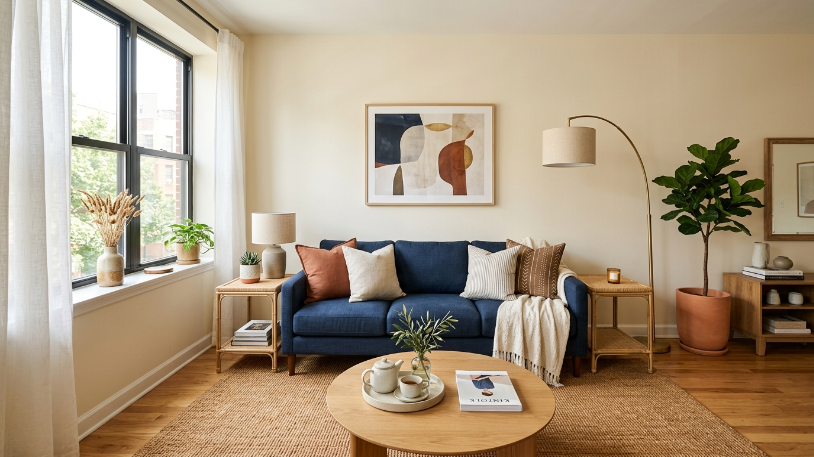
You can style a rented home to feel exactly the way you want and still walk away with your full deposit at the end of the tenancy. Most renters assume they are stuck with blank walls, flat lighting, and furniture placed wherever the room allows. That does not have to be your reality.
The real issue is not the landlord or the lease. It is not knowing which tools to use and in which order to use them. Renters who style their spaces well do not break any rules; they just know which materials work, which sizes matter, and how to layer the room from the floor up.
This guide walks you through the complete process of how to style a rented home, step by step, in a logical build order. You start with your layout and anchor pieces, then work your way up through color, rugs, texture, lighting, wall decor, and finishing touches. Each step builds on the last, so nothing looks random or thrown together.
You do not need to own the place to make it feel like yours. All you need is a clear plan. Let’s get into it.
Step 1: Read Your Lease Before You Style Anything
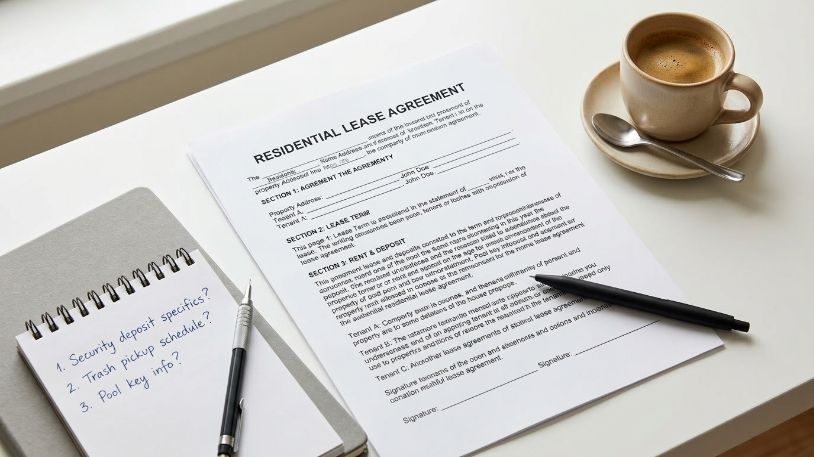
The least exciting step is also the most important one. Before you buy a single item or hammer anything into a wall, read your lease carefully. Find the section on damages, alterations, and permitted wall fixings. That section tells you exactly where the line is.
Most leases allow small picture nails in reasonable numbers. Some permit adhesive products like Command strips. A few prohibit anything on the walls at all. You will not know which category you are in until you actually read it. Also check whether felt pads are required under furniture legs on hardwood or tiled floors; some landlords deduct for scratches, even when the tenant did not know about the rule.
If your lease is vague on any point, send your landlord a short written message before you begin. Ask about wall hooks, adhesive strips, or anything else you are unsure about. A brief written reply from them protects you far more than a verbal yes at the start of the tenancy.
Lease checklist before you begin:
- Can you use adhesive hooks or strips on walls?
- Are picture nails permitted, and how many?
- Do furniture legs need felt pads on hardwood or tiled floors?
- Can you temporarily remove ceiling light fittings and restore them before you leave?
- Are there any restrictions on curtain rods or window treatments?
Step 2: Map Out Your Layout Before You Move a Single Thing
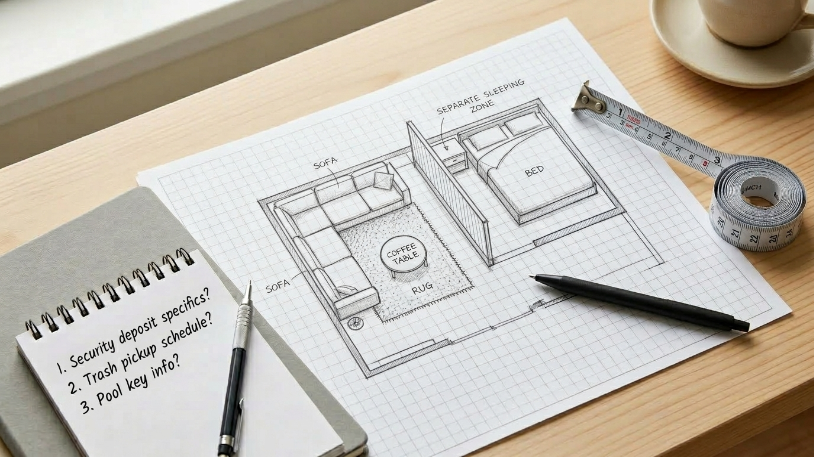
Layout is the real foundation of any styled room. One of the most common mistakes renters make is pushing all the furniture against every wall and leaving a dead zone in the center of the room. Another is buying a sofa or rug before measuring the space and then discovering it does not fit.
Start by measuring the room: length, width, and ceiling height. Write down where the doors, windows, and electrical outlets sit. Even a rough sketch on paper helps more than you would expect. Identify the main focal point of the room, whether that is a window, a fireplace, a TV wall, or an architectural feature. Then build your layout around that point.
Float your main seating piece away from the wall by at least 12 to 18 inches. This makes the room feel intentional rather than emptied out. In smaller spaces you may need to move it back closer to the wall, but still try to create at least two distinct activity zones. Even a compact studio can have a reading corner and a seating zone if the layout is planned carefully.
Layout rules to follow:
- Keep main walkways at least 36 inches wide for easy movement
- Leave 18 inches between the sofa and the coffee table
- Float the main seating piece facing or angled toward the focal point
- Use rugs to visually define separate zones in an open-plan space
Step 3: Use Color to Style a Rented Home Without Paint
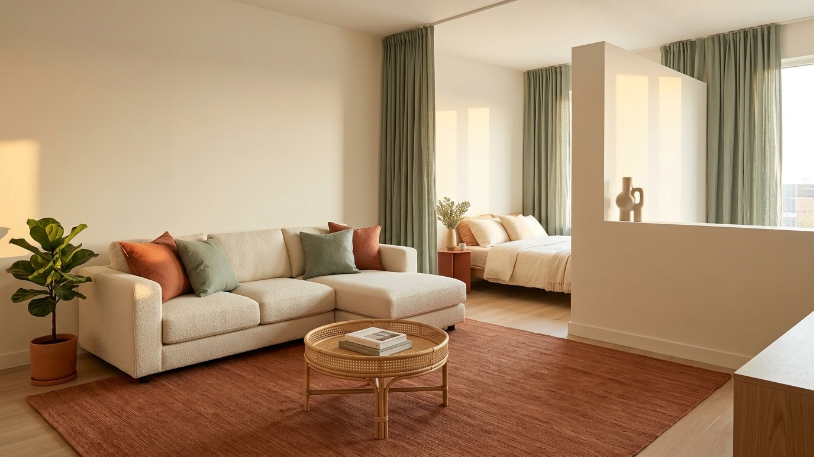
This is the step where most renters feel the most stuck. You cannot paint the walls. That does not mean you cannot have real color in the room. To style a rented home with a strong color story, you use what you can control: soft furnishings, rugs, curtains, and large-format art.
Choose a base palette of two to three colors. One neutral (usually your existing walls), one mid-tone anchor color, and one pop accent. For example: warm white walls, dusty sage as your anchor, and terracotta as your accent. Carry all three colors consistently across every textile in the room, from the rug and curtains to the cushions, throws, and accessories.
Large items carry the most color weight. The rug and curtains anchor your mid-tone. Cushions, art, and small decorative objects carry the accent. If your walls are white or beige, you have almost complete freedom to shift thire color direction through textiles alone. For free color palette tools that help you match tones across paint and textiles, both Sherwin-Williams and Benjamin Moore offer excellent online resources, even if you are not painting a single wall.
Deposit-safe ways to build your color base:
- Peel-and-stick wallpaper on one accent section, alcove, or bookcase back
- A large textile wall hanging in your anchor color
- Floor-to-ceiling curtains in a strong mid-tone (even over a small window)
- An oversized area rug that sets the color story from the floor up
| Color Combo | Wall Base | Mid-Tone Anchor | Pop Accent | Mood |
| Warm Earth | Off-White | Dusty Terracotta | Burnt Sienna | Cozy, organic |
| Cool Calm | Light Grey | Sage Green | Navy Blue | Clean, fresh |
| Boho Warm | Linen White | Camel | Deep Rust | Layered, rich |
| Modern Soft | Crisp White | Charcoal | Blush Pink | Sharp, airy |
| Natural Neutral | Warm White | Warm Taupe | Forest Green | Grounded, earthy |
Step 4: Choose Anchor Furniture That Does the Heavy Lifting
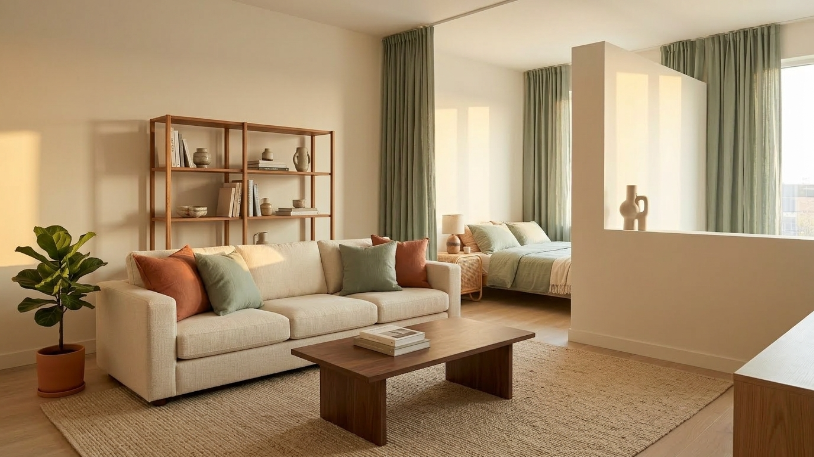
Your anchor pieces are the largest, most visible items in the room. They set the overall tone, so they deserve the most thought and, usually, the most budget. In a living room, the anchor pieces are the sofa, the coffee table, and the main storage unit. In a bedroom, they are the bed frame and the dresser.
When you style a rented home with furniture, each anchor piece should do three things: suit the scale of the room, carry your base color naturally, and look good against a plain or pale wall. Save the bold shapes and louder colors for your accent pieces, where they are cheaper to buy and easier to swap later.
Natural materials work consistently well in rentals because they look right in almost any setting. Solid wood frames, linen upholstery, rattan side tables, and dark metal coffee tables are all reliable starting points. These hold their look as you change smaller accessories around them over time, which is exactly what you want from an anchor piece.
Anchor furniture checklist:
- Sofa in neutral upholstery: cream, oatmeal, warm grey, or deep navy
- Coffee table in solid wood, rattan, or dark metal
- Open shelving unit, TV console, or media cabinet
- Bed frame in solid wood or with an upholstered headboard
- Dresser or wardrobe, if one is not already provided
One practical tip: a solid wood coffee table bought secondhand will almost always look better and last longer than a flat-pack version at the same price point. Natural materials bought used often look richer than cheap new alternatives.
Step 5: Lay a Rug to Ground the Space
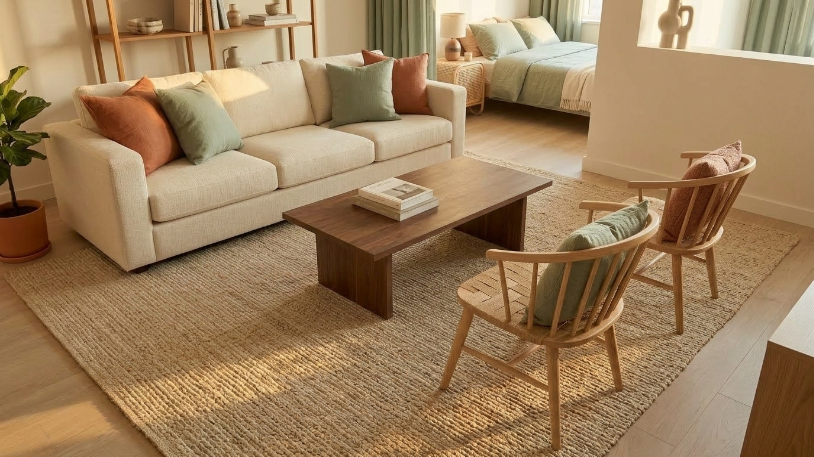
A rug does more work than almost any other single item in a room. It defines the zone, adds warmth underfoot, covers anything on the floor you would rather not look at, and carries a large share of your color story. In a rental, it also protects the existing flooring, which most landlords notice at checkout.
The most common rug mistake is sizing down. In a living room, the front legs of your sofa and accent chairs should all sit on the rug. A rug that floats in the center with no furniture touching it makes the space feel disconnected and smaller than it actually is. For a standard living room, an 8×10 or 9×12 rug is the right starting point. In a bedroom, place a 5×8 or 6×9 under the lower two-thirds of the bed, with even borders showing on both sides.
Also, always use a non-slip rug pad. It protects the floor below, prevents the rug from bunching or sliding, and adds a small layer of extra cushion. Most landlords will appreciate it; it shows you are taking care of the floors.
Rug materials at a glance:
- Jute or seagrass: Natural texture, durable, best for warm-toned rooms
- Wool: Long-lasting, soft underfoot, holds color well
- Cotton flatweave: Easy to clean; a good choice for dining rooms and kitchens
- Polypropylene: Stain-resistant and tough; ideal for busy, high-traffic zones
- Viscose or silk blend: Beautiful sheen, but not suitable for heavy traffic or spills
Step 6: Layer Texture Through Soft Furnishings
Texture is what gives a room depth and makes it feel finished. It is also one of the safest categories for renters to invest in, because every soft furnishing leaves with you when the lease ends. The goal is to mix at least three different textures within the same color family, so the room has visual interest without looking cluttered or busy.
Start with your curtains. If the rental has vertical blinds or thin café curtains, you can hang your own set over them using a tension rod or a removable curtain track. Go as close to floor-to-ceiling as the space allows. Longer curtains make ceilings feel higher and windows feel more generous, even in a smaller room.
Then build the rest of the textile layer across seating, bedding, and accessories. Pair a velvet cushion with a linen pillow and a chunky knit throw. Add a woven basket or a ceramic lamp base to break up the softness with something more structured. The contrast between rough and smooth, hard and soft, is what makes a room feel deliberate rather than simply comfortable.
Texture mix guide:
- Velvet: Sofa cushion, accent chair, throw pillow
- Linen or cotton: Curtains, main cushion covers, bedding
- Chunky knit or bouclé: Throw blanket, one accent cushion
- Natural weave (jute, rattan, bamboo): Baskets, side tables, decorative trays
- Ceramic or stone: Lamp base, decorative bowl, candleholder
Step 7: Add Lighting Layers Without Touching the Fixtures
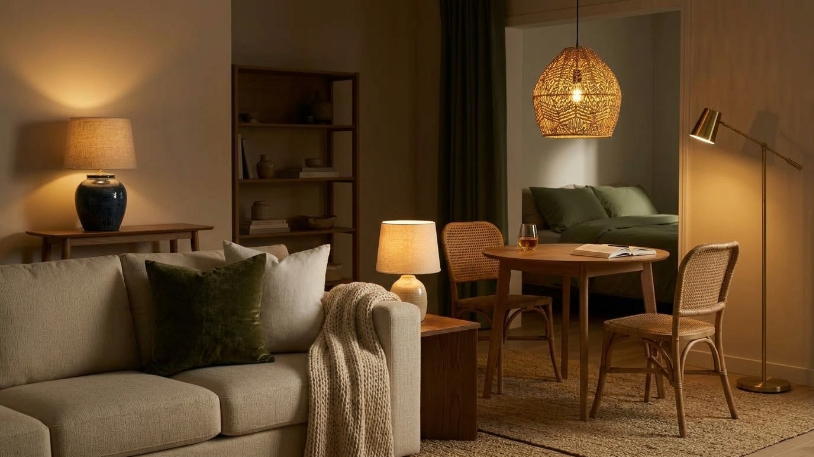
Rental lighting is almost always flat. The standard overhead fitting casts a harsh, even light that makes every room feel like a break room. You usually cannot replace the ceiling fixture, but you can completely change the mood of the space by adding your own light sources below it.
The three tools you need are a floor lamp, at least one table lamp, and a plug-in pendant. Together, they create warm pools of light at different heights, which is what makes a room feel cozy rather than simply lit. A floor lamp in the corner, a table lamp on a side table, and a plug-in pendant above a small dining spot covers every level of the room.
Plug-in pendants are one of the most underused tools renters have. Hang one from a ceiling hook (adhesive or a small nail, depending on your lease), and the cord runs down the wall to an outlet. Use a removable cord clip or cable strip along the baseboard to keep it tidy. Also, swap every bulb in the apartment to warm white (2700K to 3000K). That single change costs almost nothing and will immediately improve every room.
Lighting layers for a rental living room:
- One tall floor lamp in a corner or beside the main seating piece
- One to two table lamps on side tables, shelves, or a console
- One plug-in pendant above a dining spot, an entryway, or a bedside
- LED strip lights behind a TV unit or under shelving for soft ambient glow
- Candles, real or LED, for the lowest and warmest layer of light
Step 8: Hang Things on the Wall Without Damaging It
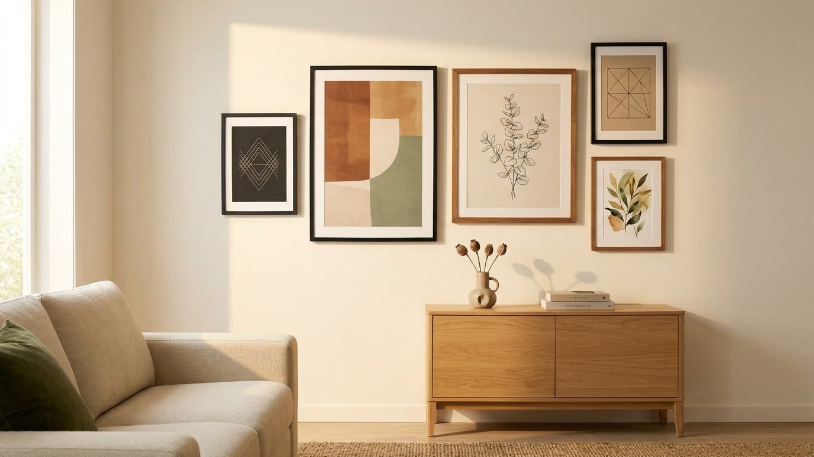
Bare walls make even well-styled furniture feel unfinished. Many renters leave everything blank out of caution, but that overcorrection costs them just as much as the approach they were trying to avoid. You have far more deposit-safe wall options than most people realize.
Command strips and adhesive hooks hold significant weight when applied correctly. Clean the wall surface first with rubbing alcohol, press each strip firmly for 30 seconds, and let the adhesive cure for a full hour before hanging anything. Used carefully, they remove cleanly. Pulled off quickly, they take paint with them. For heavier frames, a single small picture nail is almost always fine; fill the hole with white toothpaste or a dab of wall filler when you leave.
Peel-and-stick wallpaper is a strong option for renters who want a real statement. Apply it to a single accent wall, an alcove, or the back panel of a bookcase. Most quality brands remove without damage. Always test a small corner and leave it for 24 hours before committing to the full wall.
Deposit-safe wall styling options:
- Large canvas art leaned against the wall (no hanging needed)
- A gallery wall arrangement using Command strips
- A macramé or textile wall hanging from a single adhesive hook
- Peel-and-stick wallpaper on one accent section or niche
- A mirror leaned against the wall or attached with picture adhesive strips
- Lightweight floating shelves on removable adhesive shelf brackets
Step 9: Style Your Surfaces and Shelves
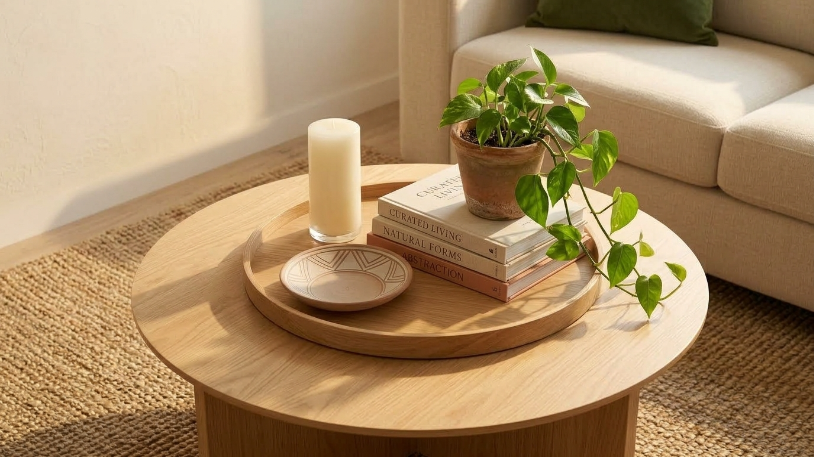
After the walls, surfaces and shelves are the last major structural layer before you get to the finishing details. Coffee tables, side tables, open bookshelves, windowsills, and dresser tops all need intentional styling. Unstyled surfaces read as incomplete, even when everything else in the room is well done.
The rule of odd numbers works consistently well here. Group objects in threes: one tall item, one medium item, and one low item. Vary the height within each group so the eye has somewhere to travel. Keep the colors within your chosen palette. Also leave some negative space in each arrangement; empty space makes the objects around it look more considered.
For shelves, mix books with objects instead of lining every book spine-out across every shelf. Pull a few forward, stack some horizontally, and place a small object on top of the horizontal stack. Add a trailing plant on one shelf. Leave one shelf mostly clear. The contrast between full and empty sections is what makes shelving look styled rather than simply stacked.
Coffee table styling formula:
- A tray to anchor the whole arrangement and contain the grouping
- One tall object: a candle, a small vase with stems, or a sculptural piece
- One low object: a coffee table book, a flat bowl, or a decorative box
- One natural element: a small plant, a bunch of dried flowers, or a smooth stone
- One functional item: remotes in a small bowl, or a neat coaster stack
Step 10: Add the Finishing Touches That Make It Feel Like Home
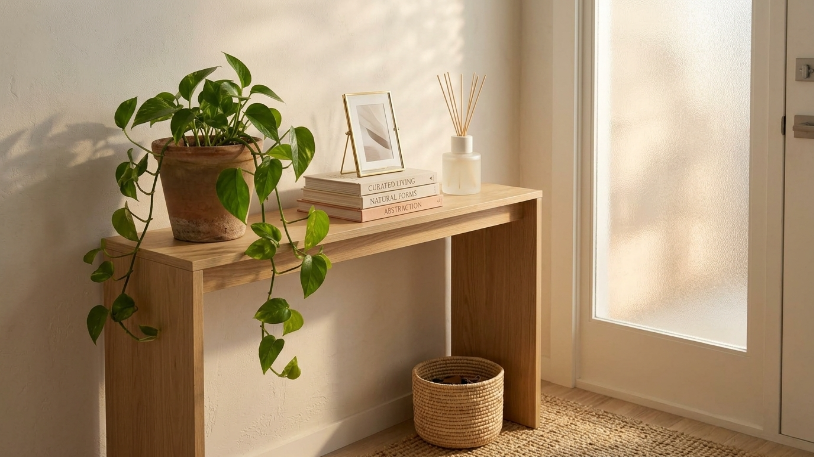
This is the final layer, and it does something that no rug or lamp alone can do: it makes the space feel personal. Finishing touches are often the smallest items in the room, but they are usually the first things people notice when they walk through the door.
Plants are the fastest way to add life to any space. Even in a low-light rental, several plants do well with minimal sun: pothos, snake plants, ZZ plants, and peace lilies all thrive in typical apartment conditions. Group two or three at different heights for the best visual impact. A single large plant in a statement pot also works well as an anchor for a bare corner.
Scent is easy to overlook and hard to ignore. A soy candle, a reed diffuser, or a linen spray in a clean, natural fragrance makes a space feel cared for before anyone has looked at a single shelf. Pick one scent and use it consistently throughout the room rather than mixing several together.
Finally, add a few items that mean something to you personally. A framed photo, a book you return to, a small object from a trip that mattered. These are not styling accessories; they are honest details, and they are what separates a decorated room from an actual home.
Finishing touches checklist:
- Two to three plants in varied heights and pot sizes
- One soy candle or reed diffuser in a clean, natural scent
- One to two personal items: a photo, a keepsake, or a meaningful object
- A tray or basket to organize small items on any surface
- Fresh or dried flowers in a simple, understated vase
- A well-chosen doormat at the entrance (often forgotten, always noticed)
How to Style a Rented Home on Any Budget
You do not need a large budget to style a rented home with confidence. The key is knowing where to spend and where to save. Anchor pieces, rugs, and curtains carry the most visual weight in any room, so they are worth the investment. Accessories and finishing touches are where you can stay frugal without the room suffering for it.
Secondhand shopping is one of the most practical tools available to renters. A solid wood coffee table or bookshelf from a thrift store or online resale platform will almost always outperform a cheap flat-pack version at the same price. Plus, natural materials bought secondhand often look richer than new synthetic alternatives bought cheap.
| Item | Budget Tier | Mid Tier | Investment Tier |
| Area Rug (8×10) | $80 to $150 | $150 to $350 | $350 to $800 |
| Curtains (one pair) | $30 to $60 | $60 to $120 | $120 to $300 |
| Floor Lamp | $40 to $80 | $80 to $180 | $180 to $400 |
| Sofa | $300 to $600 | $600 to $1,200 | $1,200 to $3,000 |
| Coffee Table | $60 to $120 | $120 to $300 | $300 to $700 |
| Cushion Set (four covers) | $30 to $60 | $60 to $120 | $120 to $250 |
| Plants (three) | $15 to $30 | $30 to $70 | $70 to $150 |
Spend more on: The rug, the sofa, and the curtains. These three items carry the most visual weight in any room and are the pieces you will likely take with you through multiple rentals.
Save on: Cushion covers, throws, candles, plants, and small accessories. These are also the easiest items to swap when you want a seasonal refresh without redecorating.
Final Thoughts
Styling a rented home is not about working around limitations. It is about using every tool available to you in the right order, at the right scale, for the space you actually have.
Start small if you need to. Pick one room. Lay a rug, add a floor lamp, and hang one piece of art with a Command strip. Then step back and see how different it feels. The rest builds naturally from there.
Your home is yours, even when the lease says otherwise.