
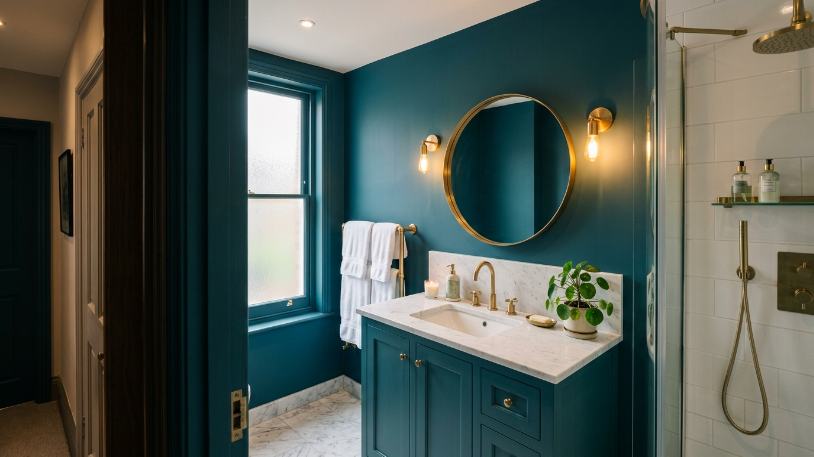
Deep teal is one of the most rewarding colors you can bring into a bathroom. It reads rich and grounded, and done well, it makes the whole room feel like a boutique spa you actually live in. But a lot of people who try to style a deep teal bathroom end up with something that feels too dark, too cold, or just slightly too much. The key is building the look in a specific order. This guide walks you through eight clear steps, starting with the color foundation and ending with the final finishing touches. Follow the build order and you will know exactly how to style a deep teal bathroom that feels serene from day one.
Step 1: Pick Your Shade of Teal and Commit to It
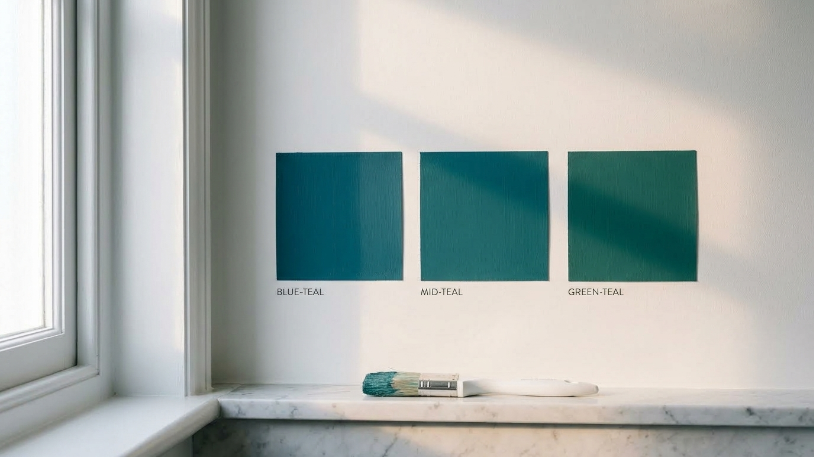
Not all teals are the same. Some pull blue, some pull green, and some sit in that deep, inky middle ground that makes a bathroom feel genuinely luxurious. Knowing which direction your teal goes before you buy anything will save you from expensive changes later.
Blue-leaning teals pair naturally with crisp white, chrome, and cool gray. Green-leaning teals sit better with warm wood tones, brass, and cream. Deep mid-teal is the most versatile and works well with both warm and cool supporting elements.
Benjamin Moore Night Tide is a strong pick for a deep, moody result. Sample at least two or three shades on your actual wall and check them at different times of day before you commit. Teal shifts more than most colors depending on the light source.
Teal Shade Quick Reference:
- Blue-leaning teal: works with white, chrome, cool gray
- Green-leaning teal: works with brass, warm wood, cream
- Deep mid-teal: works with both; the most versatile option for bathrooms
- Very dark teal: works with warm white, sand, matte black, and brass
Step 2: Plan the Layout Before You Buy a Single Thing
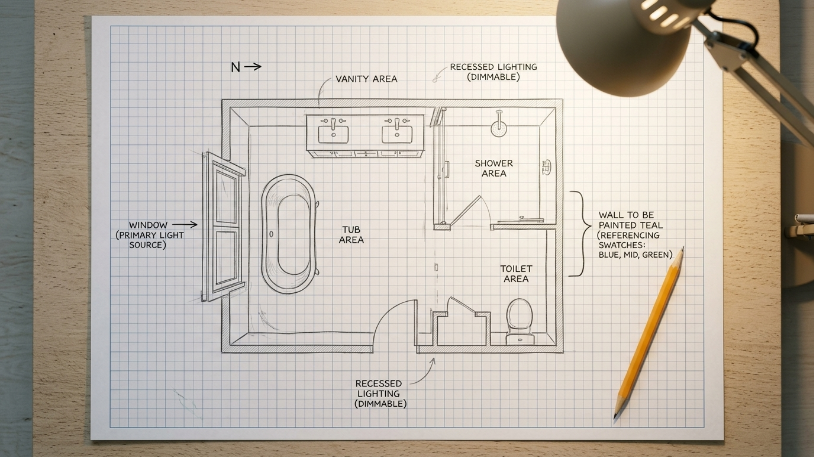
Good styling starts long before you open a paint can. Measure the bathroom first: room dimensions, ceiling height, and the location of every fixture. The toilet, sink, shower or tub, and any windows all affect how the teal reads across the space.
A deep teal bathroom works at any size, but the approach shifts. In a small bathroom, teal on all four walls can feel intense, so using it on one or two accent walls and keeping the others white or neutral is a smart move. In a larger bathroom, full teal coverage is easier to pull off and makes a bold, confident statement.
Decide early on where your teal will live: the walls, the tile, the floor, the ceiling, or a combination. Sketch a rough layout even if it is just a phone note before you start shopping. Also consider the ceiling. A teal ceiling with white walls is a strong, unexpected look that wraps the room in color without making it feel tight or claustrophobic.
Layout Planning Checklist:
- Measure the room length, width, and ceiling height
- Note the location of all fixtures and windows
- Decide if teal goes on walls, tile, floor, ceiling, or a combination
- Identify where natural light enters and which walls it hits most
- Choose one focal point wall if going partial teal
Step 3: Set the Wall Treatment to Style a Deep Teal Bathroom
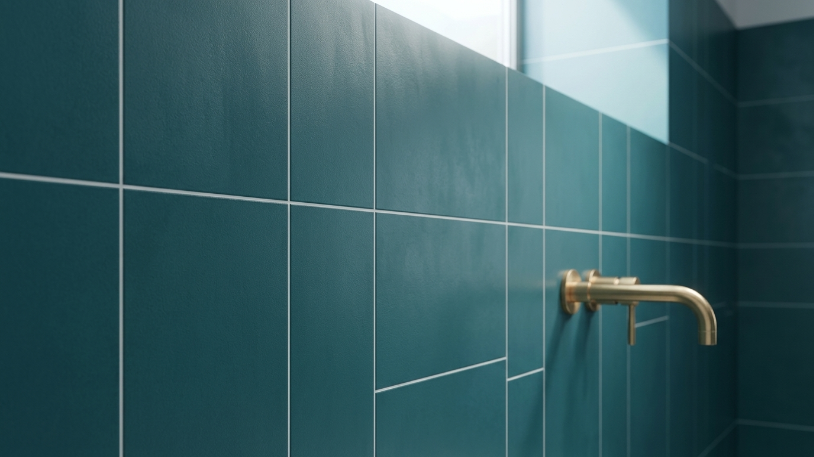
Your wall treatment is the most impactful decision in the room. Teal can go on as paint, as tile, or as a combination of both, and each option produces a very different result.
Paint is the most affordable and flexible route. A matte or eggshell finish absorbs light and reads as soft and moody. A satin finish reflects a little more and cleans up much more easily, which matters in a bathroom with daily humidity. Large-format teal tiles add texture and visual depth. Glossy tiles bounce light and make small spaces feel bigger. Matte tiles produce a quieter, more pulled-together look.
A popular approach is teal paint on the upper walls with white or natural stone tile on the lower half, separated by a simple tile border. This gives the room clear structure and keeps the teal from feeling heavy at eye level.
| Wall Treatment | Approximate Cost | Ease of Cleaning | Visual Effect |
| Matte teal paint | Low | Moderate | Moody, soft, absorbed |
| Satin teal paint | Low | Easy | Slight sheen, practical |
| Glossy teal tile | Medium to high | Very easy | Bold, light-reflective |
| Matte teal tile | Medium to high | Easy | Soft, textural, elegant |
| Paint plus tile combo | Medium | Manageable | Structured, polished |
Step 4: Pair Deep Teal with the Right Neutrals
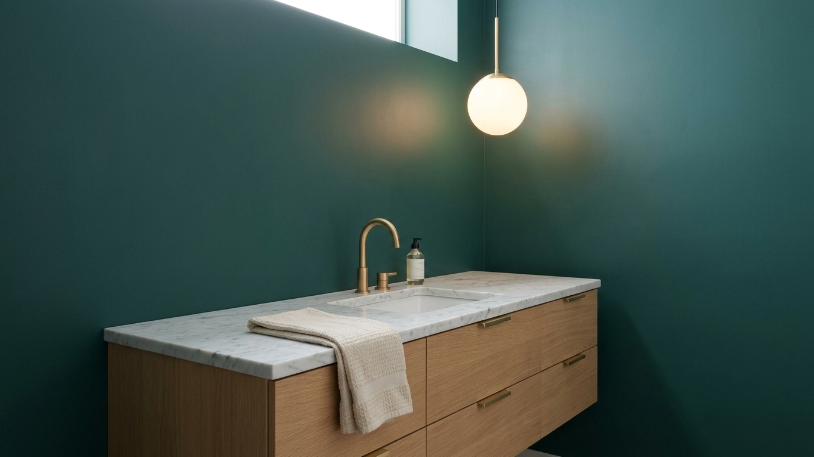
Teal is a strong color. It needs a clear, well-chosen supporting cast. The neutrals you pick will either let the teal shine or pull the room into confusion.
Crisp white is the most reliable partner. White fixtures, white trim, and a white ceiling all create the contrast teal needs to look its best. However, pure white can read a little cold next to deep teal if your light sources are mostly artificial. Warm white or off-white is the softer alternative. Cream grout, ivory towels, and a linen-white ceiling work beautifully alongside teal without tipping into sterile.
Natural materials also serve as excellent neutrals. A white oak vanity, a teak bath mat, or white marble with warm veining all bring warmth into the room without competing with the wall color. For grout, white keeps things bright; warm gray recedes and feels more deliberate. Avoid matching the grout exactly to the tile because it tends to read as flat.
| Teal Tone | Best Neutral | Best Metal Finish | Best Wood Tone |
| Blue-leaning | Cool white, light gray | Chrome, brushed nickel | Light maple, ash |
| Green-leaning | Cream, warm white | Brass, antique gold | Walnut, teak |
| Deep mid-teal | Either white, or stone | Brushed gold | White oak, teak |
| Very dark teal | Warm white, sand | Matte black, brass | Walnut, dark oak |
Step 5: Choose Your Materials and Textures
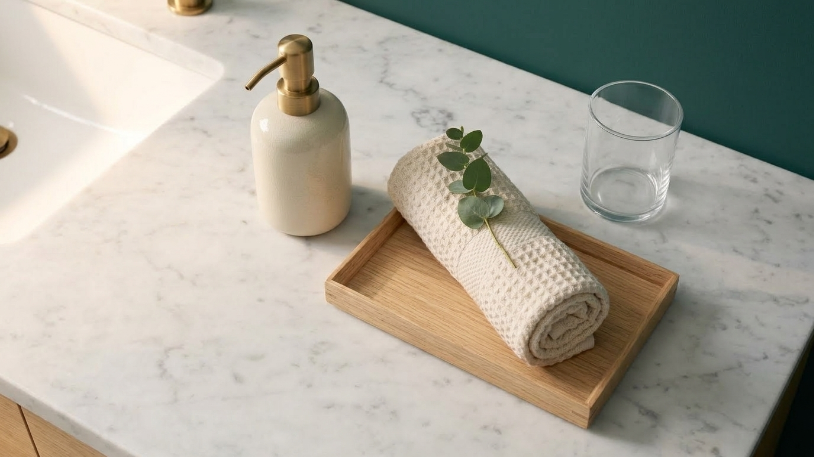
Paint or tile gives you the color base. Materials and textures give you depth. Without them, even a beautifully colored teal bathroom can feel one-dimensional and cold.
Natural stone is one of the best texture partners for teal. White marble, honed limestone, and travertine all carry warmth and natural variation that no synthetic surface can match. Use stone on the countertop, on the floor, or as a simple soap tray. Wood is the other excellent texture element. A teak shower mat, a wood-framed mirror, or a floating wooden shelf all break up the wall color in a natural, grounding way. Any wood near water should be properly sealed or moisture-rated.
Linen and cotton add softness where it counts. Your towels, bath mat, and any curtains all function as texture layers. Choose thick, quality pieces in warm neutral tones. Avoid too much plastic or low-quality synthetic material in a deep teal bathroom because these cheapen the look quickly.
Material Checklist:
- Countertop: white marble, quartz, or honed limestone
- Floor: stone tile, large-format ceramic, or sealed wood-look tile
- Towels and bath mat: thick cotton or Turkish linen in white, cream, or warm sand
- Mirror frame: brushed gold, brass, or natural wood
- Accessories: ceramic, glass, stone, or matte metal only
Step 6: Layer Your Lighting to Style a Deep Teal Bathroom
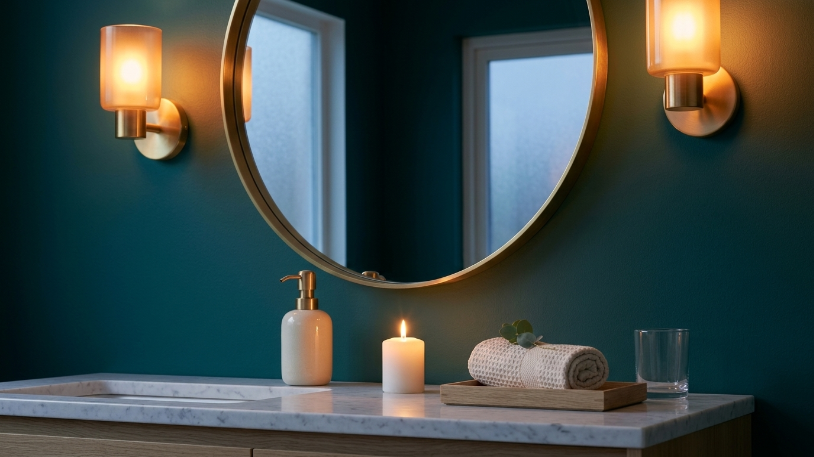
Lighting can make or break a teal bathroom. Get it wrong and the room feels like a fish tank. Get it right and it feels like a spa. That difference almost always comes down to bulb warmth and the number of light sources working together.
Deep teal absorbs light. Because of that, you need more sources than you might expect in a neutral room. One overhead fixture is rarely enough. Plan for at least two layers: ambient overhead lighting and task lighting at the vanity. Warm white bulbs in the 2700K to 3000K range bring out teal’s richness and warmth. Avoid cool daylight bulbs at 5000K or above; those push the teal toward a flat, blue-green that is genuinely hard to love at 6 a.m.
Wall sconces on each side of the mirror give you even, shadow-free task lighting. A backlit mirror adds a gentle glow without taking up physical space. If you have a frosted window, protect it and let natural light do its part.
Lighting Layer Guide:
- Ambient: recessed ceiling lights or a flush-mount ceiling fixture
- Task: wall sconces flanking the mirror, or a backlit mirror panel
- Accent: LED strip under the floating vanity, a pillar candle, a small floor uplight
Step 7: Add Textiles and Soft Accents for Warmth
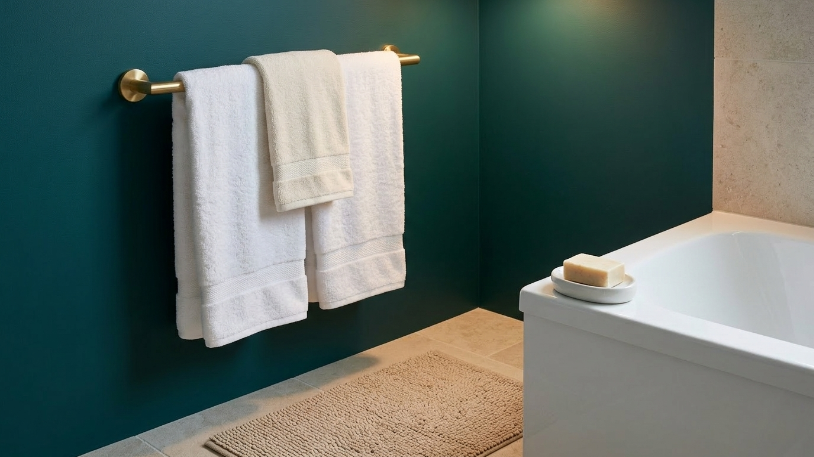
Textiles do some of the heaviest lifting when it comes to making a teal bathroom feel warm. A room with beautiful tile and no soft elements still reads as hard and cold.
Start with your towels. Choose a set in white, cream, or warm sand and fold or roll them neatly onto a towel rail or into a basket. Thick, quality towels feel better to use and simply look more intentional in the space. Your bath mat is the next priority. A natural cotton mat in cream or warm beige softens the visual landing between the wall and the floor. A woven jute mat also works well in a bathroom where the teal leans green.
If you have a window, a simple linen curtain in white or off-white adds softness without adding color competition. Keep the fabric light so natural daylight still filters through. Small organizing pieces, such as a basket, a wooden tray, or a ceramic dish, turn scattered essentials into a styled grouping.
Textile and Soft Accent Shopping List:
- 2 to 4 bath towels in white, cream, or warm sand
- 1 hand towel in a matching neutral tone
- Cotton or linen bath mat in a warm neutral
- Linen or sheer window curtain, if applicable
- 1 small basket or wooden tray for organizing bathroom essentials
Step 8: Finish with Plants, Scent, and Small Decor
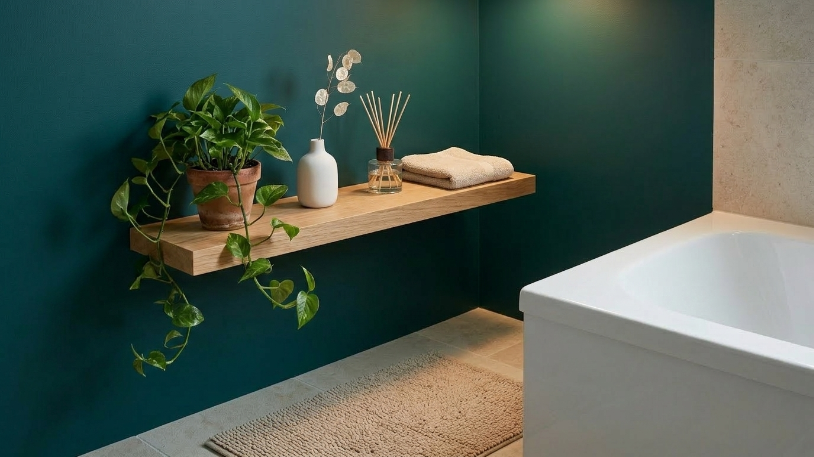
You are at the final layer now. This step is where a styled bathroom becomes a room you genuinely look forward to spending a few minutes in.
Plants are one of the easiest upgrades available. Bathrooms with good natural light can support a pothos, a small fern, or a snake plant. Bathrooms with little natural light can still hold a ZZ plant or a piece of preserved moss art on the wall. Place one plant on the counter, one on a shelf, and stop there. More than two or three and the space starts to feel like a greenhouse, which is a different styling goal entirely.
Scent matters more in a bathroom than in almost any other room. A single pillar candle or a small reed diffuser is all you need. Eucalyptus, cedarwood, and green tea all pair naturally with the cool-green character of deep teal. For small decor, stay minimal. One framed print, one ceramic object, and one functional piece like a quality soap dispenser covers the surface well. Every item should earn its place; if it does not add to the calm, it is probably clutter.
| Decor Do | Decor Don’t |
| Add 1 to 2 plants in simple pots | Crowd every surface with small objects |
| Use a single reed diffuser or candle | Mix more than two competing scents |
| Choose one framed art piece | Cover the teal wall with multiple large pieces |
| Keep accessories in one material family | Mix plastic, chrome, and gold carelessly |
| Leave deliberate negative space on shelves | Fill every shelf to full capacity |
Final Thoughts
Styling a deep teal bathroom takes a clear plan and a patient hand. Start with the right shade, set the layout, build the wall treatment, and then layer in warmth through materials, lighting, and textiles. Each good decision builds on the last. The result is a bathroom that feels genuinely calm, not just blue.
Your bathroom is one of the few rooms you walk into every single day. It is worth the effort to get it right. Now go sample some walls and enjoy the process.