
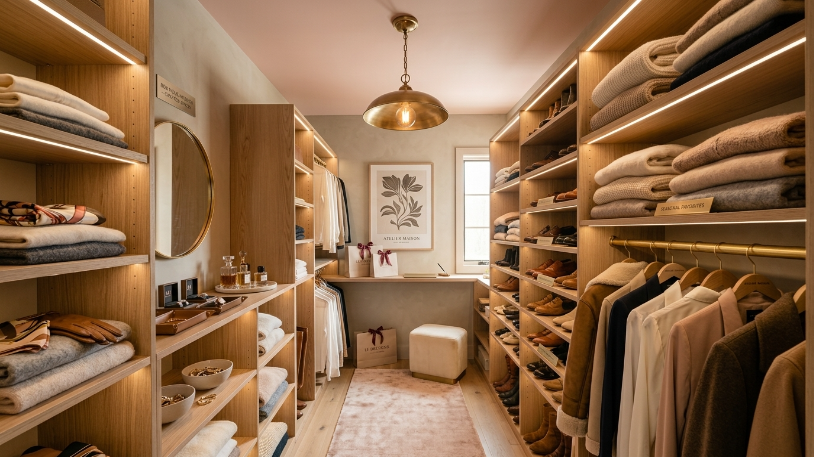
A walk-in closet is one of the most personal rooms in your home. It holds every outfit decision, every morning mood, and every piece of yourself you carry out the door. Most people, however, treat it as a storage room with better lighting, and that is a real missed opportunity.
You do not need a major renovation or a designer budget to change that. The ideas in this post are about styling, not construction. Think of it the way you think about getting dressed: with intention, a little personality, and the right details placed in the right spots. A well-styled walk-in closet looks put-together, feels calm to use, and makes you happy every time you step inside.
Also, none of these ideas require you to rebuild shelving, hire a contractor, or clear three weekends on your calendar. They are styling moves, and styling moves work at every budget level. Below are ten ideas ordered from biggest visual impact down to the smallest finishing touches.
1. Start With a Walk-In Closet Color Story
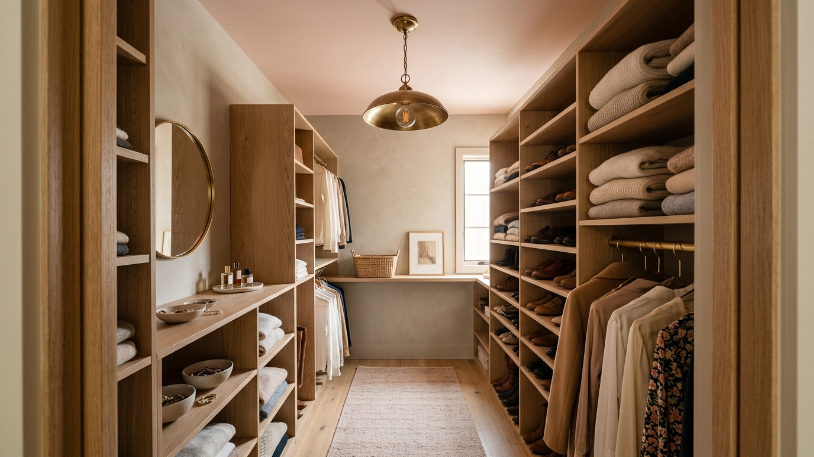
The first thing a well-run boutique does is commit to a color direction. Every wall, shelf, and fixture works together in one deliberate palette. Your walk-in closet should follow the same logic from the start.
Pick one main color for the walls, then let the furniture and storage echo it in softer or complementary tones. Warm neutrals are the most versatile starting point for most homes. Creamy white, dusty blush, warm greige, and soft sage all let your clothing become the visual focus rather than competing with a busy background. Plus, these shades tend to photograph well if you ever want to share the space on social media.
Do not overlook the ceiling, either. A painted or wallpapered ceiling instantly makes a closet read as designed rather than as an afterthought. Even a satin finish in a soft white adds a quiet polish that flat paint can never quite match. That one small change tells anyone who walks in that this room was thought about on purpose.
For a high-contrast or glamorous direction, consider a deep shade on a single accent wall paired with warm metallics in the fixtures. For a quieter, spa-like feel, keep the palette within one tone family and vary the texture instead of the color. Either approach works as long as the choices feel connected rather than random.
Here is a quick reference guide to help you choose a direction:
| Closet Style | Main Colors | Key Materials | Best For |
| Minimalist | White, greige, soft gray | Matte lacquer, linen, glass | Small to medium closets |
| Hollywood Glam | Black, gold, cream, ivory | Velvet, brass, mirrored panels | Large statement closets |
| Organic Modern | Warm wood, sage, cream | Oak shelving, rattan, cotton | Any size |
| Modern Boutique | Blush, white, soft chrome | Acrylic, glass, leather goods | Medium to large closets |
For paint inspiration suited to light-sensitive interior spaces, the Sherwin-Williams color collections page is a reliable starting point. Their warm neutral and soft white ranges work well on closet walls without making the space feel heavy or closed in.
2. Light Your Walk-In Closet Like a High-End Store
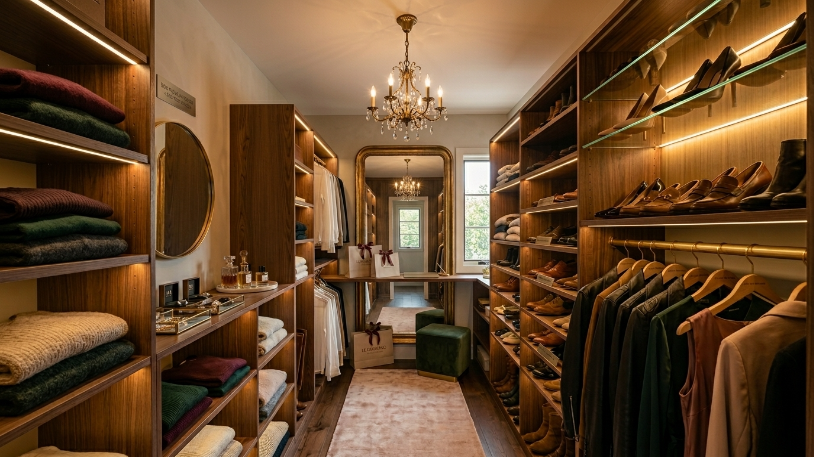
Lighting is the most underestimated tool in any styled room. In a walk-in closet, it does two jobs at once: it helps you dress accurately without second-guessing every color match, and it shapes the entire mood of the space from the moment you walk in.
The best boutique lighting is layered. Start with a general overhead source for overall brightness. Then add a secondary layer for atmosphere and detail. Small LED puck lights or strip lighting inside shelves highlight folded items and shoes without casting heavy shadows over them. A pendant or small chandelier at the center of the room adds drama and draws the eye upward, which makes the space feel taller and more intentional.
However, the quality of light matters just as much as placement. Warm white bulbs in the 2700K to 3000K range make fabrics and skin tones look accurate and flattering. Cool or daylight bulbs strip the warmth out of a room and make everything feel clinical. The Lighting Research Center at Rensselaer Polytechnic Institute conducts research on how warmer color temperatures improve both perceived comfort and color-rendering quality in interior spaces, both of which matter when you are deciding whether that blazer is navy or actually black.
Also, if your walk-in closet includes a mirror, always position a light source in front of you rather than behind you. A backlit mirror creates a dramatic silhouette at best and a complete misread of your outfit at worst. Neither is a good way to start the morning.
Finally, consider adding a small dimmer switch to your overhead fixture. Being able to lower the light in the evening changes the whole feel of the room and makes your closet feel like a destination rather than just a utility stop.
- Use warm white bulbs rated 2700K to 3000K
- Add puck lights or strip lighting inside shelves
- Include at least one decorative overhead fixture
- Avoid a single harsh overhead bulb as your only source
- Always light a mirror from the front or sides, never from behind
- Add a dimmer switch to your main overhead fixture if possible
3. Use Open Shelving as a Display Wall
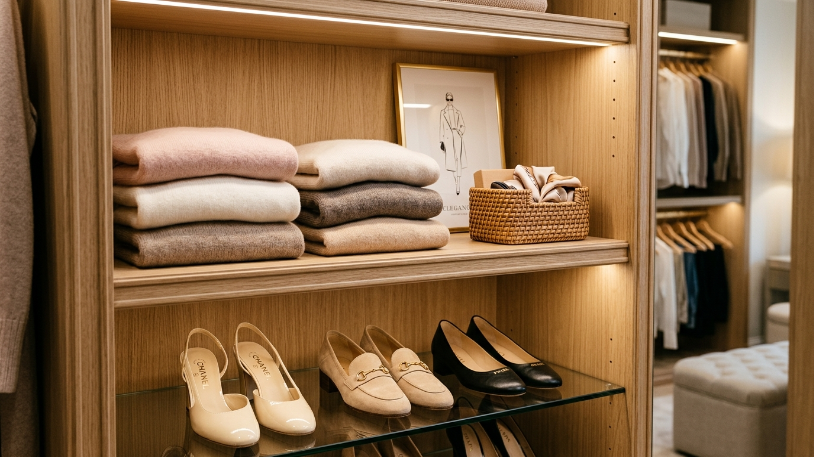
In any well-designed boutique, items are on display rather than hidden in drawers. The shelves are part of the experience. Your walk-in closet can work the same way, but only once the items on those shelves are worth looking at and organized with some intention.
Open shelving reads as curated only when the items on it are arranged with care. Fold sweaters by color and stack them in clean columns. Line up shoes with the toes pointing outward at a consistent spacing. Place handbags upright with the handles showing so the shape of each bag is visible at a glance. These are not difficult moves; they just require a little attention when you put things away each time.
Mixing textures on a shelf also adds visual richness without adding visual noise. A wicker storage basket beside a stack of folded cashmere beside a row of leather heels looks naturally layered and styled. Next, consider adding one non-clothing item per shelf section: a small framed print, a single decorative object, or a stem in a thin vase. That one non-clothing piece signals that this shelf was arranged on purpose rather than simply filled.
For the lower shelves, treat shoe storage like a store would. Shoes at eye level facing outward, in a consistent direction, grouped loosely by heel height or color, look like a wall display rather than a pile. The difference is visible within seconds of walking through the door.
The guiding rule for any open shelving in a walk-in closet: if you would not display it in a store, store it behind a closed door instead. A shelf of mismatched, unrelated items with no clear order is worse than a closed cabinet every single time.
4. Match Your Hangers and Storage Containers
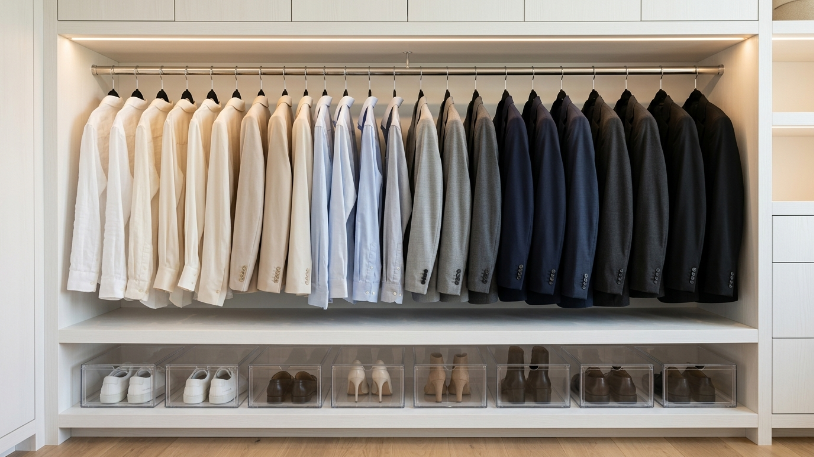
This idea sounds too small to matter. It is not. Nothing pulls a styled space apart faster than a rod packed with mismatched plastic hangers in three different colors and four different shapes. The rod is often the first thing you see when you walk into a closet, and mismatched hangers immediately signal chaos rather than care.
Swapping to matching hangers is one of the cheapest and most visually dramatic changes you can make. Black velvet hangers keep clothing slim on the rod and prevent shoulder stretching on knit fabrics. Light wood or natural cedar hangers suit a warmer, organic closet direction better. Either choice looks far better than the wire frames from the dry cleaner that have probably been living in your closet since 2011. You know the ones.
For shelf storage, the same principle applies: use one type of container throughout the space. Clear acrylic boxes work well for shoes and accessories because you can see the contents without opening anything. Woven baskets suit a warmer, organic aesthetic and add texture without adding visual clutter. Whatever you choose, stick with it rather than mixing three sizes, five colors, and two materials across the same wall of shelving.
Matching containers also help the eye move smoothly across the room. When the storage disappears into the background, your actual items, the clothes, bags, and shoes, become the visual focus. That is exactly what a boutique does with its display tools.
- Replace all mismatched hangers with one consistent style
- Use the same bin or basket type throughout the entire space
- Label any closed containers so nothing becomes a mystery box
- Store off-season items in flat bins under lower shelving
- Use small drawer dividers inside any dresser drawers
- Group similar items together rather than spreading them across multiple areas
5. Add a Full-Length or Statement Mirror
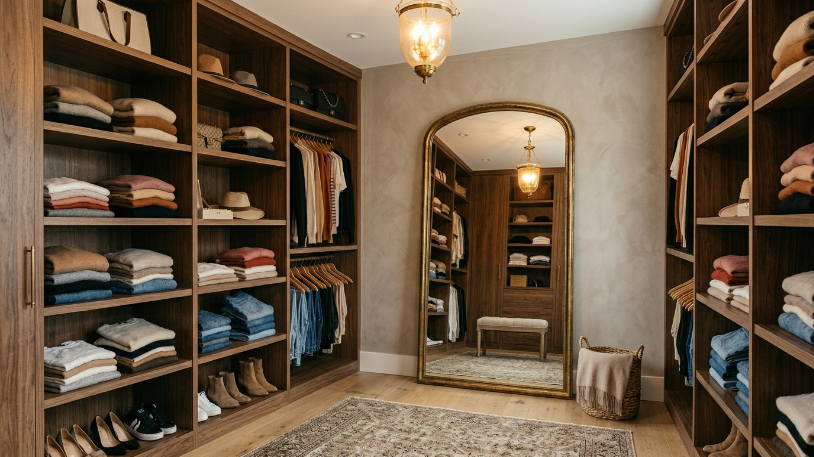
No boutique is complete without a mirror. In your walk-in closet, a mirror does two things at once: it lets you check your full outfit from head to toe, and it makes the room feel larger, brighter, and more finished as a design element. Both of those functions matter.
A leaning floor mirror with a thick, sculptural frame reads as furniture, not just a functional surface. It adds permanence and weight to the space that a small wall-hung mirror cannot match. An arched top leans into the organic or glamorous end of the style spectrum. A rectangular mirror with a thin black or natural wood frame suits minimalist and modern boutique directions well.
For glamorous or Hollywood-inspired walk-in closets, a mirror with a gold or aged brass frame adds depth and richness to the room. The frame itself becomes part of the decor rather than just a border. For cleaner, more restrained spaces, a frameless mirror or a slim black frame keeps the focus on the reflection rather than on the surround, which often looks sharper in a minimal room.
Placement matters just as much as the mirror itself. Position it where it can catch a light source, natural or artificial. A mirror placed across from a window doubles the natural light in the room. A mirror placed near a lamp or ceiling fixture amplifies that source and makes the overall closet feel brighter and more open. Both placements help the room feel less like a storage box and more like a room someone thought about.
Also, for smaller walk-in closets, a leaning floor mirror tucked into a corner takes up less visual space than a wall installation and still does every job you need it to do.
6. Sort Your Clothes by Color
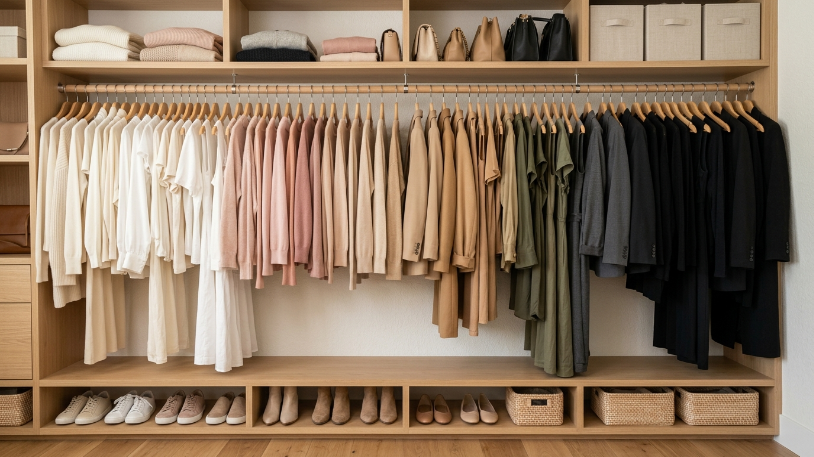
Color-organized clothing racks are one of the most recognizable visual cues of a well-run boutique. They are also one of the most satisfying things to recreate at home. Sorted clothing looks intentional the moment you lay eyes on it. It also makes getting dressed faster, which is a practical bonus you probably did not expect to find in a styling post.
For hanging items, work from light to dark across the rod, or organize by color family if your wardrobe is large enough to support it. Whites and creams on the far left, then blush and light neutrals, then olive and earthy tones, then dark blues and grays, then black on the far right. Within each color group, sort further by garment type: tanks first, then short-sleeve tops, then long-sleeve, then jackets and blazers. The result is a wall of organized color that looks designed rather than accumulated over years of impulse shopping.
For folded items on shelves, the same logic applies directly. Stack each column in one color family. A shelf section of white tees stacked neatly, followed by a column of gray, followed by a column of black reads as styled. A shelf with six different colors stacked in no particular order just reads as full.
Also, color-sorting your hanging items tends to reveal things you forgot you owned. A yellow blazer that was buried between two navy jackets suddenly becomes visible and usable again. That alone is worth the twenty minutes it takes to reorganize the rod.
Of course, this only works after you have edited your closet down first. Color-organizing forty faded T-shirts still looks like forty faded T-shirts. Still, sorting by color is often what finally motivates people to let go of the pieces that no longer serve them.
7. Bring in One Seating Piece
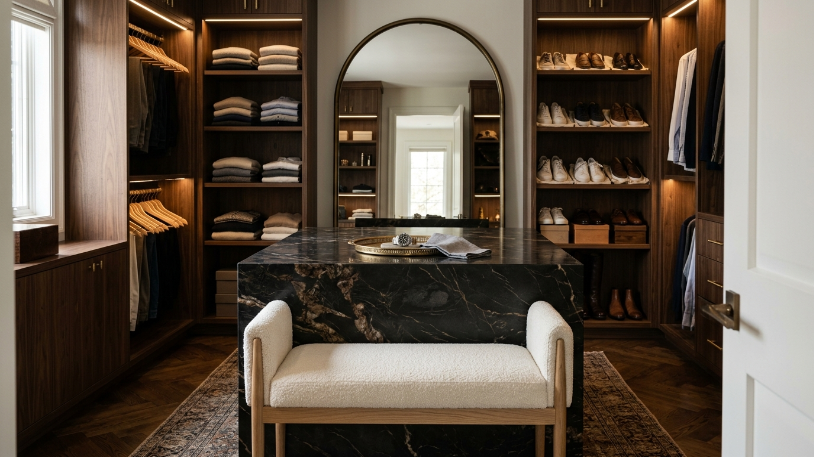
Every boutique worth visiting has somewhere to sit. It might be a velvet settee near the fitting rooms, a tufted bench beside the display wall, or a low ottoman tucked into a corner. The seating is functional, but it also sends a clear signal: this is a real room with real thought behind it, not just a space you rush through in the morning.
In a walk-in closet, a bench placed at the end of an island or against one wall is the most practical option. A bench gives you a surface for putting on shoes, setting down a bag before you leave, or simply pausing in a room you actually enjoy being in. An upholstered bench in a fabric that picks up one color from your closet’s palette ties the whole room together in a single piece without much effort at all.
For a smaller walk-in closet, a slipper chair tucked into a corner works just as well and takes up less floor space than most people expect. Velvet, boucle, and linen are all strong fabric choices. Avoid anything with oversized legs or a high back that adds too much visual bulk to a tighter room. The goal is a piece that feels purposeful, not one that crowds the space.
For fabric color, look to your closet’s wall tone for direction. A greige wall pairs well with a warm cream or caramel seat. A blush wall suits a dusty rose or soft linen fabric. A darker, more dramatic closet calls for something deeper, like burgundy velvet or forest green boucle.
However, resist the single biggest threat to the boutique illusion: using your seating as a second clothing storage area. The moment a chair becomes a fabric mountain, the entire mood of the room disappears. Not that this ever happens to anyone.
8. Style Your Walk-In Closet Accessories Like a Display Case
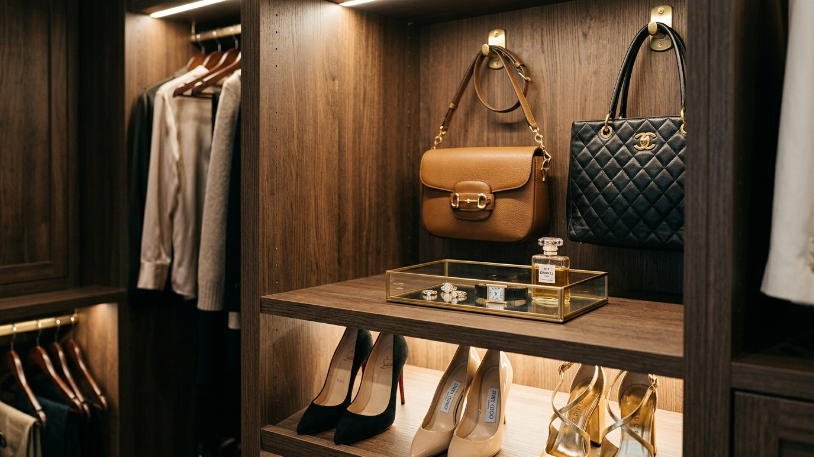
In a luxury boutique, accessories are never tossed into a bin or piled on a surface without thought. Each piece is displayed under good light with space around it so the eye can actually see what is there. Your walk-in closet can treat your personal accessories the same way, and the result is both more beautiful and more functional.
Wall-mounted hooks or a small peg rail work well for everyday bags and belts. A row of brass hooks at one consistent height keeps bags visible, accessible, and styled all at once. Acrylic or glass display trays on a shelf handle jewelry, watches, and small leather goods well. A flat velvet ring tray or a rotating stand for sunglasses reads as boutique-level styling with almost no investment at all.
For shoes specifically, a low dedicated shelf where every pair faces the same direction does more for the visual impact of a walk-in closet than almost any other single change. Plus, you can actually see what you own. That alone prevents the very common experience of buying a second pair of black ankle boots because the first pair was buried under a pile on the floor. Not that this has ever happened to anyone.
For bags, consider standing larger totes upright and leaving space between each one rather than pressing them tightly together. Stuffing a bag with tissue paper keeps its shape and makes it look like it belongs in a display window rather than a storage shelf.
- Mount a peg rail or brass hooks for everyday bags and belts
- Use a flat glass or acrylic tray for jewelry and watches
- Face all shoes in the same direction on a dedicated shelf
- Keep a small decorative bowl near the mirror for daily-use rings and clips
- Use acrylic risers to add height variation between displayed items
- Stand bags upright and leave breathing room between each piece
9. Add Scent and Small Finishing Details
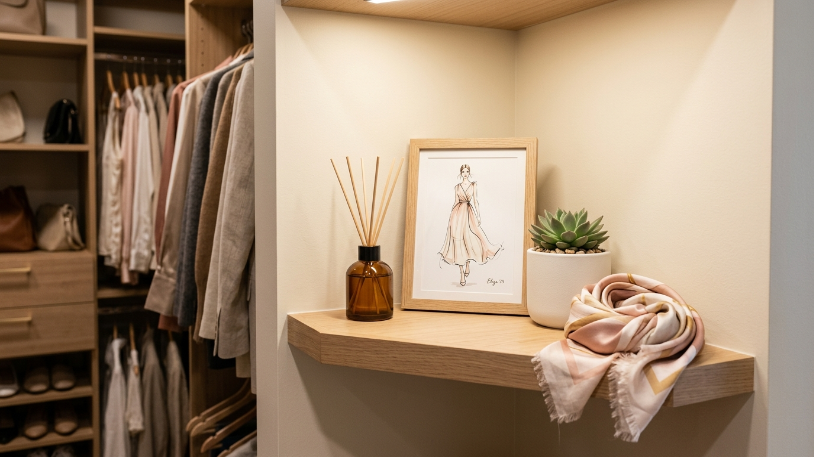
Here is where the boutique feeling really clicks into place. High-end stores smell intentional. They feel considered down to the last corner. And they have small finishing details that make the space feel complete rather than just functional. You can do all three of those things in your walk-in closet with very little money and very little time.
Start with scent. A small reed diffuser on a shelf gives the room a distinct character the moment you step inside. Cedar sachets tucked between folded sweaters do the same job and also protect natural fibers from moths and moisture. Avoid heavy floral or strongly sweet fragrances that could transfer to your clothing over time. Something woodsy, clean, or lightly herbal works best in a closet environment.
For decorative details, think about one or two small objects that add personality without crowding shelf space. A small sculptural vase, a framed fashion illustration print, a decorative bowl, or a single pillar candle all add warmth and story to the room. The key is restraint. One or two objects feel styled. Ten objects feel cluttered, and cluttered is the opposite of what you are building here.
Also consider a small plant or a cut stem in a slim bud vase near the mirror or on the island surface. Even one living element adds freshness that a diffuser alone cannot fully replicate. Plants bring movement to what is otherwise a composed, static room.
Finally, a velvet accent pillow on your bench, a silk scarf draped loosely over a hook, or a thin fabric runner on a shelf edge adds softness and texture to the space. These are small moves. They are also the moves that separate a room that looks styled from a room that feels styled.
10. Keep the Floor Open and Uncluttered
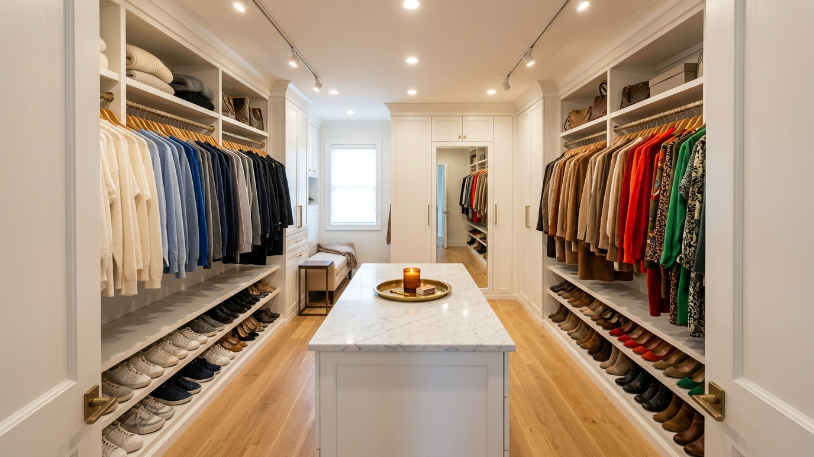
Finally, the one thing luxury boutiques never do is pile items on the floor. In a well-designed retail space, open floor area is part of the design intention, not wasted square footage. The same principle applies directly to your walk-in closet, and it is often the most overlooked piece of the whole puzzle.
A clear center path makes the room feel larger and more deliberate. If your walk-in closet has an island, keep the island surface mostly clear. A single tray with a few curated items is enough. A watch, a small candle, and a decorative bowl are plenty. If there is no island, at minimum keep a clear, unobstructed path through the center of the room at all times. The moment the floor becomes storage, the boutique feeling goes with it.
Next, resist storing items directly on the floor unless they are in a styled bin, a woven basket, or on a dedicated low display shelf. Shoes lined up on the floor in a pile read as a storage room. Shoes arranged on a low shelf, sorted by type and color, read as a boutique. That single distinction makes a bigger difference than most people expect when they first see it.
For off-season items, flat storage bins under lower shelving or labeled boxes on upper shelves keep them accessible without cluttering the visible space. Keeping only your current-season pieces at eye level makes the closet feel edited and chosen rather than packed with every item you have ever owned.
In short, open floor space is not empty space in a styled room. It is breathing room, and breathing room is what makes the whole design come together.
Final Thoughts
Your walk-in closet does not need a full renovation to feel like a boutique. It needs intention. A clear color direction, layered lighting, matched storage, and a few well-placed finishing details are what separate a room that works from a room you actually love walking into.
Start with one idea from this list and let it pull the others into place. Most people find that once the hangers match and the floor is clear, they want to keep going. That momentum is the best part. Your closet is already full of things you love. It might as well look exactly like it.