
Forest green is one of those colours that sounds bold until you see it done right, and then you wonder why every room in your house is not wearing it. Deep, earthy, and rich without being dramatic, forest green sits somewhere between nature and luxury. It brings the calm of a forest walk into your home and pairs beautifully with wood, cream, gold, and even blush tones. The good news is that you do not need a designer or a huge budget to pull this off. You just need a clear plan, the right pieces, and a little patience with paint swatches (trust the process, they always look different on the wall).
This guide will walk you through every step of building a forest green living room from the ground up, from choosing your exact shade of green to selecting your final throw pillow. Whether you are starting with a blank room or refreshing one that has lost its personality, this post has everything you need.
1) Start With the Right Shade of Forest Green
Not all greens are created equal, and this is the step most people rush past. There is a significant difference between forest green and olive green, between forest green and teal, and between forest green and hunter green. Forest green specifically leans dark, slightly cool or neutral in undertone, and is inspired by dense tree foliage. Think of the colour of pine needles, a shaded canopy in the middle of summer, or a vintage botanical print.
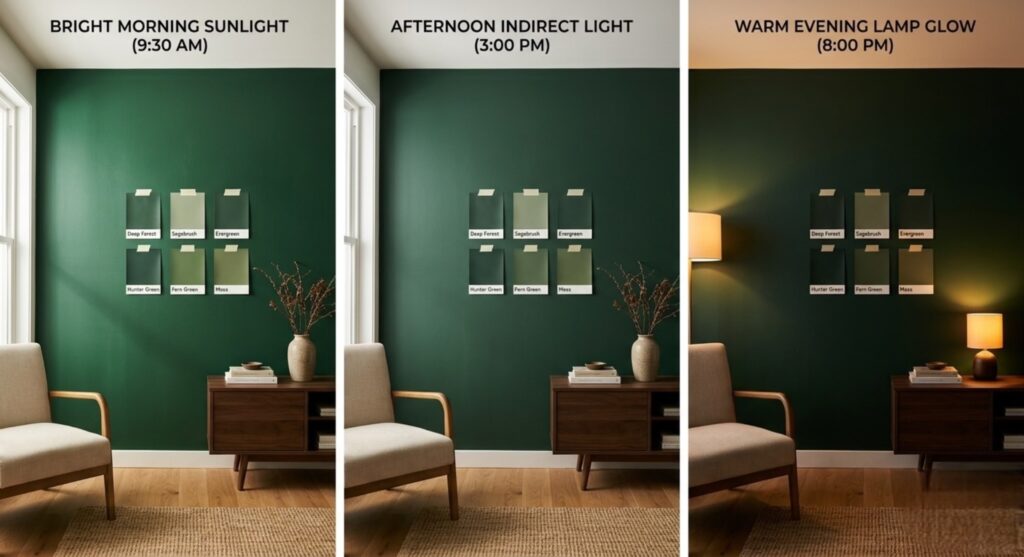
Before you commit to any paint colour or large furniture piece, you need to spend time with actual samples. Paint brands like Farrow and Ball, Benjamin Moore, Sherwin-Williams, and Behr all have excellent forest greens. Some top choices to investigate include Farrow and Ball’s Mizzle, Benjamin Moore’s Forest Green, Sherwin-Williams’ Hunt Club, and Behr’s Jasper Stone. Pick up physical paint swatches, tape them to your wall, and observe them at different times of day because morning light and evening lamplight will change how the colour reads. A shade that looks warm and cosy at night might look grey and flat in harsh midday sun.
The undertone matters more than people expect. Forest greens with blue undertones lean cool and sophisticated. Those with yellow undertones feel warmer and more earthy. Neutral-undertone forest greens are the most versatile and the safest starting point for beginners. If you are unsure, always go neutral undertone first.
2) Decide How Much Green You Want in the Room
This is the question that determines the entire personality of your space. Forest green can live in your room at different intensities, and knowing which level you are comfortable with will help you make purchasing decisions with confidence.
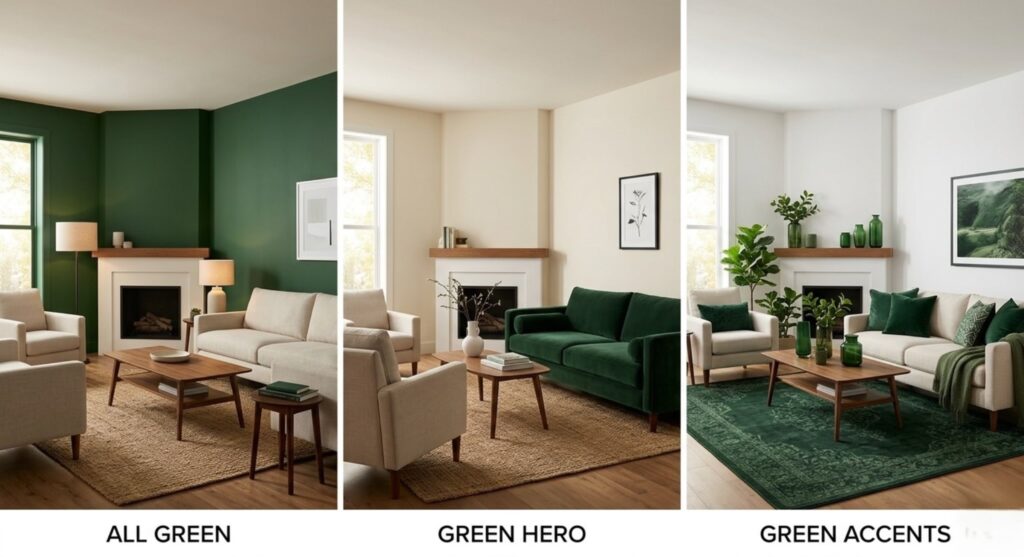
The first approach is to go all-in and use forest green as your primary wall colour. This is the most dramatic and rewarding option. When forest green covers all four walls, the room feels immersive, cosy, and deeply intentional. It is a commitment, yes, but rooms that fully embrace a dark wall colour tend to look the most editorial and the most photogenic. If the idea of four green walls scares you, start with one accent wall. Paint the wall behind your sofa or the wall facing the entrance and allow the rest of the room to stay neutral. This gives you the richness of the colour without the full commitment.
The second approach is to skip paint entirely and bring forest green in through furniture. A forest green sofa is one of the most sophisticated single furniture purchases you can make. It anchors the room immediately, acts as a colour focal point, and works with almost every neutral colour wall. You can pair it with cream walls, white walls, warm beige walls, or even light grey walls. A green sofa in a neutral room is like wearing a great coat over a simple outfit. It does all the work.
The third approach is to layer forest green through accessories and soft furnishings. This works well if you are renting, if you like to redecorate frequently, or if you simply want to test the colour before you commit. Green throw pillows, a green velvet ottoman, green ceramic vases, a green patterned rug, and green artwork mats can collectively build up enough colour in a room to make the theme feel cohesive without you painting a single wall.
Most well-styled forest green living rooms use a combination of all three approaches at different intensities. You might paint two walls, add a green sofa, and then carry the colour through accessories. The key is to make sure the green reads consistently throughout the room rather than appearing in random, unconnected spots.
3) Choose Your Base Colours and Build a Palette
Forest green does not live alone. It needs companions, and the colours you pair it with will determine whether your room feels luxurious, earthy, casual, or modern. Getting this right is not complicated, but it does require a little thought.
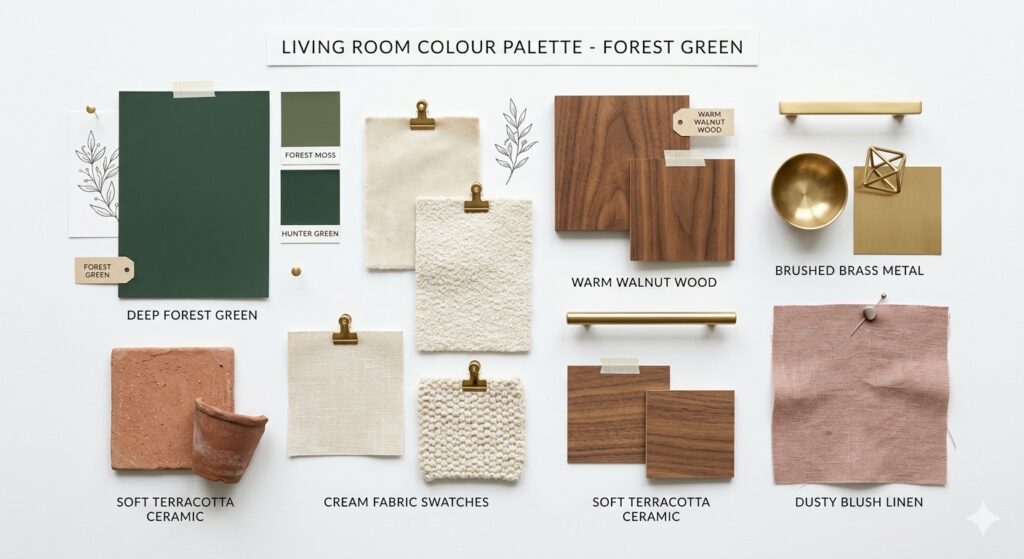
The most classic pairing for forest green is cream and warm white. Cream walls or cream furniture against forest green is one of the most naturally beautiful combinations in interior design. It echoes the way light filters through leaves onto light-coloured ground, and the contrast is soft rather than harsh. This pairing works in both modern and traditional styled rooms.
Warm wood tones are another essential companion for forest green. Light oak, warm walnut, and even darker mahogany all sit beautifully next to green because they share the same origin in nature. Coffee tables, bookshelves, side tables, and wooden flooring in warm tones will ground a forest green room and prevent it from feeling cold or heavy.
Gold and brass accents are the secret ingredient that most professional-looking forest green rooms share. Brass lamp bases, gold picture frames, gold-rimmed mirrors, and brass cabinet handles all catch the light in a way that brings warmth and a sense of richness to the space. The combination of forest green and brass has become one of the most recognisable pairings in interior design for good reason. It feels elevated without being stiff.
Terracotta and warm rust tones are a more adventurous pairing that works especially well if your forest green leans warm. A terracotta throw blanket, rust-coloured cushions, or earthy clay pots introduce a boho or Mediterranean warmth that makes the room feel relaxed and collected rather than formal.
Blush pink and dusty rose are surprisingly beautiful against forest green. If you are styling a living room that needs to feel feminine and warm without being overly sweet, a few blush accents against a forest green backdrop will do exactly that.
Stick to two or three accent colours maximum. Forest green with cream, warm wood, and brass is already a complete and sophisticated palette. Adding too many competing colours will break the visual harmony you are trying to build.
4) Select Your Furniture Thoughtfully
Furniture is where your design choices either come together or fall apart, and in a forest green living room, the shapes and textures of your furniture matter just as much as the colour.
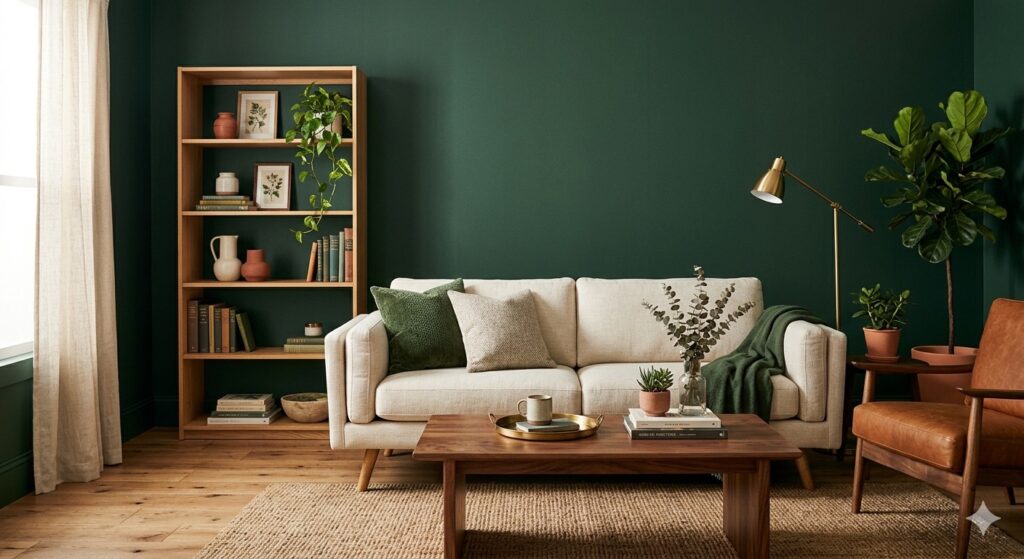
If your walls are forest green, choose furniture in neutrals. A cream or oatmeal-coloured linen sofa will soften the depth of green walls beautifully. A white bouclé armchair adds texture and lightness. Dark leather furniture, particularly in cognac, caramel, or rich brown, looks extraordinary against forest green walls and gives the room a library-like quality that feels deeply inviting.
If your walls are neutral and your sofa is forest green, build everything else around the sofa. Look for a coffee table in warm wood or black metal. Add armchairs in cream, camel, or a warm neutral that complements but does not compete with the green. Keep the overall furniture silhouette clean and slightly curved because sharp, boxy furniture can feel cold next to forest green, while softer, rounded shapes feel more organic and harmonious.
Pay attention to the legs of your furniture. Sofas and chairs with tapered wooden legs in oak or walnut will look infinitely more expensive and better-proportioned than those with dark or hidden legs. Visible furniture legs make a room feel lighter and more open, which is important when working with a deep, saturated colour like forest green.
Shelving and storage are also worth considering as design elements rather than purely functional pieces. Open bookshelves in natural wood give you the opportunity to style your books, plants, and objects in a way that extends the forest green theme. Painting the back panel of a bookshelf in forest green, even in an otherwise neutral room, is a simple and effective way to add depth and cohesion.
5) Layer Textures to Add Depth
One of the most common mistakes people make when decorating with a bold colour like forest green is treating all surfaces the same. A room where everything is smooth and flat will look dull and unfinished, even if the colour itself is beautiful. Texture is the invisible ingredient that makes a room feel rich and layered.
Velvet and forest green are a legendary combination. A velvet sofa or armchair in forest green has a depth and lustre that no other fabric can replicate. The way velvet catches light differently from different angles gives the colour a living, almost three-dimensional quality. If you cannot afford a full velvet sofa, a velvet cushion or a velvet footstool will still add that same quality of richness to the room.
Linen and cotton are the natural counterparts to velvet in a forest green room. Where velvet adds drama, linen adds ease. Linen curtains in cream or warm white soften the heaviness of a dark green room and allow light to filter in gently. Linen cushion covers and woven throws introduce a casual, natural element that prevents the room from feeling too formal or precious.
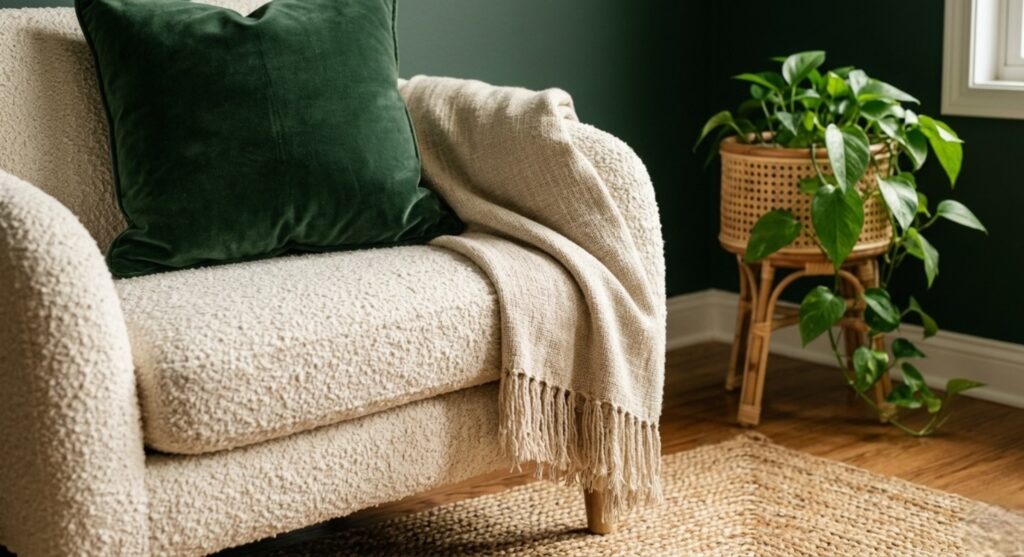
Wool and boucle add warmth and tactile interest. A boucle armchair or a chunky wool throw draped over a sofa arm adds a cosy, inviting quality to the room that makes people want to sit down and stay. These materials work particularly well in forest green rooms that lean toward a warm, nature-inspired aesthetic.
Natural materials like rattan, jute, and wicker are also excellent texture-builders. A jute rug under your coffee table, a rattan pendant light shade, or a wicker basket for throw storage brings in that organic, grounded quality that forest green naturally suggests. These pieces are usually affordable and easy to find, making them a great way to add texture without stretching your budget.
6) Get Your Lighting Right
If there is one thing that will make or break a forest green living room, it is lighting. Dark, rich colours absorb light, which means a poorly lit forest green room will feel like a cave (the bad kind, not the cosy kind). A well-lit forest green room, on the other hand, feels like the warmest and most inviting space you have ever walked into.
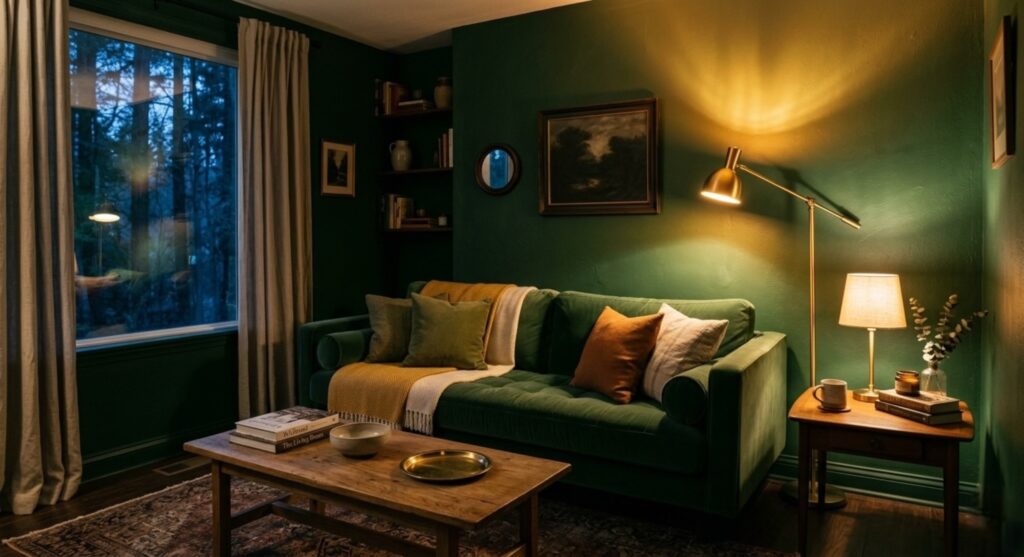
Always layer your lighting. Do not rely on a single overhead light to do all the work. Start with ambient lighting from ceiling fixtures, but then add task lighting through floor lamps and table lamps, and accent lighting through wall sconces, candles, or LED strips behind shelving. Each layer serves a different purpose and together they create a warmth and dimensionality that a single overhead bulb simply cannot achieve.
Choose warm-toned bulbs. Bulbs with a colour temperature of 2700K to 3000K produce a warm, golden light that is flattering to forest green and to the people sitting in the room. Cooler bulbs with a higher Kelvin number will make your forest green look grey and flat and your guests look like they are waiting at a bus stop.
Brass and gold lamp bases work especially well in a forest green room because they introduce the warmth of the metal tone into the light source itself. A tall brass floor lamp in the corner of a forest green room, casting an upward wash of warm light, is one of the simplest and most effective styling moves you can make.
Natural light should also be managed thoughtfully. If your room gets a lot of direct sunlight, consider linen or light cotton curtains in cream or white that soften the light without blocking it. If your room is naturally darker, opt for lighter wall colours and maximise reflective surfaces like mirrors and glass to bounce whatever light you have around the room.
7) Style Your Surfaces and Shelves
Styling the surfaces of your forest green living room is the final and most personal layer of the design. This is where your personality shows up, and getting it right will make the difference between a room that looks like a showroom and one that feels like a home.
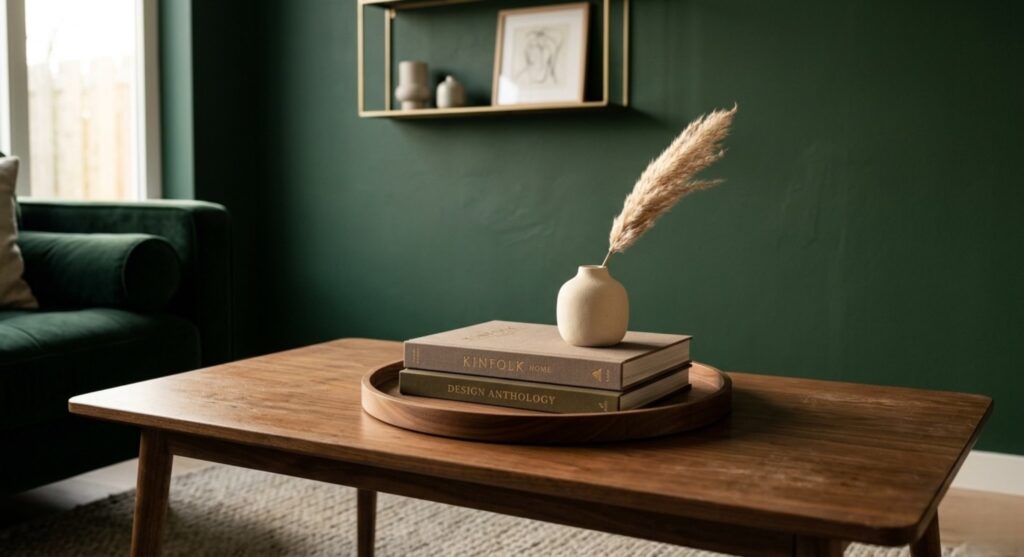
On your coffee table, start with a tray. A round tray in wood, marble, or woven texture gives you a defined space to work within and keeps your styling from looking scattered. Inside the tray, place one or two coffee table books, a small candle in a glass or ceramic holder, and a small vase with a single stem or a small arrangement of dried grasses. That is genuinely all you need. The tray does the organisational work and the objects inside it do the decorative work.
On your shelves, mix books with objects and always include at least one plant. The books can be arranged by colour, by size, or simply by whatever you have read and loved. Objects can include ceramic vases, sculptural pieces, framed photographs, or collected items from your travels. The plant is not optional in a forest green room because greenery in a green room does not look redundant. It actually reinforces the nature theme and adds life in a way that no artificial object can replicate.
On your window sills and side tables, keep things simple. A ceramic bowl, a small candle, a trailing plant, or a single decorative object is enough. Over-styling small surfaces makes a room feel cluttered and anxious. Under-styling them makes the room feel cold and unfinished. One or two intentional objects on a surface tells the story you want to tell.
Mirrors are one of the most underused tools in living room styling. A large mirror on the wall opposite a window will reflect natural light deep into the room and make the space feel significantly larger. In a forest green room, a mirror in a brass or warm metal frame will also reflect the beauty of the green itself back into the room, creating a sense of depth and richness that is hard to achieve with any other single object.
8) Bring in Plants and Natural Elements
A forest green room and plants are a natural pairing, in every sense of the word. The deep saturated green of your walls or sofa creates a backdrop that makes plants look almost theatrical, and the plants in turn make the green feel intentional and connected to the natural world rather than arbitrary.
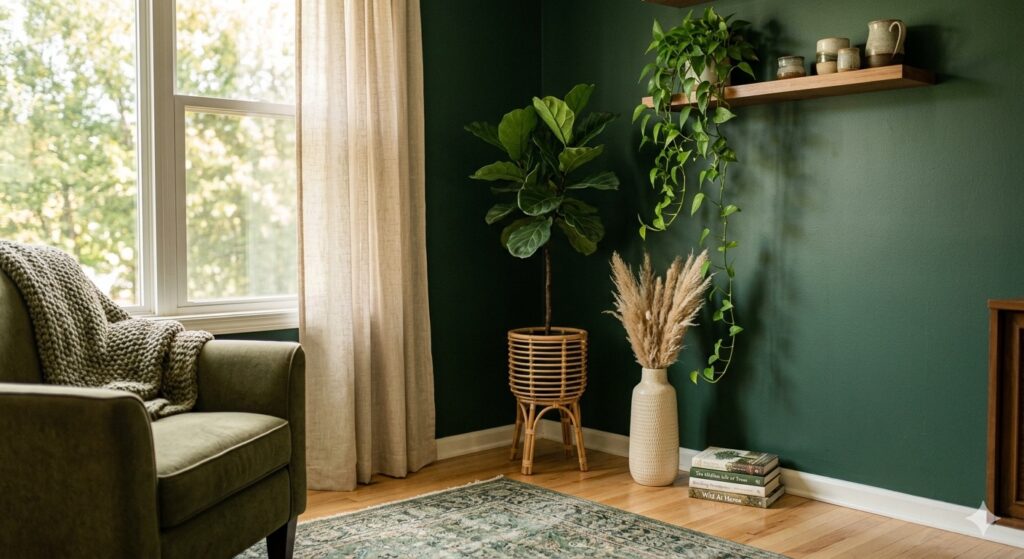
Choose plants with interesting shapes and varying heights to create visual interest. A large fiddle leaf fig tree or an areca palm in the corner of the room adds height and architectural presence. A trailing pothos or devil’s ivy on a high shelf brings movement and organic flow. Small succulents or cacti on a windowsill add texture at eye level. Grouping plants of different heights creates a layered, jungle-lite effect that suits a forest green room perfectly without making you feel like you have lost control.
If you are not confident with plant care, do not be afraid of high-quality faux plants. The market for realistic artificial plants has improved dramatically in recent years, and a well-made faux fiddle leaf fig or monstera can add all the visual benefit of a real plant with none of the guilt when you inevitably forget to water it during a busy week.
Natural decorative elements beyond plants also add to the organic quality of a forest green room. A large piece of natural driftwood as a table centrepiece, a stack of smooth river stones, dried pampas grass in a tall vase, or a woven seagrass basket all connect the room to the natural world in a way that feels cohesive with the forest green theme. These elements are usually affordable, easy to source, and add a unique, personal quality to the room that mass-produced decor pieces cannot replicate.
Final Touches: Rugs, Curtains, and Artwork
These are the finishing details that tie everything together, and they deserve as much attention as any other element of the room.
Your rug anchors the seating area and defines the living room as its own zone within the space. In a forest green room, rugs in cream, warm beige, natural jute, or soft terracotta all work beautifully. A patterned rug with abstract or botanical motifs in tones that include your accent colours is another excellent option. The rug should be large enough that the front legs of all your major seating pieces sit on it. If your rug is too small, the seating arrangement will look disconnected and the room will feel smaller than it actually is.
Curtains in a forest green room should either blend or contrast deliberately. Floor-length curtains in cream or warm white linen will brighten and soften a dark green room. Curtains in a coordinating forest green, particularly in velvet, will create a dramatic, fully-wrapped look that feels intentional and luxurious. Avoid curtains in colours that neither blend nor contrast, as these will just look accidental. The height of your curtain rod also matters significantly. Hang your rod as close to the ceiling as possible, regardless of where your window actually sits, because high-hung curtains make the ceiling feel taller and the room feel grander.
Artwork is where you can take the most creative liberty in a forest green room. Botanical prints are the obvious choice and they work beautifully, particularly in sets of two or three in matching frames arranged in a grid. Abstract artwork in warm tones including terracotta, gold, and cream against a green background creates a striking focal point. Black and white photography or line art in simple frames also looks elegant against a forest green wall. Whatever you choose, framing matters enormously. A simple print in a great frame looks like art. A great print in a cheap frame looks like an afterthought.
Putting It All Together
A well-styled forest green living room is the result of a series of deliberate, considered decisions made from the ground up. You start with the right shade, you decide your intensity level, you build a palette of two or three complementary tones, you choose furniture that speaks to the colour rather than fighting it, you layer textures generously, you light the room with warmth and intention, you style your surfaces with restraint, you bring in natural elements, and then you add the final touches that make the room feel complete.
The most important thing to remember is that there is no single way to style a forest green living room. The colour is versatile enough to live in a maximalist, plant-filled space full of pattern and richness, and equally at home in a minimal, quietly luxurious room with only a few carefully chosen pieces. Your job is not to replicate what someone else has done. Your job is to use forest green as a foundation for a space that reflects how you live and what makes you feel at home.
Start where you are. Buy one piece, paint one wall, add one plant. Then step back, live in it for a while, and let the room tell you what it needs next. That is how the best rooms are always built.