
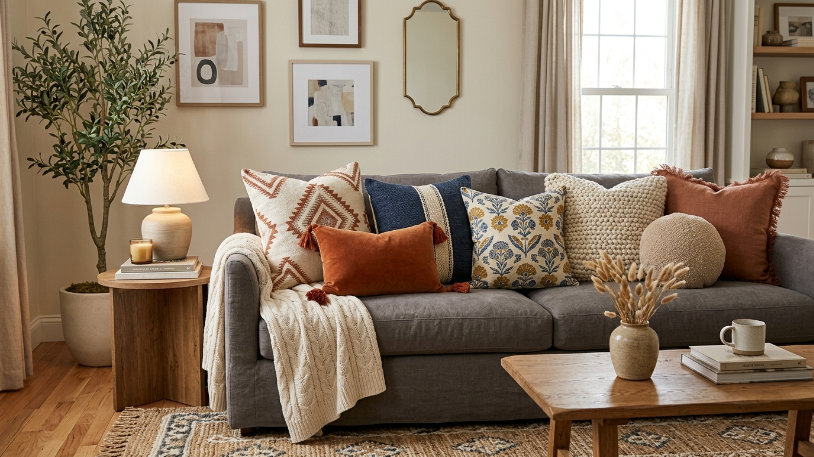
Most people who style throw pillows for the first time follow the same instinct. They grab the matching set, the one where all three pillows come from the same collection, the same fabric, and the same two colors. The sofa looks fine. Perfectly fine. And perfectly forgettable.
The good news is that the fix costs nothing extra. When you learn to style throw pillows the right way, you pull the set apart and build something better on purpose. You mix shapes, tones, textures, and sizes, and the result feels like a designer picked your pillows rather than a product algorithm.
This post walks you through every key idea, from the anchor method to pattern mixing to the one wild-card move that makes the whole arrangement click. By the time you finish reading, you will know exactly how to style throw pillows in a way that feels personal, layered, and intentional.
1. The Real Problem with Matching Pillow Sets
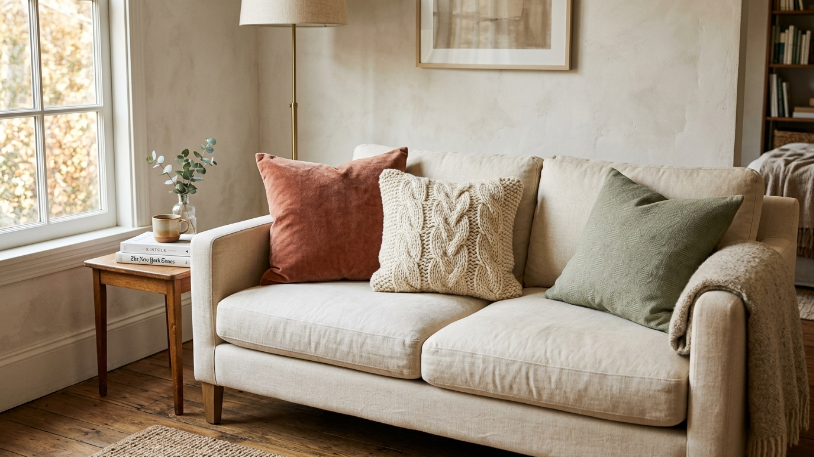
Here is the thing about matching pillow sets: they do all the thinking for you, and that is exactly the problem. When every pillow comes from the same box, your sofa ends up looking like a catalog shoot rather than a home. The matching set is safe. However, safe rarely looks interesting.
Designers do not style throw pillows by starting with a pre-packaged collection. They start with one strong anchor piece, then build around it. The goal is cohesion, not copies. Cohesion means the pillows relate to each other without being identical. Think of a good outfit: your shoes, jacket, and bag do not need to match exactly, but they should all belong to the same story.
Also, matching sets tend to flatten a sofa visually. When every pillow is the same height, the same density, and the same surface finish, there is no rhythm. The eye slides past without stopping. Contrast is what makes a person pause and look twice.
So the next time you style throw pillows, resist the pull of the boxed set. Buy pieces separately. Choose different sources, different textures, and different scales. You do not need to spend more money. You just need to be more intentional about what you pick.
2. Start with an Anchor Pillow
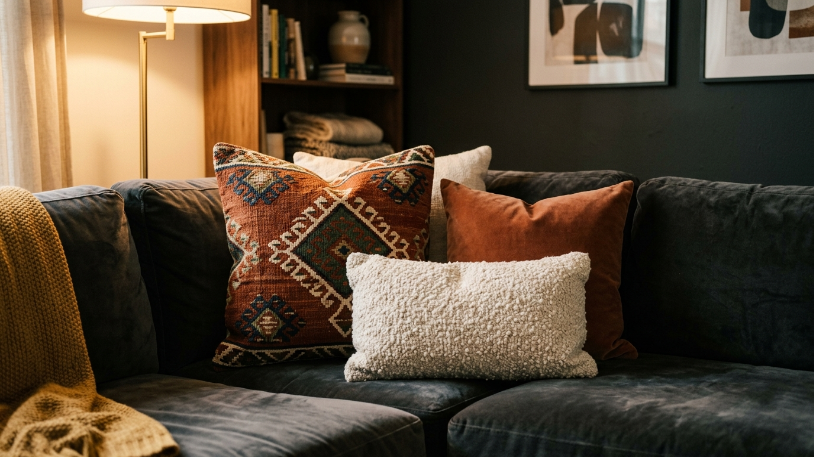
Before you buy a single pillow, choose one that will anchor the group. The anchor pillow is usually the largest one, and it carries the most visual weight in the arrangement. It might have a bold print, a rich texture, or a strong color. Everything else you choose will respond to it, so this is the one piece worth spending a little more on.
A good anchor for most sofas is a 22×22 pillow in a printed or woven fabric. Florals, abstract prints, kilim weaves, and boucle all make strong anchors. The anchor sets the color palette for the whole arrangement. Pull two or three colors from it, then use those colors in the supporting pillows.
For example, if your anchor pillow has ivory, rust, and dark olive in it, your surrounding pillows should each pick up one of those tones. One solid rust lumbar, one solid ivory square, and one textured olive square all speak to the anchor without repeating it exactly. That is how you style throw pillows the way professionals do.
The anchor method also makes shopping far easier. You are not wandering through a store hoping things will somehow match. You are looking for pieces that echo colors already present in the anchor, which gives you a clear filter.
One more tip: your anchor pillow does not need to live in the center of the sofa. Place it in one corner, lean it slightly forward, and let the smaller pillows tuck in around it. Off-center placement almost always looks more natural.
3. Use the Rule of Odd Numbers When You Style Throw Pillows
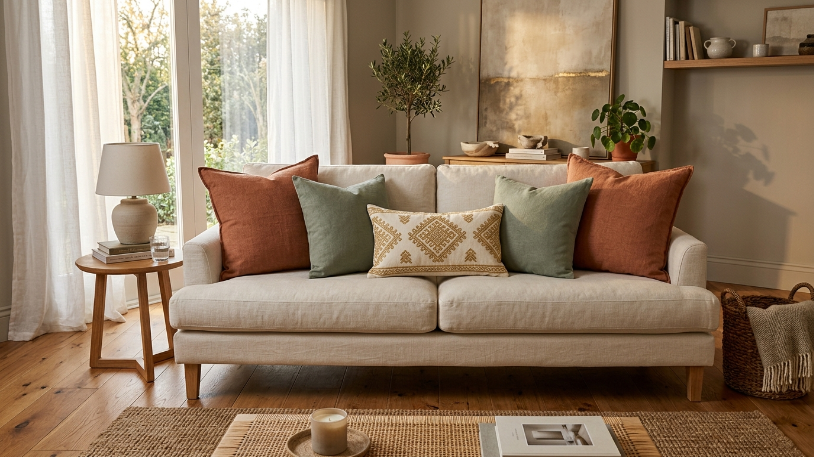
Odd numbers almost always look better than even numbers in interior styling. Three pillows on a sofa typically feel more natural than four. Five looks richer than six. This is not a strict rule, but it is one of the most reliable shortcuts you will find when you want to style throw pillows and skip the trial and error.
The reason odd numbers work comes down to asymmetry. Asymmetry creates movement. When pillows are arranged in odd groupings, the eye travels from one piece to the next rather than splitting the arrangement into two tidy, forgettable halves. Even numbers tend to create a visual anchor down the middle, which makes the setup feel stiff.
For a standard three-seat sofa, start with three pillows: two larger squares at either end and one lumbar or smaller square sitting slightly off-center in front. For a bigger sectional, five works well. Two large squares, two medium squares, and one lumbar give you layers to work with without overcrowding.
If you have an even number of pillows on hand, the fix is simple. Add one lumbar, or swap one square for a round. A lumbar pillow, usually about 12×20 or 14×24 inches, adds a long horizontal shape that breaks up the visual sameness of a row of squares. It also creates a natural front row for the arrangement.
Here is a quick count guide by sofa size:
- Love seat (two-seat): 2 to 3 pillows
- Standard sofa (three-seat): 3 to 5 pillows
- Large sofa or sectional: 5 to 7 pillows
- King bed (decorative layer): 5 to 7 pillows
4. Mix Textures, Not Just Colors
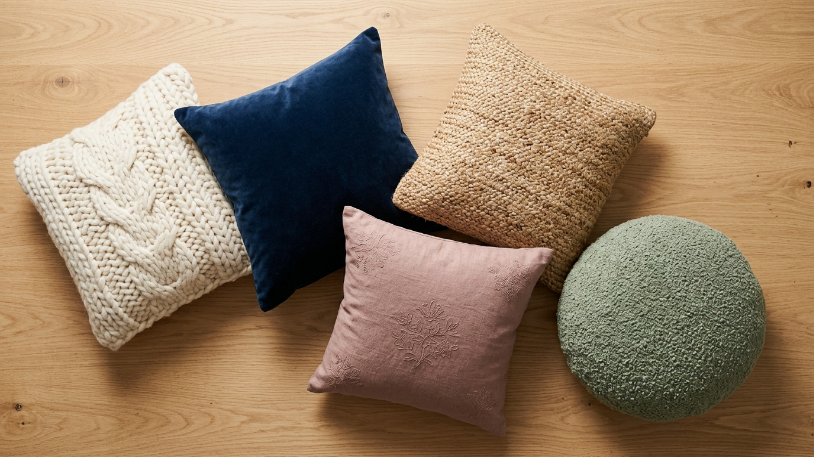
Color gets most of the attention when people style throw pillows. However, texture is just as important. A sofa covered in pillows of the same fabric will always look slightly flat, even when the colors are perfect. Texture adds dimension and makes a setup feel real rather than staged.
Mix matte with shiny. Pair a velvet pillow with a linen one. Add a chunky knit next to a smooth woven cover. Place a beaded or embroidered pillow next to a simple solid. The variety of surfaces catches light differently at different times of day, and that contrast is what gives your sofa visual life.
A few textures that work especially well together:
- Linen or cotton: crisp, matte, breathable
- Velvet: soft, light-absorbing, rich
- Bouclé: nubby, looped, warm
- Chunky knit: cozy, relaxed, casual
- Embroidered or beaded: detailed, decorative, slightly formal
- Jute or handwoven: earthy, natural, casual
You do not need all of these at once. Pick two or three that match your room’s mood, then vary them across your pillows. If your sofa is already textured, such as a bouclé or a heavy linen weave, lean toward smoother pillow covers to keep things from getting too visually busy.
Also, pay attention to the pillow insert, not just the cover. A flat, floppy pillow looks cheap no matter how nice the fabric is. When shopping, press the insert firmly. A good one should feel full and springy, not deflated. Down or down-alternative inserts give the best shape and recover well from regular use.
5. Pattern Mixing That Actually Works
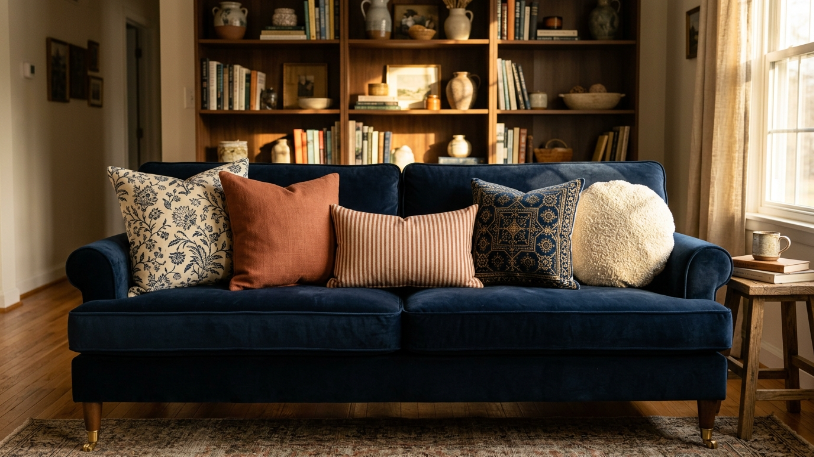
Pattern mixing intimidates most people, but it follows a simple logic. The trick is to vary the scale of the patterns so they do not compete. Pair a large floral with a small geometric. Pair a bold wide stripe with a tiny repeating dot. When two patterns of the same scale sit next to each other, they clash. When one is large and one is small, they complement.
Also, keep your color story tight when you mix patterns. As long as all your patterned pillows pull from the same two or three colors, you can mix four different prints and still look intentional. Color repetition is what holds the whole arrangement together when the patterns are different.
A simple starting point for pattern mixing: one large print, one medium print, and one solid. The solid gives the eye a place to rest between the patterns. The solid does not need to be white or beige. A solid in a rich jewel tone or a deep warm neutral works just as well, as long as it has no visible print.
For example: a large navy botanical print square, a small navy-and-cream stripe, and a solid terracotta lumbar. All three share a navy-and-cream-and-terracotta color story. Each is a different scale. The result looks layered and considered without looking chaotic.
One more detail worth noting: warm whites and cool whites are not interchangeable in a pattern mix. Pairing a warm ivory with a blue-toned white in the same arrangement can make the whole setup feel slightly off, even when the patterns are right. Stick to warm whites with warm tones, and cool whites with cool ones. Benjamin Moore’s complementary color guide is a useful free resource for understanding how color families interact when you are building out your pillow palette.
6. Scale and Size Variation Makes the Arrangement Come Alive
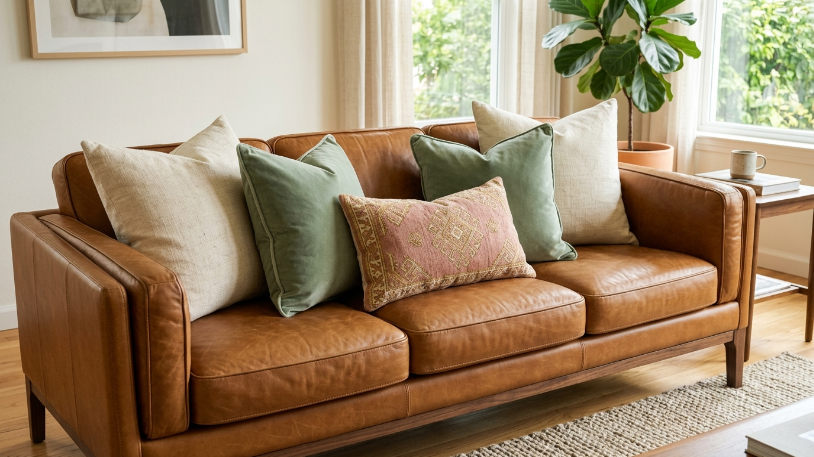
Even a perfect color story falls apart when all the pillows are the same size. Size variation is what gives a sofa arrangement its front layer and back layer, its depth, and its finished look.
Mix 22×22 squares with 18×18 squares. Add a 12×20 or 14×24 lumbar. Consider adding one round pillow, usually 18 to 20 inches in diameter, to break up the angular sameness of a row of squares. You do not need all of these on one sofa, but you do need at least two different sizes in every arrangement.
Here is a simple three-layer stacking approach for a standard sofa:
- Back row: two 22×22 squares, one at each end
- Middle row: two 18×18 squares, slightly overlapping the back layer
- Front row: one 12×20 or 14×24 lumbar, centered or slightly off-center
Round pillows work best swapped in for one of the middle-row squares. They soften the overall shape and feel more relaxed without much effort.
Next, there is a small insert trick worth knowing. A 22×22 insert actually fills a 20×20 cover better than a perfectly sized one does. The slightly oversized insert fills the corners and gives you that full, hotel-pillow look. Stuffing a matching-size insert into a matching-size cover often leaves the corners flat and the edges saggy.
Finally, avoid the one-size arrangement. It is the pillow mistake that no amount of better color choices will fix. Varied sizes, even in a simple two-size combination, make a setup look instantly more considered.
7. How to Style Throw Pillows Around Your Sofa Color
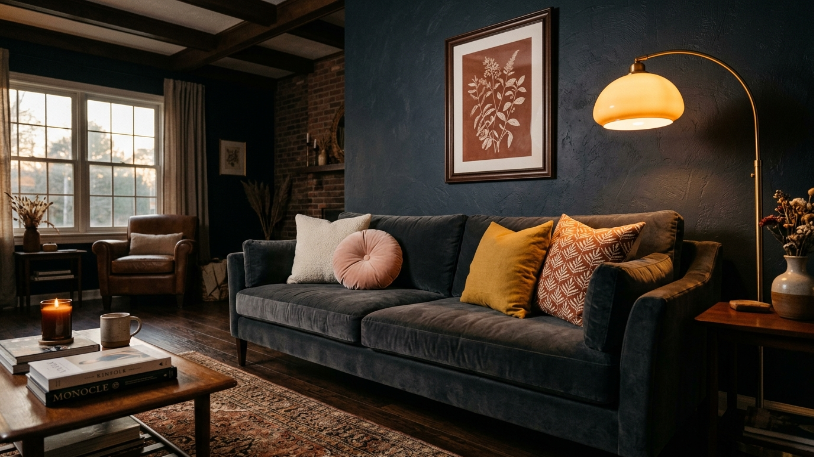
Your sofa color is the biggest variable in the whole equation. Everything you place on it needs to either contrast with it or blend into it with intention. Here is a breakdown of how to style throw pillows for the most common sofa colors:
| Sofa Color | Best Pillow Base Tones | Accent Color Pop | Best Texture to Add |
| White or cream | Warm earth tones, terracotta, sage | Deep navy or charcoal | Velvet or woven |
| Gray or charcoal | Blush, ivory, mustard, rust | Emerald or teal | Bouclé or chunky knit |
| Navy blue | Cream, rust, warm gold, blush | Burnt orange | Linen or embroidered |
| Beige or tan | Dusty rose, olive, warm ivory, rust | Camel or burnt sienna | Chunky knit or jute |
| Olive or green | Cream, warm white, caramel, blush | Terracotta or rust | Velvet or smooth linen |
| Black | Ivory, blush, warm white, soft gold | Terracotta or sage | Bouclé or embroidered |
| Brown leather | Cream, rust, camel, amber | Deep teal or forest green | Chunky knit or woven |
Also, remember that the sofa is not the only surface informing your choices. If you have warm honey-toned wood floors, a terracotta-painted accent wall, or a rust-colored area rug, let those colors feed into your pillow palette. Sherwin-Williams notes that dark rooms especially benefit from color and vibrancy through throw pillows and accent accessories to keep the space from reading as flat.
Pillows sit at eye level and work hardest when they bridge the sofa with the rest of the room, rather than sitting on top of it as an afterthought. A pillow that echoes your rug, your art, or your curtain color is doing triple duty.
8. The “One Wild Card” Move
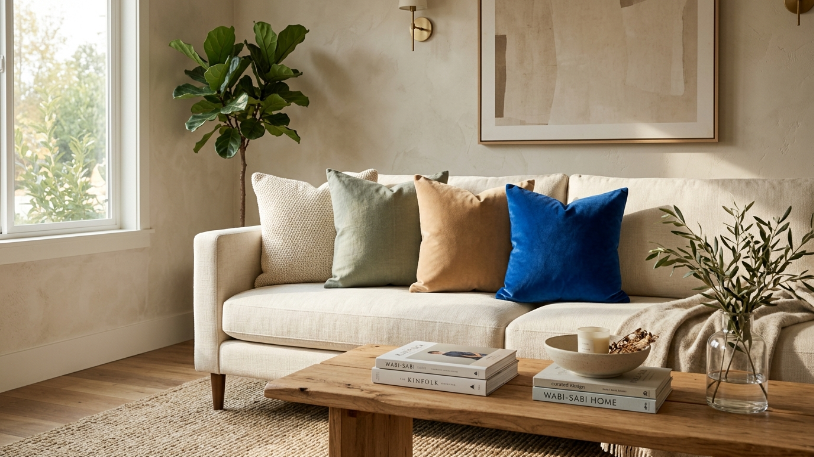
Every great pillow arrangement has one piece that surprises you. It is the pillow that does not perfectly follow the color plan or the texture strategy, but somehow makes everything else look more interesting. Designers call this the wild card, and it is one of the most underused moves in everyday home styling.
A wild card might be a jewel-toned velvet pillow, like a rich cobalt or aubergine, on an otherwise neutral sofa. Or it might be a large embroidered folk-pattern pillow on a minimal, modern setup. Or a vintage-looking kilim square on a crisp white sofa. The format does not matter much. What matters is that it introduces just enough unexpected tension to make the eye linger.
The key is that the wild card still shares something with the rest of the arrangement. Maybe it picks up one color from your anchor pillow. Maybe it echoes a texture already present in the room. However, it also does something the others do not, and that contrast is what makes the whole arrangement feel alive rather than rehearsed.
If this move sounds risky, start small. Add one pillow in a color just slightly outside your comfort zone. Warm amber on an otherwise dusty blue sofa. Soft mauve on a tan couch. Muted coral on a gray setup. You might be pleasantly surprised by how much better a little color tension looks when everything else is already in order.
The wild card is also an easy way to bring a seasonal color into a room without replacing anything else.
9. How to Style Throw Pillows on a Bed
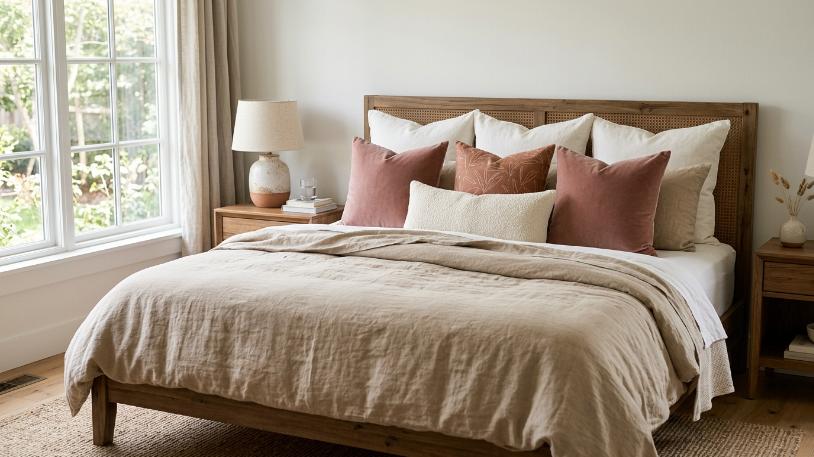
The same rules that apply to sofas apply to beds, and beds are actually easier to work with because you already have a natural back layer: your sleeping pillows. Decorative pillows stack in front of them, so the layering structure is built in.
For a king-size bed, most designers use five to seven decorative pillows. For a queen, four to five is the standard. The key is to still vary the sizes and stick to an odd count for the decorative layer in front.
A common bed arrangement:
- Back layer: two or three king shams flat against the headboard (warm white or matching duvet tone)
- Middle layer: two 22×22 or 20×20 squares in an accent color or print
- Front layer: one or two smaller squares or a long bolster in a contrasting texture
Just as with the sofa, start with one anchor pillow in the middle layer. Pull its colors into the surrounding pieces, and add one wild card for depth. Also, resist the urge to match your pillow covers to your duvet exactly. Choosing pieces that relate to the duvet but are not identical gives the bed that layered, pulled-together look that catalog images always seem to have.
Bedding in warm tones generally reads better in real rooms than in online photos. A duvet in warm cream or a dusty linen reads richer in person than a stark cool white, and warm-toned pillows will photograph and live more naturally alongside it.
10. How to Style Throw Pillows for Seasonal Swaps Without Starting Over
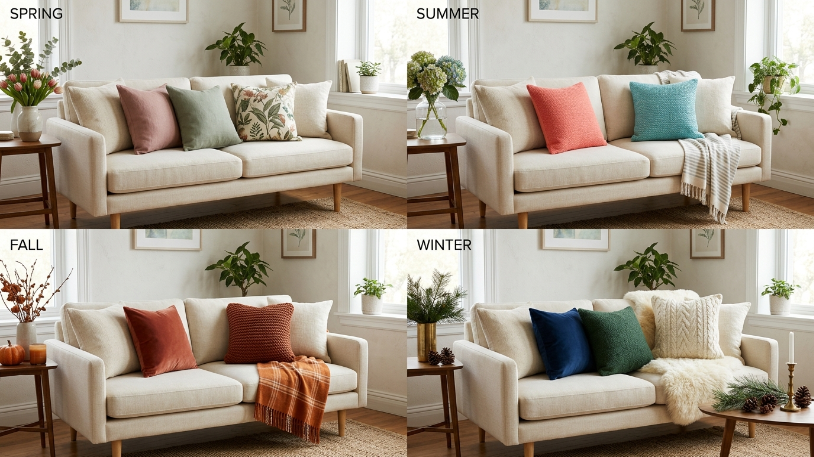
Seasonal pillow swaps are one of the fastest ways to refresh a room without repainting or replacing furniture. The key is to build your base arrangement around neutral pieces, then only swap out one or two accent pillows each season.
Start with a permanent base of two or three neutral pillows in cream, warm white, or natural linen. These stay on the sofa or bed year-round and do not need to change. Around them, rotate two seasonal accent pillows with each quarter of the year.
Here is a simple seasonal guide:
- Spring: Dusty rose and soft sage; botanical or floral prints; linen and cotton textures
- Summer: Warm coral, turquoise, or golden yellow; woven, jute, or lightweight cotton
- Fall: Terracotta, rust, amber, deep olive; chunky knit and velvet covers
- Winter: Forest green, navy, warm ivory; cable knit, plaid, or check patterns
With this approach, you need only four to six seasonal pillows in addition to your neutrals. You are not replacing the full setup each time, just refreshing the two accent pieces that shift the room’s mood. Plus, seasonal pillows tend to go on sale at the tail end of each season, which is the best time to shop ahead for next year.
Store off-season pillows in a breathable cotton bin or a sealed storage bag. Pillow inserts last much longer when they are kept away from direct sunlight and humidity. Fluff them thoroughly before putting them back on display.
11. Warm Undertone Pillow Colors That Work in Almost Any Room
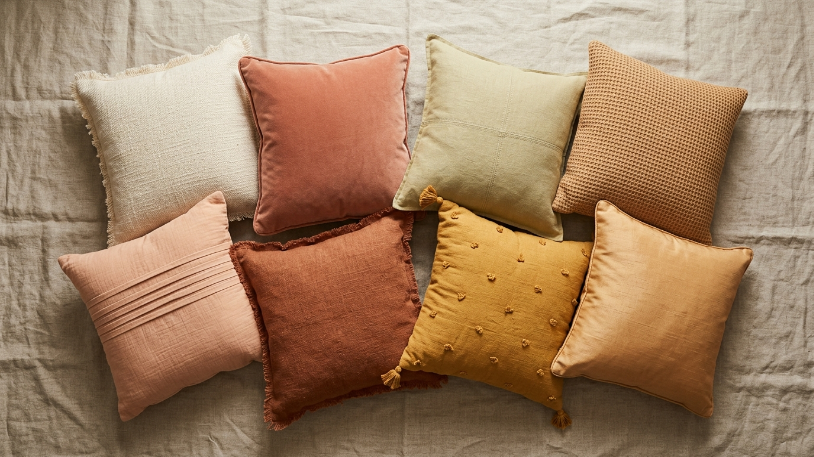
One reason throw pillow arrangements sometimes feel slightly off, even when the colors look good on screen, is an undertone mismatch. Every color has a warm or cool base. Warm undertones carry hints of yellow, orange, or red. Cool undertones lean toward blue, gray, or green.
Most rooms with wood floors, warm-painted walls, or natural textiles read warm overall. Bringing in a pillow with a cool blue-white or a gray-toned sage can feel disconnected from the room, even if the color is technically “neutral.”
Here are warm-undertone pillow colors that blend comfortably into most homes:
- Warm ivory or cream (not bright optical white)
- Dusty terracotta or clay
- Muted sage with a yellow-green base (not blue-green)
- Camel or warm tan
- Blush with a peachy or salmon base
- Rust or burnt sienna
- Warm mustard or turmeric gold
- Soft amber or honey
These colors all carry warmth in their base, so they tend to look richer in natural and incandescent light. They also sit comfortably alongside wood, rattan, brass, and natural stone, which are common in most warm-toned home setups.
If your room skews cool instead, such as white walls, marble surfaces, or cool gray furniture, mirror that approach and look for pillows in cool sage, dusty lavender, slate blue, or cool stone linen. The rule is the same either way: match the undertone of the pillow to the undertone of the room, and the colors will feel at home without any extra effort.
12. When It Still Does Not Look Right
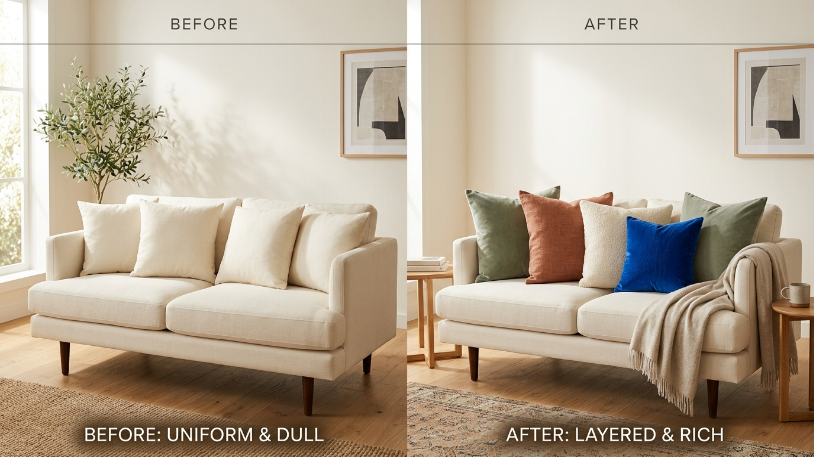
Sometimes you follow every rule and the sofa still looks slightly off. That is normal, and it usually points to one of a handful of easy fixes.
If the arrangement looks too busy or chaotic, you probably have too many patterns competing at the same scale. Remove one patterned pillow and replace it with a solid. The arrangement will calm down immediately.
If the pillows look stiff and flat rather than plush and inviting, the issue is almost always the inserts. Replace any flat inserts with down-alternative ones that are one or two inches larger than the cover. The difference is dramatic.
If the colors feel slightly mismatched even though they are in the same family, the culprit is likely an undertone conflict. Put both pillows against a piece of white paper and look at them together. The warmer one will show a yellow or peachy cast; the cooler one will look more gray or blue. Once you can see the difference, it is easy to separate them.
If the arrangement looks boring despite the right colors and textures, you are probably missing the wild card. Add one piece that does something unexpected, whether it is a brighter color, a bolder pattern, or an unusual shape. One deliberate surprise always reads better than a too-careful arrangement.
Finally, if nothing is working, strip the sofa completely. Start fresh with just one pillow you love. Build outward from there. The anchor method almost always resets a difficult arrangement faster than rearranging the existing pieces.
Final Thoughts
The matching pillow set was never the goal. It was just the default. Now that you know how to style throw pillows with intention, you have a real toolkit: an anchor color, varied textures, mixed patterns, odd counts, and one wild card that keeps the whole thing from looking too rehearsed.
Start with what you already own. Pull your existing pillows apart and rearrange them with what you have learned here. Add one new piece at a time. You do not need to start from scratch to get a result that looks and feels better.
Your sofa is the most-seen surface in most living rooms. Take a little time with it. Try a lumbar you have been avoiding. Swap one cover for a bolder texture. Add that color you keep coming back to in the store but always put back on the shelf. The worst case is that a pillow moves to the guest room. The best case is that your sofa finally looks exactly the way you imagined it could.
Happy styling.