
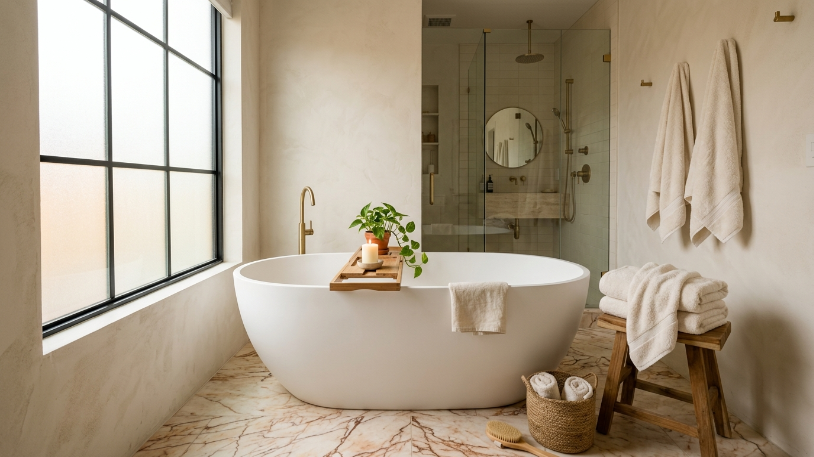
If you have ever stepped into a hotel bathroom and quietly decided never to leave, you already understand the appeal of home spa ideas. The good news is you do not need to gut-renovate your bathroom or hire a designer to get that same feeling. A few well-chosen upgrades, some layered warmth, and the right sensory details can shift even a basic bathroom into a space that genuinely restores you. This guide covers 13 brilliant home spa ideas that work across different sizes, styles, and budgets. Some take an afternoon. Others need nothing more than a candle, a good diffuser, and a rearrange.
According to the American Society of Interior Designers (ASID), spa-like bathrooms and dedicated retreat spaces are among the most meaningful upgrades in modern residential design. That matters, because a spa bathroom is not just about looks. It is about designing a space that supports how you feel every single day.
1. Bring In a Freestanding Soaking Tub
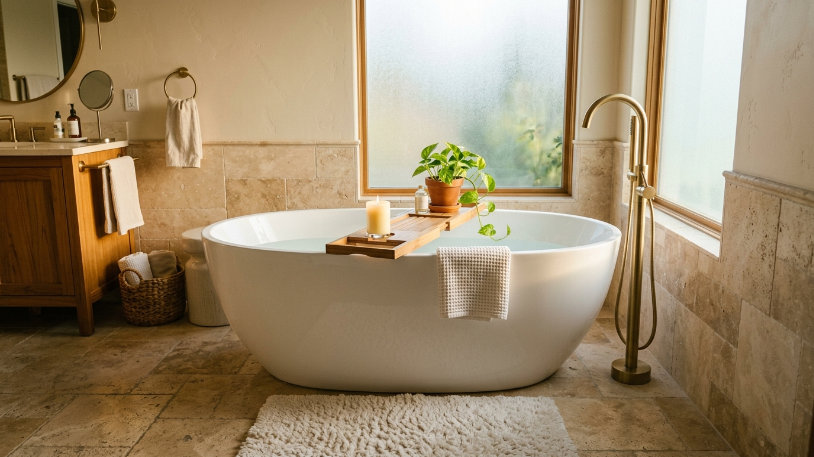
A soaking tub is the most iconic home spa idea you can add to a bathroom, and the range of styles means there is an option for nearly every room. Oval tubs feel soft and organic. Rectangular styles read modern and clean. Slipper tubs lean vintage and indulgent. You do not need a sprawling bathroom to fit one; the right placement creates a focal point that makes even a mid-sized room feel considered.
Once the tub is in, the styling around it does the real work:
- A wooden tub tray holding a pillar candle, a small plant, and a book
- A floor-mounted or wall-mounted tub filler in matte black or brushed gold
- Warm stone tiles in ivory, buff, or dusty blush on the surrounding floor
- A plush woven bath mat placed at the exit point for texture
- A small upholstered stool nearby to hold robes or a towel stack
For smaller bathrooms, a Japanese-style soaking tub (ofuro) is worth considering. It is deeper and shorter in length, designed for a full immersion experience without taking over the room. Next to the right tile and lighting, even a compact soaking tub can look like something pulled from a boutique hotel brochure.
2. Install a Steam Shower (or Convert Your Existing One)
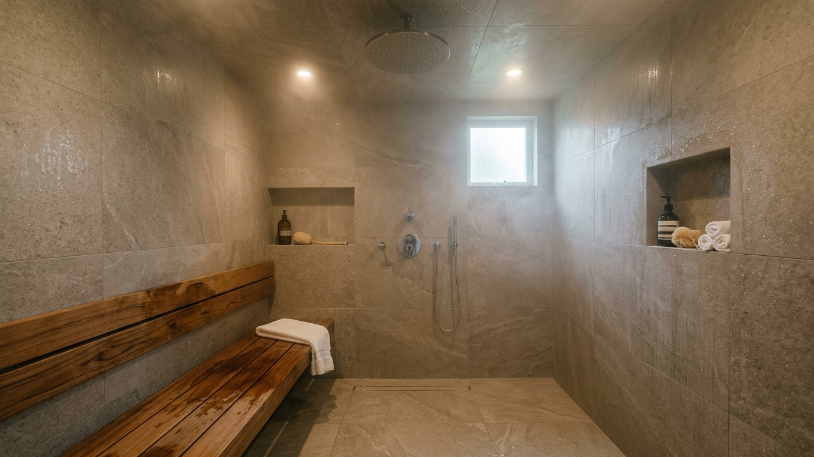
A steam shower is one of the most effective ways to bring genuine spa-level relaxation home, and it is more accessible than most people expect. You do not always need to knock out walls or start from scratch. Many existing shower enclosures can be retrofitted with a steam generator and a properly sealed glass door. The result is a closed, misted space that softens skin and clears airways in about 15 minutes.
A few details that push a steam shower from functional to truly spa-grade:
- A built-in bench or fold-down teak seat inside the enclosure
- Large-format tiles in sage green, warm greige, or natural limestone
- A small aromatherapy inlet that lets you add eucalyptus or peppermint oil directly to the steam
- An overhead rainfall shower head plus a handheld for flexible rinsing
- Low recessed lighting or a subtle LED strip along the bench base for mood
Good ventilation is essential. Steam showers need a properly sealed space and a drain that handles the extra moisture load. If you are converting an existing walk-in shower, a contractor can usually retrofit the generator and seal the enclosure without a full rebuild.
3. Layer Your Lighting to Set the Mood
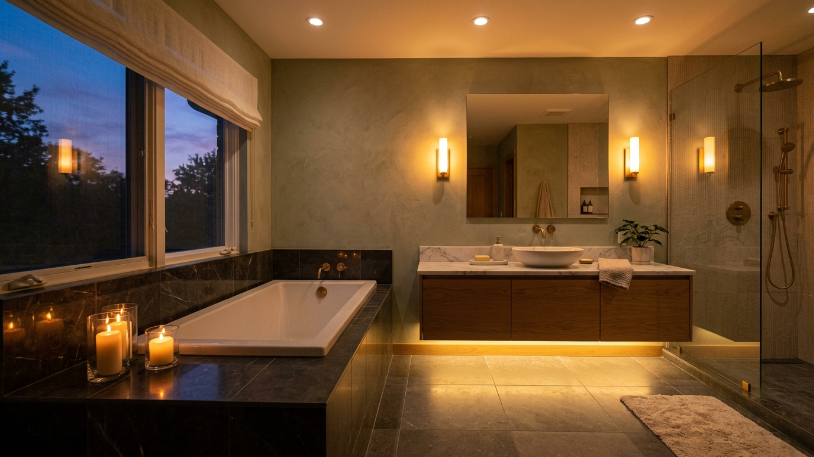
A single overhead light is the fastest way to ruin a spa atmosphere. Flat, bright ceiling lighting makes bathrooms look clinical, and that is not the mood you are building. Layered lighting fixes this by combining a few different light sources, each doing a different job, so you can control the atmosphere entirely.
Here is a simple layered lighting setup that works for a home spa bathroom:
- Overhead ambient: A recessed ceiling light or soft pendant for general visibility
- Task lighting: Warm LED sconces on either side of the mirror, not above it, for even, flattering light
- Accent lighting: LED strips along the underside of a floating vanity, inside a niche, or behind a backlit mirror
- Mood control: A dimmable circuit on all switches so you can lower the entire room
Warm-toned bulbs in the 2700K to 3000K range read soft and golden. Cooler bulbs above 4000K feel clinical and sharp. Also, a set of candles along the tub ledge or on the vanity tray adds warmth that no electric fixture can fully replicate. Candles are not a fallback; they are a feature. Even two pillar candles at the right height shift the entire mood of a bath.
4. Choose a Color Palette That Fits Your Home Spa Ideas
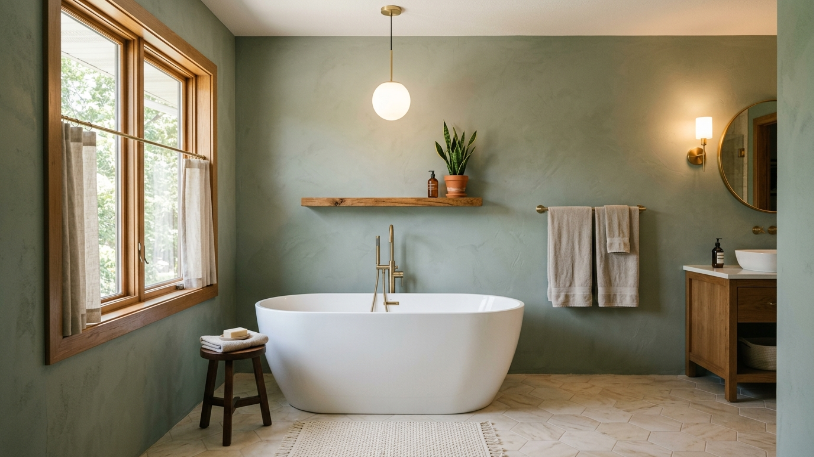
Color is working harder in your bathroom than you probably realize. The right palette can make a small room feel airy, a dark room feel rich and moody, or a plain white box feel genuinely calming. For a spa-inspired bathroom, the goal is a color story that reads soft, warm, and grounded.
Here are the color families that work best and what they bring to the room:
| Color Family | Example Shades | Mood Effect | Best Fixture Pairings |
| Warm Neutrals | Ivory, Linen, Buff, Greige | Open, calm, airy | Brushed gold, natural stone |
| Dusty Blues and Greens | Sage, Eucalyptus, Muted Teal | Serene, restful | White grout, warm wood |
| Terracotta and Blush | Dusty Rose, Clay, Warm Nude | Earthy, grounding | Matte black, rattan details |
| Deep Moody Tones | Forest Green, Slate, Charcoal | Intimate, dramatic | Brass fixtures, warm lighting |
| Stone and Cement Tones | Warm Gray, Putty, Taupe | Minimal, spa-hotel | Polished chrome, terrazzo |
Sherwin-Williams has a useful guide to their most relaxing bathroom paint colors that is worth exploring before you commit to a shade. For something with depth and richness, our post on styling a deep teal bathroom shows exactly how to make bold color feel serene rather than loud.
5. Choose Natural Stone and Wood-Look Finishes
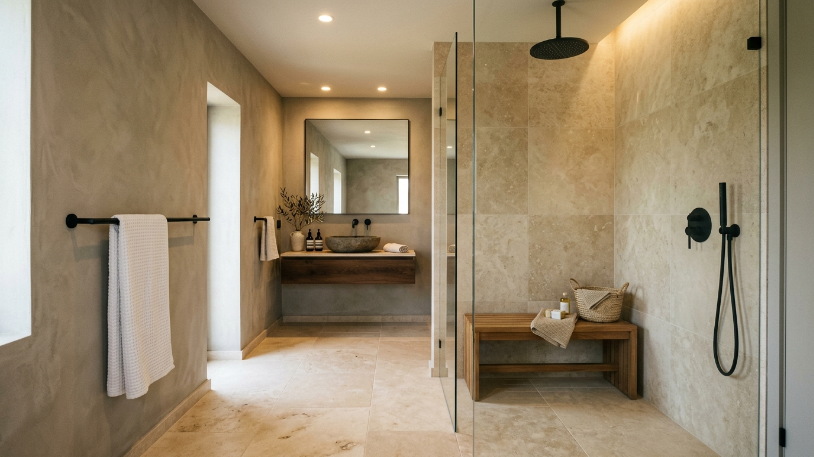
Materials are what give a spa bathroom its tactile richness. Polished ceramic tiles and glossy painted walls can look clean, but they rarely feel luxurious. Natural stone and wood finishes, or high-quality porcelain that mimics them convincingly, add a warmth and depth that makes the whole room feel more considered.
A few material combinations that work especially well for home spa spaces:
- Travertine or limestone tiles in warm ivory or buff with a honed, matte finish
- Porcelain wood-look planks on the floor for warmth without the water damage risk
- Limewash plaster on the walls for subtle texture and a soft, aged quality
- Pebble mosaic tiles inside the shower base for a grounding underfoot texture
- A teak or bamboo shower bench, bath tray, or wall-mounted shelf for natural warmth
Mix your materials freely, but keep the tones in the same warm family. A limestone tile floor, a limewash plaster wall, and a teak shelf can all live beautifully together as long as their undertones align. Plus, the contrast between soft plaster and raw stone keeps the room from looking like a tile showroom display. The goal is a layered, organic feel, not a perfectly matched set.
6. Set Up an Aromatherapy Station
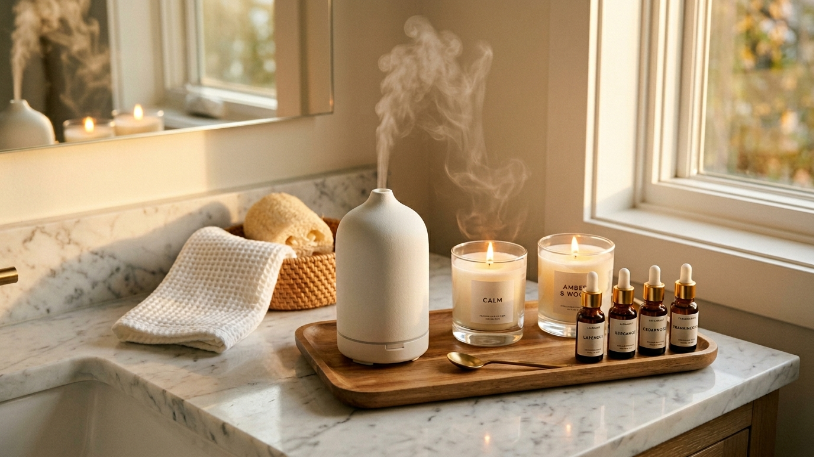
Scent is one of the fastest routes to a relaxed state of mind, and also one of the most underused home spa ideas. The right fragrance signals to your brain that it is time to wind down, which is worth more than almost any decorative accessory. Essential oil diffusers, reed diffusers, and scented candles each deliver this in different ways, so layering them strategically covers the whole room.
Here is how to build a scent setup that actually works:
- An ultrasonic diffuser on the vanity with eucalyptus or lavender essential oil
- Scented candles in glass vessels along the tub ledge or on a wooden tray
- A reed diffuser in a niche or on a shelf for continuous background scent
- A few drops of eucalyptus oil on the shower floor before a steam session
- Linen spray on towels and your robe for a soft scent when you dry off
Lavender is the classic relaxation choice. However, eucalyptus gives a more immediately spa-like quality and opens airways beautifully. Cedarwood and sandalwood both read warm and grounding. Try one primary scent and one accent, rather than layering five fragrances and ending up with something that smells like a candle shop explosion. Less is genuinely more here.
7. Invest in Plush Towels and a Towel Warmer
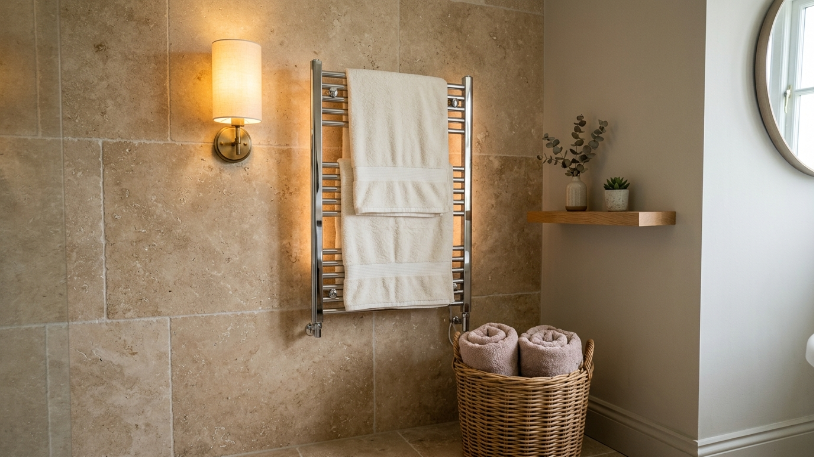
You have probably dried off with a scratchy, stiff towel at some point and felt exactly zero percent refreshed afterward. Towels are one of the most tactile parts of a real spa experience, and they are also one of the simplest upgrades you can make without touching a single wall.
For spa-quality towels, look for:
- Egyptian cotton or long-staple Turkish cotton in the 600 to 700 GSM weight range
- Waffle-weave styles for a lighter, fast-drying option with appealing texture
- Neutral tones like warm ivory, stone, dusty blush, or soft terracotta
- Oversized bath sheets that wrap generously and feel substantial
A towel warmer is the upgrade that sounds indulgent until you try it once. Wall-mounted electric towel rails are relatively affordable to install and completely change the experience of stepping out of a shower on a cold morning. Your towel is warm, dry, and ready. That detail alone makes a bathroom feel like an actual retreat rather than a functional room. Roll a few spare towels into a wicker basket on the floor or display them folded on an open shelf beside the tub. Beyond function, this also reads beautifully as a styling element in its own right.
8. Add Plants and Natural Greenery
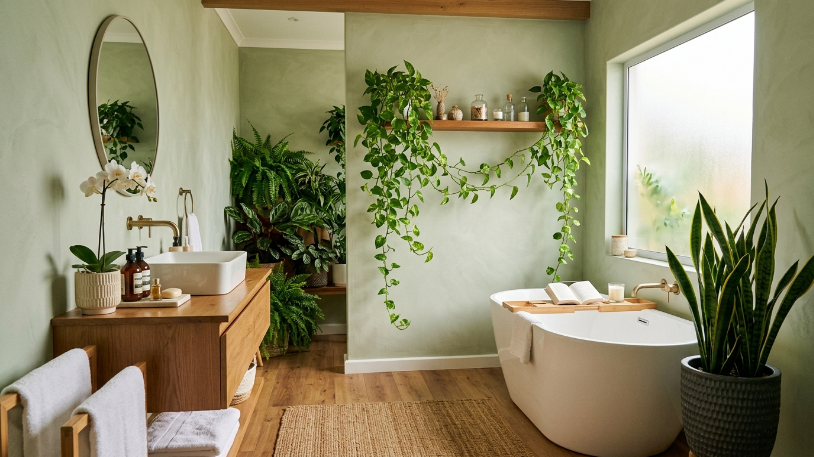
Plants do something for a bathroom that no wallpaper or mirror can replicate. They soften the space, introduce real color, and create a subtle biophilic effect that makes a room feel alive. Best of all, bathrooms are naturally humid environments, which means many tropical plants thrive there without much fuss on your part.
The best plants for a spa bathroom:
- Pothos (golden or marble queen): trail from a high shelf for a draped, lush appearance
- Peace lily: tolerates low light and filters air pollutants as a bonus
- Boston fern: loves humidity and gives a full, layered look
- Snake plant: thrives in low light and adds upright structure
- Orchid: works well on a vanity or shelf if you have decent natural light
For the best styling effect, place plants at multiple heights. A trailing pothos on a wall shelf, a snake plant on the floor beside the tub, and a small orchid on the vanity gives three levels of greenery without crowding. Ceramic and terracotta pots in warm earth tones keep the palette cohesive. Plastic pots, however practical, read out of place in a spa-inspired bathroom.
9. Build a Simple Sound Setup
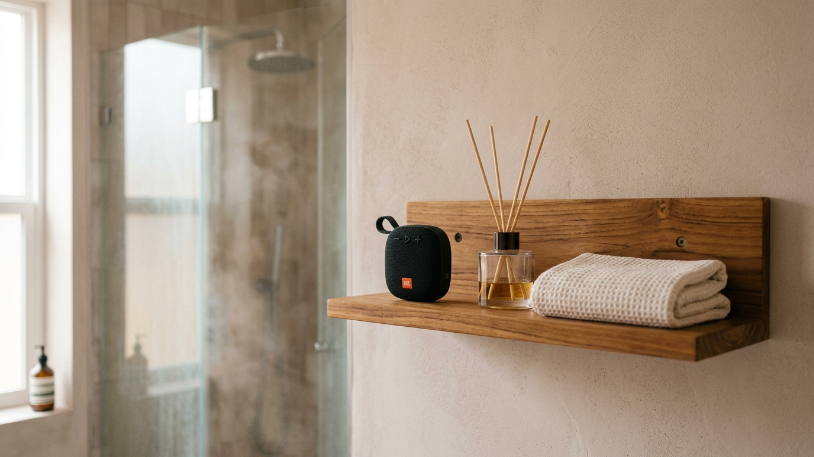
Sound is one of the first things a real spa gets right and one of the first things a home bathroom ignores entirely. Running tap water, a buzzing extractor fan, and muffled street noise are not the soundtrack to relaxation. A small, intentional audio setup changes this completely and costs very little to put together.
Realistic options for a home spa sound setup:
- A waterproof Bluetooth speaker mounted in the shower area or placed on a shelf
- A smart speaker on the vanity connected to an ambient playlist
- A white noise machine for a fully analog, screen-free option that runs quietly in the background
Put together a dedicated spa playlist before your next bath or shower. Slow-tempo instrumental music, rain sounds, ocean waves, or Japanese onsen-style ambient audio all work well. The key is low tempo and no lyrics, since lyrics engage the brain rather than quieting it. Even a 20-minute soak with the right audio is noticeably more restorative than one spent listening to the extractor fan. Next time you run a bath, queue the playlist before you even turn on the tap.
10. Style a Vanity Tray
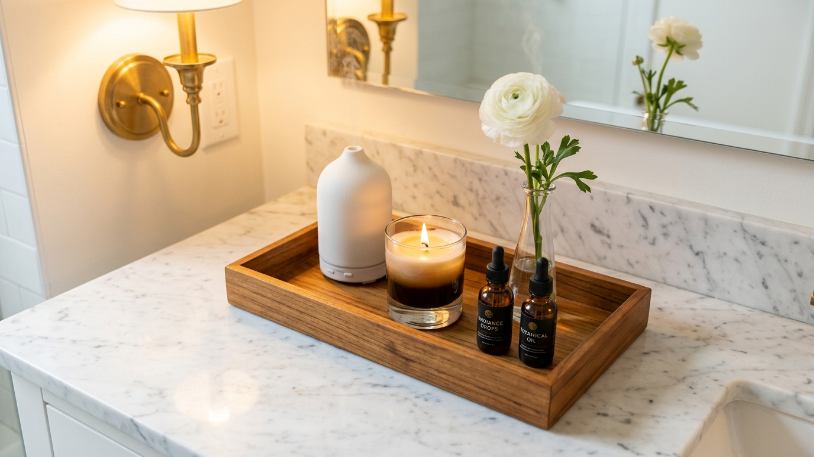
A vanity tray is one of the smallest ideas on this list and also one of the most satisfying. It gives your countertop a reason to exist as a styled surface rather than a landing zone for everything that came out of your pockets. A good tray gathers the sensory elements of your spa setup, such as your diffuser, a candle, a small plant, and a bottle of face oil, and arranges them into something intentional.
What works well on a styled spa vanity tray:
- A small ultrasonic diffuser or compact reed diffuser
- One or two glass-vessel candles in a warm, earthy scent
- A single bloom in a narrow bud vase, or a small clipping from your pothos
- A small stack of folded hand towels in a neutral tone
- One or two amber glass bottles for serum or facial oil
Keep the tray to a single material finish, whether marble, teak, or brushed gold. A mix of too many materials and finishes reads cluttered fast. Also, resist the urge to fill every inch of the tray. Negative space is a styling tool here, not wasted room. A tray that is half-full often looks more intentional than one that is packed to the edges.
11. Create Clutter-Free, Spa-Style Storage
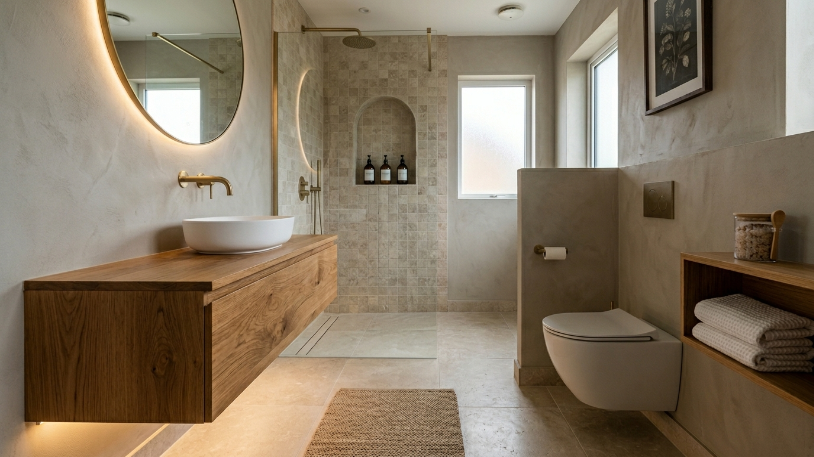
Nothing breaks a spa atmosphere faster than visual clutter. Shampoo bottles lined along a shower ledge, six half-used products crowding the vanity, and a tangle of hair tools behind the toilet door are not spa features. The good news is that fixing this requires no renovation, only a bit of discipline and a few smart organizers.
Practical spa-style storage ideas that actually work:
- Recessed shower niches tiled to match the surrounding wall, keeping products hidden but easy to reach
- A floating vanity with a deep drawer for all countertop products
- Glass canisters or ceramic jars to decant cotton rounds, bath salts, and Q-tips
- A tall narrow shelf unit beside the toilet for backup products and cleaning items
- Hooks rather than towel rings, since hooks hold robes, bags, and towels without fighting for space
The principle is straightforward: if something is not decorative, it should be hidden. Only the elements that contribute to the spa feeling, such as your styled tray, your plant, your candle, and your folded towels, should be visible. Everything else earns a drawer. This level of visual editing is what separates a bathroom that feels like a spa from a bathroom that simply has a nice tub in it.
12. Home Spa Ideas for Open Spaces: The Wet Room Layout
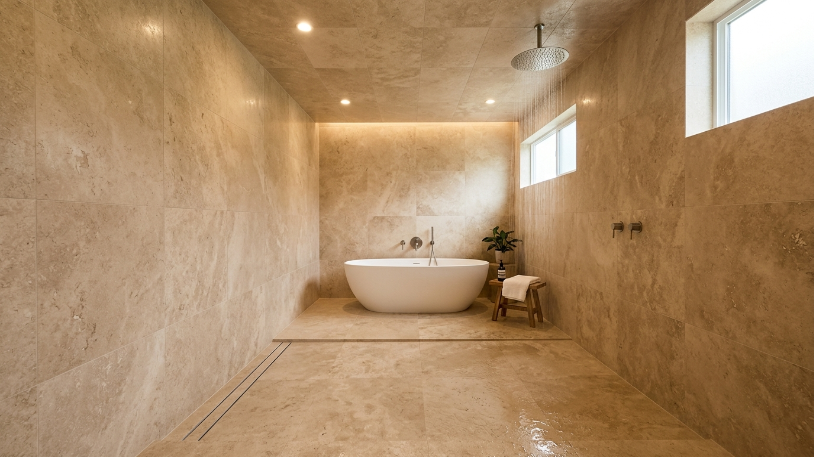
A wet room takes the open-plan approach to your shower space. No shower tray, no enclosure, no barriers. Just a fully waterproofed room where the shower and bathing area flow freely together. The result feels generous, airy, and genuinely hotel-like. It also makes cleaning significantly easier, since there are no screen tracks or tray edges collecting grime.
A wet room works especially well for home spa ideas because:
- The open layout feels expansive even in a smaller footprint
- A freestanding tub and a rainfall shower can sit in the same space without any screen separating them
- Large-format stone tiles read beautifully across an uninterrupted floor
- The whole space can be heated uniformly from a single underfloor heating system
The critical detail is the drainage. The floor needs to slope subtly toward a linear drain or a central point drain, and the waterproofing layer beneath the tiles must be thorough. Beyond that, the design possibilities are genuinely wide open. For a closer look at what a wet room can become, our post on wet room ideas that look lavish and luxurious covers 13 different approaches worth exploring before you commit.
13. Finish Your Home Spa Ideas with the Right Details
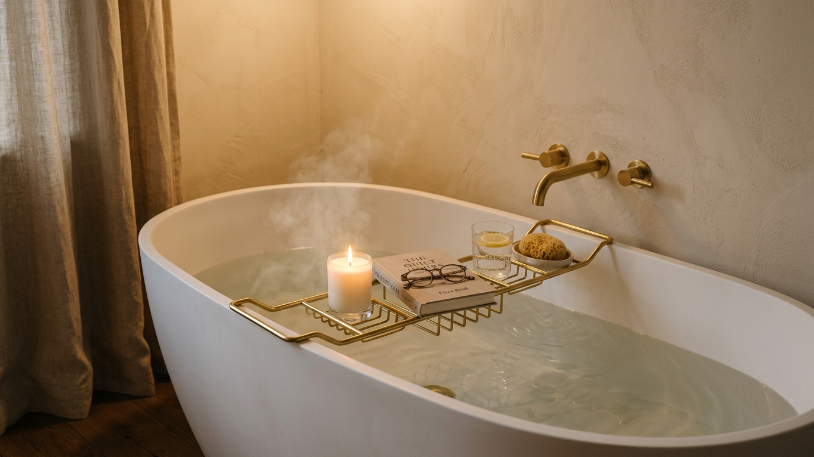
All the ideas above build the structure of a spa bathroom. This last one is what makes it feel like an experience. Candles, a simple ritual, and a few well-chosen accessories turn a nicely designed bathroom into a space you actually look forward to spending time in. These details are small, but they carry the mood.
Finishing touches that complete the home spa feeling:
- A bath caddy or tray spanning the tub, holding a book, a candle, and a glass of sparkling water
- A bath soak blend stored in a glass jar on a visible shelf, such as Himalayan salt, dried lavender, and oat powder
- A plush robe on a hook behind the door, waiting every single time you step out
- Soft background music queued before you even run the bath
- A personal ritual: lighting the same candle, using the same scent, and putting your phone in another room
The ritual is the most underestimated part of a home spa setup. A hotel spa works partly because you are somewhere unfamiliar. At home, you create that mental shift deliberately. After a few consistent repetitions, your brain starts shifting into rest mode the moment you light the candle. You do not need to book anything or pack a bag. The retreat is already there.
Final Thoughts
A home spa does not have to be one grand project you tackle all at once. You can start with better towels and a diffuser this week, add a towel warmer next month, and keep building from there. Each of these 13 home spa ideas works on its own. They get better, of course, the more you combine them. Your bathroom is one of the few rooms in the house that exists entirely for you. It is worth making it a place you genuinely want to be.