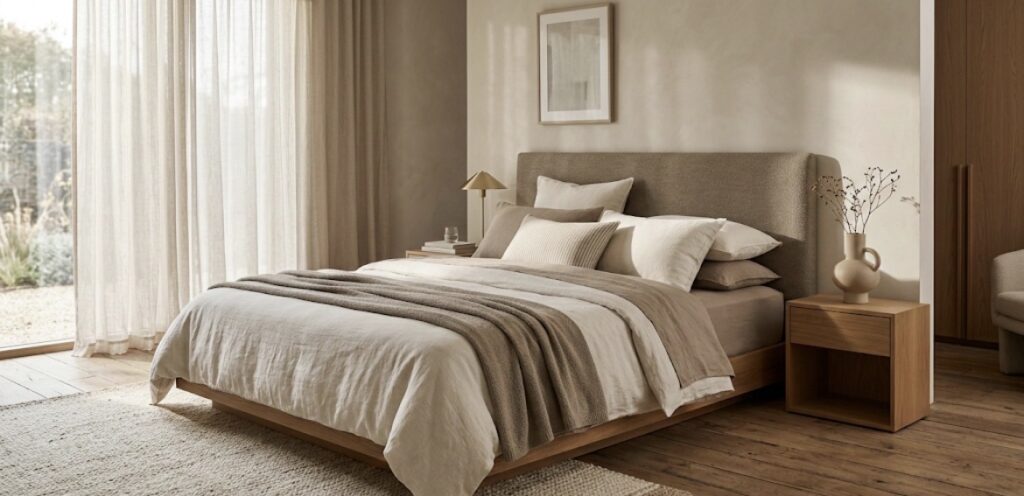
Because real luxury doesn’t announce itself — it just feels different the moment you walk in
There’s a bedroom style that has been quietly taking over mood boards, saved folders, and interior spreads — and it doesn’t look anything like the loud, chandelier-heavy “rich person” rooms you might expect. No gold-everything. No marble overload. No statement pieces screaming for attention. This is quiet luxury: a bedroom aesthetic built on restraint, softness, and the kind of calm that only comes when every element in a room earns its place.
Quiet luxury in the bedroom is about texture over trend, palette over pattern, and mood over maximalism. It’s the feeling of sinking into sheets that feel heavier than yours. It’s the way afternoon light behaves differently in a room where nothing is competing for attention. It’s the visual silence that high-end hotels have perfected — that particular stillness that makes you exhale the moment you step inside.
This post is not a decorating tutorial. It’s a collection of 16 distinct quiet luxury bedroom ideas, each with its own personality, mood, and visual story. Whether you love deep moody interiors, sun-bleached minimal spaces, or something in between, there’s a version of quiet luxury that will feel exactly right for you. Browse through, take notes, and let yourself be inspired.
Screenshot
1. The Monochromatic Greige Bedroom
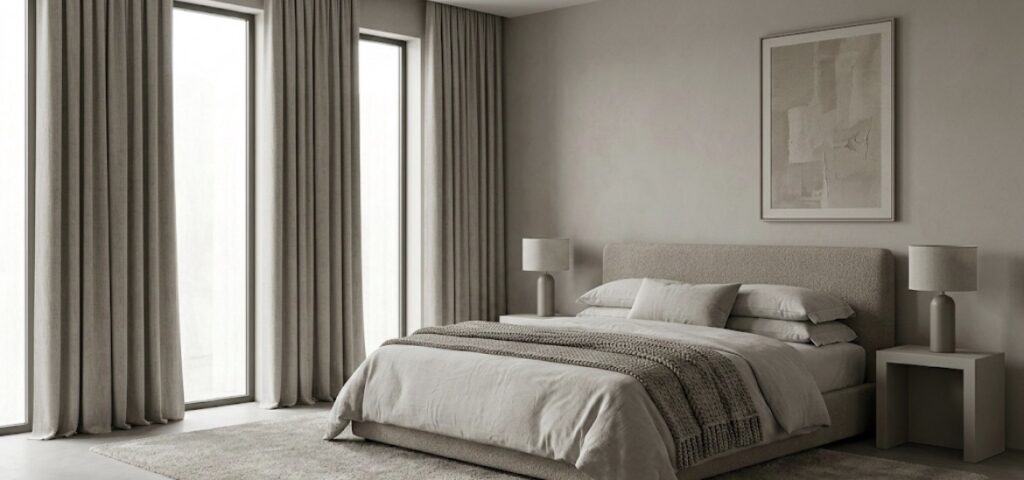
Greige — that perfect mix of grey and beige — is one of the most powerful tools in quiet luxury design. When an entire bedroom is built around a single greige palette, something almost meditative happens. Walls, bedding, curtains, rugs, and furniture all exist within the same tonal family, and the result is a room that feels neither cold nor warm, but somehow exactly right. It’s the visual equivalent of white noise — all the detail is there, but nothing jars.
What makes a greige bedroom feel truly luxurious rather than just boring is the layering of texture. A room where the walls are flat greige, the bedding is matte greige linen, the headboard is a slightly darker greige boucle, and the rug is a thick-pile greige wool feels rich in a way that a room with ten different colors never could. The differences between the shades are subtle. You notice them more as feeling than as sight. There’s warmth in the corner where the curtains pool slightly on the floor. There’s depth in the headboard fabric, which catches the light differently depending on the hour.
The furniture in this kind of room tends to be low and sculptural — a platform bed, a single nightstand with clean lines, perhaps a chaise in the corner that exists purely for beauty. Nothing fights for dominance. The art, if there is any, is tone-on-tone or abstract. The lamps are architectural. The space breathes.
This idea works in large rooms and small rooms equally well. In a smaller space, the monochromatic approach actually makes the room feel larger because there are no sharp visual breaks. In a large room, it creates an intimacy that would be harder to achieve with contrast.
Screenshot
2. Dark Moody Style
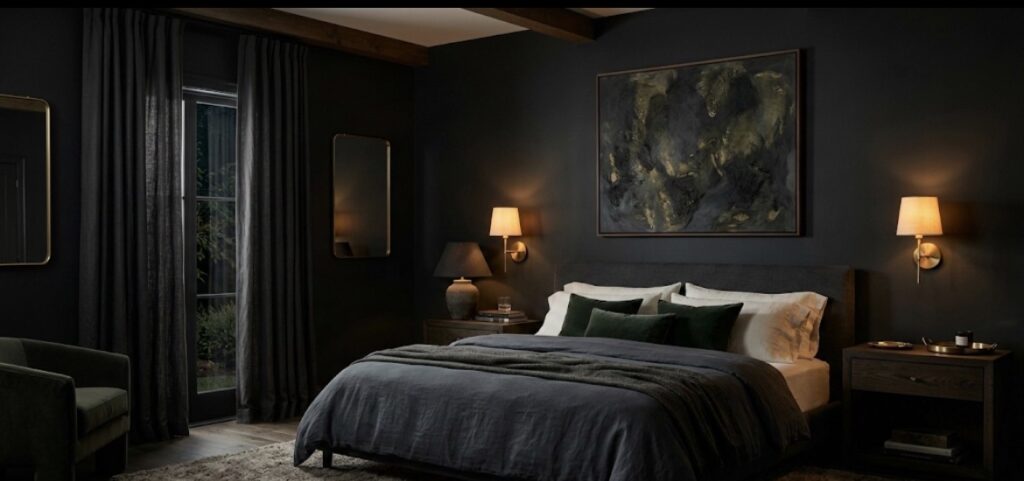
Not all quiet luxury is light and airy. Some of the most breathtaking quiet luxury bedrooms lean into darkness — deep charcoal walls, navy upholstery, forest green velvet, espresso wood. The mood is different here. It’s less “morning light through curtains” and more “candles and a book at midnight.” It’s intimate rather than open. Enclosed rather than expansive. And when done with care, it feels extraordinarily expensive.
The secret to a dark moody bedroom that reads as luxury rather than just gloomy is the quality of what’s inside it. Dark walls are a backdrop, not the feature. What they do is make everything placed against them — warm brass, aged leather, rich linen, dark wood — appear to glow. A warm-toned wooden bedside table against a near-black wall looks like something from a boutique hotel in the Swiss Alps. A single candle flame in a room this dark casts shadows that make the space feel alive.
Bedding in a dark moody bedroom leans toward deep neutrals: slate, oatmeal, charcoal, off-white. The contrast between pale sheets and dark walls creates a visual softness that keeps the room from feeling heavy. The fabrics tend to be heavier too — velvet cushions, wool throws, linen with more weight than the airy summer kind. Everything has heft. Everything feels considered.
Lighting in this bedroom is architectural and warm. No bright overhead lighting. Instead, picture sconces positioned at exactly the right height, a lamp on each nightstand that throws a warm amber glow, perhaps a single floor lamp in the corner that creates a reading nook effect. The room at night looks like a painting.
Screenshot
3. The Wabi-Sabi Styled Bedroom
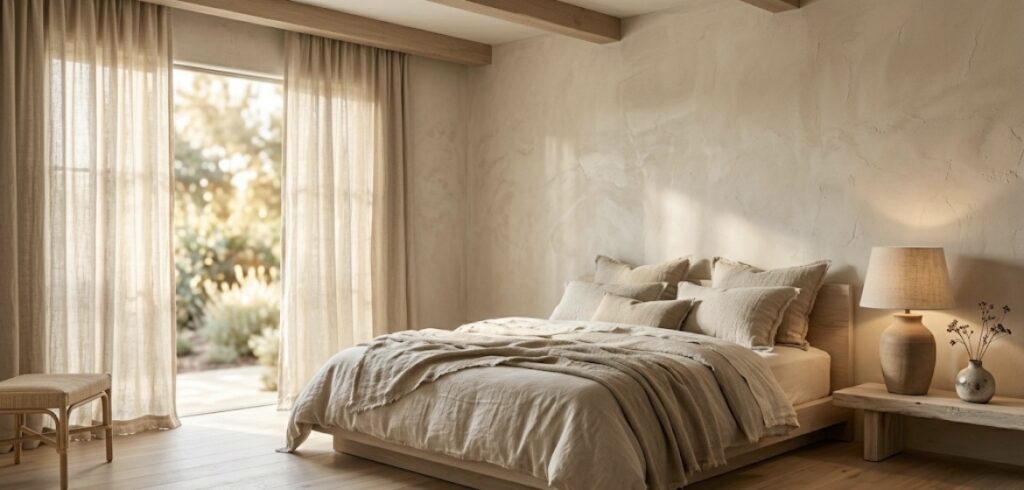
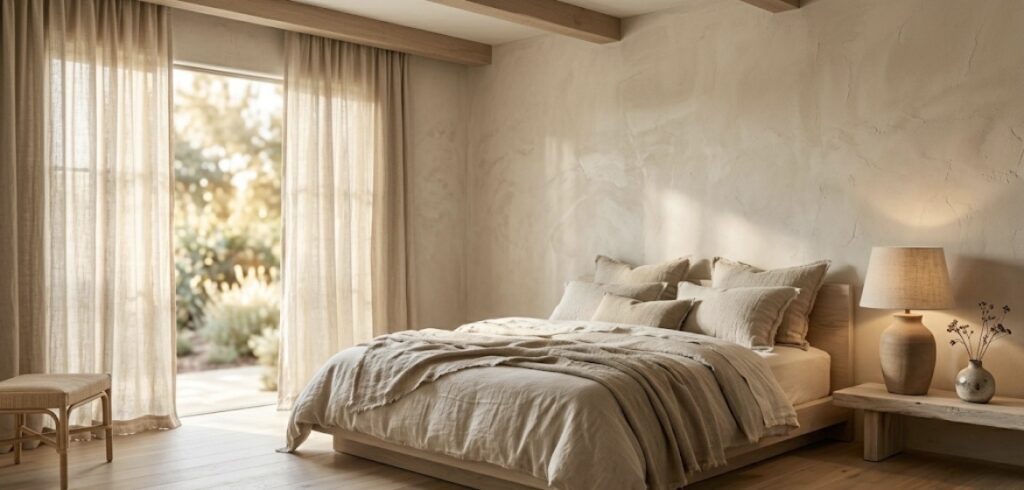
Wabi-sabi is a Japanese concept rooted in the beauty of imperfection and the elegance of things that are natural, worn, and impermanent. When applied to a luxury bedroom, it creates something that feels deeply human and quietly beautiful in a way that polished, perfect interiors never quite achieve. There are no sharp edges here. No pristine surfaces. Instead, there is linen that wrinkles beautifully, ceramics that are slightly uneven, wood that shows its grain and knots without apology.
A wabi-sabi quiet luxury bedroom tends to live in a palette of natural, muted tones — raw linen, sand, dusty clay, bleached wood, stone. The materials are natural: linen, cotton, wool, raw wood, stone, unglazed ceramics. The furniture is simple and handmade-looking — not because it’s cheap, but because something made by hand carries a quality that factory-perfect furniture rarely does. A handthrown ceramic lamp base. A linen throw folded with deliberate informality at the end of the bed. A wooden stool that might be a side table or might be purely decorative.
What makes this bedroom feel luxurious rather than just rustic is the restraint and intentionality of everything in it. Nothing is accidental. The imperfections are chosen. The worn quality of the rug, the visible texture of the plastered wall, the slight irregularity of the ceramic vase — these are the details that make a person who knows design stop and look twice. It’s the difference between a room that looks unfinished and a room that looks like it was finished by someone who knew exactly what they were doing.
This aesthetic is particularly beautiful in rooms that receive strong natural light. Morning light through unlined linen curtains in a wabi-sabi bedroom creates a warmth that feels almost cinematic.
Screenshot
4. White Cloud Bedroom
There is a version of white that feels cold and clinical. And then there is the kind of white used in the best quiet luxury bedrooms — warm, layered, soft, dimensional. This is not a white room that was simply unpainted. This is a room where white was chosen carefully: warm white linen, cream cotton, ivory wool, chalk-washed walls, bleached wood floors. The result is a room that feels like breathing out slowly.
The all-white cloud bedroom works because of tonal variation within the white palette. Walls in a warm chalk white, bedding in slightly deeper ivory, curtains in a near-cream that reads as different from the walls, a rug that introduces a barely-there natural fiber texture. None of these whites match exactly, and that is precisely the point. If everything matched, the room would be flat. Instead, the subtle variations create depth, and the depth creates luxury.
Texture carries this bedroom. The bed itself is usually the centerpiece — a high, overstuffed-looking arrangement of pillows and a duvet that looks like something from a European countryside hotel. The pillows are in different sizes and slightly different shades of white. The duvet has visible texture, whether that’s a waffle weave, a subtle embroidery, or a linen finish. The throw at the foot of the bed adds another layer of warmth.
The furniture in this bedroom tends toward natural or white-painted wood, white upholstery, or very light oak. Everything reinforces the palette. Even the art leans white: abstract works in white and grey, or a single large framed photograph with very low contrast.
Screenshot
5. The Soft Sage and Linen Bedroom
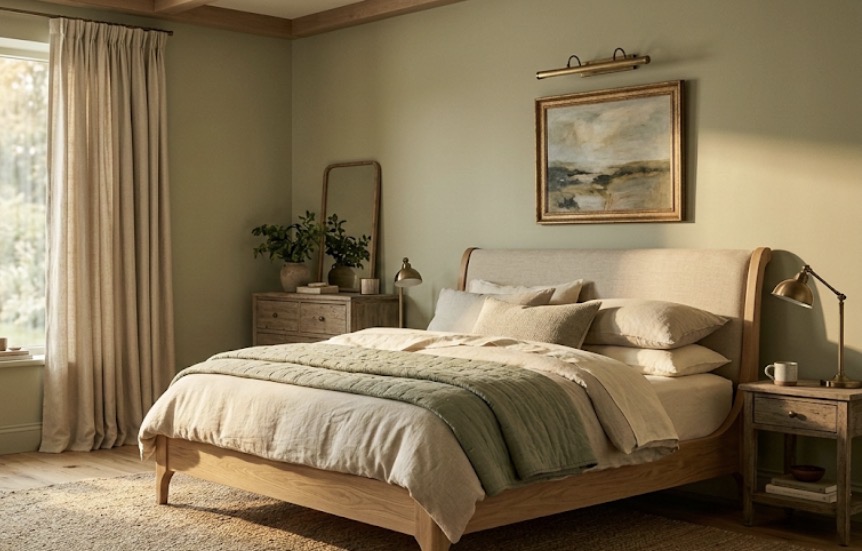
Sage green has become one of the defining tones of modern quiet luxury — not because it’s trendy, but because it sits in a place between grey and green that feels both calm and alive at the same time. In a bedroom, soft sage works with almost everything in the quiet luxury palette: warm linen, aged brass, natural wood, cream, stone, even dusty rose in small doses.
A sage and linen bedroom tends to feel like a room that exists somewhere between a Provençal farmhouse and a Scandinavian retreat. The walls might be sage, or just one wall, with the rest in warm white or cream. The bedding is almost always linen — heavy, textured, slightly rumpled in that effortlessly expensive way. The curtains pool slightly on the floor in a heavier linen or cotton. The rug is natural jute or a thick cream wool.
The warmth in this bedroom comes from the wood and brass accents that work against the cool-leaning sage. A wooden bed frame with a gentle curve. Aged brass picture lights. A terracotta pot on the windowsill. These warm tones keep the sage from feeling clinical, and the result is a room that manages to feel both energizing and restful — which is a rare thing to pull off.
Light plays beautifully in a sage bedroom. In morning light, the walls appear almost grey-green, soft and neutral. In the golden hour, they warm up and look almost like an oil painting. At night, under warm lighting, sage walls recede and let the textures in the room come forward.
Screenshot
6. The Hotel Suite Bedroom
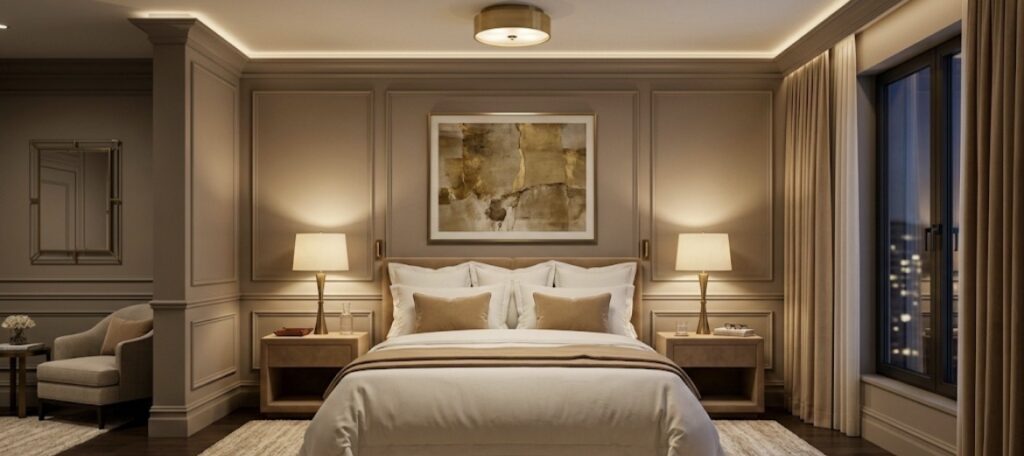
The great quiet luxury hotel suite doesn’t look like a hotel. It looks like the home of someone with extraordinary taste and the budget to match it. This bedroom idea takes everything that makes a five-star hotel room feel exceptional and brings it into a residential space — which means symmetry, layering, and a precision of arrangement that feels both formal and inviting.
In a hotel suite bedroom, symmetry is almost always at play. The bed is centered, with matching nightstands on either side, matching lamps, matching sconces or pendants if any overhead lighting is used. The bedding is impeccably layered: a crisp flat sheet folded over the duvet at the top, euro shams behind sleeping pillows, a folded throw or lightweight blanket at the foot. There is an intention to how the bed looks that makes you want to stand in the doorway for a moment before walking in.
The palette in a hotel suite bedroom is almost always very controlled — usually a combination of two or three tones that are close to each other on the spectrum. Warm white and camel. Charcoal and oatmeal. Dusty blue and ivory. The wall treatment tends to be considered: a fabric headboard wall, a paneled wall in the same tone as the paint, or a carefully chosen wallpaper that adds texture without pattern.
What sets this bedroom apart is what it doesn’t have. No visible cords. No cluttered nightstands. No mismatched accessories. The few decorative objects that exist — a small tray, a vase, a stack of books — are arranged rather than placed. The room is edited, not empty.
Screenshot
7. The Raw Linen and Terracotta Bedroom
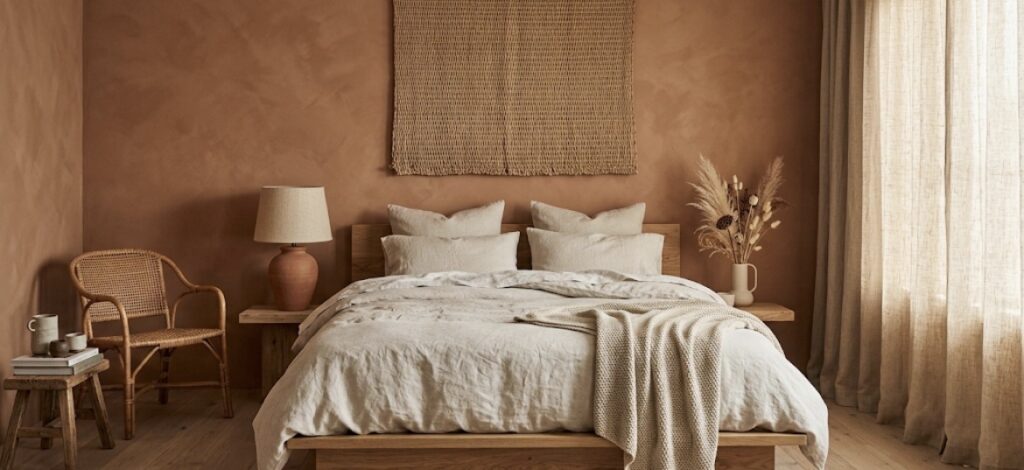
There is a bedroom aesthetic that feels like a slow morning in southern Europe — warm light, the smell of old stone, heavy curtains that don’t quite block the sun. The raw linen and terracotta bedroom captures this mood with a palette built on clay, ochre, dusty terra, raw linen, and sun-bleached cream. It’s earthy and grounded in a way that feels luxurious precisely because it feels real.
Terracotta in a bedroom doesn’t have to mean orange walls. It can appear as a single painted wall in a warm clay tone, as ceramic objects on the nightstand, as the warm undertone running through a linen rug, or as the pinkish warmth in wood that has been left unpainted or barely stained. When it’s used with raw linen — that particular shade of undyed, unbleached linen that sits between cream and tan — the combination is immediately warm and beautiful without being heavy or cluttered.
The bed in this kind of room tends toward the simple and organic. A wooden bed frame, a rattan headboard, or even a low platform bed with no headboard at all, just the weight of layered bedding. The pillows might include a subtle stripe or a textural difference in weave, but there is rarely a pattern in the traditional decorative sense. The beauty comes from the materials themselves.
Objects in this room feel handmade and collected: a terracotta lamp, a rough-hewn wooden bowl, a dried bunch of herbs or botanicals, a ceramic pot with a single trailing plant. The room doesn’t look styled. It looks inhabited by someone who picks up beautiful things on their travels and lives with them without overthinking it.
Screenshot
8. The Coastal Old Money Bedroom
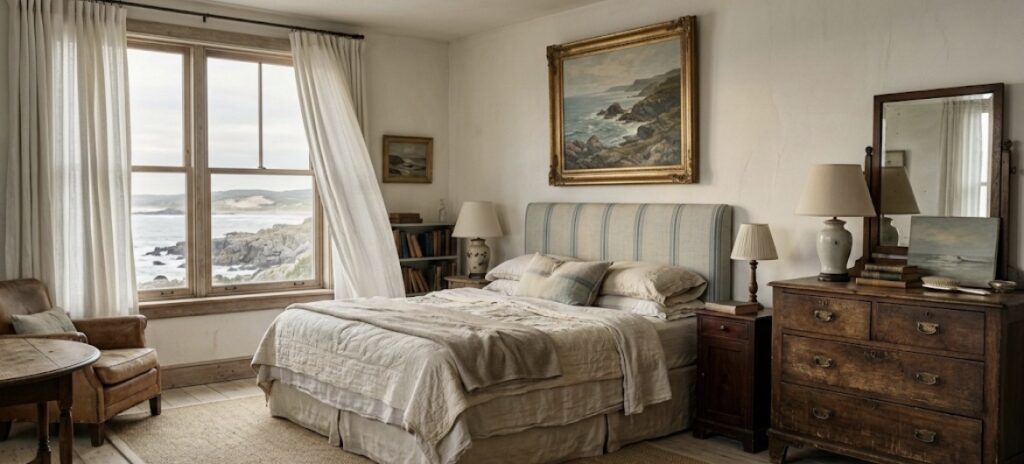
Old money coastal is not the same as beach house. There are no anchor motifs, no rope details, no “sandy toes” wall plaques. This is a bedroom that happens to exist near the sea, and the water makes itself felt only through palette, light, and a certain airiness — not through literal reference. Think faded blue linen, bleached wood, cream cotton, aged rattan, soft sea glass tones that feel inherited rather than bought new.
This bedroom feels like it has been in the family for decades. The furniture is not matched — it’s curated over a lifetime. The dresser is antique, slightly worn. The nightstands might be mismatched but exist in the same tonal family. The headboard might be upholstered in a faded stripe or a solid that was once slightly more saturated and has now softened into something even better. Nothing looks purchased as a set. Everything looks chosen.
The palette is muted and salt-bleached: dusty navy, aged cream, faded driftwood, soft grey. The bedding tends toward soft cotton or light linen in a palette that suggests the sea without being obvious about it. The rug might be a natural sisal with a simple border, or a faded cotton flat weave in a barely-there stripe. The curtains are heavy and white, the kind that billow slightly when a window is left open.
What makes this bedroom feel truly luxurious is the sense of ease and age. Rooms that have been decorated with restraint and then lived in for a long time develop a quality that brand-new rooms rarely have. The goal here is to create that feeling — a bedroom that feels deeply relaxed and quietly wealthy, the way old coastal homes feel when they are genuinely old.
Screenshot
9. The European Apartment Bedroom
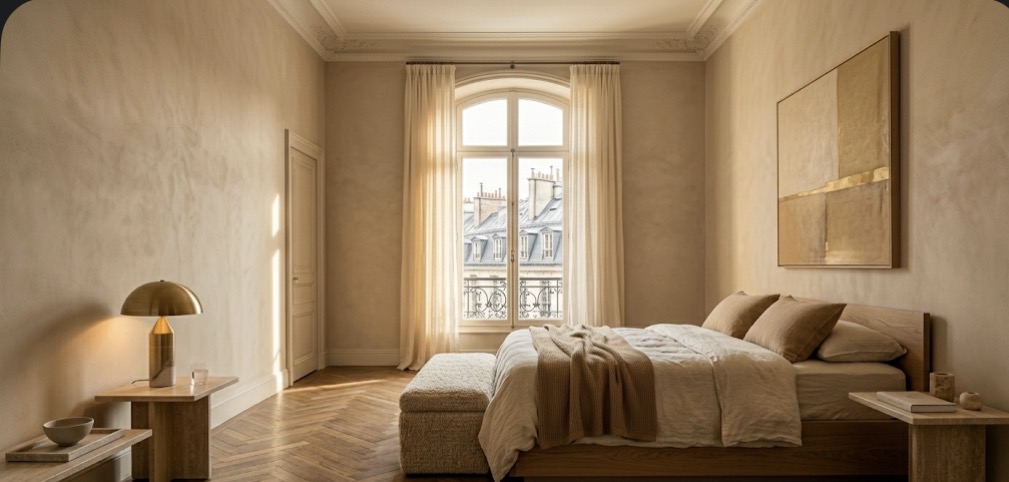
Paris. Milan. Vienna. London. The bedrooms in old European apartments have a character that almost no new construction can replicate — high ceilings, tall windows, parquet floors, walls that have absorbed decades of living. This bedroom idea draws from that aesthetic and applies it to the quiet luxury palette: muted, layered, historical in feeling but not fussy or museum-like.
A European apartment bedroom tends to sit in tones of dusty plaster, warm ivory, antique white, aged ochre, or very faded sage. The ceiling feels high, even when it isn’t, because the proportions of the furniture are considered: a tall headboard, long curtains that hang from ceiling height, art positioned high on the wall. The floors are always wood — parquet if possible, or wide plank if not — and the rug is an antique or antique-style Persian or Turkish carpet that adds warmth and pattern in a way that feels collected rather than decorated.
The bed in a European apartment bedroom is often imposing in a dignified way: a tall upholstered headboard, substantial bedding, pillows in different sizes. The bedside tables are often small antiques with marble tops or painted surfaces. The lighting includes at least one beautiful lamp — possibly an antique base with a white drum shade — and sconces on either side of the headboard at reading height.
The art in this room is personal and layered. A large oil painting or print. Several smaller frames grouped together. A mirror that has aged into its frame. Nothing feels purchased for the space specifically; it feels like it arrived through a life lived with taste.
Screenshot
10. The Warm Minimalist Bedroom
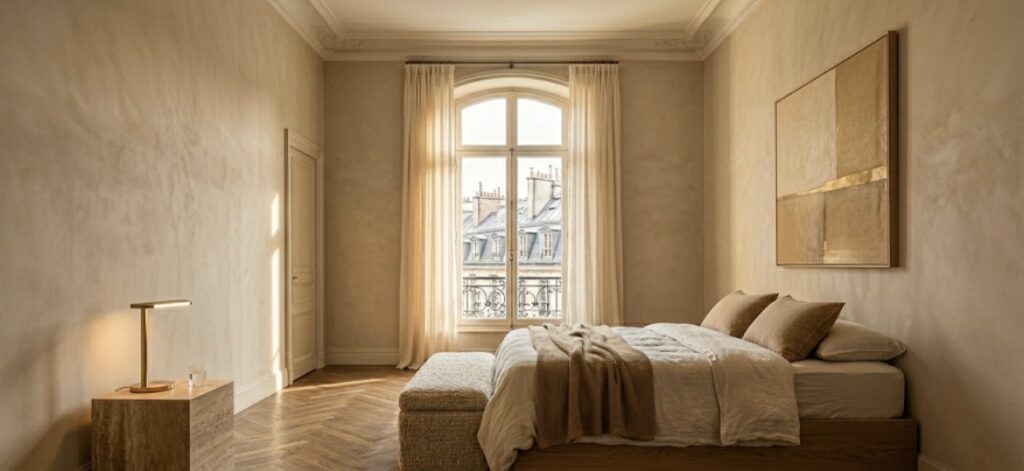
Minimalism in interior design has developed a reputation for being cold — white walls, empty surfaces, a feeling of discipline rather than comfort. But there is a version of minimalism that is warm, inviting, and deeply luxurious. Warm minimalism keeps the clean lines and the edited spaces of traditional minimalism but replaces the cold whites and greys with a palette of cream, warm sand, caramel, and the natural tones of wood and stone.
In a warm minimalist bedroom, the furniture is reduced to what is genuinely needed: the bed, a nightstand (sometimes just one, asymmetrically placed), perhaps a low bench at the foot of the bed. Each piece has weight and quality — not a lot of pieces, but pieces that are worth looking at. A bed frame in solid wood with a simple profile. A single nightstand in a complementary material — stone, warm metal, solid wood. A low bench upholstered in a thick natural wool.
The surfaces in this room are largely clear. On the nightstand: a lamp, a book, perhaps a small object. On the bench: a folded throw. The walls are almost bare, with perhaps one piece of art that was chosen carefully and positioned with intention. The rug grounds the bed in the space and adds the softness that keeps the room from feeling too sparse.
What sets warm minimalism apart from simple sparseness is the quality of the light and the richness of the materials. A room with a beautiful linen duvet, a warm wooden floor, and afternoon light coming through sheer curtains is not sparse at all — it is full of texture and warmth and beauty. The luxury is in the quality of what’s present, not in its quantity.
Screenshot
11. The Dusty Rose and Stone Bedroom
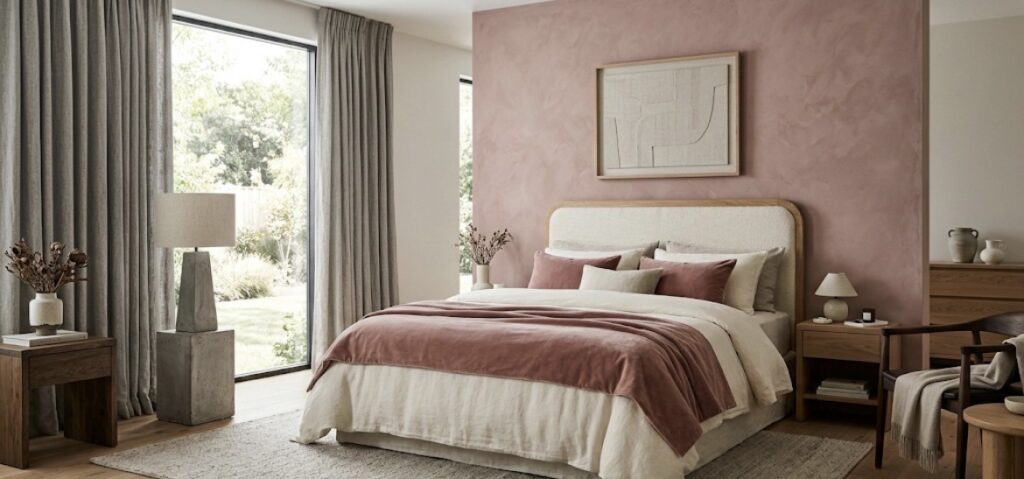
Dusty rose is one of the most underestimated colors in quiet luxury design. When it’s saturated and pink, it reads as girlish or juvenile. But in its muted, almost-grey form — the color of a dried rose petal or aged plaster — it is extraordinarily sophisticated. Combined with stone grey, warm white, and natural materials, a dusty rose bedroom lands somewhere between romantic and refined in a way that very few other palettes achieve.
The walls in this bedroom might be painted in a muted dusty rose, a warm stone grey, or a combination of both — perhaps a painted paneled headboard wall in dusty rose against stone-grey walls. The bedding leans toward cream and warm white linen, with the dusty rose appearing in cushion covers, a folded throw, or the upholstered headboard. The balance is important: rose as an accent within a neutral framework feels luxurious; rose as the dominant note risks tipping into something else entirely.
Stone and concrete elements add the weight and coolness that keep this palette grounded. A concrete nightstand or lamp base. Stone-colored curtains. A grey linen rug with a slightly rough texture. These cooler elements push back against the warmth of the rose and create a visual tension that makes the room interesting.
The mood of this bedroom is quietly romantic without being theatrical about it. There are no canopies, no dramatic drapery, no obvious romantic gestures. Just a palette that happens to be beautiful in a soft, warm, deeply human way — the color of skin and old petals and faded silk.
Screenshot
12. The Library Bedroom
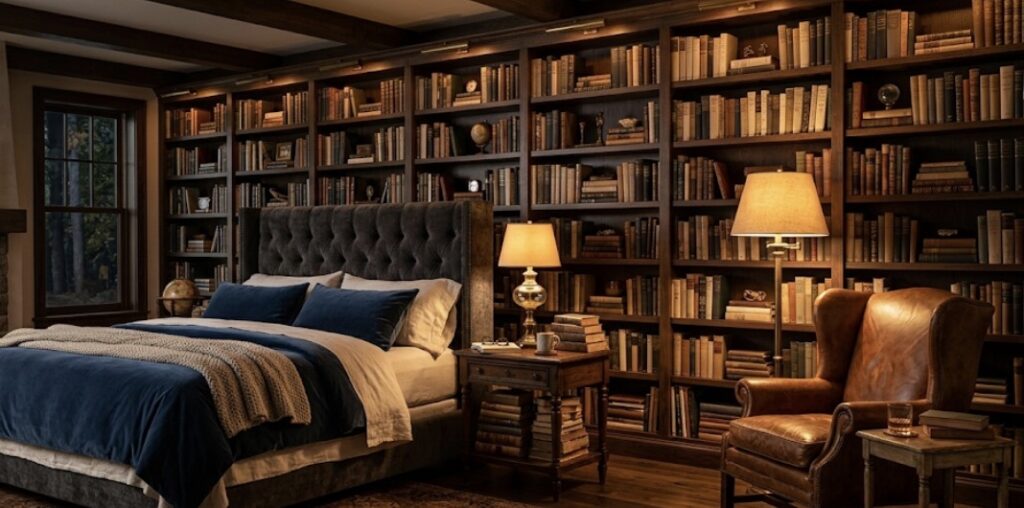
There is a particular kind of luxury that comes from being surrounded by books — not as decoration, but as the natural overflow of a life where reading matters. The library bedroom brings this into the sleeping space without turning the room into a study. The books are present but not the only story. They exist alongside beautiful bedding, warm lighting, and the kind of furniture that invites long hours of reading.
In a library bedroom, the walls might be partially lined with built-in shelving, or there might be a single deep bookcase taking one wall. The books themselves become part of the palette — their spines in varying tones of faded navy, warm red, cream, brown, and olive add color in a way that no wallpaper quite replicates. They are allowed to look well-read: slightly varied in height, some lying flat, some spine-out. They are not sorted by color in Instagram-perfect rainbow arrangements. They are sorted by use.
The palette of the room coordinates with the books without being calculated about it. Warm wood, aged leather, deep navy or forest green, cream, warm white. A leather reading chair in the corner. A low footstool. A floor lamp positioned at exactly the right angle for reading in bed. A nightstand with at least three books on it — not staged, but genuinely there because this person is always in the middle of several things at once.
The bed in a library bedroom tends toward the deeply comfortable and slightly cocoon-like: a substantial headboard that is good to lean against, pillows in abundance, bedding that is warm and heavy enough to read under for hours. The room at night, with the warm lamps on and the books behind, looks like a painting of what a good evening should feel like.
Screenshot
13. The Organic Modern Bedroom
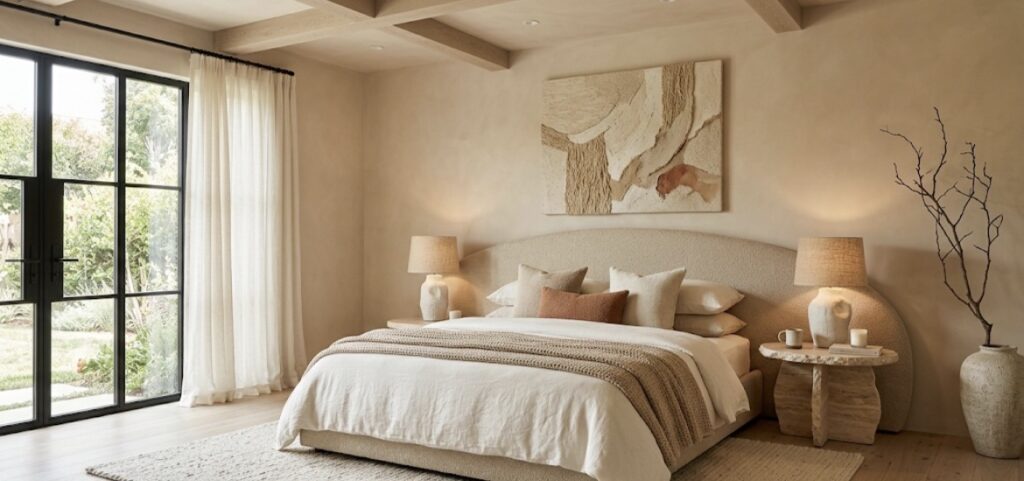
Organic modern is what happens when the clean lines of contemporary design meet the warmth and irregularity of nature. It is one of the most livable expressions of quiet luxury because it manages to feel both current and grounded — neither cold nor fussy, neither stark nor cluttered. The shapes are simple but not rigid. The materials are natural but not rustic. The palette is neutral but not boring.
A key feature of the organic modern bedroom is the bed itself, which often has a curved or softened profile — a rounded headboard, a bed frame with slightly tapered legs and no hard right angles. This softness in the main furniture piece sets the tone for everything else in the room. The nightstands might be organic in shape — rounded, slightly irregular, perhaps in a warm stone or light wood. The rug might have an irregular or abstract shape, or be a standard rectangle in a natural material with enough texture to feel interesting.
The palette lives in warm neutral territory: warm white, sand, oatmeal, soft clay, natural wood in light-to-medium tones. The materials are natural throughout — linen, cotton, wool, wood, stone, ceramic. The art in an organic modern bedroom tends to abstract or nature-derived: a large textural canvas, a sculptural ceramic on the shelf, a single branch in a tall vase that has already dropped most of its leaves.
Lighting is important in this bedroom because it carries a lot of the warmth. Sculptural lamps — ceramic bases, woven shades, organic shapes — are as much part of the visual story as any other piece of furniture. The room at night is warm and interesting in a way that doesn’t depend on drama.
Screenshot
14. The Paneled and Painted Bedroom
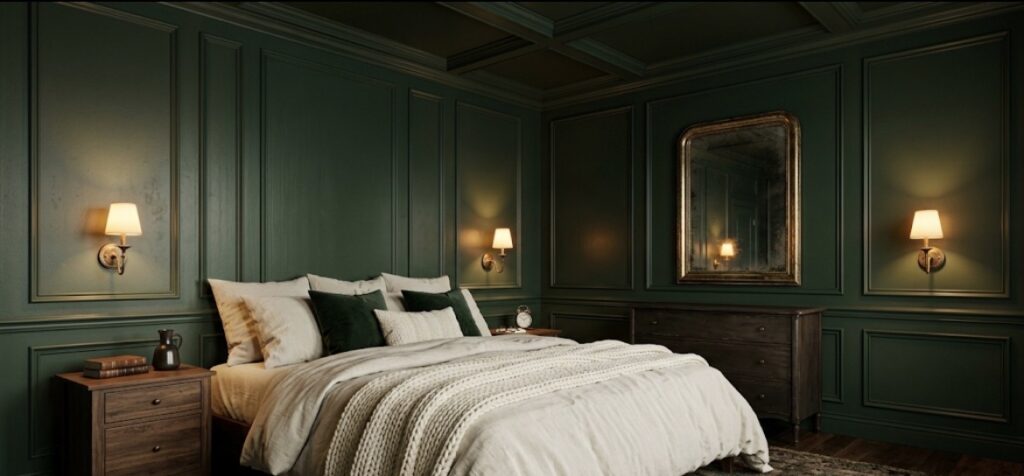
Wall paneling transforms a bedroom. Even in relatively simple, flat-panel form, it immediately adds architectural depth and a sense that the room was designed rather than simply furnished. In quiet luxury bedrooms, paneling tends to appear in soft, sophisticated tones — deep navy, forest green, warm charcoal, aged cream, dusty sage — and it is often painted the same color from floor to ceiling to create an envelope of color rather than a two-tone wall-and-ceiling combination.
When the entire room — walls, paneling, ceiling — is in one deep, muted tone, the effect is cocoon-like and extraordinary. The furniture and bedding become highlights against this backdrop. A cream linen bed against deeply paneled forest green walls reads as one of the most quietly elegant things a bedroom can be. The paneling itself adds texture and depth without introducing another color or material, which is exactly the kind of restraint that defines this aesthetic.
Bedding in a paneled bedroom tends to be kept light and simple to let the walls breathe. Crisp white or cream cotton. Ivory linen. Sometimes a single throw in a complementary deep tone to tie the bedding back to the walls. The furniture is often in natural wood or warm metals that work as a bridge between the deep wall color and the light bedding.
The room at night is particularly beautiful. Wall paneling catches light in a way that flat walls don’t — the slight ridges and reveals create shadow, and the shadow creates dimension. With warm sconce lighting positioned at the right height, a paneled bedroom at night looks like something from a design magazine that you keep going back to look at.
Screenshot
15. Collected Traveler’s Bedroom
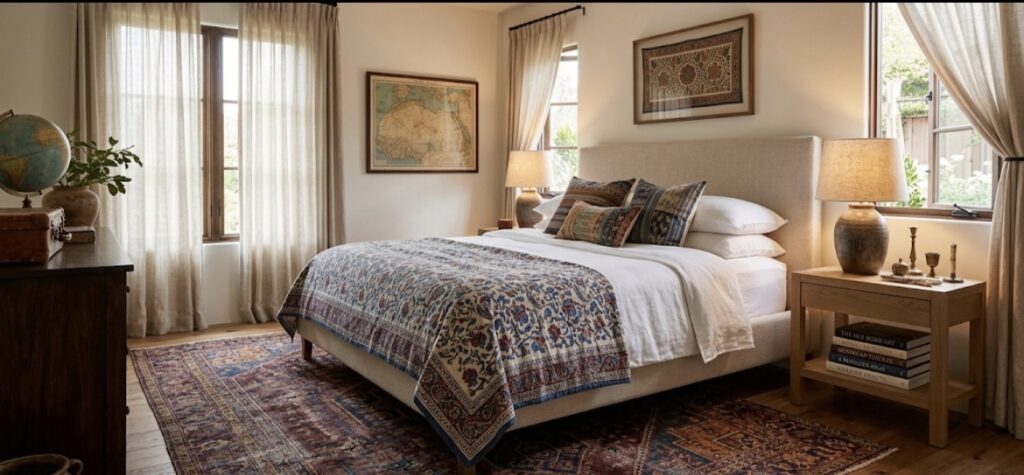
This is the bedroom of someone who has been places and brought pieces back — not souvenirs in the kitsch sense, but objects that are genuinely beautiful and that now live comfortably alongside each other without trying to coordinate. A Moroccan rug on a European floor. A Japanese ceramic lamp. A stack of art books from a museum visit in Amsterdam. An Indian block-printed throw over a contemporary bed.
The magic of this bedroom is that it feels real. There is a narrative in the room that you can sense even if you can’t fully read it. The objects have been encountered in specific places, at specific moments, and they carry that specificity with them. Nothing was purchased in a homeware chain. Everything arrived with a story.
Within the quiet luxury framework, the collected traveler’s bedroom is edited enough that it doesn’t become eclectic in the overwhelming sense. There might be five or six significant objects in the room, each from a different place or tradition, and they coexist because whoever gathered them has a consistent aesthetic sensibility even across widely different contexts. The palette is the unifying element: everything tends to land in a range of warm neutrals, deep muted tones, aged patinas, and natural materials.
The bed itself in this bedroom tends to be a restrained base — simple upholstery or a clean wooden frame — so that it doesn’t compete with the collected objects around it. The rug is usually a significant piece: an antique or near-antique hand-woven carpet in muted jewel tones that functions almost as a painting on the floor. The other objects arrange themselves around this anchor.
Screenshot
16. The Private experience Bedroom
The final idea in this collection is less about a specific aesthetic and more about an intention: the bedroom as a private retreat from the world. This is the bedroom that was designed first and foremost to feel like a refuge — to be the most comfortable, most personal, most carefully considered room in the home. Everything in it was chosen for how it feels, not how it photographs.
In practice, this tends to mean: the best bedding you can find, in the most comfortable materials you love. Window treatments that block out the morning completely or filter it gently, depending on what you prefer. Lighting that is always warm and always dimmable. A temperature that is always slightly cooler than the rest of the house. A nightstand that holds only what you actually use. Art on the walls that you never get tired of looking at. A chair or a chaise where you actually sit.
The palette in a private retreat bedroom is the most personal on this list — it is whatever makes you feel most calm and most at home. For some people that is white and cream. For others it is deep green and wood. For others still it is a single warm ochre wall and everything else in linen. The common thread is intention. Nothing in this room was an afterthought. Nothing is there because it was there when you moved in and you never got around to changing it.
This is quiet luxury in its most essential form: not a trend, not a set of rules, but a standard of care applied to the space where you rest. The luxury is in the decision to make rest itself a priority.
Final thoughts
What connects all sixteen of these bedroom ideas is not a single colour or a specific piece of furniture or a particular price point. It is a quality of intention. Every quiet luxury bedroom, in whatever direction it takes, is the result of someone making deliberate choices — about what to include, what to leave out, how the light should feel, how the room should make you feel the moment you step inside.