
The Art of the Monochrome Living Room
Introduction
There is something deeply satisfying about walking into a room where everything flows. No clashing colors begging for your attention. No random accents fighting each other. Just one beautiful, unified palette that wraps around you like a well-chosen outfit. That is what a monochrome living room feels like — and once you experience it, it is very hard to go back.
A monochrome living room is not about painting every single surface the same flat color and calling it a day. It is much more interesting than that. It is about choosing one color family — whether that is warm cream, deep charcoal, moody sage, or dusty blush — and then playing with every possible version of that color across your furniture, walls, textiles, and accessories. The result is a room that feels cohesive, intentional, and layered in a way that a multi-color room rarely achieves.
People sometimes worry that a monochrome living room will feel boring or cold. That worry usually comes from imagining a single flat tone spread across every surface with nothing to break it up. But a well-styled monochrome space is actually the opposite of boring. Because you are not relying on color contrast to create visual interest, you are forced to work with texture, proportion, material, and light — and those are the things that make a room feel truly luxurious.
This blog post is going to walk you through every aspect of styling a monochrome living room — from choosing the right color to work with, to layering textures, to getting your lighting right, to adding those finishing details that pull everything together. Whether you are starting from scratch or you want to refresh the living room you already have, this guide will give you a clear picture of what a monochrome living room can look like and how to bring that vision to life in a way that feels personal and lived-in rather than staged and sterile.
What a Monochrome Living Room Actually Means
Before you start pulling furniture or shopping for cushions, it helps to understand what monochrome actually means in the context of interior design — because it is not the same as “boring” or “all one color.”
The word monochrome comes from the Greek words for “one” and “color.” In interior design, a monochrome color scheme means you are building your entire room around one base color and using only the shades, tints, and tones within that same color family. So if you choose blue as your base, your monochrome living room could include navy, powder blue, denim, slate, pale sky blue, dusty teal, and even near-neutral grey-blue — all working together as one cohesive palette.
What makes this different from just picking a favorite color and throwing it everywhere is the intentionality. In a monochrome living room, every decision you make — the sofa color, the wall paint, the rug, the curtains, the artwork — is filtered through the same color lens. You are not asking “does this look nice?” You are asking “does this belong to this color story?”
This approach actually makes decorating easier in many ways. You do not have to worry about whether your rug clashes with your cushions or whether your accent wall is fighting your artwork. When everything is living in the same color family, the room has an automatic harmony that takes a lot of the stress out of decorating. The work becomes more about how to add depth and dimension within one color rather than how to manage five different colors at once.
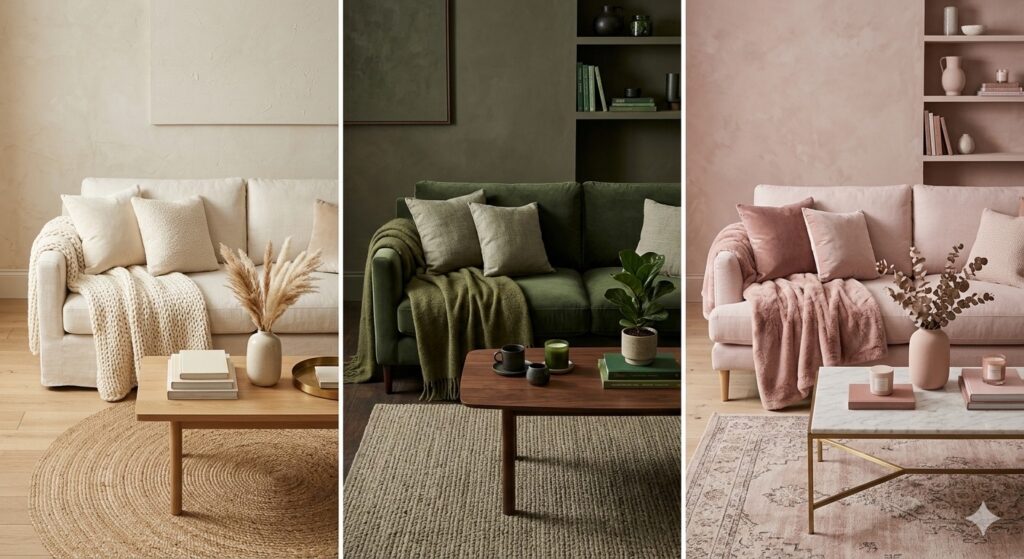
It is also worth knowing that a monochrome living room is not the same as a neutral living room, although the two often overlap. A neutral living room typically uses beige, white, and greige tones because those feel “safe.” A monochrome living room can absolutely be neutral — a beautiful all-cream or all-taupe living room is a perfect example of monochrome done with neutral tones. But monochrome can also be bold. A deep, dramatic room built entirely around forest green or terracotta or dusty rose is equally monochrome. The palette is yours to choose.
1) Choosing the Right Color for Your Monochrome Living Room
This is the most important decision you will make, and it deserves real thought. The color you choose will shape the entire mood of your living room, so it is worth slowing down here rather than rushing past it.
The first thing to consider is the natural light in your living room. Light changes color dramatically depending on the direction your windows face and how much daylight comes in. A room that gets a lot of warm, afternoon sun from the west can handle cooler, deeper tones without feeling cold or dark. A north-facing room that gets less direct light needs colors that have warmth in their undertones — creams with a yellow base, greens with earthy undertones, or rich terracottas — otherwise the room can start to feel grey and a little dreary even in the middle of the day.
Always, always look at paint samples or fabric swatches in your actual room before committing. What looks like a warm beige in a showroom can turn greenish on a north-facing wall. What looks like a cool grey in the store can go lavender in your living room light. The color you fall in love with on a Pinterest board is being photographed in specific light conditions that may be very different from yours. Bring samples home, tape them up, and live with them for a few days before deciding.
The second thing to consider is how you want the room to feel. Color carries emotion. Soft, warm neutrals like cream, ivory, wheat, and mushroom create a cocooning, gentle atmosphere — these are the shades that feel like a warm bath at the end of a long day. Cool, muted tones like sage, dusty blue, and stone create a calm, almost meditative feeling — the kind of room that slows your breathing down when you walk into it. Deep, saturated colors like forest green, navy, charcoal, and terracotta create drama and a sense of enclosure that feels indulgent and private, like a room that wraps around you.
There are no rules about which feeling is “better.” It is about what you want to feel in your own home. Do you want to walk into your living room and feel energized and creative, or do you want to feel calm and settled? Do you want the room to feel bright and open, or cozy and enveloping? Let that emotional goal guide your color choice more than trend or what is popular right now.
A few color families that work particularly well for monochrome living rooms:
Warm Neutrals — cream, ivory, wheat, sand, warm white, greige, and mushroom. These are the most approachable for beginners because they are forgiving, they work with most furniture styles, and they feel naturally cozy. The challenge with warm neutrals is avoiding flatness — you need lots of texture to keep a cream-on-cream room from looking one-dimensional.
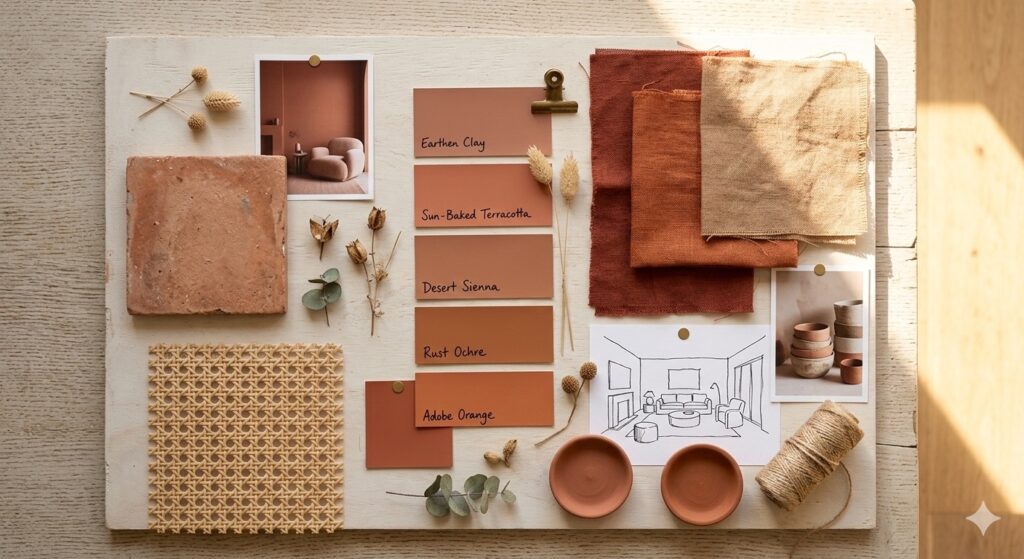
Earthy Tones — terracotta, rust, clay, warm brown, and burnt sienna. These are having a real cultural moment right now and for good reason. Earthy tones feel grounded, warm, and deeply connected to nature. A living room built around terracotta and clay tones can feel like a beautiful Mediterranean retreat or a rich African-inspired space depending on how you accessorize it. These colors are deeply versatile.
Moody Greens — forest green, olive, sage, moss, and hunter. Green is one of the best colors for a monochrome living room because it has such an enormous range within its family. You can go from a pale, barely-there sage to a deep, rich emerald and still stay within one color story. Green is also one of the easiest colors to layer with natural materials — wood, rattan, stone, linen — because it connects so naturally to the organic world.
Cool Blues and Greys — slate, denim, powder blue, storm grey, navy, and dusty blue. These create some of the most sophisticated monochrome living rooms imaginable. The key with cool tones is warmth in the materials — lots of wool, velvet, wood, and warm-toned metals like brass and bronze — to prevent the room from feeling clinical.
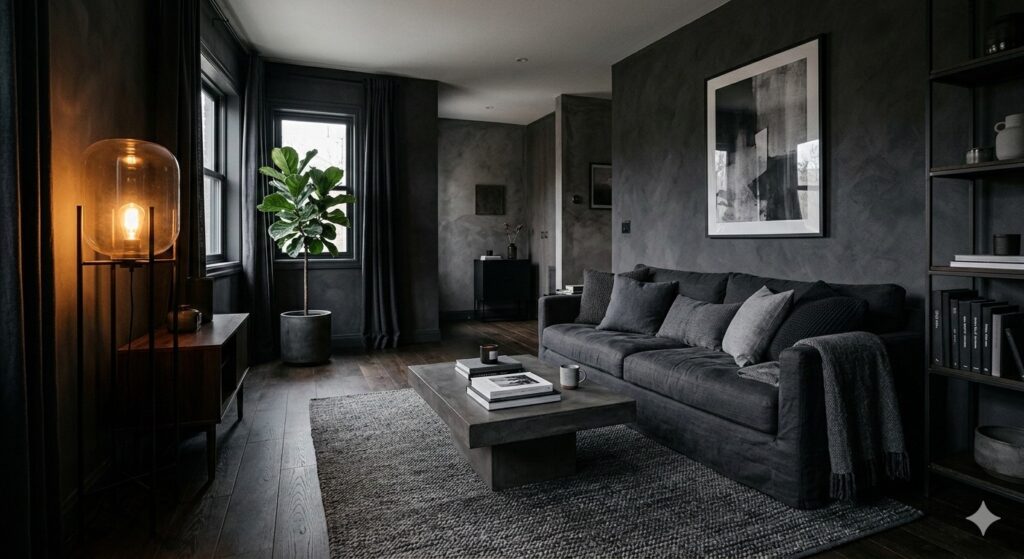
Dark and Dramatic — charcoal, near-black, deep navy, and dark chocolate. A dark monochrome living room is one of the most striking choices you can make, and it is also one of the most misunderstood. People assume dark rooms feel smaller and more oppressive. But a dark monochrome room, done right, feels incredibly luxurious and intimate. The darkness creates a sense of depth that light rooms cannot replicate. It makes art pop, it makes metallic accents glow, and it makes layered textiles feel incredibly rich.
2) Texture in a Monochrome Living Room
If color is the language of a regular room, texture is the language of a monochrome room. Without it, a monochrome living room will feel flat and lifeless. With it, a monochrome living room will feel richer and more interesting than almost any multi-color room you have ever been in.
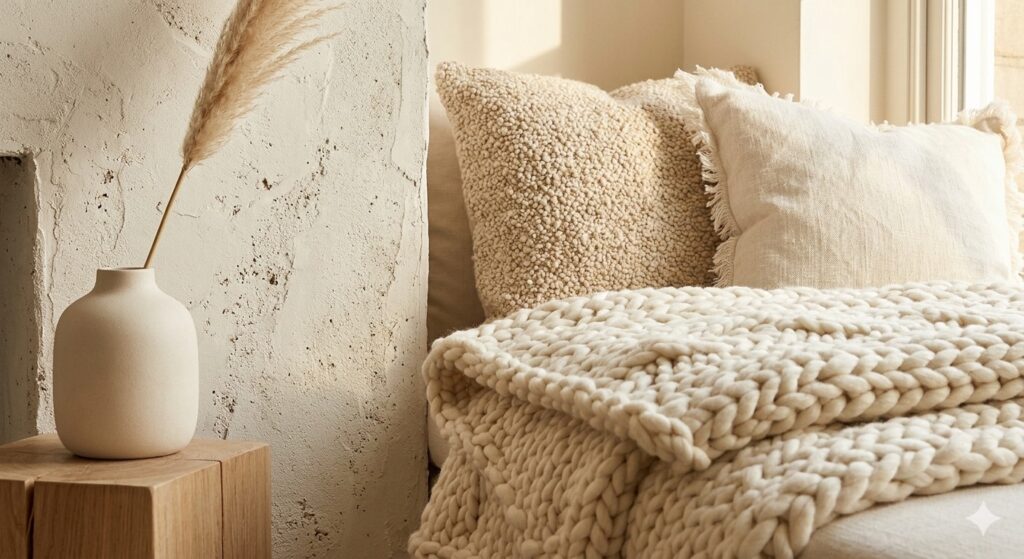
Here is the thing about texture in a monochrome space: when there is no color contrast to draw your eye around the room, texture becomes the primary source of visual movement. Your eye travels across a room and finds interest in the places where materials change — where a smooth linen pillow sits against a chunky knit throw, where a matte plaster wall sits behind a glossy ceramic vase, where a rough jute rug meets the soft pile of a velvet sofa. These contrasts are what give the room life.
Think about texture in terms of three qualities: surface, weight, and depth. Surface refers to how a material feels and looks when you touch or see it — smooth, rough, matte, shiny, grainy, silky. Weight refers to how substantial or light a material appears visually — a thick wool throw reads as heavy and grounding, while a sheer linen curtain reads as light and airy. Depth refers to how much dimension a material has — a flat painted wall has very little depth, while a plaster wall with a troweled finish or a wall hung with a woven textile has significant depth.
In a monochrome living room, you want to work across all three of these qualities in every color you introduce. If your sofa is a smooth, tightly woven fabric, balance it with a rough-textured throw pillow. If your walls are smooth and matte, bring in a coffee table with a grainy marble top or a rough concrete finish. If your curtains are heavy and structured, let your cushions be soft and pliable. The contrast in texture — even within the same color — is what creates the visual layering that makes a monochrome room look expensive and considered.
Some of the best textures to work with in a monochrome living room include:
Linen — matte, slightly rumpled, beautifully light-catching. Linen is one of the most versatile fabrics for monochrome spaces because it sits right in the middle of rough and smooth, heavy and light. It drapes beautifully as curtains, ages well as upholstery, and comes in a natural range of warm and cool neutrals. A linen sofa is the perfect anchor for almost any monochrome palette.
Velvet — rich, deep, with that distinctive pile that changes color slightly depending on which direction the light hits it. Velvet is a magic fabric in a monochrome room because it creates its own internal contrast — the same piece of velvet can look two or three shades different from different angles. A velvet sofa or armchair in the same color family as your walls adds enormous richness without introducing a new color. Velvet works especially well in deep, moody monochrome rooms.
Chunky Knit and Wool — textured in the most tactile, visual way. A chunky knit throw draped over a sofa or an armchair adds immediate warmth and approachability to a monochrome room. Wool cushions with a bouclé weave or a nubby texture add the same visual interest in a slightly more refined way. These materials are essential for monochrome rooms that could otherwise feel too polished or minimal.
Natural Fiber Rugs — jute, seagrass, and sisal. These are perhaps the most underrated element in a monochrome living room. A natural fiber rug in a warm neutral tone adds enormous texture to the floor plane without introducing any competing color. Because natural fiber rugs read as “material” rather than “color,” they slot into almost any monochrome palette with ease.
Plaster, Concrete, and Stone — these are the harder textures that give a room its bones. A concrete coffee table, a stone fireplace surround, or walls finished with a limewash or Venetian plaster technique add incredible visual depth while staying fully within your chosen color story. These materials have an inherent variation and depth that painted surfaces do not, and they make a significant difference to how luxurious and layered a monochrome room feels.
Rattan and Cane — open-weave textures that introduce visual lightness and warmth. A rattan side table, a cane-paneled cabinet, or a woven basket introduces a different kind of texture that feels natural and grounded. These work particularly well in warm monochrome palettes — cream, earthy tones, and greens.
The goal is not to use every texture at once. It is to build a considered collection of materials that contrast and complement each other while staying within your color story. Think in terms of at least four to five distinct textures in any given living room — and make sure some of them are rough, some smooth, some matte, and some with a degree of sheen.
3) Furniture and Layout in a Monochrome Living Room
Furniture in a monochrome living room does a dual job. It contributes to the color story of the room, and it defines the physical structure of the space. Because color is not doing the work of creating contrast and focal points, the shape and proportion of your furniture becomes much more important.
Start with your sofa, because it is almost always the largest piece of furniture in a living room and it will set the tone for everything else. In a monochrome living room, your sofa should ideally be within the same color family as your walls — but not necessarily the same exact shade. If your walls are a warm mid-tone taupe, your sofa could be a slightly lighter linen or a slightly deeper velvet in the same taupe family. This tonal relationship between your sofa and your walls is what creates the cohesive, enveloping feel that defines a successful monochrome room.
The shape of your sofa matters just as much as its color in a monochrome setting. Because color is not commanding attention, silhouette takes over. A low-slung, wide sofa with deep cushions and a relaxed profile creates a different atmosphere than a structured, tight-backed Chesterfield-style sofa, even if they are both in the same color. Think about the emotional tone of the room you want to create — casual and laid-back calls for a softer, more relaxed sofa shape. Sophisticated and composed calls for something with cleaner, more deliberate lines.
Mixing furniture from different periods and styles is absolutely possible in a monochrome living room — in fact, it adds a lot of richness. A mid-century armchair next to a more contemporary sofa works beautifully in a monochrome room because the lack of color competition lets you appreciate the silhouette and craftsmanship of each piece rather than getting distracted by color mismatch. The unifying factor is always the shared color story, not the matching style.
Coffee tables and side tables are an opportunity to introduce material contrast while staying within your color palette. If your sofa and chairs are all soft upholstery, bring in a coffee table that has a harder, more substantial material — stone, concrete, dark wood, or metal. In a cream and ivory monochrome room, a travertine or light marble coffee table is a beautiful choice. In a charcoal and dark grey room, a black lacquered table or a raw concrete table adds the right material contrast. In an earthy tone room, a warm walnut or raw oak table brings a natural material richness.
When it comes to layout in a monochrome living room, the same fundamental principles apply as in any living room — create a clear conversation area, avoid pushing all furniture against the walls, and make sure there is a logical flow of movement through the space. But in a monochrome room, layout takes on additional importance because you are also thinking about how to distribute texture and visual weight around the room. You do not want all your textured, heavy pieces on one side of the room and all your smooth, light pieces on the other. Think of it as visual balance — if you have a chunky, heavily textured sofa on one side, balance it on the other side with a heavily textured rug or a layer of throw pillows with strong tactile interest.
4) Walls, Paint
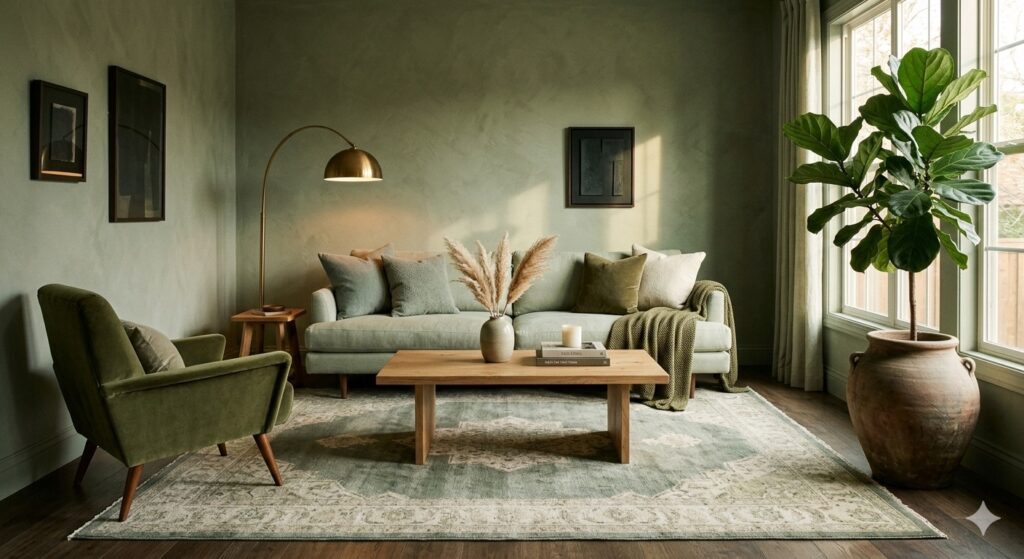
The walls of your living room are the single largest surface in the space, and in a monochrome living room, they are one of the most powerful tools you have. Getting the wall treatment right can transform an ordinary room into something that feels thoughtfully designed from floor to ceiling.
The most straightforward approach is to paint all four walls the same color from your chosen palette. But “paint all four walls” is the beginning of the conversation, not the end of it. The finish you choose for your paint makes an enormous difference in a monochrome room. A flat or matte finish absorbs light and creates a soft, almost chalky look that is beautiful in moody, enveloping rooms. An eggshell or satin finish reflects a small amount of light and creates just enough sheen to give walls a subtle luminosity — this is particularly beautiful in lighter monochrome palettes like cream or pale sage. A full gloss finish is dramatic and high-fashion, and while it is not for everyone, a glossy wall in a deep, dark monochrome room can feel incredibly sophisticated.
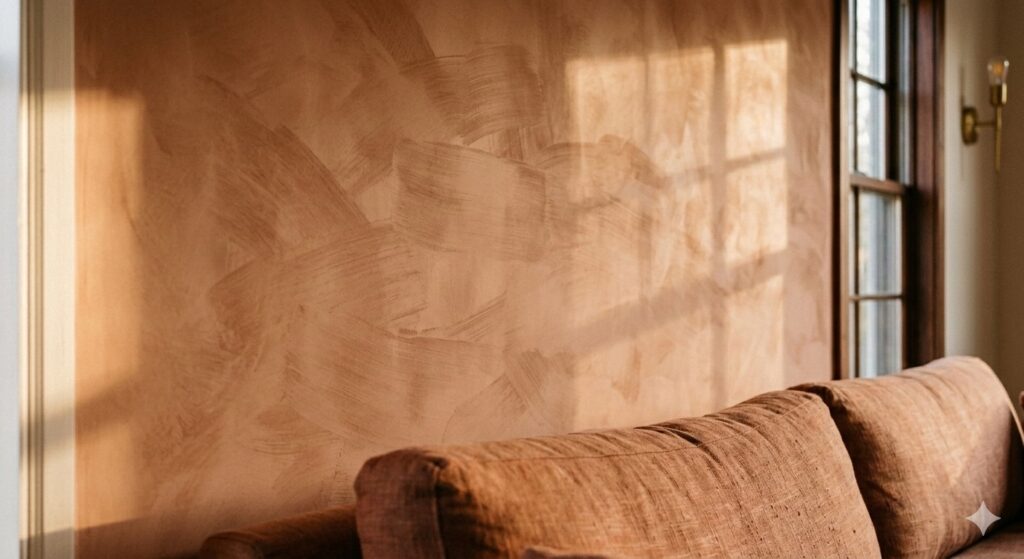
Beyond standard paint, there are wall treatments that can elevate a monochrome living room significantly. Limewash paint is one of the most beautiful options for a monochrome room — it creates a mottled, layered look that is highly textured and deeply interesting to look at. Because limewash has natural variation, it adds the kind of depth to a wall that no flat paint can replicate. It works across all color families and brings an organic, slightly antique quality to a space that feels very intentional.
Venetian plaster is the more refined cousin of limewash — a multi-layered application of plaster that, when polished, creates an almost stone-like surface with beautiful depth and a slight sheen. It is a more labor-intensive and expensive option, but the result is extraordinary. A Venetian plaster wall in a monochrome living room reads as a material rather than a surface — it looks like the wall has been carved from marble or stone, and it gives the room a sense of substance and quality that is hard to achieve any other way.
Paneling is another option worth considering. Wood paneling — whether real shiplap, board-and-batten, or MDF paneling — adds architectural texture to a wall that creates shadow lines and visual rhythm without introducing any new color (as long as you paint it the same shade as the rest of your walls). In a monochrome room, painted paneling is a beautiful way to add structure and visual interest to the wall plane while keeping everything within one color story. The same applies to plaster moldings, picture rails, and dado rails — all painted the same color as the wall, they become textural and architectural rather than decorative.
Your ceiling is part of the envelope too, and in a monochrome living room, it deserves a decision. Painting your ceiling the same color as your walls creates a fully enveloping, immersive effect — the room feels like a cocoon. This is a particularly bold choice with dark colors and can feel extraordinary in a charcoal or navy monochrome room. Painting the ceiling a slightly lighter shade of your wall color creates a sense of height while keeping the palette cohesive. Going with a pure white ceiling is the most conventional approach and works well when you want to keep the feeling of light and airiness in the room. None of these is the “right” answer — it depends entirely on the mood you are after.
5) Lighting Your Monochrome Living Room
Lighting is one of the most transformative elements in any interior, but it is particularly crucial in a monochrome living room. Because you are working with a single color palette, the quality, direction, and warmth of your light sources will have an enormous impact on how the room looks and feels at different times of day.
Natural light is your most important resource. How it moves through your room across the day affects your color palette at every hour — in the morning, your colour might look cool and fresh; by afternoon, warm and golden; in the evening, it could shift to something much richer and more complex. A monochrome living room benefits enormously from generous natural light because it shows off the full range of your chosen color at its most beautiful, revealing all the different shades within your palette as the light moves across the room.
Window treatments in a monochrome living room should ideally be within your color story, but they should also be considered in terms of how much light they allow in. Sheer linen curtains in a tone close to your wall color are almost perfect for a monochrome room — they filter light without blocking it, they add texture, and they create a seamless visual flow between the window and the wall. Heavy, lined curtains in a deeper tone from your palette create drama and a more formal, enveloping effect. Choose based on the mood you are creating.
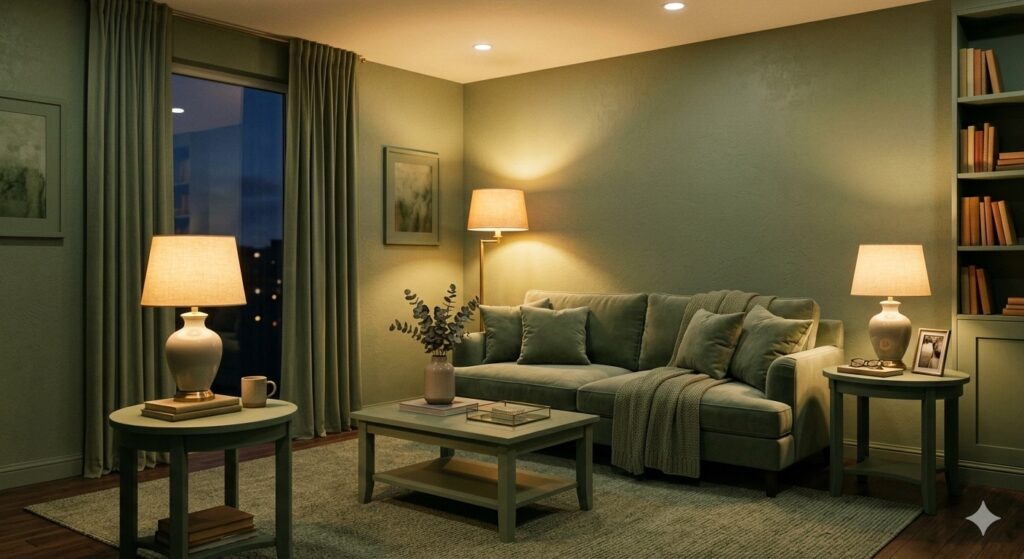
For artificial lighting, the key principle in a monochrome living room is layering. A single overhead light source — a central pendant or recessed ceiling lights — is functional but flat. It illuminates the room without creating any shadow, dimension, or warmth. Layered lighting, on the other hand, creates a completely different atmosphere. Think in terms of three layers: ambient (general room lighting), task (directed light for reading, working), and accent (decorative, atmospheric light that creates pools of warmth).
Floor lamps are one of the most powerful tools in a monochrome living room because they create warm pools of light at eye level that make the room feel intimate and cozy rather than uniformly bright. A tall arc floor lamp positioned behind a sofa creates a reading nook effect that feels incredibly comfortable and inviting. A column floor lamp in a corner adds warmth to what would otherwise be a dark, dead space. The shade of your floor lamp can either match your color palette closely (creating a seamless look) or offer a subtle material contrast — a paper shade, a fabric shade, a sculptural ceramic base.
Table lamps on side tables and console tables add another layer of warm, low-level light that makes the room feel lived-in and personal. In a monochrome room, the lamp base is an opportunity to introduce material contrast — a plaster lamp base, a ceramic base with a matte glaze, a turned wood base — while the shade can stay within your color palette. The color temperature of your bulbs matters enormously: always opt for warm white bulbs (around 2700K) in a monochrome living room, as cooler daylight bulbs will strip the warmth and richness out of your carefully chosen palette.
Candles — actual candles or high-quality candle lanterns — are the warmest, most atmospheric light source you can add to a monochrome living room. They are not a primary light source, but they create a quality of light that no electrical fixture can replicate. A cluster of pillar candles on a coffee table or fireplace mantle, all in shades within your color palette, adds warmth and intimacy to the room in a way that feels deeply intentional.
6) Styling Shelves and Surfaces in a Monochrome Living Room
This is where so much of the personality and character of your monochrome living room gets expressed. Shelves, mantels, console tables, coffee tables, and window ledges are all staging areas where you can tell a visual story within your color palette — and where it is easy to either get it beautifully right or accidentally chaotic.
The golden rule for styling surfaces in a monochrome room is to stay within your palette but vary your materials. Every object on a shelf should feel like it belongs to the same color conversation — but no two objects should be exactly the same material. This is what creates the kind of rich, curated look that feels intentional rather than collected randomly over time.
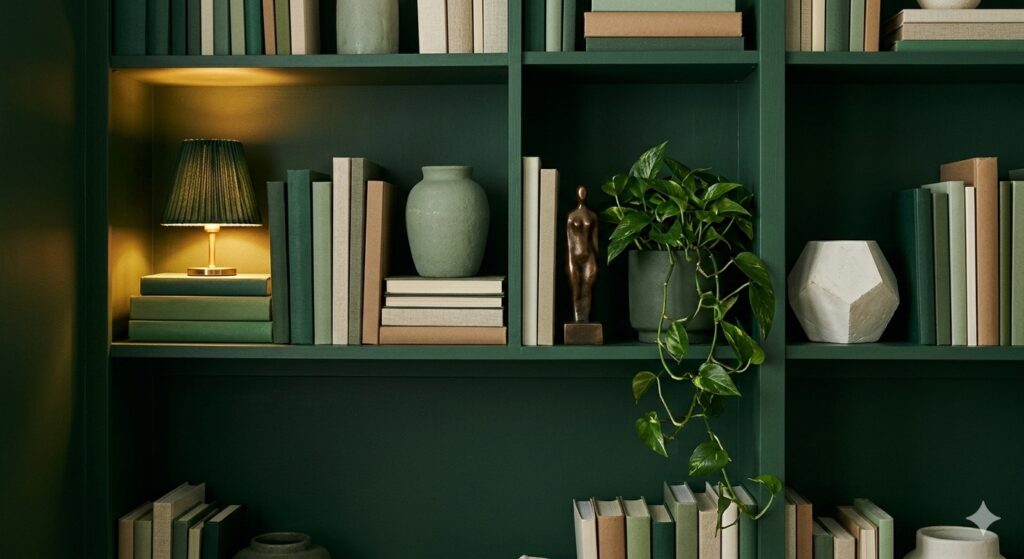
On bookshelves, a monochrome approach is particularly striking. If you organize or select books with spines in your color palette — all creams and whites, all dark greens, all black and charcoal — the shelf becomes a piece of art in itself. Intersperse books with objects in complementary materials: a smooth ceramic vessel, a geometric object in plaster or concrete, a piece of sculptural driftwood, a small framed print. The key is to vary the heights and proportions of objects rather than lining everything up at the same height. Low, medium, and tall objects on the same shelf create visual rhythm.
Fireplace mantels are one of the best surfaces to style in a monochrome living room because they are a natural focal point. Keep the mantel tightly within your color palette — a collection of objects in varying shades of your chosen color, all in different materials and heights, creates a beautiful, considered display. Resist the urge to add a single bold color contrast “for interest” — the interest in a monochrome mantel comes from the relationship between materials, not colors.
Coffee tables are perhaps the most frequently styled and re-styled surface in a living room, and in a monochrome room they have enormous impact. A coffee table styling that stays within your color palette but uses three or four different materials — a marble tray, a linen-covered book, a ceramic bowl, a glass candle — will always look more intentional and luxurious than a collection of random colorful objects. The tray is your best friend for coffee table styling — it gathers smaller objects and creates a cohesive vignette within the larger surface.
The objects you choose for a monochrome living room do not need to be expensive. A smooth stone from the beach, a handful of dried botanical stems in a simple vase, a pile of books with covers facing upward, a single oversized candle in a deep, substantial holder — these are all accessible and effective styling objects. What matters is not the price of the object but the relationship between the objects: their color, material, proportion, and how they work together.
7) Art and Walls in a Monochrome Living Room
Art is one of the areas where people most often break their monochrome scheme — and sometimes that is a beautiful, intentional choice. But there is also an entirely different philosophy to wall art in a monochrome living room that can create something really extraordinary when executed well.
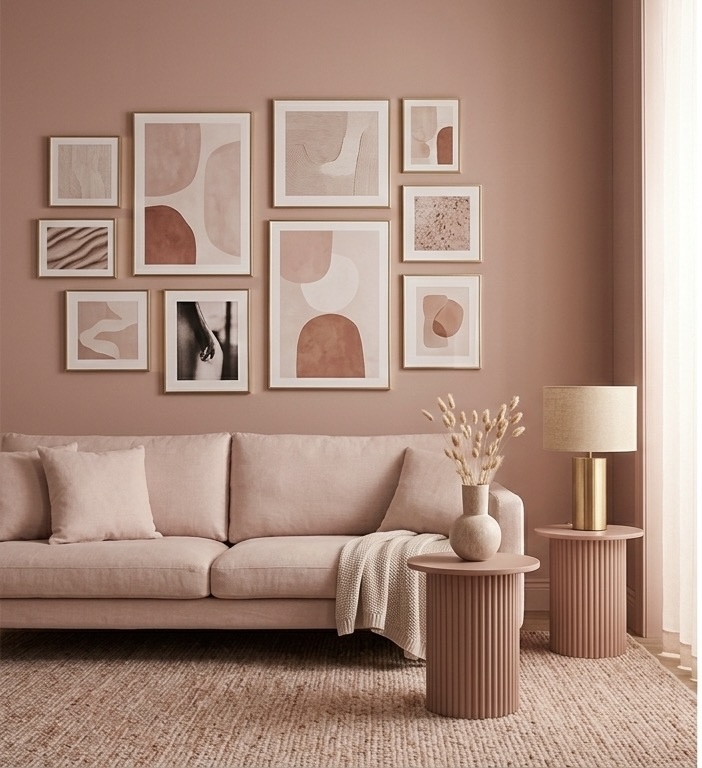
The first approach is to keep your art within your color palette. This means choosing artwork that is dominated by your chosen color family — paintings, prints, or photographs that use your palette’s shades and tones. A collection of abstract paintings in shades of warm white, cream, and sand on a warm white wall creates a beautiful tonal artwork wall where the pieces are distinguished by material and texture rather than color contrast. Black and white photography is a near-universal choice for monochrome rooms because it contributes visual interest without introducing color competition — it works in almost any monochrome palette as a very neutral, graphic addition.
The second approach is to use one piece of bold, contrasting artwork as a deliberate statement. This is not “breaking” the monochrome scheme — it is using the monochrome scheme as a backdrop to make one piece of art sing. When everything in the room is the same color family, a single canvas with a striking pop of a completely different color becomes the undeniable focal point of the room. The entire monochrome scheme becomes the stage, and the artwork becomes the actor. This approach requires a certain discipline — it works best with one piece of contrasting art, not five, and the art should be significant enough in scale or quality to earn that focal point status.
The third approach is to use sculptural or three-dimensional wall art — woven wall hangings, ceramic wall tiles, plaster relief panels, or carved wood panels — that adds textural interest to your wall without introducing any new color. A large woven wall hanging in shades within your color palette is a beautiful, artisanal way to add texture and warmth to a wall while staying completely within your monochrome story.
Scale matters enormously with art in a monochrome living room. Small, scattered artwork tends to create visual noise rather than visual interest in a monochrome room. Larger pieces — or a well-spaced gallery wall that is organized enough to read as a single composition — make a much more confident statement. If you are building a gallery wall in a monochrome room, consider either keeping all frames the same color (ideally within your palette) or choosing frames in a single material (all natural wood, all black, all white) to maintain the cohesive feel.
8) Plants and Natural Elements
Plants are one of the greatest gifts to a monochrome living room. They bring in a natural color that does not compete with your palette — green works with almost everything — while adding scale, organic shape, and life to a space that could otherwise feel static and composed.
In a monochrome living room, plants serve an additional purpose beyond just decoration. They introduce organic, irregular form into a space that is otherwise composed of very deliberate, human-made objects. The unpredictable shape of a large fiddle-leaf fig or a trailing pothos creates a visual looseness and naturalness that prevents a monochrome room from feeling too tight, too controlled, or too much like a showroom.
The scale and placement of plants in a monochrome living room matters significantly. One large, architectural plant — a fiddle-leaf fig, a monstera, an olive tree, a bird of paradise — placed in a corner or beside the sofa has far more impact than five small plants scattered across shelves. The large plant creates a visual anchor, a moment of organic drama that gives the room energy and a sense of living, breathing life. The pot it lives in should be within your color palette — terracotta for warm earthy rooms, a matte white or cream ceramic for neutral rooms, a dark glazed pot for moody rooms.
Dried botanicals are another option that works exceptionally well in monochrome rooms — particularly because many dried plants take on beautiful neutral tones that sit perfectly within almost any palette. Dried pampas grass in creamy white, dried lunaria with its papery silver discs, dried cotton stems, dried eucalyptus in dusty grey-green — these add organic texture and natural form without the maintenance of live plants, and their muted, neutral tones make them extremely easy to incorporate into a monochrome scheme.
9) The Floor: Rugs, Wood, and Stone
The floor is the fifth wall of a room — an enormous surface that has a huge impact on the overall feel of your monochrome living room. Getting the floor right, or choosing the right rug to cover it, can make or break the cohesive feel you are trying to achieve.
Hardwood floors in warm, mid-tone timber work with almost every monochrome palette because timber is a natural material that reads as a neutral rather than a competing color. The grain and variation of wood adds texture to the floor plane, and its warmth grounds and humanizes even the coolest monochrome color schemes. Light timber floors — blonde oak, ash, and light maple — work particularly well with warmer, lighter monochrome palettes like cream and pale sage. Darker timber floors in walnut, dark oak, or ebonized wood create a beautiful anchoring contrast in lighter monochrome rooms and a rich, unified depth in darker moody rooms.
Concrete and stone floors are a more considered choice but can be extraordinary in a monochrome living room. Polished concrete in a warm mid-tone grey works beautifully in charcoal, sage, or dusty blue monochrome rooms. Large-format stone tiles in limestone, travertine, or marble add incredible material richness while staying within a neutral color family that complements almost any monochrome palette.
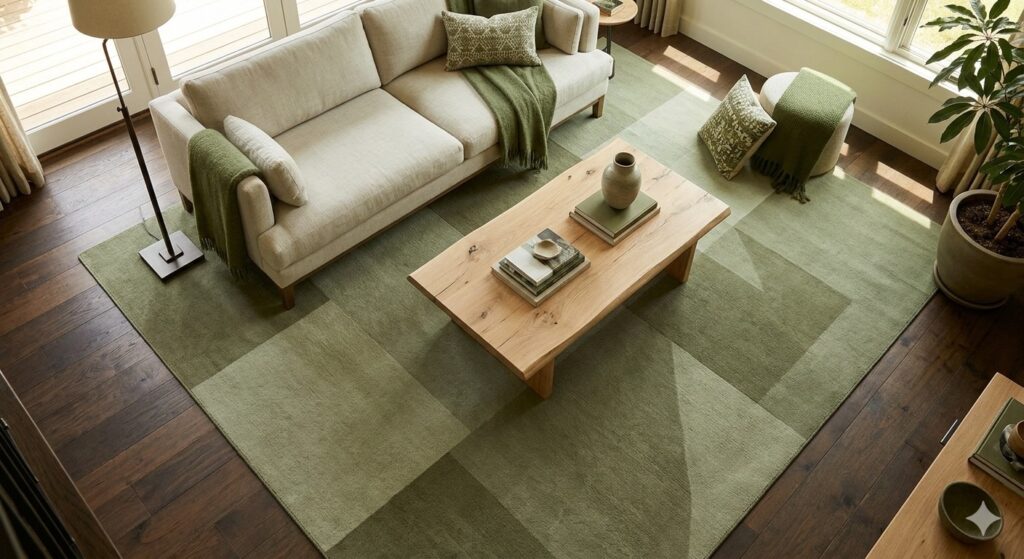
Rugs are the most flexible floor treatment because they can be changed, added, or layered. In a monochrome living room, your rug is an opportunity to introduce significant texture at the floor level — a shaggy, high-pile rug in your color palette, a flat-weave kelim-style rug in tonal shades, a natural jute rug, or a vintage-style wool rug in your chosen tones. The rug also defines the seating area and creates a visual anchor for your furniture arrangement, pulling all the pieces together into a cohesive conversation zone.
The pattern of your rug in a monochrome room can include subtle woven patterns, tonal stripes, or geometric designs — as long as all the colors within the pattern are from your chosen palette. A rug with a subtle pattern in two or three shades of your chosen color adds visual depth and interest without breaking the monochrome scheme. It creates the same kind of variation that texture does — using the same color in multiple forms to create richness.
10) Seasonal and Mood-Based Updates to Your Monochrome Living Room
One of the biggest advantages of a monochrome living room is how easy it is to refresh and update. Because the entire room is built on one color story, swapping out key elements — throws, cushions, flowers, candles — keeps the space feeling fresh without requiring any significant investment or effort.
In warmer months, lighten and brighten the monochrome by swapping out heavier textures for lighter ones. Replace chunky knit throws with lightweight linen blankets. Swap heavy velvet cushions for fine cotton cushions. Bring in fresh flowers or leafy green plants. Open the curtains wide and let natural light dominate. The room’s palette does not change — but its weight and feeling lifts considerably.
In cooler months, layer in more texture and warmth. Add extra throws across the sofa and armchair. Bring in chunky knit cushions and heavy wool blankets. Light more candles. Add a sheepskin throw over an armchair. Lower the lighting to create a more intimate, enclosing atmosphere. The structure of your monochrome room stays exactly the same — but it transitions into something cozier, warmer, and more sheltering with very little effort.
This adaptability is one of the most underrated pleasures of a monochrome living room. You are not locked into a seasonal palette swap where everything has to change. You are working within one color story that deepens and shifts with the seasons simply by adjusting your textiles and lighting. It is an incredibly low-effort, high-impact way to keep your living room feeling current and alive throughout the year.
Common Mistakes to Avoid in a Monochrome Living Room
Knowing what to avoid is just as important as knowing what to do. There are a few recurring mistakes that can flatten a monochrome room or stop it from reaching its full potential.
The first is using only one shade and one finish across every surface. A monochrome room is not about applying the same exact color everywhere in the same flat way. It is about using a range of shades, tints, and tones from within one color family, and working with different finishes and materials to create depth. If your sofa, walls, rug, curtains, and cushions are all exactly the same shade of beige in the same flat matte finish, the room will feel dull rather than cohesive. The key word is always “range” — you want a family of related colors, not a single repeated note.
The second mistake is neglecting texture. As discussed throughout this post, texture is the substitute for color contrast in a monochrome room. If you do not invest in a meaningful range of textures — rough and smooth, matte and shiny, light and heavy — the room will lack visual interest no matter how beautiful your color choice is.
The third mistake is getting every single shade exactly right. Monochrome does not mean the room has to be perfectly precise or rigidly uniform. A little variation, a shade that leans slightly warmer or cooler than the main palette, a piece of furniture that is not a perfect match but is in the same color family — these add warmth and authenticity to the room. Over-precision in a monochrome room can make it feel like a display home rather than a lived-in, personal space.
The fourth mistake is choosing the wrong undertone. All colors have undertones — warm (yellow, orange, red) or cool (blue, green, purple) — and within a monochrome room, undertone consistency matters enormously. A room where some elements have warm undertones and others have cool undertones will feel somehow “off” without the occupant necessarily being able to identify why. When building a monochrome palette, check the undertones of every element — paint, fabric, wood, metal — and make sure they are broadly harmonious.

Final Thoughts: Living Well in One Color
A monochrome living room is a commitment to depth over variety. It is the decision to go all-in on one color story and trust that the richness you need will come from texture, material, light, and proportion — not from adding more colors to the mix.
What makes a monochrome living room genuinely beautiful is not restraint for its own sake. It is the understanding that when you remove color competition from the equation, you have to engage more deeply with every other element of the room. You start to notice the way velvet catches light differently than linen. You start to appreciate the weight of a thick wool throw against a smooth marble table. You start to see how shadow shapes the perception of color and how morning light turns a room into something completely different from what it is at dusk.
The best monochrome living rooms feel genuinely personal. They are not magazine-perfect or intimidating. They feel like the room was designed from the inside out — starting with a feeling, a mood, a sensory experience — and then built outward from there using color as the thread that ties everything together.
Whether your monochrome living room is a warm, creamy retreat or a moody, dramatic sanctuary, the principles in this guide will help you build something that feels cohesive, considered, and deeply liveable. Start with one color that genuinely moves you. Let the textures do the heavy lifting. Trust the layering process. And then live in it, and let it live with you.