
There are color combinations that just make sense the moment you see them, and cream and walnut is one of those pairings that feels like it was designed by someone who actually cooks, eats, and lives in a kitchen rather than just photographs it. Cream is soft without being cold. It has warmth baked into it — a little yellow, a little beige, a little “I woke up like this” energy that white simply cannot pull off. Walnut, on the other hand, is rich and dark with natural grain lines that look like they took years to earn. It does not try too hard. It just shows up and does the work.
When you put the two together, something interesting happens. The cream lightens the walnut so the space never feels heavy or cave-like, and the walnut grounds the cream so it never looks washed out or clinical. It is the kitchen equivalent of a perfectly balanced meal — nothing fighting for attention, everything working together. The contrast is noticeable but not aggressive. It is warm without being overwhelming, modern without being sterile, and natural without looking like you accidentally built your kitchen inside a log cabin.
This blog post is not about how to build or renovate your kitchen from the ground up. It is about decor — the ideas, the combinations, the details that turn a functional kitchen into a space you actually want to spend time in. These 14 cream and walnut kitchen decor ideas cover everything from how you handle your cabinetry and countertops to the small styling choices that most people overlook but that make a significant difference when you step back and look at the whole room. Whether your kitchen is big or small, old or freshly updated, there is something in this list that will work for your space and your lifestyle.
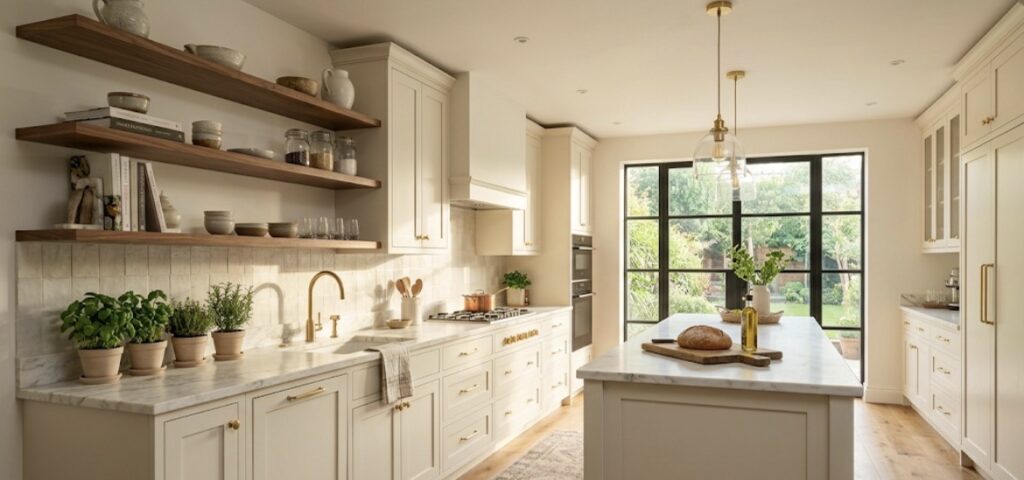
Idea 1: Cream Lower Cabinets with Walnut Upper Open Shelving
One of the most visually interesting things you can do in a kitchen is break the monotony of matching cabinets above and below. When your lower cabinets are cream and your upper cabinets are replaced with open walnut shelving, the room opens up immediately. The wall behind the shelving becomes visible, the space feels taller and airier, and you get to actually display the things you use every day instead of hiding them behind closed doors like you are embarrassed by your mug collection.
This idea works beautifully because the cream on the lower half keeps everything grounded and clean-looking, while the walnut shelves above bring in that natural wood warmth without adding visual bulk. Open walnut shelves are lighter — visually and sometimes literally — than upper cabinets, and they make a kitchen feel less like a storage unit and more like a thoughtfully designed room. You can style the shelves with white or cream-colored dishes to reinforce the color palette, add a few plants or trailing vines for life, and tuck in some cookbooks for personality. The result is a kitchen that looks curated but not uptight.
The key to making this look work is contrast and restraint. Do not overcrowd the shelves. Give each item a little breathing room. A few stacked white plates, two or three glass jars filled with dried pasta or grains, a small trailing pothos plant, and maybe a wooden bowl — that is enough. Less is genuinely more here. The walnut wood grain will do the heavy lifting as long as you let it be seen.
This decor approach also works well in smaller kitchens where upper cabinets can make the room feel closed in and box-like. Swapping even just one or two upper cabinet sections for open walnut shelving can dramatically change the feel of the space without touching a single wall or countertop.
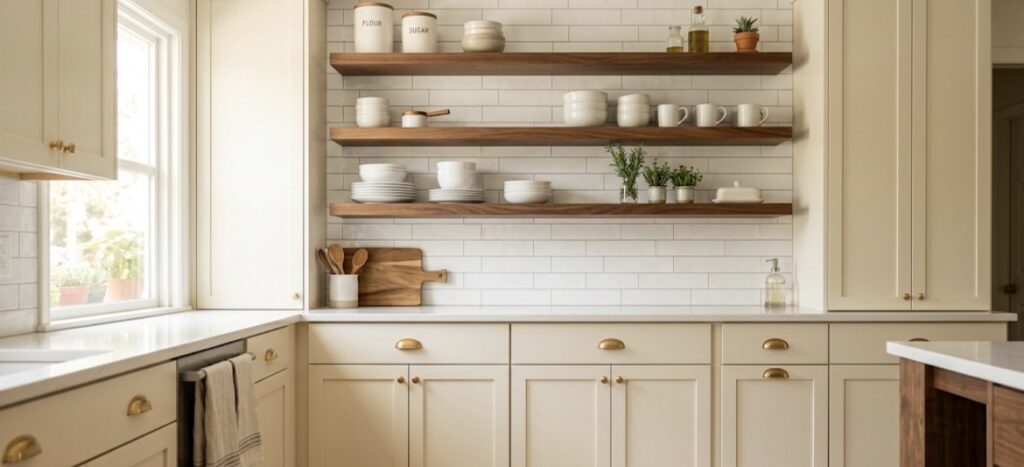
Idea 2: Walnut Kitchen Island in a Cream Kitchen
If there is one single piece of furniture that can change the entire personality of a kitchen, it is the island. And if you have a cream kitchen — cream cabinets, cream walls, light countertops — adding a walnut island is one of the smartest decorating moves you can make. It becomes the anchor of the room. It draws the eye, defines the space, and adds a richness that cream alone simply cannot provide.
A walnut island in a cream kitchen does not need to be loud or complicated. It can be as simple as a butcher-block style walnut-topped island with a cream base, or it can go the other direction with a full walnut-panel island that acts as a statement piece in the middle of the room. Either way, the contrast between the warm, dark walnut and the lighter cream surrounding it creates a visual focal point that makes the kitchen look professionally designed. It is the kind of thing that makes guests walk in and immediately say something.
The walnut island also gives you a natural gathering spot that feels different from the rest of the kitchen. It has a slightly different energy — warmer, more tactile, more inviting. People tend to gravitate toward wood surfaces because they feel natural and less formal than painted or laminate finishes. This makes the island not just a practical workspace but a social center, which is exactly what most kitchen islands are meant to be. Whether you use it for prepping food, doing homework, or hosting a very informal wine-and-cheese situation, a walnut island in a cream kitchen makes all of those activities feel a little bit nicer.
For styling, keep the top of the island relatively clean. A small wooden cutting board, a cluster of three candles at different heights, a ceramic bowl of fruit, or a single vase with dried stems — any of these work. You do not need much when the island itself is already doing so much for the room.
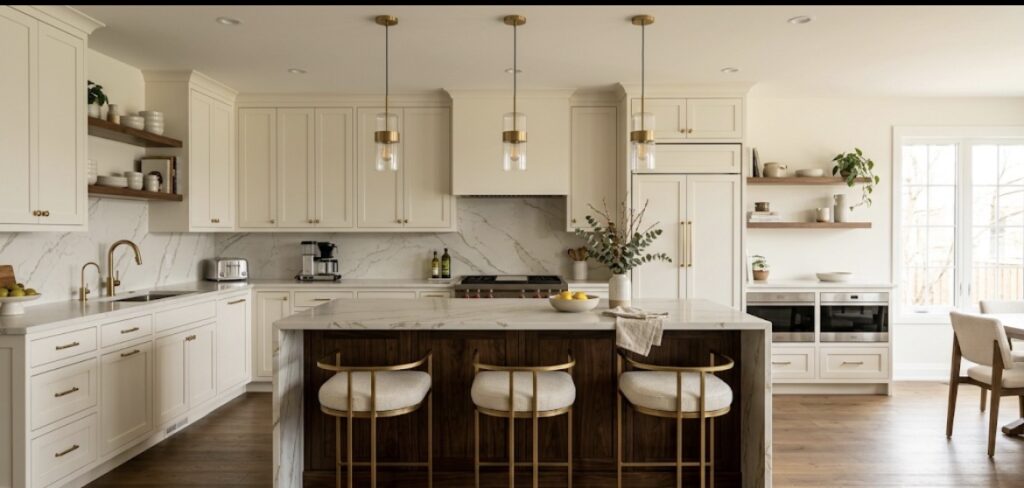
Idea 3: Walnut Floating Shelves as Decorative Accents
Not every cream and walnut kitchen idea requires a full redesign. Sometimes the smallest additions make the biggest difference, and a set of walnut floating shelves in a cream kitchen is proof of that. These shelves are not storage solutions — they are decor. They are the kitchen’s version of wall art that also happens to hold things.
Walnut floating shelves have a natural depth of color and a grain pattern that looks expensive without being garish. When you mount them on a cream wall — even just one or two — the contrast is immediate and striking. The shelves pop against the light background, and anything you place on them is automatically framed and highlighted. It is a gallery wall, but for your kitchen, and everything in it is something you actually use.
The best way to style walnut floating shelves in a cream kitchen is to think in layers. Start with the tallest items — a tall ceramic vase, a potted plant, a stack of hardcover cookbooks — and work your way down to smaller items. Mix textures: a linen napkin draped casually, a glass jar, a wooden spoon resting in a small crock. The shelves should look like they were styled by someone who lives there, not someone who was paid to style them for three hours and then left.
Placement matters too. A single walnut shelf centered above a window or sink can feel more intentional and impactful than three shelves crammed together. In a cream kitchen with lighter countertops and simple hardware, walnut shelves bring in the natural element that keeps the space from feeling too polished or too blank.
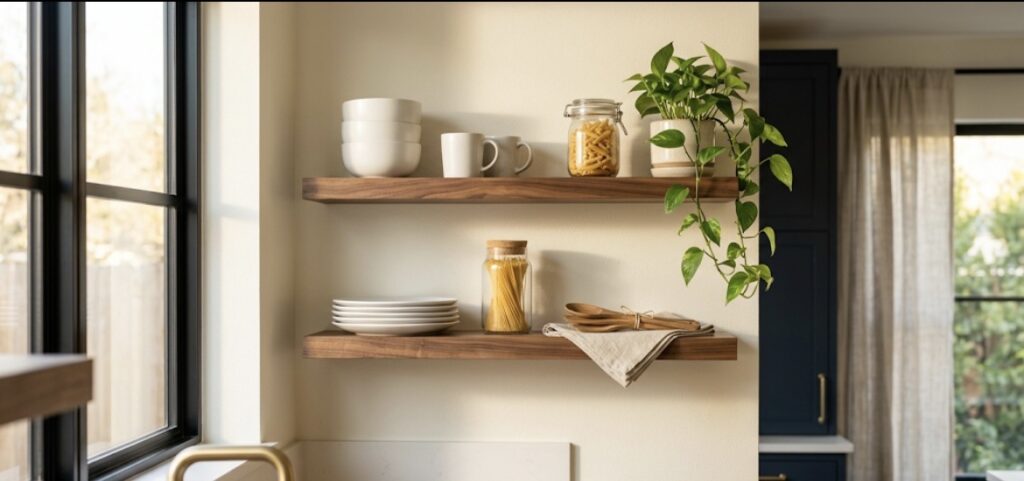
Idea 4: Two-Tone Cabinets — Cream and Walnut Together
Two-tone cabinetry has been popular for several years now and for very good reason: it works. When you pair cream upper cabinets with walnut lower cabinets — or vice versa — you get a kitchen that feels layered and thought-out rather than flat and uniform. It is the decor equivalent of wearing a well-matched outfit. Everything coordinates without being matchy-matchy.
The most popular version of this idea is cream uppers and walnut lowers. This layout feels natural because it mirrors how light and dark tend to work in a room — lighter tones above, darker tones below — which creates a sense of visual balance and groundedness. The walnut lowers have a weight and solidity to them that feels right in that position, while the cream uppers keep the upper half of the room from feeling heavy or closing in. The kitchen stays bright but gains enormous warmth and character.
Some people go the other direction — walnut uppers and cream lowers — which is bolder and more dramatic. This can work beautifully in kitchens with very good natural light, where the darker uppers will not make the space feel dim. The result is a moodier, more sophisticated aesthetic that leans toward contemporary or Scandinavian design sensibilities. If you like kitchens that feel like they belong in a design magazine from Stockholm, this is your direction.
There is a middle-ground version too: using walnut only on a specific section of cabinets — the kitchen island, a dedicated pantry wall, or the cabinets flanking the range hood — while keeping everything else cream. This creates a focal wall or feature zone without committing to a full two-tone scheme throughout the entire kitchen, and it is a great approach for people who want impact without commitment. Which, honestly, describes most of us.
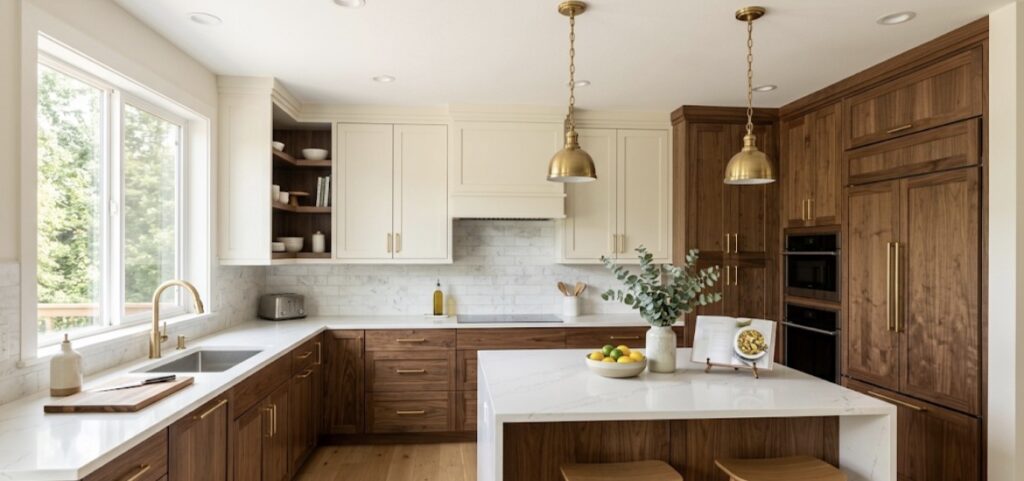
Idea 5: Walnut Countertops on Cream Cabinets
There is something deeply satisfying about a walnut butcher block or walnut slab countertop sitting on top of cream cabinets. It is warm. It is natural. It is the kind of combination that makes you want to make coffee at 7 a.m. just so you have an excuse to stand in your kitchen and look at it.
Walnut countertops — whether they are solid butcher block, walnut-veneer slabs, or a live-edge walnut surface — bring a completely different texture and depth to a kitchen compared to stone or engineered quartz. They are alive, in a sense. The grain shifts depending on how the light hits it. Small knots and variations in the wood make every countertop slightly different from any other, which means your kitchen is, technically, one of a kind. If that is not a selling point, it is hard to know what is.
On cream cabinets, walnut countertops create a contrast that is warm rather than stark. Unlike white marble or light quartz, which can feel cool and surgical, walnut countertops bring the kitchen temperature up in the best possible way. The space feels lived-in and comfortable, even when it is perfectly clean. And practically speaking, walnut countertops are forgiving in a way that light stone is not — small scratches and dents can often be sanded out and re-oiled, and the wood develops a beautiful patina over time that only improves with use.
The most common pairing for this look is cream shaker cabinets with a walnut butcher block countertop, usually with simple brass or black hardware to complete the picture. It works in farmhouse kitchens, in transitional spaces, and even in more modern settings where the wood countertop is the only natural material element in an otherwise sleek design.
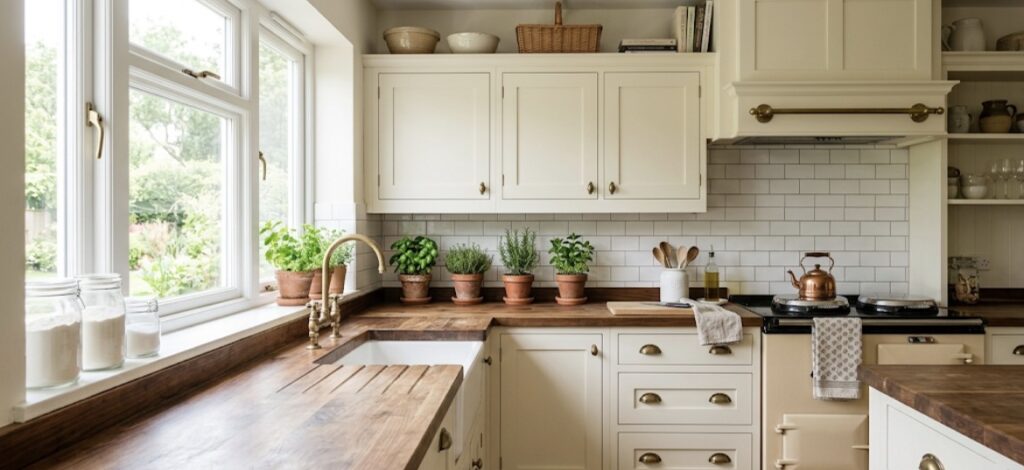
Idea 6: Cream Kitchen with Walnut Hood Surround
The range hood is one of those elements in a kitchen that often gets treated as a purely functional object, when it is actually one of the best opportunities for a design statement in the entire room. A walnut hood surround — meaning the decorative panels or casing that frame the range hood — in a cream kitchen is dramatic in the best possible way. It draws the eye up, gives the kitchen a strong focal point, and introduces the walnut element in a place where it is seen constantly but takes up no counter space.
A walnut hood surround works especially well when the rest of the kitchen is predominantly cream. The contrast is clean and intentional. The hood becomes a piece of architectural interest, something that looks like it was designed rather than just installed. Depending on the size and shape, a walnut hood surround can feel rustic, modern, or even slightly industrial — it all depends on the silhouette and the finish.
For a more modern look, a flat-panel walnut surround with clean lines and minimal trim creates a sleek, understated statement. For a farmhouse or traditional kitchen, a more decorative walnut hood with corbels, molding, or a shaped apron feels right at home. Either way, the walnut color and grain brings warmth to what is often the most visually prominent element in a kitchen.
To complete the look, keep the area around the hood relatively simple. A cream or white backsplash in a classic tile — subway tile, zellige, or a simple slab — lets the walnut hood surround stand on its own without competition. The less you clutter the surrounding area, the more impressive the hood looks, and the more the walnut grain becomes something worth noticing.
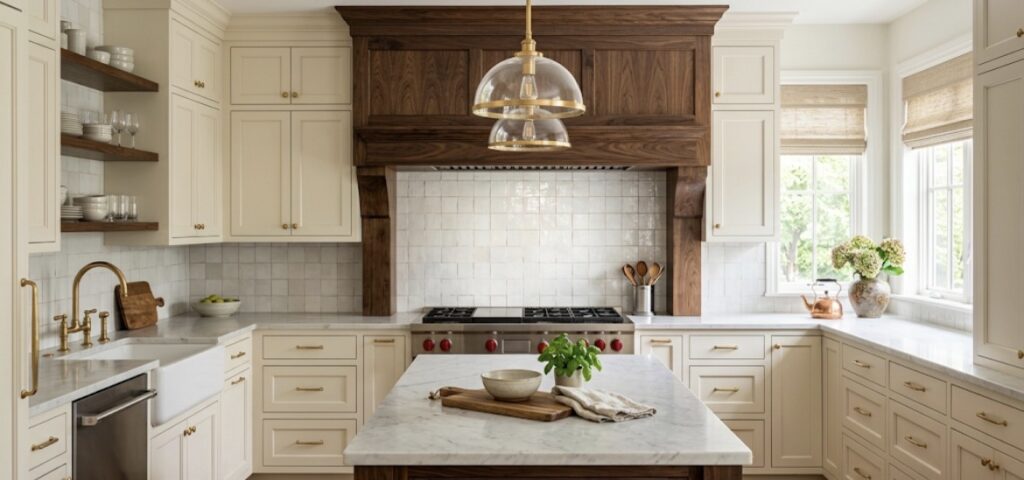
Idea 7: Walnut Bar Stools at a Cream Kitchen Island
Bar stools are one of the most underrated decor tools in a kitchen. People often choose them based purely on practicality — the right height, the right footrest — and forget that they are also furniture that sits in the middle of the room and gets looked at constantly. In a cream kitchen, walnut bar stools are a simple and effective way to bring in the walnut element without changing a single cabinet or countertop.
Walnut bar stools — whether they are solid wood with a classic silhouette, a molded seat with walnut legs, or a modern design with a walnut frame and a cushioned seat — add instant warmth to a cream kitchen island. The wood tone against the cream cabinetry creates that familiar contrast that makes the room feel complete, and bar stools are one of the easiest elements to swap out if you ever want to change the look in the future.
The style of the stool matters. In a more modern cream and walnut kitchen, a minimalist walnut stool with a contoured seat and no back creates a clean, architectural look. In a farmhouse or transitional kitchen, a walnut stool with a rush seat or a cushion in a natural linen fabric feels soft and inviting. For something in between, there are countless mid-century modern walnut stool designs — tulip legs, sculpted backs, slight tapered feet — that work across almost any kitchen style.
One styling tip: if your kitchen island has a light countertop, place the walnut stools close enough that the wood tone of the legs contrasts against the cream of the island base. This small detail creates a layered, intentional look that makes the whole kitchen feel more styled without any additional effort.
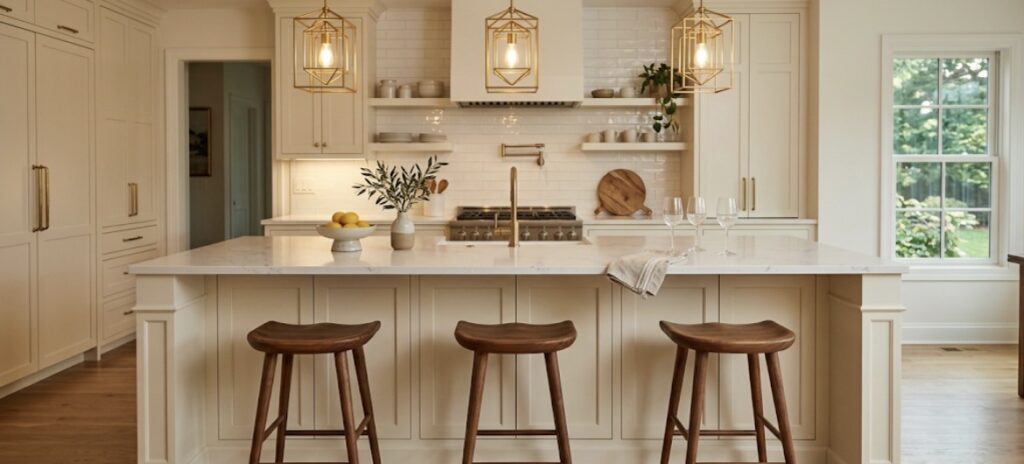
Idea 8: Cream Cabinets with Walnut Hardware and Pulls
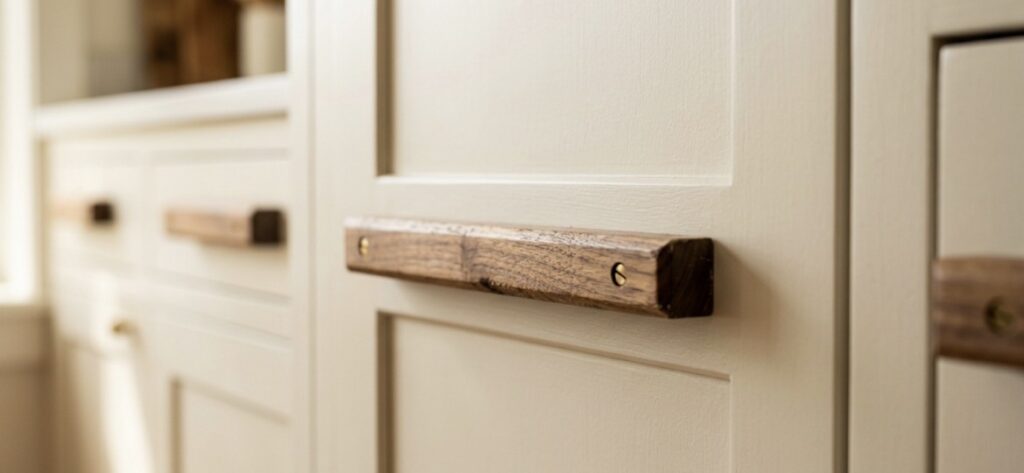
Hardware is to a kitchen what jewelry is to an outfit — and in the world of cream and walnut kitchens, walnut hardware is the unexpected choice that makes the whole look feel considered. While most people reach for brass, black, or chrome hardware when finishing off cream cabinets, wood pulls — and specifically walnut pulls — offer something different: a natural texture that no metal can replicate.
Walnut cabinet pulls, bar pulls, or knobs on cream cabinets create a soft, organic contrast that reads as warm and artisanal. The hardware does not compete with the cabinetry the way a shiny metal pull might. Instead, it feels like an extension of the natural materials used throughout the kitchen. It is a subtle thing, but when you see it, you immediately understand why it works.
This idea is particularly powerful in kitchens that already use walnut for a countertop, shelving, or island, because it ties all the walnut elements together through repetition. When the same material — or the same tone — shows up in multiple places throughout a room, the design feels intentional and cohesive rather than accidental. Walnut hardware is one of the easiest and least expensive ways to add that continuity.
Walnut pulls pair best with simple cream cabinet styles — shaker, flat-front, or inset — where the clean lines of the cabinetry let the hardware speak. On more decorative or ornate cabinet doors, the wood pulls might get lost or feel out of place. But on a clean cream shaker door, a simple walnut bar pull with brass pins on each end is a small detail that tells a very complete design story.
Idea 9: Walnut Floating Breakfast Nook or Bench Seating
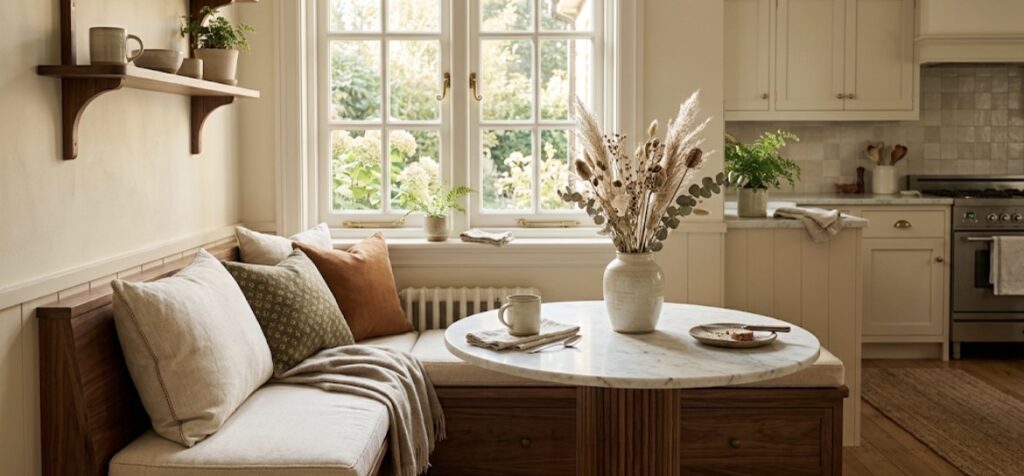
A breakfast nook is one of those kitchen features that people romanticize endlessly — and for good reason. There is something about a tucked-away corner with comfortable seating, good light, and a warm cup of coffee that just hits differently than eating at a kitchen island or dining table. In a cream and walnut kitchen, building out a breakfast nook or banquette with walnut wood as the primary material turns what could be a simple corner into the best seat in the house.
Walnut bench seating — whether it is a built-in banquette, a freestanding bench, or a combination of both — brings an enormous amount of warmth and character to a cream kitchen without requiring any cabinetry changes at all. You can add a walnut bench along one wall of your kitchen or dining area, pair it with a simple round or rectangular table, and add cushions in a cream or neutral linen fabric to tie everything back to the kitchen’s color palette. The result is cozy, functional, and genuinely beautiful.
What makes walnut particularly well-suited for a breakfast nook is the way the wood grain looks in morning light. Walnut has warm undertones — browns, ambers, occasionally a touch of purple-gray in certain cuts — that catch sunlight in a way that feels almost alive. If your breakfast nook gets morning sun, a walnut bench will glow in a way that no painted or upholstered alternative can replicate. It is one of those design choices that you feel as much as you see.
Styling-wise, this nook area benefits from a few simple touches: a small ceramic vase with a single stem, a woven place mat, a linen throw folded over one end of the bench. These are tiny details, but they make the nook feel like a real place to be rather than just a corner that happens to have a bench in it.
Idea 10: Cream and Walnut Open-Plan Kitchen with Zoned Wood Accents
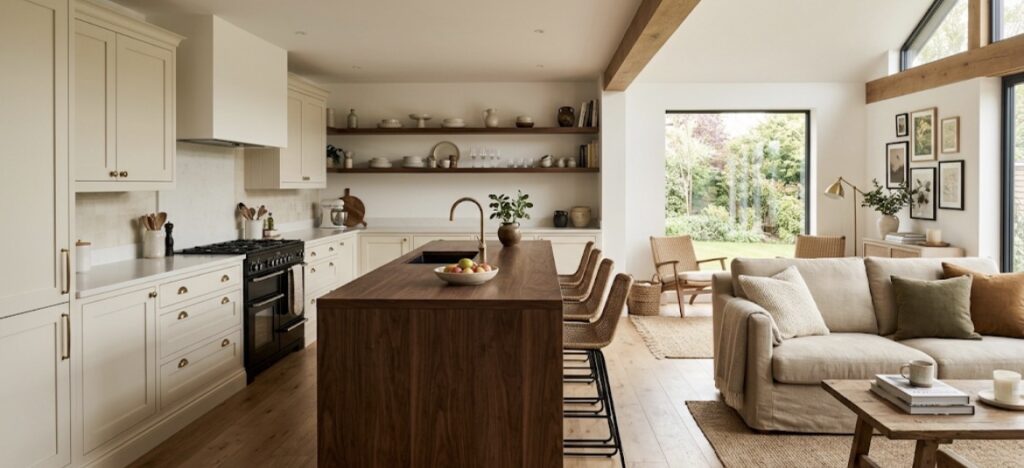
In an open-plan kitchen — where the kitchen flows directly into a living or dining area — one of the biggest design challenges is figuring out how to define the kitchen space without using walls. This is where cream and walnut become genuinely useful as a decorating strategy, because the two tones can be used to create visual zones that separate the kitchen from the rest of the space without any physical division.
The idea is to concentrate the walnut elements within the kitchen zone — an island in walnut, open walnut shelves along the kitchen wall, walnut counter stools — while the cream elements extend slightly into the adjacent living or dining area, creating a soft, gradual transition between the two spaces. This approach uses color and material as the dividing line, which is more elegant and less heavy-handed than a change in flooring or a decorative beam.
In an open-plan space, the cream and walnut kitchen also benefits from the surrounding areas. If the living room has neutral furniture, natural linen, or warm wooden furniture, the kitchen palette will feel like a deliberate continuation of the home’s overall aesthetic rather than an island of contrasting design. This continuity is what makes open-plan homes feel cohesive, and cream and walnut is an ideal palette for achieving it because both tones are warm, natural, and versatile.
For the kitchen zone itself, the walnut elements should feel concentrated enough to define the space clearly. An island in walnut is particularly effective because it creates a physical and visual boundary between the kitchen and the adjacent room. Pair it with walnut stools on the living-room-facing side, and the island becomes a natural gathering point that bridges the two spaces rather than abruptly dividing them.
Idea 11: Walnut Drawer Inserts and Interior Kitchen Details
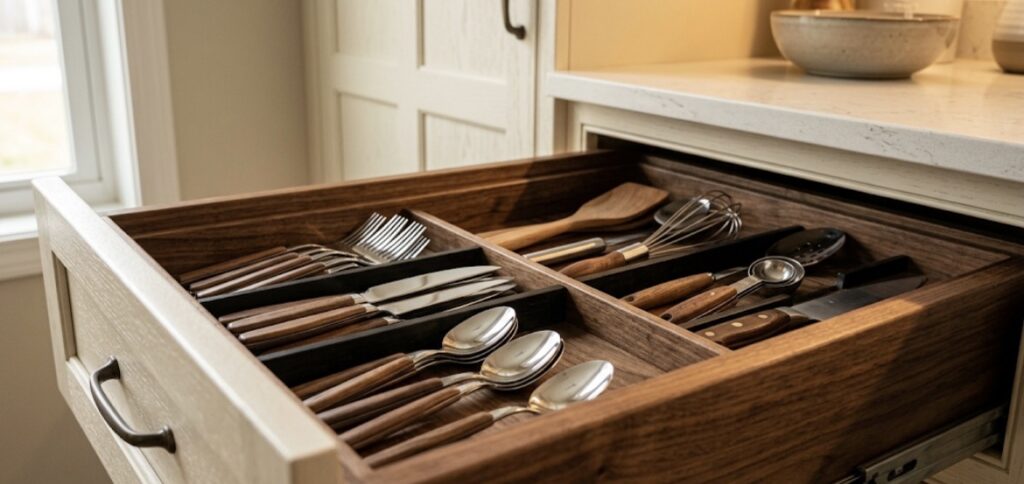
Here is a cream and walnut kitchen idea that almost nobody talks about but that makes an enormous difference when you actually use your kitchen every day: walnut interior details. Walnut drawer inserts, walnut knife blocks, walnut plate racks built into lower cabinets, walnut spice rack inserts — these are the hidden elements that make opening a drawer a small but genuine pleasure.
When you open a kitchen drawer and see a perfectly fitted walnut insert cradling your cutlery or your knives, the kitchen feels like it was designed by someone who cared about every single detail. Which, after reading this far, you clearly are. These interior elements do not show when the drawers are closed, but they add a layer of craftsmanship and warmth that elevates the entire experience of using the kitchen on a daily basis.
In a cream kitchen, walnut drawer inserts create a warm, rich contrast every time you open a drawer. The combination of cream painted cabinet exterior with a walnut interior is a small surprise — a design detail that is personal and intimate in a way that visible decor rarely is. It is the kitchen equivalent of wearing a beautiful watch that you do not show everyone. Some things are just for you.
Beyond drawer inserts, walnut can also appear in small sculptural kitchen objects that sit on the countertop: a walnut salt cellar, a walnut board for serving cheese or bread, a walnut trivet. These objects add texture and warmth to the cream countertop surface without requiring any permanent installation. They are also easy to change, update, or move — which makes them a low-commitment way to test the cream and walnut combination before committing to something more permanent.
Idea 12: Cream Walls and Walnut Flooring as the Foundation
Sometimes the most powerful cream and walnut kitchen combination does not live in the cabinets or the island at all — it lives in the bones of the space itself. Cream walls paired with walnut hardwood flooring create a kitchen foundation that almost everything else will look beautiful against. The floor becomes the largest piece of natural wood in the room, and the cream walls act as a soft, luminous backdrop that lets the walnut floor speak clearly.
Walnut hardwood flooring in a kitchen is a choice that comes up surprisingly often in design, and it works particularly well in a cream kitchen because the color temperature of both elements is warm. Walnut floors — especially in wider planks — have a richness and depth that ceramic tile and LVP often struggle to replicate. They feel softer underfoot (relatively speaking, as they are still wood), and they bring the kitchen into the same visual language as living spaces in a way that makes the whole home feel more unified.
The practical consideration with walnut floors in a kitchen is maintenance, but it is worth noting that well-finished walnut flooring is durable and can handle the spills and traffic of a kitchen environment with proper care. A matte or satin finish is generally preferable to a high gloss, both for aesthetics — the floor should complement the room, not compete with it — and for hiding the small scratches and marks that come with normal use.
In a kitchen with cream walls and walnut flooring, the cabinetry can go in almost any direction. Cream cabinets that match the walls create a tonal, seamless look where the floor becomes the hero. Adding walnut accents — a shelf, an island, or a wood hood — ties the floor and the accents together into a cohesive and warm material story. Either way, the cream-and-walnut foundation does most of the work before you even choose a hardware finish.
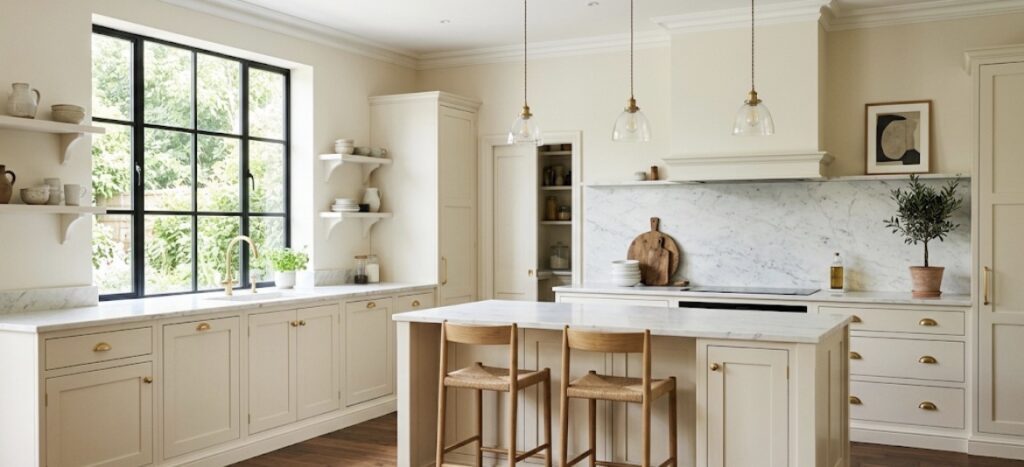
Idea 13: Cream and Walnut Kitchen with Layered Natural Textures
The fourteenth and final idea is less about one specific element and more about an approach — a way of thinking about cream and walnut that brings the whole kitchen together through layered natural textures. This idea recognizes that cream and walnut are just the beginning of a broader material conversation, and that the best cream and walnut kitchens layer in other natural materials that complement and deepen those two anchor tones.
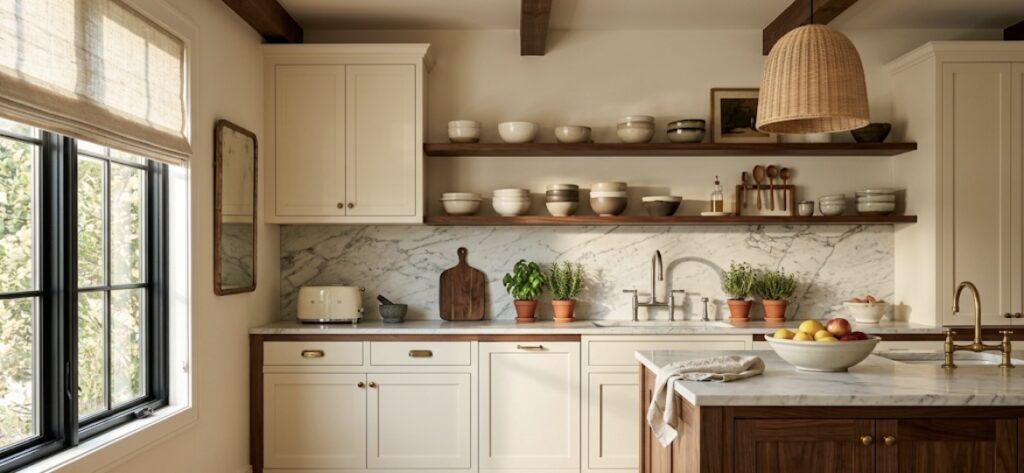
Think about what happens when you add a linen roman blind to the kitchen window. Or a rattan pendant light above the island. Or a jute rug in front of the sink. Or ceramic canisters in a warm off-white on the walnut shelves. Or a marble backsplash with gentle warm veining that echoes the walnut’s natural patterns. Each of these additions speaks the same language as cream and walnut — natural, warm, honest — and together they build a kitchen that feels layered and complete rather than decorated.
The secret to this idea is that every texture you add should feel like it belongs to the same family. Linen, jute, rattan, stone, clay, natural wood — these are all materials that come from the earth, and they coexist beautifully because of that shared origin. They all have variation, imperfection, and a warmth that manufactured or synthetic materials cannot replicate. When you layer them into a cream and walnut kitchen, the room starts to feel like a place that grew naturally over time rather than one that was assembled from a showroom catalog.
This is also the most forgiving of all the ideas in this list, because it can be applied to any existing cream and walnut kitchen at any scale. You do not need new cabinets or new countertops. You need a linen blind, a ceramic bowl, a walnut cutting board, a woven place mat, and a small plant in a terracotta pot. Start there. Layer slowly. Live with it for a while. The kitchen will tell you what it needs next.
Final Thoughts: Building a Cream and Walnut Kitchen That Feels Like You
There is a reason cream and walnut kitchen decor ideas come up again and again in design conversations, on mood boards, and in the homes of people who love to cook, entertain, and spend time in their kitchens. The combination works because it is human. It is warm. It does not try to look like a laboratory or a hotel lobby. It looks like a kitchen where things actually happen — where bread gets made and coffee gets drunk and someone always ends up sitting on the counter talking while dinner is being cooked.
The 14 ideas in this post span a wide range of approaches, from the dramatic (a full two-tone cabinet setup or a statement walnut island) to the subtle (walnut hardware or a floating shelf). Some require renovation. Some require only a weekend and a trip to a home goods store. But all of them share the same underlying logic: cream provides the light, walnut provides the warmth, and together they create a kitchen that is greater than the sum of its parts.
The best version of your cream and walnut kitchen is not the one you saw on Pinterest or in this blog post. It is the one that reflects how you actually use your kitchen, what you find beautiful, and how much of your daily life takes place in that room. Use these ideas as starting points, mix and match freely, and trust that the combination of cream and walnut will forgive almost any styling decision you make along the way. It is a remarkably generous palette. And your kitchen — like that well-matched outfit and perfectly balanced meal — is going to look exactly right.