
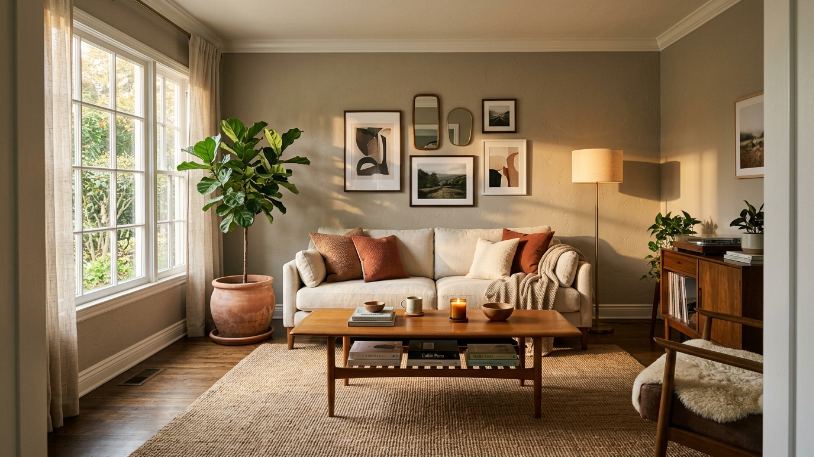
Grey gets a bad reputation. Most people assume a grey living room will feel cold, clinical, or like a government waiting room with better throw pillows. But when you know how to style a grey living room the right way, it becomes one of the most flexible, layered, and genuinely beautiful spaces in a home.
The trick is the build order. You do not just pick a grey, throw in a sofa, and hope for the best. You start with the right shade of grey, anchor the space with the right furniture layout, then build up through texture, color, lighting, and accents. This guide walks you through every step of that process.
By the end, you will know exactly how to style a grey living room that feels warm, intentional, and like it was made for you. No guessing, no backtracking.
Before You Style a Grey Living Room, Start Here
Many people skip straight to shopping. They pick a sofa, paint the walls, and then spend six months wondering why the room still feels off. The reason is almost always the same: the build order was wrong. You styled the top of the room before the foundation was solid.
This guide follows a clear build order. You begin with the foundation (the right grey, the layout, and the anchor furniture), then layer in color, texture, lighting, and accents. Each step depends on the one before it. Follow the sequence and the room comes together naturally.
One more thing before you start: measure your room and photograph it at different times of day. Natural light is your most important styling tool in a grey living room, and you need to know how yours behaves before you make any permanent decisions.
Step 1: Choose the Right Shade of Grey

Not all greys are the same. Some lean blue. Some lean green. A few lean pink or purple, and those surprises tend to show up only after the second coat dries on all four walls. Understanding the undertone in your grey is the single most important move you make when you style a grey living room, because that undertone controls every other decision.
Cool greys, those with blue or green undertones, work best in rooms with strong, consistent natural light. They feel crisp and fresh. Warm greys, often called greige because they sit somewhere between grey and beige, are more forgiving. They pair naturally with wood tones, linen fabrics, and organic materials, which makes them easier to style around.
To find the right shade for your space, paint at least three large test swatches directly on your wall. Make each one at least 12 inches by 12 inches. Then check them in the morning light, the afternoon light, and at night under your lamps. The same grey can read completely differently in each condition, and you need to see all three before you commit.
A few proven starting points worth testing:
- Repose Gray (SW 7015): A warm, balanced grey that works in almost any light condition
- Agreeable Gray (SW 7029): More beige than grey, but pulls beautifully into the warm grey range
- Classic Gray (BM OC-23): Soft and airy, reads near-white in bright rooms with large windows
- Chelsea Gray (BM HC-168): Deeper and moodier, best for rooms with good natural light throughout the day
Step 2: Plan Your Layout Before You Buy Anything
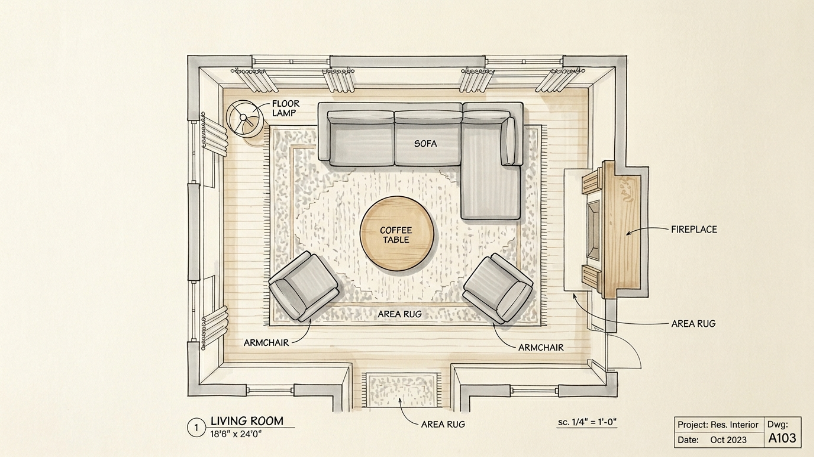
Good furniture in a badly planned layout still looks bad. So before you spend a single dollar on a sofa or a rug, sketch the room on paper. Measure the length and width of the space, mark every window and door, and note any fixed features like a fireplace, built-in shelving, or a column.
The most common mistake people make when they style a grey living room is pushing all the furniture against the walls. It feels safe, but it actually makes the room look smaller and more rigid. Instead, float your sofa and chairs toward the center and aim them at a clear focal point, whether that is a fireplace, a TV unit, or a large piece of art.
Your area rug is what anchors the whole arrangement. Size it correctly: ideally, all four legs of the sofa sit on the rug. At minimum, the front two legs should be on it. A rug that is too small makes the entire seating group look untethered, and in a grey room that already trends cool and understated, an untethered layout reads as cold and unfinished.
In an open-plan space, the rug becomes even more critical. It tells the room where the living area begins and where the dining or kitchen zone takes over. Without it, a grey open-plan space can look like one large, directionless grey room with furniture in it.
Step 3: Anchor the Room with the Right Sofa

The sofa is the most important piece of furniture in a grey living room. It takes up the most visual space, and it sets the tone for every other decision. You have two main directions: match grey to grey for a tonal, layered look, or choose a contrasting tone like cream, warm white, or camel to make the sofa stand out against the walls.
A grey sofa against grey walls can look very intentional and sophisticated. However, it requires strong texture contrast to keep the room from feeling flat. Think deep velvet, chunky boucle, or a linen weave with visible structure. Without texture, the sofa disappears into the walls and the room becomes one large grey mass with nowhere for the eye to land.
A light sofa, cream or oatmeal linen, is often the simpler starting point. It creates natural contrast against grey walls and adds warmth right away. From there, you can style grey living room accents around it without having to work against the sofa color at every turn.
Here are the main sofa fabric options to weigh:
| Fabric | Look and Feel | Best For | Watch Out For |
| Boucle | Warm, soft, heavily textured | Cozy, organic, earthy rooms | Snags easily with pets |
| Velvet | Rich, plush, luxurious | Bold, layered, statement-forward rooms | Needs regular brushing |
| Linen | Relaxed, natural, lightweight | Bright, airy, casual rooms | Wrinkles and shows wear |
| Performance fabric | Practical, clean, modern | High-traffic and family rooms | Can look less tactile |
| Leather | Sleek, smooth, structured | Minimal, modern, graphic rooms | Can feel cold in a grey room |
Step 4: Build a Color Palette That Makes Your Grey Living Room Style Work

Grey is a neutral. On its own, it does very little. It needs a supporting cast of colors to bring the room to life. Without a clear color palette, a grey living room feels unfinished no matter how good the furniture is.
For a warm, welcoming feel, pair grey walls with tones like terracotta, warm white, mustard yellow, blush, or camel. These warmer tones soften the cool edges of grey and make the space feel genuinely lived-in. For a sharper, more graphic look, work with navy, forest green, or black alongside clean white accents. The contrast reads bolder and more modern.
Here is a quick pairing guide based on grey shade:
| Grey Shade | Warm Palette | Cool Palette | Metal Tone |
| Warm grey or greige | Cream, camel, rust, blush | Dusty blue, sage green | Brushed brass |
| Cool grey (blue undertone) | Mustard, terracotta, warm oak | Navy, crisp white, black | Matte black or chrome |
| Deep grey or charcoal | Gold, off-white, warm walnut | Emerald, cobalt, silver | Polished brass or gunmetal |
| Light grey (near white) | Soft blush, warm beige, linen | Pale blue, mint, dove white | Rose gold or silver |
Stick to a three-color palette: your grey, one main accent color, and one neutral. This gives the room enough variety to stay interesting without getting busy. You can bring in a fourth accent color through accessories, but keep it rare and intentional.
Step 5: Layer Textures to Make the Room Feel Alive
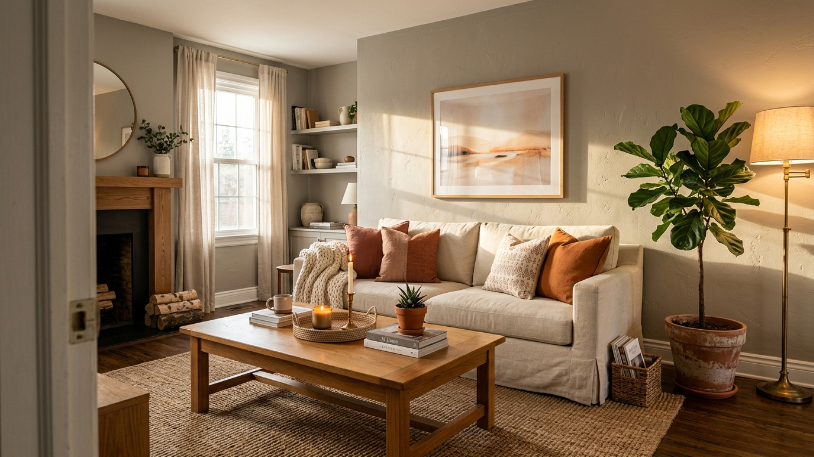
Texture is what separates a flat, forgettable grey room from one that feels rich, warm, and intentional. Grey is actually an ideal base for texture layering because it does not compete with materials the way a bolder color often does. It steps back and lets the surfaces do the talking.
Think of the room in three horizontal layers: the floor, the middle zone (furniture and walls), and the top layer (cushions, throws, and accessories). Each zone should have at least two different materials working together. For example, a jute rug on the floor, a smooth walnut coffee table in the middle, and a chunky knit throw on the sofa at the top.
Strong texture combinations for a grey living room:
- Soft textures: Boucle cushions, a wool throw, a velvet pillow cover, cotton knit
- Natural textures: Jute rug, rattan side table, linen curtains, raw linen cushions, woven basket
- Hard textures: Brushed brass lamp base, matte black candle holder, ceramic vase, smooth stone tray
- Shiny materials rule: Use no more than two reflective or shiny materials in one room. Too many reflective surfaces make a grey room feel clinical rather than calm.
Also vary the weight of your textiles. A heavy wool throw sitting beside a lightweight linen cushion feels more natural and considered than using the same fabric weight everywhere. Most people overlook this detail. It is also one of the things that makes a room look genuinely styled rather than just bought and placed.
Step 6: Layer Your Lighting

Lighting is where most attempts to style a grey living room fall apart. Grey walls absorb and reflect light differently than white walls, and a single overhead fixture is rarely enough to keep a grey room from feeling dim and heavy. You need multiple sources working together.
Build your lighting in three layers. First, ambient lighting: your main source, whether that is a ceiling fixture, recessed downlights, or a pendant light. Second, task lighting: a floor lamp beside a reading chair, or table lamps on both ends of a sofa. Third, accent lighting: a picture light above a piece of art, a wall sconce, or warm LED strip lights behind a TV unit or bookshelf.
For bulb temperature, warm white bulbs rated at 2700K to 3000K almost always look better in a grey living room than cool white or daylight bulbs. Cool bulbs push grey further toward cold and clinical. Warm bulbs bring out any warm undertones in your grey and make the whole room feel more settled.
Aim for at least three separate light sources in a standard living room. A sofa-side table lamp, a floor lamp in a corner, and one main ceiling fixture gives you a solid working base. In the evenings, try turning off the overhead entirely and relying only on the lamps. The difference is immediate, and honestly, a bit embarrassing, because you will wonder why you did not do it sooner.
Step 7: Add Accents That Help You Style Your Grey Living Room With Personality

Accents are where your personality enters the room. In a grey living room, they carry most of the visible warmth and color, so they are doing serious work even when they look casual. Think of them as seasoning, not the main ingredient. A little placed correctly goes much further than a lot placed randomly.
Cushions are the fastest way to shift the mood. Two or three terracotta and cream cushions give the room a warm, organic feel. Swap them for navy and sage, and the same room suddenly reads sharper and more graphic. Keep it at two or three cushions per sofa seat. More than that and the sofa starts to look like a furniture showroom floor model, which is not the vibe.
For walls, one large piece of art works better than a collection of small pieces. An oversized print or canvas above the sofa anchors the wall properly. If you prefer a gallery arrangement, keep all the frames in one consistent finish, matte black or warm brass, and space them evenly. Consistency in the frames pulls a mixed gallery together even if the artwork itself varies widely.
A few accent ideas that work particularly well when you style a grey living room:
- A large ceramic vase in terracotta, deep navy, or matte white
- Brass or matte black frames on art and mirrors
- A woven wall hanging in natural jute or cotton rope
- Stacked books with warm or neutral-toned spines on a coffee table
- A tray on the coffee table with one candle, one small object, and one small plant
- A single large mirror in a simple warm wood or brass frame to bounce light around the room
Step 8: The Final Edit, How to Complete Your Style Grey Living Room Look
Plants belong in a grey living room. They bring color, scale, and life that no cushion or candle can replicate. A large fiddle-leaf fig or snake plant in a corner softens the room immediately and adds warmth without any additional color layering required. Smaller plants on shelves or a windowsill add depth and a sense of the room being genuinely cared for.
Next, do the final edit. This is the step most people skip, and it is the one that separates a styled room from a merely furnished one. Once the room is fully set up, stand at the doorway and look at the entire space as a single image. Remove anything that looks random, fussy, or like it wandered in from another room. Clutter reads more harshly in a grey living room than it does in a warmer, busier space.
Then check your visual balance. If all the color is concentrated in one corner, redistribute some of it across the room. If all the texture is on the sofa, add a textured bowl to a shelf or a woven runner to the coffee table. The goal is even visual weight across the space, so no single area is pulling too hard while another corner sits empty.
Here is your final styling checklist before you call it done:
Grey shade tested in both natural and artificial light conditions
Sofa anchored on a properly sized area rug (front two legs minimum)
At least three separate light sources in the room
Texture variety across the floor, furniture, and accessory layers
Color palette limited to three main tones, four at most
At least one plant added for warmth and life
Final edit completed; nothing random, nothing fussy left on display
Final Thoughts
Styling a grey living room is really just about understanding layers. Start with the right shade of grey, plan the layout before you buy anything, anchor with the right sofa, then build up through color, texture, lighting, and accents in that order. You now have the full build sequence. Go put the room together, and go enjoy it.