
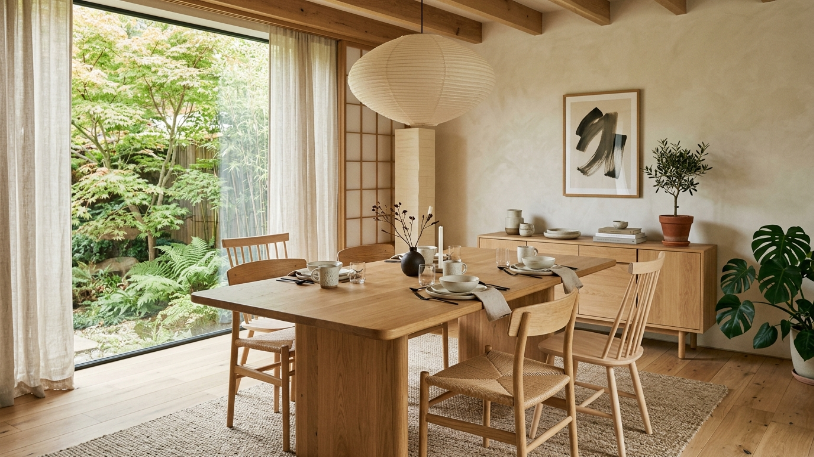
There is a certain kind of room that makes you slow down the moment you walk in. No instruction, no prompt, no sign on the wall. The room just does that on its own. Japandi dining rooms are built to create exactly that feeling.
The name combines Japanese and Scandinavian design, two approaches that share more in common than most people realize. Japanese interiors are rooted in restraint, ritual, and a philosophy called wabi-sabi, which finds beauty in imperfection and in things that have been genuinely used. Scandinavian design brings warmth, function, and hygge, that untranslatable coziness that makes cold evenings feel entirely worth staying home for. Together, they produce a dining room that is calm without being cold, simple without being sparse.
The dining room may be the best room in the house to apply this philosophy. You eat here, you talk here, you sit still here. The room should support all of that. Japandi dining rooms do exactly that. They do not distract from the meal or the people at the table. They hold everything quietly and let the important parts breathe.
This post walks you through 13 beautiful ideas for building that kind of space. Some are decisions about furniture. Others are small changes to color, light, or texture. All of them follow the same core principle: use less, choose well, and let the room settle into itself.
What Makes Japandi Dining Rooms Different
Most interior styles are defined by what they add. Japandi dining rooms are defined by what they leave out.
Where a maximalist approach fills every surface and a traditional style layers ornament on ornament, Japandi takes the opposite route. Every object has to earn its place in the room. If it does not serve a function or bring genuine calm, it simply does not belong.
However, this does not mean the style is cold or sterile. The warmth comes from the materials themselves, from the grain of a wood table, the texture of a linen runner, and the irregular glaze on a handmade bowl. These things feel warm because they are honest. They were not manufactured to look perfect. They were made to be used.
Also, the philosophy behind Japandi matters as much as the aesthetic. Japanese wabi-sabi teaches that imperfection is part of beauty. Scandinavian hygge reminds us that comfort is a basic need, not a luxury. A Japandi dining room holds both ideas at the table, which is exactly where they belong.
1. A Solid Wood Table That Anchors the Room
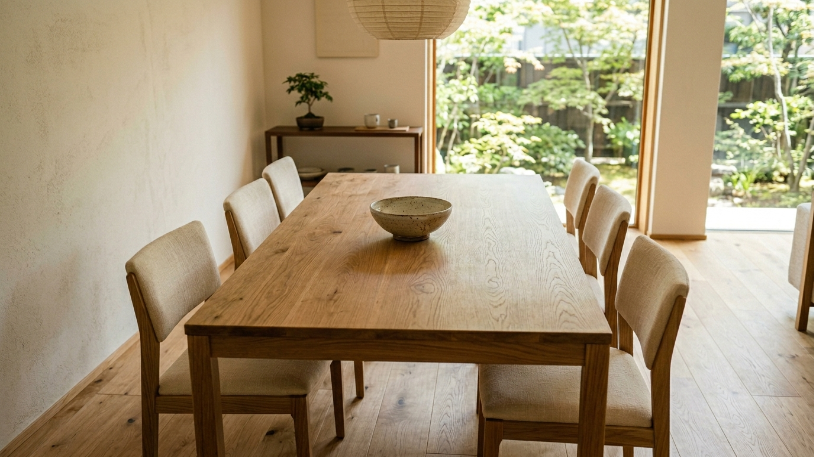
The dining table is the center of a Japandi dining room in every sense. It is the first thing you see, the thing everyone moves toward, and the piece that sets the tone for everything else in the space. For this reason, wood is the only material that truly belongs here.
Oak is the most popular choice, and it earns that status. Light oak is warm without being heavy, and it pairs cleanly with almost any neutral on the walls. Walnut is the better pick if you want more depth and contrast, though it tends to absorb light rather than reflect it, so rooms with reliable natural light suit it best. Ash and white oak sit between the two and read particularly well in smaller dining spaces.
When choosing your table, look for:
- Clean, straight lines with no excessive ornamentation
- A visible, natural grain with a matte oil or wax finish
- A size that fits the room without crowding it
- Solid wood construction rather than veneer or composite board
You do not need the largest table in the room. You need the right one. A Japandi table is not trying to impress anyone. It just needs to hold a good meal and a few good people, and for that, honest wood is always the correct material.
Once your table is in place, styling becomes the next conversation. For more on that process, see the full guide on how to style a dining table like an interior designer.
2. Neutral Wall Colors That Set the Tone
The walls in Japandi dining rooms almost always stay quiet. That is not a limitation. It is the design decision that makes every other element in the room look intentional rather than accidental.
The palette here is rooted in warmth, but that warmth comes from tone and undertone rather than any strong color. You are not painting the walls warm beige because you could not choose anything else. You are choosing a specific, considered neutral because it creates the backdrop the room actually needs to function.
For reliable warm neutrals, Sherwin-Williams Accessible Beige (SW 7036), Drift of Mist (SW 9166), and Alabaster (SW 7008) all perform consistently well in this kind of space. Benjamin Moore White Dove (OC-17) is another strong option, especially when your floors are on the darker side. Browse the full Sherwin-Williams warm neutral paint collection to find the shade that suits your room’s light and orientation.
Here is a quick guide to Japandi wall color pairings:
| Wall Color | Best Paired With | Room Mood |
| Alabaster SW 7008 | Dark walnut table, matte black hardware | Airy and grounded |
| Drift of Mist SW 9166 | White oak, rattan, warm linen | Soft and layered |
| Accessible Beige SW 7036 | Oak, warm gray, natural stone | Earthy and calm |
| White Dove BM OC-17 | Charcoal upholstery, bamboo accents | Clean and warm |
| Mindful Gray SW 7016 | Natural wood tones, sage green plants | Understated and fresh |
Keep the ceiling tone consistent with or slightly lighter than the walls. A bright white ceiling in an otherwise warm room breaks the visual calm that Japandi dining rooms depend on. Also, if your dining area opens to a kitchen or living space, carry the same wall color through. The eye needs somewhere to rest without interruption.
3. Natural Fiber Rugs for Warmth Underfoot
A rug does a lot of quiet work in a dining room. It defines the space, softens the sound, and adds a layer of texture that hard floors cannot produce on their own. In Japandi dining rooms, natural fiber is the consistent choice, and it is consistent for good reason.
Jute and sisal are the two most popular options. Jute is softer underfoot and carries a slightly golden warm tone that works well under pale walls. Sisal is more textured and more durable, which suits rooms where practicality matters as much as aesthetics. Both materials look best in their natural undyed state, though warm cream, sand, and light taupe are also appropriate.
A few things worth getting right:
- Size it so all chair legs remain on the rug even when chairs are pulled out, usually at least 24 inches beyond the table on each side
- Stick to solid tones or very subtle weave patterns with no bold prints or high contrast
- Hemp is a third option, rougher in texture but well-suited to rooms with darker flooring
Also, do not stress too much about rug maintenance in a dining room. Most natural fiber rugs age well. A little wear actually adds to the wabi-sabi quality that Japandi dining rooms are designed around. The idea is not a pristine showroom floor. The idea is a room that shows it has been genuinely lived in.
4. Statement Pendant Lighting With a Purpose
Lighting is one of the few places where Japandi dining rooms allow a little personality. The rest of the room is carefully restrained, so the light fixture above the table is free to do something a little more noticeable, as long as it stays honest about its materials.
The most common choices are woven bamboo or rattan pendants, paper lantern shapes, and simple matte black metal fixtures. Each brings something different. Bamboo and rattan add organic texture and warmth, with visual roots in Japanese craft traditions. Paper shade pendants create a soft, diffused glow that makes every meal feel somehow more relaxed than it probably is. Matte black metal pendants add a point of contrast that grounds an otherwise light palette without going heavy.
For bulbs, warm white in the 2700K to 3000K range is the correct choice. This flatters warm neutral walls and avoids the harsh clinical overhead effect that makes everyone at the table look vaguely unwell. Nobody wants that.
Practical guidelines:
- Hang the pendant 28 to 34 inches above the tabletop for standard ceiling heights
- For a long table, use two or three smaller pendants instead of one oversized fixture
- Keep the pendant diameter within two-thirds of the table width
Good pendant lighting is the difference between a Japandi dining room that photographs well and one that actually feels good to sit in. In this case, you can usually get both.
5. Low, Comfortable Seating That Invites You to Stay
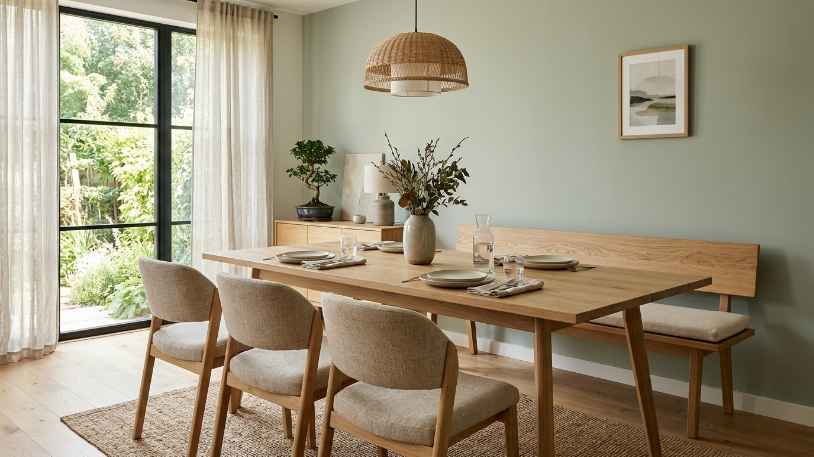
The chairs in Japandi dining rooms are designed to make you stay at the table longer than planned. Japanese furniture traditions lean toward lower, more grounded seating, and that philosophy carries into the dining room even when using standard chair heights. What matters more than any specific measurement is the spirit of the chair itself.
You are looking for clean lines, no excess ornament, and nothing that looks like it is trying too hard to be noticed.
Good seating options for Japandi dining rooms include:
- Linen or cotton upholstered chairs in warm cream, warm gray, or muted sage green
- Solid wood chairs with a simple curved back and no armrests
- Bench seating along one side of the table, in solid wood or with a slim upholstered cushion
- A combination of chairs on one side and a bench on the other
Mixing chair types actually works well in Japandi spaces. A bench on one side paired with individual chairs on the other brings an organic, relaxed quality that suits the style. However, keep the tones consistent so the seating reads as deliberate rather than assembled from different places over time without a plan.
Upholstered seats in warm linen add texture that solid wood alone simply cannot provide. The extra effort to keep them clean is worth it for what they give back to the room.
6. Handmade Ceramics as Everyday Decor
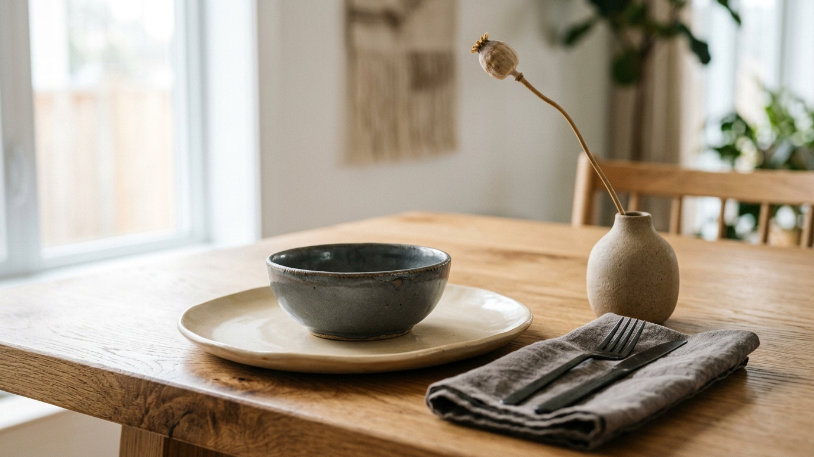
One of the most practical things about Japandi dining rooms is that the decor and the tableware are often the same objects. There is no separate category for decorative pieces and functional items. The ceramic bowl you use for dinner every night is also the most visually considered thing on the table.
This is wabi-sabi in practice. The beauty is in the imperfection: the slightly uneven glaze of a handmade mug, the faint ring left by a bowl that has been used dozens of times. None of that is a flaw. It is evidence of use, and in Japandi, use is entirely the point.
When choosing ceramics, look for:
- Matte or stone-like finishes rather than glossy glazes
- Warm neutral tones: sand, taupe, charcoal, warm white, muted sage
- Irregular shapes that feel hand-formed rather than factory-produced
- Pieces that stack and store simply
A single ceramic vase with one dried stem, a set of handmade bowls on the table, or a textured clay platter used as a centerpiece are all sufficient. For ideas on how warm neutral tones carry through different rooms and support this kind of layering, the guide on beige and cream interior ideas is worth reading alongside this one.
You are not decorating for a showroom. You are building a table you actually want to sit down at every day.
7. Dark Accents for Quiet Contrast
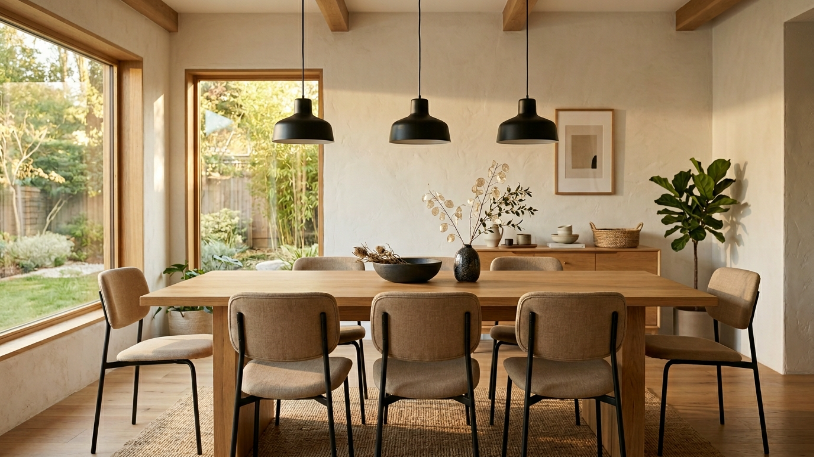
A room that is entirely cream and sand will start to feel a little anonymous after a while. Dark accents are the solution, and they work because they make the lighter tones around them look intentional rather than simply pale.
The most effective dark accents in Japandi dining rooms are matte black chair legs and table frames, dark pendant light fixtures, charcoal ceramics placed among lighter pieces, and a single dark-stained sideboard along one wall. Each adds visual weight without disrupting the overall calm of the space.
Charcoal, near-black, and deep warm brown tend to work better than pure black, which can feel slightly heavy in a warm-toned room. A soft dark shade like Benjamin Moore Wrought Iron (2119-10) is a useful reference point, though any deep, slightly warm dark tone with a matte finish will read correctly here.
The principle is restraint:
- Two or three points of dark contrast are enough for the whole room
- If you have dark chair legs, you may not need a dark pendant as well
- A single charcoal serving bowl on the table can anchor the entire palette
Getting this balance right is one of the genuinely satisfying parts of Japandi dining room design. When the dark accents land correctly, the rest of the room seems to settle into place around them. The whole space feels grounded rather than just soft.
8. Greenery That Knows When to Stop
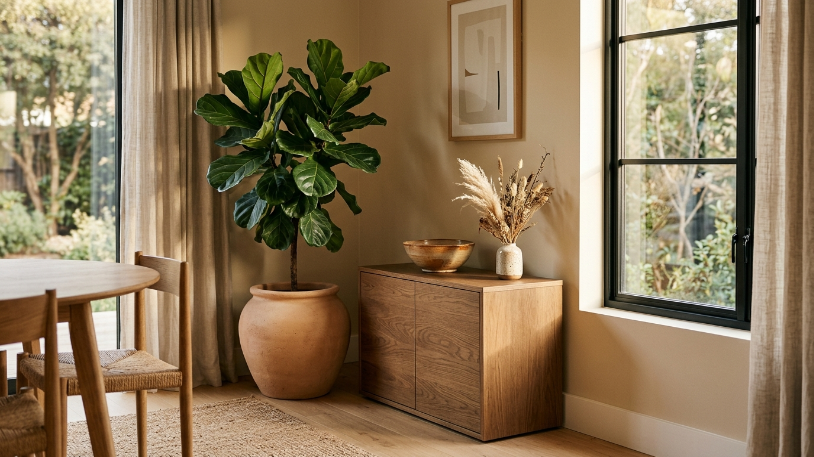
Plants belong in Japandi dining rooms, but the style is not a jungle. One or two well-chosen plants do more for a Japandi space than fifteen small pots scattered across every surface. Less, done with intention, consistently reads better here.
The best plants for this style tend to share a few qualities. They are sculptural, calm, and do not require constant intervention. A single fiddle-leaf fig in a matte terracotta pot works well in a corner with reliable indirect light. A small bonsai on a sideboard adds visual character without competing with the rest of the room. A trailing pothos in a simple stone-toned planter softens hard surfaces without overwhelming them.
Plants that suit this space well:
- Fiddle-leaf fig: tall shape, good in bright indirect light
- Peace lily: soft, low-maintenance, air-purifying
- Japanese maple bonsai: small scale, strong visual presence
- Pothos in a matte ceramic pot: trailing, forgiving, adds softness
Keep the pots simple. Matte terracotta, warm stone, unglazed ceramic, and charcoal all work within the Japandi palette. Avoid anything with very busy foliage, bold color, or an ornate container. The plant should feel like it grew up in the room.
Also, dried branches, dried pampas grass, and preserved botanicals are valid alternatives if live plants are not practical for your space. They hold their shape well and continue to look considered without needing any attention.
9. Linen Textiles That Soften the Space
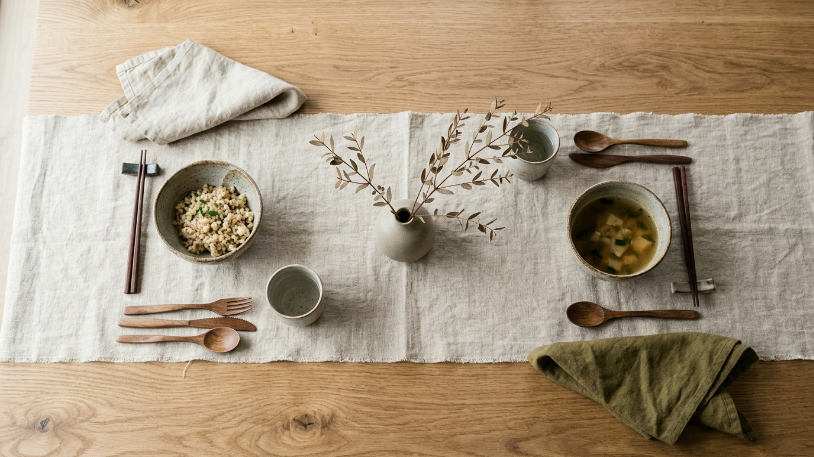
Wood, ceramic, stone, and concrete do most of the structural work in a Japandi dining room. However, without soft textiles to balance those hard surfaces, the room can tip from calm into cold. Linen is the material that fixes this, and it is genuinely hard to go wrong with it.
A linen table runner is one of the simplest changes you can make to a Japandi dining table. It does not cover the full surface, so the wood grain remains visible underneath. Still, it adds texture, warmth, and softness in a single piece. Natural undyed linen, warm cream, dusty sage green, or soft warm gray are all appropriate. Avoid prints with strong contrast or busy patterns.
Other textiles worth layering in:
- Linen napkins folded simply without elaborate shaping
- A woven cotton or linen seat cushion for solid wood chairs
- A plain cream linen curtain as a minimal window treatment
- A knitted wool table mat in a neutral earthy tone for a cold-weather look
Natural creases in linen are not a problem. In fact, a slightly relaxed runner that has been washed a few times looks better than something pressed flat and stiff. The small imperfections are part of what makes linen so well-suited to Japandi dining rooms. The slight softness, the gentle texture, and the honest material all fit the wabi-sabi philosophy without any extra effort.
10. An Open Sideboard or Minimal Wall Storage
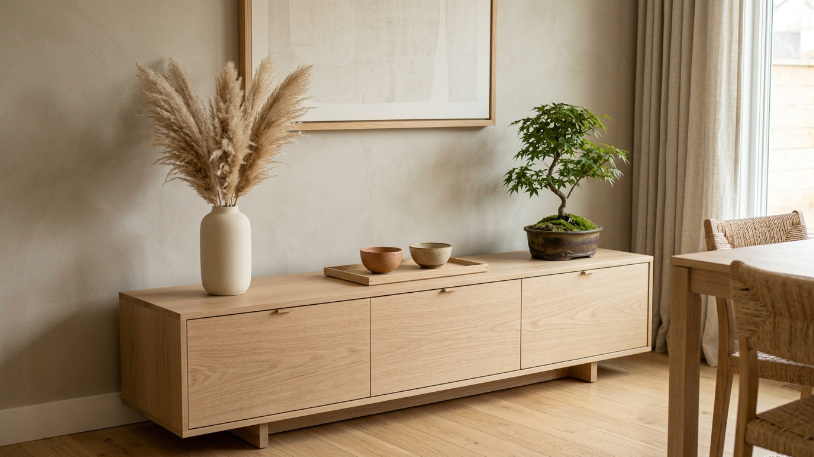
Storage in Japandi dining rooms should be honest about what it holds. You are not hiding every object behind closed cabinet doors to pretend the room has no practical function. But you are also not leaving piles of things in plain sight without any sense of order.
A sideboard is probably the most useful secondary piece of furniture you can add to a Japandi dining room. It holds dinnerware, linens, candles, and serving pieces. The objects placed on top of it also serve as the room’s secondary visual layer, so what you put there matters as much as what you put in the drawers.
For a well-styled Japandi sideboard surface:
- One or two ceramic pieces, a vase, or a small bowl in warm neutral tones
- A single plant or a few dried stems in a simple container
- One meaningful object or a very simple piece of art
- Clear, empty space between each item, not just between objects but within the arrangement itself
Low-slung sideboards in white oak, walnut, or bamboo all suit the style well. Wall-mounted floating shelves work well in smaller rooms where keeping the floor clear matters. Open shelving also means your ceramics and serving pieces are always on display, which turns functional objects into part of the decor. That is very much the Japandi approach.
Whatever storage solution you choose, give the visible surfaces ongoing attention. A sideboard that gradually becomes a catch-all for unrelated objects will undermine the whole mood of the room.
11. Shoji-Inspired Dividers for Open-Plan Spaces
Not every Japandi dining room has its own walled space. Many are open to the kitchen or living area, and the challenge becomes defining the dining zone without closing it off entirely. Shoji-inspired dividers are one of the most graceful solutions to this problem.
Traditional Japanese shoji screens use a wood frame and translucent rice paper to allow light through while creating a visual boundary between spaces. In a contemporary Japandi home, you have several options that apply the same principle:
- A freestanding wood-framed screen with frosted or semi-translucent panels
- Hanging linen fabric panels suspended from a ceiling track
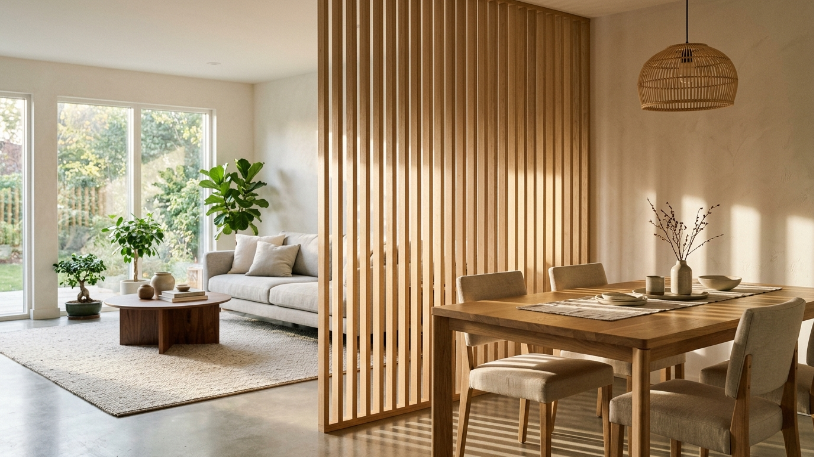
- A slatted wood partition with even spacing that allows light to pass through
- A floor-to-ceiling open shelving unit that defines the zone without blocking sightlines
Any of these options helps define the dining area without making the home feel smaller. For more compact open-plan spaces, even a low sideboard placed perpendicular to the wall can create a soft visual boundary without the formality of a full screen.
One thing worth considering: if the divider is visible from both sides, both sides should look intentional. A screen with a styled face and an unstyled back facing the kitchen will undermine the effect. Plus, natural wood tones, linen, and bamboo all work as divider materials because they stay within the same palette as the rest of the room, which is exactly where they need to be.
12. The Right Color Palette for Japandi Dining Rooms
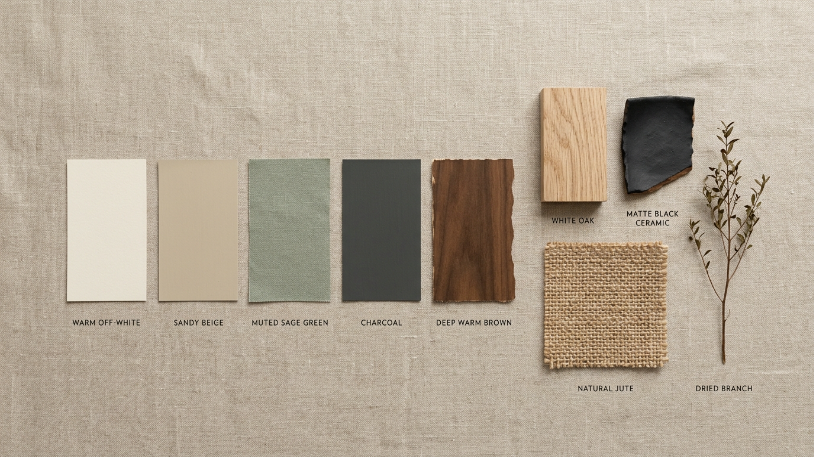
Color is where Japandi dining rooms either settle quietly into the right feeling or fall apart at the first glance. The palette is not neutral for safety’s sake. It is neutral because the whole philosophy of Japandi is about reducing visual noise so the important things, the people, the food, and the moment, are free to take center stage.
Your base should be warm whites and soft beiges. From there, you layer in muted earthy accents: dusty sage, warm gray, and deep charcoal in smaller proportions. Cool whites, bright primaries, and high-contrast patterns do not belong here.
A simple color formula to work from:
- Walls: Warm off-white; Alabaster SW 7008, White Dove BM OC-17, Drift of Mist SW 9166
- Wood tones: Light to medium; white oak, ash, or bamboo
- Textiles: Warm cream, natural linen, dusty sage
- Accent objects: Charcoal, matte black, deep warm brown
- Ceramics and plants: Earthy clay, muted sage, warm sand
For practical guidance on how neutral and earthy tones work together in a real dining room, Benjamin Moore’s dining room color ideas is a useful starting point before you commit to any paint.
The palette works because everything within the warm neutral system naturally harmonizes. One element that goes too cool or too saturated will stand out immediately against the rest. Stay within the range, and the room will always feel settled rather than assembled.
13. Natural Light as the Final Layer
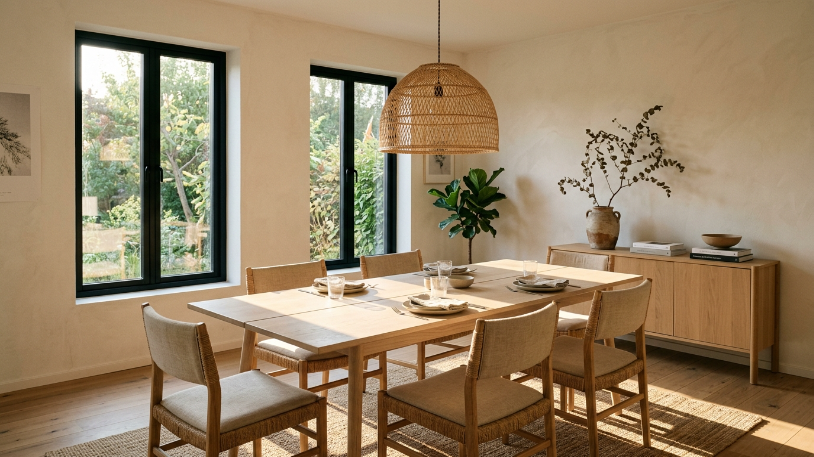
No amount of thoughtful furniture changes anything if the light is wrong. Japandi dining rooms depend on natural light the way a wood table depends on honest construction; without it, the warm neutrals go flat, the textures lose their depth, and the whole calm effect dissolves into something dim and ordinary.
If your dining room has good natural light, work with it rather than around it. Keep window treatments simple: plain linen sheers, slatted wooden blinds, or nothing at all if privacy is not a concern. Natural light filtered through a linen panel produces one of the most Japandi-appropriate effects you can create, and it costs almost nothing to achieve.
For dining rooms with limited natural light, a few approaches help considerably:
- A simple rectangular mirror on one wall to bounce light without looking ornate
- Lighter wood tones for the table and sideboard, since pale oak and ash reflect more light than darker walnut
- Layered artificial lighting: one overhead pendant, one lower-level lamp on the sideboard, and candles at the table for evening meals
Warm bulb temperatures between 2700K and 3000K matter here as well. This range mimics late-afternoon sunlight, which flatters warm neutral walls, softens ceramic textures, and makes wood grain look its very best.
In short, the ideal Japandi dining room treats light as an active part of the design rather than a passive backdrop. When the natural and artificial light sources work together with the palette and the materials, the room stops feeling like a collection of objects and starts feeling like somewhere you actually want to be.
Final Thoughts
Japandi dining rooms are not about achieving a catalog look. They are about building a room that settles you down when you walk in, whether it is a quick Tuesday dinner or a long Sunday lunch with people you enjoy.
Every idea in this post follows the same principle: use less, choose well, and let the room breathe. You do not need all thirteen of these changes at once. Pick two or three that fit where you are right now. Start with the table, or the rug, or simply the right wall color. The rest will come naturally once the foundation is right.
The calm will follow. It always does, in a room that was built to hold it.