
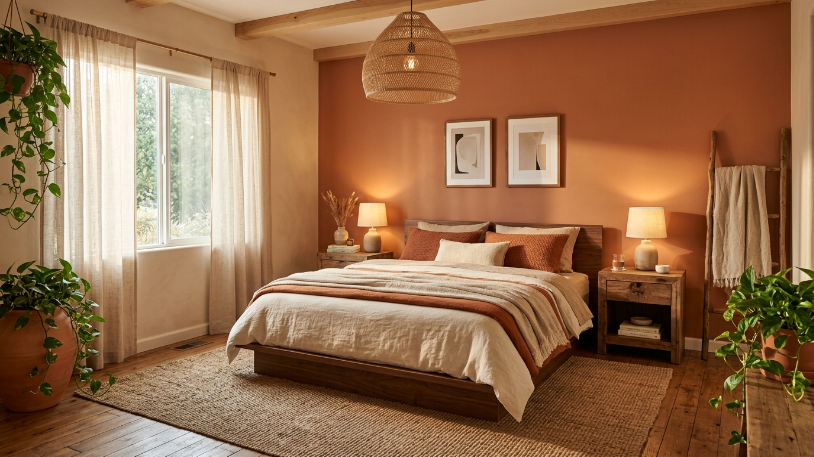
So you want to style a terracotta bedroom. Great decision. Terracotta is warm, earthy, and rich without being loud about it. It plays well with cream, olive, dusty rose, warm white, and even navy. It layers beautifully with natural materials: linen, rattan, wood, clay, and stone. Plus, it works in almost any room size when you handle it the right way.
This guide walks you through how to style a terracotta bedroom from scratch, in a clear build order. You start with your layout and anchor furniture, then work through color, bedding, natural materials, lighting, plants, accents, and final edits. Each step builds directly on the last. By the end, you will have a room that looks like you spent six weeks planning it, even if you did it in a weekend.
Before you start: terracotta covers a wide family of shades, from light sandy clay all the way to deep burnt rust. The steps here apply across the full range. This is a styling guide, not a product list. The principles do the heavy lifting.
Step 1: Nail Your Layout and Choose Your Anchor Piece

Before paint, before bedding, before a single throw pillow: sort out your layout. Your layout is the skeleton. Everything else is skin and clothing on top.
In most bedrooms, the bed is the anchor. Place it on the most prominent wall, usually the one you face when you walk through the door. Center it on that wall. This makes the room feel intentional from the moment you step in. If the room’s shape forces it to one side, that is fine, but center it whenever you can.
Once the bed is placed, check your clearances. You need at least 24 inches of walkable space on each side of the bed. If your room is small, a platform or low-profile frame works better than a tall, bulky structure. Also, keep the path to the closet and bathroom clear and obvious.
For a terracotta bedroom, your best anchor choices are:
- Solid walnut, oak, or pine bed frame in a low-profile or platform style
- Rattan or cane headboard panel
- Linen-upholstered headboard in terracotta, rust, cream, or warm sand
- Simple wooden frame with clean lines and a natural or oiled finish
Avoid glossy lacquered frames, chrome legs, and ultra-modern metal structures. They read cold. Cold is the opposite of what you are building here.
Step 2: How to Style a Terracotta Bedroom With Color
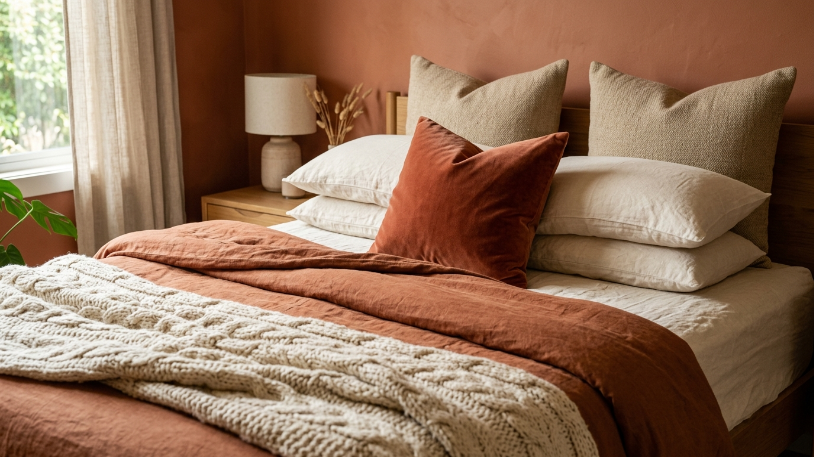
Now you get to the color work. This step sets the entire mood of the room. You have two main approaches: paint the whole room in terracotta, or pick one accent wall. Both are valid choices, and the right one depends on your room size and your confidence level.
Full-room terracotta works best in larger bedrooms or when paired with a white or warm cream ceiling and trim. It creates a cocooning effect that feels rich and quiet at the same time. Use a mid-tone terracotta, not the darkest shade available. Deep, saturated terracotta on all four walls can feel like a cave by 6pm.
Single accent wall is the more flexible option. Paint the wall behind the bed. Keep the other three walls in warm white, soft ivory, or a light sand tone. This anchors the color without overwhelming the space.
If painting is not an option, you can still style a terracotta bedroom through large textiles: a wide terracotta area rug, earthy bedding in rust or clay tones, or a woven wall hanging in warm earth tones. The color base does not have to come from paint. Browse warm-tone paint families on Sherwin-Williams, looking in the “clay,” “russet,” and “adobe” ranges.
| Terracotta Shade | Best Pairing Colors | Mood It Creates |
| Light clay terracotta | Off-white, sage, pale blush | Airy, soft, relaxed |
| Mid-tone warm terracotta | Cream, olive, dusty rose | Earthy, calm, layered |
| Deep rust-terracotta | Cream, forest green, navy | Moody, grounded, rich |
| Burnt orange terracotta | Charcoal, ochre, warm tan | Bold, warm, dramatic |
Step 3: Choose Your Bedding and Layer the Bed
Bedding is your biggest styling tool after color. In a terracotta bedroom, the goal is warmth and texture without visual noise. Start neutral and build up.
Base layer first. Use white, cream, or warm ivory sheets. This gives the eye a neutral resting point. Next, add your duvet or quilt. Linen is the best fabric choice here. A linen duvet in rust, oat, terracotta, or warm sand all read naturally in this palette. If your walls are already deeply terracotta, pull the bedding back to cream or natural linen to avoid a single overwhelming tone.
Third layer: the throw. Drape it across the lower third of the bed. A chunky knit in cream, a woven cotton throw in ochre, or a Moroccan blanket with a terracotta stripe all work well. Then come the pillows.
Pillow stacking order, back to front:
- Two Euro shams, 26×26 inches, in a neutral or tonal fabric
- Two standard sleeping pillows in matching or complementary cases
- One to two accent cushions in front in terracotta, rust, or a contrasting tone like sage or dusty rose
Do not pile on more than five or six pillows total unless you enjoy a nightly Olympic pillow-sorting event. Keep it to layers you can actually see and appreciate.
Step 4: Bring In Natural Textures and Materials

Terracotta belongs to the natural world, so your material choices should back that up. Clay, wood, linen, stone, fiber. When you get this layer right, the room stops looking styled and starts looking alive.
Materials that work well with terracotta:
- Rattan and wicker: pendant lights, headboards, mirrors, side tables
- Raw or oiled wood: bed frames, floating shelves, picture frames, nightstands
- Linen and cotton: curtains, bedding, cushion covers
- Ceramic and clay: table lamp bases, vases, decorative bowls, plant pots
- Jute and sisal: area rugs, woven baskets, wall hangings
- Stone and concrete: candle holders, small decorative objects, bookends
For your rug, a large jute rug is one of the strongest choices. Aim for at least 8×10 feet so it reaches under both nightstands. This grounds the bed area and adds that raw, earthy texture terracotta responds to. A Moroccan-style wool rug in cream and rust tones is also a strong option if you want more softness and pattern.
What to avoid:
- High-gloss plastic furniture or lacquered MDF
- Silver or chrome metal accents
- Synthetic velvet in unnatural colors
- Polyester-heavy textiles that look and feel artificial
If you want metal accents, go for brushed brass, aged bronze, or matte black. All three read warm and grounded rather than cold and industrial.
Step 5: Plan Your Lighting to Style Your Terracotta Bedroom
Lighting is the step most people underestimate in a terracotta room. Warm light makes clay tones glow. Cool light makes them look flat, tired, or oddly greenish. So your bulb choice matters just as much as your paint choice.
Use warm-white bulbs only. Look for a color temperature of 2700K to 3000K. Avoid daylight bulbs (5000K or above) entirely. They strip warmth out of the walls and undermine all the color work you just did.
Your three lighting layers:
Overhead: A rattan pendant, a woven seagrass shade, or a fabric-wrapped hanging lamp. Avoid relying on recessed LED downlights alone; they tend to cast cold, unflattering light directly downward, which does terracotta no favors.
Bedside: One table lamp per nightstand. Look for ceramic, clay, or wood bases with linen or cotton shades. The light should feel soft and warm, not task-bright.
Accent: A floor lamp in one corner adds reading light and visual depth. Candles or flameless LED candles on a dresser or shelf add evening warmth without any electrical work.
For natural light, swap harsh blinds for sheer linen curtains. Mount the curtain rod at the ceiling, or 2 to 4 inches below the crown molding, not at the window frame top. This filters daylight into golden, diffused warmth that plays well with terracotta. For reference on how color temperature affects pigment-rich surfaces, the Lighting Research Center at Rensselaer Polytechnic Institute is a good resource worth bookmarking.
Step 6: Add Plants and Greenery
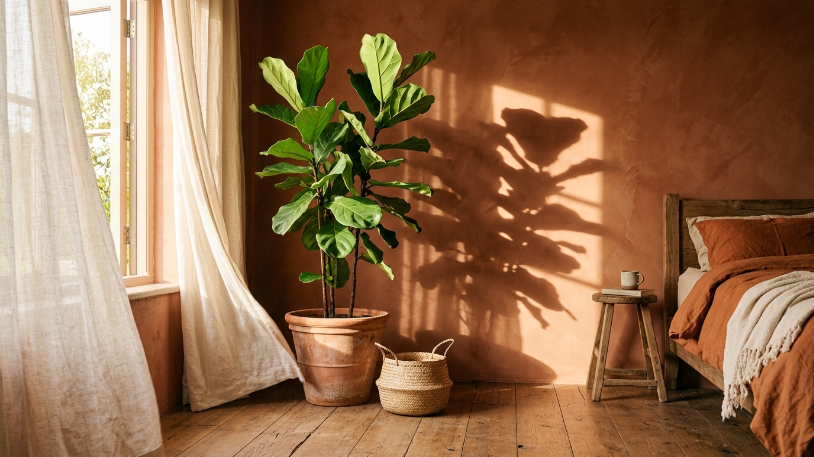
Green and terracotta are one of the best natural color pairings there is. The contrast is immediate and rich without feeling forced. Adding plants is also one of the simplest ways to make a terracotta bedroom feel like it actually breathes.
You do not need a lot. Two or three well-placed plants outperform a dozen small, struggling ones scattered across every flat surface. Choose plants based on the light your room actually gets, not the light you wish it had.
Plant placement guide:
- Corner: Fiddle leaf fig, olive tree, snake plant, or bird of paradise for height and structure
- Shelf or dresser top: Trailing pothos or heartleaf philodendron that spills naturally downward
- Nightstand: Small succulent, cactus, or air plant in a small clay or ceramic pot
- Windowsill: Herbs, a compact hoya, or a trailing string of pearls
Use actual terracotta pots wherever possible. The continuity between pot color and room palette creates a sense of intention. Real terracotta is also porous, which helps roots breathe and reduces overwatering damage. Style and function in one shot, which is always worth choosing.
If your room gets low light, skip the fiddle leaf fig and go for a snake plant, pothos, or ZZ plant. These thrive in dim conditions and still look full, lush, and green.
Step 7: Style Your Accents and Art
Accents and art are where the room picks up personality. In a terracotta bedroom, you want pieces that feel organic, warm, and grounded. Think natural world, not hotel lobby.
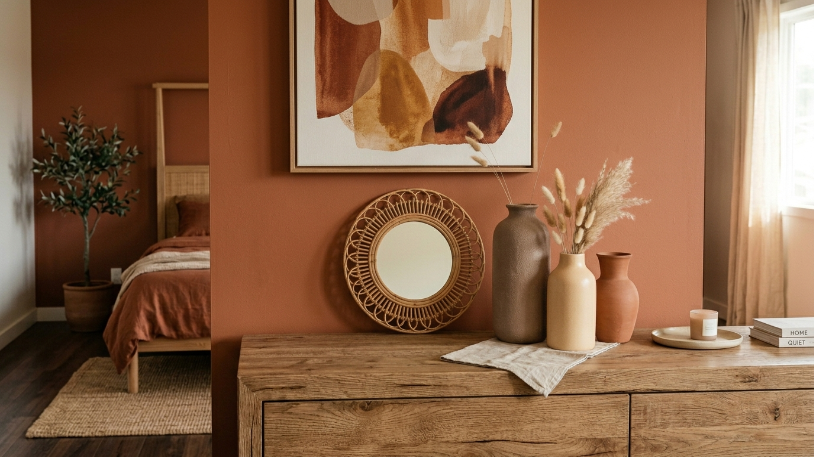
For wall art, keep it simple and consistent. One large piece above the dresser, or a small gallery wall of three to five prints in matching frames, works far better than a chaotic mix of sizes and styles. Use warm-toned frames: natural wood, bamboo, aged bronze, or brushed brass. Skip white plastic or silver frames entirely.
Art that suits a terracotta bedroom:
- Abstract canvas in rust, ochre, clay, and cream tones
- Botanical or nature prints on warm paper stock
- Woven macrame or textile wall hanging above the bed or dresser
- Black-and-white photography in a simple oak or bamboo frame
- Hand-painted ceramic plates in a small wall grouping
For surface styling, follow the rule of odd numbers: three objects on a nightstand, five on a dresser, three on a shelf. Group items by varying height so there is visual rhythm. Taller vase, medium candle, small object. This feels composed without looking staged.
Keep surfaces clean. Terracotta walls already give the room warmth and depth. Your accents should add to that, not compete with it.
Step 8: Do the Final Edit

You are nearly there. Before you call the room finished, do one last walk-through. Step in from the doorway and let your eye travel across the space naturally. Notice where it stops, snags, or feels confused.
Final styling checklist:
- All cords are hidden or clipped (use adhesive cable clips or a small cable box)
- Bedding is smooth and all layers are clearly visible
- Plant leaves are clean and all plants look healthy
- Surfaces hold only intentional objects, not keys, chargers, receipts, or stray tubes of anything
- All bulbs are warm-white, 2700K to 3000K, with no cool-white bulbs in the mix
- The rug lies flat and reaches under both nightstands
- Curtains hang from the ceiling, not from the window frame top
- All wall art sits at eye level (57 inches from the floor to the center of the piece is the standard)
- Any mirror faces open space or a light source, not a wall or the back of a door
One tip worth repeating: hang your curtains high. Mount the rod as close to the ceiling as possible and let the panels fall to the floor. This one move makes ceilings read taller and rooms feel larger. It costs nothing extra and takes about ten minutes. Do not skip it.
Final Thoughts
A terracotta bedroom comes together one layer at a time. Start with your layout, anchor your furniture, build the color, and work outward from there. Each decision you make gives the next one a clearer direction. You do not need a full renovation or a big budget. You need a clear order and a few solid choices.
Enjoy the process. It is just a room, but it will be a very good one.