
There is something quietly powerful about a minimal entryway. It is the first thing you see when you walk into your home, and the last thing you see before you leave. And yet, so many of us treat it like a dumping ground for bags, shoes, mail, and everything we were too tired to put away properly. A minimal entryway says something different. It says: this home is intentional. This home has a vibe. This home was clearly decorated by someone who has their life together (even if that is just for the thirty seconds it takes to walk through the door).
The good news is that you do not need a large space, a big budget, or a design degree to pull this off. Minimal entryways work in apartments, in small homes, in rented spaces, and in houses where the “entryway” is just a small patch of floor near the front door. The ideas in this post are not about following a formula. They are about finding what works for your space, your lifestyle, and your personality, and keeping everything else out.
Here are 16 minimal entryway ideas worth stealing.
1. The Single Console Table
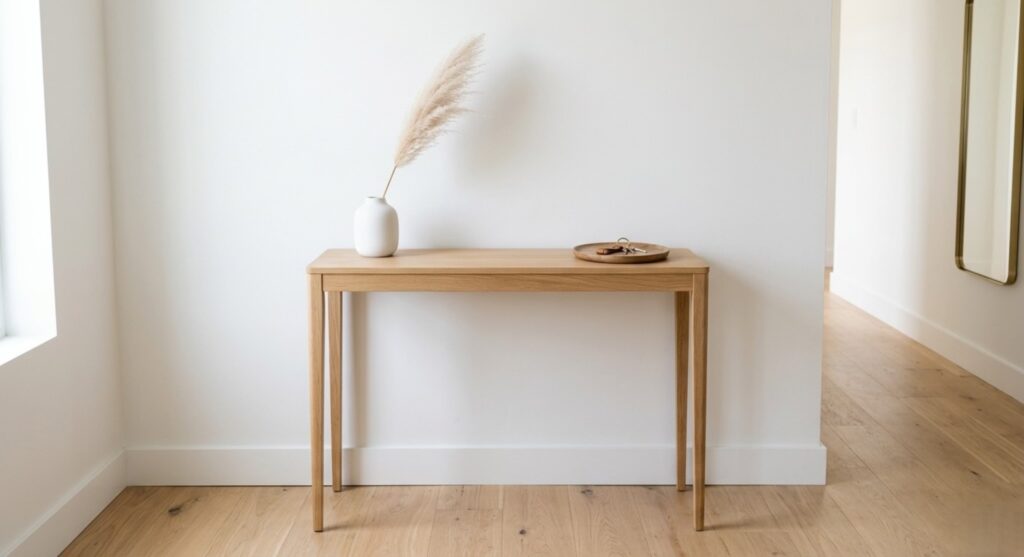
If you want to do minimal right, start with one piece of furniture and make it count. A slim console table is the anchor of almost every well-designed minimal entryway because it gives you a surface without eating up square footage. The key is to fight the urge to fill it. One tray, one small plant, maybe one candle. That is it. The moment you add a stack of books, three remote controls, and your gym gloves, the whole look is gone.
Choose a console table with legs rather than a solid base. Floating legs make the space feel open and less heavy. Materials like light oak, white lacquer, or brushed metal all work well depending on the tone of your home. And if your entryway is extremely narrow, look for a console table that is less than 30 centimetres deep. They exist, they are beautiful, and they will not block you every time someone tries to walk past.
2. The No-Furniture Approach
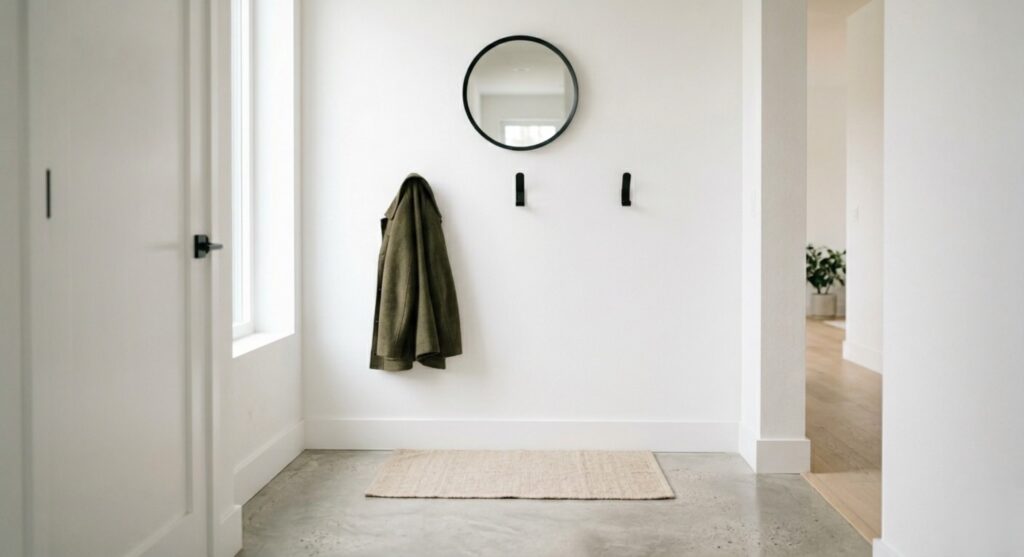
Here is a thought that might stress you out at first: what if you put nothing in your entryway? No table. No bench. No shelves. Just a wall hook, a mat, and maybe a mirror. This works surprisingly well in very small entryways where any furniture makes the space feel cramped. It also works if you prefer a completely open, breathable feel when you walk in.
The trick is that everything the entryway needs to do, like hold your keys, catch your coat, and give you a surface to dump things on, has to happen on the wall instead. A set of minimal wall hooks does the heavy lifting here. Choose hooks in a matte finish, spaced evenly, and only hang what you actually use daily. A single coat or jacket looks intentional. Six coats, a scarf, and two umbrellas look like a yard sale.
3. A Statement Mirror
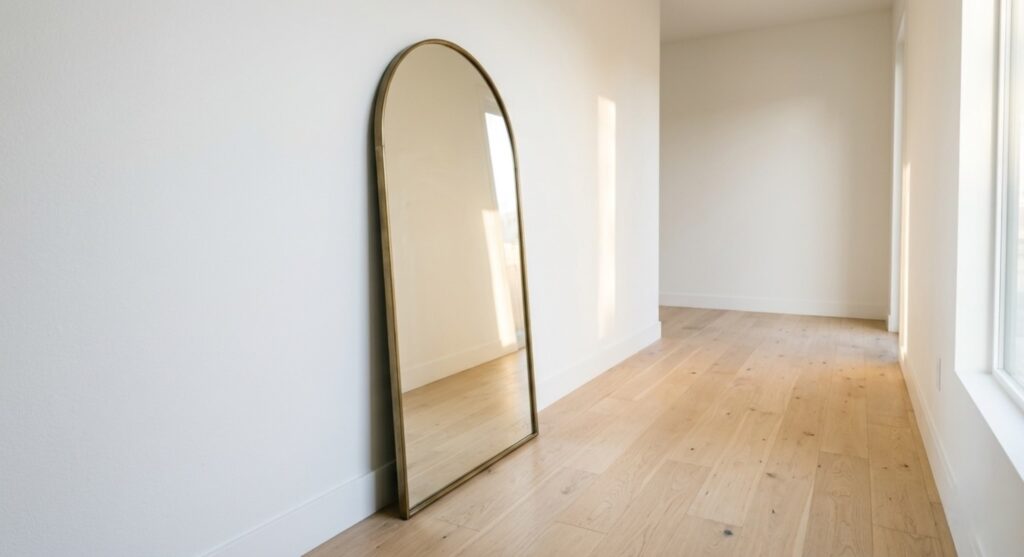
If you want drama without clutter, a large statement mirror in the entryway will do more work than any piece of furniture. Mirrors reflect light, make small spaces feel larger, and give you one last chance to check that you do not have spinach in your teeth before walking out the door. Practical and aesthetic. A two-in-one that deserves its own trophy.
For a minimal entryway, go for a mirror with a simple frame. Thin metal frames in gold, black, or unlacquered brass work beautifully. Frameless mirrors also look sharp in more contemporary spaces. The shape matters too. A tall arch mirror reads as elegant and soft. A round mirror feels organic. A rectangular mirror feels structured and clean. Pick based on the overall personality of your home, and then let the mirror be the star. Nothing else on that wall.
4. The Floating Shelf Entry
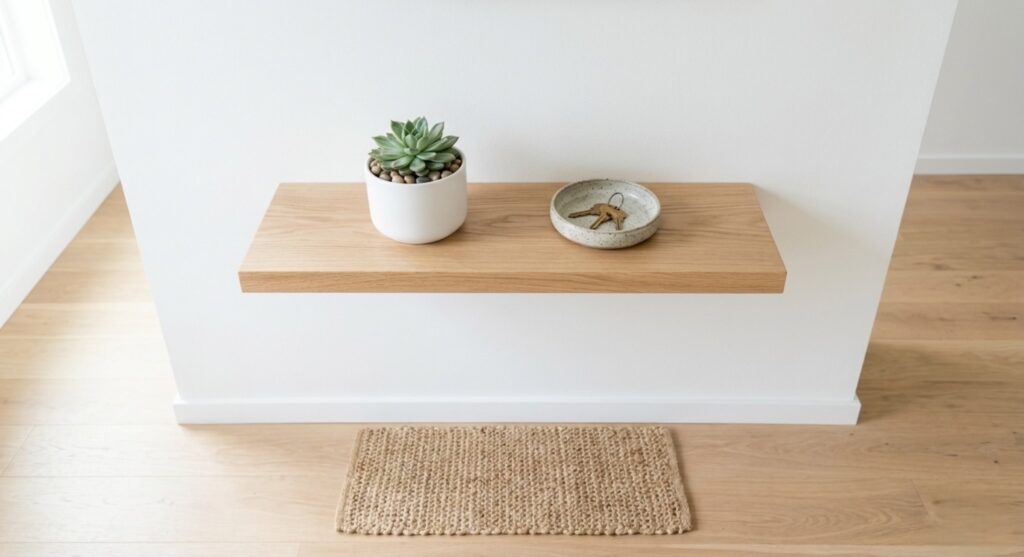
When floor space is limited, go vertical. A single floating shelf mounted at eye level or just above can replace a console table entirely. It gives you a surface for your keys, a small plant, and whatever else you need to grab on your way out the door. And because it is mounted to the wall, the floor underneath stays completely clear, which makes the whole space feel much bigger than it is.
The shelf itself should be simple. A plain white shelf, a light wood shelf, or a concrete-look shelf all work well. Keep the items on it minimal and deliberate. Resist the temptation to use the shelf as an overflow zone for random items. If something does not belong there, it does not live there.
5. Monochrome
A monochrome entryway is minimal by nature because when everything is the same colour family, the eye does not have to work hard. There is no visual noise. No competing shades fighting for attention. Just a calm, cohesive look that feels effortless even if it took a lot of thought to put together.
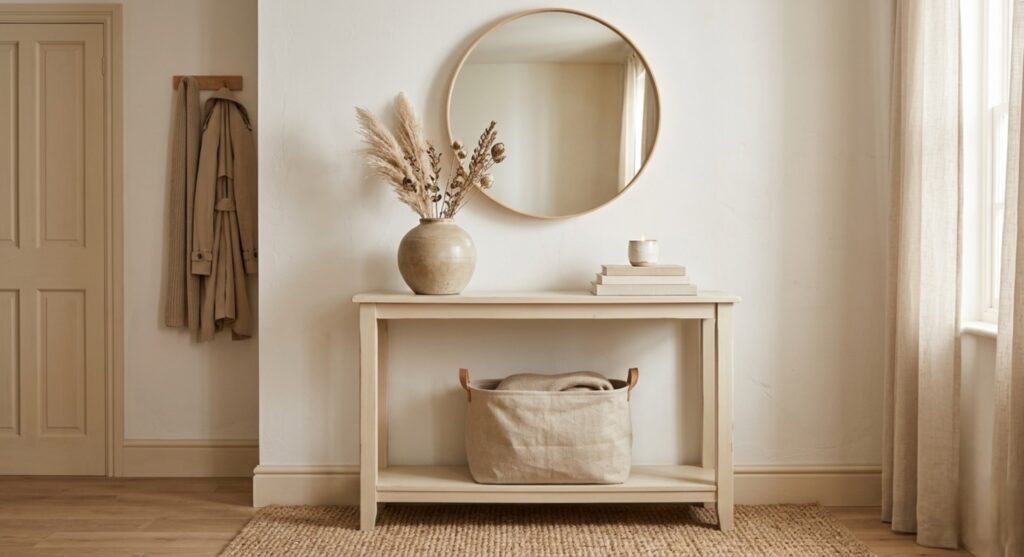
This does not mean everything has to be white. An all-beige entryway is stunning. A tonal grey entryway feels sophisticated. Even a soft terracotta palette done in one shade family reads as restrained and beautiful. The key is to vary the textures within the colour scheme so the space does not feel flat. Matte walls, a linen runner, a ceramic vase, a wicker basket. Same tone, different materials. That contrast of texture within a single colour family is what makes monochrome spaces feel rich instead of boring.
6. The Shoe-Storage Entry
Let us be honest. Shoes are the enemy of a minimal entryway. They are bulky, they multiply overnight, and left unchecked, they will take over every available surface and a significant portion of the floor. A shoe-focused minimal entryway accepts this reality and builds around it.
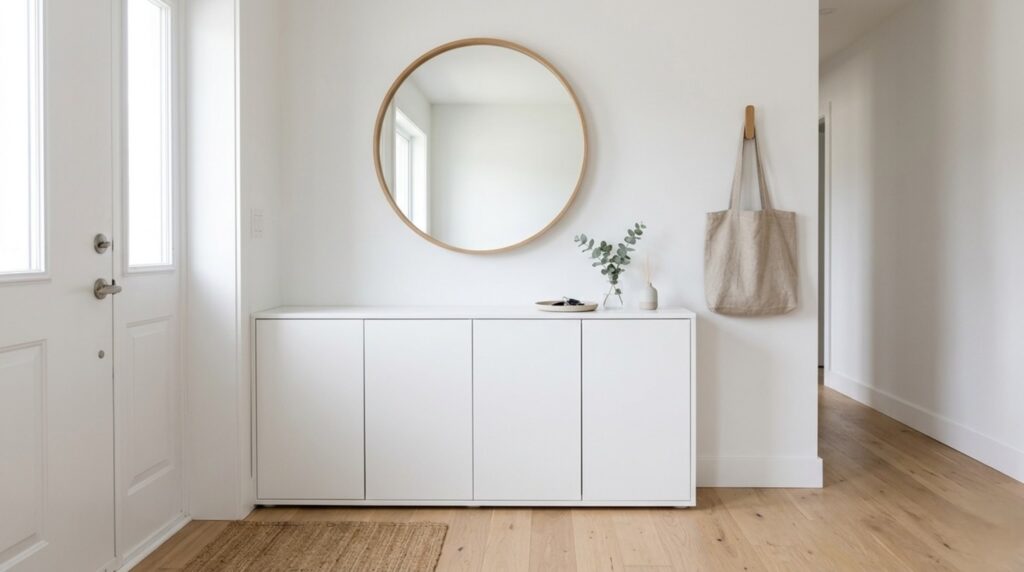
The solution is a dedicated shoe storage piece that contains the chaos without showing it. A closed cabinet with clean lines is ideal. Alternatively, a bench with hidden storage underneath works perfectly in a narrow space. The bench gives you somewhere to sit while putting your shoes on, and the lid closes on all evidence that you own seven pairs of trainers. If you go the open rack route, limit it to the shoes worn in the current season only. Everything else goes in the bedroom or a closet. Fewer visible shoes means a calmer entryway. It is not magic. It is just good editing.
7. Plants as the Only Decoration
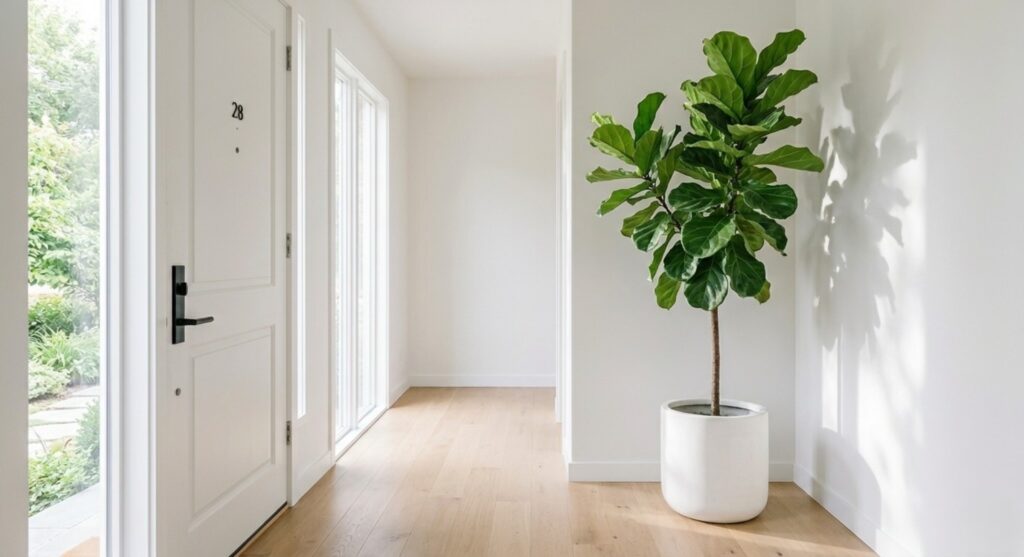
Plants are one of the most powerful tools in a minimal entryway because they bring life and colour without looking like you tried too hard. The right plant in the right spot does not just decorate the space. It transforms it. And unlike art or accessories, a healthy plant earns its place every single day.
For a minimal entryway, one large floor plant is more impactful than a collection of small ones. A fiddle leaf fig, a tall snake plant, a rubber plant, or a structural cactus all work beautifully. Choose a simple pot that does not compete with the plant itself. Terracotta, matte white, concrete, or black all work. If your entryway gets limited light, a snake plant or a ZZ plant will survive without much complaint. They are hardy, they are elegant, and unlike your last houseplant, they will not die the moment you go on a two-week trip.
8. The Hidden-Hook Entry
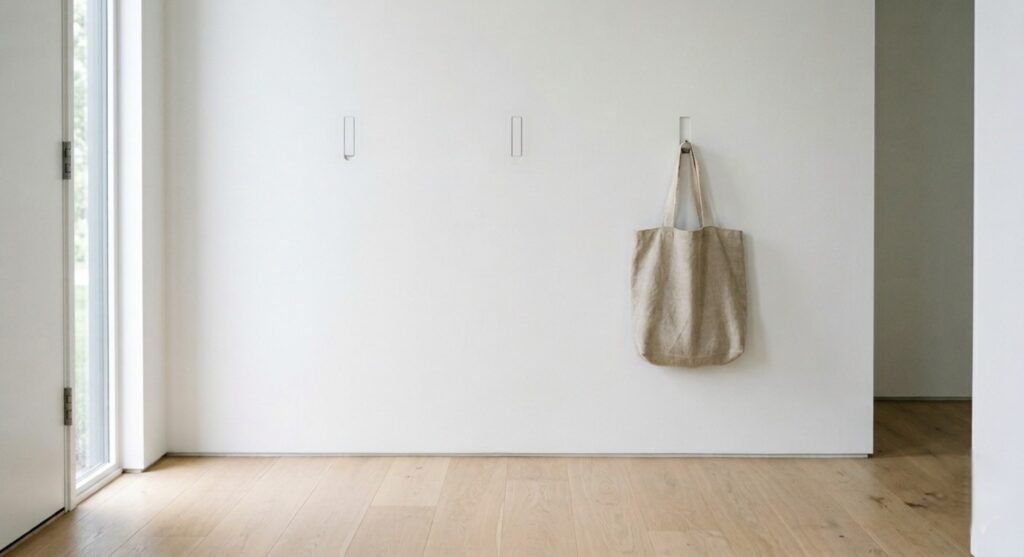
Visible hooks have their place, but in a minimal entryway, hidden hooks are a game changer. These are hooks mounted behind a flat panel or inside a recessed section of the wall, so from the outside, the wall looks completely smooth. Or you can use hooks that fold flat when not in use, making them nearly invisible until someone actually needs to hang something.
This approach requires a bit more thought during setup but the result is extraordinary. An entryway that looks like it does not even function as an entryway, right up until it reveals a perfectly organized system underneath. The other option is a pegboard with removable hooks, painted the same colour as the wall so it blends in almost completely. The hooks are there. The function is there. But the visual clutter is not.
9. The Entryway Bench Without the Bench struggles
A bench in the entryway is a lovely idea that goes wrong in about forty-eight hours when coats pile on top and bags pile underneath and the whole thing looks like a lost-and-found station. The solution is not to remove the bench. The solution is to have rules for the bench.
In a minimal entryway, the bench is styled the way you see it in showrooms. One folded throw. One small cushion. Nothing on the floor underneath it. Bags and coats have their designated wall hooks, not the bench. The bench is there for sitting while you put your shoes on, not for storage. If your bench has a lid and storage inside, great, but treat that interior as precious real estate that only gets what belongs there. A bench that is styled correctly looks intentional and inviting. A bench buried under everything you own looks like you gave up.
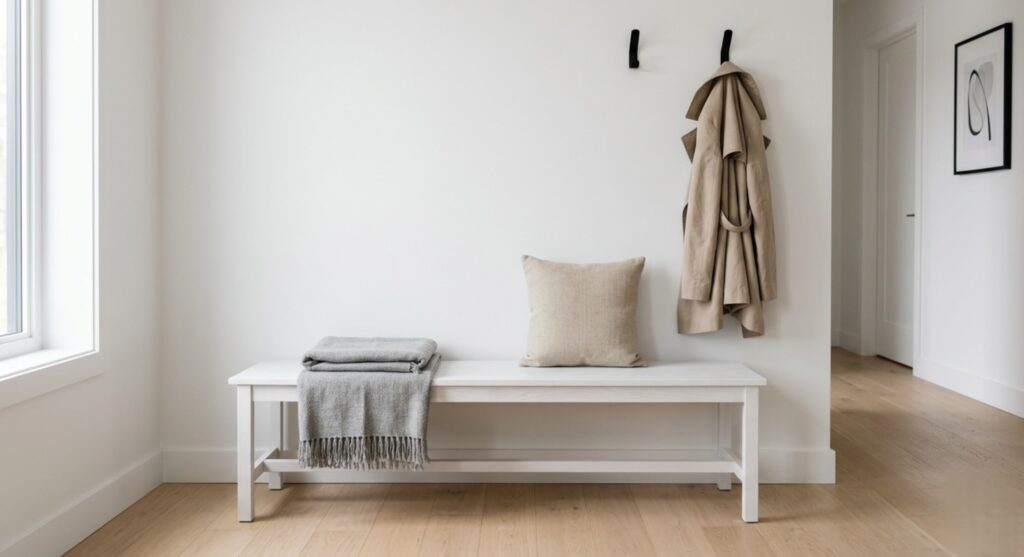
10. Art-Led Minimal Entry
Most minimal spaces avoid art, but one well-chosen piece of art can actually anchor a minimal entryway and give it personality without adding clutter. The key word is one. Not a gallery wall. Not two prints side by side. One piece, hung at eye level, large enough to make a statement on its own.
Choose art that is calm and does not compete with the architecture of the space. Abstract prints in neutral tones, simple line drawings, nature photography in black and white, or a single oversized botanical print all work well. The frame matters as much as the art. A thin black frame, a raw wood frame, or no frame at all depending on the style of the piece and the room. Let the art breathe. Do not crowd it with shelves, hooks, or furniture at the same eyeline. Give it space and it will carry the whole wall.
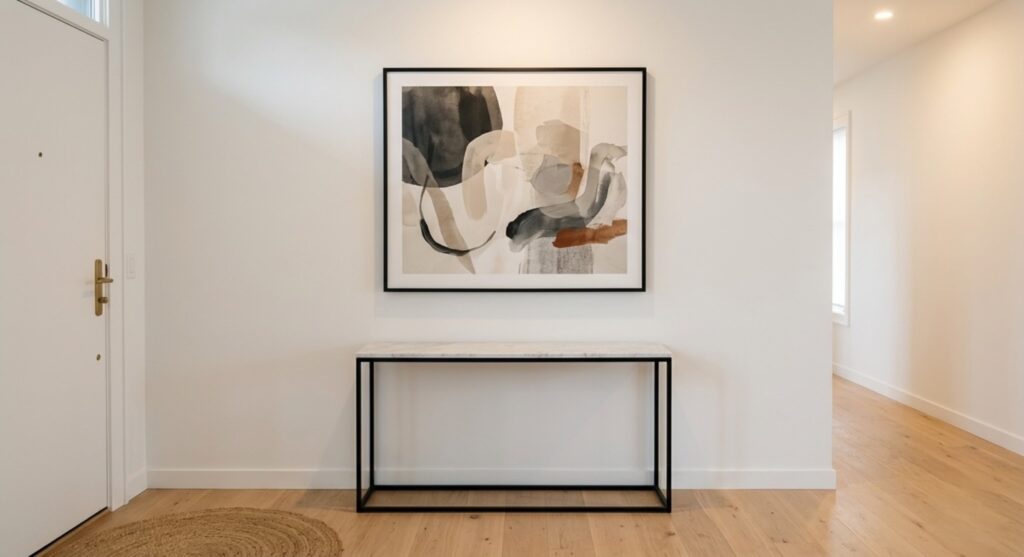
11. The Rug Entry
Sometimes the best way to define an entryway is from the floor up. If your home has an open floor plan and the entryway blends into the living area without a clear boundary, a rug can create that visual separation without any walls or furniture.
For a minimal look, choose a rug in a natural fibre like jute, sisal, or wool. These materials have texture and warmth but they read as understated rather than decorative. A striped woven rug also works well. Avoid anything too patterned, too colourful, or too fluffy for an entryway. Entryway rugs take a lot of foot traffic and they need to look intentional, not like they wandered in from the bedroom.
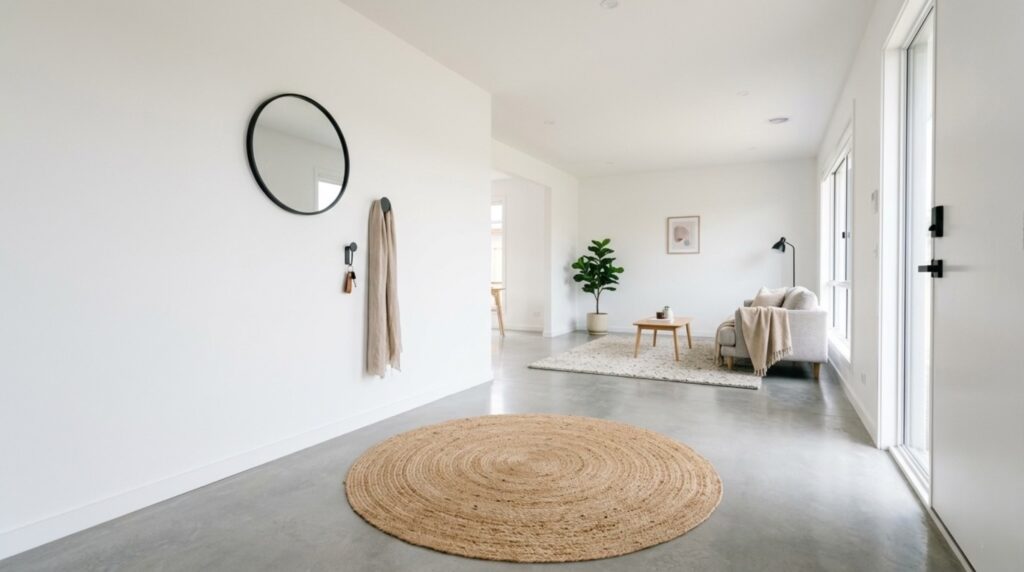
12. The Japandi Entryway
Japandi is the design child of Japanese minimalism and Scandinavian simplicity, and it is one of the most beautiful approaches you can take in an entryway. Think warm, natural materials, very little furniture, clean lines, and a quiet sense of calm that makes you feel better the moment you walk through the door. It is the visual equivalent of a deep breath.
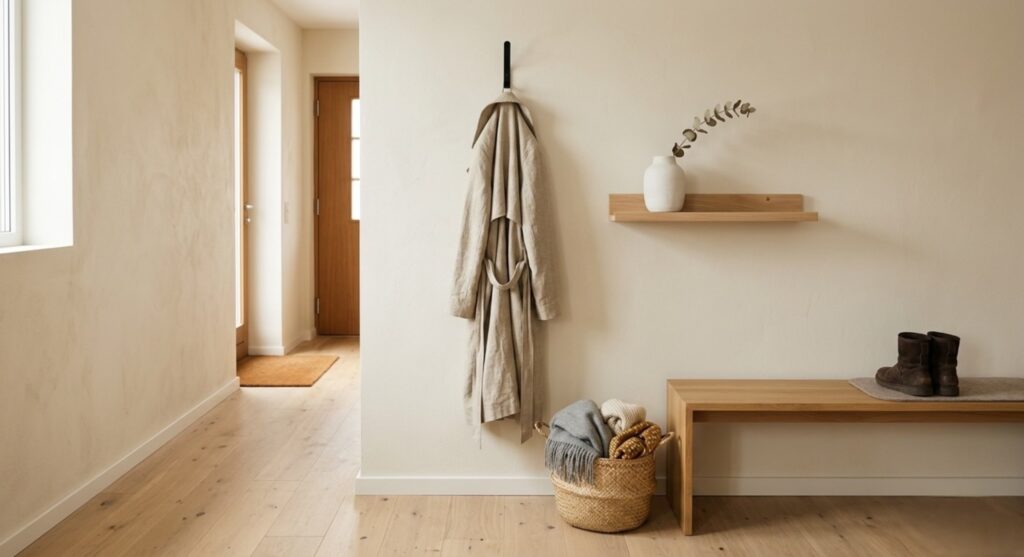
A Japandi entryway might include a low wooden bench with no back, a simple wooden wall hook, a wabi-sabi ceramic vase with a single dried branch, and that is it. The palette is warm neutrals: cream, sand, warm grey, muted olive, and aged wood tones. Nothing glossy, nothing shiny, nothing that tries too hard. The whole effect is calm and considered, which is exactly the kind of energy you want to walk into after a long day.
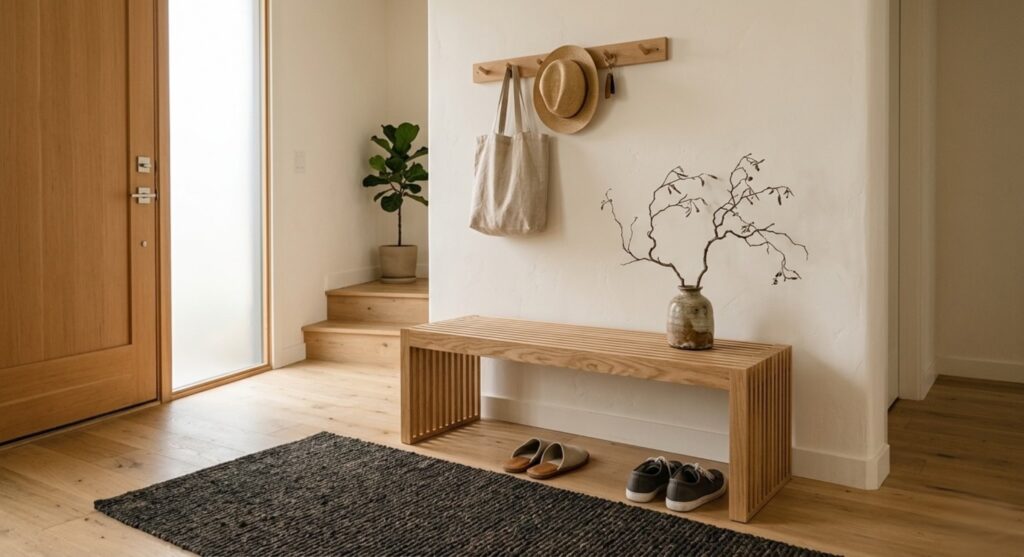
13. The Dark and Moody Minimal Entry
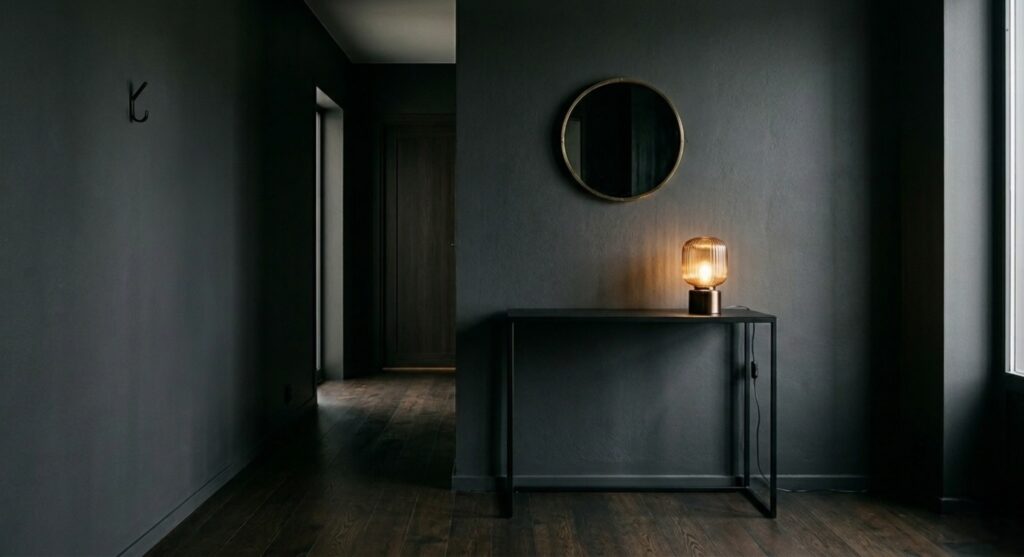
Minimal does not always mean white and bright. A dark entryway can be just as minimal and significantly more dramatic. Think deep charcoal walls, matte black fixtures, dark wood floors, and a carefully placed light source that creates atmosphere rather than just illumination.
The key to keeping a dark entryway minimal is to be even more disciplined about what goes in it. In a light space, the brightness naturally opens things up. In a dark space, every object is more visible and more impactful, which means clutter reads even more loudly than usual. One sculptural coat hook. One slim black console. One warm light source. That is the formula. Done right, a dark minimal entryway feels like walking into a luxury hotel. Done wrong, it feels like walking into a cave. The difference is curation.
14. The Light-and-Bright Maximally Minimal Entry
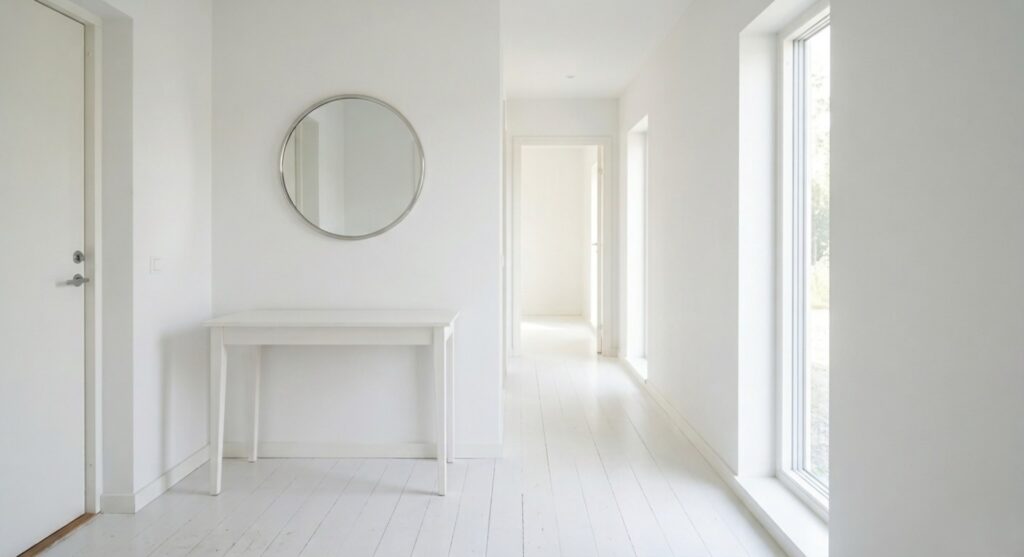
If dark is not your thing, go the opposite direction entirely and lean hard into white, brightness, and airiness. A light-filled minimal entryway feels like the beginning of a good day even when it is raining outside. The entire strategy here is to maximise light and minimise everything else.
White or very pale walls are the base. If you have a window near your entryway, keep it completely clear of anything that would block light. Use reflective surfaces carefully, a mirror, a glossy white console, a brass fixture, to bounce light around the space. Keep the floor as clear as possible. Choose storage that hides rather than displays. The goal is that when someone walks in, their first feeling is open, calm, and clean. Not because you have no life, but because you put your life away properly. Big difference.
15. The Seasonal Edit Entry
A minimal entryway stays minimal because it is edited regularly. The most beautiful entryways you see in magazines look the way they do because someone made a deliberate decision about what stays and what goes, and they revisit that decision often. One of the most useful frameworks for this is the seasonal edit: at the beginning of each season, you reset the entryway to reflect exactly what you need right now.
In summer, this might mean a single hook for a linen tote, a sandal rack, and nothing else. In winter, it might mean a bench for pulling on boots, two hooks for heavy coats, and a basket for scarves. In between, everything that does not belong in the current season gets stored elsewhere. This approach keeps the entryway minimal without requiring you to live with nothing. It just requires you to be intentional about what you keep visible and when. It is a lifestyle, really. A very organized, very aesthetic lifestyle.
Pulling It All Together
The common thread across every one of these 16 minimal entryway ideas is the same: less is intentional, not accidental. A minimal entryway is not an entryway that has nothing in it. It is an entryway where every single thing has been chosen on purpose, given a home, and kept there. The items that do not serve a purpose, aesthetic or functional, do not get a spot.
This is actually great news for anyone working with a small space or a limited budget. Minimal is by definition not expensive. It does not require a renovation or a designer. It requires a decision. You decide what stays.