
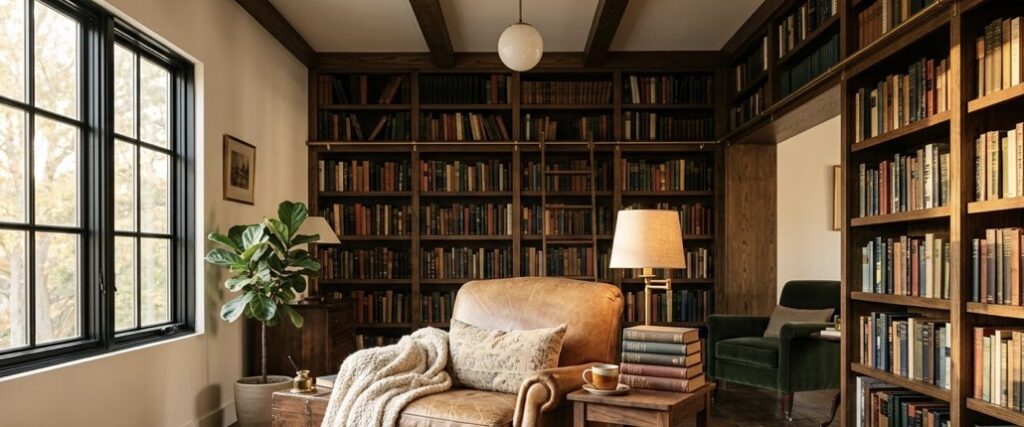
Let’s be honest. Most of us have a TBR pile — that’s ‘to be read’ for the uninitiated — that could topple a small building. And yet, somehow, we keep finding excuses not to sit down and actually read. The couch is too far from the light. The kitchen table feels like homework. The bedroom is for sleeping, or at least, that’s what we tell ourselves before we scroll our phones for forty-five minutes.
The truth is, the space you read in matters more than people give it credit for. A well-designed reading room doesn’t just look good — it actually changes how often you read, how long you stay, and how much you enjoy it. When a room feels right, you want to be in it. And when you’re in it, books happen.
This isn’t a list of expensive renovations or architect-approved overhauls. These are 12 reading room ideas that range from the deeply cosy to the architecturally bold, from the tiny spare corner to the full dedicated library. Some will work in a studio apartment. Others need a bit more space. But all of them share one goal: to make reading feel like the treat it actually is, rather than a task you keep pushing to next weekend.
Whether you like your books sorted by colour or by Dewey Decimal (no judgment — we admire the commitment), there’s a reading room idea here that will suit your style, your space, and your Saturday afternoon self.
1. The Cosy Nook
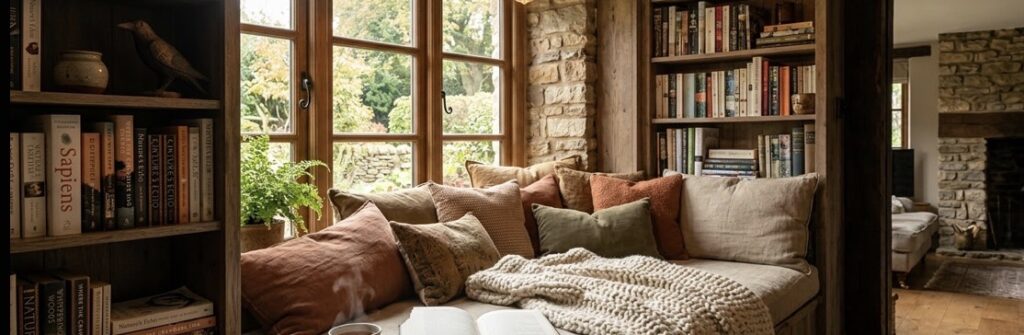
There is something deeply satisfying about a small reading nook. Not because small is better, but because a well-done nook signals something clear: this corner exists for one thing only, and that thing is you and your book. No multitasking. No Zoom calls. Just you, a cushion, and whatever fictional world you have chosen to temporarily inhabit.
The reading nook works best when it has a sense of enclosure. Think window seats with cushions built directly into the sill, alcoves carved out under the stairs, or a deep bay window dressed up with a thick pad and a couple of pillows. The moment a space feels like it wraps around you, rather than simply containing you, it becomes a reading nook rather than just a chair in a corner.
Lighting is everything in a nook. Because they tend to be tucked away from main light sources, a dedicated reading lamp — ideally positioned just over your shoulder — transforms a cosy little corner into a fully functional reading space. Wall-mounted swing-arm lamps are perfect here because they take up no floor space and can be adjusted as natural light changes throughout the day. Add a small wall shelf for your current read, a candle, and a spare hair tie (you’ll need it), and you have everything.
Storage is the final piece. Built-in shelves on either side of the nook, a small ledge for your book and your tea, or even a fabric pouch attached to the armrest — these small touches make the nook self-contained. Everything you need is right there. Getting up to find a bookmark should not be on today’s agenda, and yet here we are, looking at the bookmarks we bought six months ago, still in the packaging, on the other side of the house.
The cosy nook is the reading room idea that works in virtually any home. A spare wall, a deep windowsill, even a repurposed wardrobe with the doors removed — the nook is adaptable, personal, and quietly one of the best investments a book lover can make in their living space. It takes a corner and gives it purpose, which is really what all good design does.
2. The Floor-to-Ceiling Library
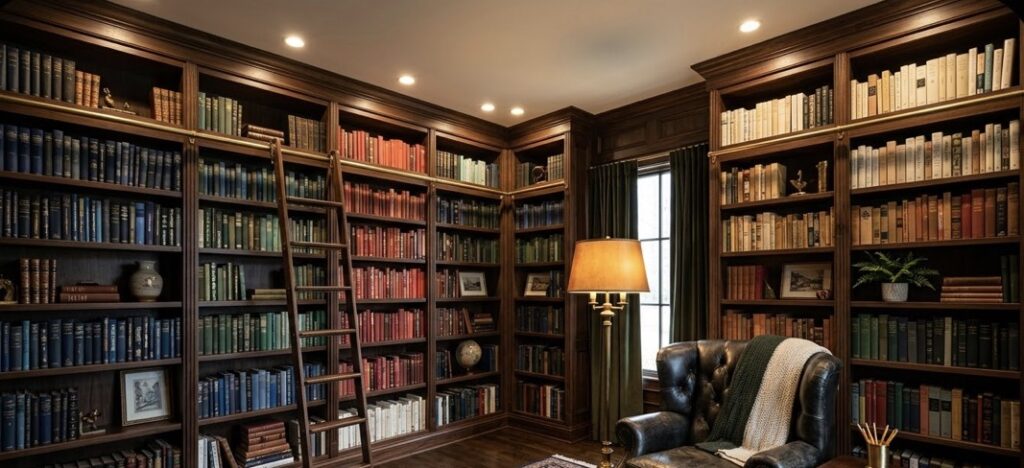
If the cosy nook is the introvert of reading rooms, the floor-to-ceiling library is the one who walks into a gathering and immediately commands attention. This is the reading space that makes guests stop in the doorway and say ‘oh’. It is statement-making, yes — but it is also deeply practical, because it takes the thing you love most (books) and turns them into the architecture of the room itself.
A floor-to-ceiling bookshelf does something clever: it raises the perceived height of a room while simultaneously making it feel intimate and purposeful. The walls are not empty — they are working. Every inch is doing something. And the cumulative effect of hundreds of books arranged spine-out creates a visual texture that no wallpaper or paint colour can replicate. You could spend an hour just looking at a well-stocked floor-to-ceiling library and not get bored. The books alone tell stories before you open a single one.
The arrangement of books matters enormously in this kind of library. Some people organise strictly by genre and author, treating the library as a working reference system. Others sort by colour, creating ombre effects that shift from warm yellows and reds to cool blues and greens across the shelves. A mix of both — mostly logical organisation with occasional colour-blocked sections — tends to look both intentional and lived-in, which is exactly the sweet spot for a home library that is also trying to be a good-looking room.
The seating in a floor-to-ceiling library should feel grounded and generous. A deep leather armchair with a high back, a chesterfield sofa in bottle green or burgundy, or a wide bench with cushions along one wall — whatever you choose, it should look as though it belongs to the room, not borrowed from another one. A rolling library ladder is the obvious dream addition, and it genuinely serves a purpose once those upper shelves start filling up. Which they will. You already know they will.
Lighting in a large book-lined room needs layers. Recessed ceiling lights provide general illumination. A floor lamp beside the reading chair handles task lighting. And small LED strip lights along the underside of shelves create that warm, dramatic glow that makes the whole room look like a film set for a story about someone who reads a great deal and makes excellent decisions.
3. The Minimalist Reading Room
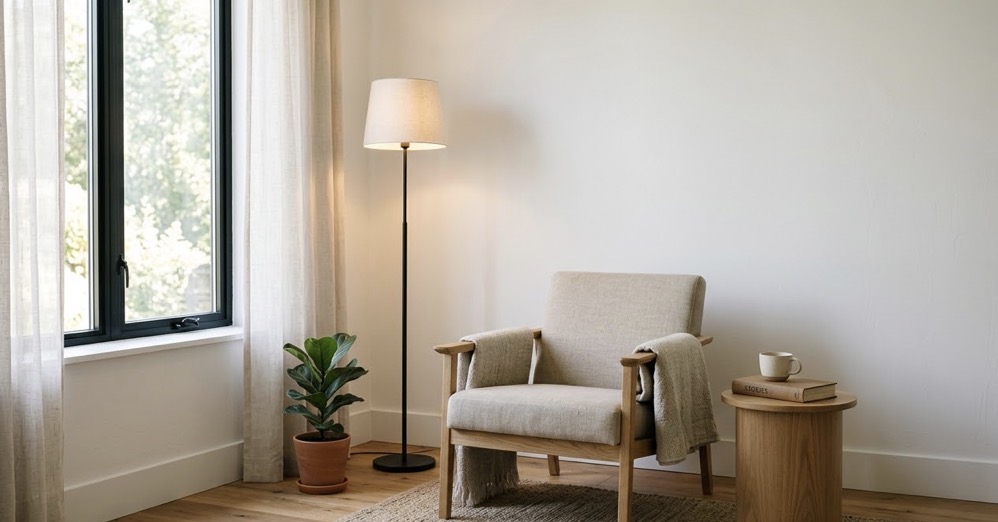
Not everyone wants to be surrounded by their entire book collection while they read. Some people find that a room full of things — even beautiful things — pulls their attention in too many directions, and what they need to focus is less. The minimalist reading room is built around that idea: reduce everything to what is truly necessary, and what remains will feel more intentional and more restful than any overfurnished space.
In a minimalist reading room, every object earns its place. The chair is chosen for comfort and proportion. The side table is there for your drink and your current book — not a stack of them, just the one you are reading right now. The lamp is positioned precisely. The rug defines the reading zone without cluttering it. Nothing else needs to be there, and nothing else is. This is either deeply liberating or slightly alarming, depending on your personality. If it sounds alarming, the floor-to-ceiling library idea is two sections back.
The palette in a minimalist reading space tends toward neutrals: soft whites, warm creams, pale greys, natural linens, and the occasional muted sage or dusty blush. These are colours that recede rather than compete, letting the act of reading take the foreground. Wood tones add warmth without fuss. A single plant in a ceramic pot adds life without becoming a collection.
Japandi style — that beautiful meeting point between Japanese minimalism and Scandinavian simplicity — is particularly well suited to a reading room. Low furniture, natural materials, a focus on craftsmanship over quantity, and a real emphasis on negative space make it feel both calming and considered. It is the design equivalent of a deep breath, and it happens to look remarkable in photographs, which is never a reason to choose a style but is a perfectly acceptable bonus.
The minimalist reading room is also the most forgiving on a budget. Because you are choosing quality over quantity, you can invest in one genuinely good chair, one thoughtfully designed lamp, and one beautiful small table, rather than filling a room with furniture that doesn’t quite fit. Fewer decisions, better results — a principle that applies both to interior design and, conveniently, to your to-be-read list. Even if applying it to the latter remains an ongoing project.
4. The Vintage Reading Room
The vintage reading room is for people who find old things more interesting than new things, which is a perfectly reasonable position when you spend a lot of time with old books. There is a consistency here that makes design sense: a room full of objects with history is the right home for stories with history. The whole space feels like it has been read before. There is a continuity of use that is quietly satisfying.
Getting the vintage reading room right is less about finding specific antiques and more about capturing a mood. The furniture does not need to be genuinely old — it needs to look as though it has been loved for a long time. A wingback armchair in a worn floral fabric, a side table with turned legs and a slightly uneven surface, a floor lamp with a fabric shade and a brass base: these are all things that read as vintage whether they came from an estate sale or a furniture shop that understands the assignment.
Colour is a major part of the vintage reading room palette. Deep, slightly muted tones work best: forest green walls, soft burgundy upholstery, faded gold in the lamp and picture frames, aged cream on the ceiling and woodwork. These are colours that have settled, that do not shout. They make the room feel as though it has been there for decades, which is exactly the point. If the room could wear a fragrance, it would be old paper and something warm.
Decorative objects matter here in a way they do not in a minimalist room. A vintage globe, a stack of leather-bound books doubling as a side table base, framed botanical prints, a porcelain tea set on the shelf, an old brass inkwell on the desk — these create depth and tell a story. The key is to gather them gradually rather than arranging them all at once, because authentically vintage rooms accumulate; they are not styled in an afternoon. That takes either patience or a very good eye at a car boot sale.
Books themselves become part of the decor in a vintage reading room. Old paperbacks, hardbacks with worn cloth spines, books inherited from grandparents or picked up in secondhand shops with someone else’s margin notes still inside — they all add to the visual texture. If you are missing some genuine old volumes, secondhand bookshops are an obvious and thoroughly enjoyable solution. Consider it research. Consider it interior design homework. Consider it an excellent reason to spend a Saturday morning browsing shelves. It needs no further justification.
5. The Garden Reading Room
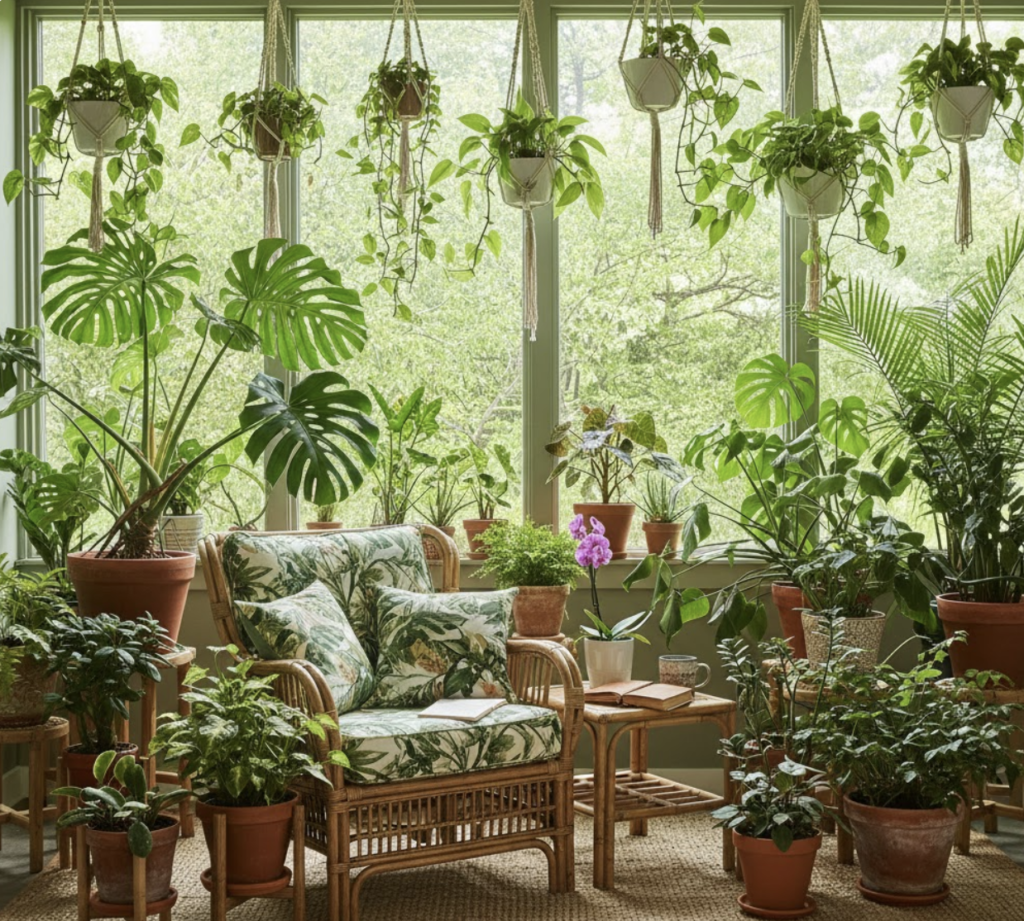
Plants and books have more in common than you might expect. Both require a certain patience. Both reward regular attention. Both have a tendency to multiply faster than anticipated. And both make a room feel immediately more alive, which is why a reading room that combines them generously tends to be one of the most genuinely pleasant spaces in any home. If anything, the two are natural companions. They have been waiting to share a room this whole time.
The garden reading room — sometimes called a biophilic reading space, which is the slightly more scientific way of saying ‘there are a lot of plants in here’ — works on the principle that being surrounded by greenery makes people feel calmer and more focused. The research supports this, but honestly, most plant people already knew. You do not need a study to tell you that sitting next to a large, healthy monstera while reading feels better than sitting next to a bare wall. Some things are just obvious.
Plant selection matters both practically and aesthetically. Large statement plants — fiddle leaf figs, bird of paradise, large monsteras — work well as architectural elements, filling corners and framing the reading chair the way furniture would. Medium plants on shelves alongside books create that beautifully layered look where greenery weaves through spines and objects. Trailing plants on high shelves — a pothos is ideal for this — add movement and softness to what might otherwise be a static arrangement.
Materials in a garden reading room should feel natural and organic. Rattan and wicker furniture, linen cushions in botanical greens and earthy terracottas, wooden shelves and side tables, jute and seagrass rugs — these all reinforce the connection to the outdoors without requiring you to actually go outdoors. Which, when a book is very good, is the entire point. The outdoors is beautiful. It can wait.
Light needs attention in a plant-heavy reading room. Plants need good natural light to thrive, which conveniently also makes for excellent reading conditions. A room with large windows, ideally with a north or east-facing aspect for gentler morning light, will support both your reading habit and your plant collection simultaneously. If your space is short on natural light, grow lights designed to look like normal bulbs do the job for the plants without compromising the room’s appearance. Everyone wins.
6. The Dramatic Dark Reading Room
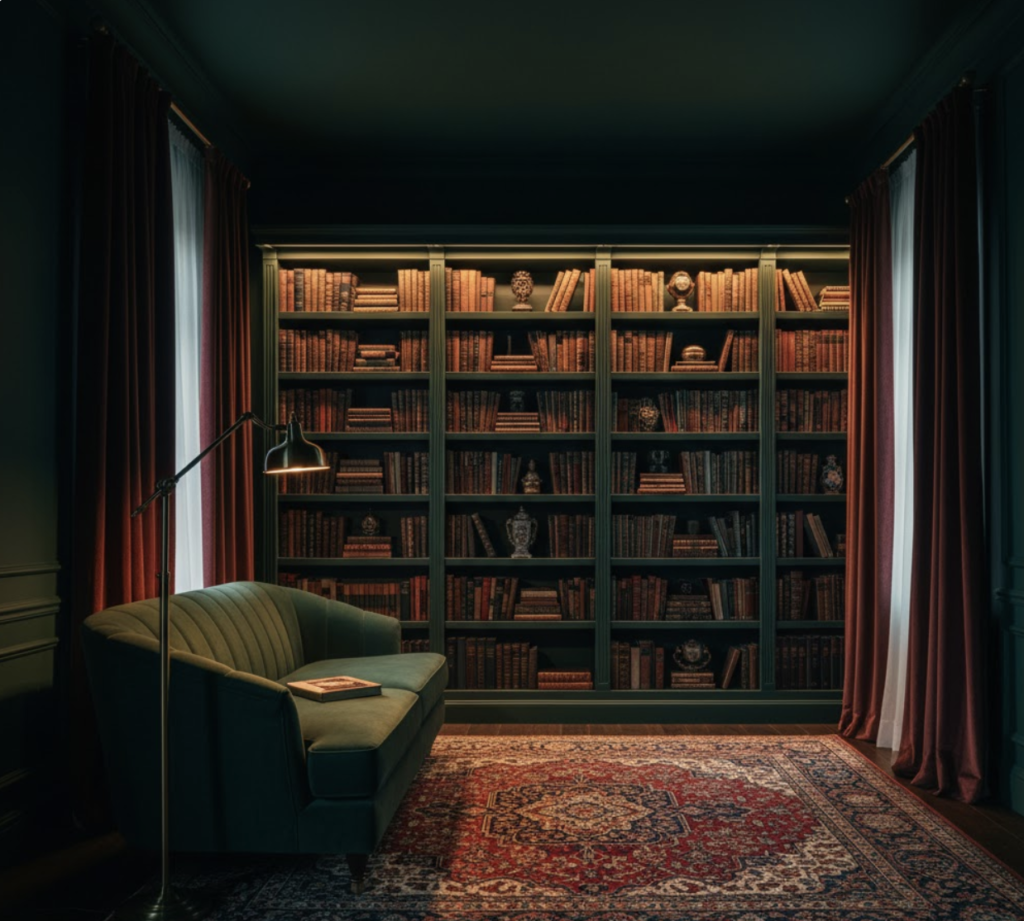
At some point in most book lovers’ lives, the thought arrives: what if the reading room was dark? What if, instead of soft whites and natural linens, it was all deep greens and moody charcoals, velvet and candlelight, the kind of atmosphere that makes you feel as though you are about to read something important? This is a legitimate interior design choice, and it deserves to be taken seriously. Also, it looks absolutely wonderful.
The dramatic dark reading room leans into depth rather than brightness. Deep wall colours — navy, charcoal, forest green, inky black, rich burgundy — absorb light rather than reflecting it, creating an enclosed, cave-like atmosphere that many readers find deeply conducive to long stretches of concentration. The room folds inward. The outside world recedes. It is just you, the book, and approximately seventy-five carefully chosen objects that all happen to be in beautiful, saturated colours. Restraint, as you can see, is optional here.
Velvet is the fabric of the dramatic dark reading room. A velvet sofa or reading chair in emerald, midnight blue, or deep plum becomes the centrepiece of the whole space. It absorbs light in a way that no other fabric does, creating a richness and depth that looks genuinely luxurious. Velvet also happens to be extremely comfortable for long reading sessions, which is a very practical benefit dressed up in a great deal of glamour.
Lighting in a dark room requires deliberate thought. Without it, the room just becomes a dim space rather than a dramatic one — and there is a meaningful difference. A brass floor lamp positioned beside the reading chair provides warm, directional task lighting. Candles add flickering, atmospheric light on side tables and mantels. Recessed ceiling lights with warm bulbs on a dimmer give you control over the overall light level. The goal is layers of warmth, not a single overhead bulb working very hard and succeeding at nothing.
Books look stunning against dark walls. Pale spines glow. Colourful covers pop. The visual contrast between a dark backdrop and the varied colours of a well-stocked shelf creates an image that ends up on mood boards and in magazine shoots. If you have ever wondered how to make your book collection look its absolute best, the answer may simply be: put a dark wall behind it. The books have been waiting for a backdrop worthy of them.
7. The Scandinavian Reading Room
If you have spent any time on interiors blogs in the past decade, you have encountered the word hygge. It is Danish, it refers to a feeling of cosy contentment and warmth, and it has become so widely used that it is borderline overexposed as a concept. And yet, when it comes to reading rooms, it remains stubbornly relevant — because what a reading room is really trying to achieve, at its core, is exactly that: a feeling of being warmly, peacefully at home. The Danes were right. There, we said it.
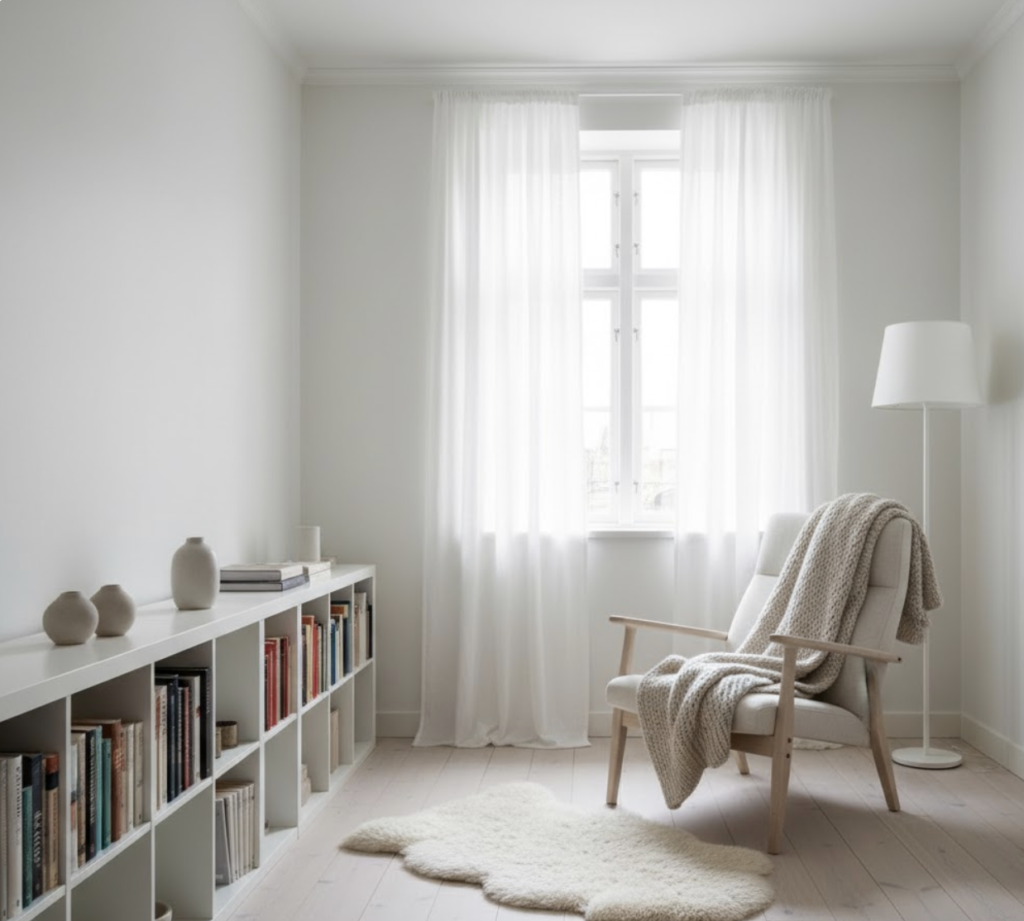
The Scandinavian reading room takes hygge as its design brief. The palette is light and restrained: white walls, pale ash or pine wood, creams and warm oatmeal tones in textiles, with occasional soft greys and barely-there blues. The furniture is simple and functional, with clean lines and a focus on natural materials. There is nothing unnecessary, but nothing is missing either — every choice is considered, comfortable, and calm. It is the design equivalent of someone who always knows what to order and never regrets it.
Textiles carry enormous weight in a Scandinavian reading room. A chunky knit throw over the arm of the chair. A sheepskin on the seat. Wool cushions in natural undyed tones. A thick woven rug on a pale wood floor. These layers of texture create warmth without colour, which is a skill worth appreciating. Touching the room — the softness of the wool, the smoothness of the wood, the slight roughness of the linen — is part of the experience of being in it.
Candles are non-negotiable. A small cluster of white candles on a windowsill, a wooden coffee table, or a side shelf — they add flickering, warm light that no electric bulb fully replicates. In a pale room, the warm orange of candlelight creates a contrast that is immediately cosy. It is the simplest possible upgrade to a reading space, costs almost nothing, and will make every book feel at least fifteen percent more enjoyable. This is not scientifically verified, but it feels true.
Natural light is treated with care in Scandinavian design, partly because in Scandinavia, you cannot always take it for granted. Large windows are kept relatively unobstructed. Sheer linen curtains diffuse light beautifully rather than blocking it. The reading chair is almost always positioned near a window, because daylight is the best reading light there is — free, natural, and flattering to both the reader and the room. The Scandinavians have been getting this right for a very long time.
8. The Kids’ Reading Room
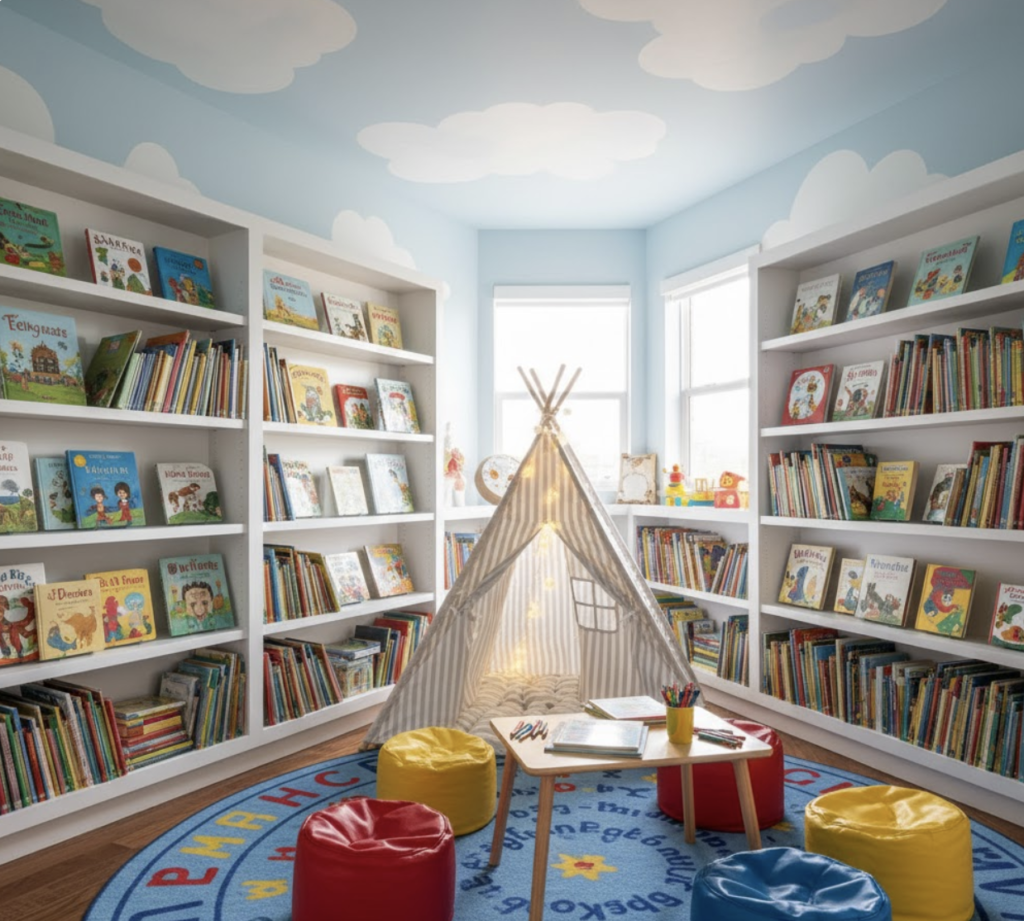
Children’s reading rooms are one of those ideas that sounds like a luxury but is, in practice, one of the most useful investments a family can make. Children who have a dedicated, inviting space for reading develop reading habits more easily and naturally than those expected to read at the kitchen table between homework and dinner. The space gives the activity weight and importance. It says: reading is worth a whole room. Which, to a child, is a significant statement.
The design should be led by what children actually enjoy, not just what looks good in photographs — though there is no reason these two things cannot overlap significantly. Low shelving that lets children see and reach their own books independently encourages them to self-select, which builds both confidence and the habit of choosing reading as a leisure activity rather than a chore. Face-out displays, where the cover rather than the spine is visible, are especially effective for younger children who navigate by pictures rather than titles.
Seating needs to be small, soft, and numerous. Bean bags, floor cushions, small armchairs sized for children, a reading tent or teepee with a cushion inside — the more options there are, the more likely a child is to find their preferred position and stay there for a while. Some children like to sprawl on their stomach. Others curl their legs under them. Very few six-year-olds naturally adopt the upright posture of a Victorian reading adult, and the room should accommodate their actual reading habits rather than imaginary ideal ones.
Storage in a children’s reading room should make books visible and accessible. Colour is a friend here: bright shelves, a bold rug, cheerful cushion covers, and illustrated posters create an atmosphere of energy and joy that makes the room feel like a destination rather than a duty. As children grow, the room can evolve with them — lower shelves become study zones, bright primary colours give way to whatever aesthetic phase their current personality demands, which could be anything from deep space to dark academia to horses. There are no wrong answers.
Lighting deserves particular attention in a children’s reading room. The main light should be generous and warm, without harsh shadows. Fairy lights along shelves or inside a reading tent add magic without being overwhelming. A small lamp for older children who might read independently adds functionality when the main light is off. The goal is a room that children want to go into, feel safe and comfortable in, and leave with a story they want to tell someone — ideally you, at bedtime, just as you were about to have a quiet moment to yourself.
9. The Converted Space Reading Room
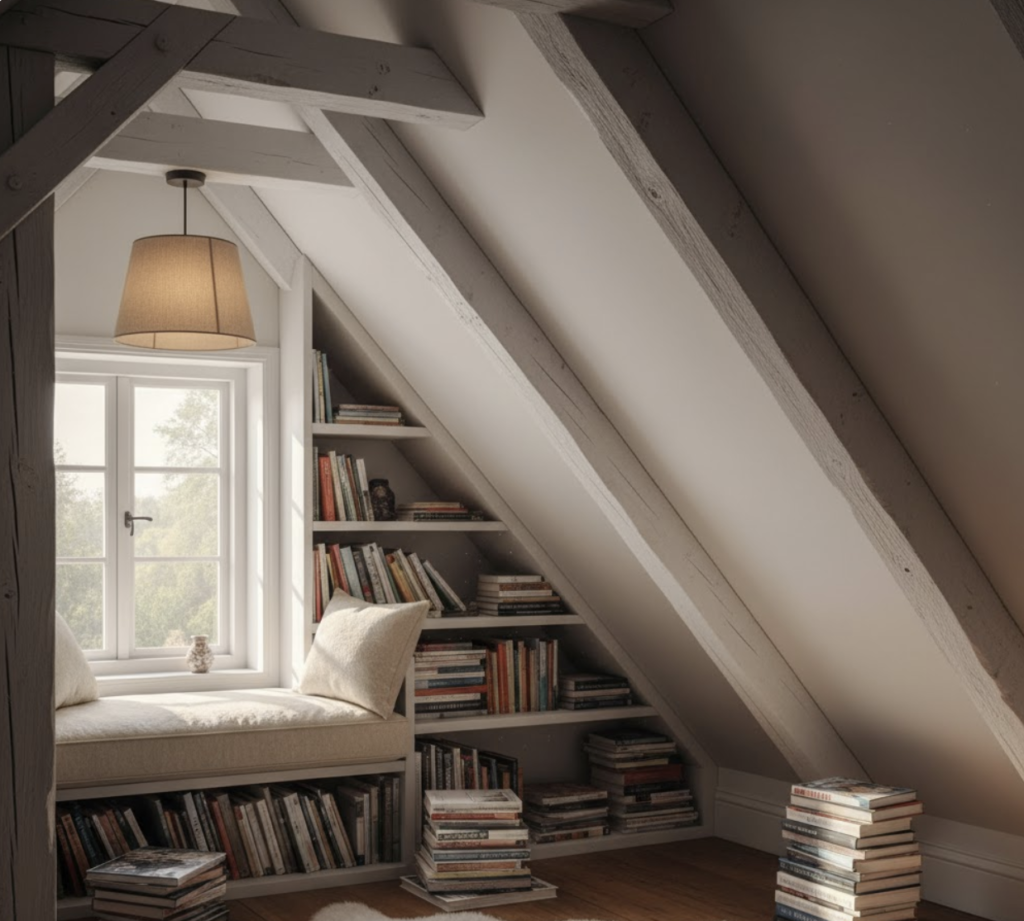
Some of the best reading rooms in existence were not designed to be reading rooms at all. They started life as something else — a spare bedroom, a loft, an underused dining room, a basement with good bones — and through a process that is equal parts practicality and imagination, they became the ideal reading space. There is something very fitting about this. Books, too, are full of things that became something different from what they started as.
The converted attic is perhaps the most romantic version of this idea. Low ceilings with exposed beams, a dormer window that floods one end with natural light, sloped walls that naturally frame a window seat or reading chair — the attic has architectural character that ground-floor rooms often lack. It feels removed from the rest of the house in the best possible way, a slightly separate world where the normal interruptions of household life feel at least one floor further away than they actually are.
A converted spare bedroom offers the more straightforward advantage of being an actual room with a door that closes. This single feature — the ability to shut out noise, distraction, and the pile of laundry waiting in the hallway — makes it enormously valuable as a dedicated reading space. The transformation from spare bedroom to reading room is primarily about removing the bed (or keeping it, if you are the kind of reader who prefers horizontal, which is a valid and underrepresented reading posture) and adding appropriate seating, lighting, and shelving.
Basements and below-ground spaces offer a different atmosphere entirely — quieter, cooler, removed from the sounds of the street and the upper floors. With the right lighting and careful attention to warmth and comfort, a basement can become one of the most focused reading spaces in a house. The slightly cocoon-like nature of a below-grade room, which might feel limiting in a living or dining space, becomes an asset in a reading room where the goal is sustained, undistracted focus.
A garage conversion, a garden outbuilding, a conservatory that was being used as storage — any of these can become a reading space that feels genuinely separate from the rest of your life, which is sometimes exactly what you need. The garden reading room in a separate structure especially carries the appeal of a retreat: you step out of the house, cross a small distance, open a door, and you have arrived somewhere. That small physical journey adds ritual to the act of reading. It makes it feel chosen, deliberate, and entirely yours.
10. The Modern Reading Room
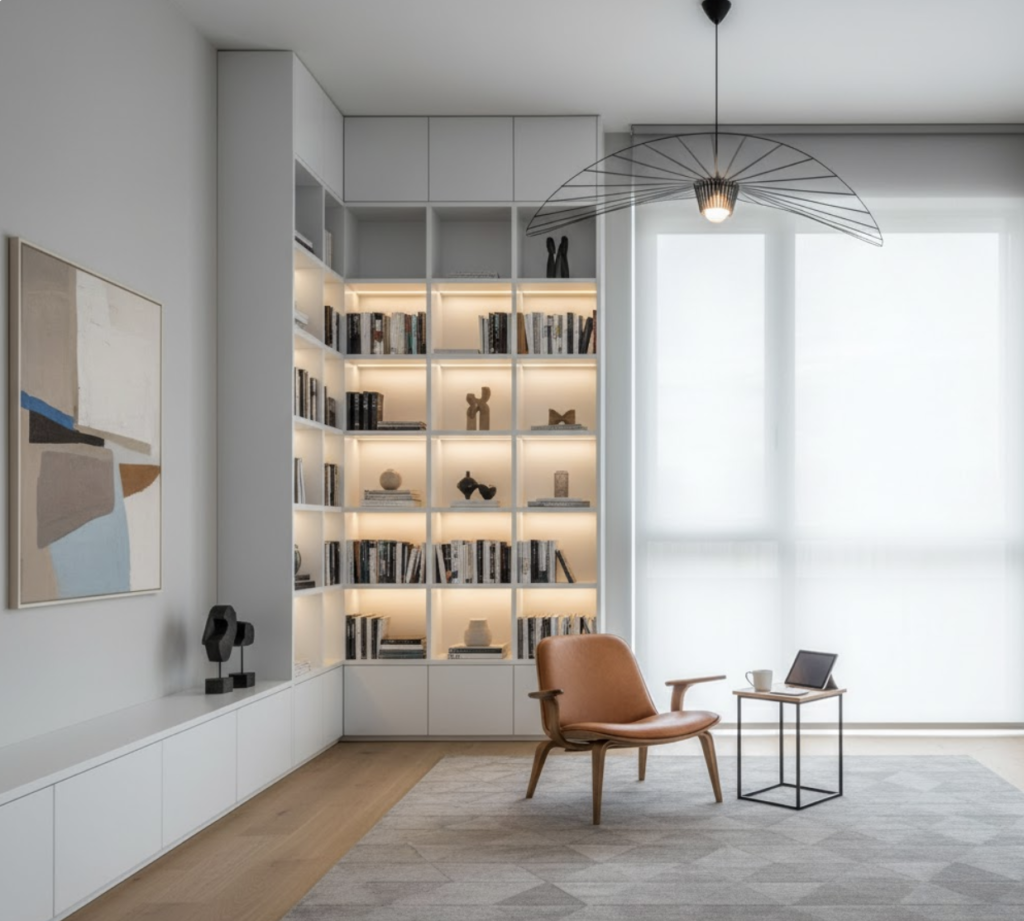
A modern reading room carries no allegiance to oak shelves and leather armchairs. It has its own aesthetic: clean lines, smart storage, carefully chosen materials, and a total absence of clutter that would make a Victorian library scholar deeply uneasy. It is the reading room for people who love books and also happen to love design — and who see no contradiction between the two, because there genuinely is not one.
Modern reading rooms often feature modular or built-in shelving with integrated lighting, where LED strip lights tucked under each shelf level create even, flattering illumination across the books without needing additional floor or table lamps. The shelving tends toward clean, unfussy lines — no ornate cornices, no carved details, just good proportions and materials that age well. White, light grey, pale ash, and matte black are all common choices that work with a wide range of book colour palettes and do not demand to be the main event.
The reading chair in a modern room is where character is often introduced. A designer chair in cognac leather, a sculptural form in deep grey wool, a low-slung piece with a deliberately architectural shape — the chair is chosen as carefully as the bookshelves, because in a minimal room, every object carries more visual weight. Accompanying it: a simple side table, nothing more than a surface and a leg, holding a lamp that casts clean, directional light exactly where it is needed.
Technology is welcome in the modern reading room, without apology. An e-reader on the side table is not a betrayal of physical books — it is another format, and the modern reading room is comfortable with this. A small, discreet speaker for background music or ambient sound, a USB charging point within reach of the chair, smart bulbs that shift from cooler daylight reading light to warmer evening tones — these practical additions make the room work better for the actual activity of reading, which is the whole point of the room.
Art is handled carefully in a modern reading room. Rather than filling walls with many pictures, the modern approach favours one or two considered pieces — a large abstract print, a single framed poster with genuine graphic impact, or even the bookshelves themselves as the primary visual element. The goal is a room that feels intentional rather than accumulated, designed rather than just decorated. Books will do their best to undermine this over time. This is understood, accepted, and frankly expected.
11. The two way reading room
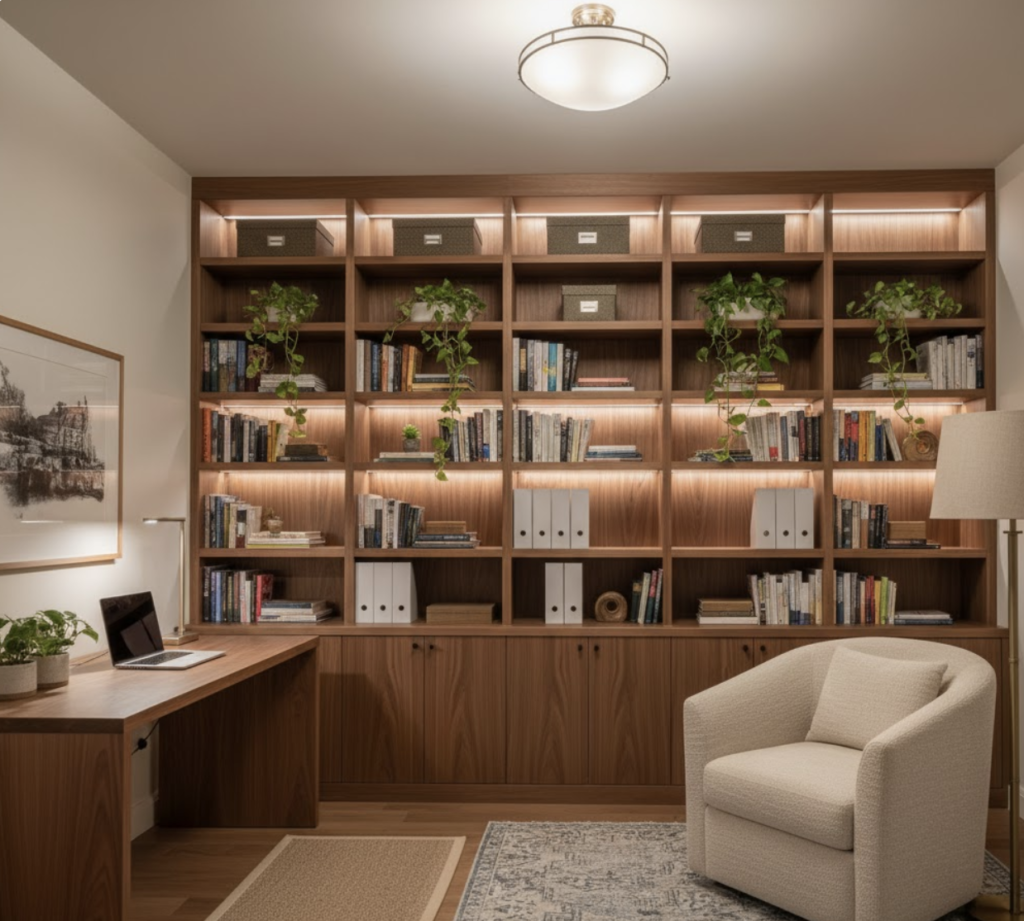
Not everyone has the luxury of dedicating an entire room solely to reading. For many people, the reading space needs to share territory with a home office, a guest bedroom, or some other function with equally legitimate claims on the square footage. This is not a compromise — or at least, it does not have to be. A dual-purpose room containing both a working zone and a reading zone, designed so that each feels genuinely separate, can be one of the most satisfying rooms in a house.
The key to making a dual-purpose reading and working room function well is creating a clear physical distinction between the two areas, even without a physical divider. A rug under the reading chair defines it as its own distinct zone. The desk faces away from the reading corner, so that when you are at the desk, the reading chair is behind you and not visible in your eyeline — and when you are in the reading chair, the desk and its to-do list are not looming. The zones reinforce each other by contrast: the desk is where you are productive, the chair is where you are not, and that boundary makes both activities feel more legitimate.
Storage in a combined reading-and-working room needs to serve both functions cleanly. Full-wall shelving that holds both work files and personal books is a beautiful solution — the uniformity of the shelving unifies the room visually even as the contents divide it functionally. Baskets and boxes hold the administrative clutter every home office accumulates, while the books take up their usual, more aesthetically pleasing space alongside them.
Lighting requires particular thought. The desk needs bright, focused task lighting for work — ideally cooler, daylight-spectrum light that helps with concentration and reduces eye strain. The reading corner needs warm, soft, directional light that signals relaxation. These two lighting needs are different enough that they should be handled by separate fixtures rather than one overhead solution. A good desk lamp for work and a good floor lamp for reading, both on separate switches or dimmers, give you full control over which mode the room is in at any moment.
The dual-purpose reading room also has a practical psychological benefit: it gives you somewhere to go within the room when work stops. The physical act of moving from the desk to the reading chair — even just a few feet — creates a transition that signals to your brain that work is over. For anyone who works from home and struggles with that blurred line between ‘technically still working’ and ‘actually finished for the day’, having a reading chair within reach is, in its small way, a mental health tool as much as a design choice. The book is the off switch.
12. The Outdoor Reading Room
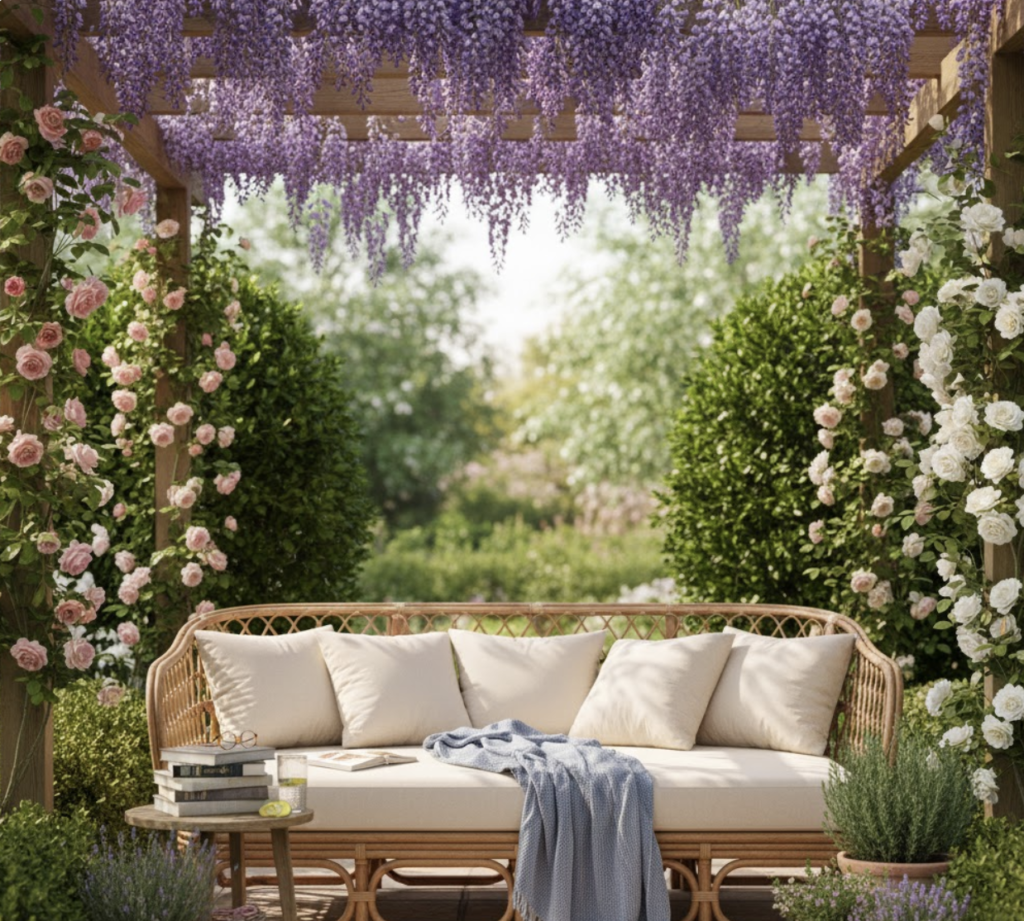
The outdoor reading room is a comfortable place to sit with a book, where the environment around you is as pleasant as possible, and where the main design element is nature doing its job magnificently. Wind is the only real enemy, and even that can be managed. Everything else — the light, the air, the sounds, the temperature on a good day — is working very much in your favour.
Creating an outdoor reading space is about defining and furnishing a specific zone within a garden, terrace, balcony, or outdoor area that serves reading specifically, rather than just being a spot where outdoor furniture happens to live. A daybed under a pergola draped with wisteria or climbing roses, a pair of deep chairs in a sheltered corner of a terrace, a hammock strung between two trees — each of these becomes an outdoor reading room when you add the intention behind it: this is where reading happens. Full stop.
Comfort is non-negotiable. Outdoor furniture for reading needs to be genuinely soft and supportive for extended sitting. Thin cushions on metal frames are for people who will be outside for forty minutes at most, eating lunch and checking emails. For reading, you need thick cushions in a durable outdoor fabric, a side surface for your drink and sunglasses, and ideally something to lean your back against properly. A daybed or a deep-seated rattan chair with a high back and armrests covers all of these requirements in a single, visually pleasing piece.
Shade matters enormously, and not just for comfort. Direct sunlight on a book or a screen makes both almost impossible to read without squinting, which is not the relaxed, joyful experience anyone is aiming for. A pergola covered with climbing plants provides beautiful dappled shade that is more pleasant than a solid canopy. A large umbrella offers flexibility and can be adjusted through the day. A sail shade installed at an angle covers more space for less money and looks genuinely architectural when well positioned. Whichever solution you choose, the reading space should have it.
The outdoor reading room has one quality that no indoor room can replicate, no matter how many plants you add or windows you open: it is actually outside. The temperature is real. The sounds are unfiltered. The light changes as clouds move and the sun shifts across the afternoon. Time behaves differently when you read outside — it moves more gently, which is perhaps why a chapter read on a warm terrace with a cold drink at hand always feels twice as enjoyable as the same chapter read at the kitchen table. This is not magical thinking. This is excellent prioritisation, and you deserve full credit for it.
Conclusion
Viola, for my book readers, these are 12 reading room ideas to try to design a room you enjoy reading a book in. So if you’ve been considering on having a room where you just read, then try these ideas