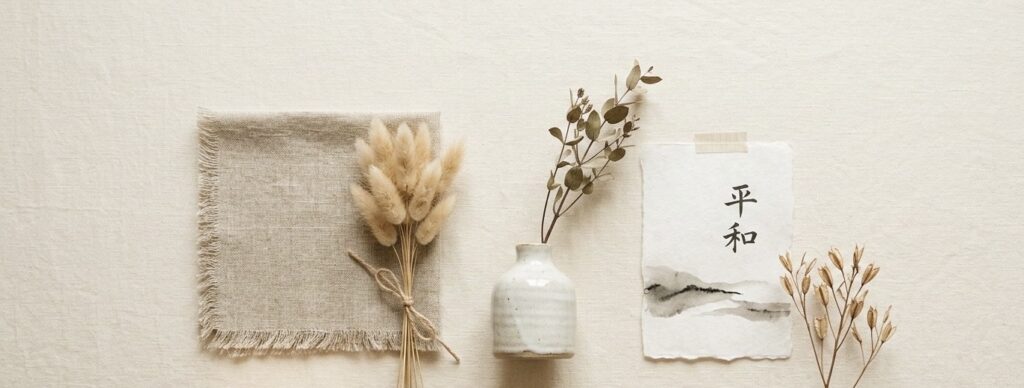
Simple, beautiful, and full of calm — these Japandi bedroom ideas show you exactly how this blend of Japanese and Scandinavian style can transform any bedroom into a place you never want to leave.
There is something about a Japandi bedroom that is hard to put into words. The moment you see one, you feel it — a sense of quiet, of breathing room, of everything being exactly where it should be. It does not feel cold or empty. It feels settled. Warm. Intentional. If you have ever walked into a hotel room and thought, ‘I want my bedroom to feel like this,’ chances are you were looking at a Japandi space without even knowing it.
Japandi is a design style that grew from the connection between Japanese minimalism and Scandinavian simplicity. Both cultures, though on opposite sides of the world, share a deep appreciation for nature, honest materials, and spaces that feel restful. Japan has wabi-sabi — the beauty of imperfect, natural things. Scandinavia has hygge — the comfort and warmth of cozy, slow living. Put them together and you get Japandi: rooms that feel stripped back but never bare, minimal but never cold, simple but never boring.
The bedroom is arguably the best place to explore this style. It is the one room in your home that belongs entirely to you. It is where you start and end every day. And Japandi ideas for the bedroom are not about throwing out everything you own and starting from scratch. They are about shifting the mood, rethinking the layers, and choosing pieces that carry meaning instead of just filling space.
Below you will find 17 distinct Japandi bedroom ideas, each one detailed enough that you can truly picture it, understand why it works, and feel inspired by it. At the end, you will also find two optimised Pinterest pin ideas to help you save and share this content.
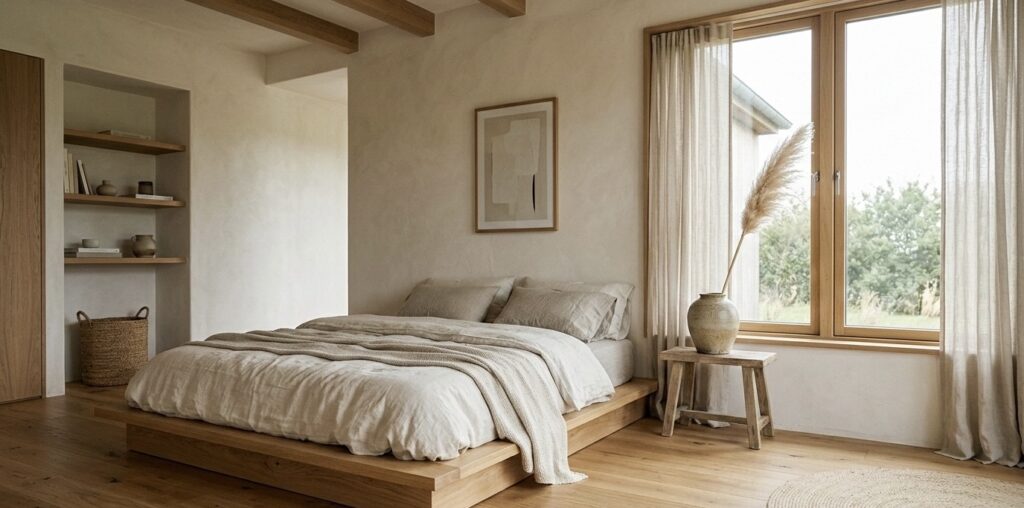
1. The Low Platform Bed With Linen Layers
If there is one piece of furniture that defines a Japandi bedroom more than anything else, it is the low platform bed. It sits close to the ground, which immediately changes the whole energy of the room. The ceiling feels higher. The space feels calmer. There is a groundedness to it, both literally and emotionally, that a raised bed frame simply cannot replicate. In Japanese home design, sleeping close to the floor is a tradition rooted in humility and connection to the earth. In Scandinavian design, low-profile furniture keeps rooms feeling open and uncluttered. In Japandi, these two ideas meet beautifully.
The bed frame itself is usually made from light or medium-toned wood — think pale oak, ash, or a warm walnut. The lines are completely clean. No ornate headboard carvings, no curved edges, no fussy details. Just honest, visible wood grain and simple joinery. Some Japandi platform beds have a slightly raised wooden headboard panel — minimal and flat — while others have none at all, letting the wall behind become part of the design.
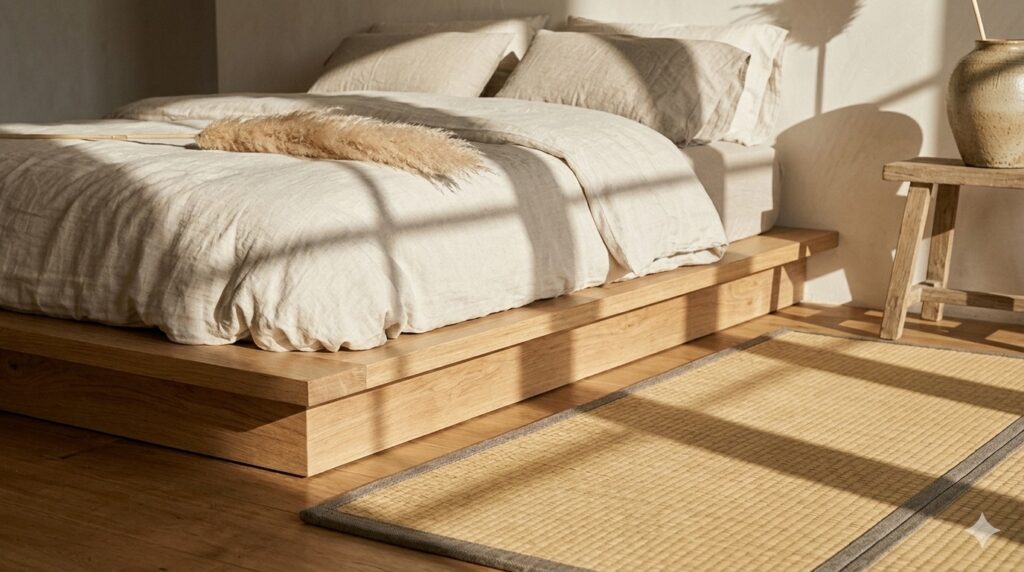
The bedding in this kind of bedroom is what brings warmth and softness to all that wood and calm. Linen is the fabric of choice. It has a natural texture that photographs beautifully, wrinkles in a way that looks intentional rather than messy, and comes in the exact muted, earthy tones that Japandi is built on. Think undyed linen, warm sand, dusty sage, pale terracotta, or fog grey. Layer a heavier linen duvet over a fitted sheet, add one or two textured cushions in complementary tones, and you have a bed that looks effortlessly put together even when it is not perfectly made.
This idea works especially well in rooms with natural light. Sunlight hitting linen bedding creates a soft glow that feels like a photograph every morning. Add a small tatami-style woven rug beside the bed, and the whole look comes together in a way that feels both Japanese and Nordic at the same time.
2. A Neutral Palette With One Warm Accent
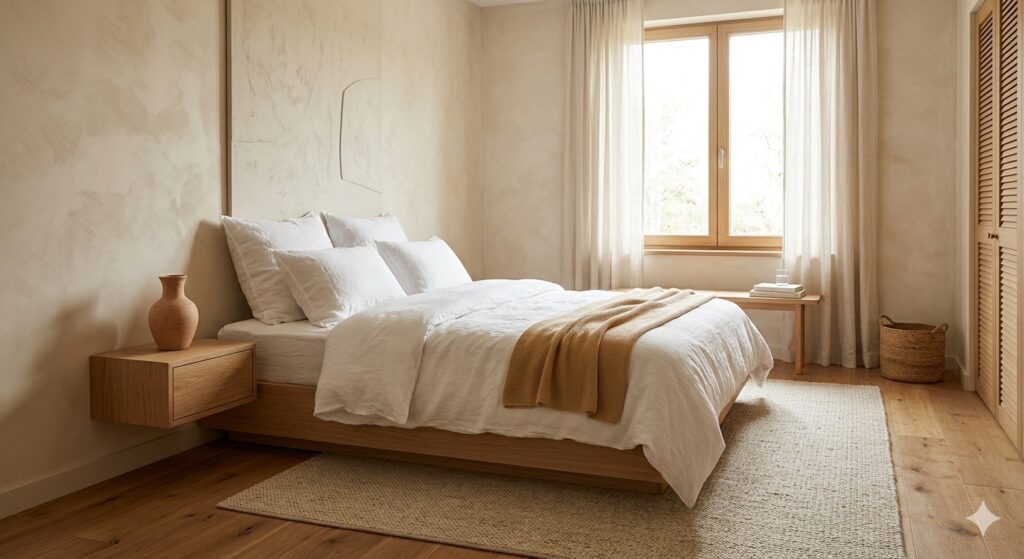
Japandi bedrooms are famously neutral. But neutral does not mean grey and cold. It means a palette built from the colours you would find in nature — off-white walls the colour of sand, floors in warm honey oak, textiles in cream, stone, and driftwood. This is a colour story that feels soft and liveable, not stark or clinical. The key is to choose neutrals that have warmth built into them rather than neutrals that lean cool or blue-toned.
Within this calm neutral backdrop, one warm accent can completely transform the room’s character. This might be a single terracotta-coloured throw draped across the foot of the bed. It might be a rust-orange ceramic lamp base on the bedside table. It could be a deep ochre cushion, a warm caramel leather tray, or even a small woven basket in a rich camel tone. The accent is never loud. It is just enough to catch the eye and give the room something to anchor to.
The reason this works so well in a Japandi bedroom is that it mirrors the natural world. In nature, you rarely see sharp colour contrasts. Instead, you see harmonious tones with small moments of warmth — a clay pot, a dried leaf, the amber light of late afternoon. This is exactly the energy that a well-chosen warm accent creates in a neutral Japandi bedroom. The room breathes, and the accent gives it a heartbeat.
3. Shoji-Inspired Room Dividers
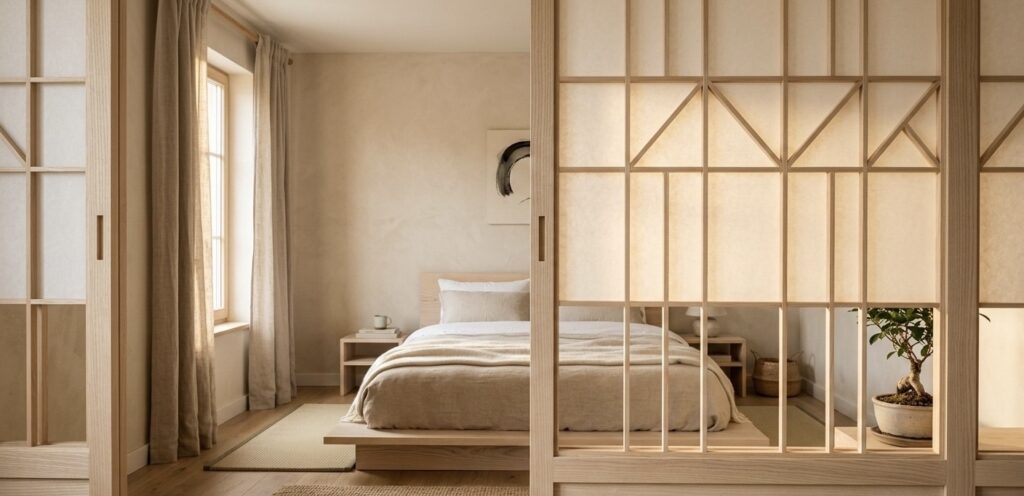
One of the most instantly recognisable elements of Japanese interior design is the shoji screen — a sliding panel made from a wooden lattice frame and translucent rice paper. In traditional Japanese homes, shoji screens are used instead of solid walls and doors to divide spaces. Light passes through them in the most beautiful way, turning a bright window into a soft, glowing panel that fills the room with diffused warmth without any harshness.
In a modern Japandi bedroom, the shoji screen gets a contemporary update. Instead of sliding panels fitted to the architecture, you might see a freestanding room divider with a similar lattice structure, or floor-to-ceiling curtains in a sheer, woven fabric that mimics that same paper-like translucency. The idea is not to replicate a traditional Japanese room but to borrow its most poetic quality — the way it handles light.
A shoji-inspired divider in a Japandi bedroom can serve multiple purposes. It can separate a small dressing area from the sleeping space. It can create a sense of enclosure around the bed without adding a wall. It can soften the look of a large window while still letting in plenty of light. In a studio apartment or an open-plan bedroom, a shoji-style divider is one of the most elegant ways to create zones without breaking the room’s calm, open feeling.
The materials matter here. Look for natural wood frames in pale ash or bamboo, and screens in washi-paper panels or linen-cotton blends. Avoid anything plastic or synthetic — it breaks the visual honesty that Japandi is built on. When light hits a real shoji panel, the glow is entirely different from anything artificial, and that difference is everything.
4. A Wabi-Sabi Approach to Wall Decor
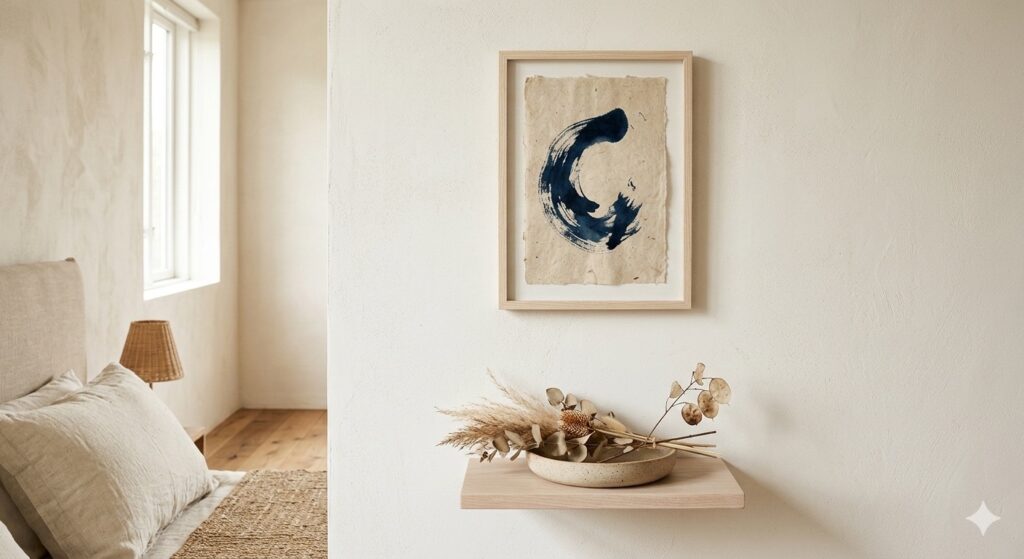
Wabi-sabi is a Japanese philosophy that finds beauty in imperfection, incompleteness, and the natural passage of time. A cracked ceramic pot repaired with gold. A piece of driftwood worn smooth by water. Handmade paper with uneven edges. These are wabi-sabi objects, and they carry a quiet beauty that mass-produced, perfect things simply do not have. In a Japandi bedroom, wabi-sabi thinking shapes how you approach the walls.
Instead of a gallery wall full of frames or a bold piece of modern art, a wabi-sabi Japandi bedroom wall might hold a single piece of handmade paper art with visible fibre texture. It might display a piece of raku-fired ceramic mounted on a wooden panel. It could be a simple ink brushstroke painting on washi paper, a length of indigo-dyed fabric stretched over a wooden frame, or a dried botanical pressed under glass. The point is that each piece feels crafted by hand and shaped by nature, not manufactured for maximum visual impact.
Wall decor in a Japandi bedroom is also about restraint. One or two carefully chosen pieces will always say more than a wall covered in art. Negative space — the empty wall around the artwork — is part of the composition. It gives the eye somewhere to rest and makes the piece itself feel more significant. This is a concept borrowed directly from Japanese aesthetics, where a single flower in a vase is considered more beautiful than a dozen.
5. Built-In Storage That Disappears Into the Wall
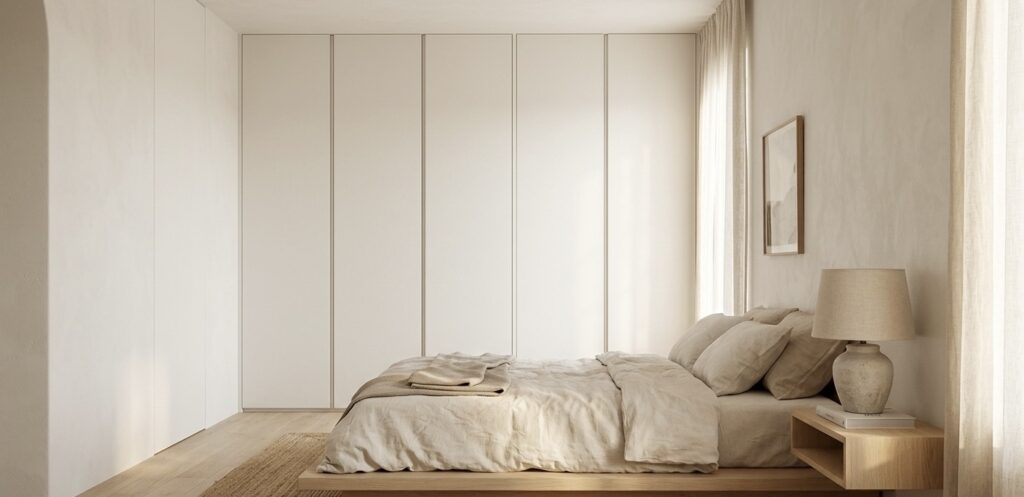
One of the biggest differences between a Japandi bedroom and a standard bedroom is how storage is handled. In most bedrooms, storage is visible — a wardrobe here, a chest of drawers there, a pile of things that haven’t found a home yet somewhere else. In a Japandi bedroom, storage is designed to disappear. The walls become the storage, and the room stays completely calm.
Built-in wardrobes and cupboards with flush, handle-free doors are the gold standard here. When the doors are the same colour and texture as the walls, they become invisible. The room looks larger, cleaner, and far more peaceful because the eye is not drawn to a collection of different furniture pieces. Instead, it moves smoothly around the space and settles on the few intentional elements — the bed, the bedside table, the window.
In a Japandi bedroom, even the bedside storage is simplified. Instead of a traditional nightstand with drawers and handles, you might see a simple floating shelf, a small wooden crate, or a single slim drawer unit that sits flush with the wall. The surfaces of these pieces hold only what is used daily — a lamp, a book, a small plant, a glass of water. Everything else is put away, out of sight, and out of mind.
Scandinavian design has a long tradition of practical, thoughtful storage solutions, and this is where that Nordic influence in Japandi really shines. Ikea’s flat-pack culture notwithstanding, Scandinavian interior design has always understood that a tidy room is a restful room, and that storage is not just about utility — it is about creating the conditions for calm.
6. The Japandi Reading Nook
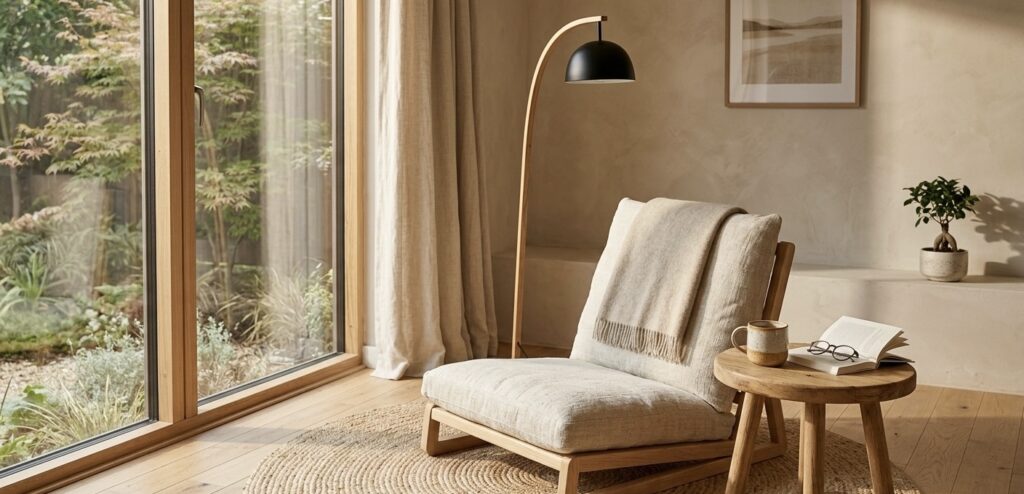
A reading nook in a Japandi bedroom is not a Pinterest fantasy corner with a swinging chair and string lights. It is something much quieter and more considered. It is a corner of the room that has been given purpose and permission — a place to slow down, to sit with a book, to think. In Japandi style, this might be as simple as a low floor cushion or zaisu chair (a Japanese legless chair) placed beside a window, with a small side table and a lamp nearby.
The zaisu is a wonderful Japandi element. It is a chair without legs, designed for sitting on the floor in the Japanese tradition. Modern versions come in clean-lined shapes with upholstered seats in linen or bouclé fabric. Placed on a small woven rug with a low wooden side table and a simple floor lamp, it creates a reading spot that feels deeply intentional without taking up much space or demanding attention when not in use.
The Scandinavian equivalent of this idea is the hygge corner — a cosy, softly lit spot designed for comfort and introspection. In Japandi, you get the warmth of the hygge concept without the excess. No piles of blankets, no fairy lights, no cluttered side table covered in candles. Just the right amount of softness, the right amount of light, and the right amount of calm. It is the kind of corner that makes you want to put your phone down and read a real book.
7. Natural Wood in Every Form
Wood is the backbone of Japandi bedroom design. Not every surface, and not overwhelmingly — but woven through the room in different forms and finishes, it creates a sense of nature being present even when you are indoors. This idea is about committing to wood as a material and exploring the many different ways it can show up in a single bedroom.
You might have a light oak bed frame paired with a darker walnut bedside table, a bamboo woven blind at the window, a small branch used as a curtain rod, wooden wall hooks for hanging robes, and a shallow wooden tray on the dresser for holding everyday objects. None of these pieces needs to match perfectly — in fact, it is more interesting when they do not. The variety of wood tones and textures creates depth without pattern or colour.
Both Japanese and Scandinavian design traditions have a deep respect for wood as a material. In Japan, the grain of the wood is considered part of its beauty — you do not paint over it or cover it up. In Scandinavia, wood is treated as a living material that warms and ages gracefully. In a Japandi bedroom, this translates to a preference for natural wood finishes over lacquered or painted ones. The visible grain, the knots, the slight variations in colour from piece to piece — all of this is welcomed, even celebrated.
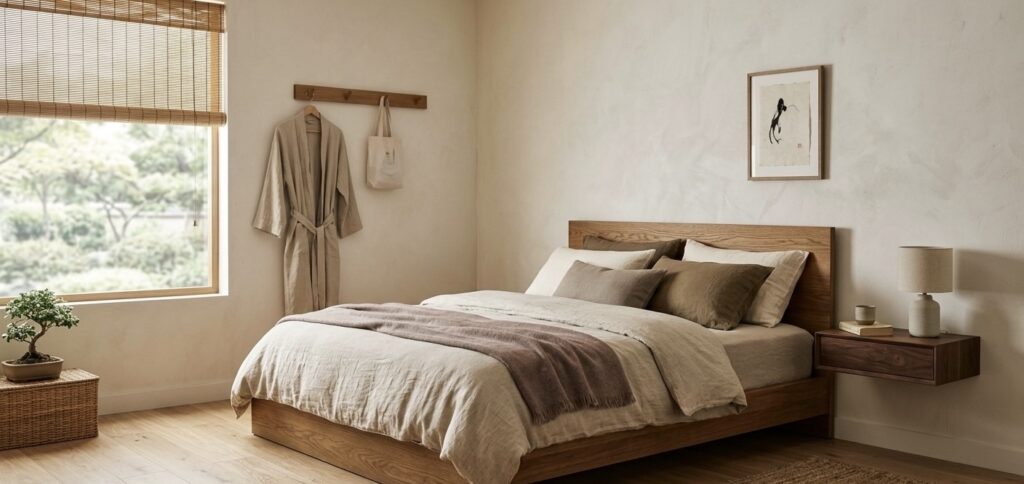
8. A Dark, Moody Japandi Bedroom
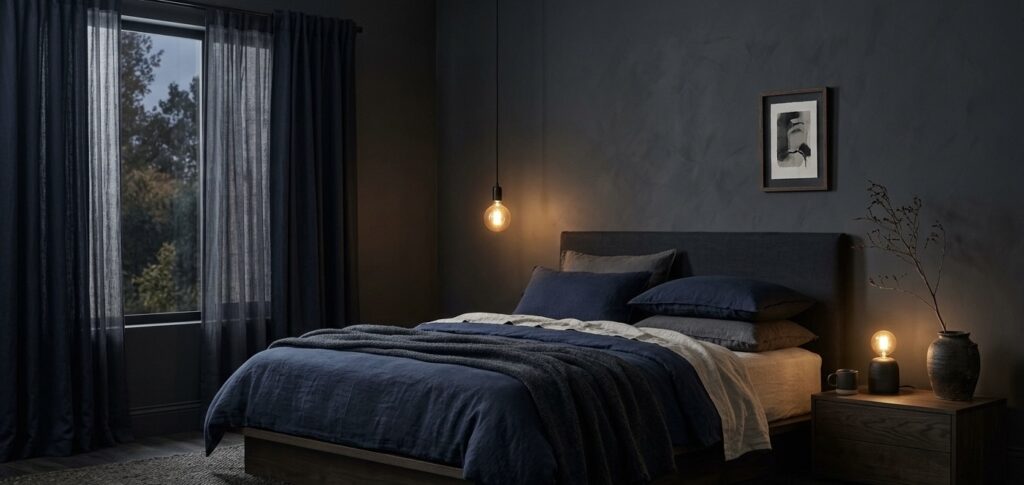
Most Japandi bedrooms you see are light and airy — pale woods, creamy whites, soft natural light. But there is a whole other version of this aesthetic that is darker, moodier, and just as compelling. A Japandi bedroom built around deep, rich tones can feel like stepping into a forest at dusk — enveloping, quiet, and profoundly calm.
In this darker version of the style, the walls might be painted in a deep charcoal, soft black, or dark sage green. The bedding shifts to deep navy linen, storm grey, or forest green. The wood tones become darker too — smoked oak, blackened timber, or dark walnut. And yet the room does not feel heavy or oppressive because the Japandi principle of restraint still applies. There is nothing cluttered, nothing excessive. The darkness is clean and intentional.
Lighting becomes especially important in a dark Japandi bedroom. A single warm pendant above the bed, a low lamp on the bedside table, and perhaps a small candle or two create pools of amber light that make the dark walls glow. This is where the hygge influence is most strongly felt — the warmth and intimacy of a room that wraps around you like a weighted blanket. The Japanese concept of ma (negative space) is also at play here; the dark colour makes the spaces between objects feel more significant.
This idea works especially well in north-facing bedrooms or rooms that receive very little natural light. Rather than fighting the room’s natural character by painting it white, you lean into the darkness and let it become a feature. A dark Japandi bedroom is the most envelope-like version of this style, and it is one of the most genuinely restful sleeping environments you can create.
.
9. Bringing the Outside In With Dried Botanicals
Both Japanese and Scandinavian design philosophies are rooted in a deep connection to the natural world. In Japan, this connection is celebrated through ikebana (the art of flower arranging), bonsai, and the use of organic materials throughout the home. In Scandinavia, it is reflected in the use of natural wood, stone, sheepskin, and a preference for bringing greenery indoors during the long winter months. In Japandi, this love of nature finds its most restrained and beautiful expression in dried botanicals.
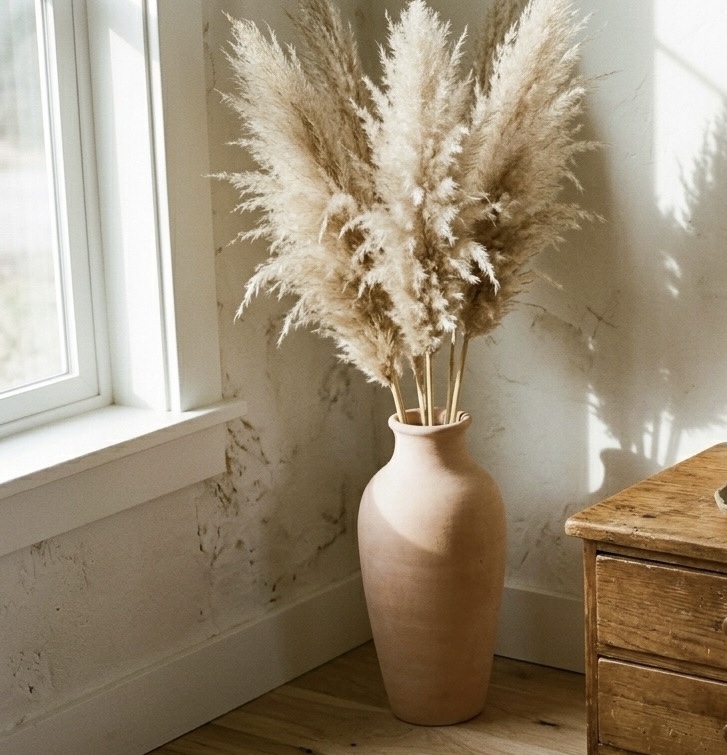
Dried botanicals are perfect for a Japandi bedroom because they age gracefully. Unlike fresh flowers, which must be replaced and can feel high-maintenance in a minimal space, dried stems last for months or even years, slowly changing colour and texture as they dry further. A tall stem of pampas grass in a simple ceramic or terracotta vase. A bundle of dried lavender tied with linen twine and hung on a hook. A few dried lunaria (money plant) pods in a slim glass vase on the window ledge. A single dried anemone in a small bud vase on the bedside shelf.
The scale and placement of botanicals in a Japandi bedroom is important. One large, dramatic stem in a corner makes a completely different statement from three small vases clustered on a shelf. The first is architectural and calm; the second is decorative and curated. Both can work beautifully depending on the rest of the room. The key is to treat each botanical as a piece of art — chosen carefully, placed intentionally, and allowed to breathe.
10. The Japandi Bedroom With No Overhead Light
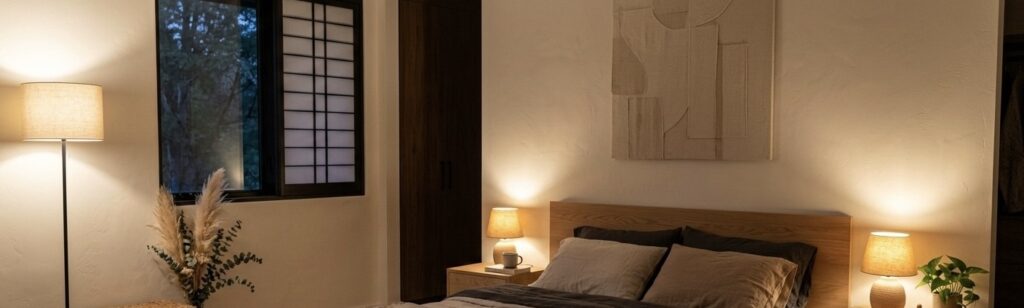
One of the most transformative and underrated Japandi bedroom ideas is to remove the overhead light entirely — or at least stop using it. The harsh, flat light that comes from a central ceiling fixture does something deeply unflattering to any room. It flattens texture, creates shadows in the wrong places, and produces a kind of institutional brightness that has no place in a restful bedroom. Japandi design, particularly in its Scandinavian mode, relies instead on layered, warm, low-level lighting.
Instead of one central light, a Japandi bedroom uses multiple light sources, all at a lower height. A small lamp on each bedside table casts warm pools of amber light perfect for reading. A floor lamp in the corner fills the room with a gentle ambient glow. A pendant light hung low above the bed serves as both a light source and a design feature. Wall sconces on either side of the bed keep the bedside tables clear while still providing directional light. And if you want to add atmosphere, a single candle in a ceramic holder brings a flicker that no LED can replicate.
The Japanese concept of ma is relevant here too — the idea that the spaces between things are as important as the things themselves. When you have multiple gentle light sources instead of one blaring overhead light, the ‘spaces’ between those pools of light — the soft shadows — become part of the room’s beauty. The room feels dimensional, textured, and alive in the evening in a way that flat overhead lighting simply cannot achieve.
11. A Japandi Bedroom Built Around Texture
Because Japandi bedrooms use such a restricted colour palette, texture becomes the primary way of creating visual interest and warmth. This is actually one of the most enjoyable aspects of designing a Japandi space — the way that different materials and surfaces interact with each other and with light. A room in cream, stone, and warm wood tones can look completely flat if everything is smooth, but layer in enough texture and it becomes endlessly rich to look at.
Texture in a Japandi bedroom comes from many sources. Linen bedding with its natural, slightly rough weave. A chunky knit throw over the foot of the bed. A woven seagrass or jute rug on the floor. Rattan lamp shades. Handmade ceramic objects with uneven surfaces. A plaster wall with a deliberate, slightly rough finish. Woven grass window blinds. A wooden headboard with visible grain. Even the ceiling can contribute texture — a limewashed or textured plaster ceiling has a depth and interest that a flat painted one does not.
The art of layering texture in a Japandi bedroom is about contrast and conversation. Smooth next to rough. Soft next to hard. Matte next to slightly reflective. When you have a raw plaster wall, a smooth wooden floor, a linen duvet, and a rough ceramic vase all in the same room, each one makes the others look better. The variety keeps the eye engaged without the room ever feeling busy or loud.
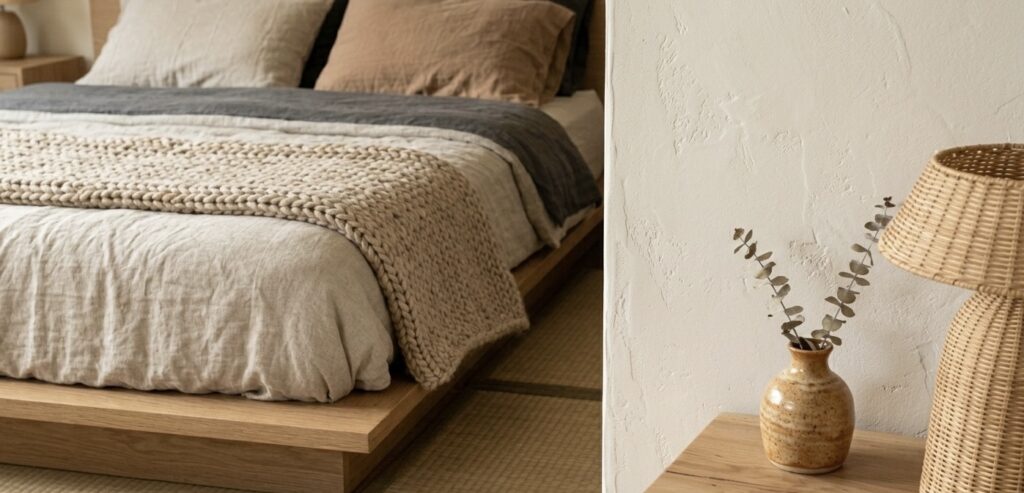
12. Sliding Doors Instead of Hinged Ones
This idea might seem like a purely practical consideration, but in a Japandi bedroom it is deeply aesthetic as well. Hinged doors swing open and need clearance space on both sides — they interrupt the flow of a room every time they move. Sliding doors, by contrast, disappear into the wall or stack beside it, keeping the room feeling open and continuous. In traditional Japanese architecture, all interior doors are sliding, and there is a reason for that beyond just space-saving.
A sliding door in a Japandi bedroom might lead to an en-suite bathroom, a walk-in wardrobe, or simply serve as the bedroom door itself. When it is closed, a well-designed sliding door blends almost invisibly into the wall — especially if the door panel is the same colour and material as the surrounding wall. When it is open, it stacks neatly to one side without invading the room. The visual result is a bedroom that feels more like a flow of connected spaces than a box with openings cut into it.
Modern Japandi sliding doors often feature a simple inset pull — a small recessed finger grip in the door edge — rather than a protruding handle. This keeps the surface completely flat and uninterrupted. The track system is hidden within the floor or ceiling, so there is no visible hardware at all. The door simply glides, silently and smoothly, and the room benefits from its absence as much as its presence.
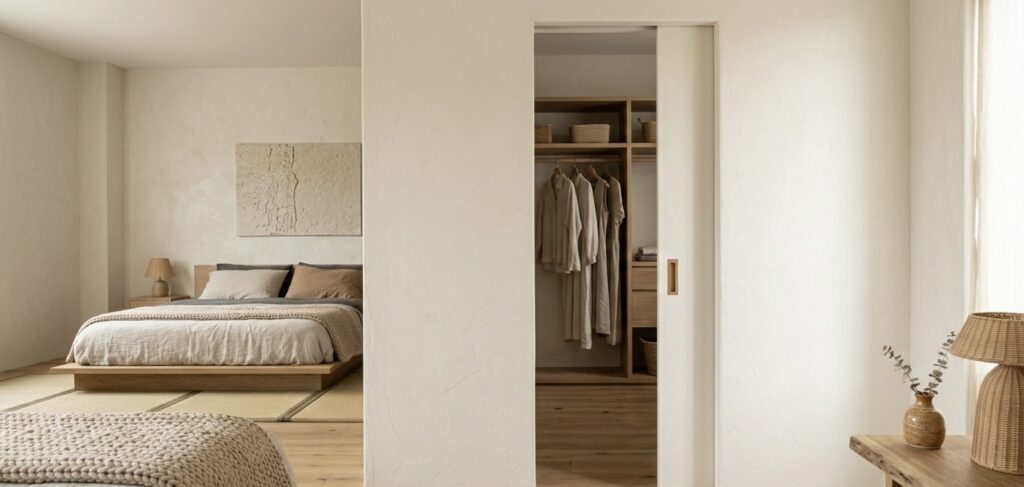
13. The Futon-styled Floor Sleeping Setup
For those who want to go deeper into the Japanese side of Japandi, a floor sleeping setup inspired by the traditional Japanese futon is one of the most radical and rewarding ideas on this list. A Japanese futon is not the fold-out sofa bed familiar in the West — it is a firm, cotton-filled mattress that is placed directly on the floor (or on a thin wooden slat base) and traditionally rolled up and stored during the day to give the room back its floor space.
In a modern Japandi bedroom, you would not necessarily roll the futon away each morning — but the aesthetic borrows from this tradition. The mattress sits very low or directly on the floor, dressed in high-quality natural bedding. Around it, the floor is left largely empty, with just a small side table, a lamp, and perhaps a woven rug. The bedroom becomes a study in floor-level living — unhurried, grounded, and utterly peaceful.
This idea works best in rooms where the floor itself is beautiful — warm oak boards, smooth concrete, or tatami matting are all ideal. It also works best in rooms with a certain amount of ceiling height, because low sleeping needs open space above it to feel generous rather than cramped. When done well, a futon-inspired Japandi bedroom is one of the most serene and distinctive sleeping spaces you can create.
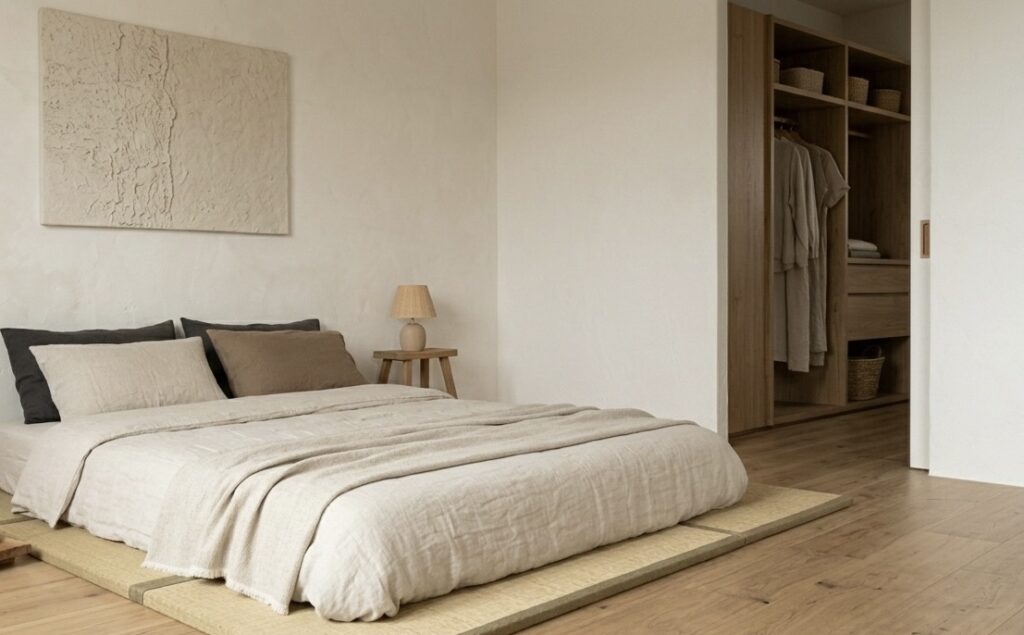
14. A Japandi Bedroom With a Green Wall Panel
While most Japandi bedrooms stick to neutral, earthy tones throughout, there is a growing trend for adding one statement wall — not in an accent colour, but in a particular material or finish that gives the room visual depth and a connection to the natural world. One of the most beautiful versions of this idea is a wall panel in a deep, muted green — not a bright emerald, but something closer to sage, fern, or moss — applied in a limewash or clay-based paint that gives it texture as well as colour.
Placed behind the bed, this kind of wall panel functions like a natural headboard. It grounds the bed visually, creates a focal point for the room, and brings in a sense of nature that is both immediate and subtle. Against this green backdrop, linen bedding in cream or warm white looks extraordinary. The contrast of the organic green wall and the pale, natural fabrics captures something of what it feels like to sit in a forest or a Japanese garden — surrounded by nature but perfectly at rest.
Limewash and clay-based paints are particularly good for this idea because they have a depth and variation that flat paint does not. The colour shifts slightly as the light changes throughout the day — darker in shadow, lighter where the light catches it. This is a very wabi-sabi quality, and it brings the wall to life in a way that feels genuinely connected to the natural world. Pair it with wooden furniture, dried botanicals, and warm lighting, and the effect is breathtaking.
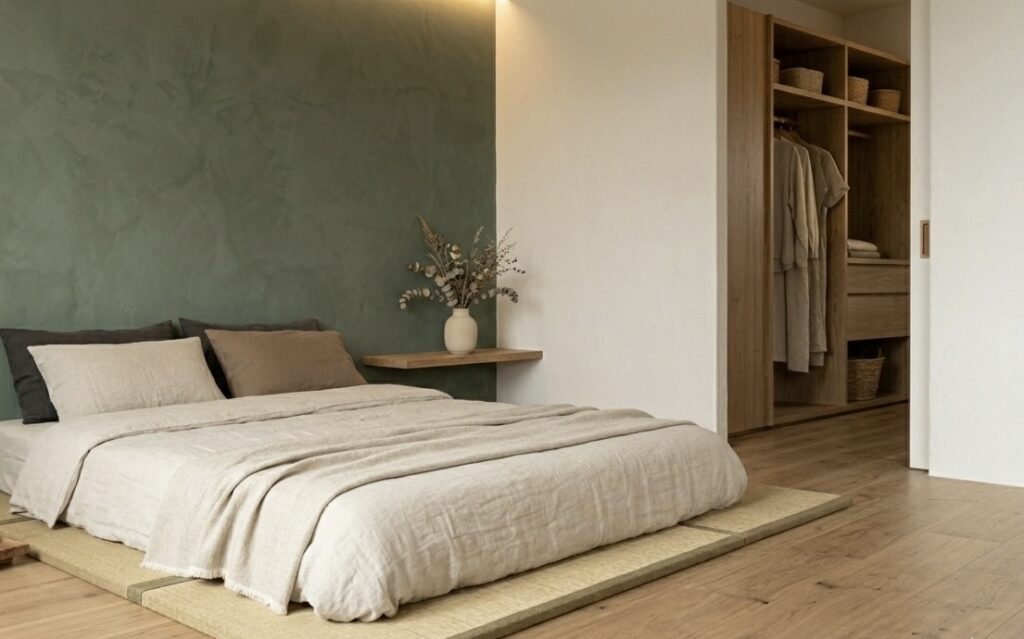
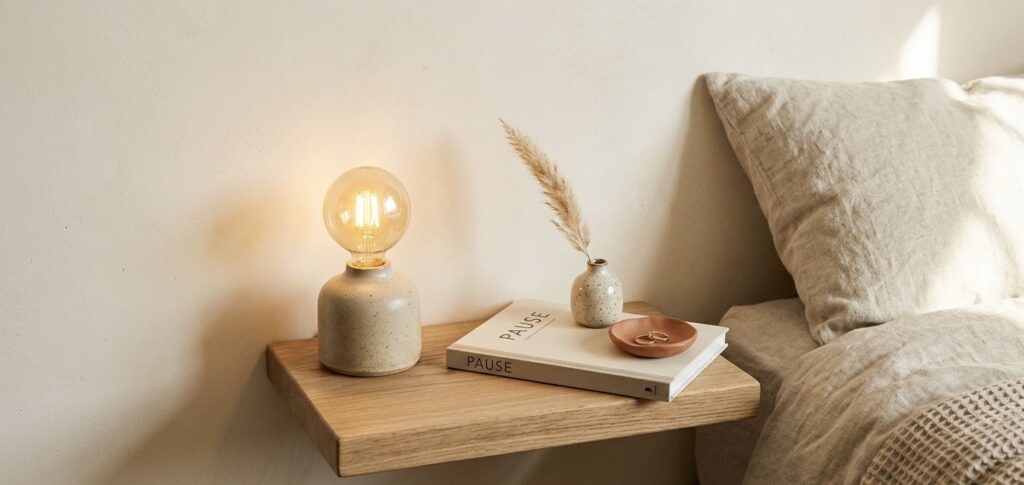
15. Thoughtful Bedside Table Styling
The bedside table is a small surface, but in a Japandi bedroom it carries a lot of design weight. It is one of the first things you see when you walk into the room and one of the last things you look at before you close your eyes at night. Getting this surface right — not perfect, but right — is a small act of intention that makes the whole room feel more considered.
A Japandi bedside table is typically very simple in form — a floating wooden shelf, a slim wooden crate, a single-drawer unit in pale oak, or even a small wooden stool repurposed as a side table. What sits on it follows a clear logic: only what you actually use before bed and after waking. A lamp. One book (not a stack). A small ceramic dish for a ring or a hair tie. A glass of water. Perhaps a single small plant or a bud vase with one dried stem. Nothing else.
The Japandi approach to styling a bedside table is also about the space between objects — allowing each item room to be seen and appreciated. Cramming too much onto a small surface is the fastest way to undermine the calm of a minimal bedroom. When in doubt, take one thing off. Then consider whether you could take another. The bedside table in a Japandi bedroom is curated rather than accumulated, and the difference is immediately visible and felt.
16. The Japandi Bedroom Without a Headboard
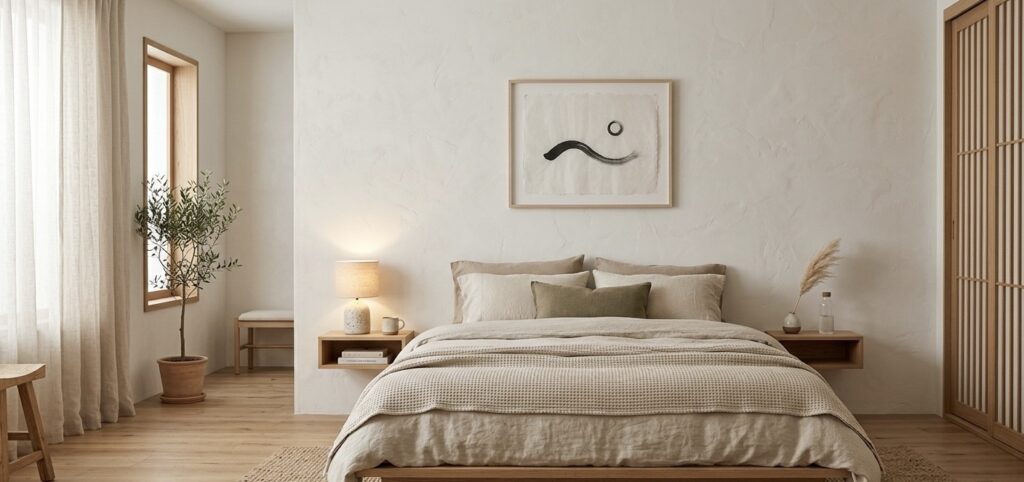
The headboard is such an established part of Western bedroom design that removing it feels almost radical. But in a Japandi bedroom, the absence of a headboard is not a lack — it is a choice. A deliberate, design-forward choice that simplifies the room and gives the wall behind the bed a new kind of presence.
When a bed has no headboard, the wall behind it becomes the design statement. This might be a beautifully textured plaster wall in warm white. It might be the sage green limewash panel from Idea 15. It might be a single piece of handmade art hung slightly higher than the pillow line. Or it might be completely empty — just wall, and the deliberate space around the bed. In each case, the eye reads the bed and the wall as a single composition rather than as separate elements, and the result is a room that feels more integrated and more still.
This idea is also a practical one. Headboards are expensive. A beautiful wall finish or a single piece of thoughtfully chosen art can create the same visual anchor for a fraction of the cost. And because there is no headboard dictating the scale or style of everything else, the rest of the room is free to evolve without being locked into a fixed design decision. The headboard-free Japandi bedroom is one of the most flexible and genuinely beautiful expressions of this aesthetic.
Bringing Your Japandi Bedroom together
Looking through these 16 Japandi bedroom ideas, a few clear patterns emerge. Every idea involves a commitment to restraint — not emptiness, but careful selection. Every idea involves natural materials in some form — wood, linen, clay, dried plants. And every idea is built around the idea of the bedroom as a sanctuary rather than a showroom.
The beauty of Japandi as a style is that it is remarkably forgiving. You do not need to start from scratch or match every piece perfectly. You can begin with one of these ideas — swap your busy bedding for natural linen, remove the overhead light, clear the bedside table, replace one decor piece with a handmade ceramic — and feel the shift immediately. Japandi is less about a strict rulebook and more about a direction: toward simplicity, toward nature, toward rest.
The Japanese concept of ma reminds us that empty space is not wasted space — it is essential space. The Scandinavian concept of hygge reminds us that comfort and warmth are not in conflict with simplicity. Together, in a Japandi bedroom, they create something that is increasingly rare in modern life: a room that genuinely helps you slow down.
Whether you are starting with a completely blank canvas or looking to shift the mood of a room you already love, these Japandi bedroom ideas give you a rich range of directions to explore. Take the ones that resonate and make them yours. That is, ultimately, the most Japandi thing you can do.