
There is something about a villa that feels different from every other kind of home. It is not just the size, the private pool, or the fact that there is usually a terrace big enough to host a small wedding. A villa has a kind of confidence about it. It does not apologize for being beautiful. It does not squeeze its furniture together and hope for the best. It breathes. And when the interior design is done right, that confidence fills every single room.
The tricky part? Villa interiors can go wrong just as dramatically as they can go right. Walk into one that has been designed without intention, and you will find a collection of expensive things that somehow feel cold, disconnected, or — the interior design equivalent of a very loud tie — simply too much. But walk into a villa that has been thoughtfully designed, and you will feel it in your chest. You will slow down. You will want to sit in every chair and stay in every room just a little longer than you planned.
This post is a collection of 16 distinct villa interior ideas, each one with its own personality, its own mood, and its own way of making a space feel extraordinary. Whether you are renovating, decorating from scratch, dreaming on your lunch break, or just looking for a reason to open a new Pinterest board, there is something here for you. No two ideas are the same. Some are breezy and light-filled, some are rich and moody, some are quietly luxurious in a way that creeps up on you slowly — which is honestly the best kind.
So let us get into it. Sixteen ideas, one brilliant villa, zero regrets.
1. The Mediterranean Living Room
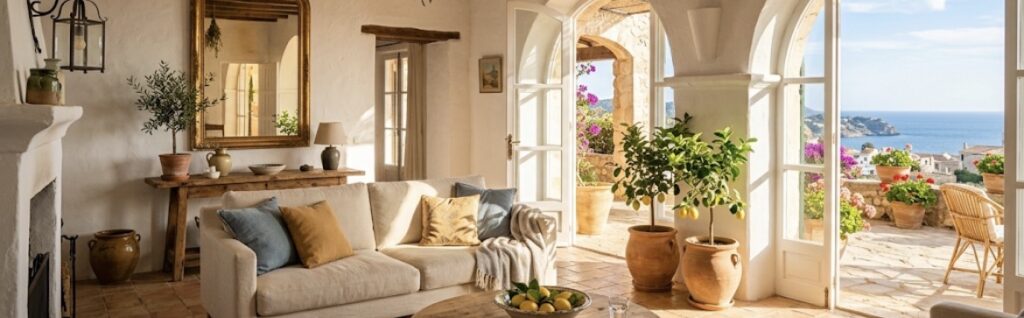
The Mediterranean living room is the one idea that has genuinely stood the test of every design trend that has come and gone. It is rooted in something so honest — light, natural materials, a love of the outdoors — that it never feels dated. It just feels right. And in a villa setting, where the architecture itself tends to lean toward arches, thick walls, and open terraces, this style feels less like a design choice and more like a homecoming.
Whitewashed walls, whether rough-plastered in the way of old Greek island homes or smoothly painted in a warm off-white, are the canvas that makes everything else work. From there, the colours come in through texture and object rather than paint: the warm terracotta of handmade floor tiles, the faded blue of linen cushions that have seen many summers, the earthy yellow of a ceramic lamp base, the bleached silver of a driftwood sculpture propped against the wall. None of these colours fight for attention. They simply coexist, the way people do at a very good dinner party.
Furniture in a Mediterranean living room is low and welcoming. A deep sofa upholstered in natural linen or cotton, worn just enough to look lived-in but not so worn that it looks neglected. Wooden coffee tables — ideally olive wood, which has the most beautiful grain — sit low and are almost always decorated with a bowl of fresh fruit, a stack of photography books, or both. The seating arrangement is generous, because in Mediterranean culture, the living room is not a room you pass through. It is the room you stay in, talking and eating and drinking long after the sun has set.
The key accessory in a well-done Mediterranean villa living room is the window or the door. Floor-to-ceiling shuttered windows that open out onto a terrace, or wide arched doorways draped in sheer linen curtains that move with the breeze, do more for the atmosphere of this space than any piece of furniture ever could. The inside and outside are meant to blur here. That blurring is the whole point.
2. The Jewel-Box Bedroom
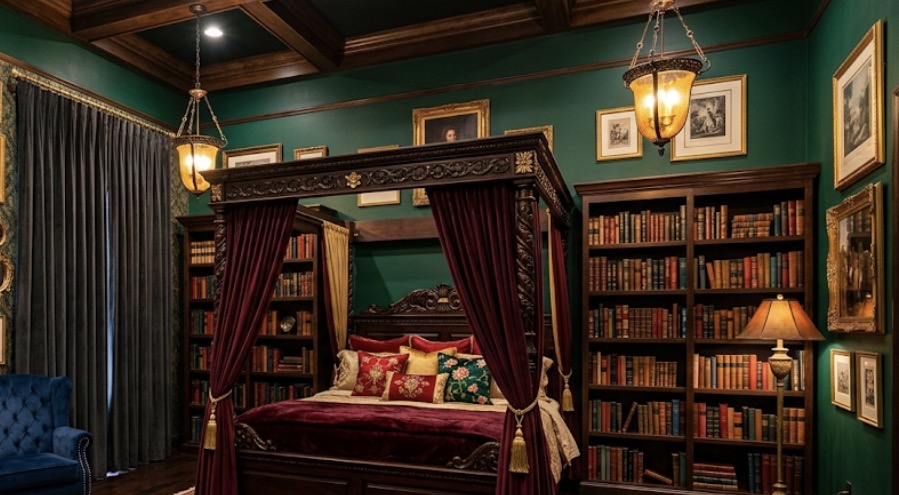
The jewel-box bedroom is the opposite of minimalism in every possible way, and it is absolutely glorious for it. In a villa, where the rooms are often large enough to absorb drama without collapsing under its weight, this approach is not just possible — it is an invitation.
The jewel-box bedroom starts with colour, and it starts boldly. Deep emerald green, rich sapphire blue, plum, forest navy, burnt terracotta — these are the shades that set the stage. The walls become the backdrop for everything that follows, and when you layer jewel tones over jewel tones, something interesting happens: instead of looking chaotic, the room starts to feel enveloping. Like being inside something precious. That is exactly the sensation this interior is after.
The bed is the centerpiece, and it earns its starring role. A carved wooden four-poster, a curved Art Deco headboard in velvet, or a heavy iron frame with an antique patina — whatever the style, the bed in a jewel-box room is not subtle. It is dressed in layers: a base sheet in silk or high-thread-count cotton, a heavy bedspread in a contrasting texture, throw cushions in three or four coordinating patterns, and a folded blanket at the foot that looks like it came from a Parisian antique shop. Because in this room, more is more, and less is just less.
The rest of the room fills in around the bed like a very well-curated treasure collection. A Persian rug with intricate patterns and deep warm tones. A velvet armchair in a contrasting jewel shade. Bookshelves lined not just with books but with objects: small sculptures, glass decanters, framed photographs, candles in brass holders. Chandeliers with coloured glass shades that throw amber and rose light across the room in the evenings. The maximalist bedroom is not finished when it looks full. It is finished when it feels like a world unto itself.
3. The Open-Plan Kitchen That Doubles as a Social Hub
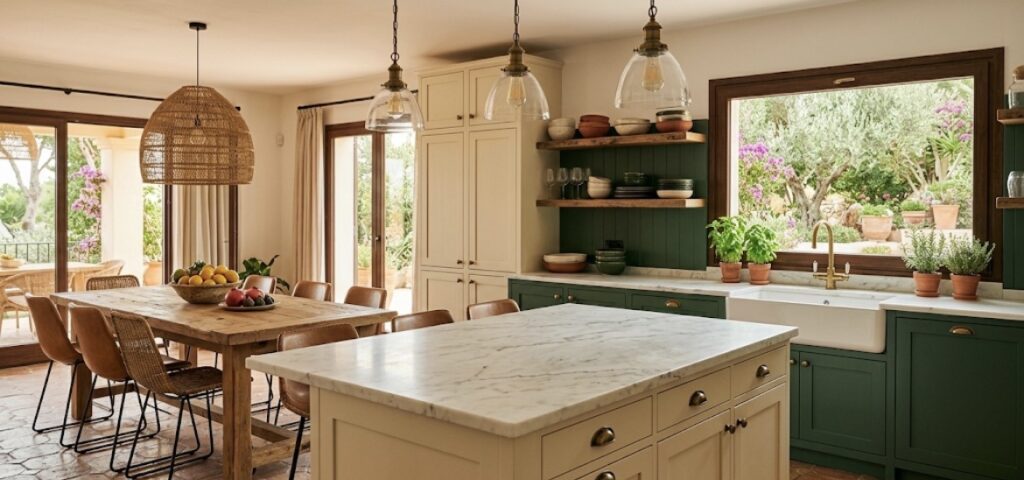
Whoever decided that the kitchen should be hidden away from guests clearly never threw a very good dinner party. In a villa, the kitchen is not a utility room. It is one of the most social spaces in the entire home, and when it is designed with that in mind, it becomes something spectacular.
The open-plan villa kitchen works because it refuses to be separated from the life of the house. It opens directly onto the dining area, and often onto the living space beyond that. The island — always the island — becomes the gravitational centre of the entire downstairs. People sit at it with coffee in the morning, hover around it with glasses of wine in the evening, and stand at it having conversations while someone else is cooking, because the design of the space makes that feel natural rather than intrusive.
In terms of look and finish, the most beautiful villa kitchens tend to balance cold and warm materials with a kind of studied carelessness. A marble island countertop — classic Calacatta or the warmer Emperador brown — pairs with warm timber cabinetry in sage green or deep navy. Brass or unlacquered bronze fixtures age gracefully over time and add warmth to surfaces that might otherwise feel clinical. Open shelving displays ceramics and glassware that are meant to be looked at, not hidden behind doors. The shelf itself becomes a piece of decoration.
The dining table within an open-plan kitchen should be long and generous. Eight seats at minimum, twelve if the space allows. A long wooden table — rough-hewn, with the marks and character of real use — feels more honest and more inviting than a sleek lacquered surface. Mix the chairs: leather and rattan, linen and wood, a bench on one side. The slight visual mismatch creates warmth and personality. And above the table, pendant lights hung low enough to create an intimate canopy of light, even in a high-ceilinged room, make dinner feel like an event every single night.
4. The Indoor-Outdoor Living Room
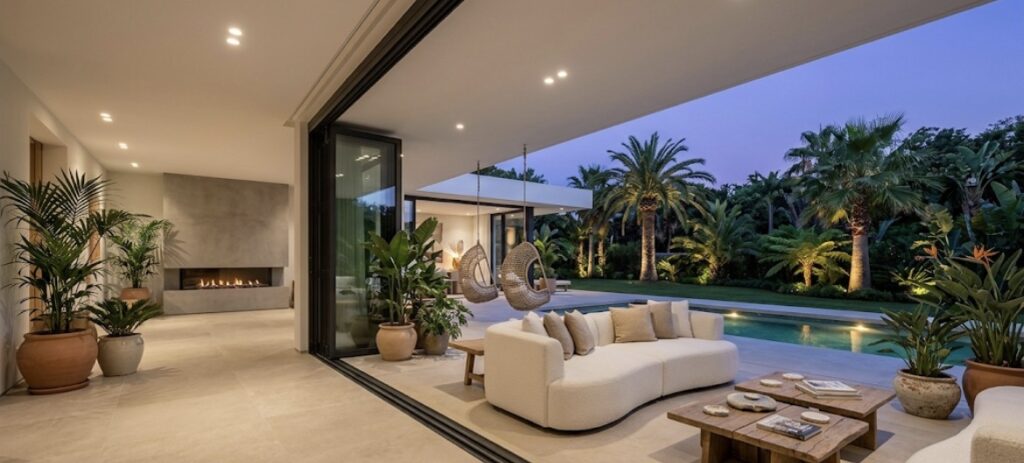
This is the idea that makes people stop scrolling. The indoor-outdoor living room — where the glass walls fold away completely and the room simply becomes one with the garden, the terrace, and the view beyond — is perhaps the single most impressive thing a villa can do. It is architecture and interior design working together to dissolve the boundary between shelter and nature, and when it is done well, it is breathtaking.
The foundation of this concept is the floor. The flooring material used inside must continue, or at least flow naturally, outside. Large-format limestone tiles, travertine, or polished concrete that extends from the interior living space out onto the terrace creates the seamless visual connection that makes this idea work. The moment the eye tracks from inside to outside and does not notice a seam, the two spaces become one. The floor is doing all the heavy lifting, and it earns every square metre of attention.
The furniture in this kind of living room has to be chosen for flexibility and durability without sacrificing comfort or beauty. Deep, low modular sofas in weatherproof fabric — off-white, stone, warm sand — work both inside and on the terrace. Natural materials like teak, rattan, and stone are ideal because they look equally at home in both settings. The key is to avoid the visual trap of separate ‘indoor furniture’ and ‘outdoor furniture’: in this concept, the two are the same thing, treated the same way, arranged with the same intention.
Lighting is what transforms this space from daytime impressive to evening magical. On the interior ceiling, recessed warm lights create a gentle glow that spills outward. In the garden, uplighters at the base of trees and along pathways extend the lit world far beyond the house itself. Candles on every surface, from the coffee table to the low garden walls, add the kind of soft, flickering warmth that no electric light can truly replicate. As dusk falls and the lights come on and the garden glows, the indoor-outdoor living room earns every superlative ever written about it.
5. The Spa-styled Master Bathroom
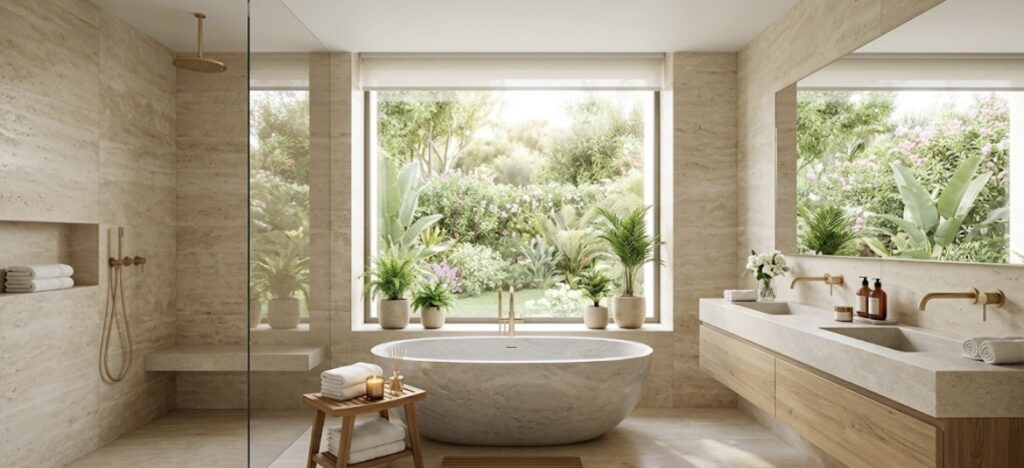
A bathroom in a villa should feel like the kind of place you go when you want to be alone with your thoughts — and possibly a very good bath oil. The spa-inspired master bathroom takes the standard idea of a bathroom and replaces every clinical, functional, get-in-and-get-out element with something slower, more sensory, and considerably more indulgent.
The defining feature of a villa spa bathroom is the bathtub. Not the shower, which in most homes gets all the attention — the bathtub. A freestanding tub, positioned thoughtfully in the room rather than tucked into a corner, is the centrepiece. The most beautiful examples are made from stone resin, cast iron, or genuine carved stone: an oval vessel that sits low and wide, commanding space and attention in equal measure. Positioned in front of a window with a garden view, or beside a wall of natural stone tile, the freestanding tub becomes a piece of sculptural furniture.
The material palette in a spa bathroom is natural, warm, and calm. Stone or travertine tiles in tones of cream, warm beige, or soft grey. A timber vanity with undermounted basins. Matte gold or brushed brass fixtures that add warmth without flash. The overall effect is a room that feels grown from the earth rather than assembled from a showroom catalogue. Natural materials have a quality of absorbing light and sound in a way that synthetic materials do not, and in a bathroom, this translates directly into the sense of quiet that makes a spa feel like a spa.
The accessories in this bathroom are few, well-chosen, and deliberately sensory. A teak bath mat and small stool. White towels so thick they feel like a warm embrace. A candle or two in stone or ceramic holders. A single orchid or a small potted tropical plant on the windowsill. A wooden tray on the side of the tub holding bath salts, a book, and a small glass of whatever the occasion calls for. This is not a bathroom that rushes you. It is a bathroom that makes a very convincing argument for staying.
6. The Library and Study That Smells Like Good Decisions
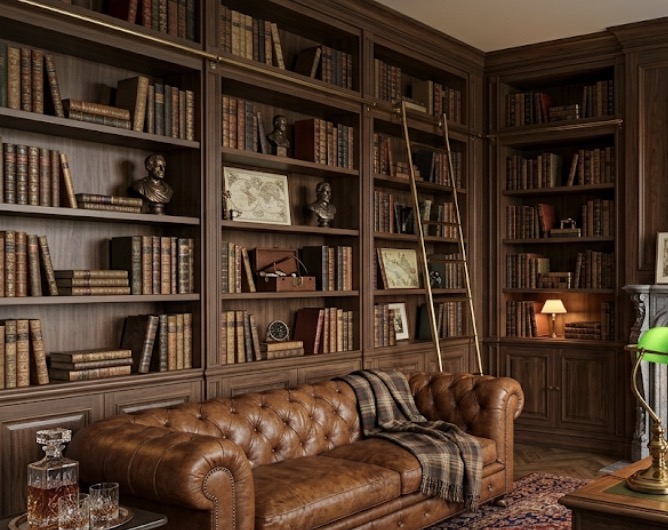
Some rooms in a villa are designed to be seen. The library is designed to be lived in. This is the room where the personality of the owner speaks most loudly — through the books on the shelves, the objects on the desk, the art on the walls, the quality of light in the late afternoon. A well-designed villa library and study is also, without exception, the most frequently complimented room in the house. Because nothing impresses people more than a room that looks like someone actually uses it.
The bones of a great villa library are the bookshelves, and they should be floor-to-ceiling, wall-to-wall, and generous enough to hold far more books than you currently own. Dark walnut or mahogany wood gives the room its sense of weight and warmth. The books themselves should not be arranged by colour for Instagram — they should be arranged by subject or author or whim, with objects tucked between them: a small bronze sculpture, a framed photograph, a vintage globe, a stack of papers held down by a beautiful stone paperweight. The shelves tell a story, and that story should be yours.
The desk is the other great anchor of this room. The desk chair should be comfortable enough for long sessions but formal enough to remind you that this is a working room, not a napping room. Though a deep Chesterfield sofa in aged leather along one wall will absolutely undermine that intention on quieter afternoons, and no one will judge you for it.
The library earns its atmosphere through details: a crystal decanter on a side table, a brass library ladder on rails that actually gets used, a Persian rug that softens the hardwood floor underfoot, a fireplace that is lit on autumn evenings and gives the whole room a smell of woodsmoke and papery warmth. This is the room where deals get made, novels get finished, glasses of whisky get poured at 6pm on a Tuesday because you work from home and the villa has a library, so why would you not.
7. The Cool, Calm Japandi Bedroom
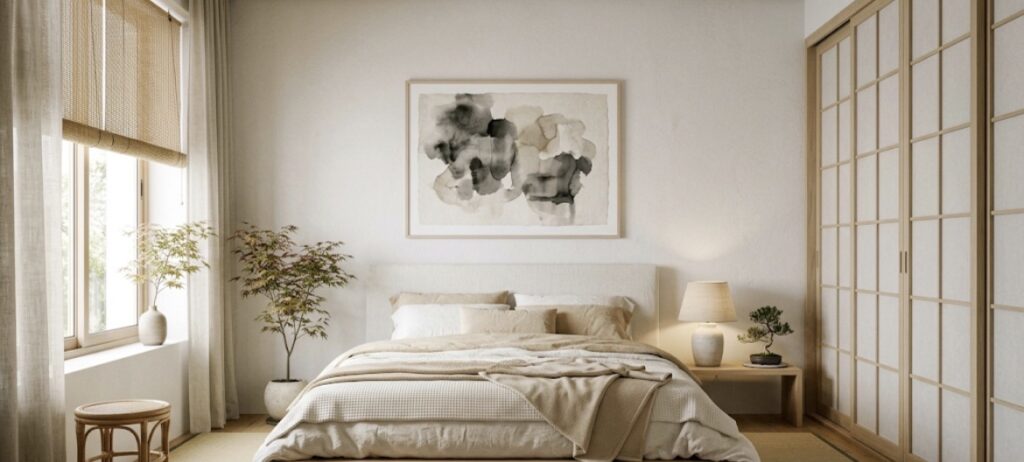
Japandi — the design mix of Japanese minimalism and Scandinavian simplicity — has earned every inch of its popularity because it does something that most design trends fail to do: it makes you feel genuinely calm just by looking at it. In a villa bedroom, where the temptation to fill space with furniture and accessories can be overwhelming, the Japandi approach offers a counterintuitive argument: less space used means more space felt.
The Japandi villa bedroom starts on the floor, which is kept low and simple. A platform bed — close to the ground, with a natural linen or cotton upholstered headboard in off-white or warm oat — anchors the room without dominating it. The bedding is layered in two or three tones of the same neutral family: cream, sand, warm white, with a hand-stitched linen quilt folded at the foot. There are no patterns. There is no contrast for its own sake. The room breathes because it has room to breathe.
The colour palette of a Japandi bedroom is warm neutrals, natural wood, and the occasional single colour used very sparingly — a soft sage green in a ceramic vase, a pale terracotta in a linen throw, a muted charcoal in the abstract artwork above the bed. Nothing shouts. Everything earns its place. The furniture is low and functional, made from natural wood with visible grain: a bedside table that is essentially a wooden cube, a small stool in rattan, a single chest of drawers with minimal hardware.
The things that are left out of a Japandi bedroom are as important as the things that are included. No bedside table covered in clutter. No visible cables or charging equipment. No extra chairs that exist only to hold tomorrow’s outfit. The wardrobe doors are simple — shoji-inspired sliding panels in pale timber — and hide everything that would otherwise disrupt the room’s quiet visual logic. A single plant, a single lamp, a single artwork. Three things. And somehow, that is exactly enough.
8. The Tension Dining Room
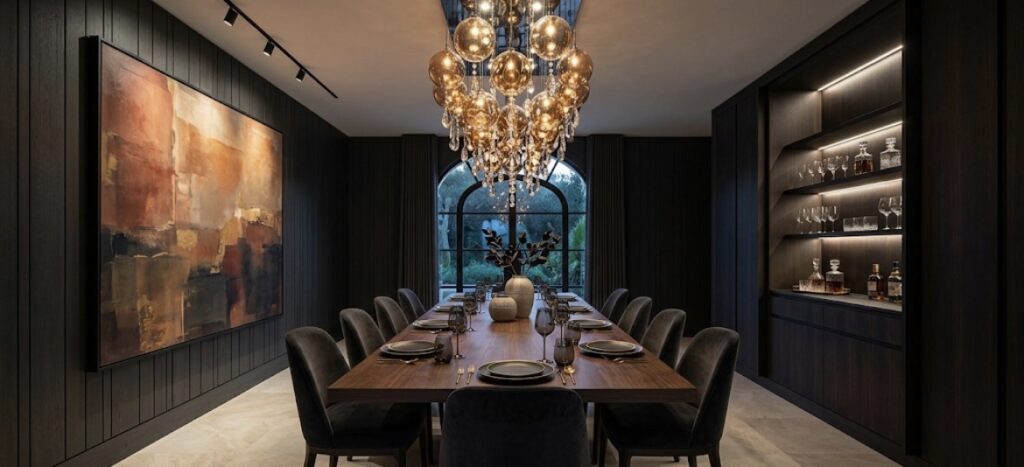
A villa dining room should, at least occasionally, make a person nervous about whether they are dressed well enough to sit at the table. Not because it is cold or unwelcoming — quite the opposite — but because it takes the act of dining seriously, and that seriousness communicates itself through the room itself. The drama-forward dining room is a statement that dinner in this house is not just eating. It is an occasion.
The table is long, dark, and impressive. A ten or twelve-seat dark walnut or ebonised oak dining table, low-gloss, with the natural variation of real wood showing through the finish. The chairs are upholstered in velvet — deep forest green, navy, charcoal, or a rich plum — with high backs that create a sense of enclosure around each seat. The visual effect of looking down a table lined with tall velvet chairs, with candles lit and glasses filled, is one of the most compelling things interior design is capable of producing. It looks like a scene from a very good film.
The ceiling is where this room really justifies its drama. A chandelier that makes a statement — either enormous and crystalline, filling the space above the table like a burst of frozen light, or sculptural and hand-crafted, with hand-blown amber glass orbs hanging at different heights like a suspended garden. The chandelier is dimmed at dinner and turned up only when you need to find a dropped fork. This is not a room for bright overhead lighting. It is a room for pools of warm, directed light that make every person at the table look like they are being photographed.
The walls of a drama-forward dining room should not be white. Charcoal, deep navy, or forest green — sometimes even black — create the sense of a room that exists slightly apart from the rest of the house, a special envelope that signals to your brain: this is the dinner part of the evening, and the dinner part is important. A large abstract painting in warm copper and amber tones breaks the darkness of the wall without softening it. The drinks cabinet, backlit and stocked with beautiful, adds to the sense of ceremony.
9. The Warm, Earthy Guest Suite
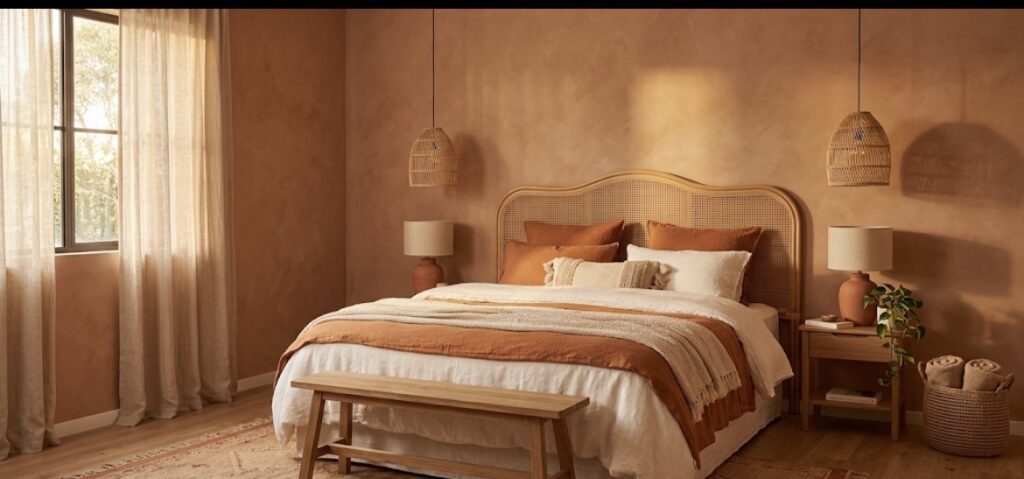
A guest bedroom in a villa carries a particular responsibility: it must make the people who sleep in it feel genuinely welcomed, rather than simply accommodated. There is a difference between a guest room that says ‘this is where we put visitors’ and one that says ‘we thought about you specifically when we designed this.’ The warm, earthy guest suite falls firmly in the second category, and it does so through a combination of colour, texture, and detail that prioritises comfort above everything else.
The colour story of this room begins with terracotta. Limewash or clay-effect paint in a warm rust-orange or burnt sienna tone gives the walls the quality of something handmade — uneven in the most beautiful way, with depth and movement that changes as the light shifts through the day. This is not a background colour. It is a presence. And against it, everything else — the white linen bedding, the natural wood floor, the warm rattan furniture — glows in a way that no neutral wall could ever achieve.
The bed is the star of the earthy guest suite, and it earns its billing through texture rather than drama. A curved rattan or cane headboard — the kind that looks like it was made by hand in a small workshop — sits against the terracotta wall and creates an instant sense of organic warmth. The bedding layers from the mattress outward: a crisp fitted sheet, a weighted duvet in white cotton, a throw in hand-woven rust and oat tones folded at the foot, and three or four cushions in complementary earthy shades. Guests who sleep in this room will not want to leave in the morning, which is either wonderful or mildly inconvenient depending on your situation.
The small details in this room are what elevate it from ‘nice bedroom’ to ‘hotel-worthy experience.’ Fresh flowers or a trailing plant on the bedside table. A wicker basket holding a neat pile of rolled hand towels. A carafe of water and a small dish of chocolates on the dresser. A few carefully chosen books. Good reading lamps on both sides of the bed. These are not expensive gestures — they are thoughtful ones, and in a guest room, thoughtfulness is the most luxurious material of all.
10. Entrance Hall That Sets the Tone
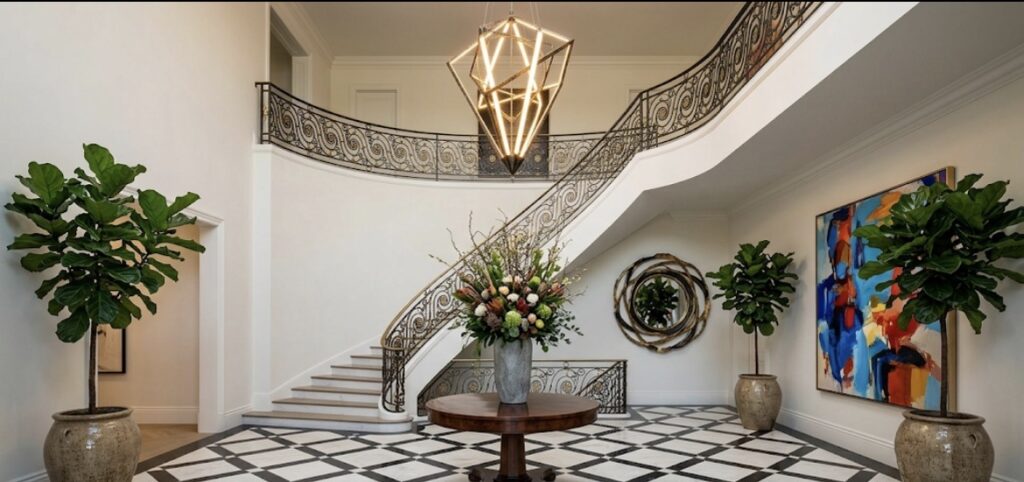
The entrance hall is the first impression, the handshake, the opening sentence. Get it right and every room that follows benefits from the goodwill it generates. Get it wrong and even the most beautifully designed living room will spend the rest of the evening trying to recover. In a villa, where the entrance hall is often double-height and generously proportioned, this space has the potential to be genuinely extraordinary — not just a room you pass through, but a room that tells visitors something important about the house they have just entered.
The floor is where the entrance hall makes its most lasting architectural statement. Large-format marble in a geometric black and white pattern, a single slab of honed travertine, or polished limestone tiles laid in a diamond configuration — the floor is what the eye falls to first, and it communicates quality and intention before any piece of furniture has had a chance to speak. In a high-ceilinged entrance hall, a grand staircase curving upward with an ornate iron or brass railing draws the eye in exactly the right direction: up, and inward, and into the house.
The centrepiece of a well-designed entrance hall is almost always a console table or round hall table, positioned directly in the sightline of the front door. On it: a dramatic flower arrangement in a tall ceramic or stone vase — something architectural in its own right, not just a bunch of flowers in a jug. Above it: a mirror with a sculptural or gilded frame, large enough to reflect the space back on itself and make the hall feel twice as wide. To either side: a pair of potted trees — fiddle-leaf figs, olive trees, or bay standards — that stand like quiet sentinels and signal that this is a house where living things are tended to.
The ceiling pendant in a double-height entrance hall is not optional — it is essential. A chandelier or sculptural pendant light that fills the vertical space above the hall, visible from both the ground floor and the landing above, creates the kind of architectural drama that photographs could never fully capture. This is the light that glows warmly when guests arrive on winter evenings and sparkles in the afternoon sun when the front door stands open. It is the light that makes people look up and say, quietly, ‘oh, this is something.’
11. The Rooftop Terrace Lounge
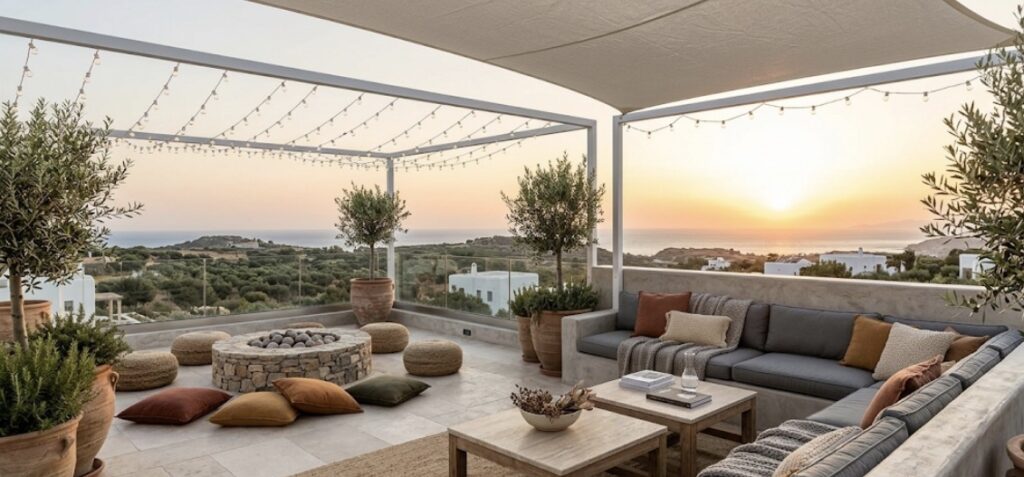
In many villas around the world, the rooftop terrace is treated as an afterthought — a place for the water tank and the satellite dish. This is, to put it diplomatically, a missed opportunity of almost criminal proportions. A rooftop terrace, properly designed, is one of the most extraordinary outdoor living spaces a home can have. It has views. It has sky. It has the particular magic that comes from being above everything and enclosed by nothing, and when it is designed with the same care as any interior room, it becomes the place where every good evening ends up.
The furniture of a rooftop terrace lounge needs to be built for outdoor life without looking like it is trying too hard. Built-in seating — a curved or L-shaped sofa constructed from concrete or stone and dressed in thick, weatherproof cushions in deep grey, warm rust, or sage green — grounds the space and removes the anxiety of chairs blowing away in the wind, which is a practical concern and also just good interior philosophy. Low wooden coffee tables with stone surfaces are heavy enough to stay put and beautiful enough to justify their place. Woven poufs and floor cushions in ochre and terracotta add layers of comfort and colour.
Planting on a rooftop terrace does something important: it softens the hard lines of the architecture and creates the illusion of a garden in the sky. Large terracotta pots with olive trees, rosemary, lavender, and ornamental grasses move gently in the breeze and fill the air with scent. They also create natural privacy screens, which on a rooftop, can be genuinely useful depending on the neighbours. A canvas shade sail overhead provides relief from the midday sun without closing the sky off entirely, which would defeat the point.
The evening transformation of a rooftop terrace is where the design earns its most enthusiastic approval. String lights strung between overhead frames, a central fire pit glowing with low flames, the candles lit on every surface, and the sky shifting from gold to pink to deep blue above it — this is not interior design, it is stage design, and the effect on everyone sitting in that space is immediate and profound. No one leaves a well-designed rooftop terrace early. They stay until they are out of conversation or wine, and usually the wine runs out second.
12. The Coastal Blue and White Living Room
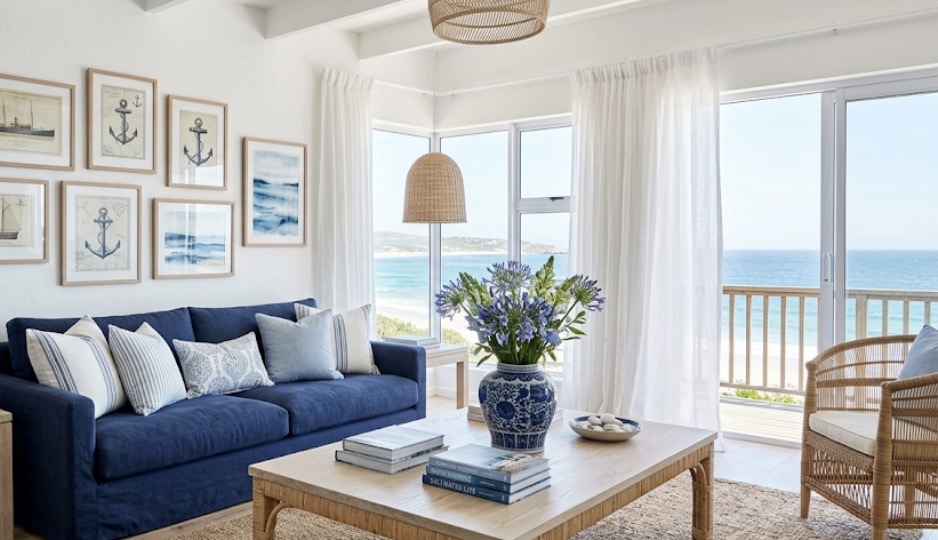
The coastal blue and white villa living room is one of those ideas that seems almost too obvious until you see it executed well, at which point it is suddenly everything. Blue and white is not a trend — it is a combination that has been used in Mediterranean, Aegean, and coastal homes for centuries, and the reason it keeps returning is simple: it captures the specific quality of light you find by the sea, and it translates that quality into the interior of a room. The result is a space that feels perpetually fresh, perpetually calm, and perpetually like you are three steps from the water.
The blue in a well-done coastal living room is not uniform or predictable. It ranges from the soft, almost grey-blue of a morning sky to the deep navy of deep water, with every shade between appearing in cushions, ceramics, artwork, and upholstery. The white, likewise, is not flat — it is warm, textured, present in linen and cotton and washed wood and plaster. These two colours in combination create rhythm. The eye moves across the room from one blue accent to the next, resting on white surfaces between each stop, and the movement is restful in the way that watching waves is restful.
The texture of this room matters as much as its colour. Linen upholstery that is slightly rumpled and entirely comfortable. Rattan and woven furniture that brings the feeling of the outdoors in. A large jute rug that grounds the room and adds earthy warmth underfoot. Driftwood sculpture on side tables. Washed oak flooring. These materials carry the associations of shore and sea and outdoor life, and they reinforce the coastal narrative even in a room with no view of the water.
The art in a coastal blue and white living room works best when it references the sea without being literal about it. Abstract watercolours in ocean tones. Framed antique nautical illustrations. A collection of five or six small paintings of waves or sky, hung close together as a grid. Large-scale photography of coastal landscapes. The art is not decoration — it is the view the room provides when the real view is unavailable, and it should be chosen with the same care you would give to a window.
13. The Private Cinema Room
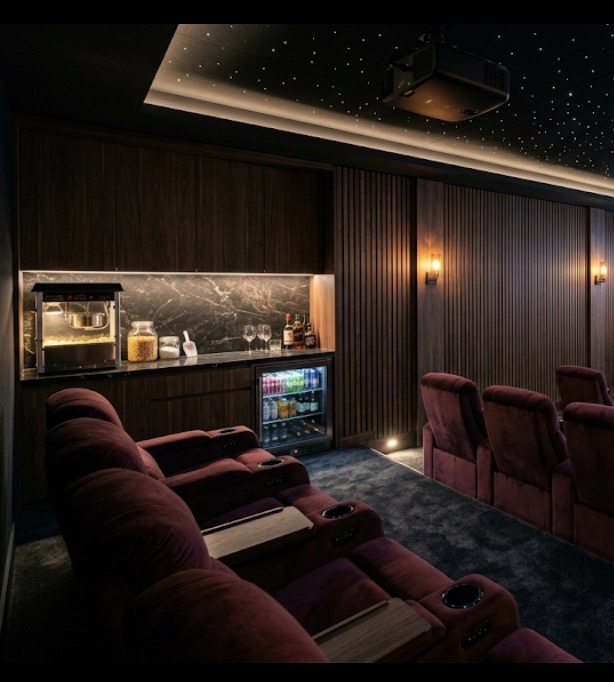
A private cinema room is the villa feature that prompts the most unguarded response from guests. Not the wine cellar, not the pool, not even the master bedroom — the cinema room. Because a cinema room that has been properly designed, with the screens and the sound and the seating and the lighting all working together, produces a feeling of joy that is almost embarrassingly pure. It is a room that gives people permission to be completely entertained, and in a well-designed villa, it is one of the most-used rooms in the house.
The design of a private cinema room is, first and foremost, about acoustic and visual performance. The screen must be enormous — filling the entire front wall, ideally a 4K projection onto a dedicated cinema screen surface — and positioned at the right height and distance for the seating. The walls should be treated with acoustic panels: timber slat panels in dark walnut are currently the most beautiful way to do this, as they double as a striking design feature while performing the function of absorbing sound and preventing echo. Dark walls and dark carpet absorb light and sound simultaneously, keeping the visual and acoustic environment focused entirely on the screen.
The seating in a private cinema room is where the luxury of a villa truly shows itself. Not rows of cinema seats borrowed from a multiplex, but custom-designed tiered platforms holding two or three wide, deeply cushioned recliners per row, in velvet or leather, with built-in cupholders and personal USB ports. The tiers mean that every seat has an unobstructed view of the screen, and the recliners mean that every seat is also, essentially, a very good napping opportunity — which is entirely your business.
The ceiling of a cinema room can be one of the most magical elements in the entire villa if handled well. A starfield ceiling — thousands of tiny fibre optic LEDs embedded in dark acoustic material — transforms the ceiling into a night sky when the main lights dim. The effect, combined with a great film and those recliners and perhaps a glass of something cold, is genuinely wonderful. This is not an indulgence. This is architecture serving the human need to be transported, and it does the job beautifully.
14. The Lush, Plant-Filled Sunroom
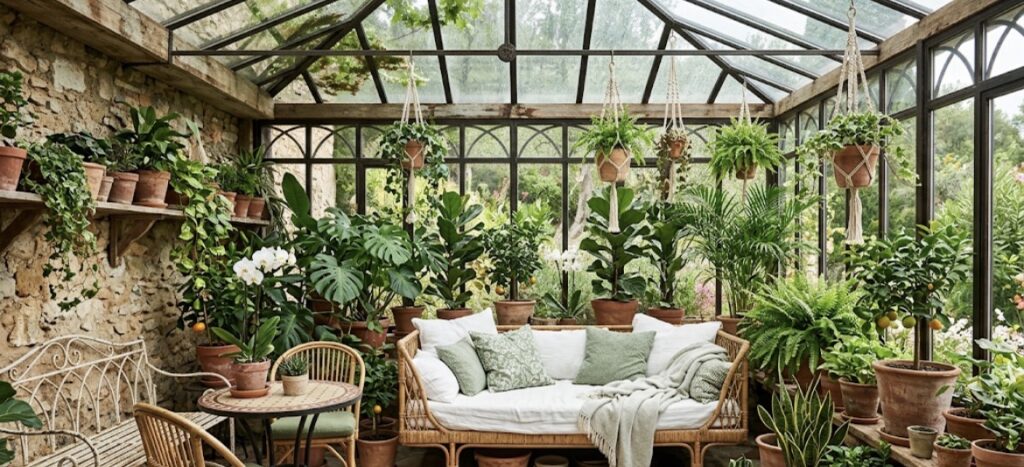
There is a growing and very well-founded argument that living with plants makes people genuinely happier and calmer. If that argument is correct, then the lush plant-filled villa sunroom is essentially a room designed to be as good for your nervous system as it is beautiful to look at. This is a room you retreat to on difficult afternoons, where the quality of light is different from anywhere else in the house and everything is growing.
A sunroom or garden room in a villa has the enormous advantage of glass — lots of it. A glass ceiling, glass walls on at least two sides, and ideally a glass roof that connects directly to the garden through wide sliding or folding doors. This glass is not just structural — it is the room’s primary design material. It is what allows the outside world to fill the space with changing light across the day, from the cool silver of early morning to the warm amber of the late afternoon. The light in a well-positioned sunroom is never the same twice, and the plants in it respond to this fact in a way that makes the room feel alive in a quite literal sense.
The planting in a villa sunroom should be generous to the point of excess. Not a few tastefully placed ferns — a true indoor forest, with plants at every scale from the tall fiddle-leaf fig in the corner to the small succulents lined along the windowsill. Trailing plants hang from the ceiling in macrame holders. Climbing plants work their way up a trellis against the stone wall. Orchids sit on the rattan shelving unit beside the terracotta pots of herbs. The floor is a mosaic of pots of every size and shape, and navigating through them requires a certain amount of gentle attention, which is not a bad thing at all.
The furniture in a sunroom should feel like it belongs in a garden: rattan and wicker, iron and cane, worn wood and woven cotton. A deep rattan daybed piled with cushions is the central piece, the destination the eye moves toward as soon as you open the door. A small bistro table with two chairs sits near the glass, catching the morning light for coffee. A wooden potting bench along one wall holds the tools and materials for plant care, which in this room is not a chore — it is the closest thing to meditation the week will offer.
Final Thoughts
Sixteen ideas, and not a single one of them was about perfection. A great villa interior is not perfect — it is specific. It reflects the people who live in it, the place it sits in, the life it is meant to support. The Mediterranean living room only works if someone in the house loves light and warmth and long meals. The maximalist jewel-box bedroom only works if someone in the house is willing to commit to it, all the way, without flinching. The library only works if someone is going to sit in it.
The best villa interiors in the world are not the ones photographed most often. They are the ones where the people inside them look entirely at home — where the chair fits the person, the light suits the hour, and the room feels, on a quiet Tuesday afternoon, like the best possible place to be. That is the standard every room in this post is reaching for. Not the magazine cover, but the Tuesday afternoon.
So pick the ideas that speak to you. Mix them if you like — the Japandi bedroom and the drama dining room can absolutely coexist in the same villa if the person who lives there contains multitudes, which the best people do. Let the rooms be different from each other. Let some be quiet and some be loud. Let the house tell a full story about someone interesting. That is the only brief that matters.