
If you have ever stood in the middle of a studio apartment and thought, ‘So… my bed is also my dining room,’ you are not alone. Studio apartments ask a lot of their owners. They ask you to sleep, eat, work, relax, and host guests all in one room — sometimes all on the same Tuesday. The good news is that with the right interior design approach, your studio apartment does not have to feel like a glorified storage unit. It can feel like a real home. A stylish one, at that.
This guide is for anyone who has ever Googled ‘how to make a small apartment look bigger’ at midnight while sitting on a bed that is also their sofa. We are going to walk through every part of building a studio apartment interior, from planning the layout and choosing furniture to picking colors, lighting, and the small finishing details that make a big difference. We will talk about real decisions you will need to make, explain why each one matters, and give you clear steps to follow. Think of this as your blueprint for turning a single room into a multi-purpose home that actually works — and actually looks good.
The studio apartment is not a compromise. It is a design challenge. And like most challenges, the people who do it well are the ones who have a plan before they start moving furniture around.
1. Start With a Floor Plan Before You Buy a Single Thing
The single biggest mistake people make when decorating a studio apartment is buying furniture first and asking questions later. They fall in love with a velvet sectional sofa online, buy it, and then discover it takes up sixty percent of their floor space. The sofa wins. The human loses. Do not let this happen to you.
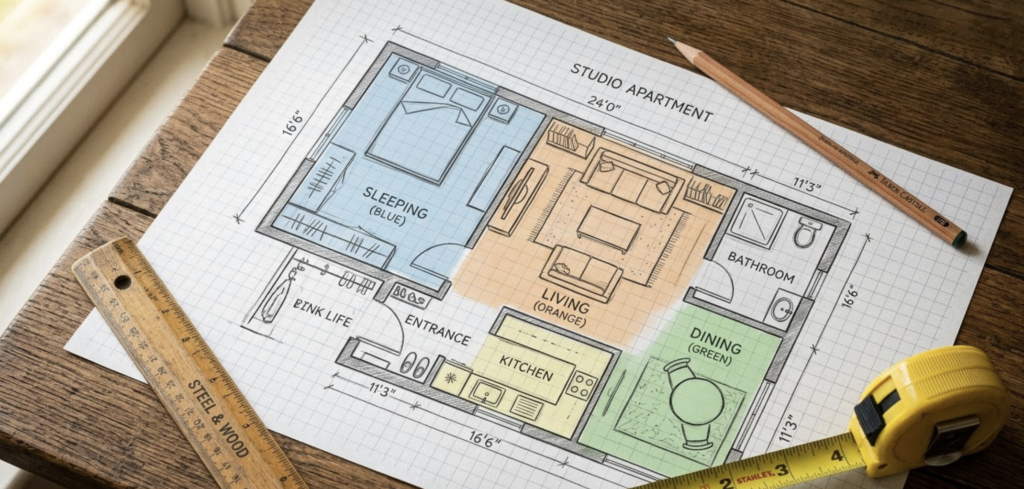
Before you buy anything — before you even think about colors or styles — you need to measure your apartment and draw a floor plan. This does not need to be fancy. A piece of graph paper, a tape measure, and thirty minutes of your time is enough. Measure the total length and width of the room, then measure every window, every door, every closet opening, and every outlet on the wall. These details matter because they will affect where furniture can and cannot go.
Once you have your measurements, sketch out different arrangements on paper. Think about how you move through the space during a normal day. When you wake up, where do you go first? When you sit down to eat, where do you want to face? When you have a friend over, where will they sit? These questions help you figure out where each zone in your apartment should live. A zone is simply a defined area of the room that has one main purpose — sleeping, eating, working, or relaxing. In a studio apartment, you might have three or four zones all sharing the same open floor space, which is why the layout plan matters so much.
One of the most useful things you can do during this planning stage is to tape out furniture sizes on your floor using painter’s tape. If you are thinking about a certain sofa, tape its footprint on the floor and walk around it. Live with it for a day. You will immediately feel whether that piece of furniture belongs in that space or whether it will make the room feel cramped. This trick sounds a little silly, but it has saved many people from expensive returns and even more expensive regrets.
2) Choose a Color Palette That Makes the Room Feel spacious
Color is one of the most powerful tools in a small apartment, and one of the most misunderstood. A lot of people assume that you must paint every wall white if you want a studio to feel spacious. That is not entirely true. While light colors do tend to make a room feel more open, the real goal is to create a color palette that is cohesive — meaning the colors in your space work together so smoothly that the eye does not stop and stumble anywhere. When the eye flows easily around a room, the room feels bigger.
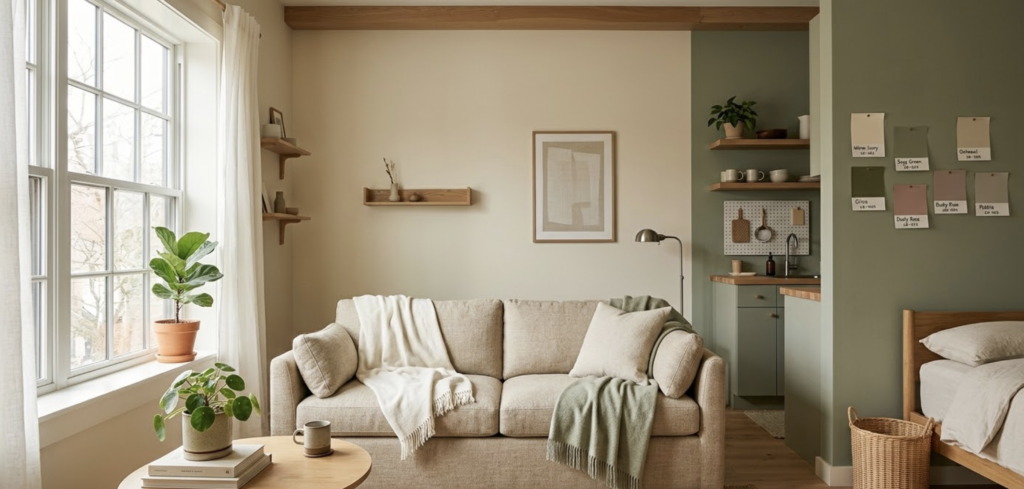
For a studio apartment interior, the best approach is to choose one main neutral color as your base and then add two or three accent colors that complement it. Your base color should cover most of your walls, your largest furniture pieces, and your rugs. Good base colors for studios include soft whites, warm creams, light grays, soft sage greens, and pale taupes. These colors reflect light well and do not compete with each other. Your accent colors can be richer and more personal — a deep navy, a terracotta, a muted gold — but they should appear in small amounts, such as in throw pillows, artwork, or a single piece of furniture.
One technique that works beautifully in studio apartments is called a monochromatic palette. This means using different shades of the same color throughout the space. For example, you might have pale blush walls, a dusty rose sofa, and a deep mauve throw blanket, all in the same family of pinkish tones. This creates a very calm, layered look that feels intentional rather than boring. It also visually expands the space because there are no sharp color contrasts breaking the room into separate sections.
Another important rule is to keep your floors and ceiling in the same color family as your walls whenever possible. If your floor is light wood and your walls are a warm cream, the room will feel seamless and tall. If you paint your walls dark and your ceiling remains stark white, the ceiling will visually drop and make the room feel shorter. In a studio apartment, you want every design decision to work in your favor, and color is one of the cheapest and most effective ways to do that.
3) Pick the Right Furniture
Here is where studio apartment decorating can go either very right or very wrong. Furniture is the backbone of your interior, but in a small space, every piece needs to earn its place. A piece that only does one job in a studio apartment is a luxury you may not be able to afford — not financially, but spatially. The golden rule is: every piece of furniture should serve at least two purposes, or it needs to be the best possible version of itself in terms of scale and proportion.
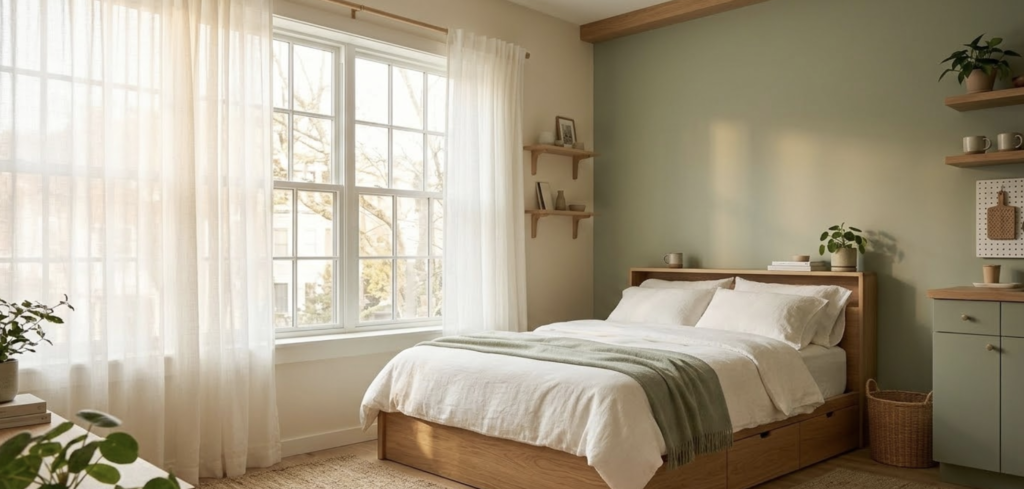
Let us start with the bed, since it is usually the largest item in the room. The most popular option for studio apartments is a platform bed with storage drawers built into the base. This gives you a sleeping surface and hidden storage for linens, clothes, or anything else you need to keep out of sight. Another option is a Murphy bed, which folds up into a wall unit when not in use and can look like a piece of cabinetry or even a bookshelf when closed. Murphy beds have come a long way from their old reputation of falling out of walls at inconvenient moments — modern versions are smooth, sturdy, and genuinely stylish. If you work from home, you can even find Murphy bed systems that fold down to reveal a full desk setup, which is essentially the studio apartment equivalent of finding twenty dollars in an old jacket.
For seating, the size of your sofa matters more than almost any other decision you will make. A sofa that is too large will dominate the room and make everything else feel crowded. A good rule of thumb is to choose a sofa that is no wider than two-thirds of the wall it sits against. Look for sofas with legs rather than sofas with solid bases that sit flat on the floor — the visible floor space beneath a sofa makes the room feel more open. A loveseat plus one armchair is often a better combination than a large three-seater sofa, because it gives you flexibility in how you arrange the seating zone.
Dining is a common challenge in a studio apartment. A full-sized dining table is often out of the question, but you still need somewhere to eat. A wall-mounted fold-down table is one of the cleanest solutions — it disappears completely when not in use and takes up zero floor space. A small round table with two stools or chairs is another great option, and a round table is specifically useful in small spaces because it has no sharp corners that interrupt the flow of movement through the room. Some people in studios eat at their coffee table or their kitchen counter, and that is fine too, as long as the choice is intentional rather than something that happened because the apartment won the argument.
Coffee tables deserve a special mention here. In a small studio, a coffee table with storage — drawers, a shelf underneath, or a lift-top that reveals a hidden compartment — is always a better choice than a solid decorative table. Glass coffee tables are also a popular choice for studios because the transparency makes them visually lightweight; they take up physical space but they do not feel heavy on the eyes.
4) Use Room Dividers to Create Zones Without Walls
One of the most important things you can do in a studio apartment is create the feeling that different parts of the room have different purposes. When everything blurs together — when your bed is basically your sofa and your dining table is basically your desk — the space starts to feel chaotic no matter how clean it is. Creating visual zones gives the room structure and makes it feel much more intentional.
The good news is you do not need actual walls to create zones. There are many ways to separate areas of a studio apartment using furniture, rugs, shelving, curtains, and lighting. Each method has its own advantages, and the best studios often use a combination of two or three of them.
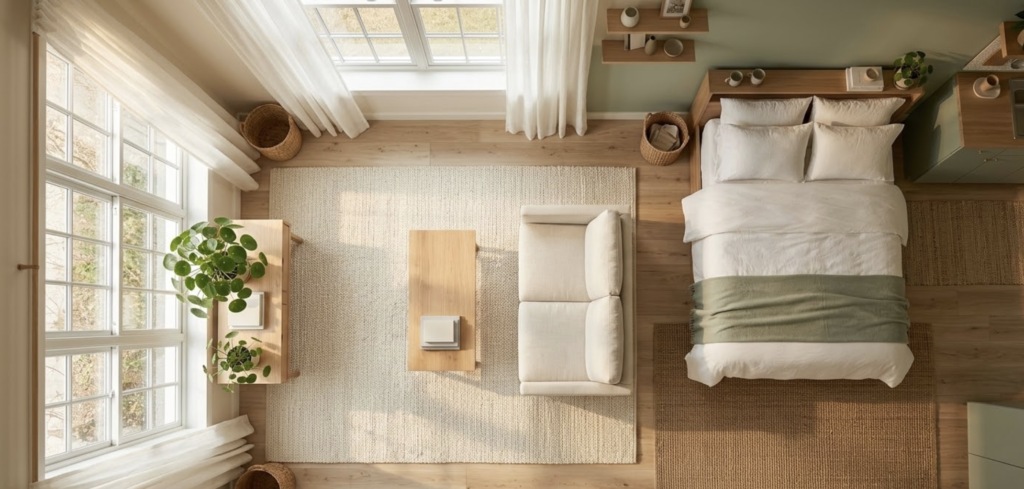
Rugs are the easiest and most affordable way to define a zone. A large area rug under your sofa and coffee table immediately says, ‘This is the living area.’ A smaller rug under your bed or beside it says, ‘This is the sleeping area.’ The visual separation created by different rugs is surprisingly powerful — it sends a clear signal to both you and your guests about where one space ends and another begins. When choosing rugs for a studio, stick to the same color family for all your rugs so they feel coordinated rather than competing, and make sure your rug is large enough. A rug that is too small for the furniture it sits under is one of the most common decorating mistakes in small apartments, and it always makes a room feel disjointed.
Bookshelves and open shelving units are another excellent way to separate zones in a studio. A tall bookshelf placed perpendicular to the wall — meaning it sticks out into the room rather than sitting flat against it — creates a natural divider between, for example, the sleeping area and the living area. Open shelves are particularly good for this because they create separation without blocking light or making the room feel closed off. You can style the shelves with books, plants, baskets, and decorative objects, which means they do double duty as storage and as a design feature.
Floor-to-ceiling curtains on a ceiling-mounted rod are perhaps the most dramatic and flexible room divider option. A curtain track installed along the ceiling can slide a panel of linen or velvet across the room to separate the sleeping area from the rest of the apartment. This is especially useful if you share your studio with a partner, if you work from home and need a psychological separation between your work desk and your bedroom, or if you simply want to be able to hide the bed completely when you are entertaining. There is something deeply satisfying about being able to close a curtain and have your apartment suddenly feel like it has multiple rooms. It is the closest thing to magic that interior design offers.
5) Make the Most of Vertical Space and Wall Storage
When floor space is limited, there is only one direction left to go: up. Studio apartments rarely take full advantage of vertical space, and that is a missed opportunity of significant proportions. The wall area above your furniture, the space near your ceiling, and the backs of doors are all real estate that most people leave completely empty. In a studio, empty vertical space is wasted potential.
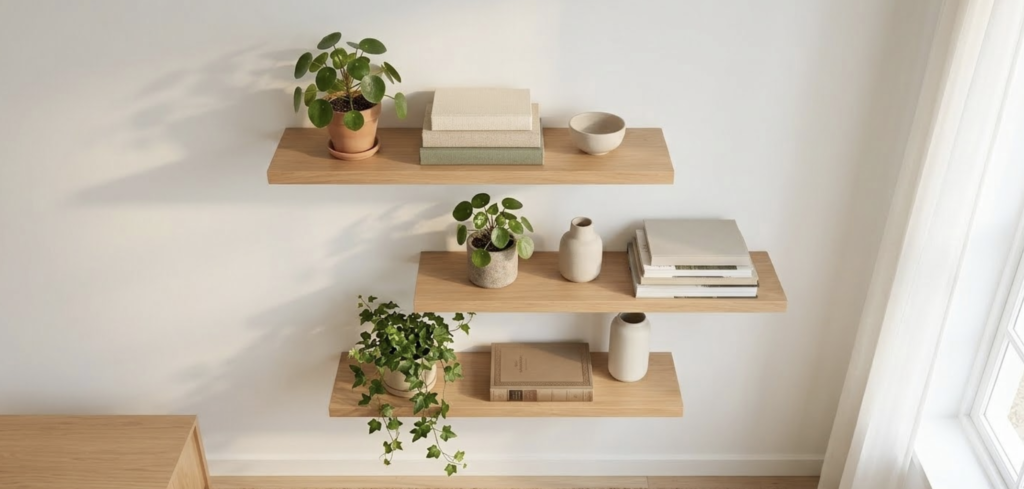
Start by thinking about your walls as a storage system. Wall-mounted shelves above your desk, your sofa, or your kitchen counter give you storage and display space without taking up any floor area. Floating shelves are particularly popular in studio apartments because they look clean and minimal — they appear to hover against the wall without any visible brackets, which keeps the visual weight of the room low even as you add more storage. When you style floating shelves in a studio, follow the simple formula of grouping objects in odd numbers and varying the heights — a tall candle, a medium plant, and a small book stacked horizontally next to each other looks much more intentional than a row of objects all the same height.
Pegboards and wall grid panels are another very practical vertical storage solution that has become fashionable in recent years. Originally used in garages and workshops, pegboards have been embraced by the home décor world because they are endlessly customizable. You can hang hooks, shelves, baskets, and organizers on a pegboard and rearrange them whenever your needs change. In a studio apartment kitchen, a pegboard above the counter can hold pots, pans, utensils, and spice jars, freeing up cabinet and counter space. In a studio home office area, a pegboard can hold everything from your calendar to your headphones to a small succulent plant.
Tall furniture is your friend in a studio apartment. A wardrobe or bookshelf that extends from floor to ceiling does two things at once: it maximizes the storage you get from each piece of furniture, and it draws the eye upward, which makes the ceiling feel higher and the room feel larger. When you walk into a studio that has a floor-to-ceiling wardrobe wall, the room does not feel small — it feels considered. There is a difference, and tall furniture is a big part of what creates it.
Do not forget the backs of doors. The back of your front door, bathroom door, and closet door can all hold over-the-door organizers, hooks, or small shelves. These are especially useful for things like shoes, cleaning supplies, bags, and accessories that tend to accumulate in a small apartment without a proper home. In a studio apartment, every inch counts, and the backs of doors represent several square feet of storage that most people never use.
6) Layer Your Lighting
Lighting is the most underrated element of interior design, especially in a small studio apartment. Most people move into a studio, plug in a floor lamp, and call it done. But lighting has the ability to completely transform the mood, the perceived size, and the warmth of a room. A studio apartment that relies entirely on a single overhead light will always feel flat, clinical, and small. A studio apartment with layered lighting feels alive, warm, and spacious even if nothing about the furniture or layout has changed.
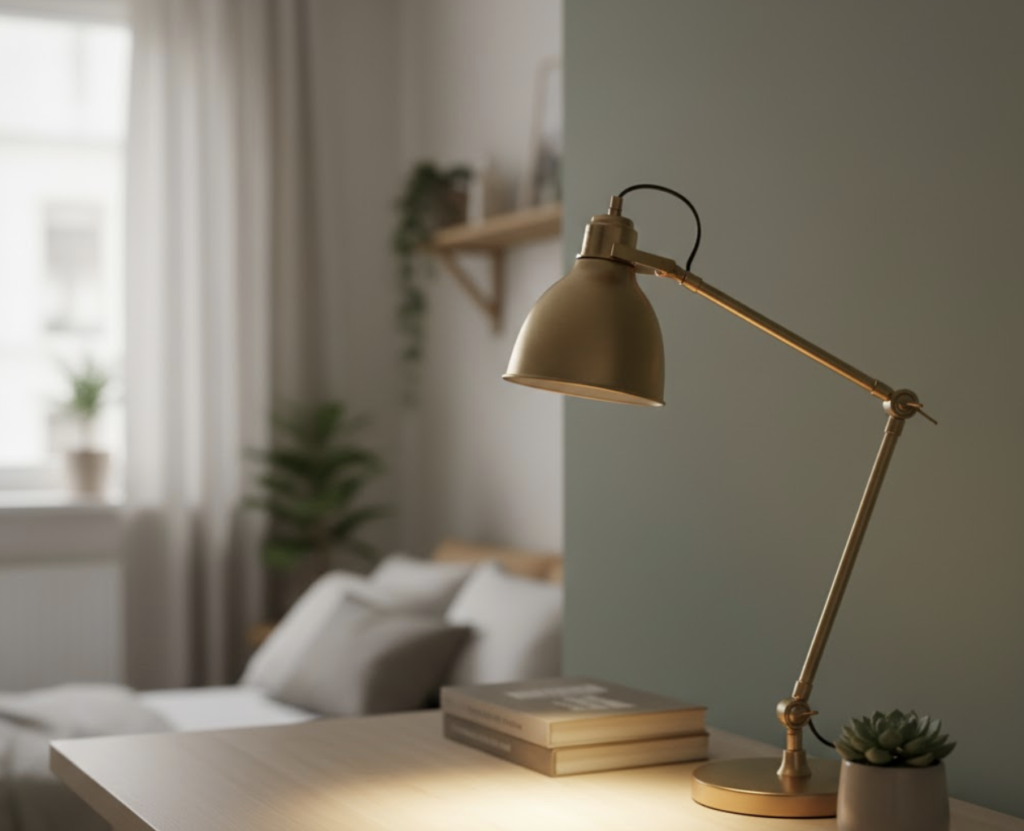
Layered lighting means using three types of light in the same space: ambient light, task light, and accent light. Ambient light is the general background light that fills the whole room — this is usually your ceiling light or a large floor lamp. Task light is directed light for specific activities — a desk lamp for working, a reading lamp by the bed, a light above the kitchen counter for cooking. Accent light is decorative light that adds warmth and visual interest — string lights, a small table lamp with a warm bulb, a backlit shelf, or a candle-like LED.
In a studio apartment, it is especially important to avoid relying on a single overhead light because overhead lighting tends to flatten a space and make it look institutional. Instead, aim to have at least five or six light sources in your studio — some at ceiling level, some at eye level, and some close to the floor or on surfaces. When all of these are turned on at different levels, the room has depth. The shadows and highlights created by multiple light sources make the room feel layered and three-dimensional, which is the opposite of the flat, cramped feeling you want to avoid.
One lighting trick that works extremely well in studio apartments is placing a floor lamp behind a sofa or in a corner. The light bouncing off the wall behind it creates a warm, glowing effect that makes the corner of the room feel like a destination rather than a place where things get shoved. This technique is sometimes called ‘uplighting’ and it is one of the simplest ways to make a small room feel cozy and inviting without spending a lot of money.
Dimmers are worth every penny in a studio apartment. Being able to adjust the brightness of your lights means you can shift the mood from bright and productive in the morning to soft and relaxing in the evening — without changing anything else about the room. In a studio where the same space has to serve multiple purposes throughout the day, dimmers give you a form of control that feels almost like having separate rooms. If your studio uses recessed ceiling lights, installing a dimmer switch is a small investment that will make a large difference in how the apartment feels day to day.
7) Build Smart Storage Into Every Corner
Storage is not glamorous. Nobody pins a photo of their well-organized under-bed storage bins to their mood board. But here is the truth: in a studio apartment, storage is everything. The difference between a studio that looks styled and one that looks chaotic is almost always the amount of thought that went into storage. When everything has a place and can be put away quickly, the apartment looks intentional. When things pile up on the counter and the floor and the one chair that is now purely decorative, the apartment looks like it lost a fight with itself.
The first principle of studio storage is to use every bit of hidden space you have. Under the bed is an obvious one — storage bins, vacuum-sealed bags, or a platform bed with built-in drawers can hold an enormous amount of stuff. Under the sofa, if there is clearance, is another option. Inside ottomans — a storage ottoman in place of a coffee table gives you a surface, a seat for guests, and a storage compartment all in one piece of furniture. Inside a storage bench at the foot of the bed. These hidden storage locations are valuable precisely because they do not add any visual clutter to the room.
The kitchen in a studio apartment often receives the least design attention, which is a mistake. A studio kitchen is almost always small, and without good organization, it becomes the messiest corner of the apartment very quickly. Install a tension rod under the kitchen sink to hang spray bottles and free up shelf space below. Use magnetic knife strips on the wall instead of a knife block on the counter. Hang a small pegboard or rail system above the stove or counter to keep utensils and small tools within reach without cluttering the limited counter space. Stack your plates vertically using plate organizers in your cabinets — vertical stacking uses less horizontal space and makes it easier to grab what you need without unstacking everything.
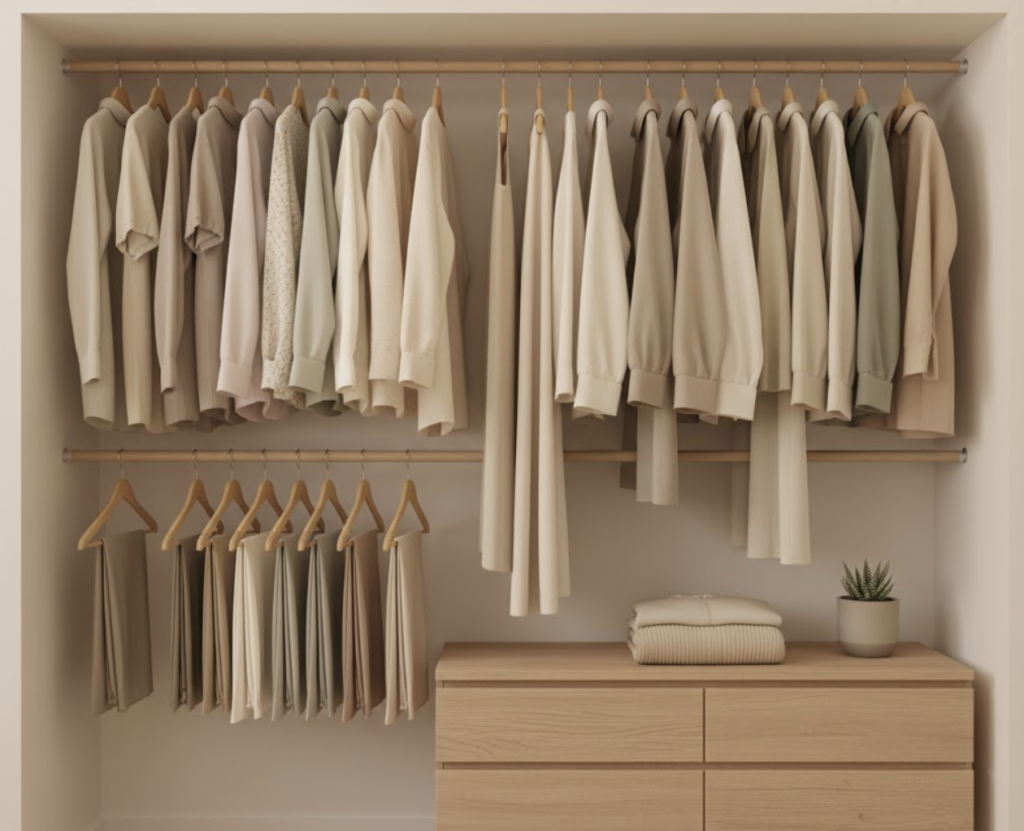
In the closet, the single best upgrade you can make is to add a second hanging rod below your existing one. Most studio closets are set up with one high rod for hanging clothes, but that leaves an enormous amount of unused vertical space beneath it. Adding a second rod doubles your hanging capacity and costs almost nothing. Pair this with some shelf dividers, a set of matching hangers, and a small drawer unit on the closet floor, and you will find that your closet suddenly holds twice as much as it did before — without buying a single new piece of furniture.
One final storage thought: baskets and boxes with lids are your visual best friends in a studio apartment. Exposed storage — open shelves, counters, and surfaces — always looks better when the items on it are contained in matching baskets, boxes, or bins. Rather than a shelf that looks like the aftermath of a very enthusiastic shopping trip, you get a shelf that looks curated and calm. Investing in a set of matching woven baskets or linen-covered boxes is one of the cheapest ways to instantly make a studio apartment look more put-together.
8) Add Mirrors to Open Up the Space Visually
Mirrors are the oldest trick in the interior design book, and they still work because they are not actually a trick — they are physics. A mirror reflects light and reflects the room itself, which creates the genuine visual impression of more space. In a studio apartment, one or two strategically placed mirrors can make the room feel noticeably larger and brighter without you changing a single other thing.
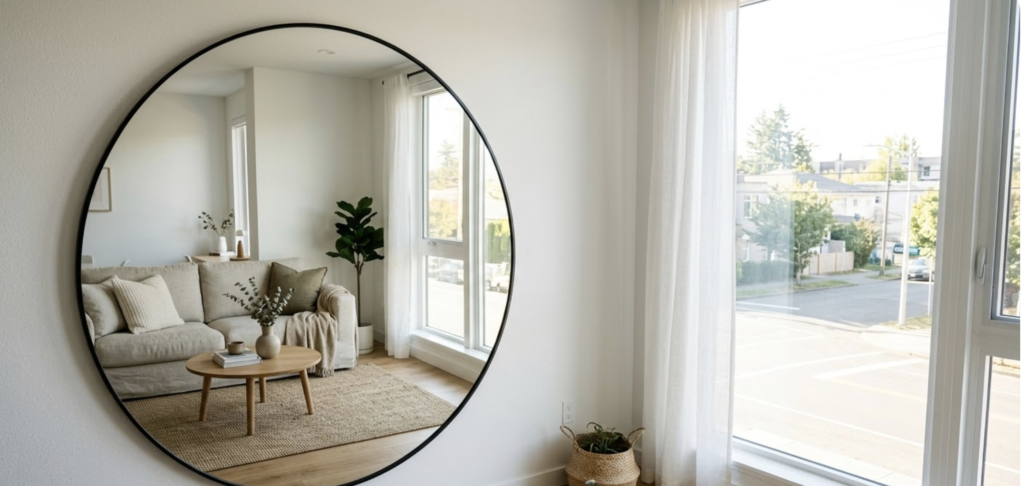
The most effective placement for a large mirror in a studio apartment is opposite a window. When a mirror faces a window, it bounces the natural light coming through the window back into the room, effectively doubling the amount of light in the space. This is particularly useful for studio apartments that do not have a lot of windows or that face north and receive relatively little direct sunlight. A large mirror opposite the main window will make even a dark studio feel significantly brighter on a cloudy day.
Leaning mirrors — large floor mirrors leaned against the wall rather than hung — have become very popular in studio apartments for good reason. They are easy to move and adjust, they do not require any holes in the wall, and they come in a wide range of styles from minimalist metal frames to ornate vintage frames. A large leaning mirror in a studio bedroom zone serves the practical purpose of a full-length mirror for getting dressed, while simultaneously making the sleeping area feel taller and more open. Position a leaning mirror next to a window at a slight angle so it reflects both the window light and the view outside — the effect is genuinely impressive.
Mirrored furniture is another option worth considering for studio apartments. A mirrored side table, a mirrored tray on a dresser, or a mirrored panel on a wardrobe door all add reflective surfaces to the room without the commitment of a large mirror. These smaller reflective elements catch light and create sparkle throughout the room, which contributes to the overall feeling of brightness and space. Avoid over-using mirrored furniture, though — too many reflective surfaces can start to feel like a funhouse, and the goal is a home, not a carnival.
9) Bring Nature In With Plants and Natural Materials
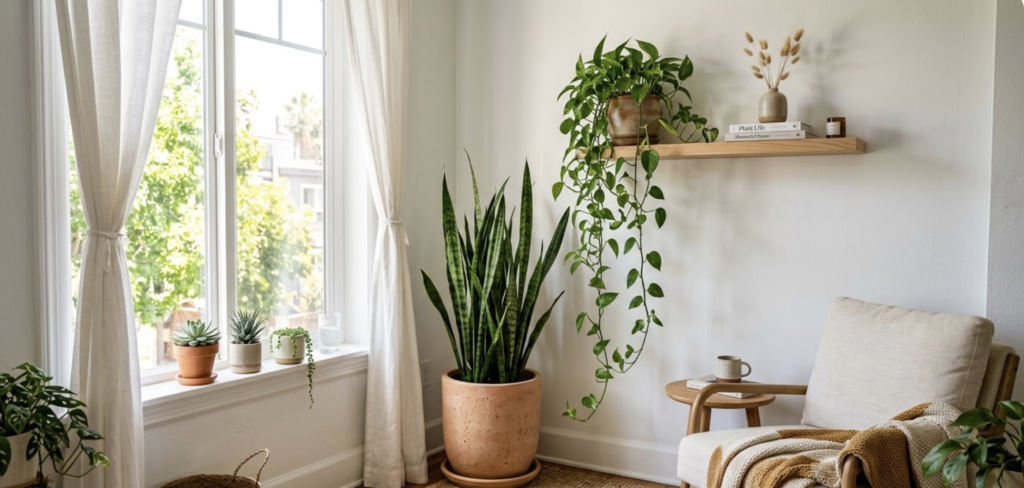
There is a reason that nearly every beautifully styled studio apartment you see online has at least one plant in it. Plants do something to a space that no piece of furniture or wall art can replicate — they bring it to life. A studio apartment can have the most thoughtfully chosen color palette and the most precisely scaled furniture, but without some form of natural life or natural material, it will still feel slightly flat. Plants add color, texture, and a sense of organic energy that immediately makes a space feel more like a home and less like a showroom.
For a studio apartment, the best plants are ones that do not require a lot of care, do not take up too much floor space, and grow in a way that adds visual interest. Some excellent choices are the pothos, which is nearly indestructible and trails beautifully from shelves or hanging planters; the snake plant, which grows tall and architectural and thrives in low light; the rubber tree, which has large, glossy leaves and grows slowly into a dramatic statement plant; and the peace lily, which tolerates shade and adds a soft, elegant touch. A small collection of succulents on a windowsill adds texture and greenery without taking up any significant space.
Beyond potted plants, natural materials in your furniture, textiles, and decor choices contribute enormously to the warmth and depth of a studio apartment. Wooden furniture — whether light ash, warm walnut, or whitewashed pine — brings a natural grain and warmth that painted or lacquered surfaces cannot. Linen and cotton textiles for curtains, throw pillows, and blankets feel softer and more natural than synthetic fabrics, and they photograph beautifully if that matters to you. Woven baskets, rattan chairs, jute rugs, and ceramic objects all introduce natural textures that layer the room and give it a depth that purely manufactured materials do not.
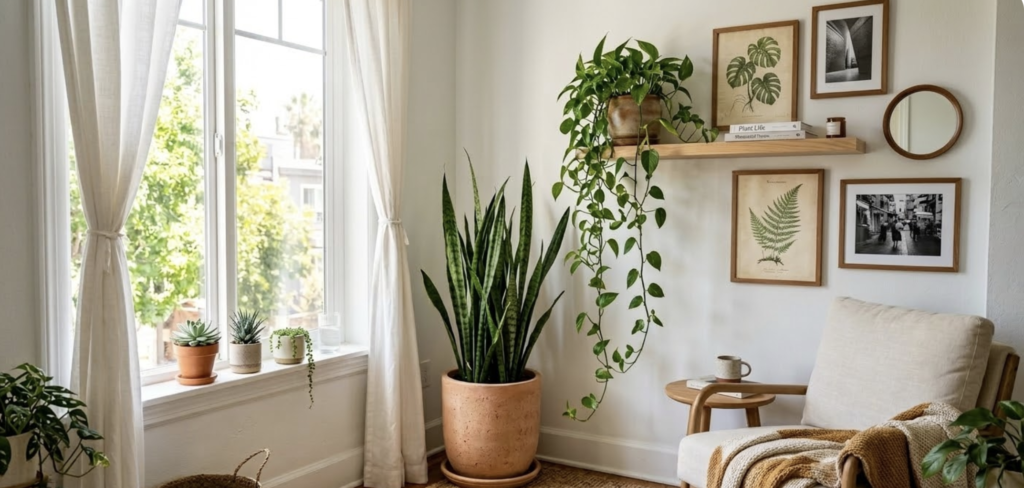
One easy and affordable way to bring natural materials into a studio apartment is through your choice of picture frames and mirrors. Wooden frames, especially ones with visible grain or a natural finish, immediately warm up a wall. A gallery wall built from different wooden frames, all in the same warm tone but slightly different styles, adds texture and personality to a wall without making it feel busy or overwhelming.
10) Decorate the Walls
The walls of a studio apartment are not just boundaries — they are surfaces that have enormous potential to add personality, depth, and color to the room. Bare walls in a studio make the apartment feel unfinished, like the person living there is always about to move. Walls that are thoughtfully decorated send the message that this is a real home, one that belongs to a specific person with specific tastes. You do not need expensive artwork or a lot of it. You need the right pieces in the right places.
A gallery wall is one of the most popular wall treatments for studio apartments because it allows you to use a mix of art prints, photographs, mirrors, and decorative objects to fill a wall in a way that feels personal and collected rather than generic. To create a gallery wall that looks intentional rather than random, start by laying all the pieces out on the floor and arranging them until you find a composition you like. Aim for a mix of sizes — one or two larger pieces and several smaller ones — and a consistent color palette within the frames and mats, even if the artwork itself varies. Before putting any nails in the wall, trace each frame on paper, cut it out, and tape the paper templates to the wall to see how the arrangement will look at full size.
If a gallery wall feels like too much for your space or your personal style, a single large piece of artwork can have an equally powerful impact. A large canvas or framed print hung above a sofa or bed becomes the visual anchor of that zone and immediately makes the area feel complete. The rule of thumb for sizing art above furniture is that the artwork should be roughly two-thirds the width of the furniture it sits above. A painting that is too small over a large sofa will look like a postage stamp. A painting that fills the proper proportion of the wall above the sofa will look like it belongs there.
Wallpaper, especially peel-and-stick wallpaper designed for renters, is another option worth considering for studio apartment walls. Using a statement wallpaper on a single accent wall — behind the bed, behind the sofa, or on the wall facing the front door — adds pattern and personality to the room without overwhelming it. Choose a pattern that uses colors already present in your palette, and the accent wall will feel like a natural extension of the room’s design rather than an afterthought.
11) Style the Small Details That Make It Feel Like Home
You can have the perfect layout, the right colors, the ideal furniture, and excellent lighting, and the apartment will still feel unfinished without the small personal details that make a space feel truly lived in. Styling is the final layer of interior design, and it is the layer that most people either rush through or skip entirely. This is a shame, because the small details — the books on the shelf, the tray on the counter, the throw blanket draped over the sofa — are what make a studio apartment feel warm and personal rather than like a furniture showroom.
The concept of styling in threes is a useful guide for arranging decorative objects on surfaces. Group objects in sets of three, varying the height of each object in the group. For example, a tall candle, a medium ceramic pot, and a small stack of books make a visually pleasing trio on a side table or shelf. This principle works because odd-numbered groupings feel more natural and dynamic to the eye than even-numbered ones. Two objects side by side tends to look like a before-and-after comparison. Three objects together look like a moment that happened naturally.
Textiles are one of the most impactful finishing touches in a studio apartment. A good throw blanket draped over the arm of a sofa adds color, texture, and the suggestion of comfort all at once. Cushions on the sofa can introduce pattern and personality in a controlled way — choose two or three cushions in complementary patterns and colors, rather than buying a mismatched collection over time. A table runner on your dining table or a linen napkin under a vase on a coffee table adds a layer of softness that bare surfaces lack. These are small things, but they accumulate into a feeling of care and intention that makes the apartment feel truly styled.
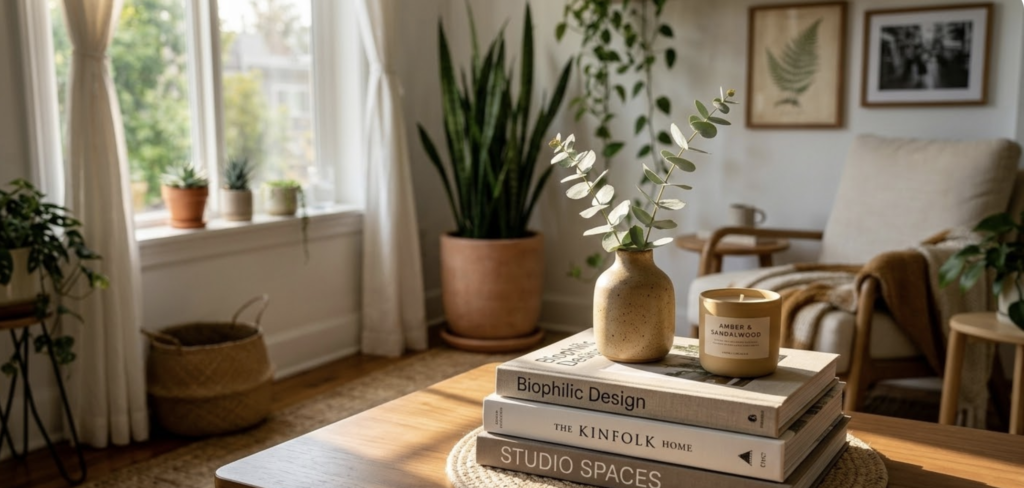
Scent is an often forgotten element of interior design, but it has a powerful effect on how a space feels. A scented candle in a jar, a diffuser with a clean botanical oil, or a small vase of fresh flowers near the entrance of the apartment all contribute to the sensory experience of the space. When someone walks into your studio apartment and it smells fresh and intentional, the space makes a strong first impression before they have even looked at the furniture. In a small apartment where you want every element working in your favor, scent is an easy and inexpensive detail to get right.
Books deserve their own mention as styling objects. Books are uniquely effective in a studio apartment because they serve as storage, as display objects, and as personality markers all at once. A well-curated shelf of books tells a story about who you are and what you care about, which is exactly what you want your home to do. Stack some horizontally to vary the visual rhythm, place a small object on top of a horizontal stack to create a mini vignette, and do not be afraid to arrange books by color on one section of a shelf for a particularly satisfying visual effect.
Make Your Studio Apartment Work for Every Mood and Hour of the Day
The true test of a well-designed studio apartment is not how it looks in photographs. It is how it works at seven in the morning when you are getting ready for work, at noon when you are eating lunch at your desk, at four in the afternoon when you need to decompress, and at nine in the evening when you have a friend over for dinner. A studio apartment that only works in one mode — say, it looks great but is impossible to function in, or it is very practical but feels cold and joyless — has not been fully designed. The goal is a space that adapts to you throughout the day.
Multi-functional furniture is the foundation of a studio that works across multiple modes. We have already talked about storage beds, Murphy beds, fold-down tables, and storage ottomans. But the concept goes further than furniture. Think about how you can shift the room’s function with small changes rather than large ones. Can you move the coffee table aside to create floor space for a yoga session? Can you fold away the dining table and set up a projector for movie night? Can you close a room-dividing curtain to create a separation between your work area and your sleeping area when you need to unwind? The more flexible your layout is, the more uses your studio can serve without you feeling like you are living inside a puzzle.
Routine and organization matter as much as furniture in a studio apartment. A well-designed studio that is always messy will never feel good to be in. Develop simple daily habits — making the bed every morning, clearing the counter before bed, doing a five-minute tidy before you leave — that keep the apartment in a state that you are happy to come back to. In a small space, clutter accumulates faster and has a bigger visual impact than in a larger home. Keeping on top of it daily is far less effort than doing a major clean once a week, and the payoff is a space that feels calm and welcoming every single day.
Finally, and perhaps most importantly: design your studio apartment for the life you actually live, not the life you think you should have. If you never cook, do not spend your budget on a beautiful kitchen setup — invest in a comfortable sofa and great lighting instead. If you work from home every day, make your desk area a true priority, not an afterthought shoved in a corner. If you love having friends over, design the living zone to accommodate gathering, even if it means making the sleeping area smaller. Your studio apartment should reflect your actual daily life, and when it does, it will always feel right — regardless of how many square feet it has.