
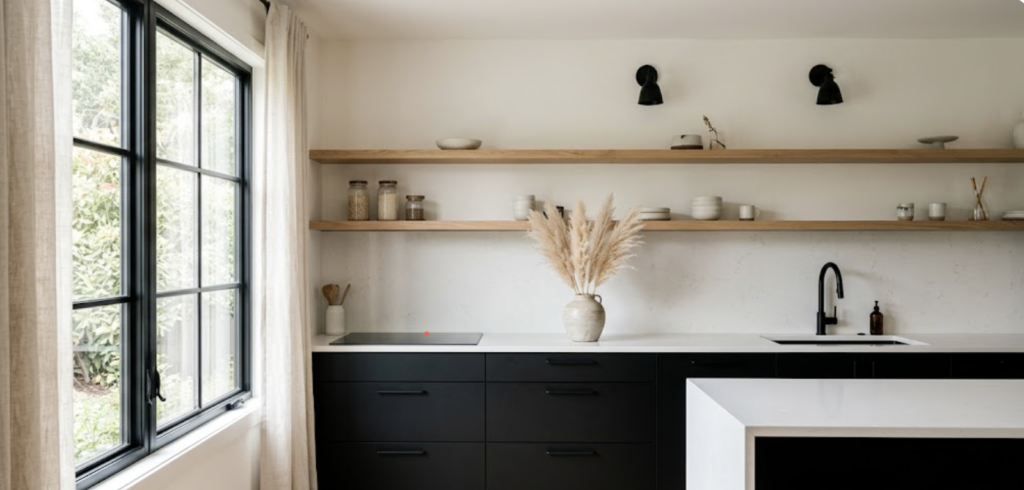
There is a joke that goes around in interior design circles: “A minimalist kitchen is just a kitchen where someone forgot to go grocery shopping.” And honestly? That joke exists because minimalist kitchens have gotten a bad reputation for looking sterile, cold, and painfully empty — like a hospital break room that lost all its will to live.
But here is the truth. A well-styled minimalist kitchen is one of the most beautiful, functional, and deeply satisfying spaces you can build in a home. It is the kind of kitchen that makes you want to wake up early just to stand in it with a cup of coffee. It feels intentional. It feels calm. And it most definitely does not have to be boring.
The problem is that most people confuse “minimalist” with “minimal effort.” They strip everything out, hang nothing on the walls, pick all-white everything, and then wonder why their kitchen feels like a blank void. True minimalist kitchen design is not about removing things until you feel nothing. It is about keeping only the things that work hard — visually, physically, and emotionally — and making sure each one of those things counts.
This guide is going to walk you through exactly how to build and style a minimalist kitchen that has personality, warmth, and genuine visual interest. Not a showroom that no one lives in.
Part One: Understanding What Minimalist Actually Means in a Kitchen
Before you move a single cabinet or pick a single paint color, you need to reframe how you think about minimalism in a kitchen context. This is not an aesthetic choice you make at the end of a project. It is a design philosophy that starts from the very first decision and runs through every single choice you make after that.
Minimalism in interior design — specifically in the kitchen — is rooted in the idea that space itself is a design element. The gaps between things, the stretches of uninterrupted countertop, the clean line of a cabinet door with no handle, these are not absences. They are decisions. Intentional choices that give the eye a place to rest and the mind a moment to exhale.
When you walk into a cluttered kitchen, your brain immediately starts cataloguing everything it sees. The fruit bowl, the coffee maker, the pile of mail, the three different cutting boards, the magnetic knife strip, the herbs on the windowsill, the mug rack, all of it is competing for your attention at once. It is visually noisy, and noise creates low-level stress even when you do not consciously notice it.
A minimalist kitchen removes that competition. It edits the visual field down to a small number of intentional elements, and then it makes those elements excellent. That is the philosophy. Not emptiness. Excellence.
The practical implication of this is important: minimalist kitchen design requires you to make harder, more deliberate decisions than any other style. It is genuinely easier to fill a kitchen with stuff than to curate it down to the essentials and make those essentials beautiful. Anyone can pile things on a counter. It takes real thought to decide what earns its place there.
This is also why minimalist kitchens that are done poorly look so terrible. When you strip things away without adding intention, you get nothing. But when you strip things away and replace the noise with quality, you get something extraordinary.
The good news is that you do not need a big budget or a gut renovation to build a minimalist kitchen that looks considered and interesting. You need the right framework which is exactly what this guide provides.
Part Two: Cabinets, Color, and Layout
Everything in your minimalist kitchen sits on top of the decisions you make about your cabinets, your color palette, and your layout. These are the bones of the space, and if the bones are wrong, no amount of clever styling will fix it.
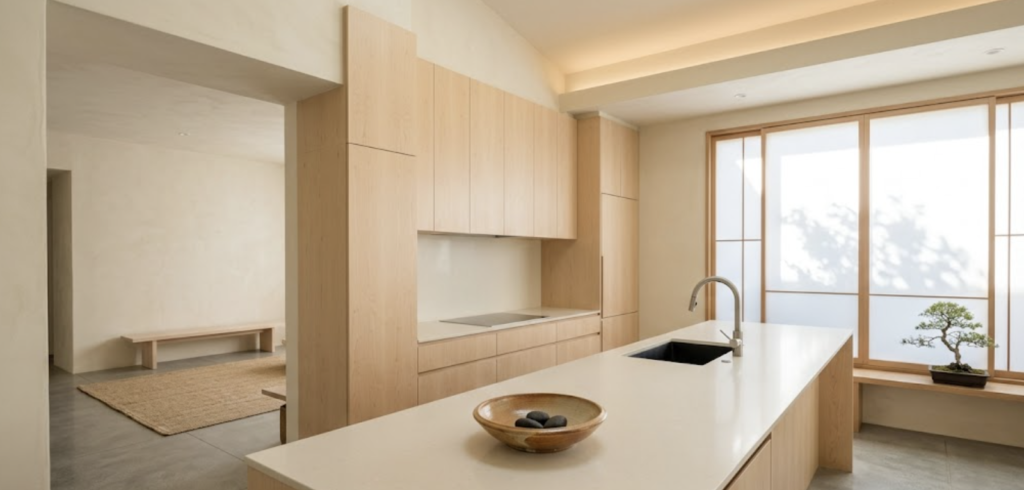
Starting with cabinets: the single most important thing you can do for a minimalist kitchen is choose flat-front cabinet doors. This is non-negotiable. Shaker cabinets — which have that recessed panel detail — are beautiful and they are everywhere right now, but they are not truly minimalist. Shaker cabinets have lines. Minimalist cabinets have none. You want a completely smooth, frameless door with no routed edges, no raised profiles, and no decorative detail. Just a flat plane of material.
The reason this matters so much is that cabinets occupy the majority of your visual space in a kitchen. They are what you see first, what your eye lands on when you scan the room, and what creates the overall impression of the space. Flat-front cabinets create a seamless, calm visual field. They let the walls, the counters, and your deliberate styling choices do the talking.
On color: you have more freedom here than most people think, and this is one of the biggest areas where minimalist kitchens can avoid looking boring. White is the classic minimalist choice and it works beautifully — but it is only one option. Soft warm whites, creamy ivories, and off-whites with a slight beige or yellow undertone are warmer and more liveable than stark bright white. They feel like a decision rather than a default.
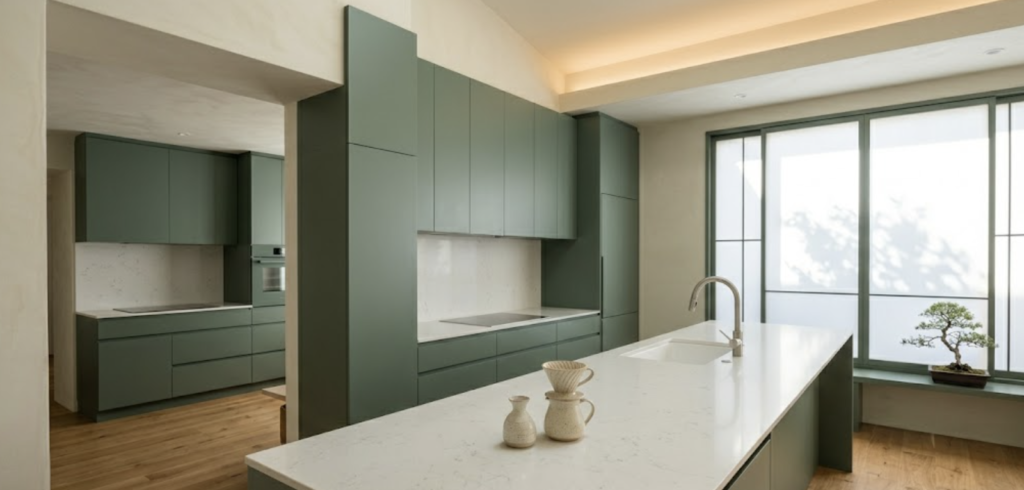
Beyond white, consider muted, desaturated tones. A soft sage green, a warm putty grey, a deep charcoal navy, a muted dusty terracotta, or a very pale blush can all work brilliantly in a minimalist kitchen. The key word is muted. You want colors that have been greyed down, softened, or desaturated — not bright or saturated. Think of the kind of colors you would find in a Scandinavian paint brand’s palette: quiet, sophisticated, and deeply calming.
Two-tone cabinet schemes are also a wonderful way to add depth and personality without adding visual noise. Upper cabinets in soft white, lower cabinets in a warm mushroom or clay tone. Or all cabinets in one color, with an island in a contrasting shade. Done well, a two-tone approach adds a layer of visual interest that makes the kitchen feel designed rather than default, while still keeping everything clean and controlled.
Layout deserves its own discussion because the layout is where function and aesthetics meet in the most practical way. In a minimalist kitchen, you want to eliminate visual interruptions wherever possible. This means integrated appliances wherever your budget allows — a refrigerator behind a panel that matches your cabinets, a dishwasher with a matching cabinet front, an oven built flush into cabinetry. When appliances disappear into the cabinet line, the room looks instantly more calm and considered.
Counter-depth refrigerators are another smart choice for minimalist kitchens. Standard refrigerators protrude significantly beyond the counter line, creating a visual bump that interrupts the clean plane of the cabinetry. Counter-depth models sit flush, which costs a bit more but pays enormous visual dividends.
Think hard about your upper cabinets too. Upper cabinets are extremely practical for storage but they break up your wall space into grid-like sections, which can feel heavy and busy. Many minimalist kitchens use open shelving instead of upper cabinets — which we will discuss in detail later — or they extend upper cabinets all the way to the ceiling with no gap, which creates a clean vertical line rather than a floating box-and-soffit look.
Whatever you choose, make sure your cabinets and layout decisions are made in service of creating long, uninterrupted horizontal and vertical lines. Those lines are what make a minimalist kitchen feel spacious, calm, and architecturally confident.
Part Three: Countertops and Backsplash
If your cabinets are the bones of your minimalist kitchen, your countertop is the skin. It is large, highly visible, and constantly in use — which means it needs to be both beautiful and practical. Fortunately, this is also one of the places where you have real creative latitude without betraying the minimalist ethos.
The most important principle for a minimalist countertop is continuity. You want the countertop material to run in one uninterrupted slab — or at least the visual impression of one — with as few seams as possible. Seams break the clean horizontal plane you are building. If you are working with stone, pay for the larger slabs that minimize or eliminate visible seams. If your budget does not stretch to stone, choose a material like quartz that can be fabricated in longer runs.
Quartz is honestly the reigning champion of minimalist kitchen countertops, and for good reason. It is extremely durable, non-porous, easy to maintain, comes in a vast range of beautiful tones, and because it is engineered, you can get very consistent appearance across large surfaces without the natural variation that sometimes makes stone countertops feel busy. If you want something quieter and more uniform, quartz is your best friend.
That said, natural stone — particularly marble and quartzite — can be absolutely extraordinary in a minimalist kitchen when chosen thoughtfully. The key is to select a stone with soft, flowing veining rather than dramatic, heavily contrasting patterns. A Calacatta marble with gentle grey veining on a white background is genuinely breathtaking and still feels calm. A stone with huge dramatic brown and gold veining might be beautiful in a different context but it fights against the controlled, edited feeling you are building in a minimalist space.
Honed finishes are worth serious consideration over polished. Honed stone — which has a matte, soft surface rather than a mirror shine — feels more organic, more architectural, and more aligned with the understated quality that minimalist design is after. Polished countertops reflect light dramatically, which can be beautiful but can also feel more glamorous than serene. If you want warmth and quiet sophistication, honed is almost always the better choice.
Concrete countertops deserve a mention here because they are genuinely excellent in minimalist kitchens when done well. A smooth, well-sealed concrete counter has an incredible quality — it is simultaneously industrial, artisan, and deeply architectural. It comes in a range of natural grey tones, takes on a beautiful patina over time, and creates a wonderful textural contrast against smooth cabinet fronts.
Now for the backsplash, which is where a lot of minimalist kitchens either succeed beautifully or make a very timid mistake. The most common mistake is choosing a plain white subway tile backsplash because it feels “safe” and “minimal.” Plain white subway tile in a minimalist kitchen almost always looks like the homeowner simply ran out of ideas. It adds no texture, no visual interest, and no warmth — it just fills the space between the counter and the upper cabinets with something that says “I did not want to think too hard about this.”
The minimalist approach to backsplash is to choose something that creates a genuinely interesting surface — but with restraint. A large-format slab backsplash in the same material as your countertop (called a “waterfall” or “slab” backsplash) is perhaps the most considered and architectural choice you can make. It extends the countertop material vertically up the wall, creating a continuous plane that feels expensive, deliberate, and beautifully calm. It also photographs spectacularly, which is not the worst thing.
Other strong minimalist backsplash choices include: textured plaster or Venetian stucco, large-format unfussy porcelain tile in a warm tone, fluted or ribbed stone tile laid vertically, handmade zellige tile in a single muted color (the slight variation in each tile adds beautiful handmade texture without visual noise), and natural stone mosaic in a very tight herringbone or stacked pattern.
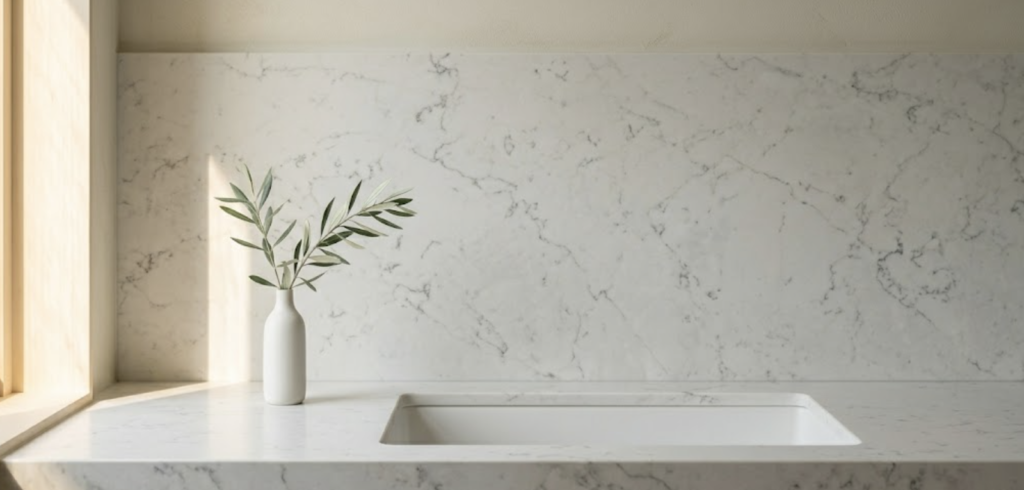
What you want to avoid: anything with a loud pattern, multiple colors, small intricate detailing, or busy grout lines. Grout is worth paying special attention to — in a minimalist backsplash, choose grout that matches the tile as closely as possible. Contrasting grout turns your backsplash into a visible grid pattern, which adds visual complexity you do not want.
Part Four: Hardware, Fixtures
Here is a dirty little secret about minimalist kitchen design: the small details matter more in a minimal space than in any other style. When you remove visual noise and reduce everything to clean surfaces and simple lines, every single remaining detail becomes highly visible and incredibly impactful. The hardware on your cabinets, the faucet at your sink, the handles on your appliances — in a minimalist kitchen, these are not afterthoughts. They are design statements.
Let us start with hardware. There are three main approaches to cabinet hardware in a minimalist kitchen, and each one creates a different feeling.
The first is integrated or handleless hardware — where the cabinet door has a routed groove, a push-to-open mechanism, or a recessed finger pull built into the door itself. This is the most extreme minimalist approach and it creates an extraordinarily clean, uninterrupted cabinet surface. It is particularly powerful on floor-to-ceiling cabinet walls where you want the cabinetry to read as one seamless plane. The downside is that push-to-open mechanisms can be finicky and handleless routed cabinets need to be used confidently — a gentle touch will not open them.
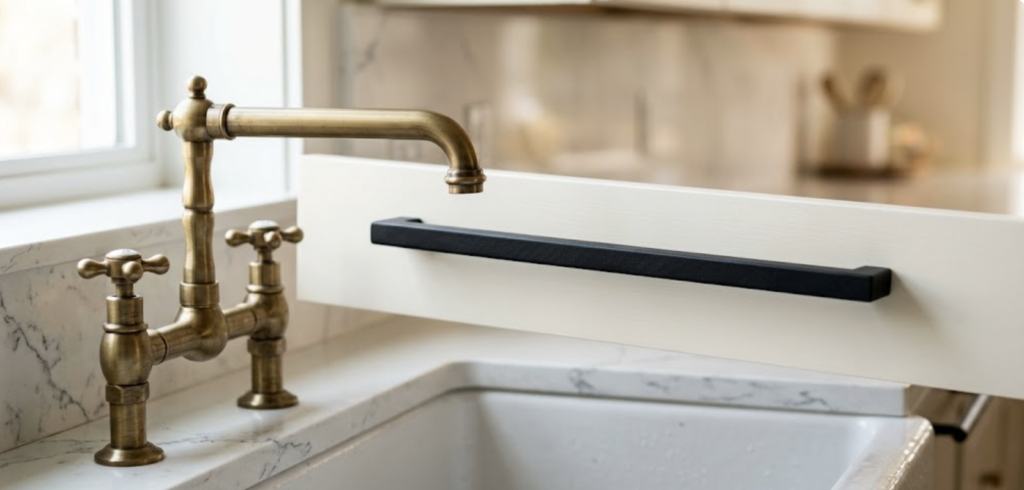
The second approach is linear bar pulls — long, narrow bars in metal or wood that run horizontally or vertically on cabinet and drawer fronts. Bar pulls are the most popular hardware choice in minimalist kitchens because they are clean, geometric, and unpretentious. A long thin bar pull in matte black, brushed brass, or brushed nickel adds a subtle vertical or horizontal line that creates rhythm across your cabinetry without being loud or decorative.
The third approach is no hardware at all on upper cabinets and simple bar pulls on lower drawers, or vice versa. This mixed approach keeps the visual simplicity of handleless cabinets while maintaining excellent practicality on the most-used storage elements.
On finish: matte black, brushed gold/brass, brushed nickel, and warm bronze are the most widely used finishes in minimalist kitchens right now, and they each create a distinct feeling. Matte black is sharp, modern, and strong — it creates a high-contrast graphic element against white or light cabinets. Brushed brass and brushed gold warm the space up beautifully and pair wonderfully with warm wood tones and cream or ivory color palettes. Brushed nickel and stainless are cleaner, cooler, and more neutral. Warm bronze sits between brass and black — it is rich, slightly vintage-feeling, and deeply beautiful against white or muted green cabinets.
Your faucet is a fixture that deserves significant budget allocation in a minimalist kitchen. You likely have one, it is at eye level, it sits in open space above your sink, and it is used dozens of times a day. A beautifully designed faucet — in an arc or bridge style, in a finish that coordinates with your hardware — elevates the entire kitchen. A cheap or generic faucet in a minimalist kitchen sticks out like someone wearing dress shoes with sweatpants. Invest here.
The sink itself is another element worth thinking about carefully. An undermount sink — which mounts below the countertop so that the counter edge is visible — creates a very clean, continuous countertop line and is easier to keep clean than a drop-in sink. A farmhouse or apron-front sink, where the front of the sink is exposed below the counter, adds a wonderful organic, slightly traditional element that prevents the kitchen from feeling too cold or corporate. Farmhouse sinks in white fireclay, concrete, or matte black are particularly beautiful in minimalist kitchens and add a quality of handmade, rooted authenticity that the style often needs.
Lighting is often treated as purely functional in kitchens, but in a minimalist kitchen, your lighting fixtures are actual design objects and they need to be chosen with that in mind. Pendant lights above a kitchen island or peninsula are the most significant lighting design opportunity in most kitchens, and this is where you can add real sculptural interest without adding clutter. A beautiful pendant — in ceramic, blown glass, spun metal, or natural material — adds dimension and character that a minimalist kitchen genuinely needs.
Recessed lighting is wonderful for ambient illumination but should not be your only light source. Layer it with under-cabinet task lighting (LED strip lighting installed under upper cabinets is both practical and beautiful — it creates a warm glow that bounces off the countertop and makes the kitchen feel incredibly inviting in the evenings) and pendant or statement lighting for focal points.
Part Five: The Role of Natural Materials in Preventing Blandness
This is, without any exaggeration, the most important section in this entire guide. If you read nothing else, read this. Because the single most effective thing you can do to prevent your minimalist kitchen from looking boring, cold, and lifeless is this: add natural materials.
Not a lot of them. Not a chaotic mix of them. A thoughtful, deliberate selection of natural materials that introduce warmth, texture, and organic life into the controlled environment you are building. Wood, stone, ceramic, linen, woven materials, dried botanicals — these are your tools for making a minimalist kitchen feel human.
Wood is the most powerful of these. A minimalist kitchen with absolutely zero wood looks clinical and uncomfortable. A minimalist kitchen with the right amount of wood in the right places looks warm, alive, and deeply inviting. The question is not whether to use wood but where and how.
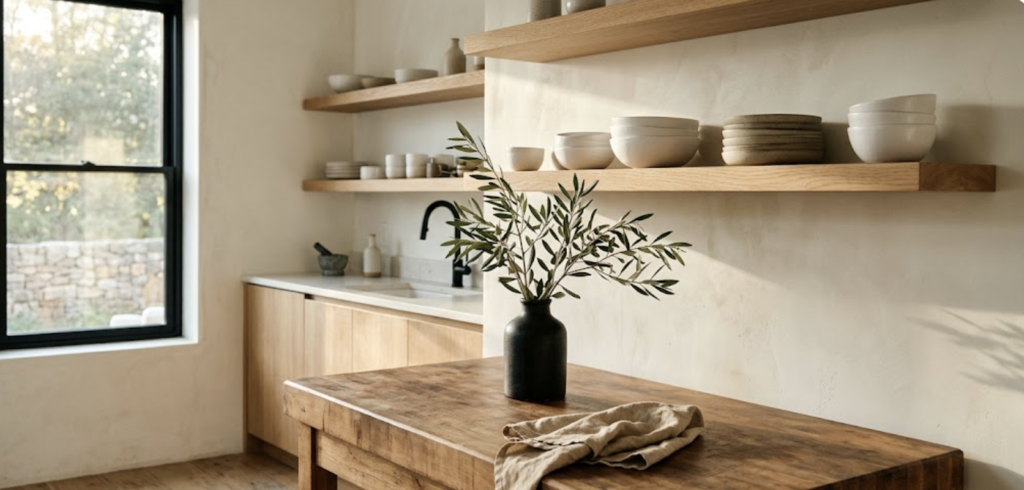
Open shelving in natural wood is perhaps the most beloved minimalist kitchen move, and it works because it does several things at once. It breaks up a solid wall of upper cabinetry, it creates a display space for the objects and materials that give your kitchen personality, it introduces a warm natural material at eye level, and it creates beautiful depth against the flat surface of the cabinets below. Light to medium-toned wood species — white oak, ash, maple, walnut in a lighter finish, birch — work beautifully in minimalist kitchens. Very dark wood can feel heavy. Very pale wood in a very pale kitchen can disappear. You want enough contrast for the wood to read clearly but not so much that it shouts.
A wooden kitchen island top, butcher block style, is another spectacular choice. Using a different material on the island top than on your perimeter counters creates a natural visual distinction between prep space and clean surface, adds warmth and texture, and introduces a beautiful handmade quality. Butcher block is also genuinely wonderful to use — it is kind to knives, it develops a gorgeous patina over years of use, and it can be sanded and re-oiled if it gets marked.
Wood floors deserve a mention here because they do enormous work in warming up a minimalist kitchen. Light to medium oak floors — wide planks, low sheen, a natural or very warm stain — ground the entire kitchen in organic warmth and immediately counter the potential coldness of white cabinets and stone countertops. Very light blonde wood floors are light-enhancing and airy. Medium warm oak tones read as classic and deeply warm. Both are excellent choices.
Beyond wood, stone introduces texture and weight. A stone tile floor, a stone slab on a kitchen island, stone accessories — these add mineral richness that makes the space feel considered and real. Ceramic and stoneware do similar work at a smaller scale: a row of ceramic canisters on a shelf, a handmade stoneware bowl on the counter, clay oil bottles near the stove — these small ceramic elements add an incredible warmth and craft quality.
Linen and cotton textiles — a natural linen dish towel hanging from an oven rail, a woven cotton table runner on the kitchen table if you have one, a simple woven basket for produce — all add softness and texture that prevents the hard surfaces of a minimalist kitchen from feeling cold and unwelcoming.
Plants are the ultimate natural material addition, and they deserve a whole sub-conversation. A single well-placed plant in a minimalist kitchen is not decor. It is punctuation. It adds life, color, and organic movement to a controlled, geometric space. The best plants for minimalist kitchens are those with strong, clean forms: a single stem of eucalyptus in a narrow ceramic vase, a small potted olive tree on the countertop or in a corner, a trailing pothos in a simple white pot on an open shelf, a cluster of small succulents in terracotta pots on the windowsill, or a bunch of dried pampas grass or dried botanicals in a low ceramic jar. What you want to avoid is a chaotic collection of mismatched pots and plants in every corner — that works in a maximalist space, not a minimalist one. Choose one or two plant moments, make each one considered, and let them breathe.
Part Six: How to Style Open Shelving Without It Looking Like a Mess
Open shelving in a minimalist kitchen is either a triumph or a disaster, and the difference comes down entirely to how you style it. There is essentially no middle ground. Badly styled open shelves in a minimalist kitchen look chaotic, dusty, and mentally exhausting. Beautifully styled open shelves look like the most curated, intentional, and characterful thing in the room.
The first rule is that open shelves are not storage. They are display. This is a critical mindset shift. If you approach your open shelves the same way you approach the inside of a closed cabinet — as a place to put all the things you need access to — you will end up with a jumble of mismatched plates, odd glasses, random spice bottles, and a cleaning challenge. Instead, think of your open shelves as a small gallery or installation. Every single item on them has been chosen because it is beautiful, meaningful, or both.
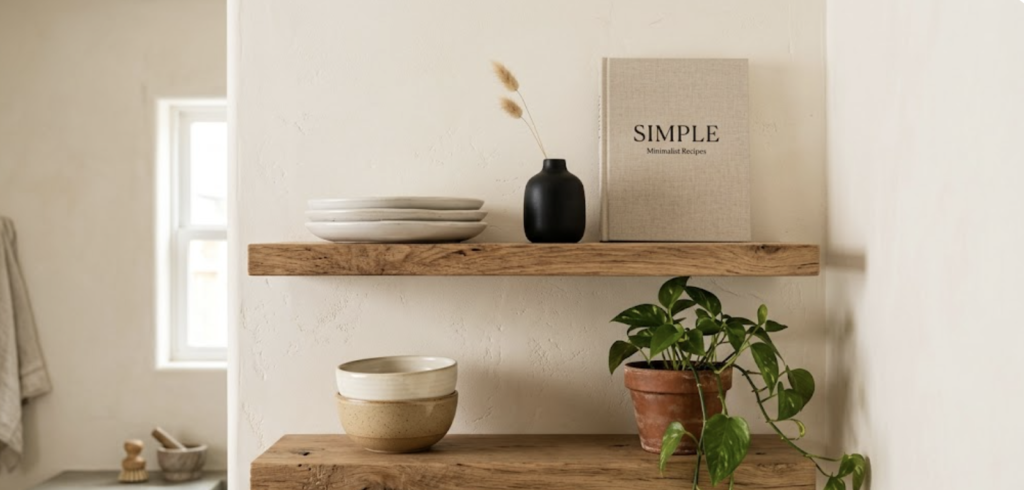
This means you need to be genuinely selective about what goes on open shelves. A cohesive set of ceramic or stoneware plates and bowls in natural, earthy tones — not a mismatched set of six different dishes you have accumulated over the years. Two or three beautiful glasses of the same type, or a set that coordinates. A small collection of ceramic canisters for coffee, tea, and salt. One or two cookbooks with beautiful spines. A plant. A small sculptural object. That is roughly it.
The second rule is tonal and material cohesion. Everything on your open shelves should feel like it belongs to the same family. This does not mean everything must be identical, but the palette should be controlled: whites, creams, natural wood tones, earthy terracotta, warm grey, matte black. Avoid introducing bright colors, plastic items, or things with loud graphics and text. If something does not look good on the shelf, it goes in a closed cabinet or drawer. No exceptions.
The grouping principle is your practical styling tool. Rather than spacing items evenly across the shelf like a supermarket display, group objects in small clusters, two or three items close together and then leave a gap before the next group. This creates natural rhythm and visual interest while maintaining the breathing room the space needs. Vary the heights within each group: a tall vase next to a short bowl next to a medium canister reads as dynamic and considered.
Part Seven: The Counter (What to Keep Out and What to Hide)
The kitchen countertop is where the battle between function and aesthetics is fought every single day. It is the hardest surface in a minimalist kitchen to maintain because it is also the most used surface in your entire home. It gets loaded with appliances, groceries, mail, keys, coffee cups, recipe books, and the mysterious accumulation of things that seem to migrate there from every other room.
Managing your countertop is a discipline, not just a styling decision. But before you can manage it, you need to design it — meaning you need to think very carefully about what you are going to allow to live on your counter permanently, and then design storage solutions that make everything else easy to put away.
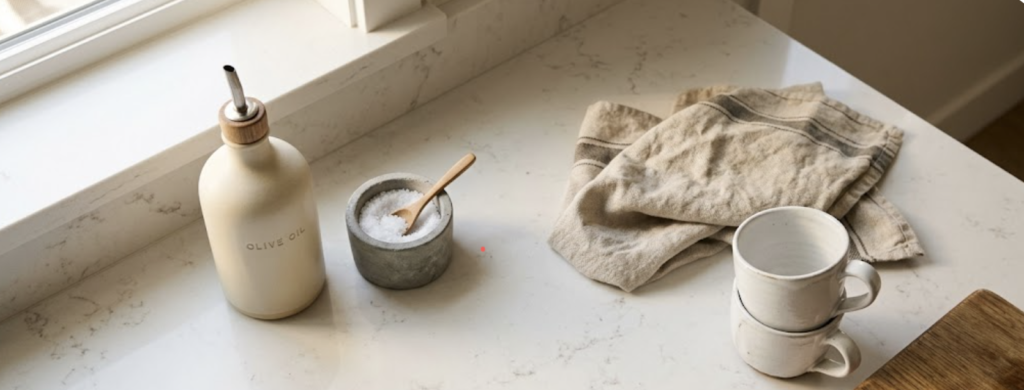
The rule for a minimalist countertop is that only things used daily — and that are also beautiful — earn permanent counter space. Everything else goes away. This means your coffee setup (if you make coffee every morning and your equipment is attractive), your most-used cooking oil in a beautiful bottle, a small cutting board that coordinates with the rest of the materials, and a small plant or botanical. That is the maximum for most kitchens. Many minimalist kitchens keep just one or two items out permanently and clear everything else completely.
The appliances are where most people struggle. The toaster, the coffee maker, the stand mixer, the air fryer — these are all things that get used regularly but that are often visually loud and difficult to integrate. The solution is a combination of choosing appliances in neutral, beautiful finishes when possible, and designing storage that makes them genuinely easy to put away. An appliance garage — a section of counter with lift-up or roll-up door that hides small appliances while keeping them accessible — is one of the smartest investments in a minimalist kitchen. When closed, it presents a flat, uninterrupted cabinet surface. When opened, everything you need is right there.
The sink area deserves special attention. Most sink areas accumulate a collection of dish soap, sponges, brush holders, and drying racks that quietly destroy the clean look of a minimalist kitchen. The solution is simple but requires a small investment: choose a dish soap dispenser that is beautiful — a refillable ceramic pump in white or matte black. Choose a single natural sponge or brush that looks at home. Use a drying rack mat in natural linen that folds away when not in use rather than a permanent wire drying rack. These small swaps cost very little but make an enormous difference.
Part Eight: Color, Contrast, and How to Add Visual Interest Without Adding Clutter
One of the most frequently asked questions about minimalist kitchen design is: “How do I make it interesting without it looking cluttered?” The answer is contrast — and understanding the difference between visual interest created by quality and depth versus visual interest created by quantity and variety.
In a minimalist kitchen, interest comes from texture, tone, material variation, and the occasional considered accent, not from filling the space with decorative objects. When you have reduced the visual noise to a minimum, the remaining elements become highly potent. A single accent color, one beautiful texture, a strong material contrast — these things read loudly and beautifully in a minimal context in a way they simply would not in a busier space.
Contrast is your best tool here. Light against dark, rough against smooth, organic against geometric, matte against semi-gloss — these pairings create visual tension and interest without adding a single extra object. Pale grey-green cabinets against white walls creates a beautiful, quiet color contrast. A rough natural linen curtain against the hard surface of a stone countertop creates a tactile contrast. The clean straight lines of flat-front cabinetry against the organic curves of a handmade ceramic bowl on the shelf creates a formal contrast. These juxtapositions are what give a minimalist kitchen its visual life.
Color accents in a minimalist kitchen work best when they are very small in quantity and very deliberate in placement. You do not need much. A terracotta-toned ceramic on one shelf. A single painting or print with a subtle color palette hung on one wall. A small vase in sage green or dusty blue on the countertop. A set of linen napkins in a warm blush on the kitchen table. These moments of quiet color — one or two at most — create warmth and personality without breaking the calm of the overall space.
The most successful minimalist kitchens often operate on a base palette of three tones: a dominant neutral (the cabinets and walls), a secondary material tone (the countertop, floor, or shelving), and an accent tone (the hardware finish or small accessories). Everything works within this three-tone palette, which creates coherence without blandness. The genius is in how interesting you can make those three tones by playing with texture and material variation within each one.
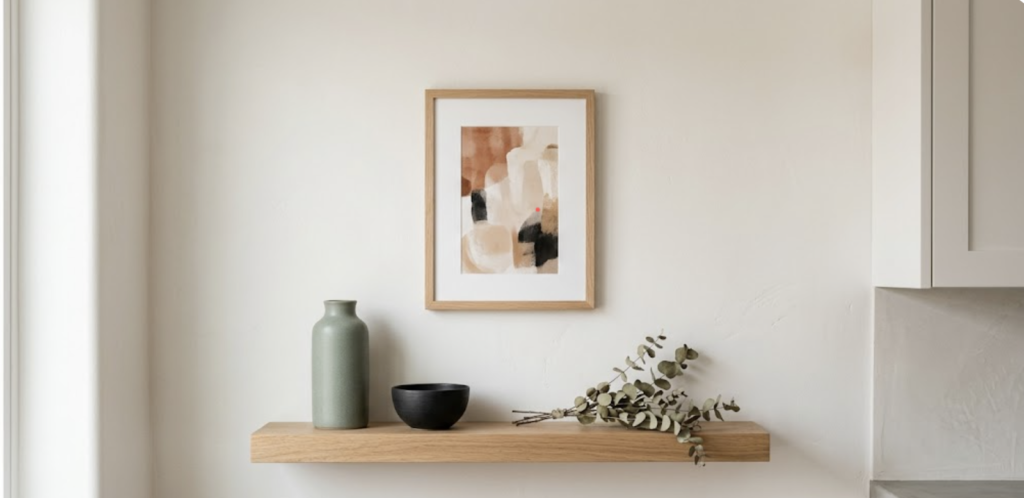
Art in the kitchen is underutilized and misunderstood. Many people think art is not appropriate for a kitchen — that it will get greasy or be out of place. But a single well-chosen piece of art in a minimalist kitchen is transformative. It adds the humanizing layer that keeps the space from feeling like a catalog page. It should be simple: a small abstract print in muted tones, a framed botanical illustration, a simple black-line drawing, or even a beautiful piece of hand-lettered typography in a simple frame. Hang it where it has space around it — not surrounded by other things — and let it be the one moment of pure visual pleasure in the room.
Part Nine: Flooring and the Importance of What Is Under Your Feet
Floors are one of the most significant design decisions in any room, and in a kitchen — where they are completely visible and span the entire square footage — they are even more impactful than usual. In a minimalist kitchen, the floor is a major part of the overall palette and it needs to work harmoniously with everything above it.
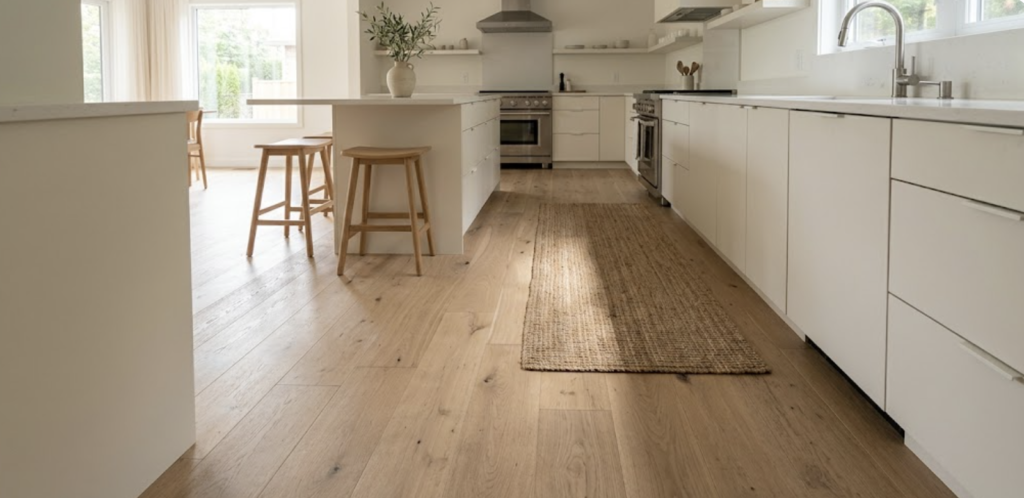
The most universally successful flooring choice for a minimalist kitchen is wide-plank hardwood or engineered wood in a light to medium natural oak tone. Wide planks — anything from five inches to eight or more inches in width — create fewer visible grout lines and seams, which means the floor reads as a more continuous, calm surface. The natural variation in the wood grain adds organic texture and warmth without visual noise. A low-sheen or matte finish reads as more natural and architectural than a high-gloss finish, which tends to look more formal and reflective than the minimalist aesthetic typically calls for.
Light blonde or natural oak floors are the reigning favorite in minimalist interiors because they are light-enhancing, warm, and neutral enough to work with virtually any cabinet color. They also age beautifully and can be refinished if needed.
Large-format porcelain or ceramic tiles are the other excellent choice for minimalist kitchen floors. Large format — 24×24 inches or larger, or long-format tiles like 12×48 or 24×48 — creates that same desirable continuity as wide-plank wood. Fewer grout lines means a calmer, more expansive-feeling floor. Choose tiles in warm neutral tones: warm grey, soft beige, creamy white, warm taupe. Avoid cool blue-grey tiles in a kitchen that you want to feel warm, as they can tip the whole space into feeling cold and corporate.
Concrete is the third strong option, whether poured-in-place, polished, or in the form of large concrete-look tiles. Concrete floors have an industrial honesty and architectural quality that is particularly effective in kitchens with warm wood tones and white cabinets. They are visually grounding, incredibly durable, and age with beautiful character.
One detail that enormously impacts how a minimalist kitchen floor reads is the transition between the kitchen and adjacent spaces. Where possible, use the same flooring material throughout open-plan living areas for visual continuity. When you have one continuous floor flowing from kitchen to living area, the space feels larger, more cohesive, and architecturally intentional. A sudden change in flooring material creates a visual break that interrupts the calm, expansive feeling you are building.
A kitchen rug — which may seem at odds with minimalist principles — can actually be a wonderful addition when chosen carefully. A simple flat-weave rug in natural jute, cotton, or wool in a neutral or very subtly patterned design, placed in front of the sink or in a cooking zone, adds warmth and defines the kitchen zone in an open-plan space. It also helps acoustically, softening the hard surface reflections that can make a kitchen feel echo-y. Keep it simple: a solid, near-solid, or very subtle geometric or stripe pattern in natural tones.
Part Ten: Lighting Layers
Light does more for a minimalist kitchen than any single piece of decor, any paint color, or any piece of furniture. It is the invisible ingredient that determines whether your kitchen feels cold or warm, clinical or inviting, flat or dimensional. And in a minimalist kitchen specifically, where the visual field is calm and uncluttered, light becomes even more powerful because there is less competing with it.
The foundational principle is to build three layers of lighting: ambient (general illumination), task (focused work light), and accent (atmospheric or focal light). Most kitchens have only the first layer — recessed overhead lights that flood the room with even, functional illumination. This is useful but not beautiful. It flattens everything, eliminates shadow, and makes the space feel like a workplace rather than a home.
Recessed lighting is your ambient layer. It should be on a dimmer — absolutely, non-negotiably on a dimmer. The ability to dial your ambient light down in the evening transforms the entire feeling of the kitchen from operational to atmospheric. Use warm-toned LED bulbs (2700K to 3000K) rather than cool or daylight bulbs, which read as institutional under dimmer settings. Space your recessed lights carefully and avoid over-lighting — a common mistake in kitchens that creates harsh, bright uniformity.
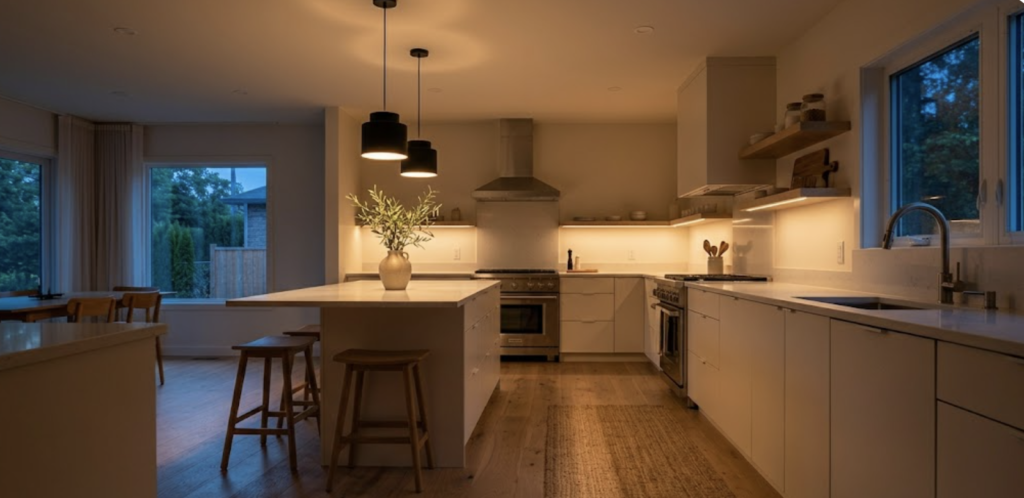
Under-cabinet lighting is your task layer and it is one of the best investments per dollar in kitchen design. LED strip lights or puck lights mounted under upper cabinets (or the underside of open shelving) illuminate the countertop directly for practical work purposes, but more importantly they create a beautiful warm glow that bounces off the countertop and creates a band of light at a lower level than your overhead fixtures. In the evening, with the recessed lights dimmed down and the under-cabinet strips lit, the effect is warm, cozy, and deeply inviting. It is the kitchen equivalent of candlelight. Install these wherever you have upper cabinets or shelving above a work surface.
Your accent and focal layer is the pendant lighting above your island or peninsula, and the deliberate use of any display lighting if you have glass-front cabinets or backlit shelving. Pendant lights above an island are simultaneously practical — they throw direct light onto the working surface below — and deeply decorative. In a minimalist kitchen, choose pendants that are strong, clean design objects. A blown glass globe in smoked or amber glass. A spun metal cone in matte black or brushed brass. A sculptural ceramic pendant. A simple cage or industrial-style pendant in a warm metal. Whatever you choose, make sure it is something you would describe as beautiful on its own, independent of the kitchen context. Hang two or three pendants in a row over an island for the most satisfying rhythmic effect.
Natural light management is often overlooked but profoundly important. In a minimalist kitchen with large windows, you want light control that does not block the view or add visual weight. Roller shades in natural linen or white fabric, mounted inside the window frame or at ceiling height for a floating effect, are the classic minimalist window treatment. They are clean, simple, and practical. Roman shades in a natural fabric work similarly. What you want to avoid is heavy curtains, fussy treatments with tiebacks, or anything that adds a lot of visual complexity to the window area.
Part Eleven: The Small Things That Make a Difference
By now you have the structure, the materials, the layout, the shelving, the lighting, and the palette. You are building something excellent. But there is a final layer of styling that separates a minimalist kitchen that looks good in a floor plan from one that makes people catch their breath when they walk in — and it is entirely about the small things, the micro-details, the objects that seem almost too humble to mention but do enormous amounts of work.
Your dish and cookware — the everyday objects of actual kitchen use — are part of your kitchen’s visual identity in a minimalist space. When your shelving is open, your cookware is stored visibly, and even your dish drying situation is visible, every object becomes part of the aesthetic. This sounds burdensome but it is actually liberating, because it gives you a reason to invest in cookware and kitchen objects that are beautiful as well as functional. A set of matte ceramic plates in creamy white. Handmade stoneware mugs in earthy tones. A beautiful cast-iron skillet. A simple olive wood cutting board. These are not luxury items — they are available at reasonable prices — and having them makes the entire kitchen feel more considered.
The kitchen table or kitchen seating, if your kitchen includes it, is another opportunity that many people overlook. In an open-plan kitchen that flows to a dining area, the dining table and chairs become part of the kitchen’s visual composition. A natural wood dining table with simple, clean-lined chairs — in wood, metal, or upholstered in a natural fabric — extends the minimalist aesthetic into the eating area and creates a coherent, calm space. If you have bar stools at a kitchen island, choose stools with clean lines, no fussy arms or backs, in wood or metal that coordinates with your hardware finish.
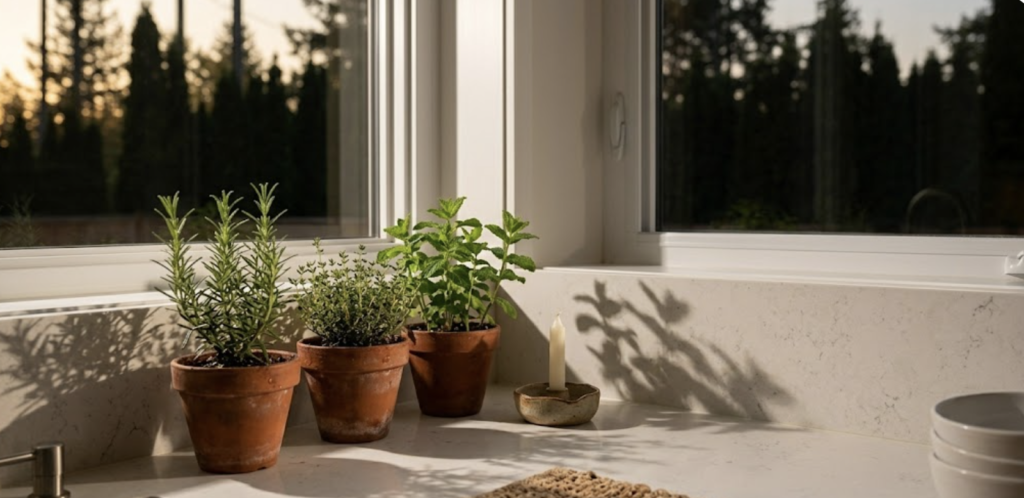
Smell, which is not a visual element at all, nonetheless contributes enormously to whether a space feels boring or alive. A minimalist kitchen that smells of nothing has a clinical quality that visual calm alone cannot overcome. Fresh herbs on the windowsill — rosemary, thyme, mint in simple terracotta pots — add both a botanical visual element and a genuinely beautiful kitchen scent. A beeswax candle burning on the counter during the evenings, in a simple ceramic container, contributes warmth and scent simultaneously.
Dishware storage and organization — the inside of the cabinets — matters even though it is mostly unseen, because when the cabinet doors open the interior is briefly visible and because organization affects how quickly and naturally you can maintain the clean exterior look. Dedicate specific places for categories, use simple dividers and drawer organizers in wood or neutral materials, and resist the urge to keep every random item that enters your kitchen. A minimalist kitchen that is only minimalist on the outside but chaotic inside eventually becomes chaotic on the outside too. The discipline is architectural — it goes all the way through.
Finally, there is the practice of the reset. A minimalist kitchen requires a small daily habit: at the end of cooking and cleaning, everything goes back to its place. The counters are cleared. The dish cloth is folded neatly. The coffee equipment is aligned. This takes literally two minutes and it is the difference between a minimalist kitchen that looks beautiful every morning and one that gradually becomes invisible under layers of accumulated stuff. Think of it not as cleaning but as maintenance of your own design — the final step that honors the work you put into building the space.
A Note on Budget: Minimalism Does Not Mean Expensive
It would be dishonest to write a guide like this without addressing budget. Some of the elements discussed here — stone countertops, integrated appliances, custom cabinetry are genuinely expensive. But minimalist kitchen design is not exclusively for people with renovation budgets that could fund a small expedition.
The core principle of minimalism keeping only what works hard and making it excellent — actually becomes more accessible when you work with a tighter budget, because it demands that you prioritize ruthlessly. You cannot spend money on everything, so you choose the one or two things that will have the most visual impact and you invest there. For some kitchens that is the countertop. For others it is the lighting fixtures. For others it is the hardware swap that transforms old cabinets with a screwdriver and a small budget.
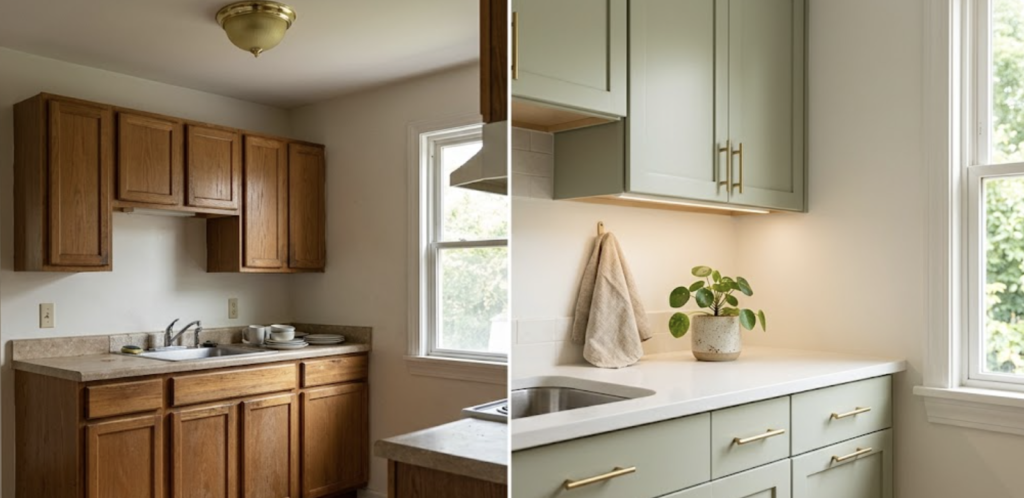
Repainting existing cabinets in a considered color, a soft warm white, a muted sage, a quiet charcoal costs a fraction of replacing them and has an enormous impact. Replacing cheap hardware with quality bar pulls changes the entire feeling of a cabinet. \Adding open shelving on a single wall, removing upper cabinets on one side of the kitchen, installing under-cabinet lighting — these are all relatively affordable interventions that create a dramatically more minimalist, more beautiful kitchen.
The most expensive thing in minimalist kitchen design is not any single product — it is the editing. Deciding to live with less, to store things properly instead of leaving them on the counter, to resist the urge to add one more thing. That discipline costs nothing. And it is, ultimately, what makes the style work.
Conclusion: Your Kitchen, Edited
A minimalist kitchen is not a trend. It is not a style for people who do not cook or do not eat or do not really live in their homes. It is a philosophy of making a space that works better — practically and emotionally — because every element in it has earned its place.
Building a minimalist kitchen that is not boring requires you to resist two equal and opposite temptations: the temptation to add more things in the name of “personality,” and the temptation to remove everything in the name of “minimalism.” The path runs between them. It requires quality over quantity, intention over abundance, and texture over decoration.
You now have the framework. The flat-front cabinets and considered color palette. The countertop and backsplash that create a calm, continuous surface. The hardware and fixtures that function as design objects. The natural materials — wood, stone, ceramic, linen — that keep the space warm and human. The open shelving styled as a gallery, not a storage unit. The counter discipline that keeps the surface clear. The lighting layers that make the kitchen feel alive at every hour of the day. The small things — the ceramics, the plants, the habits — that make it yours.
You do not need to be a minimalist to have a minimalist kitchen. You just need to love your kitchen enough to edit it — and to trust that what remains after the editing will be better than everything you started with.