
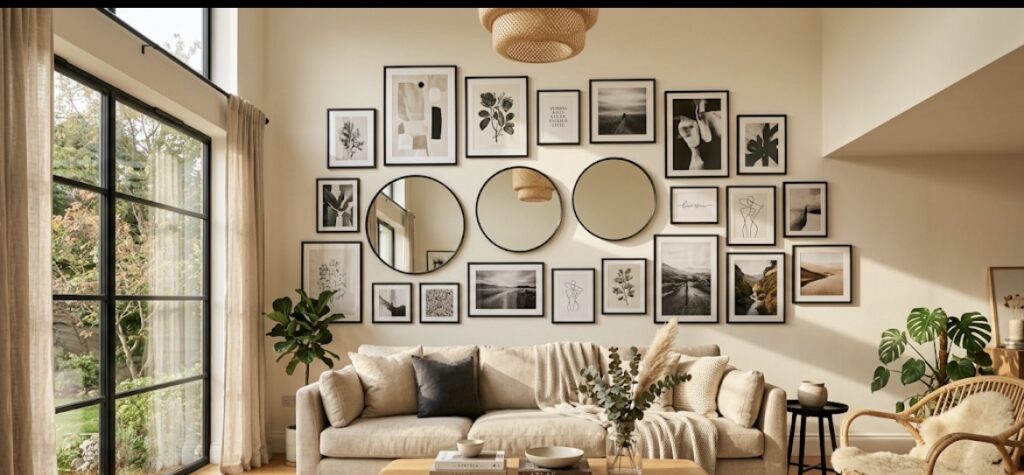
There is something both exciting and terrifying about a blank wall. It just sits there, staring at you, waiting for you to do something brilliant with it. A gallery wall, when done right, can completely transform a room — it gives a space personality, depth, warmth, and that “wow, who lives here?” energy that everyone secretly wants their home to have.
But here is the truth nobody tells you upfront: most gallery walls that look effortless took a lot of effort. The good news? Once you understand how they work — the logic behind the layout, the art of mixing frames, the way color ties everything together — it becomes much less intimidating and a whole lot more fun. Think of it as decorating a wall like a stylist, not like someone who just grabbed everything off the shelf at a home goods store and hoped for the best.
This guide will walk you through every single step, from choosing your wall and picking your pieces, to arranging them on the floor, hammering the nails, and stepping back to admire something that genuinely looks like it belongs in a design magazine. No guesswork. No “I think this looks okay?” moments. Just clear, simple steps and the confidence to trust your eye.
Step 1: Choose the Right Wall for Your Gallery
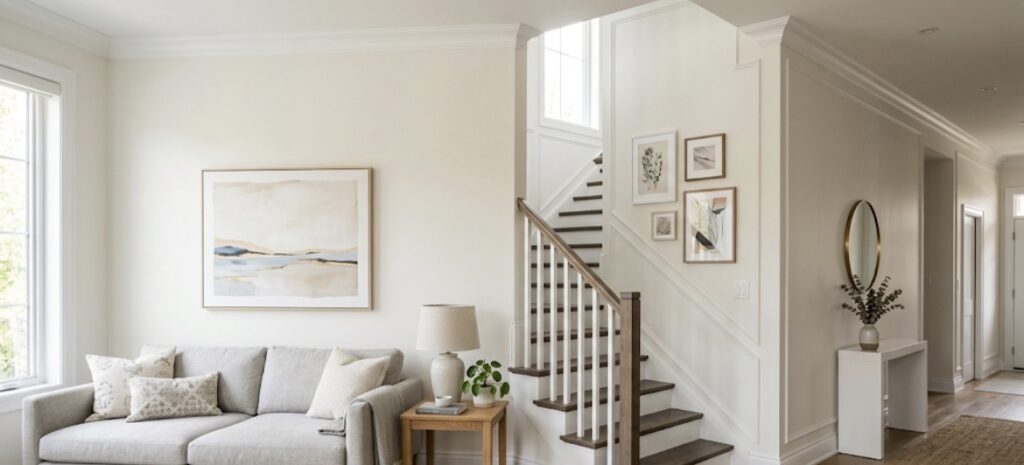
Before you buy a single frame or print a single photo, you need to choose your wall wisely. Not all walls are created equal, and picking the wrong one can make even a beautiful collection look awkward and out of place.
The best walls for a gallery display are ones that already have natural “anchors” around them — meaning there is furniture, a doorway, or an architectural feature that gives the wall a visual boundary. A wall above a sofa is the most popular choice, and for good reason. The sofa acts as a grounding piece, so the art has something to relate to. The wall does not float — it sits in conversation with the furniture below it. Similarly, a staircase wall is a fantastic option because the diagonal line of the stairs gives you a natural frame to work with, and it is one of the few places where an asymmetrical arrangement looks intentional rather than accidental.
Hallways are another underused option. People tend to ignore hallway walls, but a gallery wall in a hallway creates a beautiful “gallery corridor” experience — the kind that makes people slow down as they walk through your home. The only challenge with hallways is the width. If the hallway is narrow, stick to smaller frames and hang them at eye level in a single horizontal line rather than trying to fill the entire wall.
What you want to avoid is placing a gallery wall on a wall that has too many interruptions — windows, outlets, switches, or vents that will break up your arrangement and force you into awkward compositions.
A wall that is at least five to six feet wide gives you enough room to breathe and arrange pieces without everything feeling crammed together. If you are working with a smaller wall, do not panic — a tightly grouped cluster of four to six small frames can look just as intentional as a large sprawling arrangement.
Also, think about the wall color. Gallery walls pop most on walls painted in mid-tone or deep colors, but they also look stunning on crisp white or soft warm white. What tends to fall flat is a gallery wall on a very pale, cool gray — the frames and art can get lost against the wall rather than standing out from it. If your wall is a light neutral, consider adding a small piece of wallpaper in that section, or simply commit to frames with a stronger presence — dark wood, matte black, or thick gold frames that command attention.
Step 2: Decide on a Visual Theme
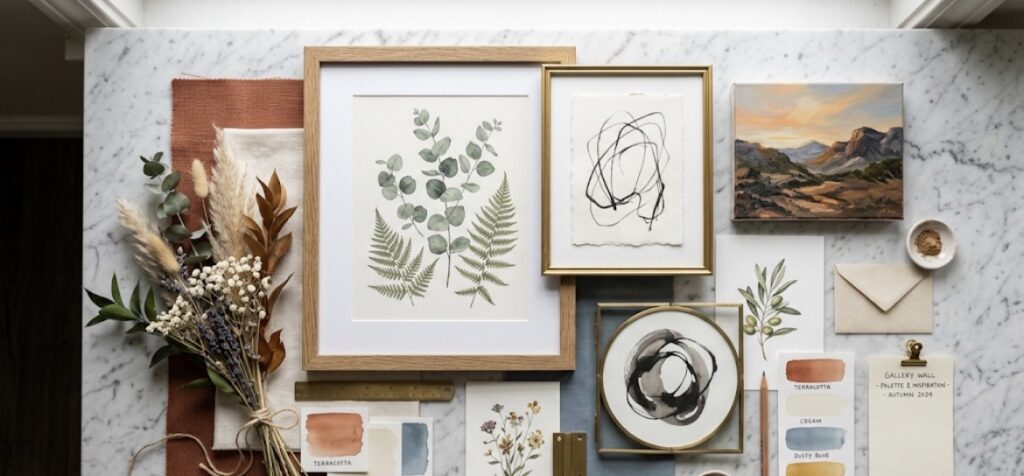
The word “theme” can sound restricting, like you can only hang pictures of one thing. That is not what this means at all. A theme is simply a common thread — a visual idea that runs through all your pieces and makes them feel like they were collected with intention, not grabbed randomly.
Themes come in many forms. A color theme is the most flexible — you simply make sure every piece of art or every frame shares at least one color with the rest of the collection. If you are working with warm, earthy tones like terracotta, rust, gold, and cream, every piece you add should have at least a touch of those colors. This does not mean every piece has to be the same color — it means the palette is consistent. A black and white photograph, a terracotta abstract, a warm beige botanical print, and a gold-framed mirror can all live together beautifully because the warm undertone runs through all of them.
A subject theme is more literal — you collect pieces that are all about the same topic. Botanical prints. Architectural drawings. Vintage maps. Animal portraits. Coastal or ocean art. This kind of theme is particularly easy to shop for because you know exactly what you are looking for, and it creates a very clear, cohesive story on the wall. The risk is that it can feel a little flat if every single piece is too similar. The way to avoid this is to vary the style within the subject — mix a photographic botanical print with a hand-drawn illustration and a pressed flower in a frame, and suddenly you have three “botanical” pieces that all look different from each other.
A style theme is perhaps the most design-forward approach — you choose pieces that all share an aesthetic sensibility, regardless of subject. Minimalist line art. Maximalist colorful folk art. Vintage and antique. Mid-century modern graphic design. This kind of theme works best when you have a clear sense of your overall interior style, because the gallery wall should feel like a natural extension of the room’s personality, not a foreign element that wandered in from a different house.
You do not have to pick just one type of theme. In fact, the most interesting gallery walls often combine two — a color theme and a style theme, for example. The key is simply that when someone looks at your wall, they feel a sense of “yes, this was chosen” rather than “did this just happen?”
Step 3: Mix Frame Styles the Right Way
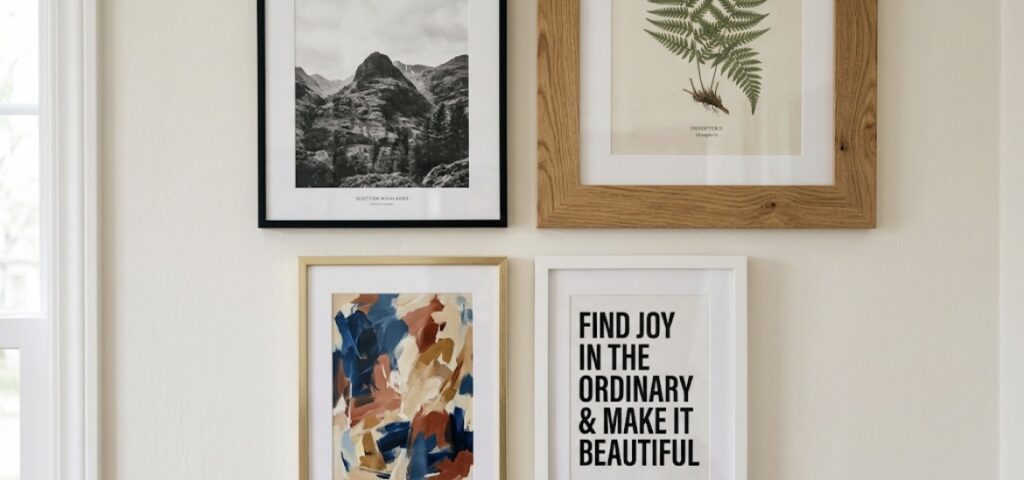
This is where most people get nervous, and honestly, it is the step where most gallery walls either come together beautifully or fall apart completely. The question of whether to use all matching frames or a mix of different ones has a surprisingly clear answer: both work, but they create very different feels, and you need to commit to one or the other.
Matching frames — meaning all the same color and style, though they can vary in size — create a clean, gallery-like, highly curated feel. This approach is particularly effective in modern and minimalist spaces, or in rooms that already have a lot of visual activity (busy wallpaper, patterned rugs, colorful furniture) and need the gallery wall to be a calm, organized presence. If you go this route, matte black frames are the most universally versatile. They work in every style of interior, they make colors in artwork pop, and they give even inexpensive prints an elevated look. White frames are equally versatile in lighter, more airy spaces, and natural wood tones work beautifully in warm, organic interiors.
Mixed frames, on the other hand, create a layered, collected-over-time feel that many people find more personal and interesting. The secret to making a mixed frame arrangement work is to have a unifying element. Either unify by metal finish (all frames are gold, or all frames have a warm wood tone, even if the shapes and sizes vary), or unify by one repeated element (for example, three of your seven frames are the same matte black, and the others are all warm-toned woods — the black frames act as anchors that hold the arrangement together).
What you absolutely want to avoid is a truly random mix — thin gold, thick black, thin white, chunky dark walnut, cheap plastic chrome, all in the same arrangement. Even if the art inside is beautiful, the frames will fight each other and the whole thing will feel chaotic rather than curated. The frames are the “outfit” for your art — and just like getting dressed, the pieces need to coordinate even if they do not match.
One more thing about frames: do not overlook the power of frameless options and non-frame elements mixed into a gallery wall. Hanging a small woven wall tapestry, a round rattan mirror, a small ceramic wall plaque, or even a sculptural wall hook within your gallery arrangement adds texture and dimension that flat frames alone cannot achieve. These three-dimensional elements are what give a gallery wall that editorial, “I did not just buy a wall kit” quality.
Step 4: Choose and Curate Your Art
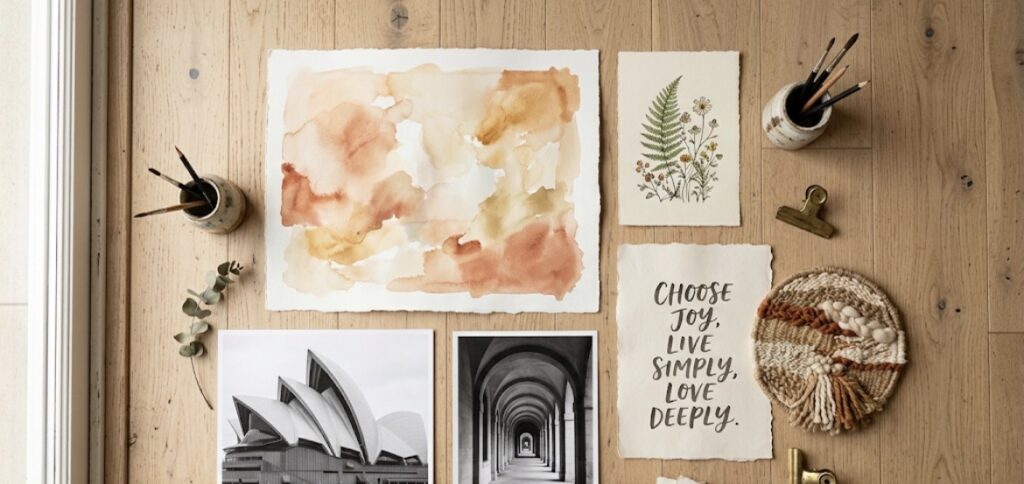
Your art is the heart of the gallery wall, and choosing it thoughtfully is what separates a gallery wall that feels meaningful from one that just fills space. The good news is that you do not need expensive original artwork to make this work. Some of the most beautiful gallery walls are made almost entirely of affordable prints, personal photographs, and found objects — the magic is in how they are curated and arranged, not in how much they cost.
Start by thinking about the size range you want to work with. A gallery wall with all the same-sized pieces can look elegant and structured, but it can also feel a little stiff. A mix of sizes — at least one large anchor piece, several medium pieces, and a few small pieces — creates visual rhythm and makes the eye move across the wall in an engaging way. As a general rule, you want your largest piece to be roughly one-third to one-half the total width of your arrangement. If you are planning a gallery wall that spans six feet wide, your anchor piece might be a 24×36 inch print. Everything else builds around it.
When you are choosing what to hang, think about creating contrast not just in size but in type. Pair a photograph with a drawing. Pair something text-based with something purely visual. Pair something very detailed and busy with something minimal and simple. This contrast keeps the eye engaged and prevents the wall from looking like a catalog page where everything matches too perfectly.
Personal photographs deserve a prominent place on any gallery wall. There is a tendency to feel like personal photos are “less designed” than art prints, but a well-chosen personal photograph — printed large, on quality paper, in a beautiful frame — can be the most powerful piece on the entire wall. Print your photos at higher resolution than you think you need, and use a quality print service rather than a home printer. The difference in quality is significant, and on a gallery wall where people will stand close and look carefully, that quality matters.
If you are building a gallery wall on a tight budget, digital art marketplaces are your best friend. Sites like Etsy, Society6, and Creative Market sell downloadable art files that you can purchase once and print yourself or through a local print shop. For the cost of a couple of cups of coffee, you can print a stunning 18×24 inch art print that looks completely original and intentional. Nobody needs to know it cost you four dollars — and frankly, nobody should care, because what matters is whether it looks beautiful, not what it cost.
Step 5: Plan Your Layout Before You Touch a Nail
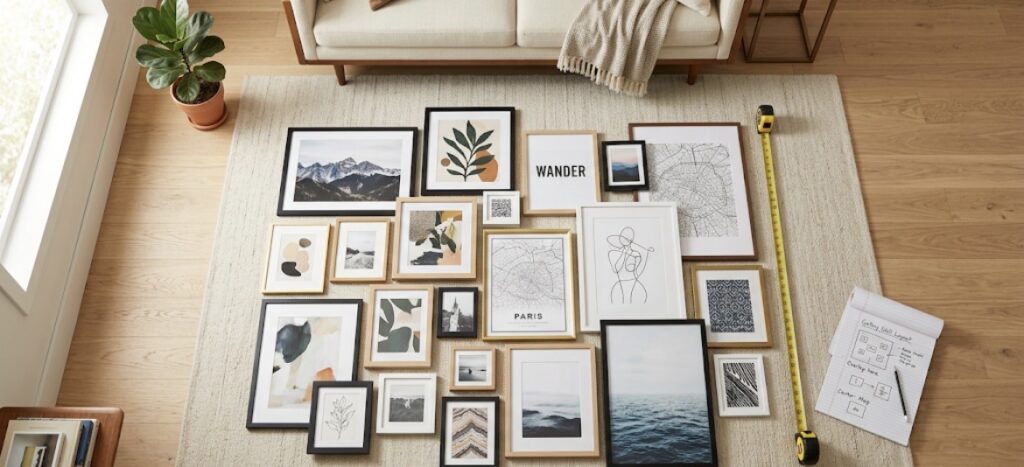
Here is the step that separates people who end up with a wall full of unnecessary nail holes from people who get it right on the first try. Before you hang a single thing, lay your entire arrangement out on the floor directly in front of the wall where it will be installed. This is not optional — it is the most important planning step in the entire process, and skipping it is the interior design equivalent of assembling furniture without reading the instructions. (We have all been there. We have all regretted it.)
Start by outlining the rough size of your intended gallery wall on the floor with painter’s tape, so you can see exactly how much space you are working with. Then start placing your frames and pieces within that taped-out space. Move things around freely — this is your chance to experiment without any commitment. Try placing the largest piece in the center, then off to the left, then off to the right. See how it changes the feel. Try a more symmetrical arrangement, then a more organic, asymmetrical one.
The spacing between pieces matters enormously. Two to three inches between frames is the sweet spot for most gallery walls — close enough that the pieces relate to each other and read as a group, far enough that each piece has room to breathe and be seen individually. If pieces are too far apart — more than five or six inches — the arrangement starts to feel scattered rather than cohesive, like your frames are avoiding each other at a party. If they are too close — less than an inch — the wall starts to feel cramped and busy.
Pay attention to how the “visual weight” is distributed across your arrangement. Visual weight is simply how heavy or light a piece looks — a large, dark, heavily detailed piece has more visual weight than a small, light, simple piece. You want the visual weight to be roughly balanced across your arrangement, not all clustered on one side. This does not mean you need perfect symmetry — it means that if you have a large dark anchor piece on the left, you might balance it with two or three medium pieces on the right, or a round mirror that draws the eye.
Once you have an arrangement you love on the floor, photograph it from directly above with your phone. This photo becomes your blueprint. You will refer to it constantly as you hang the actual pieces.
Step 6: Transfer Your Layout to the Wall
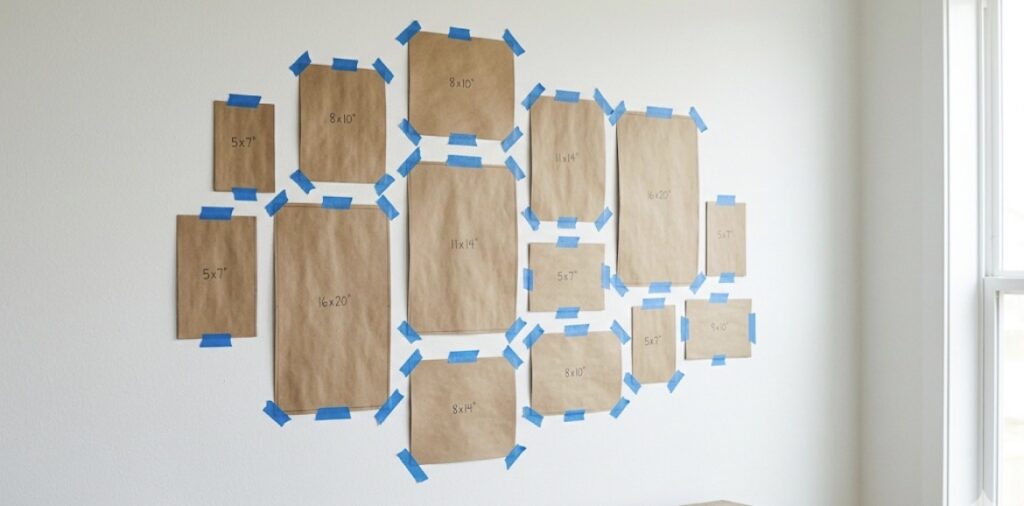
Now comes the part that requires just a little bit of patience and precision — transferring your floor layout to the actual wall without losing the arrangement you carefully planned. The best method for this is the paper template technique, and once you try it, you will never go back to the “measure and hope” approach.
For each frame you plan to hang, cut a piece of kraft paper or newspaper to the exact size of that frame. Label each template with the name or description of the piece it represents (you can write directly on the paper). Then, on each template, mark exactly where the nail or hook will go — the easiest way to do this is to flip the frame over, hold the template up to the back of the frame, and mark where the hanging hardware sits. Now you have a paper template with a nail marking that exactly mirrors your frame.
Tape all your templates to the wall using painter’s tape, arranging them in the exact layout you planned on the floor. Use a level to make sure horizontal lines are actually horizontal, and step back frequently to check that the overall arrangement still looks the way you want it to. This is still a zero-commitment phase — move templates around freely until you are happy.
Once every template is exactly where you want it, hammer your nails right through the marked spots on the paper. Then gently tear away the paper templates (the painter’s tape will come off cleanly without damaging the wall), and you are left with nails in exactly the right positions. Hang your frames, step back, and resist the urge to immediately start adjusting — give yourself a full minute to look at it fresh before making any tweaks.
A note on wall anchors: if your gallery wall includes anything particularly heavy — a large mirror, a heavy frame, a ceramic wall piece — make sure you are hanging it from a wall stud or using an appropriate drywall anchor rated for the weight. A gallery wall that falls off the wall at 2am is nobody’s idea of good interior design. Use a stud finder for heavy pieces, and invest in quality hanging hardware. The frames may look beautiful, but they need to stay on the wall to do their job.
Step 7: Add Lighting to Make It Glow
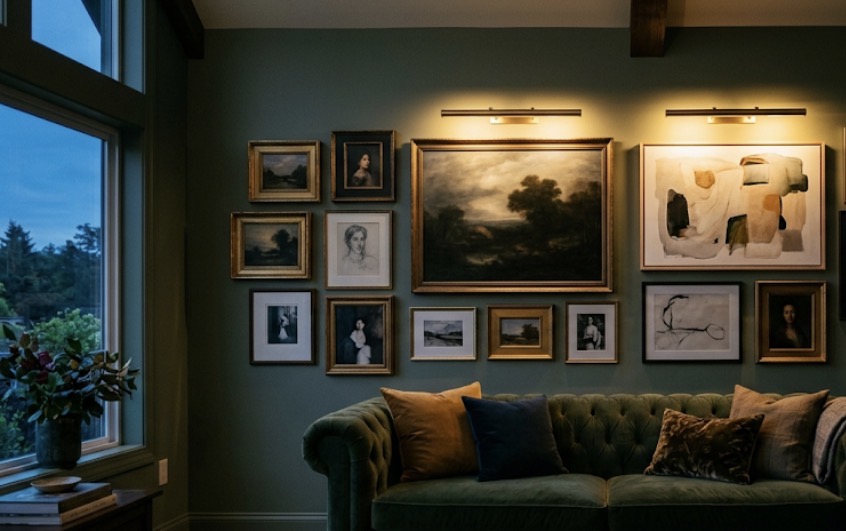
Most people hang their gallery wall and call it done. The ones with truly stunning gallery walls do one more thing: they light it. Proper lighting is what elevates a gallery wall from “nice wall display” to “this looks like a real design feature,” and it is one of the most underrated elements of interior design in general.
The simplest option is to add one or two picture lights — small, slim light fixtures that mount directly above a frame and shine light down onto the artwork below. These are battery-operated or hardwired, come in styles ranging from sleek brass to matte black, and they are specifically designed to illuminate artwork without glare. A single picture light above your largest anchor piece can completely transform the look of the entire gallery wall, even if the other pieces are not individually lit.
Track lighting or adjustable ceiling spotlights pointed at the gallery wall are another elegant solution, particularly in rooms with higher ceilings. This gives you the most control — you can angle each light to illuminate exactly the part of the wall you want to highlight. It requires a bit more planning and potentially an electrician if you are adding new lighting, but the result is genuinely spectacular.
Even without installing any new fixtures, you can improve how your gallery wall looks by simply repositioning an existing floor lamp or table lamp so that it throws warm light upward toward the wall. Warm-toned bulbs (2700K to 3000K) are much kinder to artwork than cool white bulbs — they bring out the warmth in wood frames, make colors in prints appear richer, and give the entire arrangement a cozy, curated glow.
Step 8: Style the Space Around the Gallery Wall
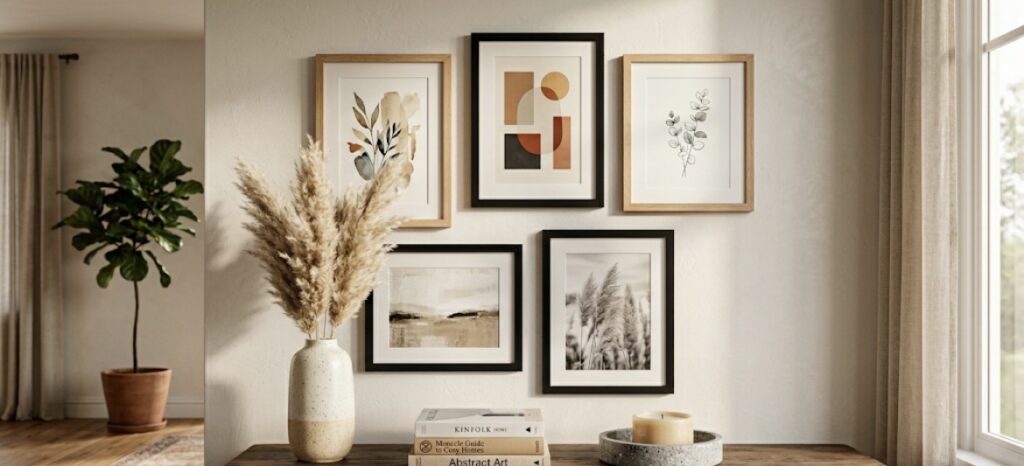
A gallery wall does not exist in isolation — it is part of a room, and the way you style the furniture and surfaces around it has a huge impact on how the wall reads. Think of the space below and around your gallery wall as the supporting cast. The gallery wall is the star of the show, but even the best lead actor needs a good ensemble.
If your gallery wall is above a sofa, the sofa itself is your most important supporting piece. Make sure the sofa is styled with cushions that pick up colors from the artwork on the wall. This creates a visual dialogue between the furniture and the art — the room starts to feel like it was designed as a whole rather than assembled from unrelated pieces. You do not need to match exactly; pulling one or two colors from the artwork into your cushion selection is enough.
If your gallery wall is above a console table, a sideboard, or a credenza, use that surface to create a small styled vignette that complements the art above. A tall vase with stems, a stack of books, a small sculptural object, and a candle are the classic building blocks of a console table vignette, and they work because they add varying heights and textures that visually connect the flat wall art to the three-dimensional furniture below. Avoid cluttering the surface — the goal is to enhance the gallery wall, not compete with it.
Also think about the rug. If your gallery wall is in a living room or bedroom, the rug on the floor ties the whole composition together. A rug that picks up even one color from your gallery wall creates a sense of the room being decorated top to bottom with intention, which is exactly what you want people to feel when they walk in.
Step 9: Evolve Over Time
One of the best things about a gallery wall — as opposed to, say, built-in shelving or wallpaper — is that it is wonderfully easy to change. You can add pieces, swap things out, try new arrangements, and keep the wall feeling fresh as your taste evolves and your collection grows. A gallery wall that never changes is a gallery wall that eventually stops being noticed, because your eye adjusts to it and it becomes invisible background rather than an active design element.
Plan from the beginning to treat your gallery wall as a living thing. When you travel, look for small affordable art or prints that you could add to the wall. When your taste evolves — and it will — give yourself permission to retire pieces that no longer feel right and bring in new ones that do. The occasional swap of even one or two pieces can completely refresh a gallery wall without requiring a full redo.
As you add pieces over time, keep your original unifying elements in mind — the color palette, the frame finish, the general style. These are the threads that hold the collection together, and as long as new additions respect those threads, you can keep growing the collection indefinitely. The most beautiful gallery walls are the ones that clearly developed over years — a mix of things from different eras of someone’s life and taste, held together by a consistent visual sensibility.
Final Thoughts
After all these steps, all this planning, all this deliberate choosing and arranging — at the end of the day, the gallery wall that truly works is the one that makes you feel something when you look at it. That is the only standard that matters.
Design rules are tools, not laws. They exist to help you, not to restrict you. If you have followed every step in this guide but something still feels slightly off, trust that feeling and move things around until it feels right. Your instincts about your own space are valuable and worth listening to. The spacing between frames is “supposed to be” two to three inches, but if two of your pieces look incredible right next to each other with barely any gap at all, leave them that way.
A gallery wall is one of the most personal things you can do in a home. It is, in the most literal sense, a curated display of the things that matter to you — the images and objects that you have chosen to surround yourself with. No design guide can tell you what those things should be. What this guide can tell you is how to display them in a way that does justice to why you chose them in the first place.
Go make your wall something worth staring at.