
Most people have a dining table. Very few people have a styled dining table. The gap between those two things is not money, square footage, or some interior design degree hanging on your wall. The gap is knowing how to look at a table and understand what it’s missing — and more importantly, what it already has going for it.
The dining table is one of the most used pieces of furniture in any home. Breakfasts happen there. Kids do homework there. Friends gather around it with wine and way too much cheese on a Saturday night. It gets crumbs, spills, candle wax, mail, and occasionally a cat that was absolutely not invited to sit there. And yet, when you look at beautifully styled dining rooms in magazines or on social media, there’s this calm, composed quality to the table that makes you think — how?
The answer is layering. It’s proportion. It’s knowing that a styled table isn’t about putting more things on it. It’s about putting the right things on it, in the right amount, in a way that feels both beautiful and believable. Because here’s the thing nobody tells you: a table that looks too perfect actually feels cold. The goal isn’t a museum display case. The goal is a table that makes people want to pull up a chair, pour something cold, and stay a while.
This guide is going to walk you through the entire process — from the very first decision you need to make (and it’s not what you think) to the small finishing details that take a dining table from “fine” to “wait, did you just redecorate?” We’ll cover everything: table runners, centerpieces, candles, placemats, textures, heights, proportions, colors, and the art of knowing when to stop. We’ll also talk about how to style a dining table that you actually use every day, not just one you’re afraid to eat at.
No design degree required. No Pinterest rabbit hole necessary. Just clear, practical guidance that will change how you see your dining table — and your whole dining room — permanently.
Step One: Understand Your Table Before You Style It
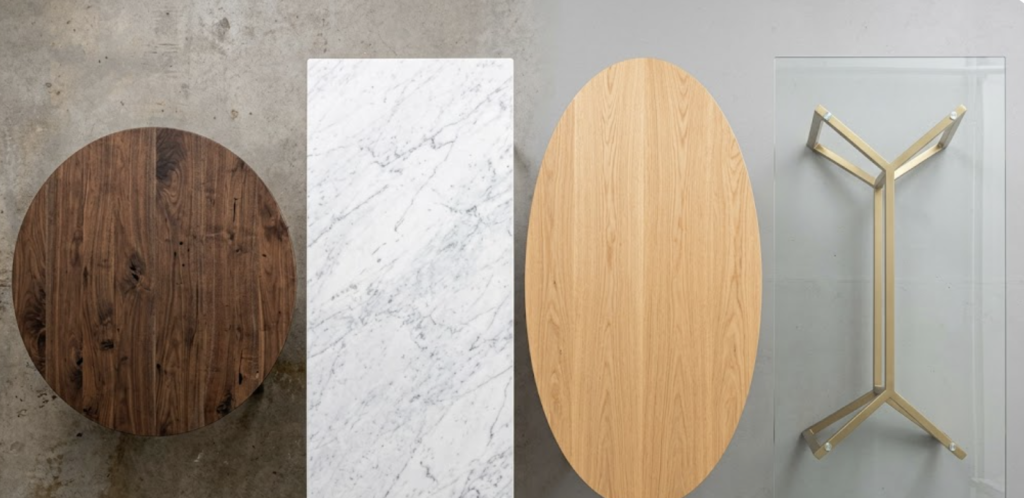
Before you buy a single thing, before you pin a single image, sit down with your dining table — literally. Pull out a chair and just look at it. What shape is it? What material? How big is it? What’s the room around it doing? These questions matter far more than the trend you saw online this morning, because a styling approach that looks incredible on a round marble table in a minimalist all-white apartment is going to look completely off on a rectangular dark walnut table in a warm, rustic dining room. Interior design is not one-size-fits-all. It’s one-size-fits-this-specific-table-in-this-specific-room.
Round tables have a naturally social, intimate quality. Everything placed on them needs to have a central focus — usually one strong centerpiece in the middle. Because there’s no head of the table, round tables feel more democratic, which means the styling should feel balanced from every angle. You can’t have a centerpiece that looks great from one side and chaotic from the other, because someone will always be sitting on that “other side.”
Rectangular tables are the most common and also the most versatile. They give you a clear visual axis to work with — a long, horizontal line that you can either follow (with a long runner and a series of objects along the center) or deliberately break (by clustering things asymmetrically to create interest). The length of a rectangular table can work for you or against you depending on whether you’re filling it well or just spreading things thinly across it.
Oval tables are the diplomats of the furniture world — they have the length of a rectangle and the social softness of a round table. They’re also one of the trickier tables to style because the tapered ends mean your centerpiece needs to feel like it belongs in the middle of an organic shape, not just sitting on a plank.
Glass tables need a different approach entirely. Because you can see through the tabletop, what’s underneath matters — the chairs, the legs, the floor. A glass table with beautiful sculptural chairs beneath it is its own piece of art. Over-styling a glass table makes it feel heavy and cluttered very quickly, so restraint is your best friend here. One strong centerpiece, minimal layers, and a focus on the quality of individual objects over quantity.
Wood tables — whether light oak, dark walnut, or anything in between — are warm and forgiving. They add texture and character on their own, which means you don’t need to work as hard to make them feel cozy. You do, however, need to be thoughtful about contrast. A dark wood table with all dark accessories becomes a moody, cave-like situation. A light wood table with all pale, neutral accessories can feel washed out and boring. Think about what your table’s material is already bringing to the room, and then decide what to add that creates a conversation with it, not an echo.
Once you’ve assessed the table itself, look at the room around it. What’s on the walls? What’s the floor doing? Where does the light come from and at what time of day? A dining table doesn’t exist in isolation — it’s part of a room, and the styling needs to make sense within that room, not fight against it.
Step Two: Build Your Base (The Table Runner and What Goes Under Everything)
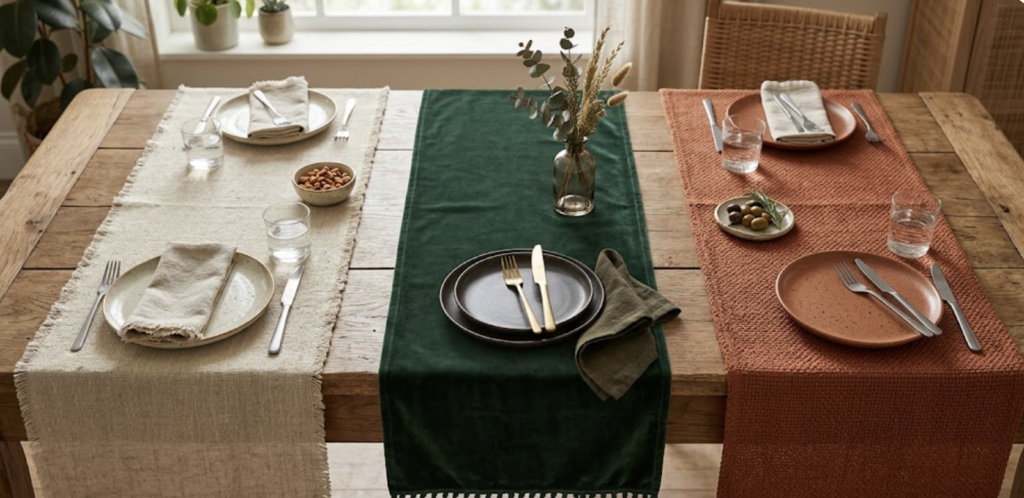
The table runner is the foundation of your dining table styling. It’s not decorative in the way a candle or a vase is decorative — it’s structural. It defines the visual center of the table, gives you a stage to place everything else on, and immediately makes the table feel considered and put-together, even before you add a single other object. A bare table with no runner can still look beautiful, but it requires significantly more skill to pull off because everything you place directly on it has to carry all the visual weight. A runner gives every subsequent object a home.
The first thing to get right with a table runner is the drop — how much of the runner hangs over each end of the table. The general rule is six to eight inches of drop on each side, but honestly, the visual effect matters more than the measurement. Too little drop and the runner looks like it shrank in the wash. Too much drop and it looks like a tablecloth that gave up halfway through. When in doubt, err slightly longer rather than shorter. A generous drop reads as intentional. A skimpy one just looks like you ran out of fabric.
In terms of material, linen is almost universally flattering on a dining table. It has a natural, easy texture that reads as relaxed but elevated — like someone who got dressed without trying too hard and still looks incredible. Linen also comes in a beautiful range of natural tones: oat, ivory, sand, warm white, soft grey. These neutral tones mean linen plays well with virtually every table material and almost every color palette. If you’re unsure where to start with a table runner, start with a natural linen in a neutral tone. You will almost never regret it.
Velvet runners are a different energy entirely. Deep jewel tones — emerald green, navy, burgundy, dark plum — in velvet bring instant richness and warmth to a dining table. They’re particularly effective in autumn and winter, and they pair beautifully with brass and gold hardware. The caveat is that velvet reads as more formal, so if your dining room is relaxed and casual, a velvet runner can feel a little overdressed, like showing up to a backyard barbecue in a tuxedo.
Woven cotton runners with texture or pattern bring warmth and personality. Whether it’s a subtle stripe, a check, a textural weave, or a geometric pattern, a woven runner adds visual interest at the base layer without requiring you to add a lot of pattern elsewhere. Just make sure the pattern in the runner doesn’t compete with patterns you already have in the room — curtains, rugs, cushions. One leading pattern at a time is generally the safest approach.
Step Three: The Most Talked-About Part of Any Dining Table
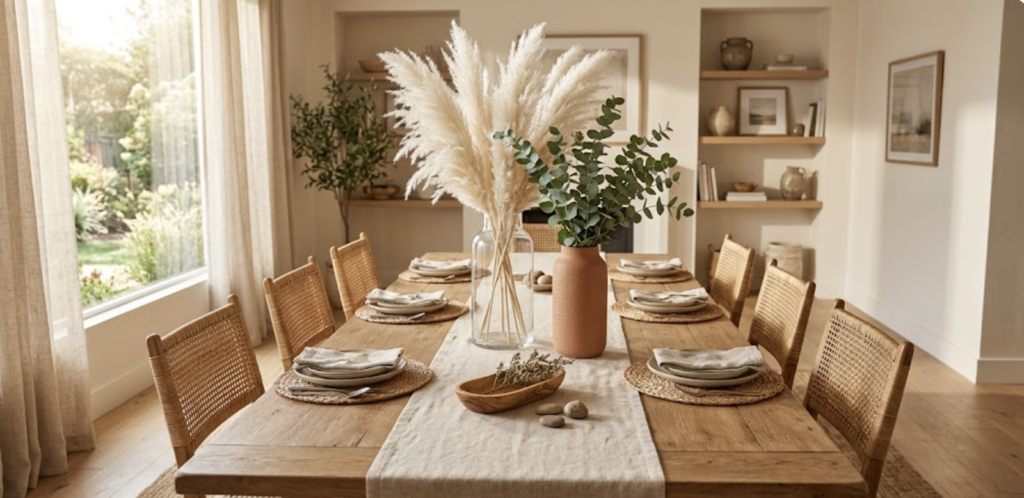
The most important principle for a dining table is varying height. A single flat, low object in the center of a table reads as accidental, not intentional. A collection of objects that are all the same height looks ordered but boring. What creates visual interest — what makes the eye travel, pause, and find something new to look at — is a range of heights grouped together. Think of it like a city skyline: there’s something tall, something medium, something low, and together they create a silhouette that’s interesting to look at.
In practice, this looks like: a tall slender vase or candlestick (around 18–24 inches), a medium-height ceramic or textured vessel (around 10–14 inches), and something low and wide — a squat bowl, a stack of books, a wooden tray with small objects on it (around 4–6 inches). These three heights, clustered together slightly off-center of the table’s length, create what designers call a “vignette” — a small, composed arrangement that tells a visual story.
The grouping should occupy roughly a third of the table’s length for a rectangle, or about a quarter of the diameter for a round table. Any more and it starts to feel like the table is being overtaken by decoration; any less and it looks lost. Think of the centerpiece as having a conversation with the rest of the table — it needs to be loud enough to be heard but not so loud it’s the only thing anyone can talk about.
Flowers and plants are the most intuitive choice for dining table centerpieces, and they’re wonderful — but they need maintenance, and fresh flowers on a dining table die on their own schedule, which is never convenient. If you love the look of fresh flowers, go for it enthusiastically. Just keep the arrangement below eye level when seated — the golden rule of dining table flowers. A centerpiece so tall you have to tilt sideways to see the person across from you is a beautiful centerpiece that nobody will thank you for. Ideally, everything on your dining table should be under 12–14 inches when you plan to have people eating there, so conversations can happen over the top of the arrangement, not around it.
Dried botanicals — pampas grass, dried cotton stems, bunny tail grasses, dried eucalyptus, preserved citrus slices — are having a major moment in interior design, and for good reason. They last indefinitely, they require zero water, and they have a soft, natural texture that photographs beautifully in any kind of light. They work in almost any interior style from modern farmhouse to Japandi to maximalist boho. The one thing to keep in mind with dried botanicals is that they can shed. Pampas grass, particularly, has a tendency to leave a little fluffy trail across your table if disturbed, which is charming until someone sits down to dinner and finds a small cloud of fluff in their soup.
Books on a dining table are one of the most underused styling tools in home décor. A stack of two or three coffee table books — ideally with beautiful spines or covers, and ideally related to themes the people in your household actually care about — adds height, visual texture, and personality to a centerpiece arrangement. They tell a story about who lives in this home. Stack them with the largest at the bottom and the smallest at the top. You can place a small object on top of the stack — a smooth stone, a small ceramic sculpture, a decorative bowl — to turn the stack into a little moment of its own.
Step Four: Texture, Material, and the Art of Making Things Feel Layered
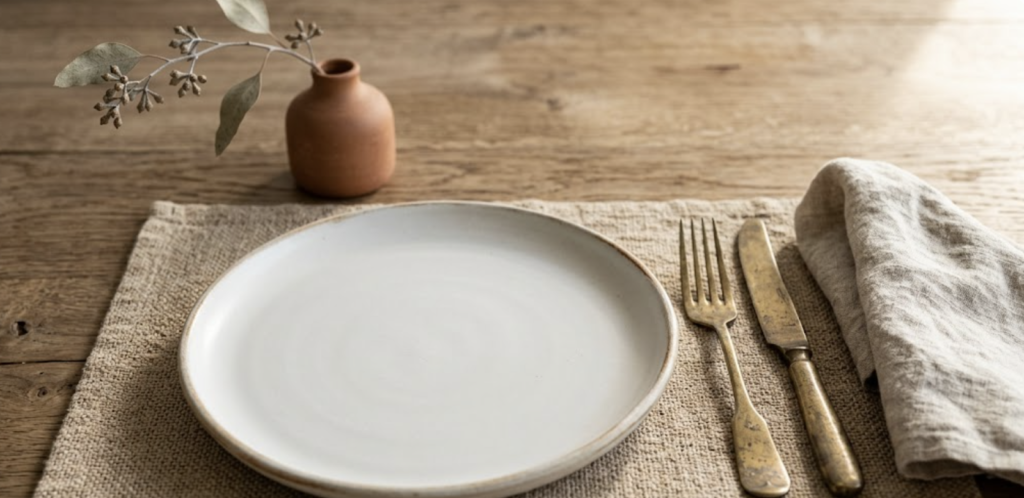
Here is one of the most important things about beautiful interior design that nobody teaches you until you’ve already spent too much money on things that don’t feel right: texture matters as much as color. In fact, when you’re working within a neutral color palette — the creams, oats, warm whites, and muted tones that characterize so much of modern interior design — texture is color. It’s the thing that stops a neutral room from looking like a hospital waiting area and makes it feel warm, rich, and considered.
On a dining table, layering texture means making sure that the objects on your table feel different from each other when you look at them — and ideally when you touch them. A smooth ceramic vase next to a rough woven placemat next to a polished brass candlestick holder next to a softly crumpled linen napkin — each of those surfaces is doing something visually different. Your eye moves between them, and the contrast between the textures creates a sense of richness and depth that you simply cannot achieve by using five objects that are all the same material or finish.
In practical terms, here’s how to think about texture on your dining table. You want something smooth (a ceramic, a glass, a polished metal object), something rough or woven (linen, rattan, a natural fiber placemat, a jute-wrapped vase), something soft (a linen napkin, a velvet or cotton runner), and something organic (a wooden object, a dried botanical, a stone piece). You don’t need all four in every single arrangement, but the more texture diversity you have, the richer and more interesting the table will look.
Placemats are a key textural element that most people either skip entirely or use without much thought. Placemats serve double duty: they define each person’s seat at the table (giving the table structure and a sense of “this is where you sit”), and they add a layer of material texture to the base of the table. Natural fiber placemats — woven seagrass, jute, rattan — are incredibly versatile and work in almost every style of home. They add an earthy, organic warmth that offsets harder, cooler materials like ceramic, metal, and glass. Linen placemats are softer and more formal-casual than natural fiber, and they come in a wider range of colors. For a more modern or minimalist table, a simple rectangular placemat in a solid color or subtle texture keeps things clean and well-defined without adding visual noise.
Napkins are one of the most overlooked styling elements on a dining table, which is a shame because they’re cheap, they’re easy to switch out, and they have a significant visual impact when done well. A linen napkin, loosely folded or gently rolled and placed inside a simple napkin ring, adds texture, personality, and a sense of care to a table setting. Matching your napkins to your runner creates cohesion. Contrasting your napkins with your runner — a white linen napkin on a deep green runner, for example — creates visual interest and a sense of intention. You do not need to fold napkins into complicated origami shapes. A simple loose fold, a gentle gather tucked into a ring, or a knot — all of these look better than a stiff geometric fold that makes your table feel like a chain restaurant on Valentine’s Day.
Step Five: Color – How to Build a Palette That Actually Works
Color on a dining table works differently than color on a wall or a sofa, because the table is a smaller, more concentrated canvas. Too many colors in a small space creates chaos. Too few creates boredom. The sweet spot is almost always a palette of two to three main tones — usually a neutral or near-neutral base, one accent color, and one additional tone that bridges the two.
The most reliable approach for beginners — and honestly, for anyone — is to start with your room’s existing color story and pull from it. If your dining room walls are a warm white and your chairs are natural wood, your table styling palette is already partially decided for you: warm whites, natural wood tones, and oat/ivory textiles are going to feel cohesive because they echo what’s already in the room. You then get to add one pop of something — a terracotta vase, a sage green runner, a deep navy napkin — that adds personality without overriding the room’s existing tone.
Warm neutrals — cream, oat, sand, warm white, warm wood tones, and accents of brass, amber, or terracotta — are the most popular dining table palette for a reason: they’re flattering, they’re versatile, and they make food look beautiful. When you’re eating, you want the colors around you to feel warm and appetite-friendly. Cool, stark colors can actually make food look less appealing, which is one reason why high-end restaurants almost always design their dining spaces in warm, amber tones.
Cool neutrals — slate grey, crisp white, stone, muted sage or eucalyptus green, brushed silver, and matte black — create a more modern, graphic quality. This palette is striking and sophisticated but requires more care to feel warm. The trick is to add organic texture (linen, wood, a natural botanical) to soften the coolness. Otherwise it starts to feel like you’re eating dinner in a concept kitchen showroom.
Rich, jewel-toned palettes — deep forest green, navy blue, burgundy, dark plum, mustard yellow — are bold and absolutely beautiful when done with restraint. They work best as accents within a largely neutral setting. An all-jewel-tone dining table sounds incredible in theory but can feel overwhelming in person, especially in a smaller room. Use these colors in your runner, napkins, or a single standout vase, and let the neutrals carry everything else.
One important note about metallics: they are neutrals. Brass, gold, copper, silver, and matte black are all effectively neutral tones that can be treated as such in a color palette. The warmth of the metallic matters — brass and copper are warm metals that work beautifully in warm-toned palettes; silver and chrome are cool metals that belong in cool or modern palettes. Mixing metals (a brass candlestick with a silver napkin ring) is fine and can look intentional when done deliberately, but mixing metals randomly just looks like things accumulated on the table without a plan.
Step Six: Height, Scale, and the Spatial Rules Nobody Taught You
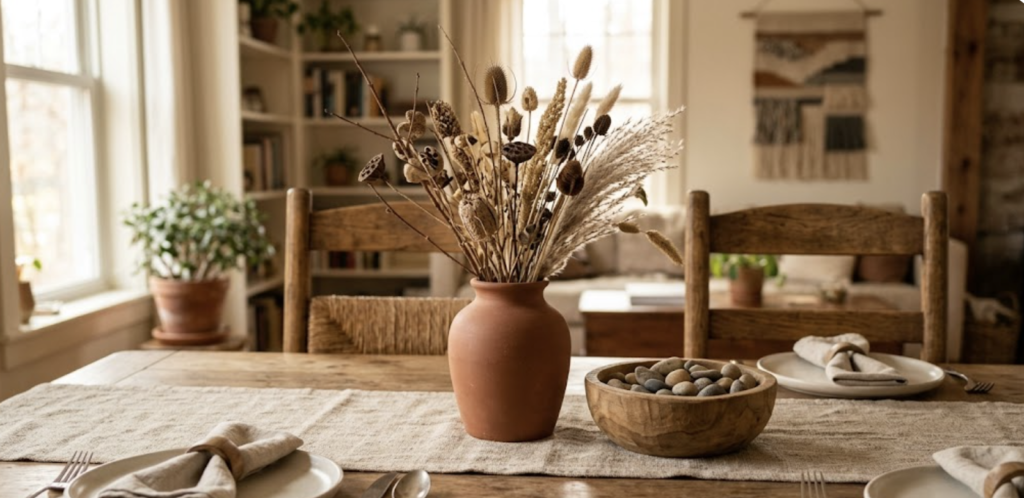
Scale is the thing that separates a dining table that was styled by someone who reads design books from a dining table that was styled by someone who went to the store and bought things that looked nice on the shelf. The issue is almost never the individual objects — it’s the relationship between them, and their relationship to the table itself and the room around it.
The most common scaling mistake on a dining table is going too small. People choose delicate, petite objects — a tiny bud vase, a small tea light, a dainty little bowl — and arrange them on a large dining table, and then stand back and wonder why it looks empty even though there are technically objects on it. Small objects on a large table look like decorations that weren’t quite sure they were invited. You need the scale of your centerpiece to feel proportionate to the table — and that generally means going bigger than your instincts tell you.
If you have a large rectangular table (eight to ten seats), your centerpiece arrangement should span at least three to four feet of the center. This might mean a large ceramic vase, a longer arrangement of multiple objects, a wide low bowl flanked by candlesticks, or a grouping that includes multiple elements of varying sizes. If you have a smaller table (four to six seats), your centerpiece can be more restrained — but it should still have presence.
Another critical scale principle is this: odd numbers are more visually interesting than even numbers. Three objects in a group look more dynamic and natural than two objects in a group. Five objects look more interesting than four. This isn’t a rule you have to follow to the letter, but it’s a useful guide when you’re trying to figure out why an arrangement isn’t landing. Two symmetrical candlesticks flanking a central vase is nice but a little stiff. Three candlesticks of different heights, loosely grouped, are instantly more alive.
The height rule we’ve already touched on — but it bears expanding. The maximum height for any object on your dining table that will be in use during meals is approximately 12–14 inches. This is the height at which a centerpiece starts to obstruct seated conversation. Below 12 inches, people can talk over and around it freely. Above 14 inches, you start turning your dinner guests into participants in an obstacle-course conversation. For decorative purposes when the table isn’t being used for dining, there’s no height restriction — go as tall as you like. But for an everyday, functional styled table, keep the central arrangement low enough that nobody has to play peek-a-boo with your tall vase.
Step Seven: The Everyday Table vs. The Special Occasion Table
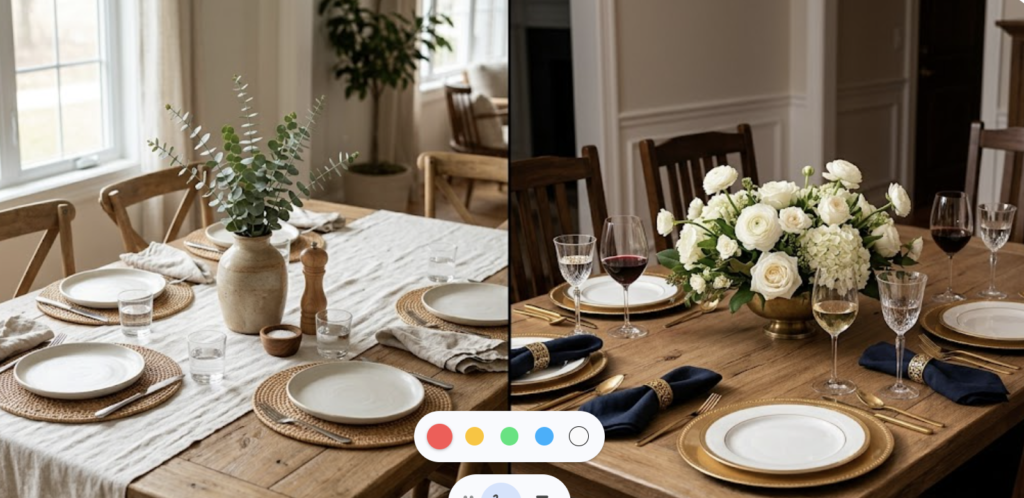
One of the most practical questions about dining table styling is this: how do you have a table that looks beautiful every day and adapts when you have guests coming over? The answer is to think about your table styling in two modes — the everyday base, and the special occasion layer.
The everyday base is what you maintain all the time. It’s the runner, the centerpiece vignette, and any permanent-ish objects like candles in holders, a ceramic vase, or a decorative bowl. The everyday base should be styled but not precious — it’s going to be pushed aside for homework, moved for big family meals, occasionally used as a landing strip for grocery bags. It should be easy to tidy back into place. It should be things you actually like looking at every single day. It should not require weekly fresh flowers or constant maintenance. Think of it as the “resting face” of your dining table.
The special occasion layer is what you add when you’re hosting. This is where you bring in the good napkins, the matching placemats, the extra candles, the flowers from the weekend market, the wine glasses, the charger plates if you have them. The special occasion layer builds on top of the everyday base — it doesn’t replace it. Your everyday centerpiece moves to the side or is supplemented with fresh flowers for the evening. Your casual napkins are swapped for the nicer ones. The candles you always have on the table get lit.
This two-mode thinking is incredibly practical because it means you only need to maintain one level of styling on a daily basis. The special occasion upgrade is a temporary enhancement, not a full rebuild. It also means your dining table always looks intentional — on a random Tuesday morning, there’s still something beautiful there. On Saturday night when friends come over, it genuinely looks like you tried.
For the everyday base, here is a reliable starting formula: one runner, one vignette of two to three objects (a vase, a candle or two, and one decorative object), and two to four placemats if you use them daily. That’s it. That’s all it takes to have a styled dining table that looks great every single day without being a burden to maintain.
Step Eight: Style Your Dining Table for the Season Without Buying New Things
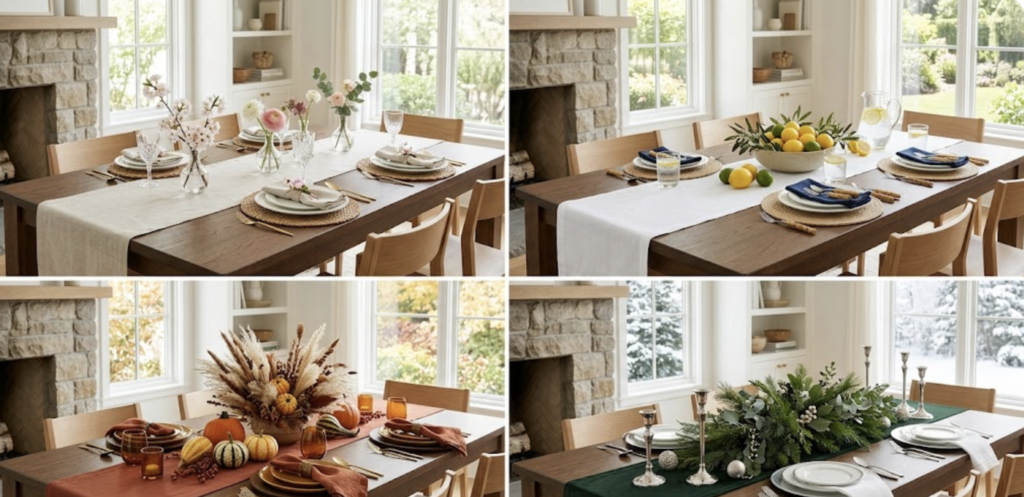
One of the most beautiful and most affordable things you can do with a dining table is style it seasonally. Not in a huge, expensive way — not buying entirely new décor every three months — but in a subtle, intentional way that reflects what’s happening outside the window. Seasonal styling keeps your home feeling alive and present rather than like a static photo from a catalog taken in 2022.
The key is identifying the two or three seasonal swaps that have the most visual impact. These are the same objects, just cycled through. Your runner might be linen in spring and summer (light, breathable, fresh), and a deep velvet in autumn and winter (rich, warm, cozy). Your vase might hold dried grasses all year, but in spring you add a small bud vase of whatever’s blooming in the garden or the corner store. In autumn, a bowl of seasonal fruit — deep red apples, small gourds, persimmons — is a centerpiece that cost you twelve dollars and looks better than most things you could buy at a home store.
Candle colors can shift seasonally with very little effort. White and ivory candles are fresh and clean for spring and summer. Deep amber, dark green, and burgundy candles add richness in autumn and winter. You’re not buying new candle holders — just new candles. Same hardware, different feeling.
Texture also shifts with the seasons in a way that feels instinctive. In spring and summer, lighter, breezier textures — thin cotton, light linen, woven seagrass — feel right. In autumn and winter, heavier textures — thick woven cotton, velvet, warm wool-look textiles — feel comfortable and appropriate. These swaps don’t require buying an entire new set of linens; often, just swapping the runner and the napkins is enough to shift the entire feel of the table.
The other magic of seasonal styling is that it gives you a reason to look at your table with fresh eyes a few times a year. Instead of walking past it without noticing it for six months, you’re regularly re-engaging with it, editing it, and keeping it feeling current. That act of regular engagement — even small adjustments — is what keeps a home feeling alive and loved rather than set-and-forgotten.
Step Nine: Common Mistakes
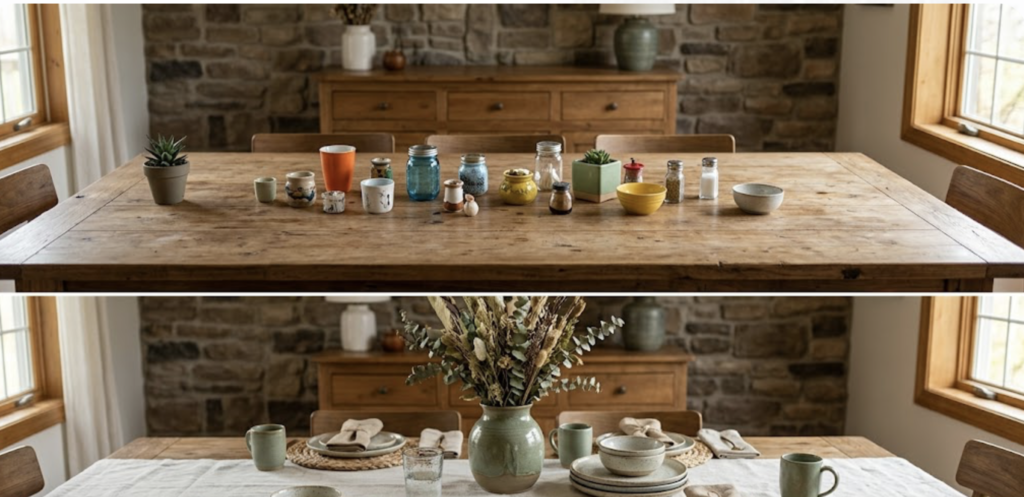
Let’s talk about the styling mistakes that happen most often, because recognizing them is half the battle.
The too-small centerpiece. This is the number one mistake. People choose objects at the store that look substantial in isolation, bring them home, put them on the table, and immediately they look tiny and lost. Always size up when buying for a dining table. If you’re standing in the store wondering if it’s too big, it’s probably just right.
Too many small, scattered objects. A table covered in many small objects — a little candle here, a small vase there, a decorative bowl somewhere else — with no central grouping looks disorganized rather than styled. Objects need to be grouped to look intentional. Three small objects in a tight cluster read as a composed vignette. Three small objects spread across a table read as things that were put down and never picked up again.
All one height. We’ve mentioned this, but it bears repeating because it’s so easy to do accidentally. If everything on your table is roughly the same height, the arrangement looks flat and static. Vary the heights — something tall, something medium, something low.
Ignoring the room. Your table doesn’t exist in a vacuum. If your dining room has warm wood floors, cream walls, and natural fiber textures throughout, a table styled in cool grey and chrome is going to look like it was teleported in from a different apartment. Let the room inform the table.
Overthinking it. Interior design is not surgery. Nothing you put on your dining table is permanent. If you try something and it doesn’t look right, you move it. If you buy something and it doesn’t work on the table, it can go somewhere else in the house, or you can return it. The stakes are genuinely low, and the process of experimenting and adjusting is how you develop an eye for what works. Nobody gets it perfect the first time. The best-styled homes in the world belong to people who tried things, noticed what was off, adjusted, tried again, and kept going until it felt right. That process is not interior design failing — it’s interior design working.
Buying everything new at once. The most beautiful, most personal home interiors are rarely assembled all at once. They’re built over time, with a mix of new purchases, things collected on trips, objects inherited or gifted, pieces found in second-hand shops. A dining table that has one thing with a story — a small ceramic bowl brought back from a holiday, a candlestick holder from a grandmother’s kitchen — has more character and warmth than a table that was assembled from a single online shopping cart. Start with one or two key pieces, live with them, and add slowly.
Step Ten: Putting It All Together (Your Complete Styled Dining Table Formula)
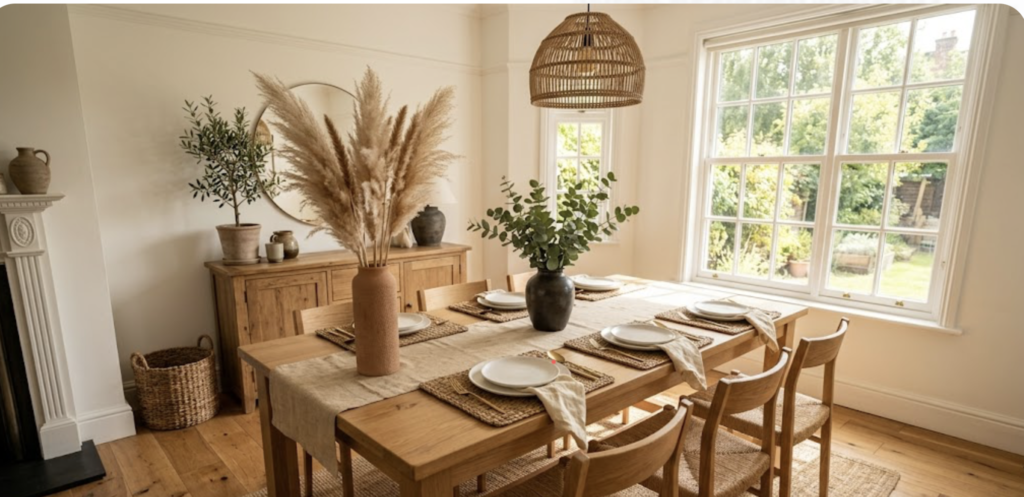
Here is everything distilled into a clear, repeatable formula that you can apply to any dining table, in any home, at any budget.
The Foundation: Choose a runner in a material and tone that suits your room and table. Default to natural linen if you’re unsure. Make sure the drop is six to eight inches on each end.
The Centerpiece: Group two to three objects of varying heights in the center-to-slightly-off-center of your runner. Include something tall (a vase or candlestick), something medium (a ceramic vessel, a stack of books), and something low (a bowl, a tray, a small sculpture). Keep the arrangement under 12–14 inches if the table is used daily for eating.
The Candles: Always include candles. At least two. In holders that suit your material palette. Real candles are worth it for the quality of light they produce.
The Texture Layer: Make sure your arrangement includes at least three different surface textures — something smooth, something rough or woven, and something organic or natural.
The Color Edit: Stick to two to three tones. Let the table material and room inform your palette. Add one accent color through textiles or a single standout object.
The Place Setting (for everyday): Two to four placemats, set loosely. A napkin (folded simply, placed on the placemat or beside a plate). Optional: a small bud vase at each place setting for special occasions.
The Scale Check: Step back after styling and look at the table from the doorway. Does the centerpiece feel proportionate to the size of the table? Does the overall arrangement have presence — or does it look a little shy? If it looks shy, size something up or add one more object to the grouping.
The Final Edit: Remove one thing. This is the secret step. Whatever you added last — the thing you added because you thought it needed “just one more element” — take it off. Nine times out of ten, the table looks better without it. Styling is as much about restraint as it is about addition.
Final Thoughts: Your Dining Table Is Not a Still Life Painting
The best dining tables are the ones that look beautiful and get used. A table that’s styled so perfectly and preciously that nobody dares put a coffee cup on it has failed at the actual job of a dining table, which is to be the center of home life — the place where people eat, talk, laugh, and linger.
Style your dining table in a way that makes it feel like a place you want to be. Make it warm. Make it welcoming. Make it reflect who you are and what you love. Let it evolve with the seasons, with what you find and collect, with your changing tastes. Let it be a little imperfect on a Tuesday morning. Let it be genuinely beautiful on a Friday night.
The dining table is where people gather. Make it worth gathering around.