
A Complete Step-by-Step Guide to Building a Warm, Calm, and Beautiful Living Space — No Interior Design Degree Required
There is something deeply about walking into a room that feels like a warm hug. You know the kind — where the light is soft, the fabrics are touchable, and everything looks like it belongs together without trying too hard. That is exactly what a cozy neutral living room feels like. And the good news? You do not need to hire a fancy designer, spend a fortune, or own a magic eye for decorating to get there. You just need a plan, a little patience, and perhaps a very strong cup of tea.
This guide is going to walk you through every single step of building a cozy neutral living room from the ground up. We are talking about choosing the right colors, layering textures, picking furniture that makes you want to sink in, and adding all the little details that make a room feel truly lived-in and loved. Whether you are starting with a completely empty room or trying to transform a space that currently looks like a furniture catalogue with no personality, this post has you covered. Think of this as the interior design equivalent of a recipe — follow the steps in order, taste as you go, and adjust to your own preferences. Unlike an actual recipe, there is no risk of burning anything.
Neutral does not mean boring. Let us get that out of the way right now. In fact, a well-done neutral room is one of the most sophisticated and emotionally satisfying interiors you can create. Neutrals are the kind of colors that let you breathe. They do not compete for attention. They let the textures, the shapes, the light, and the small personal touches do all the talking. Think of it this way: neutrals are the quiet, dependable friend who always makes you feel at ease. We all need more of those in our lives — and in our living rooms.
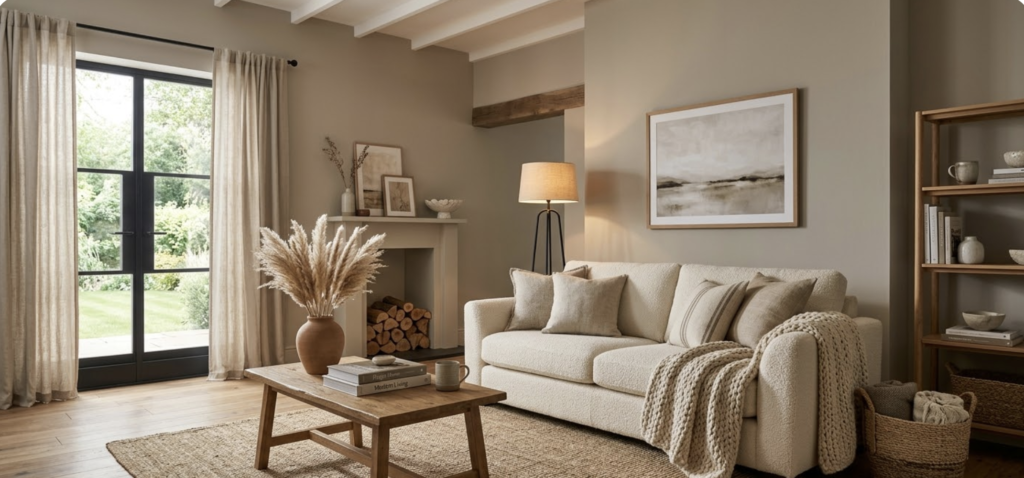
Step 1: Understanding What Cozy and Neutral Actually Mean
Before you buy a single throw pillow or open a single paint swatch, it helps to really understand what you are going for. The phrase ‘cozy neutral living room’ gets thrown around a lot on Pinterest and interior design blogs, but what does it actually mean when you are standing in your living room trying to make decisions? Let us break it down clearly so you have a picture in your mind that you can actually work toward.
A neutral color palette is built around shades that do not fight for attention. These are your whites, creams, off-whites, warm taupes, warm grays, beiges, soft tans, and greiges — that wonderful blended word that describes a color sitting between gray and beige, which happens to be one of the most useful and beautiful neutrals you can use in a living room. These colors do not jump out at you. They settle around you. The important thing to understand is that neutral does not mean just one color. A truly beautiful neutral room is actually a collection of many close, harmonious shades that layer on top of each other to create depth and warmth without any visual noise.
The cozy part comes from how you fill that neutral foundation. Coziness is created through softness — thick rugs underfoot, plush cushions you can sink into, chunky knit throws you can wrap around yourself, and velvet upholstery that catches the light beautifully. Coziness is created through warmth — warm-toned bulbs, candlelight, wood accents, rattan, and natural materials that look like they came from the earth rather than a factory. And most importantly, coziness is created through intention — the feeling that someone actually lives in this room, that they curl up here with a book, that they have real conversations on that sofa, that they chose every single item in this room because it meant something to them. Cozy is never sterile. Cozy is never cold. And cozy is absolutely never the result of leaving a room half-finished and hoping it sorts itself out.
Think of your cozy neutral living room as a layered cake. The walls and large furniture pieces are your base layers — they create the structure and the foundation. The rugs, cushions, throws, and curtains are your filling — they add warmth, softness, and texture. The plants, candles, books, trays, artwork, and objects are your icing — they add personality, depth, and the finishing quality that makes the whole thing feel complete. Every single layer matters, and that is exactly what we are going to go through together in this guide, from the very bottom layer to the final sprinkle on top.
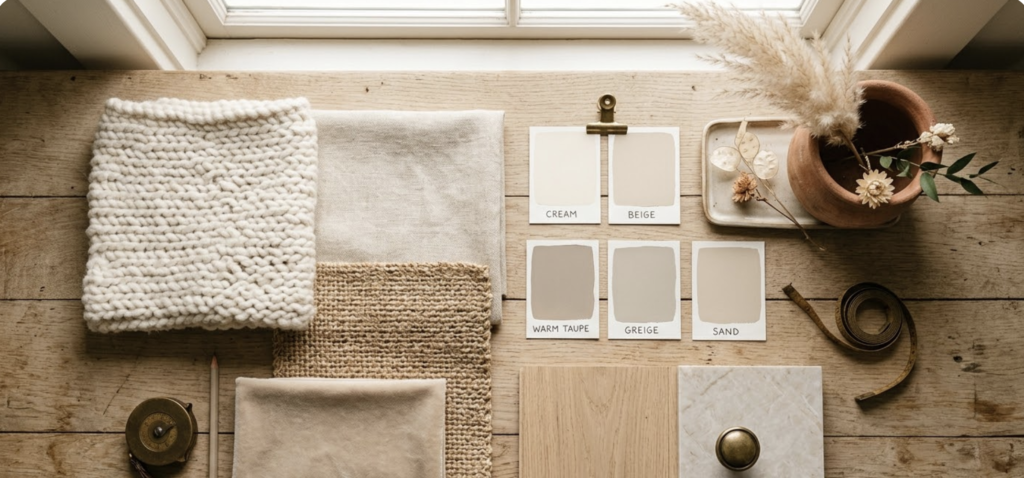
Step 2: Choosing Your Warm Neutral Color Palette
Here is where most people get stuck, and it is completely understandable because the choices feel overwhelming. There are genuinely about forty different shades of white alone, and picking the wrong one can make your room look dingy, cold, or like a hospital waiting room — none of which are the aesthetic we are going for. But once you understand a few simple principles about how neutral colors work together and against each other, choosing your palette becomes much more enjoyable and a lot less like defusing a bomb.
The single most important thing to understand about neutral colors is the concept of undertone. Every single neutral color has an undertone — a slight warmth or coolness hiding beneath the main color. A white wall can look pinkish, yellowish, greenish, or slightly blue depending on its undertone, and this matters enormously when you are building a palette. When you are creating a cozy living room, you generally want to lean toward warm undertones throughout. Warm neutrals — those with yellow, orange, or red undertones — feel naturally more inviting and comfortable. Cool neutrals — those with blue or green undertones — can look more crisp and modern, but they require much more layering and effort to make feel genuinely cozy.
A great starting palette for a cozy neutral living room might look something like this: a warm off-white for the walls rather than a stark bright white — think something with a slightly creamy or sandy quality. A warm medium beige or greige for the largest furniture pieces like your sofa, where you want something that reads as a neutral but has enough warmth to feel welcoming. A slightly darker warm taupe or soft caramel for accent chairs or ottomans, which adds just enough tonal variation to keep the room from feeling flat. And then natural wood tones, rattan, wicker, stone, and woven textures throughout to add the organic warmth that pulls everything together. Within this palette, you can introduce very muted whispers of other colors — a soft dusty sage in a cushion, a dusty rose in a throw, a warm terracotta in a vase — and they will all work cohesively because your neutral base holds the whole composition together like a very calm, diplomatic referee.
Never, ever choose your wall color from a paint chip alone. Colors look completely different on a wall than they do on a tiny rectangle of card, and this catches people out every single time. Always test your wall color by painting a large sample — at least twelve by twelve inches, bigger if possible — directly on the actual wall of your room, and then look at it at different times of day. Morning light will show you one version of the color. Noon sunlight will show you another. Evening lamp light will show you something different again. This is completely normal, and it is actually one of the most beautiful qualities of a well-chosen neutral — the way it shifts and breathes with the changing light throughout the day, offering you a slightly different room in the morning than the one you had coffee in the evening before.
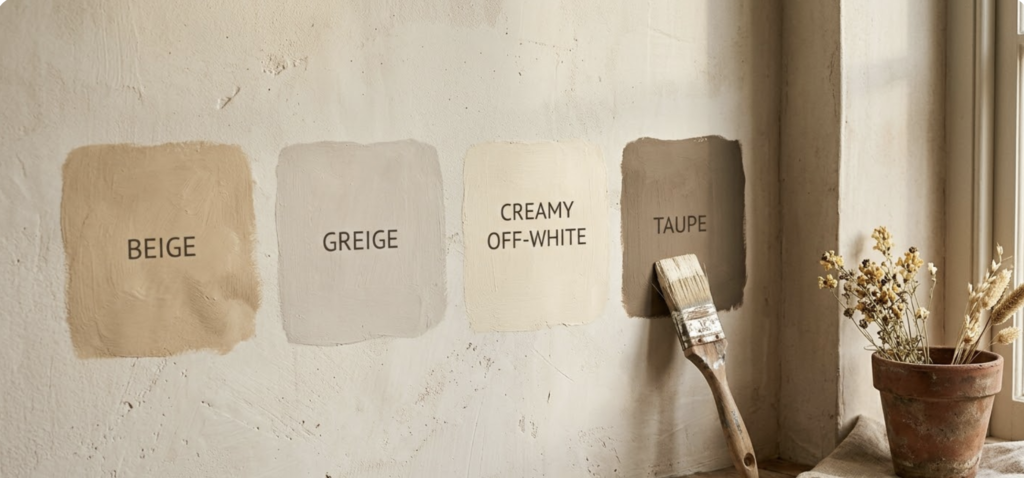
If you find yourself paralyzed by the paint aisle and just want a reliable answer, here it is: a soft warm greige — a color that sits right between a warm medium gray and a sandy beige — is one of the most versatile and reliably cozy wall colors you can choose. It works in almost every lighting condition, it pairs beautifully with wood, white trim, cream linens, and brass or warm metal accents, and it reads as sophisticated and calm rather than cold or flat. Start there if you need a starting point, and you can always layer in deeper accent tones on a single feature wall as your confidence grows. A warm medium clay or muted terracotta on one wall, with the warmer greige on the remaining three, is one of the loveliest combinations you can create in a neutral living room — it adds depth and warmth without disrupting the calm quality of the space.
Step 3: Walls, Floors, and Ceilings
Now that you have a color palette in mind, it is time to think about the big surfaces — the walls, the floor, and the ceiling. These three elements set the tone for your entire room and everything that goes into it. They are the canvas on which you are about to build your masterpiece, and getting them right makes every other decorating decision easier and better. Get them wrong, and even the most beautiful furniture and accessories will struggle to save the room. The good news is that walls, floors, and ceilings are actually very manageable once you know what to look for.
For your walls, once you have settled on your warm neutral color, think about the finish you are using. Matte and eggshell finishes tend to feel significantly softer and cozier than semi-gloss or high-gloss finishes, which reflect more light and give walls a slightly commercial, hard quality. A matte finish absorbs light and creates that gentle, diffused look you see in beautiful interior photographs — the kind where the walls seem to glow softly rather than shine. For a living room, eggshell is usually the ideal choice: it has just enough sheen to make it washable when life inevitably leaves a mark, without looking shiny or clinical. And do not forget the ceiling. Most ceilings get a coat of standard flat white paint and are then permanently ignored, which is a missed opportunity in any cozy room. Painting your ceiling in a very pale version of your wall color — or even the same color if you want a fully wrapped, cocoon-like feeling — makes the room feel embraced and warm rather than cut off at the top.
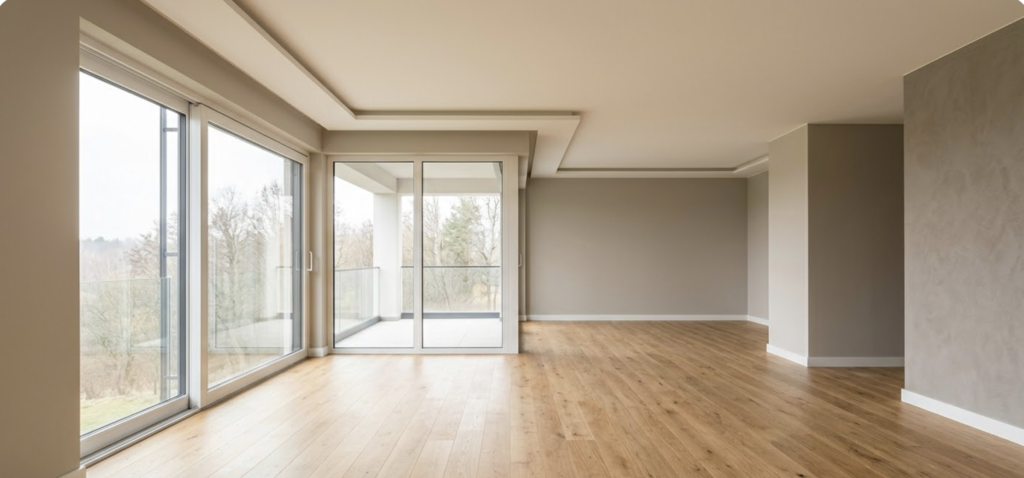
Flooring is arguably the most impactful single element in a living room, because it covers the largest horizontal surface in the space and your eye returns to it constantly. Warm-toned hardwood floors — medium to light oak, walnut, pine, ash — are among the most perfect partners for a neutral living room palette that exists. They add a natural warmth that no other flooring material quite replicates, they age beautifully, and they work with almost every neutral shade you could choose for your walls and furniture. If you have existing hardwood floors that are very cold and gray-toned or have a dark stain, a large area rug becomes critically important for warming the space. If you have carpet, aim for a warm neutral shade — a soft oatmeal, a warm light gray, or a natural undyed tone works well. If you have tile or laminate, the same rule about a large rug applies and applies emphatically.
Area rugs deserve a dedicated conversation because they are one of the most transformative elements in a living room and one of the things people most commonly get wrong. A rug does several jobs simultaneously: it defines and anchors the seating area, it adds warmth underfoot, it introduces texture and visual softness, and it absorbs sound in the room which contributes enormously to that quiet, contained, cozy feeling. For a cozy neutral room, look for rugs in natural fibers — wool, jute, sisal, cotton, or a blend. A hand-knotted or hand-tufted wool rug in a warm cream or natural undyed tone is genuinely beautiful and ages wonderfully, developing a patina over time that only makes it lovelier. A jute or sisal rug adds gorgeous organic texture and earthy warmth, though be aware that they can feel slightly rough underfoot compared to wool. If you like to walk barefoot, a soft wool rug will be your best friend.
The single most important rule about rugs: always buy bigger than you think you need. A rug that is too small for a seating arrangement is one of the most common and most damaging decorating mistakes a person can make, because it makes the whole room feel unanchored and disconnected. In a living room, your sofa should rest its front two legs on the rug at minimum, and ideally all the legs of all your seating pieces should sit on or beside the rug. A rug that is an island in the middle of the room with all the furniture floating around it is a rug that is not doing its job. As a working guideline, an eight by ten foot rug is the starting point for most standard living rooms, and a nine by twelve is often significantly better.
Step 4: The Sofa
If your living room were a film, the sofa would be the main character. Everything else in the room exists in relationship to it, and it needs to be excellent on multiple levels simultaneously: beautiful to look at, genuinely comfortable to sit in, durable enough to handle real life, and harmonious with everything around it. Choosing the wrong sofa is one of the most costly and frustrating interior design mistakes you can make, because sofas are expensive, they are heavy, and they are not easy to change. Your sofa is a long-term commitment, like a very comfortable houseplant that you will have for a decade or more. Treat the decision accordingly.
For a cozy neutral living room, the most beautiful and practical sofa choice is a warm neutral upholstery in a natural or soft fabric. The most popular and most genuinely beautiful options are linen, cotton, boucle, and velvet. Linen is perhaps the most versatile of all — it has a naturally casual, airy quality, it comes in beautiful warm neutral tones, and the fact that it wrinkles slightly is not a flaw but a feature, because those soft wrinkles are part of the lived-in, relaxed look you are creating. Cotton is durable, easy to clean, and works in a huge range of weights and weaves. Boucle — that looped, textured fabric that has been enormously popular in recent years — has earned its popularity entirely on merit. It is soft, visually interesting, wonderfully tactile, and manages to look both casual and refined at the same time. Velvet in a warm neutral — warm ivory, oat, dusty caramel, soft blush — adds a quiet luxuriousness and a beautiful way of catching light that makes it particularly beautiful in the evenings.
For the color of your sofa, warm cream, ivory, natural linen, warm sand, and medium warm taupe are all excellent choices that will serve you well for many years. These colors add warmth to the space, they provide a beautiful neutral anchor for all your layered cushions and throws, and they photograph wonderfully in natural light. Yes, a lighter sofa will show more everyday life than a very dark one, and yes, you will need to clean it periodically. But that is why removable covers, machine-washable slipcovers, and good fabric protector spray exist. The visual warmth and beauty of a well-chosen light sofa is absolutely worth the minimal extra care.
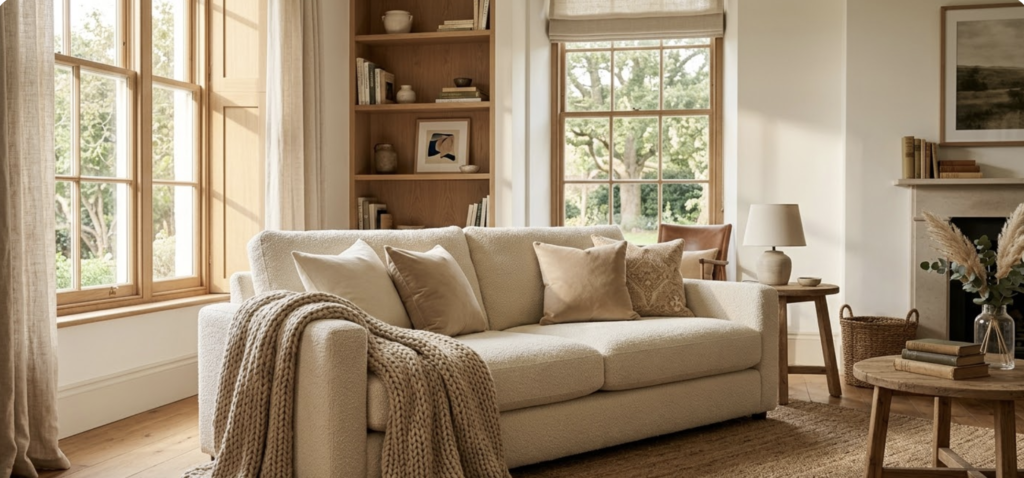
In terms of style and shape, sofas that feel generous and inviting — deep-seated, with plump cushions and a slightly lower profile — are universally more cozy than stiff, upright, formally structured styles. A sofa with feather-and-foam cushions that give slightly when you sit and bounce back gently is infinitely more welcoming than one with dense foam cushions that hold their perfect shape no matter how hard you try to make an impression on them. You want a sofa that says ‘come, sit, stay a while’ rather than one that says ‘this is technically furniture.’ A generous sofa with room to tuck your legs up sideways or stretch out fully is the gold standard of living room coziness, and once you have sat in one, going back is genuinely difficult.
Do not stop at the sofa when thinking about seating. An accent chair or two adds enormous character, warmth, and flexibility to a living room, and they offer the opportunity to introduce a second material or texture that contrasts beautifully with the sofa. A warm cognac leather armchair beside a cream linen sofa creates a gorgeous combination of soft and firm, light and warm. A woven rattan or cane chair adds beautiful organic texture and a more relaxed, natural quality. A small velvet armchair in a slightly deeper neutral — a warm dusty mauve, a muted forest green, a soft rust — can act as a subtle accent color that brings life to the room without disrupting the neutral scheme. Mix your seating pieces and your room will immediately feel more personal and more considered.
Step 5: Layering Textures
Here is the single most important principle in interior design, and it applies regardless of the style or color palette you are working with: texture is what makes a room feel good. Color can make a room look beautiful in a photograph. Layout can make a room function well. But texture is what makes you walk into a space and feel something in your body, something warm and welcoming and physical. It is what makes you want to reach out and touch the cushion, run your hand along the wood surface, curl your toes into the rug. In a neutral room especially, texture is absolutely everything, because when you are working with a limited and restrained color palette, the variety of surfaces and materials is what provides all the visual and sensory richness.
Think about all the textures that could potentially exist in a well-layered living room: the smooth matte painted wall beside the rough grain of wood, the soft pile of a velvet cushion against the open weave of a jute rug, the tight loop of a boucle sofa next to the liquid drape of linen curtains, the cold smooth surface of a ceramic vase beside the rough bark of a dried twig arrangement, the warm shine of a brass lamp base next to the woven texture of a rattan basket, the loose knit of a wool throw against the clean surface of a marble tray. Each of these surfaces catches and reflects light differently. Each one creates a slightly different sensation when you look at it and when you touch it. When you layer all of these different textures together within your warm neutral color family, the result is a room that is visually rich without being busy, and physically inviting without being overdone. It is the difference between a room that looks like a catalogue page and one that looks like a home.
The key to layering textures well is contrast and balance. You want rough surfaces alongside smooth ones. You want matte finishes alongside surfaces with a gentle sheen. You want soft, yielding materials alongside firm, structural ones. You want organic, irregular materials from nature alongside clean, refined human-made ones. This contrast is what creates visual movement and interest.
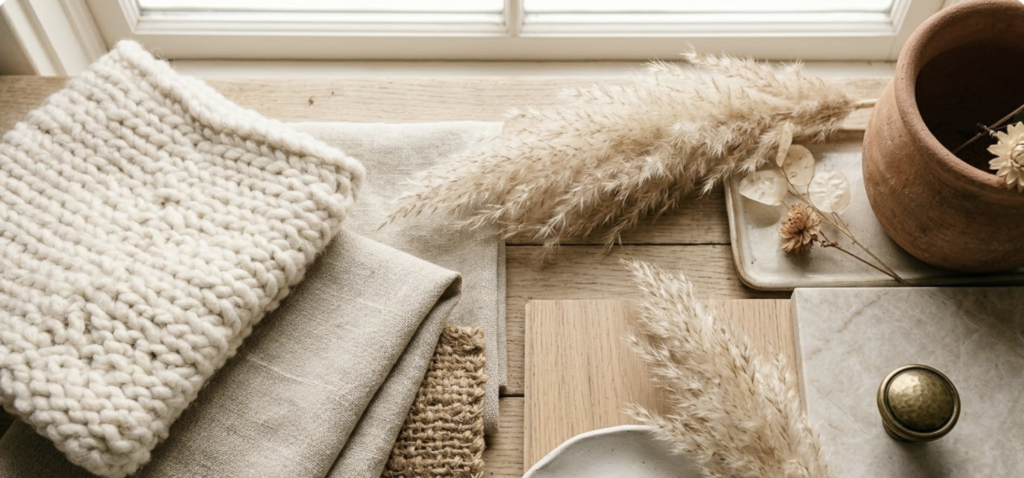
Cushions and throws are your most powerful and most flexible texture tools, and they are also the easiest and most budget-friendly way to dramatically change how a room feels. For cushions, work with a mix of sizes and shapes rather than a matching set — standard squares in two or three sizes, a lumbar cushion which adds a pleasing horizontal element, and perhaps a bolster or a round cushion for an unexpected shape that catches the eye. Mix your cushion fabrics within the same neutral palette: a natural linen cover next to a boucle cover next to a velvet cover, all in warm creams and taupes and soft tans. Add a cushion or two with subtle textural detailing — a slubby weave, a fringe trim, a subtle tone-on-tone woven pattern — and the whole arrangement suddenly looks far more layered and intentional. The goal is to look effortless, which in interior design means planning everything carefully and then pretending you did not.
Throws are the final cozy layer, and they deserve to be approached with the same care you give to everything else. Drape one over the back of the sofa in a casual, slightly undone way. Fold one over the arm of an accent chair. Keep another one loosely in a large woven basket nearby. A chunky hand-knit throw in cream or oatmeal is perhaps the single coziest thing you can add to a living room, and it costs relatively little. A waffle-weave throw in warm white has a more refined texture. A plaid or herringbone blanket in muted, warm tones adds a hint of pattern without disrupting the neutral palette. Keep your throws looking used rather than arranged — the point is to look like someone wraps themselves in them regularly, because they absolutely should.
Step 6: Curtains and Window Treatments
Windows are consistently among the most underestimated elements in living room design, and getting the window treatment right can change how a room feels more dramatically than almost any other single decision. The goal in a cozy neutral living room is to maximize the sense of light, airiness, and height while also creating the option to make the room feel warm and enclosed when the light fades and the evening sets in. It is a balance between openness and intimacy — and it is entirely achievable with the right fabric and the right hanging approach.
Linen curtains are the perfect window treatment for this style of room, and this is not a close contest. Linen has a natural texture that adds gentle visual interest without being busy or loud. It hangs in soft, organic folds rather than stiff pressed pleats. It filters light in a gorgeous, diffused way that fills the room with a warm, even glow on bright days. It comes in all the warm neutral tones you are working with — oatmeal, natural undyed linen, warm white, warm sand, soft taupe. And it manages to look simultaneously relaxed and refined, casual and beautiful, which is exactly the quality you want running through your entire cozy neutral room. If there is one thing worth spending a little more money on in your living room, it is a set of floor-length linen curtains in a beautiful warm neutral shade.
The way you hang your curtains matters just as much as the curtains themselves, and this is one of the highest-impact, lowest-cost upgrades you can make to any window in any room. Always hang your curtain rod as close to the ceiling as possible — ideally within a few inches of the ceiling line rather than just above the window frame. And always extend the rod several inches — ideally at least six to eight inches — past the window frame on both sides. These two adjustments make the window appear significantly taller and wider than it actually is, they make the room feel more spacious and light-filled, and they allow the curtains to hang in those long, elegant, uninterrupted vertical lines from ceiling to floor that are so characteristic of beautifully styled interiors. Curtains that hang from just above the window frame and end at the sill, no matter how lovely the fabric, will make the room feel smaller, lower, and less considered. Floor-length curtains hung high and wide are a genuinely simple change that makes an enormous visual difference.
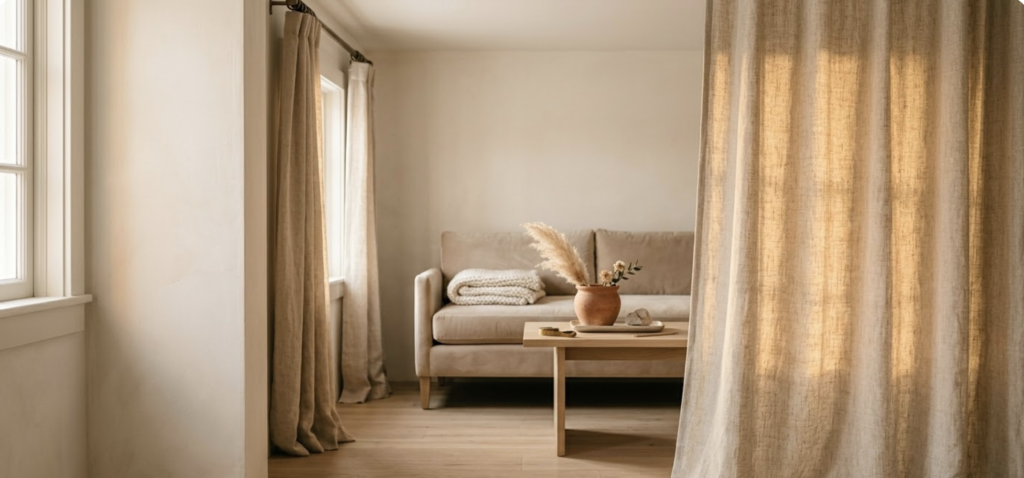
If privacy or light control is a concern — and in most living rooms it is, at least some of the time — layering your window treatments is the most elegant solution. A simple white or off-white roller blind fitted within the window recess behind your linen curtains gives you complete privacy and light control when you need it, while allowing the curtains to remain the visual hero of the window from both inside and outside. This layered approach also creates more depth at the window itself, which reads as more luxurious and thoughtful than a single layer of fabric. Roman blinds in a warm linen or cotton fabric are another beautiful alternative, particularly in rooms where you want a slightly cleaner, more structured look — they give a warm, tailored quality that pairs wonderfully with more relaxed and casual furnishings elsewhere.
Step 7: Lighting Your Room Like a Professional
If texture is the secret to how a room feels in your hands, lighting is the secret to how a room looks and feels in your entire body at any given moment. Good lighting is what separates a room that photographs beautifully from a room that actually feels beautiful to be in day after day, morning and evening, with company and alone. In a cozy neutral living room particularly, lighting is critical, because neutral colors are extraordinarily responsive to light — they shift and change as the quality of light changes, and the right lighting will make your warm neutrals glow like honey while the wrong lighting will make them look flat, cold, and slightly depressing. This is not an exaggeration. The wrong light bulb can ruin a room that took months to put together, and the right one can make a mediocre room look genuinely beautiful.
The first and most important principle of living room lighting: never rely on a single overhead light as your only light source. A single ceiling light in the center of the room is perhaps the least cozy lighting solution in the history of indoor spaces. It creates harsh, downward-facing shadows. It lights the room too evenly, which paradoxically makes it feel flatter and less interesting than a room with multiple, varied light sources. And it gives off an energy that belongs in a school cafeteria, not in a room where you are trying to relax. Overhead lighting has its place — a beautiful pendant or chandelier can be a wonderful focal point — but it should never be working alone, and in the evenings you should almost always have it turned off or dimmed while other, warmer sources take over.
What you want is what designers call layered lighting — multiple light sources at different heights around the room that you can combine and control to create entirely different atmospheres at different times of day. In a living room, this means a floor lamp beside the sofa for reading and general ambient light, a table lamp on the side table for warmth and task lighting, a smaller accent lamp on a shelf or console for depth and visual interest, and then candles or very low-level decorative lighting for evenings when you want everything softened to its most beautiful. When all of these sources work together at medium or low levels simultaneously, the room takes on a warmth, depth, and intimacy that no overhead light can ever come close to replicating. It is genuinely one of the most impactful things you can do for a room, and much of it costs very little.
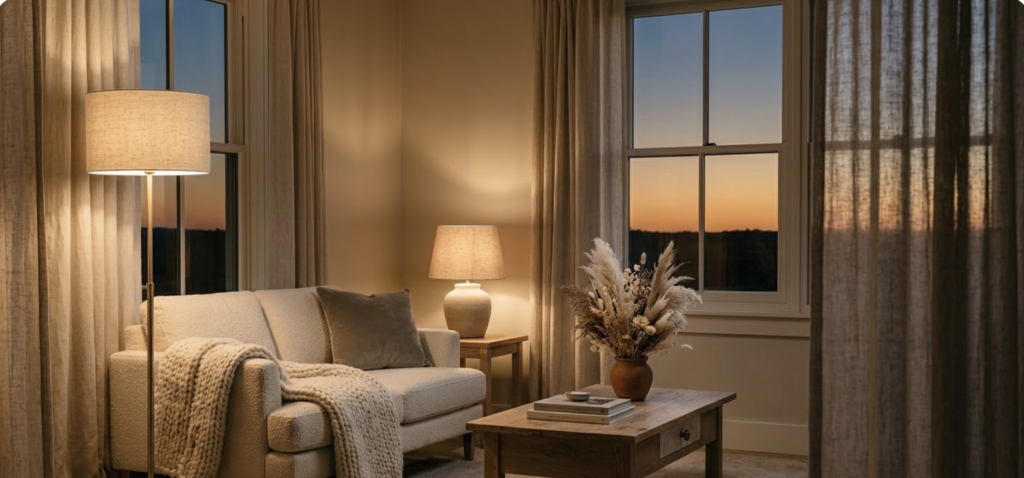
For bulbs, always use warm white LEDs in your living room. Look for a color temperature of 2700K to 3000K — these are the bulbs that produce the warm, golden light that makes skin glow, makes wood look rich, and makes neutral fabrics look like they are bathed in late afternoon sun. Bulbs labeled ‘cool white’ or ‘daylight’ — anything 4000K and above — produce light that skews blue or white, and in a cozy neutral room, this completely undermines everything you have worked to create. It is one of those decisions that costs almost nothing to get right (and almost nothing to fix if you have gotten it wrong so far) but makes an enormous difference to the entire feeling of the room. While you are thinking about bulbs, install dimmer switches where possible. The ability to drop your lights to thirty percent in the evening is one of the small, underappreciated luxuries of a well-considered home.
Lamp shades are another lighting detail that gets overlooked. A lamp shade made of a slightly translucent warm-toned linen or cotton fabric will diffuse the light coming from the bulb and create a soft, amber glow around the lamp that adds genuine warmth to the room — it is like a little lantern sitting in the corner, and it is one of the loveliest things you can have in a cozy space. Opaque shades block most of the light and create a more directional, spotlight-like effect, which can work but is less warm. Bright white shades produce a cleaner, cooler light. For a cozy neutral room, warm-toned, slightly translucent fabric shades are the clear winner.
Step 8: Furniture Layout and Arrangement
You can have the most beautiful sofa, the most perfectly chosen curtains, and the most carefully considered neutral palette, and if your furniture is arranged badly, the room will still feel wrong. Furniture layout is the underlying architecture of your living room — it is the structure that determines how the room flows, how people move through it, how they talk to each other in it, and whether the whole thing reads as a cohesive, intentional space or as a random collection of items that happened to end up in the same room. Getting the layout right is not about following rules rigidly but about understanding the principles well enough to apply them to your specific space.
The most fundamental principle of living room furniture arrangement is this: group your seating together, facing each other, for conversation. This sounds obvious, but it is remarkable how many rooms have all the furniture pushed to the perimeter, hugging the walls in a ring, leaving a large empty space in the middle that nobody ever sits in. Rooms laid out this way feel more like waiting rooms than living rooms, no matter how beautiful the individual pieces. Pulling furniture away from the walls and grouping it more closely and centrally — creating an intimate conversation zone where people can actually see and speak to each other at a comfortable distance — is one of the single most effective changes you can make to any living room. The gap between the furniture and the wall is not wasted space. It is breathing room, and it is part of the design.
A reliable and beautiful layout for a cozy living room works as follows: the sofa anchors the arrangement, placed facing the primary focal point of the room — whether that is a fireplace, a large window, a gallery wall, or a television. Two accent chairs face back toward the sofa, positioned at slight angles that create a natural, slightly rounded conversational grouping. A coffee table sits at the center of this arrangement, within easy reach of all the seating pieces — close enough to set a drink on without leaning forward uncomfortably, but not so close that it becomes an obstacle to moving around. Side tables at both ends of the sofa and beside each chair complete the functional arrangement. This layout works because it is designed around real human behavior — around the way people actually want to sit and talk and read and rest — rather than around the shape of the room.
Scale is the furniture consideration that catches most people out, because our eyes are genuinely poor at judging how large something will actually be in a real space. Furniture that looked reasonably sized on a showroom floor can look enormous — or disappointingly small — once it arrives in your home. Before buying any significant piece of furniture, always measure the space it will occupy carefully, look up the exact dimensions of the piece, and then mark out its footprint on your actual floor using painter’s tape. Spend a day or two living with the taped outline before you commit. Walk around it. See how it changes the flow of the room. Check that drawers and doors have room to open. Make sure the proportions look right relative to the other pieces in the room. This costs nothing and saves enormous amounts of money and frustration.
Step 9: Coffee Tables, Side Tables, and Surfaces
The coffee table is the visual heart of your seating arrangement, and in a cozy neutral living room it offers a wonderful opportunity to introduce contrast, warmth, and character in a way that is specific to this piece. Because the coffee table is surrounded by softer elements — the sofa, the chairs, the cushions, the rug — it benefits enormously from being made of something with more structural presence. Solid wood, rattan, wicker, stone, marble, or combinations of these materials make beautiful, warm, and character-rich coffee tables that anchor the seating arrangement with real visual weight.
A chunky oak or walnut coffee table with visible natural wood grain is perhaps the most perfect coffee table for a cozy neutral room — it is warm, organic, durable, and it will only become more beautiful as it ages and develops the small marks and patina of everyday life. A rattan or cane coffee table in a natural honey or warm brown tone adds gorgeous open texture and a relaxed, natural quality that gives the whole room a more casual, lived-in feeling. A marble-topped table on warm brass or matte black legs sits slightly more formally and adds a quiet sense of luxury along with a beautiful way of catching the light. Any of these will work beautifully, and the choice largely comes down to how relaxed versus how refined you want the overall mood of the room to feel.
Styling a coffee table well is one of the small arts of interior decoration, and it has surprisingly simple rules once you know them. Work in odd numbers where possible — a group of three objects has a more natural, dynamic balance than two or four. Always vary the heights of the objects you group together so that the arrangement has a sense of movement rather than sitting completely flat. Include a purposeful mix of object types: something with height such as a small vase of dried flowers or a tall candle, something flat and horizontal such as a beautiful stack of coffee table books, and something with an interesting form or material such as a sculptural ceramic bowl or a small smooth stone. And always leave some empty surface visible — a table covered entirely with objects looks cluttered no matter how beautiful the individual pieces.
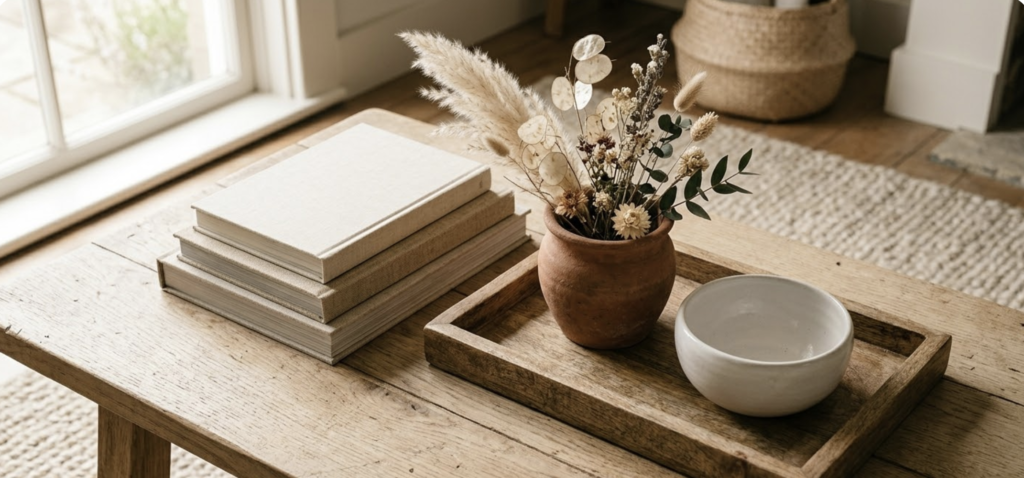
Step 10: Plants, Botanical Elements, and Nature
One of the most effective — and most frequently underestimated — ways to make a neutral living room feel genuinely alive and cozy rather than just carefully decorated is to bring natural elements inside. Plants, dried botanicals, natural stones, wood objects, shells, branches, and similar organic elements do something that no mass-produced decoration can fully replicate: they introduce the subtle beauty and richness of the natural world, with all its irregularity, imperfection, and life. Even a small dried flower arrangement in a simple vase carries more visual complexity and emotional warmth than a perfect ceramic object from a design shop, because the natural world has a depth and character that human-made design is always trying to capture.
For living plants, choose varieties that honestly suit your lifestyle rather than aspirationally suit the lifestyle of the person you would like to be. If you travel often, work long hours, or simply have a complicated history with houseplants, choose varieties that are genuinely resilient and forgiving. A pothos will trail beautifully from shelves and survive almost total neglect. A snake plant is architectural and nearly indestructible. A ZZ plant needs water perhaps once a month and has gorgeous deep glossy foliage. A rubber plant has large, dramatically beautiful leaves and is much easier to keep than it looks. For a statement corner, a large fiddle leaf fig or monstera adds an incredible sense of lush organic life that fills empty wall space and makes the whole room feel more complete. The key is choosing plants you will actually keep alive rather than plants that will become a source of guilt after two weeks.
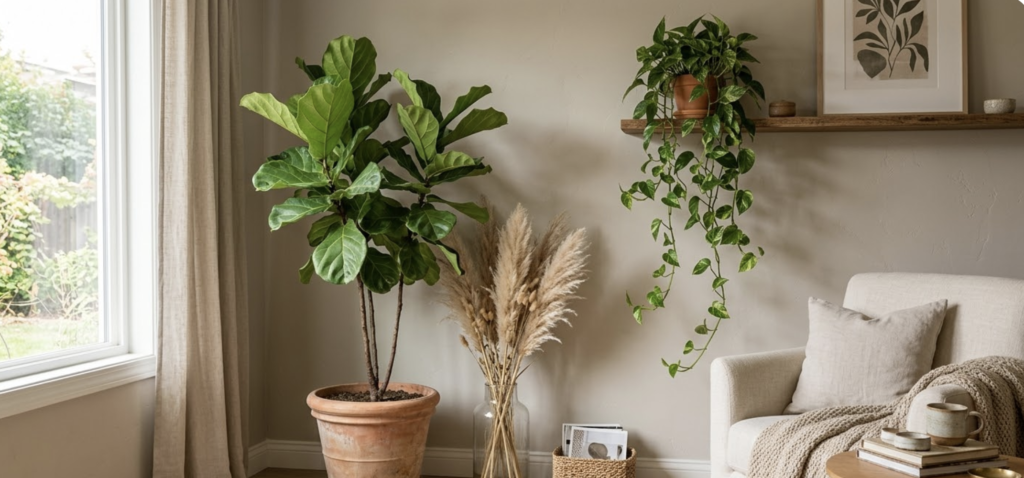
Dried botanicals have become one of the most beloved elements in this style of interior, and they deserve every bit of their popularity. They are beautiful, they last indefinitely with minimal care, they require no watering whatsoever, and they come in a range of warm natural tones — cream, ivory, wheat, warm brown, dusty blush, dried green — that feel entirely at home in a neutral palette. Pampas grass in its natural ivory tone remains genuinely beautiful when used thoughtfully in a large vase or a tall floor arrangement. Dried wheat, preserved eucalyptus, cotton stems, dried lunaria with its translucent silver seed pods, and dried seed heads all bring different textures and shapes and are wonderful either displayed individually or grouped together in an eclectic arrangement.
The containers and vessels you use for your botanicals and plants matter enormously to the overall look. Terracotta is perhaps the most perfect material for a cozy neutral room — its warm reddish-clay color works with every neutral, its surface texture is beautiful and tactile, and it has that ancient, earthy quality that grounds everything around it. Matte ceramic pots in cream, warm white, or earthy tones are equally lovely and slightly more refined. Woven seagrass baskets and jute plant holders are wonderful for larger potted plants and add another beautiful layer of natural texture to the room. Even the simple act of choosing vessels that feel organic and handmade rather than perfect and plastic makes an enormous difference to the warmth and character of the room.
Step 11: Art, Gallery Walls, and Making the Space Personal
Bare walls are one of the fastest ways to make a beautifully furnished room still feel incomplete, and yet many people leave their walls bare because they feel uncertain about art — what to buy, where to hang it, how to arrange it, and how to make choices that will stand the test of time without spending a fortune. The truth is that art in a cozy neutral living room does not need to be expensive, does not need to be by recognized artists, and does not need to match in any coordinated way. What it needs to do is reflect something genuine about the person who lives in the space, sit comfortably within the warm neutral palette, and be hung at the right height in the right groupings to feel intentional rather than random.
For a cozy neutral room, the most beautiful and appropriate types of art tend to be organic, quiet, and warm in tone. Abstract prints or paintings in earthy, natural tones — warm ochre, raw sienna, soft terracotta, dusty sage, muted warm gray — look stunning on warm neutral walls and add a sense of artfulness without competing with the calm of the space. Botanical prints in simple warm frames have a classic, natural quality that works beautifully in this context and brings a subtle organic feel to the wall. Landscape photography or illustration in warm, muted, slightly desaturated tones can add a beautiful sense of depth and openness. Simple line drawings and gestural sketches framed in light wood or warm frames are elegant, understated, and age very gracefully. Handmade ceramics hung as wall art — a beautiful decorative plate, a textured wall hanging, a small sculptural piece — add three-dimensional texture to the wall and a wonderful sense of the handmade that mass-produced prints cannot replicate.
Gallery walls — arrangements of multiple art pieces on a single wall — are one of the most charming and personal ways to make a living room feel truly inhabited, and they work especially well in neutral interiors because they allow you to build a collection slowly over time, adding pieces as you find them rather than having to source everything at once. The secret to a gallery wall that feels intentional rather than chaotic is consistency in framing — using the same frame finish, whether that is light wood or warm black, throughout the arrangement — while varying the sizes of the pieces themselves. Cut paper templates of each frame and arrange them on the wall using painter’s tape before committing to any nails. Live with the arrangement for a day or two. Adjust until it feels balanced and right. Then hang everything at once.
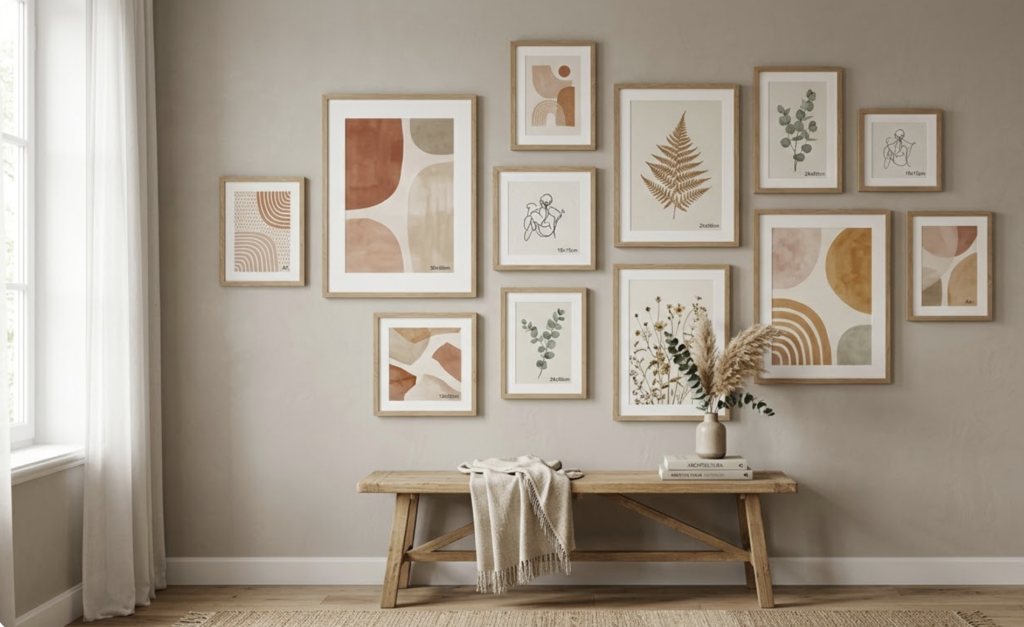
The height at which you hang art is another thing that seems like a minor detail but makes a dramatic difference. Art should be hung so that the center of the piece is at roughly eye level when standing — approximately 57 to 60 inches from the floor in most spaces. This is the standard used by most galleries and museums, and it works because it means the art is viewed at a natural, comfortable height. Art hung too high — a very common mistake — loses its connection to the room and the people in it, looking stranded on the wall rather than integrated into the space. Art hung as part of a gallery wall should follow the same principle, with the center of the overall arrangement sitting at eye level even as individual pieces vary above and below.
Bringing It All Together
Here is the thing about cozy neutral living rooms that no design guide will tell you: the most beautiful ones are never the result of following every rule perfectly. They are the result of someone who understood the principles well enough to weave their own personality through them. The room that makes you catch your breath when you walk in is the one that has all the foundations right — the warm colors, the layered textures, the thoughtful lighting, the furniture arranged for real life but also has the personal touches that could only belong to the person who lives there. The stack of books that reflects a genuine reading habit. The imperfectly formed handmade mug your niece made in a ceramics class. The slightly battered throw that has been loved through two winters and a bout of mild illness. The dried flowers from a walk you took on a day you wanted to remember.
A cozy neutral living room is not a magazine spread. It is a home, and homes need to be lived in to be beautiful. The small imperfections — the cushion that is slightly askew, the throw that has been washed enough times to have a gentle softness that new throws do not have, the coffee table with the ring mark from the mug you forgot to put a coaster under — are not errors to be corrected. They are evidence that the room is doing its job. That it is being used. That it is bringing someone comfort, warmth, and pleasure on a regular basis. That is the entire point of a cozy room, and it is the entire point of interior design done well.
So start where you are. If you can only do one thing today, repaint the walls. If you can only do one thing this week, buy the throw. If you can only do one thing this month, rearrange the furniture. Every small step toward the room you have in mind is a step worth taking. And on the day when all the layers are in place — when the light is warm and the candles are lit and the throw is on the sofa and the plants are alive and everything is exactly as you envisioned it — sit down in the middle of it and appreciate how well you did. You built that. No interior design degree required.