
Because a bare coffee table is just a surface, but a styled one is the whole vibe.
Let’s be honest. You have walked past your coffee table at least three times today and secretly wished it looked more put-together. Maybe there is a remote control sitting alone in the middle like it’s waiting for a very boring meeting. Maybe there is a stack of magazines from six months ago and a coaster that has seen better days. Or maybe your table is completely empty and staring back at you like a blank canvas that is both full of possibility and mildly intimidating. Whatever the current situation is, you are in exactly the right place.
Styling a coffee table is one of the easiest and most satisfying things you can do in your living room. It does not require a design degree, a big budget, or a trip to an expensive home store. What it does require is a little bit of knowing what works, why it works, and how to put the pieces together in a way that feels natural and personal to you. That is exactly what this guide is going to walk you through, step by step, section by section, with practical advice that you can start using today.
We are going to cover everything — the foundational rules of good coffee table styling, how to choose your objects, how to group them, how to use height and texture, how to make it feel personal, how to keep it functional without losing the beauty, and how to adapt all of this to different interior styles. Whether your home is modern, cozy, minimal, maximalist, boho, or something completely in between, this guide will help you build a coffee table look that feels right for your space.
Why the Coffee Table Is an Important Surface in Your Living Room
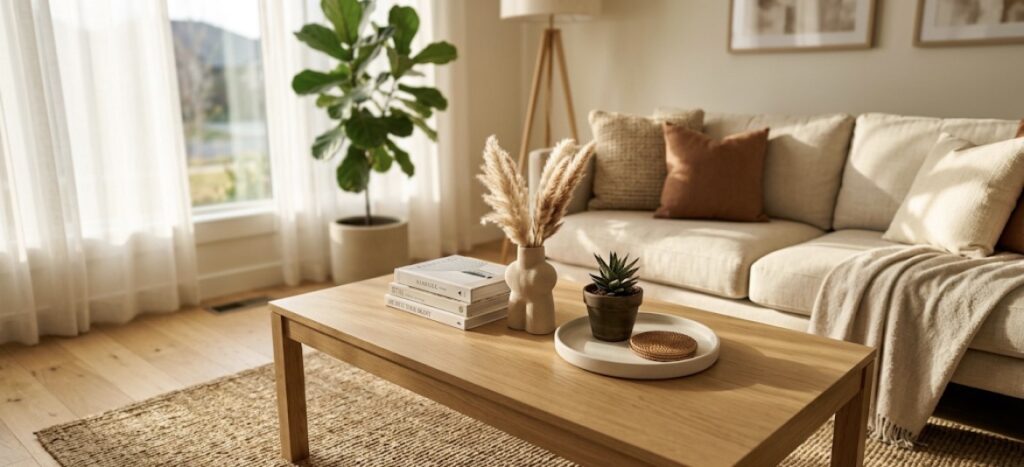
Before we get into the how, let’s spend a moment on the why. Your coffee table sits right at the center of your living room. Physically, yes — but also visually. When anyone walks into your living room, whether it is a friend, a family member, or yourself coming home after a long day, the first thing the eye naturally travels to after the sofa is the coffee table. It is the anchor of the entire seating area. It connects the sofa to the room and gives the space a sense of intention.
A styled coffee table communicates something about the person who lives in the home. It says: someone who is thoughtful lives here. Someone who cares about beauty, even in the small things, lives here. It sets the tone for the rest of the room. When your coffee table is styled well, the whole room looks more pulled-together, even if nothing else has changed. That is the power of this one simple surface.
But there is another side to the coffee table that is just as important — function. A coffee table is not a museum display. People put drinks on it, books on it, their feet on it (no judgment), snacks on it during movie nights. Good coffee table styling has to honor both of these realities at the same time: it needs to look beautiful and it needs to work as a surface for everyday life. The good news is that these two goals are absolutely compatible when you know the rules.
Think of your coffee table the way an interior designer thinks about a room: you want it to tell a story, have layers, feel balanced, and leave a little breathing room. It should never look cluttered, and it should never look too empty. The goal is that sweet spot in the middle — curated, purposeful, and lived-in all at once. Getting there is easier than you might think, and we are going to do it together.
The Rules of Coffee Table Styling
Every great coffee table follows a few core principles. These are not rigid rules that you have to follow exactly — think of them as guidelines that will always steer you in the right direction. Once you understand why they work, you will naturally apply them without even thinking about it.
The first rule is the rule of odd numbers. Objects grouped in odd numbers — threes and fives in particular — look more natural and visually interesting than even groupings. Two identical candlesticks look like bookends. Three different-height candles look like a scene. Our brains find odd-numbered groupings more dynamic and pleasing to look at because they create movement and variety. So when you are building a vignette on your coffee table, think in threes.
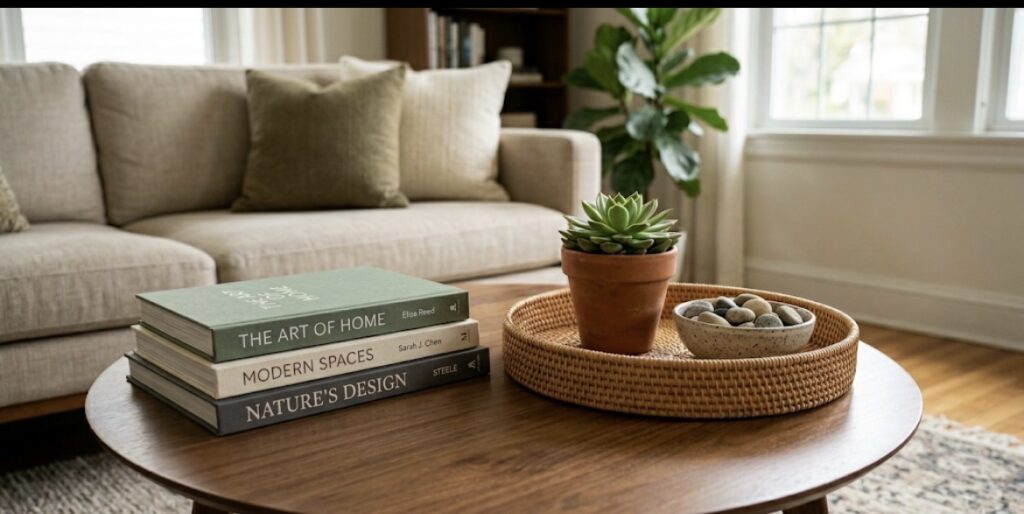
The second rule is about height variation. A flat coffee table covered in objects of the same height looks like a store shelf — organized but not interesting. What makes a table look beautifully styled is the variation in height. You want something tall, something medium, and something low. A tall vase or plant, a medium-height stack of books, and a low flat tray creates a natural landscape on the table surface. The eye moves across different levels and it feels alive.
The third rule is the one that most people forget: leave empty space. A good coffee table is not covered from edge to edge with objects. That would look chaotic and actually reduce the impact of each individual piece. Empty space on a coffee table is not something missing — it is an intentional design choice. It gives the eye somewhere to rest, and it makes the things you have chosen to display feel more important and deliberate. Think of the space on your coffee table the same way you think of the margins on a page. Without them, the content would be overwhelming.
The fourth rule is texture mixing. A coffee table that is all smooth and shiny can feel cold. A table that is all rough and matte can feel flat. The magic is in the contrast. A glass vase next to a linen-covered book next to a raw ceramic candle holder creates a combination of surfaces that is interesting to look at and interesting to touch. Mixing textures adds depth and warmth to the table and makes the arrangement feel more layered and considered.
The fifth rule is the tray trick. When in doubt, put things on a tray. A tray is one of the most powerful styling tools you have. It visually contains objects, makes them feel like they belong together, and also keeps the table surface cleaner and easier to clean around. It makes a collection of random items look intentional and cohesive. We will talk much more about trays later, but for now: if you are feeling overwhelmed, start with a tray.
The Building Blocks: What to Put on a Coffee Table
Now we get to the actual objects. There are six core categories of coffee table items, and when you build your arrangement using a mix of these, it almost always looks great. You do not need one from every category — but understanding what each one brings to the table (literally) will help you make better choices.
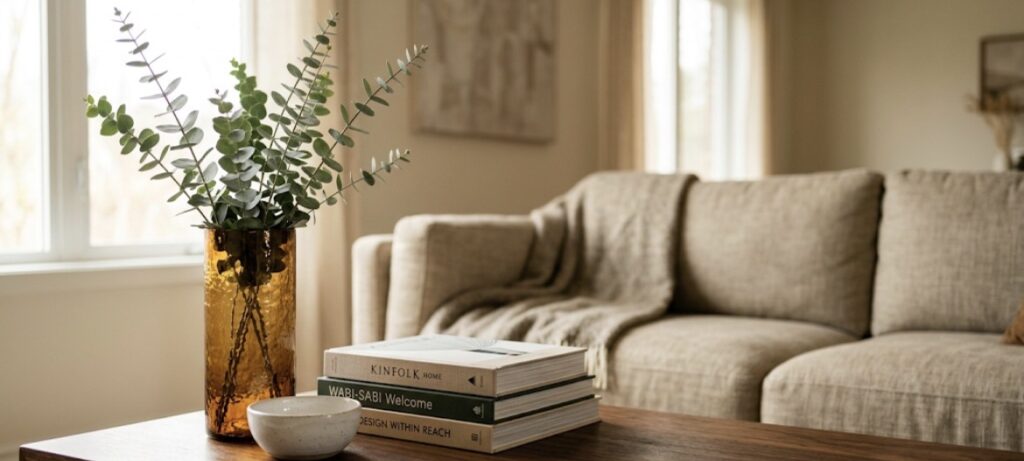
Coffee table books: They are functional, they add color and pattern, they double as a riser for other objects, and they tell visitors something about your interests. The key is in the stacking. A single book lying flat does not make much of a statement. Two or three books stacked with their spines facing the same direction, with a small object placed on top, creates a layered focal point. Choose books based on their covers as much as their content — a beautifully designed cover in the right color is the foundation of many great coffee table arrangements.
Plants and florals: There is something about greenery or flowers on a table that immediately makes the room feel warmer, more alive, and more cared-for. You do not need a full floral arrangement — a simple stem or two in a beautiful vase, a small trailing plant in a pot, or a few dried stems in an earthy vessel can do the job perfectly. If you are not confident with plants, dried flowers and pampas grass are wonderful because they last indefinitely and require zero maintenance. Your only job is to put them in a vase. You can definitely manage that.
decorative pieces: These are things that do not have a specific function beyond looking interesting — a ceramic ball, a carved wooden figure, a piece of driftwood, a small sculpture, a geode, a glass paperweight. These items are conversation starters and they reveal something personal about your taste. The best coffee tables have at least one object that makes someone pick it up and ask about it. It does not have to be expensive or from a fancy shop. The object just has to be interesting and feel like it belongs to you.
Trays, bowls, and containers: serve as both functional and aesthetic elements. As we mentioned earlier, a tray is one of the most powerful tools in your coffee table arsenal. A bowl filled with round stones, wooden beads, or even fruit can be a beautiful centerpiece. A small shallow dish can hold jewelry when you come home or serve as a visual focal point when empty. These containment pieces bring order to the table and give other objects a home.
Coasters: A set of beautiful coasters is both functional and decorative. Stone coasters, marble coasters, woven rattan coasters, leather coasters — there is a version of this simple object in every style. A neat stack of beautiful coasters on the corner of your coffee table is both practical and polished.

How to Actually Build Your Coffee Table Arrangement
Now that you know what to put on your coffee table, let’s talk about how to actually put it together. This is where most people feel stuck — they have all the right objects but they cannot figure out how to arrange them so it looks intentional rather than random. The good news is that there is a reliable process for this, and once you understand it, it becomes almost second nature.
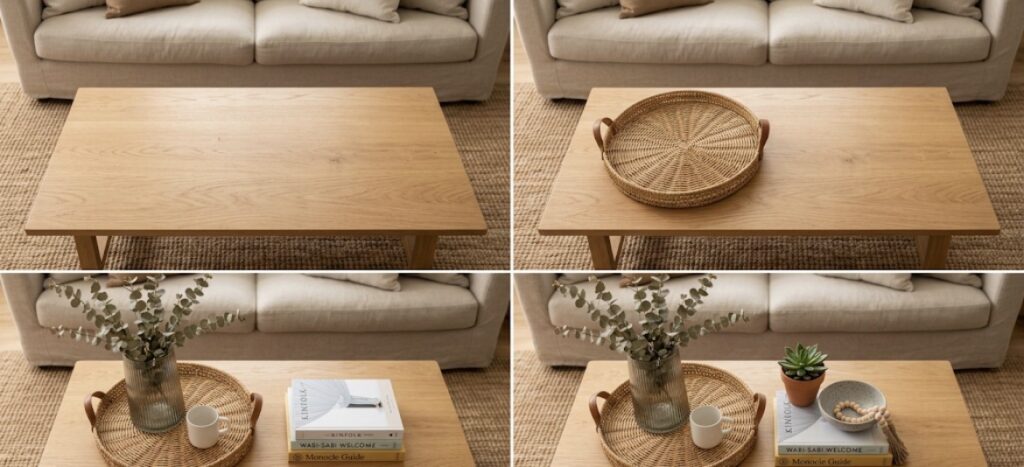
Start by clearing the table completely. This sounds obvious but it is actually important. You need a blank surface so you can see the table itself — its shape, its material, how much space you are working with. A rectangular table is styled differently from a round one or a square one, and you need to see what you are dealing with before you add anything back.
Next, decide on your anchor. Every good coffee table arrangement has an anchor — one larger piece that the other objects are built around. This is usually your tray, your book stack, or your largest plant or vase. Place your anchor first. For a rectangular table, the anchor often sits slightly off-center, either toward one end or two-thirds of the way down the table. For a round table, the anchor often goes in the center. Once your anchor is placed, everything else will be organized around and in relationship to it.
Now add your height. Place your tallest element near or beside your anchor. This is usually your vase, your tall candle, or your plant. Think about where you are viewing the table from — you want the tall elements to be visible and to draw the eye upward, creating that vertical dimension that makes the arrangement feel complete. Do not put the tallest element right at the edge of the table, as it can look precarious and unbalanced. Keep it slightly inward.
Then add your medium and low elements. These fill in around the anchor and the tall piece. A small bowl, a candle, a sculptural object, a stack of coasters — these go in and around the grouping, creating layers and depth. Think about varying the distances between objects. Not everything needs to be touching. Some space between objects actually makes each piece feel more considered. The arrangement should feel like a natural collection, not a lineup.
Step back and look. Literally, walk away from the table and look at it from the sofa. This is the view your guests will have. Does it look balanced? Is there too much on one side? Is there empty space on the other that feels awkward? Are any of the objects blocking each other so you cannot see them? Adjust as needed. This part is not about being perfect — it is about looking at your arrangement with fresh eyes and making small tweaks. Move an object six inches to the left. Swap two things. Remove one thing entirely. Sometimes less is dramatically more.
Styling by Interior Style: How to Match Your Table to Your Room
The same object can look completely different depending on the room it is placed in. A white marble tray feels luxurious and sleek in a modern room, but out of place in a rustic farmhouse living room. This is why it matters to think about styling your coffee table in the context of your room’s overall aesthetic. Here is how the approach changes across the most popular interior styles.
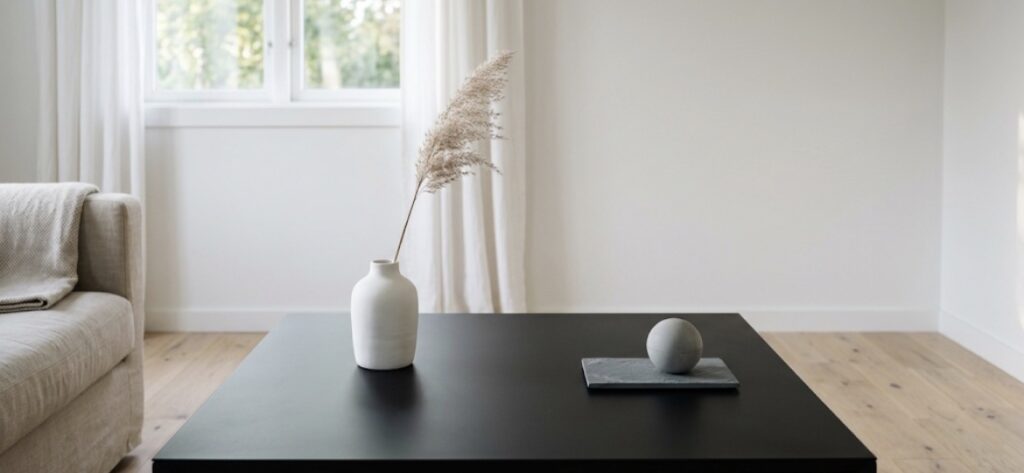
In a modern or minimalist living room, the coffee table should feel clean, intentional, and edited down. Fewer objects, more negative space, and a focus on high-quality materials. A single sculptural object, one beautiful vase with a single stem, and a small tray with one or two items is often enough. The materials should feel cool and refined — glass, brushed metal, white ceramic, stone. The color palette should be neutral or monochromatic with one deliberate accent. Every single object on a minimalist table needs to earn its place, because in a minimal room, you cannot hide behind a lot of things.
In a cozy, Scandi, or Hygge-inspired room, the coffee table should feel warm and inviting. Think natural textures, soft colors, and objects that feel handmade or organic. A linen or woven tray, a chunky knit blanket folded neatly on the sofa nearby, a small pot of succulents, candles (always candles — these people are obsessed with candles and honestly, they are right), a stack of cozy books. The materials should feel natural: wood, clay, linen, rattan, cotton. The mood should say: come sit here, you are welcome.
In a boho or eclectic living room, the coffee table is where you get to have the most fun. This style celebrates layering, mixing, and personal collections. You can mix metals and woods and ceramics without them needing to match. A macrame coaster, a piece of crystal on a stack of books, a woven bowl filled with feathers or shells, a trailing plant, a vintage candle holder found at a market. The key to making boho not look messy is still the same rule: every object should feel intentional, even if they do not obviously go together. The cohesion comes from a consistent color theme running through the whole arrangement.
In a mid-century modern living room, the coffee table styling should complement the clean lines and warm wood tones of the furniture. Think graphic shapes — a round bowl, a cylinder vase, a geometric object. Use warm neutrals and earthy colors — mustard, rust, forest green, caramel. Objects should be simple in form but interesting in material. A teak tray, a terracotta vase, a stack of design or architecture books, a simple plant. Everything should feel slightly retro but also completely current.
In a traditional or maximalist room, the coffee table can be more elaborate. More layers, richer materials, bolder colors. A silver or brass tray with multiple objects arranged inside, a stack of large art books with a small sculpture on top, an arrangement of varied-height candles, a vase with full blooms. The rule of threes still applies. Height variation still applies. The difference is that you can include more pieces, richer textures, and a more complex color palette.
How to Use a Tray Like a Designer
We mentioned the tray several times already, and now it is time to give it the full attention it deserves. A tray is the single most useful styling tool on a coffee table, and understanding how to use one properly will immediately elevate your arrangement. It is the styling shortcut that interior designers use constantly, and once you start using them, you will wonder how your table survived without one.
The fundamental purpose of a tray is to contain and unify. When you place three separate objects on a table surface, they look like three separate objects. When you place those same three objects inside a tray, they look like a curated collection that belongs together. The tray creates a visual boundary that groups the objects and tells the eye: these things go together. This is why a tray can make almost any combination of objects look intentional.
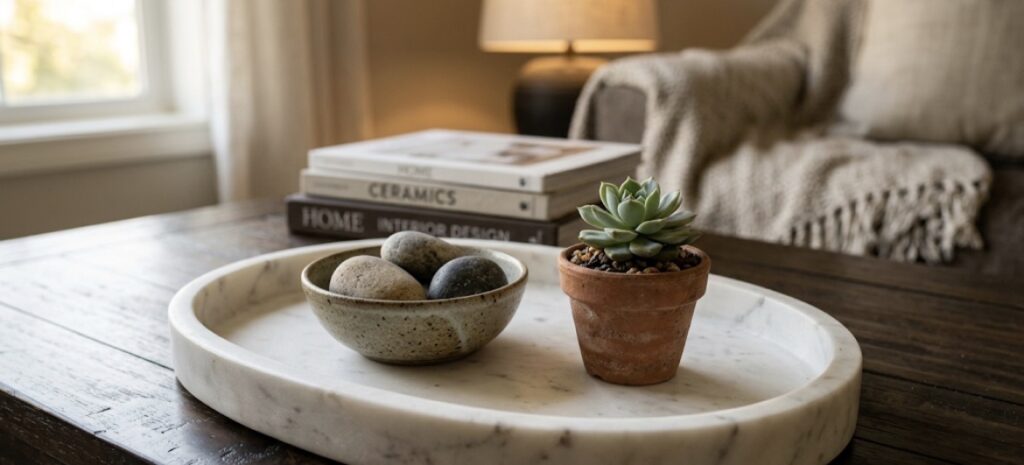
Choosing the right tray matters. The tray should complement your coffee table material rather than compete with it. A glass coffee table often benefits from a solid opaque tray — black lacquer, raw wood, or ceramic — because the opacity grounds the arrangement. A dark wooden table is beautifully offset by a light tray — white lacquer, light rattan, or natural marble. A stone or concrete table pairs well with a warm tray — wood, leather, or woven rattan. Think about the tray as a bridge between the table and the objects on top of it.
The shape of your tray should relate to the shape of your table. A round tray tends to look best on a round or square table. A rectangular tray tends to work better on rectangular or oval tables. However, these are not hard rules — a round tray on a rectangular table can create a nice contrast. The proportion matters more than the shape: your tray should be large enough to hold two or three objects comfortably but not so large that it takes up the entire table and leaves no breathing room on the surface around it.
Inside the tray, the same styling rules apply as for the table as a whole. Vary height, vary texture, use odd numbers. A classic tray arrangement might be: a short wide candle, a small ceramic bowl with a few objects inside it, and one small piece of greenery. Three objects, three heights, three textures. Simple, but it looks like you thought about it deeply. Which, technically, now you have.
Color, Material, and the Art of the Visual Story
The objects on your coffee table should not be chosen in isolation. They need to tell a cohesive visual story together, and that story is told primarily through color and material. Getting this right is what separates a table that looks good from one that looks genuinely beautiful.
For color, start with your room palette. Look at your walls, your sofa, your rug. What colors are dominant? What accent colors appear? Your coffee table arrangement should pull from this existing palette rather than introduce an entirely new one. If your room is neutral with warm beige tones, bring in objects in cream, sand, terracotta, and soft green. If your room has a jewel-tone accent wall in deep teal, you can pick up a small amount of that color in your coffee table arrangement — a teal book cover, a teal ceramic bowl — to create a visual connection that makes the room feel unified.
A simple approach to coffee table color that always works: choose one neutral, one warm tone, and one organic color (like the green of a plant or the honey brown of wood). This combination covers every style and works in almost every room. You can swap out the warm tone for a cool one in a more modern space — white, grey, and deep green, for example — but that triangle of color relationships tends to look balanced and natural.
For materials, the key is to mix rather than match. An arrangement where everything is ceramic can feel one-note. An arrangement where you have ceramic, glass, wood, and natural fiber feels layered and interesting. Think about the tactile range you are creating. When you look at your coffee table, can you mentally feel the different textures just by looking at them? That sensory richness — even at a visual level — is what makes an arrangement feel luxurious and thoughtfully designed.
There is one material pairing that almost never fails: matte and shiny. A matte vase beside a glossy book cover. A rough stone beside a smooth glass candle holder. A woven rattan tray underneath a sleek white ceramic bowl. The contrast between matte and shiny surfaces is one of the easiest ways to add visual interest to a table without changing anything about the objects themselves — just how they relate to each other.
Seasonal Styling
One of the most enjoyable things about styling a coffee table is that it does not have to stay the same forever. Your table can evolve through the seasons, and even small seasonal updates can make your living room feel completely refreshed. You do not need to buy all new things — swapping out just one or two objects with seasonally appropriate alternatives is enough to shift the mood entirely.
In spring, think fresh and light. Swap heavy candles for lighter-colored ones in blush or mint. Bring in fresh flowers — tulips, ranunculus, cherry blossom stems — even just one or two stems in a simple vase. Use softer textures and lighter colors throughout. A woven basket, a light linen table book cover, a small pot of fresh herbs. Spring is about energy returning, so the table should feel a little more lively and fresh.
In summer, bring in natural elements and breezy textures. Shells, smooth beach stones, sea glass in a bowl. A simple vase with tall grasses or sunflowers. Lighter books with bright covers. Clean, bright, and natural — like the season itself. If you have access to natural foraging materials — interesting seed pods, branches with interesting shapes, large tropical leaves — summer is the season to use them.
In autumn, go warm and rich. Deep amber candles, a small bowl of acorns or pinecones, dried flowers in warm rust and copper tones, a darker-toned book stack. Thicker textures — chunky ceramic, leather-bound books, a darker wood tray. The table should feel like it is leaning into the warmth of the season, inviting you to curl up on the sofa beside it with something warm to drink.
In winter, make it cozy and a little more festive without going overboard. A cluster of candles at different heights creates beautiful ambient light in the shorter days. A small spray of evergreen or eucalyptus in a vase. A velvet or metallic accent element. Warm whites and creams, deep burgundy or forest green as accent colors. The goal is warmth and glow, not a holiday decoration store. Restraint and intention, even in winter, will always look better than excess.
Keeping It Functional
This is the section for the people who are thinking: this all looks great but I actually live in my house. My kids put their cups on the table. My partner always loses the remote. I have a Sunday newspaper habit. How does any of this beautiful styling survive contact with real daily life? This is such a valid question, and the answer is: entirely, if you plan for it.
The tray again becomes your best friend here. When you want to put drinks on the table, you move the tray to one side and put the drinks where the tray was. Or drinks go on the tray if there is room. The tray protects the table, contains the display, and makes restyling after use incredibly quick. When the movie night is over, you put the glasses back in the kitchen and the arrangement is right where you left it — or nearly so.
For families with young children, the answer is simpler: style lower, avoid fragile things, and use fewer objects. A single stack of sturdy coffee table books, a simple bowl with a plant, and a set of beautiful coasters can look just as good as a more elaborate arrangement — and it will survive the chaos of daily life much better. As children grow, the arrangement can grow with them. There is no rule that says your coffee table must be styled the same way forever.
For the remote control problem (and it is always a problem): consider a small decorative bowl or dish placed in a consistent corner of the table as the designated spot for remotes.
For the newspaper and magazine habit: a basket beside the coffee table (rather than on it) is the elegant solution. A beautiful wicker or rattan basket on the floor next to one leg of the table stores magazines, newspapers, and even extra blankets without cluttering the table surface. It becomes part of the overall living room composition while keeping the table free for its styled arrangement.
Shopping Smart: Building a Great Coffee Table Collection on Any Budget
You do not need to spend a lot of money to have a beautifully styled coffee table. Some of the best-looking tables in beautifully designed homes include objects that cost almost nothing, because what matters is not the price tag but how the objects work together. That said, there are smart ways to invest when you do spend money, and there are clever ways to find beautiful things without spending much at all.
If you are going to invest in one thing for your coffee table, make it the tray. A high-quality tray in a beautiful material — marble, lacquered wood, woven sea grass, hammered brass — will elevate everything else placed in or beside it. A good tray lasts forever, works across styles, and can travel with you to future homes. It is the one item where quality genuinely shows and pays off.
For books, the most affordable option is often charity shops or second-hand bookstores. Large format art, design, architecture, nature, and travel books are incredibly common in these places and cost a fraction of their original price. The book’s content matters less than its cover — look for clean, well-designed covers in colors that work for your space. You might find exactly what you need for under a few dollars. Your guests do not need to know you paid less than the price of a coffee for a book that now looks like it belongs in an editorial shoot.
For vases and ceramic objects, markets, thrift stores, and even discount home stores are wonderful sources. A simple, interestingly shaped vase in a neutral or earthy color can cost very little and look stunning. You are looking for good shape and good color — the material does not need to be expensive. A basic ceramic vase from a budget store in the right shape and color will look exactly as good on a coffee table as one that cost ten times as much.
For natural elements — stones, shells, driftwood, dried grasses, branches, pinecones — the best source is free: the outdoors. A walk on the beach, a trail through the woods, or even your own garden can yield beautiful natural objects that look wonderful in a bowl or vase on a coffee table. These found objects bring a warmth and authenticity that no store-bought item can replicate, and they cost nothing. Some of the most beautiful coffee table arrangements include a handful of smooth river stones in a dish that the homeowner collected on a trip years ago. The story behind the object matters too.
Common Coffee Table Styling Mistakes
Even with the best intentions, there are a few common mistakes that appear again and again in coffee table styling. Knowing what they are means you can spot them in your own space and fix them quickly.
The most common mistake is too much stuff. When a coffee table is covered with too many objects, it loses all impact. The individual pieces cannot be appreciated because there is too much competing for attention. The fix is simple: take half of what is on your table and put it away. Step back and look again. It almost certainly looks better. Then add back one or two pieces at most if it still feels too sparse. It takes courage to remove things, but the result is almost always more beautiful.
The second mistake is placing everything at the same height. When all the objects on a table are the same low height — all flat, all similar — the table looks like a shop display or a tray of items at a garage sale. Fix this immediately by introducing at least one tall element. A vase, a tall candle, a plant on a riser — anything that adds vertical dimension to the arrangement will instantly make it feel more dynamic.
The third mistake is using objects that have nothing to do with each other visually — no shared color, material, or theme. Your grandmother’s ceramic figurine, a car magazine, a gym water bottle, and a novelty mug from a tourist trap may all be items that belong in your home, but they do not belong on your coffee table at the same time. Styling is about curation. The coffee table is not a dumping ground for things without a home. Give the random objects a proper home elsewhere and let the table be the beautiful intentional space it deserves to be.
The fourth mistake is objects that are too small for the table. A single small candle in the middle of a large coffee table looks lost and a little sad, like it has been put in timeout. Scale your objects to your table. On a large table, you need larger anchor pieces — a big tray, a tall vase, a generous stack of books. Small objects work beautifully as supporting players but rarely as the main act on a large surface.
The fifth mistake is forgetting that the coffee table needs to be re-styled after it gets used. Life happens — drinks get set down, things get moved, remotes escape their bowl. Taking thirty seconds to reset the arrangement after use is the difference between a styled table and a table that happens to have things on it. Restyling is not a chore once you know what the arrangement is supposed to look like. It takes less time than you think.
Putting It All Together: A Simple Step-by-Step Checklist
Now that you have all the knowledge, here is a simple practical checklist you can use every time you style or restyle your coffee table. Think of this as your personal interior designer in bullet-point form.
Start by clearing the table completely and looking at the surface. Then choose your anchor — a tray, a book stack, or a plant — and place it slightly off-center on a rectangular table or centrally on a round one. Next, add your tall element nearby. Then fill in with two or three smaller objects, varying their height, material, and texture. Make sure you have a mix of at least two different materials in the arrangement. Add any functional elements — coasters, a remote bowl — in a way that feels deliberate rather than incidental. Step back to the sofa position and assess. Remove any object that does not feel necessary. Leave at least one-third of the table surface visually empty. Look one more time and call it done.
The whole process should take about ten minutes the first time and five minutes every time after that. Once you have built your arrangement and know what it is supposed to look like, resetting it is almost automatic. And once it looks the way you want it to look, you will notice the difference every single time you walk into the room.