
A step-by-step guide to pulling off that dreamy, woodsy, glass-walled living room that makes everyone who walks in go “WHOA.”
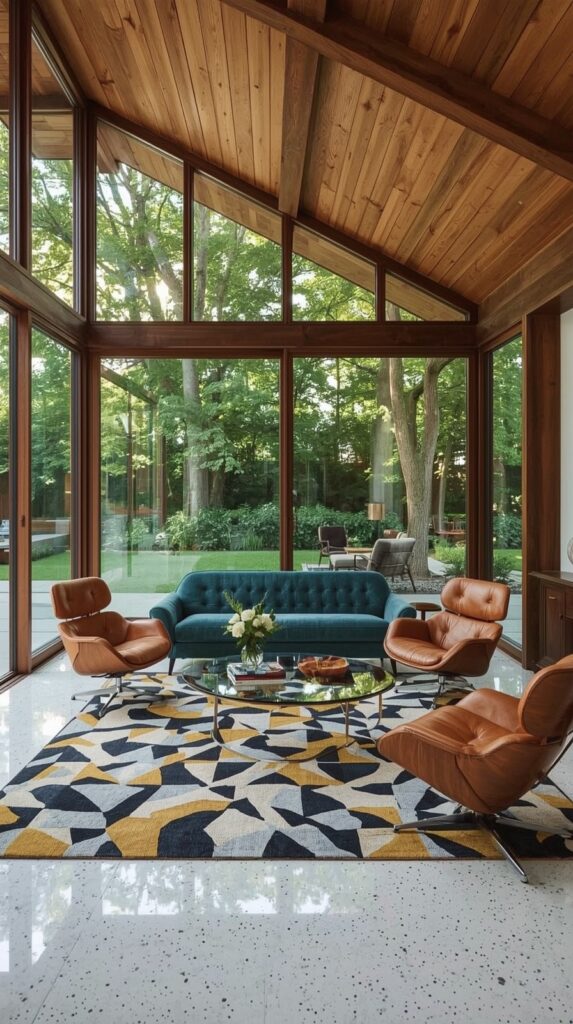
So you stumbled across a photo of the most gorgeous living room ever — high wood ceilings, floor-to-ceiling glass walls, lush trees right outside, leather chairs that look like they belong in a fancy architect’s house, and a teal sofa that somehow ties everything together perfectly. And now you can’t stop thinking about it.
Same.
The good news? This look — which is called mid-century modern, though it’s honestly more of a “I want my house to feel like a chic forest cabin that also happens to be incredibly sophisticated” vibe — is totally buildable. Whether you’re starting from scratch, renovating an existing space, or just want to refresh a room with some key pieces, this guide is going to walk you through every single element in that photo and tell you exactly how to recreate it.
We’re talking ceilings, floors, windows, furniture, rugs, coffee tables, accessories, lighting, and even the view outside. We’re going all in. Let’s build something beautiful.
Part 1: The Bones of the Room — Architecture First
Before you go furniture shopping (don’t worry, we’ll get there), you need to understand that the reason this room looks so incredible starts with the structure of the space itself. The architecture is doing at least 60% of the heavy lifting here, and if you want to nail this look, you need to start from the ground up — literally.
1) The Cathedral Ceiling (aka The Star of the Show)
The moment your eyes land on this room, the first thing that hits you is that ceiling. It’s high. It’s dramatic. It’s covered in warm, rich wood planks that run the length of the room, and it peaks at the center in a classic A-frame or cathedral style. It’s the kind of ceiling that makes you feel like you’re in a very, very fancy treehouse.
What you’re looking at: This is a vaulted cathedral ceiling clad in tongue-and-groove wood planks, most likely cedar or pine. The planks are installed horizontally across the ceiling, following the slope of the roofline, and the wood has a warm, medium-brown stain that brings out all the natural grain.
If you’re building new or doing a major renovation, a vaulted ceiling is created by removing the flat drywall ceiling and exposing the roofline from inside. This requires structural work — you’ll need an architect or structural engineer to make sure your roof can handle the open span without support beams getting in the way. In this room, the ceiling appears to be a clean, open span, which means the structural support is handled by the walls and possibly hidden steel beams.
For the wood cladding, tongue-and-groove cedar planks are the go-to choice. They interlock neatly, lie flat, and look stunning. You can buy them pre-stained or stain them yourself. If you want that exact warm, honey-brown look from the photo, look for a medium walnut or cedar stain — not too dark, not too orange, just right.
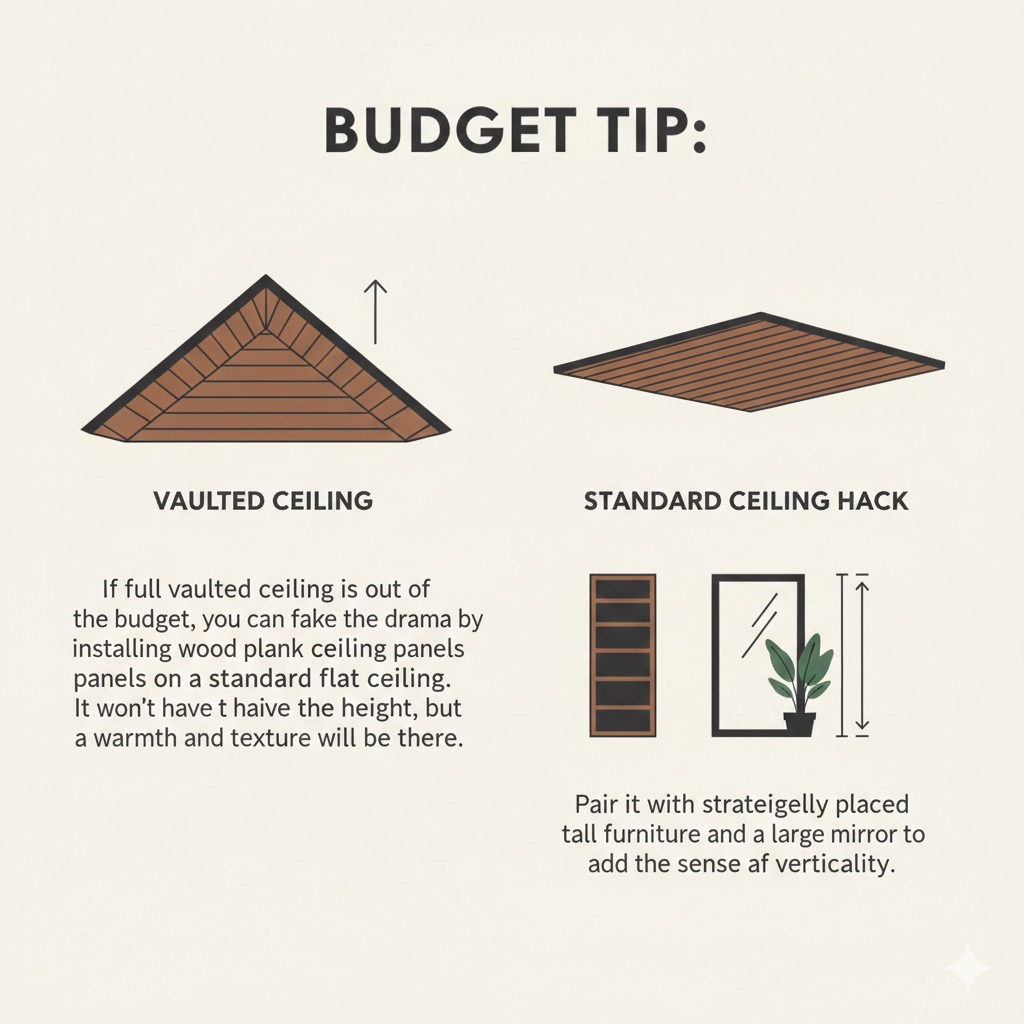
Budget tip: If a full vaulted ceiling is out of the budget, you can fake the drama by installing wood plank ceiling panels on a standard flat ceiling. It won’t have the height, but the warmth and texture will be there. Pair it with strategically placed tall furniture and a large mirror to add a sense of verticality.
What to shop for: Tongue-and-groove cedar planks (typically 1×6 or 1×8 inches wide), a medium walnut or warm brown stain, and a polyurethane finish to seal and protect the wood from humidity.
2) The Floor-to-Ceiling Glass Walls
This is the feature that takes this room from “nice house” to “jaw-dropping architectural masterpiece.” The entire back wall — and then some — is made of glass. Big, beautiful, floor-to-ceiling glass panels framed in dark wood, letting in an insane amount of natural light and basically making the lush garden outside feel like a living painting on your wall.
This is the big-ticket architectural feature of the room. Floor-to-ceiling glazing systems like this are typically custom-ordered from glazing specialists or purchased as curtain wall systems. Here’s what you need to think about:
The framing: Mid-century modern design loves wood-framed windows. You’re looking for dark-stained wood frames — likely mahogany or walnut-stained pine — in a grid pattern. The frames are structural and part of the wall system, meaning they’re built into the actual construction of the house, not just hung.
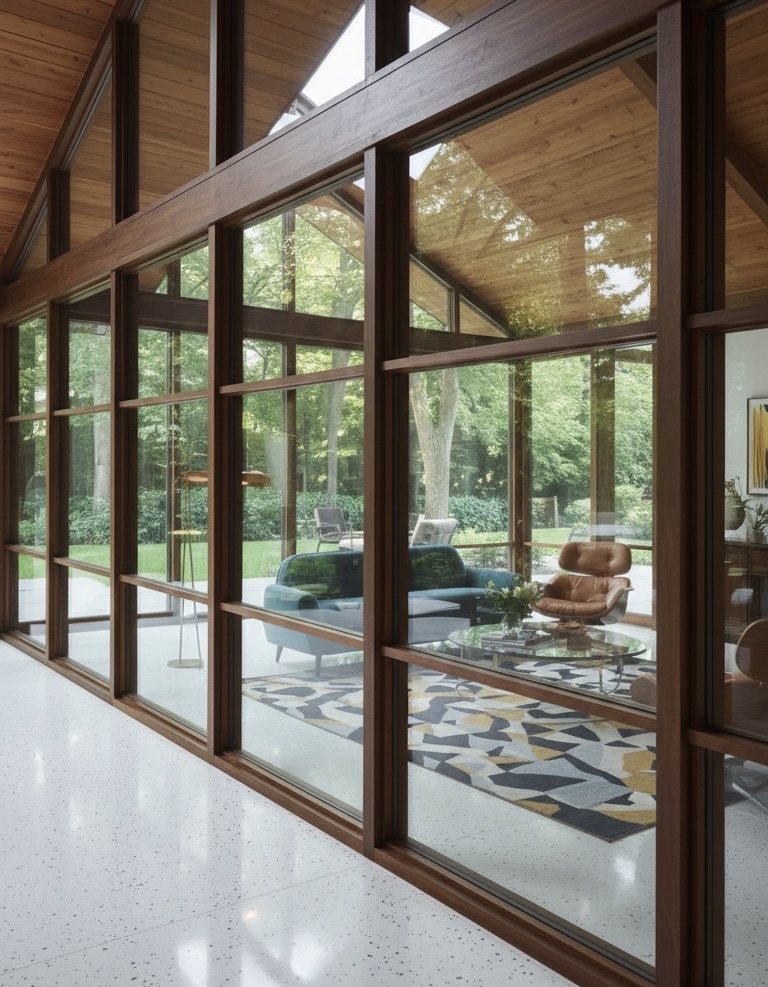
The glass: For a wall this large, you’ll need double or triple-pane insulated glass units (IGUs). These help with energy efficiency, keeping heat in during winter and cool air in during summer. For floor-to-ceiling panels this size, tempered safety glass is required by building code.
The layout: The windows in the photo appear to follow a grid pattern — large rectangular panes at the bottom, with the upper triangular sections filled in with glass to follow the roofline. This creates a dramatic peaked window wall that mirrors the cathedral ceiling above.
What to shop for: Custom wood-framed curtain wall or window wall system, tempered insulated glass panels, dark walnut or mahogany-stained frame finish. Work with a glazing contractor or architect for this one — it’s not a DIY project, but it’s worth every penny.
Apartment or rental hack: Can’t knock out a wall and add floor-to-ceiling windows? Get as close as possible by hanging sheer, floor-to-ceiling curtains in a warm cream or white on a ceiling-mounted rod to mimic the tall vertical lines. Place large mirrors to reflect light. Add a large indoor tree (like a fiddle leaf fig or a big bird of paradise) in front of your existing windows to bring the outside in.
3) The Terrazzo Floor
Look down. That floor is absolutely gorgeous. Polished terrazzo in a light, speckled pattern — creamy white base with little flecks of grey, black, and possibly green or gold scattered throughout. It’s smooth, reflective, and luxurious without being fussy.
What you’re looking at: Terrazzo is a composite flooring material made from chips of marble, quartz, granite, or glass set into a cement or epoxy resin base, then ground down and polished to a smooth, glossy finish. It was hugely popular in mid-century architecture (think 1950s and 60s public buildings and upscale homes), and it’s having a massive comeback — and for good reason.
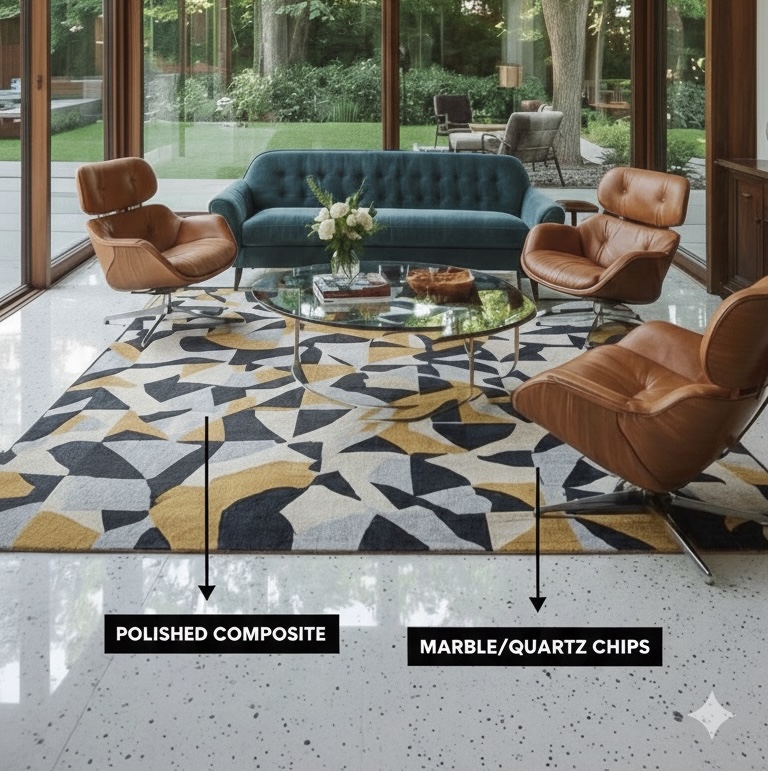
Traditional terrazzo is poured in place by a terrazzo contractor. The process involves pouring a layer of cement or epoxy resin mixed with aggregate chips, letting it set, then grinding and polishing the surface until it’s silky smooth. The result is seamless — no grout lines, no tile edges, just a continuous polished surface that looks like a work of art.
For this specific room, the terrazzo appears to be a light neutral base with small-to-medium chips. The finish is high-gloss polished, which creates that beautiful light-reflective quality you see in the photo.
DIY-friendly alternatives:
- Terrazzo-look porcelain tiles: Many tile manufacturers now make large-format porcelain tiles that mimic the terrazzo look closely. They’re much more affordable and easier to install.
- Terrazzo-look vinyl plank or LVT: Even more budget-friendly, these come in sheets or planks and can be DIY-installed over existing floors.
- Epoxy terrazzo coating: You can apply a terrazzo-look epoxy coating over existing concrete floors — a popular choice for renovations.
What to shop for: For authentic terrazzo, contact a certified terrazzo contractor. For tiles, look for “terrazzo effect porcelain tiles” in a light/white base with grey and black chips. Sizes of 24×24 inches or larger will look most authentic.
Part 2: The Furniture — Getting That right Mix
This is where the fun really starts. The furniture in this room is a masterclass in mid-century modern done right. It’s a careful balance of colors, textures, and shapes — and every single piece earns its place.
1) The Teal Tufted Sofa (The Hero Piece)
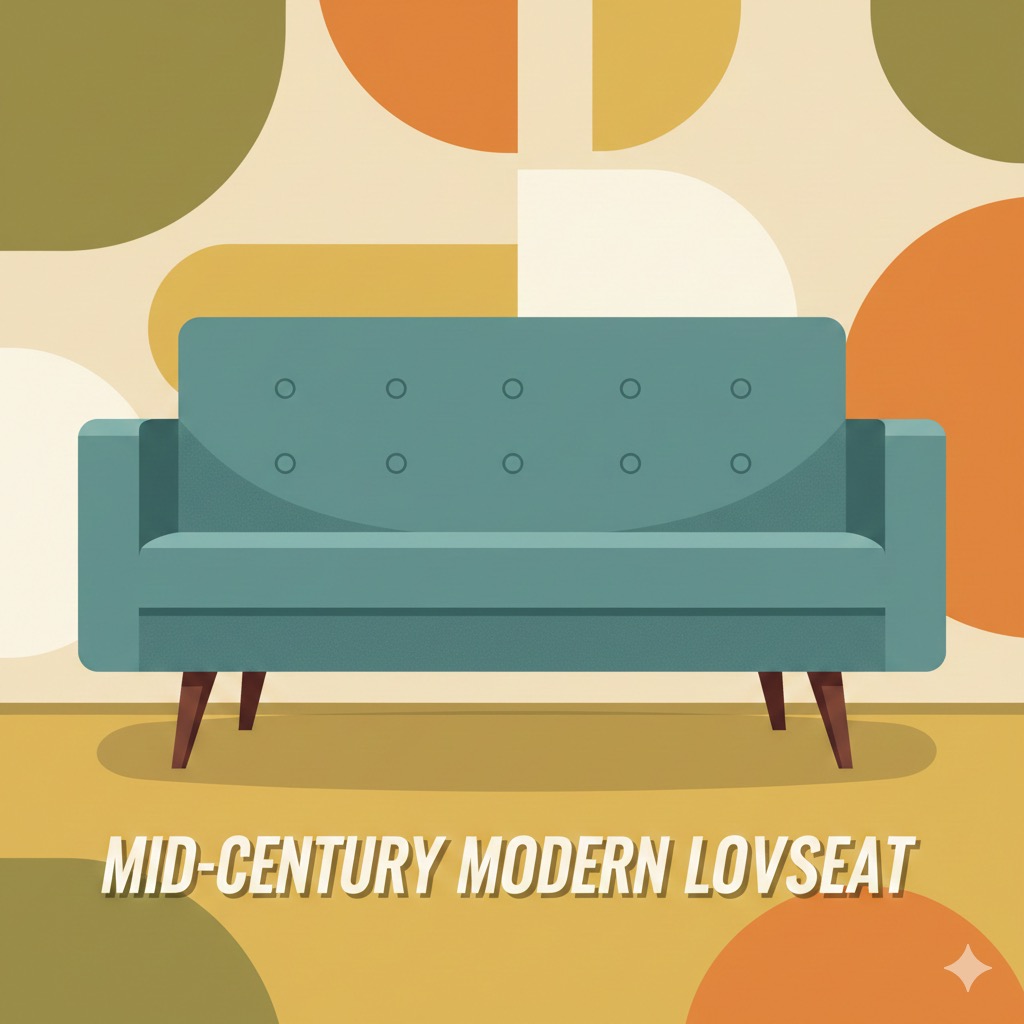
Front and center, the teal sofa is the beating heart of this room. It’s the piece that everything else responds to. The color is deep, saturated, jewel-toned — somewhere between teal and peacock blue — and the upholstery is a velvet or velvet-like fabric with button tufting across the back.
What you’re looking at: This is a mid-century modern style loveseat or two-seater sofa, probably around 60-70 inches wide. The silhouette is very characteristic of the era: slightly low to the ground, with tapered wooden legs, a clean boxy profile, and button tufting on the back cushion. The arms are narrow and simple.
How to find it:
Search terms to use: “mid-century modern tufted sofa teal,” “button tufted velvet loveseat peacock blue,” “retro tufted sofa with wooden legs.” You’ll find great options at stores like Article, CB2, West Elm, AllModern, and Joybird. Joybird, in particular, is famous for this exact look.
Things to look for when shopping:
- The legs: They must be tapered wood legs, not metal and not bulky. Walnut-finish legs are ideal.
- The seat height: Aim for around 17-18 inches from floor to seat cushion for that authentic low-profile look.
- The fabric: Velvet or performance velvet gives the richest color payoff. Linen or tweed works too but won’t look as saturated.
- The tufting: Button tufting on the back only (not the seat cushions) is the more sophisticated, authentic look.
Color: If you can’t find the exact teal, look for “peacock,” “teal,” “petrol blue,” or “forest teal” in the product color options.
2) The Eames Lounge Chairs (The Icons)
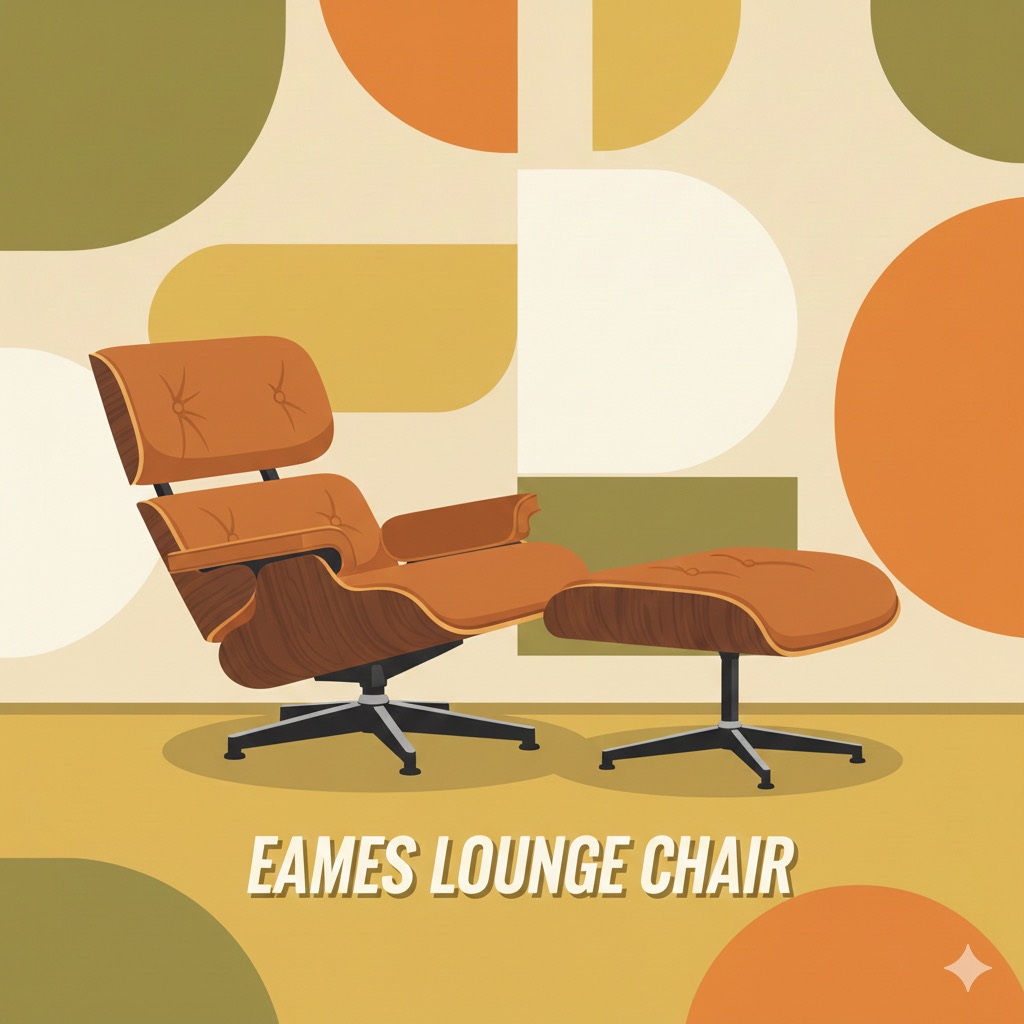
Oh, you know these. Those gorgeous, sculptural, cognac-colored leather chairs with the matching ottoman? Those are — or are inspired by — the iconic Eames Lounge Chair and Ottoman, designed by Charles and Ray Eames in 1956 for Herman Miller. They are arguably the most famous chair design in history, and they look absolutely perfect in this room.
There are three of them in this photo — two upright facing the sofa and one positioned slightly more casually in the front right of the frame. That clustering creates an inviting, conversational seating arrangement that feels both formal enough for entertaining and relaxed enough for a cozy Sunday afternoon.
What you’re looking at: The Eames Lounge Chair has a deeply reclined shell made of molded plywood (usually walnut veneer), padded with leather cushions. The base is a four-star aluminum base on a swivel. The leather in this photo is that gorgeous warm cognac/saddle brown color that just gets better with age.
How to find it:
The authentic version: Herman Miller still makes the original Eames Lounge Chair and Ottoman, and it will cost you anywhere from $5,000 to $9,000 per set. Yes, it’s expensive. Yes, it’s worth it if you can swing it. These are genuinely heirloom pieces.
The replica version: There is a massive market for Eames-style lounge chair replicas, ranging from very poor quality to genuinely excellent. Brands like Kardiel, Manhattan Home Design, and Philippe Collection offer well-made versions for $600-$1,500. Look for ones that use genuine leather (not PU/faux leather), actual walnut veneer plywood shells, and aluminum swivel bases.
What to look for in a replica:
- Genuine aniline-dyed leather or full-grain leather
- Three-piece shell construction (the authentic chair has a three-piece shell — seat, back, and headrest — that are each slightly different angles)
- Walnut veneer with visible wood grain
- Five-star or four-star aluminum base
- Swivel function
Color: Cognac, saddle brown, or tan leather. This warm brown plays beautifully against both the teal sofa and the wood ceiling
3) The Glass Coffee Table
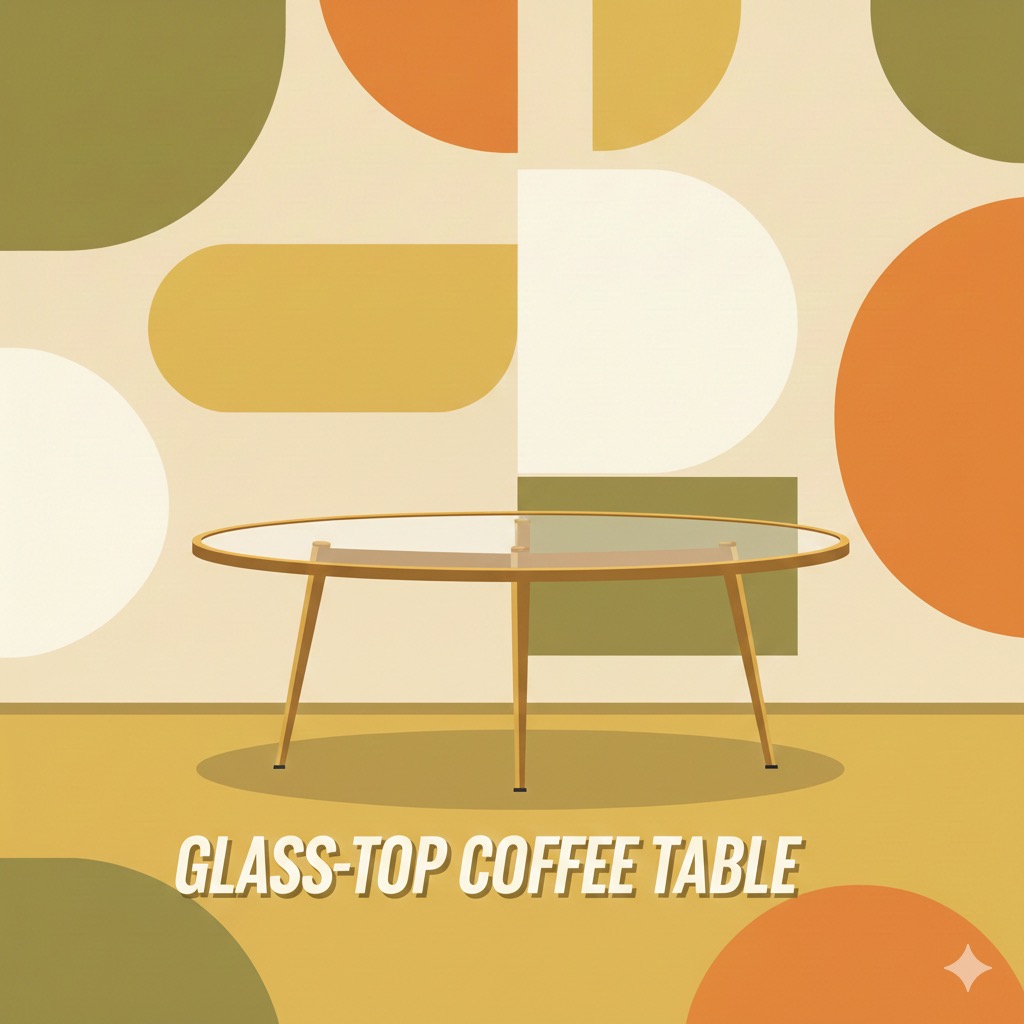
Sitting at the center of the seating arrangement is a round glass coffee table on a thin metal base. It’s low (as mid-century tables should be), it’s light and airy (glass doesn’t visually weigh down the space), and it lets you see the gorgeous rug underneath without interruption.
What you’re looking at: An oval or round glass-top coffee table, likely with a thin brass or gold-toned metal frame/base. The legs appear to be slim and slightly angled in a classic tripod or four-leg spread. The glass top is clear, and it sits at the standard coffee table height of around 16-18 inches.
How to find it:
Search terms: “mid-century modern glass coffee table oval,” “glass top coffee table gold legs,” “retro glass coffee table round.”
Great retailers for this include West Elm (their mid-century glass tables are excellent), CB2, AllModern, and Wayfair. Vintage and thrift stores are incredible for finding authentic mid-century glass tables at a fraction of retail prices — look for them at estate sales and antique markets.
What to look for:
- Slim metal legs, not chunky
- Clear or lightly tinted glass top (not smoked glass for this look)
- Warm metal tones — brass, gold, or champagne — rather than chrome
- Low profile — the table should sit at roughly knee height
Styling the table: In the photo, the table is dressed simply and beautifully — a glass vase with fresh white flowers, a couple of books stacked casually, and a ceramic or wooden bowl with a few items. That’s it. Resist the urge to pile stuff on it. Less is more with glass tables.
Part 3: The Rug — The Foundation of the Whole Room
If the sofa is the hero, the rug is the stage it performs on. And this rug is seriously something else.
1) The Bold Geometric Area Rug
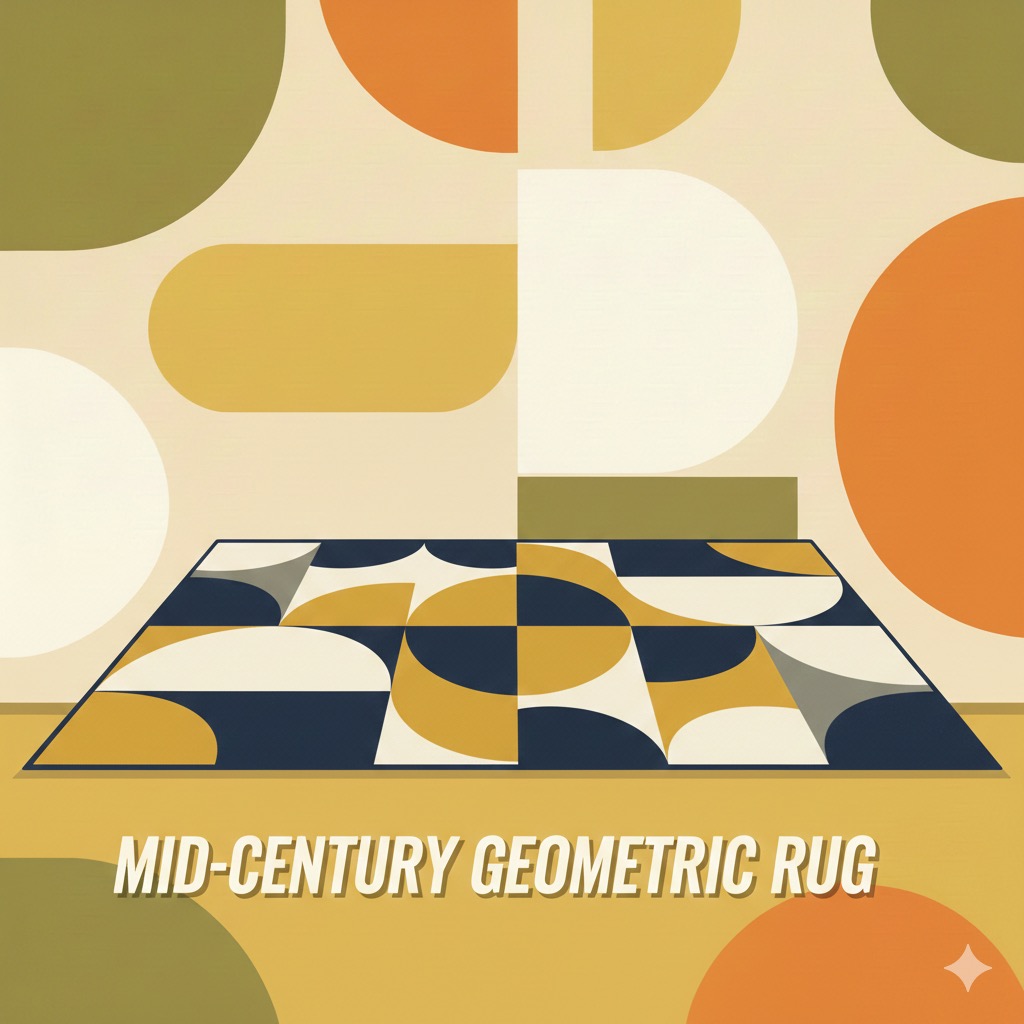
The rug in this room is large — probably 8×10 or 9×12 feet — and it features a dynamic geometric pattern in navy blue, mustard yellow, cream, and soft grey. The shapes are angular and abstract, almost like a deconstructed starburst or pinwheel pattern. It’s bold. It’s graphic. It’s the visual anchor of the entire seating arrangement.
What you’re looking at: This is a flat-weave or low-pile area rug with an abstract geometric pattern. The color palette — navy, mustard/gold, cream, and grey — is absolutely classic mid-century modern. It references the graphic design sensibility of the 1950s and 60s without copying any one specific historic pattern.
How to find it:
Search terms: “geometric abstract rug navy mustard,” “mid-century modern area rug bold pattern,” “angular starburst rug navy yellow grey.”
Rugs USA, Lulu and Georgia, Joss & Main, Wayfair, and Society6 all carry rugs in this style. For a more artisan feel, Etsy has incredible hand-knotted or hand-tufted rugs with bold geometric patterns at various price points.
What to look for:
- Size: Go big. In a living room this scale, an 8×10 is the minimum. The rug should sit under the front legs of all the seating, creating a unified zone.
- Pattern scale: The pattern should be large-scale and graphic, not tiny and busy.
- Color palette: Stick to navy or dark blue, mustard or ochre yellow, cream or off-white, and grey. This combo is the mid-century sweet spot.
- Pile height: Low pile or flat-weave will look most authentic and will be easier to maintain under a swiveling lounge chair.
- Material: Wool is ideal for durability and natural texture. Polypropylene is a great budget-friendly option that’s also easy to clean.
Placement: The rug should be centered under the coffee table and seating arrangement. All the legs of the sofa should be on the rug, at least the front two legs of the chairs, and the coffee table should sit fully on the rug.
Part 4: The Color Story — How These Colors Work Together So Well
Let’s take a moment to talk about why this room looks so cohesive and visually satisfying. It’s not an accident. The colors have been carefully chosen to work together in a very specific way.
1) The Palette Breakdown
Warm wood tones (ceiling, window frames, chair shells): These are the foundation. The warm brown of the wood reads as a neutral in this context — it’s everywhere, from ceiling to floor to furniture frames, tying everything together.
Cream/white (terrazzo floor, rug background, flowers): The light floor and light areas of the rug create breathing room. Without these light elements, all that dark wood and saturated color would feel heavy.
Teal/peacock blue (sofa): This is the cool counterpoint to all the warmth. A deeply saturated jewel tone that stands out against the wood backdrop while also echoing the greens and blues of the garden outside.
Cognac/saddle brown (leather chairs): A warm, rich brown that bridges the gap between the wood tones and the teal. It’s warm like the wood but deeper and richer. This is what ties the furniture together.
Navy and mustard (rug): The rug picks up both the warm and cool tones from the room and intensifies them. The navy references the teal of the sofa; the mustard references the warm golds in the wood.
Green (the view outside): The outdoor greenery isn’t just a pretty view — it’s part of the color palette. The green of the trees comes right through those glass walls and acts as a fifth color in the room. This is why indoor-outdoor connection is so important in this design style.
2) How to Apply This to Your Space
When shopping for furniture and decor, keep this mental checklist:
- At least one piece in a jewel tone (teal, deep green, mustard, rust, or burgundy)
- Warm wood in at least two places (ceiling, floor, furniture legs, or frames)
- A neutral foundation (light rug, light floor, white or cream walls)
- Warm brown leather as a grounding element
- Bring in the outdoors with plants or a garden view where possible
Part 5: Lighting — How to Illuminate This Look
You might be wondering about artificial lighting since the photo is taken in beautiful natural daylight. But eventually the sun goes down, and you need your space to still look incredible at night.
1) Natural Light First
This room is designed to maximize every ray of natural light that enters. Those floor-to-ceiling windows aren’t just for the view — they flood the room with light all day long. The polished terrazzo floor reflects that light back up, bouncing it around the room. The wood ceiling absorbs some light and adds warmth. The glass coffee table reflects light from multiple angles. Every material choice has been made with light in mind.
To recreate this in your space:
- Remove heavy curtains or blinds if possible, or replace them with sheer panels
- Use high-gloss or polished flooring materials that reflect light
- Add mirrors strategically to bounce light around
- Keep window sills clear of clutter
- Choose furniture with glass or reflective surfaces
2) Artificial Lighting Plan
For a room like this, you want a layered lighting approach:
Ambient lighting (the general glow): Recessed lighting in the ceiling is the cleanest option for a mid-century modern space — you don’t want big, clunky ceiling fixtures competing with that gorgeous ceiling. Use warm white bulbs (around 2700-3000K) and install them on a dimmer.
Task and mood lighting: A pair of floor lamps positioned behind or beside the lounge chairs are essential. Look for arc floor lamps or tripod floor lamps with warm brass or walnut-finished details and a fabric drum shade in white or cream. The Arco lamp by Flos is the quintessential mid-century modern floor lamp — it’s expensive but stunning. Lookalikes are everywhere.
Table lamps: A pair of table lamps on side tables flanking the sofa adds warmth and symmetry. Look for ceramic base lamps in earthy or jewel tones — a deep teal, a warm mustard, or a rich walnut base would all be perfect here.
Accent lighting: If you want to show off that incredible ceiling, consider installing directional spotlights or wall-mounted uplights to cast light upward onto the wood planks at night. This creates a dramatic, cozy warmth after dark.
What to shop for: Brass arc floor lamp, tripod floor lamp, ceramic table lamp, recessed LED downlights with dimmer, warm white bulbs 2700-3000K.
Part 6: The Side Tables and Smaller Furniture
Between and beside the main seating pieces, you’ll notice a few supporting players doing important work.
1) Side Tables
In the photo, there appear to be one or two small side tables nestled between or beside the chairs. These are small, circular or square, and likely have a simple pedestal or single-leg base.
What to shop for: Look for side tables in walnut veneer, solid walnut, or wood with brass accents. Tulip-style side tables (round top on a single pedestal base), hairpin-leg side tables, or simple drum side tables all work beautifully. Keep them small — 18 to 22 inches in diameter is ideal — and low, around 20-24 inches tall.
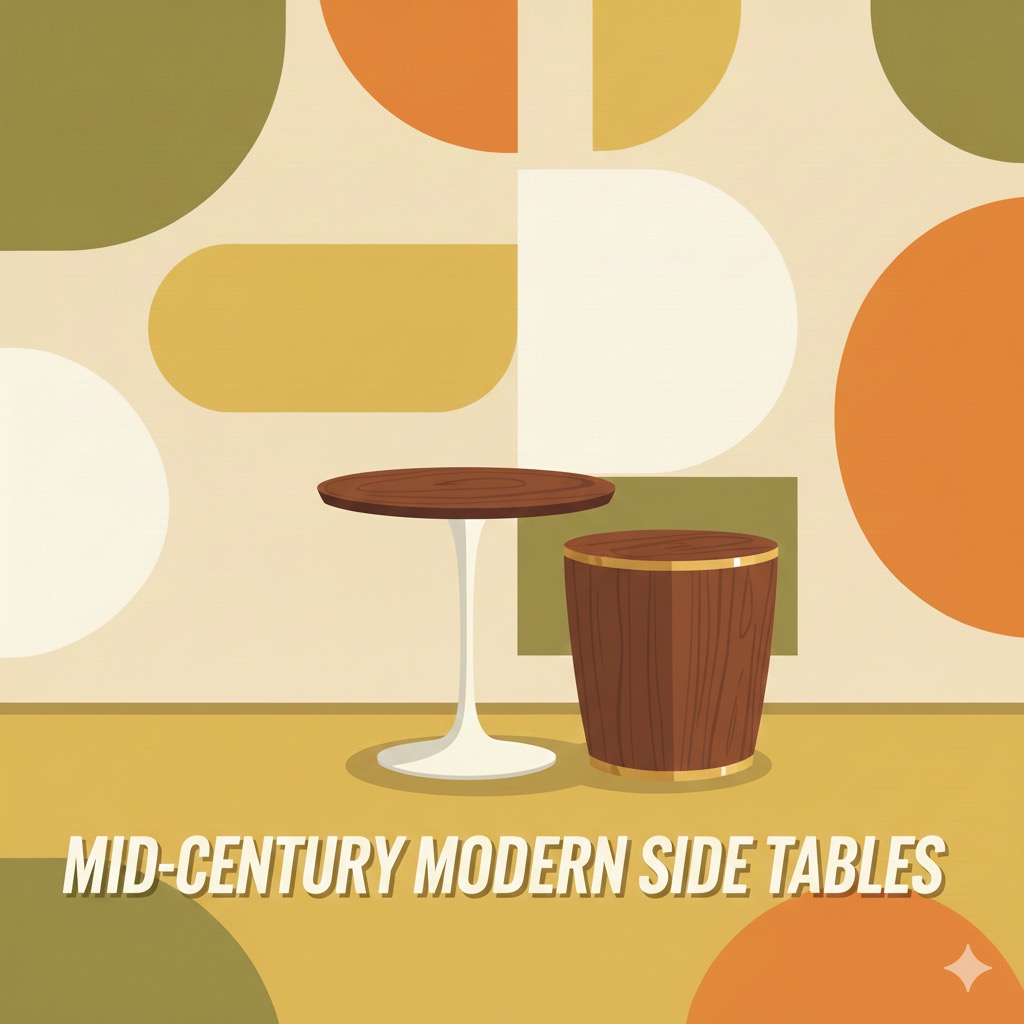
Great options: The Noguchi side table, any variation of a Saarinen tulip table, or any small round table with a thin metal or wood pedestal leg.
2) The Credenza or Media Cabinet (Visible on the Right)
On the far right edge of the photo, you can see what appears to be a low-profile credenza or sideboard in a dark wood finish. This is another hallmark mid-century modern furniture piece.
What you’re looking at: A low, horizontal cabinet — probably 60-72 inches wide and only about 30 inches tall — with sliding or hinged doors and possibly tapered legs. This style of furniture (often called a “credenza” or “Danish sideboard”) was everywhere in mid-century modern homes and is still being produced today in almost identical forms.
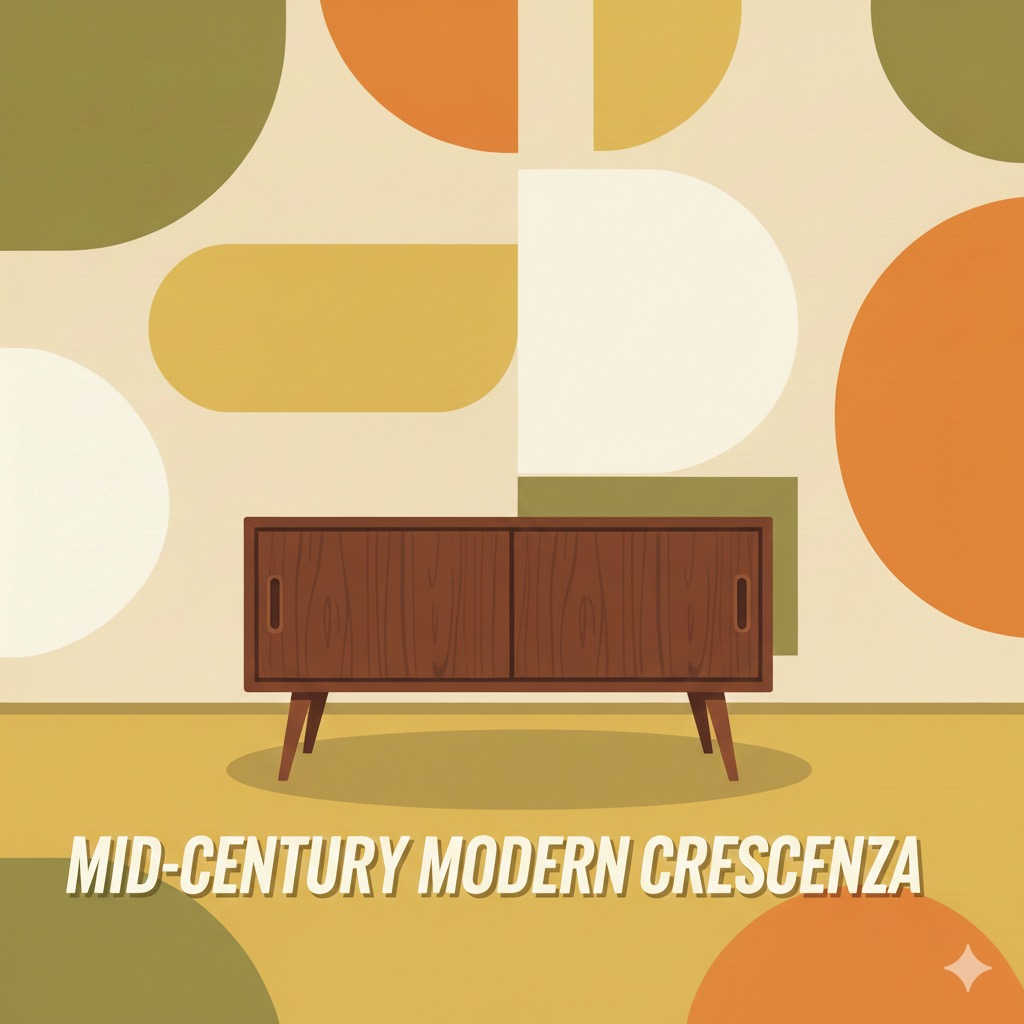
What to shop for: Look for “mid-century modern sideboard,” “Danish credenza,” or “mid-century credenza walnut.” West Elm, Article, Joybird, and Scandinavian Designs all make great versions. For authentic vintage pieces, check 1stDibs, Chairish, Facebook Marketplace, and local estate sales. Brands like Lane, Drexel, and Broyhill made incredible credenzas in the 1950s-70s that are widely available on the vintage market.
What to look for:
- Low profile (30 inches or shorter)
- Walnut or teak veneer
- Tapered wooden legs
- Clean, hardware-free or minimal-hardware doors (wooden pulls, not metal)
- Horizontal orientation (wider than it is tall)
Part 7: The Accessories and Styling
This is where you add personality and warmth to the space without cluttering it up. Mid-century modern styling is all about restraint — a few well-chosen objects rather than shelves full of stuff.
1) Fresh Flowers
Front and center on the coffee table is a glass vase with fresh white flowers — looks like hydrangeas or ranunculus. This simple gesture adds life, fragrance, and a natural softness to an otherwise structured room.
How to style it: Use a clear glass vase (cylindrical or bubble-shaped) and fill it with white or cream flowers. Keep it simple — one type of flower is more elegant than a mixed bouquet in this context. Replace weekly to keep the room feeling fresh and alive.
2) Coffee Table Books
A small stack of two or three oversized coffee table books sits casually on the table. These are functional objects (you can actually read them!) and also work as decor. Look for books with beautiful covers — architecture, photography, design, travel, or art books all work here.
What to shop for: Books with minimal, graphic covers in white, black, or neutral tones. Stand them in a stack of two or three, varying sizes. Great topics for this aesthetic include mid-century architecture, Scandinavian design, nature photography, and modernist art.
3) A Decorative Bowl
On the coffee table, there’s also a shallow decorative bowl — it appears to be ceramic or wood, earthy and warm in tone. This is the kind of object that holds things casually (keys, a candle, small stones) or just exists as a sculpture.
What to shop for: A low, wide ceramic bowl in earthy tones — terracotta, warm brown, olive, or cream. Brands like Heath Ceramics, Hasami, and many small ceramic artists on Etsy make gorgeous options.

4) Plants and Greenery
While the main greenery in this room is the dramatic forest view outside, any recreation of this look needs indoor plants to bridge the gap between inside and outside.
Best plants for this look:
- Fiddle leaf fig (tall, dramatic, architectural)
- Bird of paradise (large leaves, tropical feel)
- Monstera deliciosa (big graphic leaves, very mid-century)
- Snake plant (sculptural, low-maintenance, great in corners)
- Olive tree (soft, airy, sophisticated)
Place a large statement plant in a corner, near the windows, or beside the credenza. Use simple ceramic or concrete planters — no fussy baskets or elaborate stands.
Part 8: The Connection to the Outdoors
One of the most defining features of this room — and of mid-century modern design in general — is the way it blurs the boundary between indoors and outside. Those floor-to-ceiling windows exist specifically to bring the garden into the room. The colors of the outdoor landscape (green trees, blue sky) become part of the room’s palette. The light from outside is the room’s primary light source.
1) Designing Your Outdoor Connection
If you have any control over your yard or garden, think about what’s visible from inside the living room. In this photo, the view is of a lush, mature garden with large deciduous trees, green lawn, sculptural shrubs, and what looks like some outdoor furniture in the distance.
For your own space:
- Plant large trees or tall shrubs near the house to frame the view
- Keep the immediate area outside the windows clean and green — not paved or cluttered
- Add a small outdoor seating area that’s visible from inside, creating depth and interest in the view
- Use drought-tolerant, low-maintenance plants so the garden always looks good without constant work
2) Bringing the Outside In
Even if your windows aren’t floor-to-ceiling, you can create a stronger indoor-outdoor connection by:
- Placing large potted trees near windows
- Choosing upholstery and rug colors that reference nature (greens, blues, earthy tones)
- Using natural materials throughout (wood, stone, ceramic, leather)
- Keeping window treatments minimal or sheer
Part 9: The Overall Layout and Furniture Arrangement
Getting the furniture placement right is just as important as getting the furniture itself right. The arrangement in this room is a classic conversational seating layout — all seats face each other around a central point (the coffee table), creating an intimate and welcoming setup.
The Conversational Seating Arrangement
The sofa sits at one end of the rug, facing toward the windows. Two lounge chairs sit on either side of the sofa (one to the left, one to the right), and a third chair is placed at the front right, slightly angled. The coffee table sits in the center.
This arrangement means that no matter where you sit, you can make eye contact with everyone else in the room. It’s sociable and warm — perfect for conversations, entertaining, and cozy evenings in.
How to build this:
- Start with the sofa as your anchor piece, placed with its back to the wall or toward one end of the space
- Position lounge chairs on either side at slight angles (not perfectly parallel to the sofa, but angled slightly inward)
- Place the coffee table in the center, close enough to all seats to be reachable (about 18 inches from sofa edge is ideal)
- If you have a fourth seat, angle it at the foot of the seating arrangement to close the “circle”
Part 10: How to Pull This Off Room by Room (Budget Tiers)
Not everyone is building a glass-walled forest house from scratch. Here’s how to get this look at three different investment levels.
The “Dream Budget” Approach ($50,000+)
You’re renovating or building. Do the full thing: vaulted wood-plank ceiling, floor-to-ceiling glazing system, polished terrazzo floors, Herman Miller Eames chairs, Joybird or custom sofa, authentic vintage credenza, custom rug. This is the full expression of the look, and done right, it’s absolutely incredible.
The “Serious Investment” Approach ($10,000–$30,000)
You’re working with an existing space but willing to make some big moves. Consider:
- Installing a wood plank ceiling (either vaulted if structure allows, or flat application over existing ceiling): $3,000–$8,000
- Replacing flooring with terrazzo-look large-format porcelain tiles: $3,000–$7,000
- Buying high-quality replica Eames chairs in genuine leather: $1,200–$2,500
- Finding a beautiful mid-century sofa in velvet teal from a quality retailer: $1,500–$3,000
- A statement geometric rug: $500–$1,500
- A glass coffee table: $400–$800
- A vintage or quality-replica credenza: $800–$2,000
You’re working with what you have but making targeted upgrades:
- A bold geometric area rug: $200–$600
- A velvet teal accent chair or sofa if your current sofa is neutral: $600–$1,200
- Warm-toned throw pillows in cognac, mustard, and navy: $150–$300
- Rearranging existing furniture into the conversational layout
- Adding large indoor plants in simple planters: $100–$300
- Coffee table styling (books, ceramics, flowers): $100–$200
- A statement floor lamp with warm brass tones: $200–$500
- Replacing existing light bulbs with warm white LED: $50–$100
Part 11: The Key Shopping List (Everything You Need)
Here’s your master shopping list with search terms and where to look for each item:
Architectural elements (professional installation required):
- Tongue-and-groove cedar planks for ceiling (lumber yard, home improvement store)
- Medium walnut or cedar stain + polyurethane sealer
- Large-format terrazzo-effect porcelain tiles (tile specialty store)
- Floor-to-ceiling window/glazing system (glazing contractor, custom fabrication)
Furniture:
- Teal/peacock velvet tufted sofa with walnut legs (Joybird, Article, West Elm, CB2)
- Eames-style lounge chairs + ottomans in cognac leather (Herman Miller for authentic; Kardiel, Manhattan Home Design for quality replicas)
- Round or oval glass top coffee table with brass/gold legs (West Elm, CB2, vintage/antique market)
- Low-profile walnut credenza/sideboard (West Elm, Article, Joybird, vintage market)
- Small walnut or brass side tables (West Elm, AllModern, Etsy)
Rug:
- Bold geometric area rug, 8×10 or 9×12, navy/mustard/cream/grey palette (Rugs USA, Lulu and Georgia, Joss & Main, Etsy)
Lighting:
- Arc floor lamp or tripod floor lamp, brass finish (CB2, Article, Rejuvenation)
- Ceramic table lamps in jewel tone or earthy finish (West Elm, Anthropologie, Etsy)
- Warm white LED bulbs, 2700K (any hardware store)
Accessories:
- Clear glass cylindrical vase (IKEA, West Elm, Crate & Barrel)
- Fresh white flowers (hydrangea, ranunculus, or white roses)
- 2-3 oversized coffee table books (bookstores, used bookshops, thrifted)
- Low wide ceramic bowl in earthy tones (Heath Ceramics, Etsy, local ceramicists)
- Large indoor plant: fiddle leaf fig, bird of paradise, or monstera (local garden center)
- Simple ceramic or concrete planter
Final Thoughts
Here’s the thing about this room that makes it so incredibly appealing beyond just the individual pieces and materials. It has a spirit. It has a philosophy.
This is a room that says: *I love where I live. I want to be surrounded by beautiful things that were made thoughtfully and