
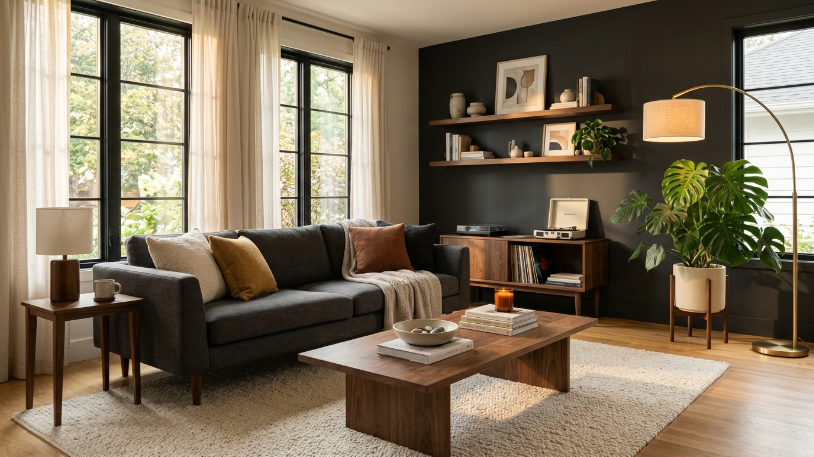
A charcoal and warm wood living room is one of the most rewarding combinations you can build. The pairing works because the two tones balance each other naturally: the cool depth of charcoal steadies the richness of warm wood, and neither one overwhelms the other. You get a space that feels grounded and confident without trying too hard.
This guide walks you through the full build, step by step. Start at Step 1 and work forward. Each step builds on the one before it, so you are layering the room rather than randomly adding things and hoping they click. There is a clear logic to the order, and following it will save you money, returns, and a lot of second-guessing.
Before you shop for a single thing, read all nine steps once. Getting the full picture first means better decisions at every stage. Also, note that the charcoal and warm wood palette is forgiving in many ways, but it rewards attention to material quality and tone. A slightly off-warm wood or a charcoal that pulls too blue can undercut the whole look. The details covered in these steps are the ones that actually matter.
Step 1: Plan Your Layout Before You Buy Anything
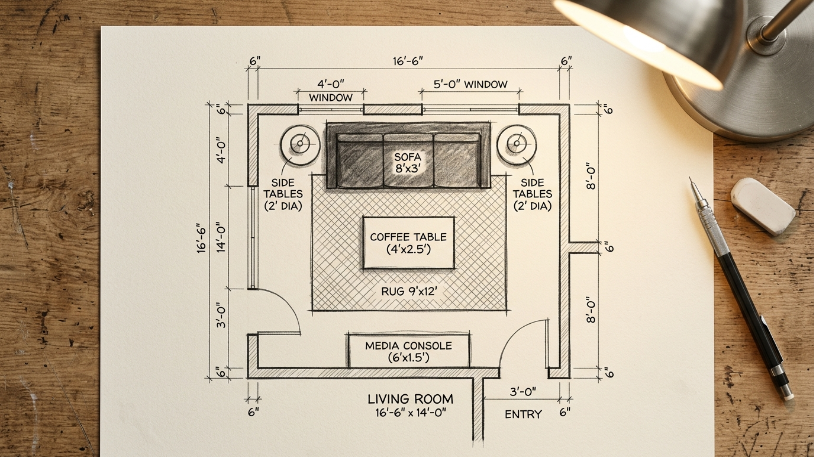
The biggest mistake in any living room project is buying furniture before understanding the room. Layout is the foundation. It decides every sizing decision you make from sofa width to rug dimensions, and getting it wrong means expensive returns or pieces that never fit properly.
Start by measuring the room from wall to wall. Note where the doors and windows are, and mark which wall gets the most natural light and which gets almost none. Charcoal walls absorb light rather than reflect it, so the north-facing wall of a room with limited windows will get very dark. That is not automatically a problem, but it changes your lighting plan in Step 7.
Next, decide where the sofa will sit. In most living rooms, the sofa is the anchor and everything else arranges around it. For a charcoal and warm wood room, place the sofa facing either a fireplace, a media console, or a large window. Work out the coffee table, accent chairs, and any side tables on paper before ordering anything.
Leave enough clearance for comfort. About 18 inches between the sofa and coffee table is a workable distance. Walkways around the seating zone need at least 30 inches, ideally 36. Smaller rooms can still carry this look; you just edit down the number of pieces rather than forcing everything in.
Before you order any large furniture, tape out the footprint on your actual floor. Live with the tape for a day. It is consistently the fastest way to know whether a size will work.
Step 2: Set Your Color Base for a Charcoal and Warm Wood Room
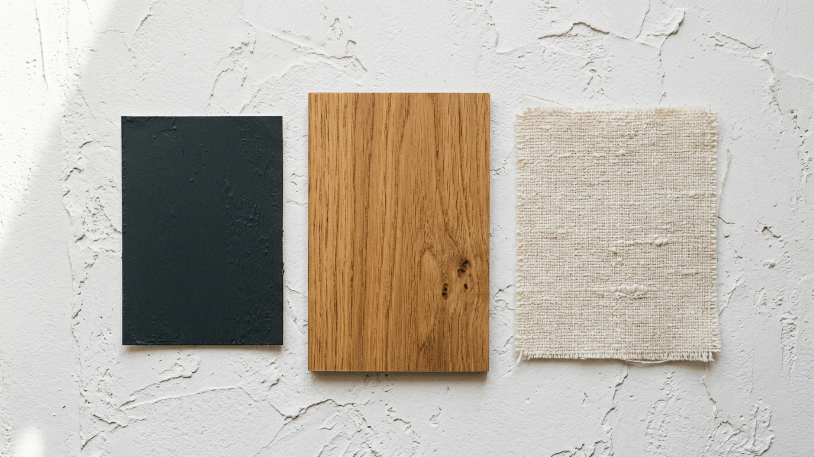
The palette for this look is controlled. You are working with two main tones, charcoal and warm wood, plus one or two neutrals, and small accent colors get added much later. Introducing too many colors now is the fastest way to lose the cohesion you are trying to build.
Charcoal can live on the walls, on the sofa, or on both. If you paint the walls charcoal, keep the sofa in a lighter neutral such as warm oatmeal, creamy ivory, or soft greige. If the sofa is charcoal, the walls can go warm white, soft beige, or warm medium grey. You do not have to go wall-to-wall charcoal to get the full effect. A single charcoal accent wall behind the sofa can carry the look with less commitment and easier future changes.
For warm wood, target tones in the amber, honey, walnut, and natural oak range. Avoid grey-toned or whitewashed wood; those tones compete with charcoal rather than complement it. The goal is wood that reads warm and rich next to charcoal, not washed out beside it.
Two reliable charcoal paint options are Sherwin-Williams Urbane Bronze SW 7048 and Benjamin Moore Kendall Charcoal HC-166. Both read as true charcoal with enough warmth to pair beautifully with wood tones. Neither pulls too blue or too green, which is a common trap with dark grey paints.
Set the palette on paper before you buy anything. Every piece you choose later will flow from this decision.
Step 3: Choose Your Charcoal Anchor Piece
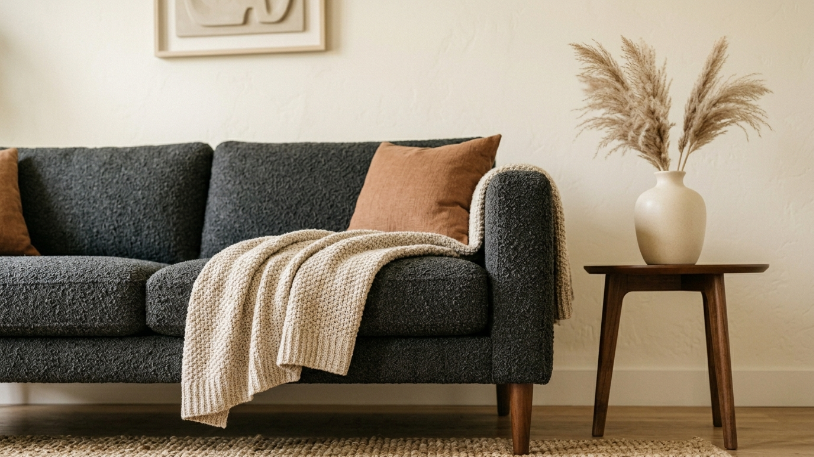
Your anchor piece is the item the eye goes to first when someone walks into the room. In most living rooms, that is the sofa. In some rooms, it might be a large charcoal accent wall with a statement mirror or artwork as the focal point. Either way, you pick one anchor and commit. The room builds around it.
If the sofa is your charcoal anchor, pay close attention to fabric. A flat-finish microfiber charcoal sofa can read as dull and slightly office-like. Texture is what gives the sofa presence. Good fabric options include:
- Bouclé or teddy fabric in charcoal: soft, tactile, and visually interesting even from across the room
- Linen or linen-blend in dark slate or graphite: clean and versatile, relaxed but refined
- Velvet in charcoal: richer and more formal, pairs especially well with walnut legs and brass hardware
- Performance fabric in charcoal or dark graphite: a smart choice for households with kids, pets, or heavy daily use
The sofa legs matter more than people expect. For a charcoal and warm wood room, choose legs in walnut, oak, or solid brass. These bridge the gap between the charcoal sofa and the warm wood pieces you add in the next steps. Black metal legs work in other palettes but push this room cool, so skip them here.
If your anchor is a charcoal wall rather than a sofa, your sofa color opens up considerably. Cream, oatmeal, warm rust, or soft sage all work well against a charcoal wall. Still keep the sofa legs warm.
Step 4: Bring In the Warm Wood
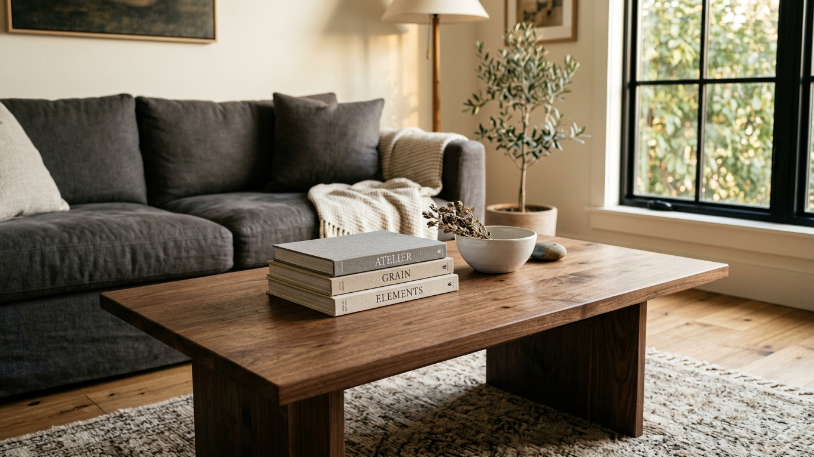
This is where the room starts to feel like itself. Warm wood pieces are what make the charcoal feel alive rather than heavy, and the charcoal is what makes the wood glow rather than disappear. Aim for at least two or three wood pieces at different scales, because one wood item in a charcoal room looks accidental rather than intentional.
The coffee table is usually the most visible wood piece and the right place to start. Look for walnut, white oak, mango wood, or any species with warm amber or honey undertones. A simple rectangular solid wood table, a round slab on tapered legs, or a wood table with a lower shelf all work well here. Avoid glass-top coffee tables; they interrupt the warmth you are building and make the room feel colder.
Next, consider your shelving or media console. A floating walnut shelf or a solid oak entertainment unit adds another layer of warm wood without competing with the coffee table. In smaller rooms, one console is enough. In larger rooms, a console plus a bookshelf gives you more display surface to work with.
Then look for smaller wood moments to layer in:
- A wooden tray on the coffee table surface
- A pair of wood-framed mirrors or art panels
- A wood-based table lamp or pendant
- A small wooden stool serving as an extra side table
The rule of three applies well here. One large wood piece, one medium wood piece, and two or three small wood accents make the palette feel designed rather than collected. Vary the scales and the room reads as intentional.
Step 5: Anchor the Floor with a Rug
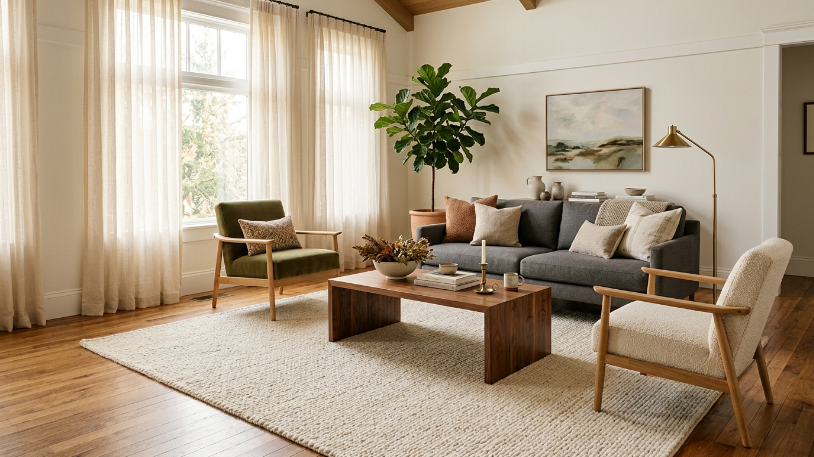
The rug pulls your seating zone together. Without it, the sofa, coffee table, and chairs feel like individual items that happen to share a room. With the right rug, they become a defined conversation area that feels considered from the moment you walk in.
For a charcoal and warm wood room, rug color should complement rather than compete. Good options:
- Cream or warm ivory: lets the charcoal and wood do the work without adding noise
- Natural jute or sisal: adds organic texture at a lower price point and works especially well with oak tones
- Warm sand or oatmeal: slightly more presence than ivory, still very versatile
- Soft terracotta or muted rust: introduces a warm accent without going loud or bold
- Muted olive or forest green: a moodier option that works well in larger rooms with higher ceilings
Avoid cool grey, blue-grey, or silver rugs. They read cold next to warm wood and create a visual disconnect under a charcoal sofa. A charcoal rug under a charcoal sofa also tends to flatten the whole space into one dark mass.
Size is critical and often underestimated. For a standard sofa arrangement, a 9×12 rug is usually the minimum. The front legs of the sofa and all accent chairs should sit on the rug. If only the coffee table sits on the rug, the rug is too small and the room will look like someone placed a postage stamp on the floor.
For materials, wool is durable and looks good long-term. Jute adds natural texture at a lower cost. For busy households, a flat-weave polypropylene rug in a warm tone is easier to maintain than a high-pile option.
Step 6: Layer in Texture with Fabrics and Materials
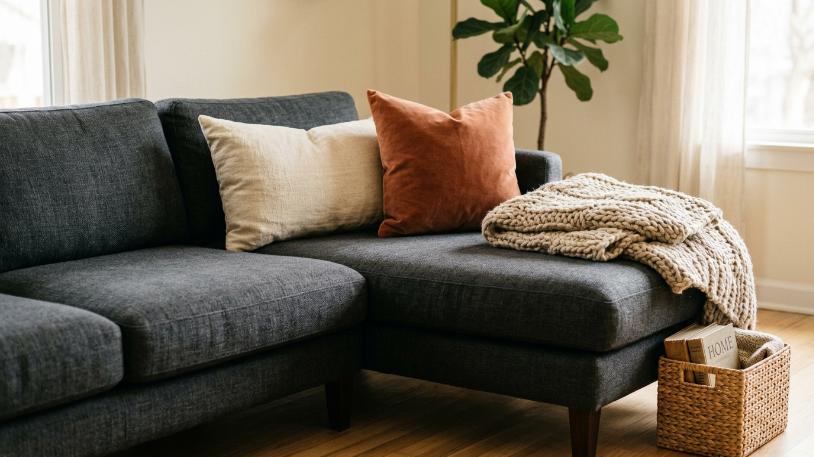
Texture is what separates a room that looks nice in photos from a room that feels good to be in. At this stage the structure is in place. Now you add the layers that give the space warmth, depth, and a sense that someone thoughtful lives there.
For textiles, work through this checklist:
- Throw pillows in linen, velvet, or woven cotton. Two to four on the sofa is the right range. More than four means you spend every evening relocating pillows to the floor.
- A throw blanket in chunky knit, herringbone wool, or textured cotton, draped over one armrest or folded on a corner seat cushion.
- Floor-length curtains in off-white linen or sheer natural fabric, hung as high and wide as the window allows. This also makes any ceiling look taller.
- An accent pillow in terracotta, rust, or muted olive, if you want a color pop beyond the main palette. One or two is enough.
For harder materials, bring in:
- Ceramic or stoneware vessels in cream, sand, or warm white
- Woven rattan or seagrass baskets for storage that also adds texture
- A small cognac or tan leather accent, such as a pouf, a wrapped planter, or a few book covers
- Stone or concrete in small doses, such as a candle holder or a tray
The contrast between soft and hard materials is what keeps the room interesting. A room that is only soft fabrics feels shapeless. A room that is only hard surfaces feels like a furniture showroom. Mixing them deliberately is what makes the space feel real.
Step 7: Get Your Lighting Right
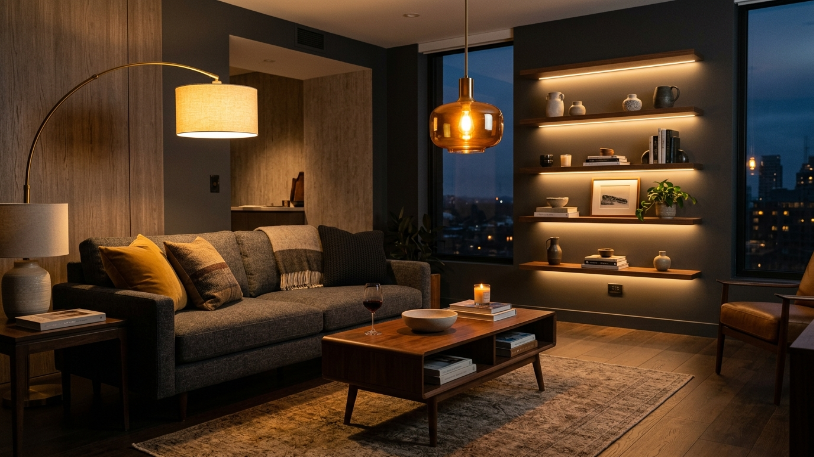
Lighting is the step most people leave until the end, then immediately wish they had planned earlier. For a charcoal and warm wood room, lighting is not optional or decorative. It is essential. Charcoal absorbs light rather than reflecting it, which means you need to introduce light deliberately from multiple sources.
Build your plan around three layers:
- Ambient light: Your main ceiling fixture. Choose a pendant or semi-flush mount in warm brass, oil-rubbed bronze, or matte black with a warm-toned shade. Brushed nickel and cool chrome fight the warm wood palette, so skip them here.
- Task light: A floor lamp beside the sofa or a table lamp on a side table. This is your primary evening light and the one that matters most to how the room feels at night. Use warm white bulbs at 2700K to 3000K.
- Accent light: Under-shelf LED strips, a small picture light, or a plug-in sconce. Even one or two accent lights change how the room reads after dark and add a layer of depth you cannot get from a single overhead fixture.
Invest in a dimmer switch for your main ceiling light. It costs very little and lets you shift the room from bright and functional in the afternoon to warm and intimate in the evening. Also, bulb temperature is non-negotiable. A 2700K warm white bulb inside a brass or bronze fixture, set against charcoal walls and warm wood surfaces, is one of the most satisfying lighting combinations in residential interiors. Get this detail right and the room feels refined at no extra cost.
Step 8: Style Your Shelves and Surfaces
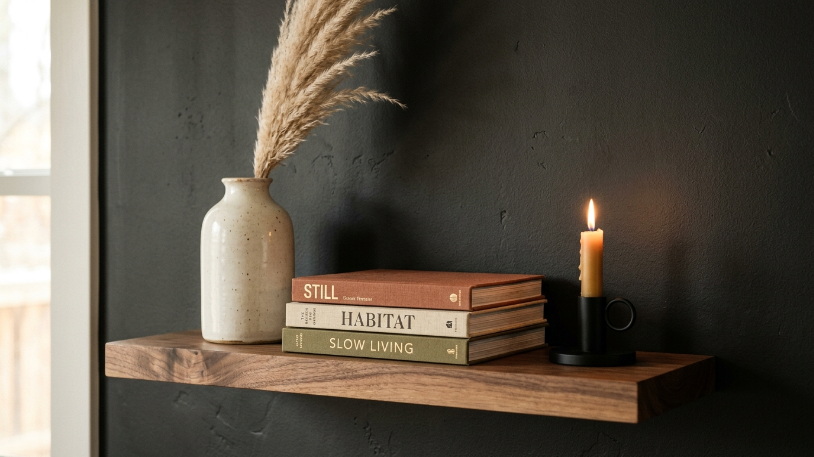
Shelf styling is where many people stall out. The furniture is in, the rug is down, the lights are working, and then the shelves sit half-empty or get piled with random objects until someone visits. Neither version is the goal.
For floating shelves or a bookcase in a charcoal and warm wood room, follow this formula:
- Group objects in odd numbers: three or five per shelf cluster reads more naturally than two or four
- Mix heights: a tall vase next to a shorter book stack next to a small ceramic object creates visual rhythm without effort
- Use books as structure: face them outward if the covers are beautiful, stack them flat if they are not, and place objects on top either way
- Leave breathing room: empty shelf space is not wasted; it is rest for the eye and it makes the styled sections look more intentional
Color-wise, keep shelf objects within your established palette: cream, warm white, terracotta, warm wood tones, muted olive, and one or two matte black or dark objects for contrast. A single dark vase or a dark-spined book adds depth without breaking the palette you have built.
For the coffee table, think small. A wooden tray anchors the surface and keeps things from looking scattered. Inside or around the tray: one candle, a small plant or dried stem, two or three stacked books, and one decorative object. That is enough. Resist the urge to keep adding pieces; more rarely improves a coffee table.
A clean surface next to a styled one always looks more confident than a surface crowded with objects on every inch.
Step 9: Add the Finishing Touches
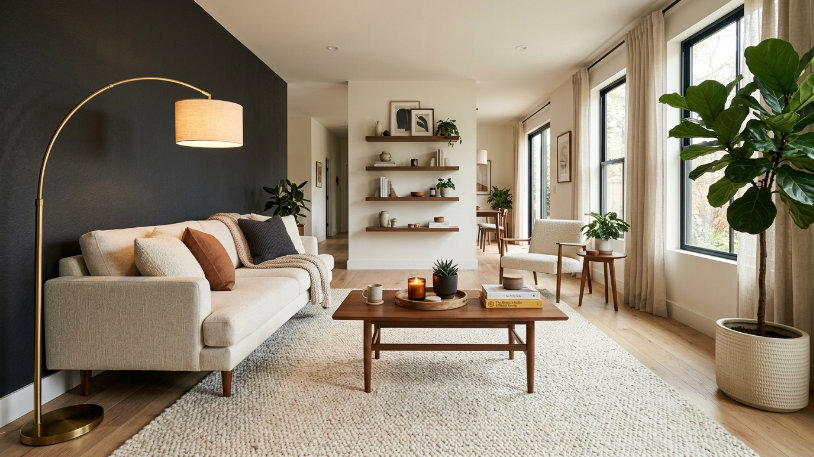
Finishing touches are roughly ten percent of the work and do about forty percent of the emotional impact. At this stage the room is functional and looks good. These last additions are what move it from “looks like it could be a living room” to “feels like someone actually lives here.”
For a charcoal and warm wood living room, consider:
- A large-leafed plant: a fiddle-leaf fig, monstera, or olive tree in a ceramic or rattan planter. Green reads as alive and natural next to charcoal in a way nothing else quite does.
- A statement mirror: one large mirror with a warm wood or aged brass frame on the wall opposite a window. Mirrors open the room and bounce light back into darker spaces.
- Curtain hardware: warm brass or matte black rods and rings. Chrome or silver hardware will look like an oversight in this palette.
- Candles: one or two in warm amber or unscented cream on the coffee table or a side surface.
- A few books stacked flat: cover-up if the covers are interesting, spine-out if they are not.
Also, here is what to avoid at the finish line:
- Do not add too many metallics. One or two warm brass moments is enough; more reads as a catalog.
- Do not match everything. Three identical vases in a row looks staged, not styled.
- Do not crowd every surface. A clear surface next to a styled one looks deliberate and confident.
Stand at the doorway and look at the room. That view is almost always the most honest one you will get.
Your Charcoal and Warm Wood Shopping Checklist
Before you start buying, run through this list. It covers every category from the build, organized by room element. Use it to shop in order rather than picking up things that look good in isolation and hoping they fit together later.
Foundation pieces:
- Sofa (charcoal bouclé, linen, or velvet; walnut or oak legs)
- Coffee table (solid walnut, white oak, or mango wood)
- Accent chair or side chairs (optional; warm fabric, warm legs)
- Media console or bookshelf (walnut or oak finish)
Floor and window:
- Area rug (cream, ivory, warm sand, or terracotta; 9×12 minimum for most rooms)
- Curtain panels (off-white linen or sheer natural fabric, floor-length)
- Curtain hardware (warm brass or matte black rod and rings)
Lighting:
- Main ceiling fixture (warm brass, oil-rubbed bronze, or matte black)
- Floor lamp (warm brass or wood base)
- Table lamp for side table
- Warm white bulbs, 2700K to 3000K, for every fixture
- Dimmer switch for main ceiling light
Textiles and textures:
- Throw pillows in linen, velvet, or woven cotton (two to four)
- Chunky knit or herringbone throw blanket
- Woven rattan or seagrass basket
Accents and styling:
- Ceramic or stoneware vessels in cream or warm white
- Wooden tray for coffee table
- Candles in warm amber or cream
- A plant (fiddle-leaf fig, monstera, or olive tree) in a ceramic or rattan planter
- Statement mirror with warm wood or aged brass frame
- Books for shelves and coffee table styling
Charcoal and Warm Wood: Quick Reference Guide
Use this table while shopping. It covers the most common decisions in the build and what to steer clear of at each one.
| Element | Best Choice | Good Alternative | Avoid |
| Wall color | Deep charcoal (Urbane Bronze, Kendall Charcoal) | Warm greige or warm medium grey | Cool grey, blue-grey |
| Sofa fabric | Bouclé, linen, velvet | Performance fabric in charcoal | Flat microfiber, stark white |
| Sofa legs | Walnut, oak, solid brass | Matte black (on light-colored sofa only) | Chrome, brushed nickel, silver |
| Coffee table | Walnut, white oak, mango wood | Dark marble with warm veining | Glass top, painted white wood |
| Rug color | Cream, ivory, warm sand | Terracotta, muted olive | Cool grey, blue-grey, silver |
| Rug material | Wool, jute | Flat-weave polypropylene in warm tone | Light-color shag |
| Ceiling fixture | Warm brass, oil-rubbed bronze | Warm rattan or woven pendant | Chrome, brushed nickel |
| Bulb temperature | 2700K warm white | Up to 3000K | Cool white or daylight (5000K+) |
| Curtain color | Off-white linen, ivory sheer | Warm natural canvas | Blackout panels in dark colors |
| Accent color | Terracotta, rust, warm olive | Muted mustard, warm sage | Bright orange, cool blue, neon |
| Plants | Fiddle-leaf fig, monstera, olive tree | Snake plant, trailing pothos | Artificial plants near real wood |
Final Thoughts
A charcoal and warm wood living room comes together when you work in order. Start with the layout, set the palette, build up from your anchor pieces, and layer in from there. Each step gives the next one something to hold on to.
Take your time with it. This look rewards patience more than budget. A well-chosen piece in the right spot will always do more than a rushed purchase that never quite fits. Plus, the process of putting a room together thoughtfully is genuinely enjoyable when you are not scrambling.
Your room will get there. Enjoy building it.