
A step-by-step guide to building a warm, cozy, and beautifully simple modern farmhouse living room from scratch, even if you are starting with a blank, boring box of a room.
The modern farmhouse living room is one of those rare interior styles that manages to feel both fresh and familiar at the same time. It is not trying too hard. It does not shout. It just walks into the room, sits down on a linen sofa, and immediately makes everyone feel at home. If you have been scrolling through beautiful home photos wondering how people actually build this look without a design degree or a renovation budget the size of a small country, this guide is for you. We are going to walk through every single layer, from the walls to the throw pillows, so you can create a modern farmhouse living room that feels genuinely yours.
What Makes a Living Room “Modern Farmhouse” in the First Place
Before you buy a single thing, it helps to understand what this style actually is because the phrase gets thrown around so loosely online that it has started to mean everything and nothing at the same time. Modern farmhouse is not just shiplap and mason jars. It is a very specific balance between two things: the raw, honest character of a traditional farmhouse (think worn wood, natural fabrics, simple shapes) and the clean, intentional lines of modern design (think white walls, open space, and furniture that does not have curlicue legs). When those two worlds meet in the right way, you get a room that feels both collected and calm.
The key ingredient is warmth without clutter. Modern farmhouse rooms breathe. They have open space, but every object in them feels purposeful and handpicked. The wood looks like it has a history. The textiles feel soft enough to nap under. Nothing is overly shiny or overly perfect. If a room looks like it came directly out of a showroom with no one living in it, it is not modern farmhouse. It is just modern. The “farmhouse” part is what gives it soul, and that soul is built through texture, natural materials, and a little imperfection that feels intentional rather than accidental.
🌿
A quick gut check: look at your room and ask if it feels like somewhere a person actually lives. If the answer is no, it needs more texture, more warmth, or more of the small personal touches that we will cover later in this guide.
1) Starting With the Walls
Your walls are going to do most of the heavy lifting in a modern farmhouse living room, so this is where you need to make confident decisions before anything else. The most common choice is white, and for good reason. White walls reflect natural light, make a room feel larger, and create the perfect neutral backdrop for all the warm wood tones and soft textiles that will come later. But not just any white will work. You want a white that leans warm, not cool. Look for shades described as “creamy white,” “antique white,” or “linen white.” A cool, bright white will fight against your warm wood furniture and make the whole room feel disconnected.
If you want to add architectural texture, shiplap is the most iconic move in modern farmhouse design. Shiplap is horizontal wood planking installed on a feature wall or fireplace surround, and it adds that unmistakable layered depth that flat drywall simply cannot achieve. You do not need to shiplap every wall; one accent wall behind your main sofa or around your fireplace is more than enough. If actual wood shiplap is outside your budget, there are excellent shiplap wallpapers and MDF panels that create the same effect at a fraction of the cost. Just paint them the same warm white as the rest of your walls to tie everything together. Think of it as giving your room a beard: you do not need to cover the whole face, just enough to add character.
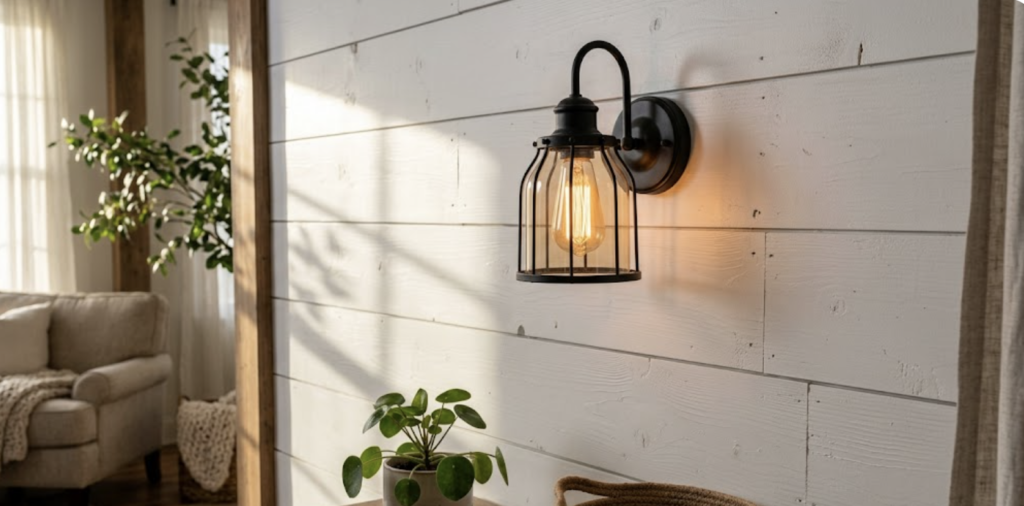
Another option that works beautifully in this style is board and batten, which involves vertical panels of trim spaced evenly along a lower section of the wall. Paint the panels the same white as the wall and they create subtle geometric structure that reads as intentional and slightly architectural without being loud. For rooms that lack natural architectural detail, this is one of the best low-cost upgrades you can make before you add a single piece of furniture.
2) Choosing Your Flooring
Flooring in a modern farmhouse living room should feel natural and grounded. Hardwood floors are the gold standard here, and if you have them, you are already halfway there. The ideal hardwood for this look has wide planks, a matte or satin finish, and a warm honey-to-medium-brown tone. Avoid floors that are too orange or too gray; orange leans too traditional and gray has become so common that it now reads more “builder special” than “intentional farmhouse design.” If you have gray floors already, do not panic. Layering warm rugs over them will correct the undertone and pull everything together.
If you do not have hardwood, luxury vinyl plank flooring has gotten remarkably convincing in recent years. Look for a plank width of at least five inches, a realistic wood grain texture, and an “embossed in register” finish, which means the grain lines in the surface texture actually line up with the printed grain pattern. This detail alone is what separates convincing vinyl plank from the stuff that looks like a laminated photocopy of wood. For a modern farmhouse room, a lighter oak or whitewashed finish in vinyl plank will look beautiful and will pair well with all the other warm elements you are building in.
Whatever floor surface you have, you will want a large area rug on top of it in the main seating area. The rug is one of the hardest-working design elements in a modern farmhouse living room because it defines the conversation zone, adds softness underfoot, and introduces texture. The best rug choices for this style are natural fiber rugs like jute, sisal, or seagrass for a more rustic feel, or a thick cotton or wool flatweave in a simple stripe or subtle pattern for something slightly softer. Layer a smaller, softer rug on top of a jute base rug if you want the best of both worlds: texture and comfort at the same time.
3) The Sofa: The Most Important Piece of Furniture You Will Buy
Your sofa sets the entire tone of the living room, so this is not a place to compromise. In a modern farmhouse living room, the sofa should have a clean silhouette with no fussy ornamental details. Think straight arms rather than rolled arms, simple cushion seams, and legs that are either natural wood or completely hidden by a skirted base. The most popular and successful choices are slipcovered sofas in linen or cotton, or sofas with performance fabric upholstery in a neutral tone. The color family you are working in is broad: warm white, oatmeal, light gray-beige (also called “greige”), soft sage, or even a deep charcoal if you want contrast. All of these can look beautiful in this style.
Linen slipcover sofas have become synonymous with the modern farmhouse aesthetic, and for very good reason. They are casual without being sloppy, soft without being precious, and the slight natural wrinkle of linen adds the lived-in quality that makes this style feel authentic. The main practical concern with linen slipcovers is that they show everything, and if you have children or pets or a spouse who eats snacks on the sofa (we all have one), you may want to look at performance fabrics instead. Performance linen-weave fabrics have come a long way, and many of them are indistinguishable from real linen at a glance while being entirely wipeable. Your sofa can be stylish and forgiving. It does not have to choose.
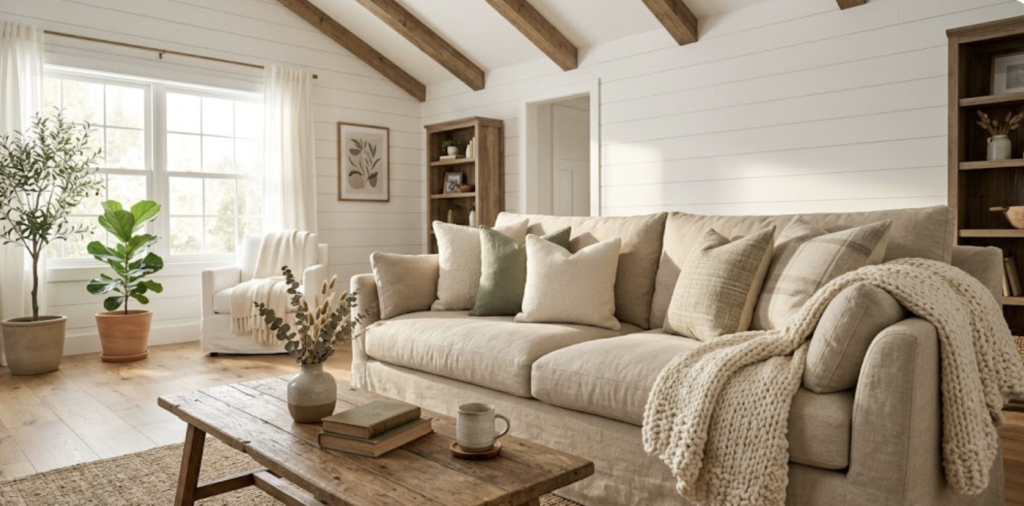
“The sofa is not just furniture. It is the gravitational center of your living room. Everything else in the room will orbit it, so make sure it is worth orbiting.”
4) Layering Furniture: Coffee Tables, Chairs, and Side Tables
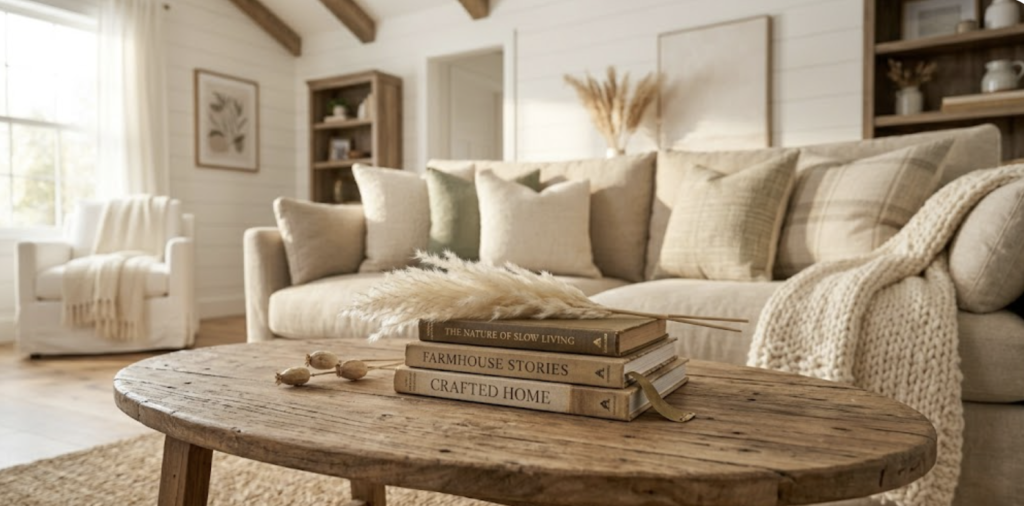
Once your sofa is in place, you start building the rest of the furniture conversation around it. The coffee table in a modern farmhouse living room is almost always wood, and it tends to be one of the most character-rich pieces in the room. Look for a table with visible wood grain, a solid chunky base, or even a table made from a reclaimed or distressed wood that shows age marks and natural variation. Round and oval coffee tables work especially well in modern farmhouse rooms because they soften the rigid angles of the sofa and rug, and they are far more forgiving in smaller spaces because you will not be walking into sharp corners at 2am in the dark. Consider that a personal recommendation.
For accent chairs, this is where you get to add a little personality. A wingback chair in a thick woven fabric, a rattan or wicker armchair with a cushion, or even a simple linen club chair in a contrasting color all work beautifully. The goal is to have at least one chair that offers something slightly different from the sofa, whether that is a contrasting material, a different tone within your color palette, or an interesting shape. Side tables can be a mix of wood and metal, or a small stacked-drum style table in natural mango wood. The rule in modern farmhouse design is that all wood tones do not need to match. In fact, mixing two or three different wood tones makes the room look more collected and less like you bought the furniture as a set from a showroom floor.
5) The Fireplace: Building the Focal Point
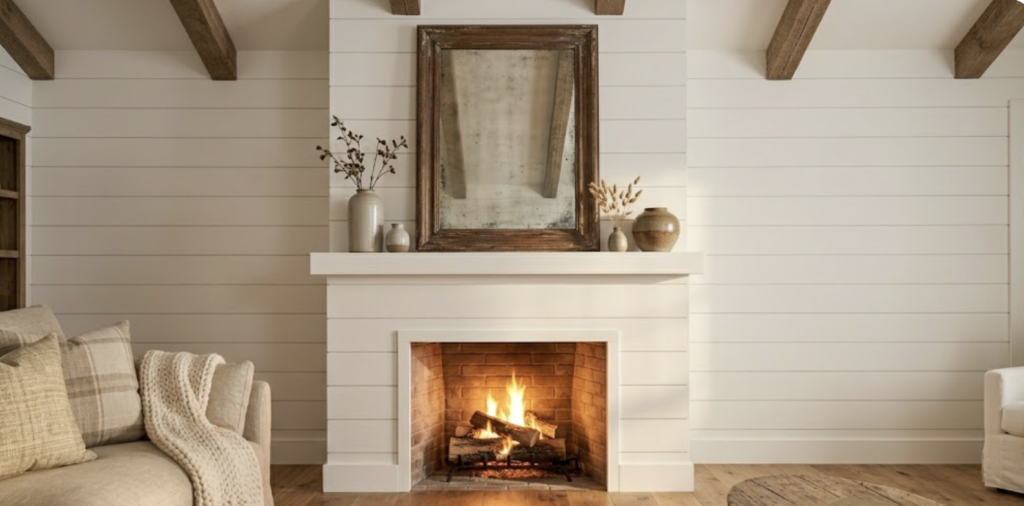
If your living room has a fireplace, you already have your focal point handed to you, and your job is simply to dress it well. The modern farmhouse fireplace surround is typically white shiplap or painted brick, with a simple wooden mantel shelf above it. The mantel is one of the most important styling surfaces in the room because it sits at eye level and draws the eye immediately when you walk in. Keep the styling simple: a large wooden-framed mirror or a piece of art above the mantel, a few chunky candle holders or ceramic vases in varying heights on the mantel shelf, and maybe a small piece of greenery or dried botanicals for organic softness. Do not line everything up in a straight row at the same height. Stagger the heights for visual interest.
If your room does not have a fireplace, you can still create a focal point with a large piece of artwork, a dramatic gallery wall, or a freestanding electric fireplace insert set into a custom-built shiplap surround. Electric fireplaces have become genuinely beautiful in recent years, with realistic flame effects and real heat output. For a modern farmhouse room, building a simple plywood and MDF shiplap surround around an electric fireplace insert is one of the most transformative weekend projects you can do. The room will look completely different, and you will spend at least three evenings just sitting in front of it feeling very smug about your decision.
6) Lighting
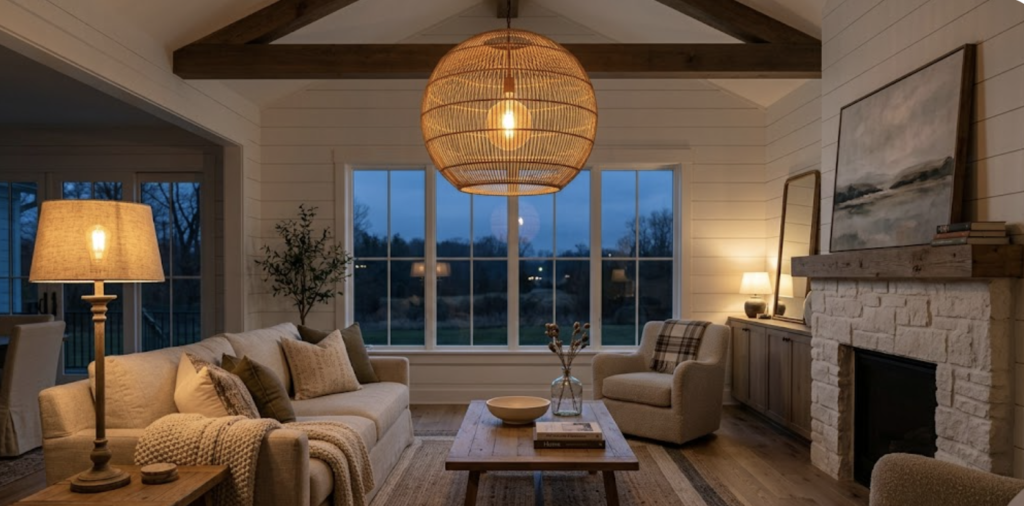
Lighting is the single most underestimated element in any interior design project, and modern farmhouse living rooms are no exception. The goal is layered lighting, which means you are not relying on a single overhead fixture to do all the work. You want ambient light (the overall fill), task light (for reading or specific activities), and accent light (for atmosphere and drama). In a modern farmhouse living room, this usually translates to a statement pendant or chandelier overhead, a pair of floor lamps flanking the sofa, and some smaller table lamps on side tables or console tables.
The chandelier is where you can make a real design statement in this style. Woven rattan or seagrass chandeliers are extremely popular right now and they add incredible organic texture overhead while keeping things light and airy. Wrought iron chandeliers with candle-style bulbs lean more traditional farmhouse but still work beautifully if you keep the rest of the room clean and modern. For floor lamps, look for a simple arc floor lamp in black metal or brushed brass, or a tripod floor lamp in dark wood. All bulbs throughout the room should be warm white, meaning 2700K to 3000K on the color temperature scale. Cool or daylight bulbs will undo all the warm coziness you are building with your furniture and textiles. It is like spending an hour making a beautiful meal and then eating it under fluorescent lighting.
7) Textiles and Layers
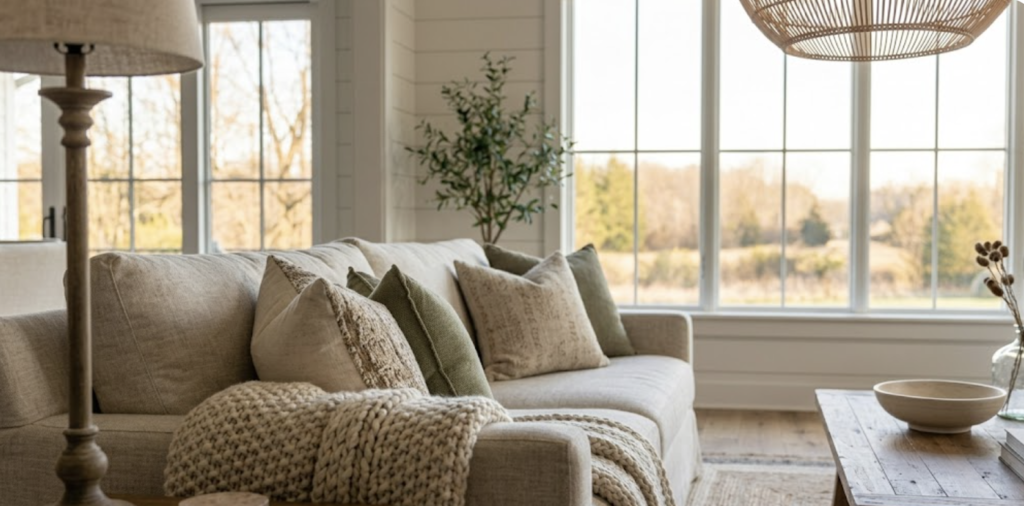
Textiles are the heartbeat of a modern farmhouse living room. They are the difference between a room that looks like a furniture display and a room that makes you want to curl up and stay for three hours. The layering approach works like this: start with your sofa cushions in your base neutral, add throw pillows in a mix of textures and subtle pattern, drape a throw blanket over one armrest or corner of the sofa, and make sure your rug has enough texture to contribute to the conversation. Each layer adds softness, depth, and warmth that hard furniture simply cannot provide on its own.
For throw pillows, the modern farmhouse formula tends to work in groupings of five or seven on a standard three-seat sofa. You want variation in size: a couple of larger 22-inch squares, a few 20-inch squares, and a lumbar pillow in the front. For fabric, mix linen, cotton waffle weave, chunky knit, and maybe one subtle stripe or simple geometric pattern. Keep the color palette tight, within three or four tones, so the pillows feel curated rather than random. Throw blankets should be chunky and inviting. Waffle weave cotton, thick knit wool, or a soft sherpa-backed throw all read beautifully in this style. The placement matters too: do not fold it into a perfect square. Drape it with one corner tumbling off the arm of the sofa. Intentional imperfection. Your room is lived-in, not laminated.
8) Bringing in Nature: Plants, Wood, and Organic Textures
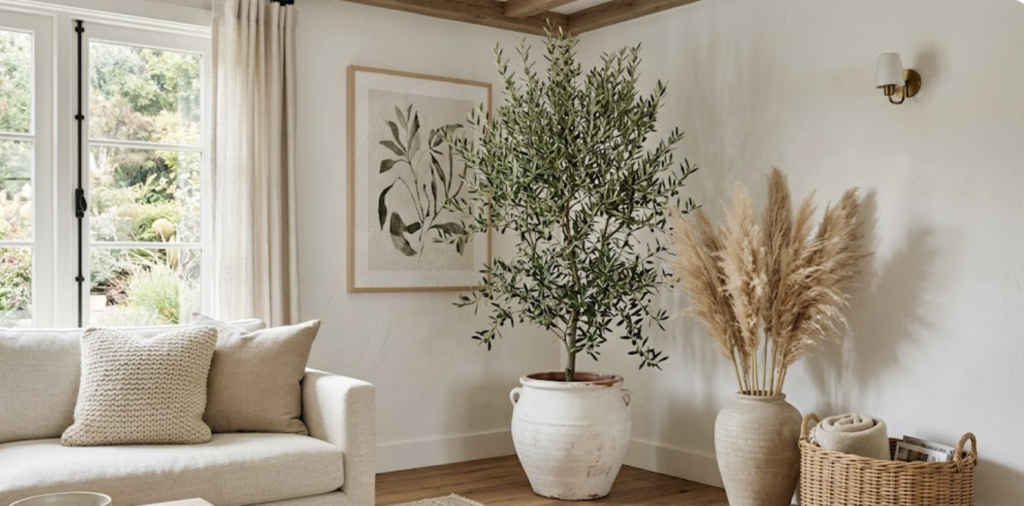
One of the defining characteristics of modern farmhouse design is the presence of nature inside the room. This is not just a decorative trend; it reflects the core idea that a farmhouse is a place rooted in land and the outdoors. Bringing natural elements inside creates a connection to the outside world that makes a room feel grounded and alive. The most accessible way to do this is with plants. A large potted plant, like a fiddle leaf fig, an olive tree, or a tall snake plant in a simple white or terracotta pot, adds height, life, and a pop of organic green that complements every neutral palette in this style.
Beyond plants, you can bring in nature through materials. A wooden bowl on the coffee table, a stone candle holder on the mantel, a basket made from seagrass or wicker tucked beside the sofa holding a throw blanket, dried botanicals like pampas grass or eucalyptus in a simple ceramic vase. Dried botanicals in particular have become a defining accessory in modern farmhouse rooms because they are low maintenance, they add incredible texture, and they age beautifully rather than dying on you. Every time a friend asks how your dried pampas grass is doing, you can honestly say it has never looked better. This is deeply satisfying.
9) The Art of Styling Shelves and Surfaces
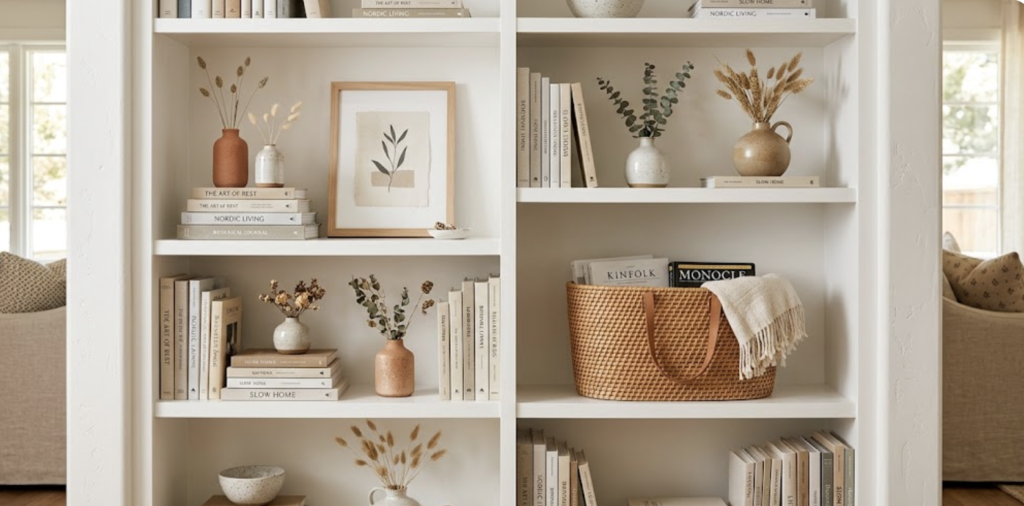
Open shelving, built-in bookcases, and styled surfaces like mantels and console tables are the places in a modern farmhouse living room where your personality really shows up. The most common mistake people make when styling shelves is putting too much on them. The modern farmhouse approach to shelf styling is intentional and spacious. You want negative space to breathe between objects. A general guideline is to use objects in odd numbers, vary the heights, mix textures, and include at least one organic element (a small plant, a wooden bowl, a piece of driftwood) in each shelf section.
Books are one of the best styling tools on a shelf because they can be grouped horizontally or vertically, and stacking a few horizontally with an object on top creates a visual anchor. Use hardcover books and consider facing some with their pages outward rather than their spines if the spine colors are too bright or busy for your palette. Ceramic objects, woven baskets, small framed prints, and candles all work beautifully as styling accessories. Just remember that less is more on the shelf. You are not trying to fill the shelf; you are trying to compose it. The difference sounds small but it changes everything about the result.
10) Color Palette: Keeping It Warm and Cohesive
The modern farmhouse color palette is built on a foundation of warm neutrals and then accented with nature-inspired tones. Your base palette will typically include a warm white for the walls, a medium warm neutral for large furniture pieces like the sofa and main rug, and a warm wood tone that comes from your floors, coffee table, and other wood accents. On top of this base, you layer accent colors that are drawn from nature: soft sage green, dusty blue, muted terracotta, warm taupe, or deep charcoal for contrast. These accent colors appear in your throw pillows, small accessories, plants, and perhaps one or two pieces of furniture like an accent chair or side table.
The reason this palette works so well is that it is inherently forgiving and easy to evolve over time. Because the base is neutral, you can swap out pillows, change the accent color of a throw, or introduce a new accent shade with a lamp or vase without redesigning the whole room. This is intentional. Modern farmhouse rooms are meant to feel like they have grown and collected over time rather than being designed in one fell swoop. Start with your neutrals, add one accent color in two or three places throughout the room for cohesion, and then layer in your wood tones and organic textures. You will be surprised how complete and considered the room feels with a relatively simple palette.
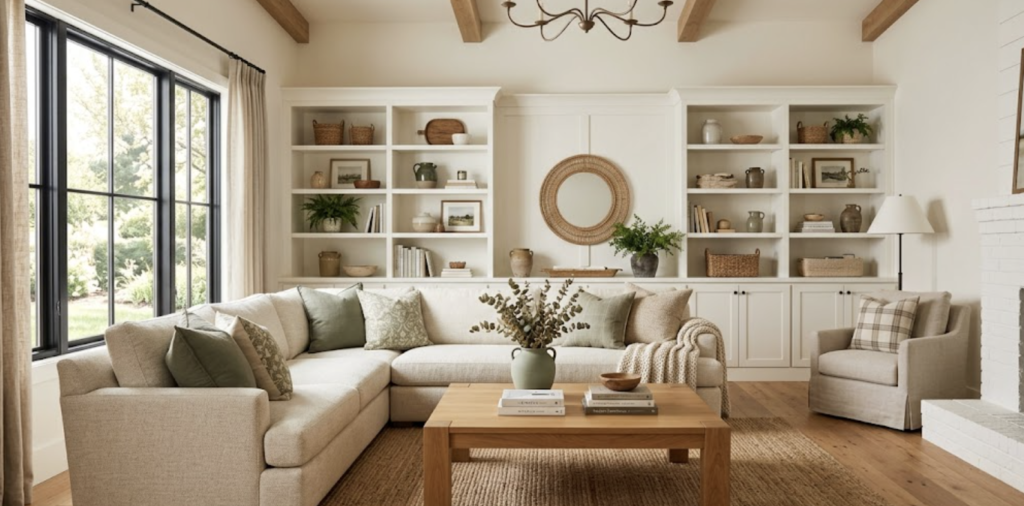
Final Touches
The final layer of a modern farmhouse living room is everything that makes the room feel truly finished and personal. These are the accessories, the art, the lighting details, and the small moments of surprise that make someone walk into your room and say “I love this space.” A tray on the coffee table styled with a candle, a small ceramic bowl, and a succulent. A vintage-style analog clock on the wall. A woven hanging textile above the sofa if you prefer something softer than framed art. A pair of black lantern candle holders on the floor beside the fireplace. A stack of oversized coffee table books with beautiful covers.
Art in a modern farmhouse living room tends to lean toward simple, organic, or abstract rather than busy or heavily colored. Black and white photography in simple white frames, abstract paintings in earth tones, botanical prints, and vintage-style illustrations all work beautifully. A large single piece of art above the sofa or fireplace is more impactful than many small pieces scattered around the room. If you want a gallery wall, keep the frames cohesive (all black, all white, or all natural wood) and leave generous space between each piece so the wall breathes rather than looks crowded. Every single detail in this room should feel like it was chosen, not accumulated. That distinction, more than any specific product or trend, is what makes a modern farmhouse living room truly beautiful.