
Turn your bedroom into a rich, moody retreat that feels like a five-star hotel — with your own personal touch
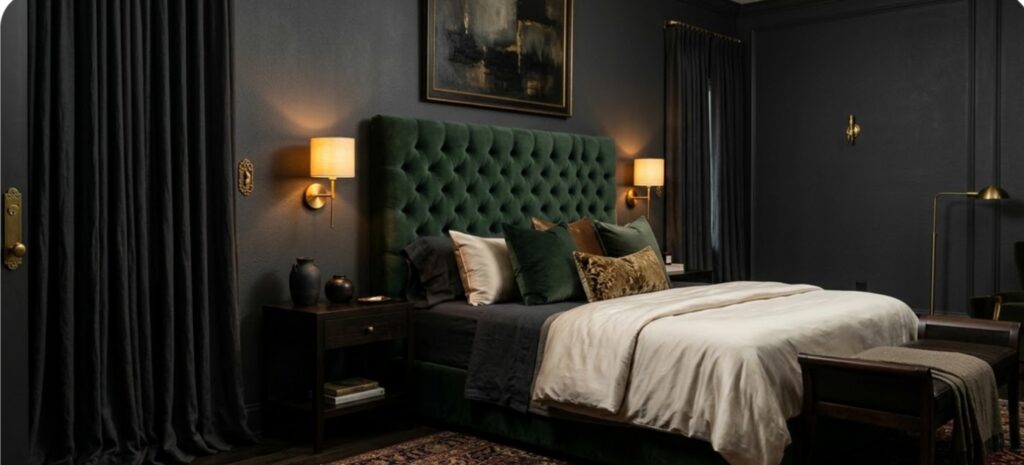
There is a certain kind of bedroom that makes you stop at the door. It does not shout. It does not perform. It simply pulls you in with its quiet confidence, its deep colours, its heavy textures, and its warm low light. It smells like cedar and clean linen. It feels like the inside of a very good idea. That is what a moody luxe bedroom is — and if you have been dreaming of one, this guide will show you how to build it from scratch, step by step, without needing a designer on speed dial or a budget that could fund a small country.
A moody luxe bedroom is not just a dark room. It is a carefully layered space where colour, texture, light, and furniture all work together to create a feeling. The feeling is warmth. The feeling is depth. The feeling is the kind of rest you actually look forward to. Moody does not mean sad, and luxe does not mean cold. When you get this right, your bedroom will feel like the most indulgent, grounded, and genuinely comfortable place in your entire home. (Think of it as the introvert’s paradise — beautiful, quiet, and absolutely no pressure to be cheerful before 9am.)
This guide covers everything: how to choose the right wall colour, how to layer your bed like a professional stylist, how to pick furniture that has weight and personality, how to use light to set the mood, and how to finish the room with the kind of accessories that make people say “wait, did you hire someone?” You did not. You just read this.
1) Your Colour Palette
Everything in a moody luxe bedroom starts with colour. Your wall colour is the single most powerful decision you will make in this space, because it sets the emotional tone for every single thing that goes inside it. The good news is that deep, moody colours are easier to work with than most people think. The bad news is that choosing the wrong shade can make a room feel like a cave — and not the glamorous kind.
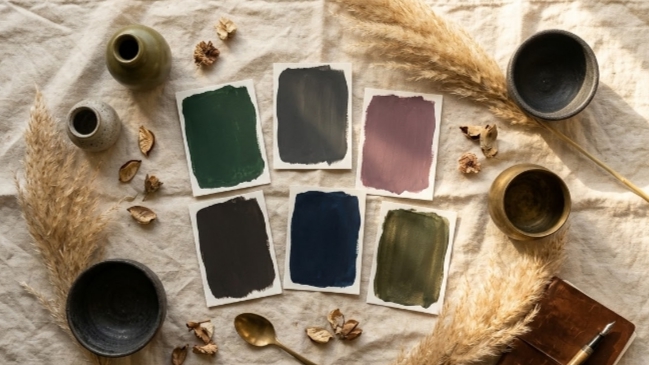
The key colours that anchor a moody luxe bedroom are deep greens, rich charcoals, warm blacks, dusty mauves, dark taupes, and inky navies. These are not harsh colours. They are sophisticated, quiet, and deeply flattering in low light. When you paint a wall in forest green or aged charcoal, something interesting happens to everything else in the room — the warm wood tones glow warmer, the gold accents look richer, the white linens look crisper. The dark wall does not shrink the room; it gives it edges, and edges create intimacy.
The most popular moody wall colour choices right now are shades that sit between two tones. Think of a green that is also a little grey. Think of a black that has a little warmth in it — almost a very dark brown. Think of a navy so deep it reads as almost black until the light hits it. These nuanced, in-between shades are what make a room feel expensive rather than just dark. When you are standing in a paint store squinting at chips the size of a business card, you will not be able to tell the difference. Do yourself a favour and order large peel-and-stick samples, tape them to your actual wall, and live with them for at least two days before you commit. Light changes everything, and your bedroom light in particular — which is likely dimmer and warmer than the rest of your home — will shift these colours significantly.
Your accent colours should stay within the same quiet, rich family. Think dusty gold, aged brass, warm ivory, soft terracotta, burgundy, and very warm white. These colours do not compete with your dark walls. They sit against them like jewels — catching the light in small, deliberate ways that make the room feel curated rather than decorated. Avoid anything cool, bright, or stark: no cool greys, no icy blues, no stark whites, no pops of orange or bright red. The goal is a room that feels warm even when it is empty, even at midnight, even when all the lights are off except one small lamp on the bedside table.
For those who feel genuinely nervous about going full dark on all four walls, there is a perfectly elegant compromise: paint just the wall behind your bed in your chosen deep colour, and keep the remaining walls in a warm mid-tone — a warm greige, a soft clay, a deep cream. This gives you all the drama of a dark feature wall without the commitment. It also creates a beautiful frame around your bed, which is exactly what a moody luxe bedroom is supposed to do. Your bed should look like it was placed in the room intentionally, like a statement.
2) The Walls
Once you have your colour, you need to think about what you are actually applying it to. A flat, smooth wall is fine. But a moody luxe bedroom thrives on texture, and there are a few ways to bring that texture to your walls that do not cost a fortune and do not require a structural engineer.
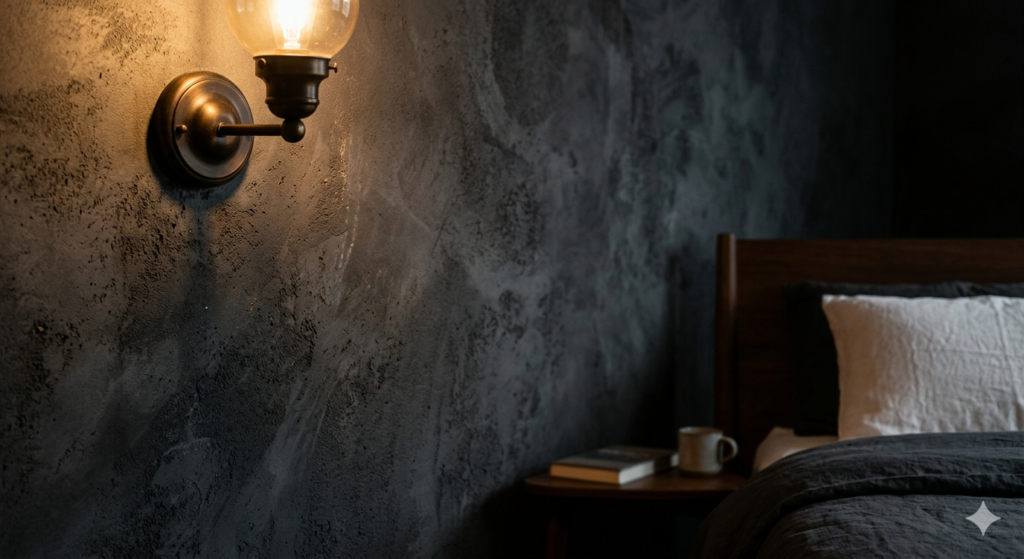
Limewash paint is having a very well-deserved moment, and it is perfect for the moody luxe aesthetic. Unlike regular paint, limewash creates a slightly mottled, organic finish that looks like aged plaster. It catches light differently across the surface, which adds genuine depth to a wall without you needing to do anything complicated. It can be applied over regular painted walls with a wide brush and a somewhat casual attitude, which is exactly the right amount of effort for a project this rewarding. When applied in a deep shade — a dark charcoal, a forest green, a deep plum — limewash looks extraordinarily expensive. It looks like the walls of a very old, very beautiful Italian villa. That is a compliment to your bedroom and your taste.
Vertical wood panelling, particularly beadboard or Shaker-style panelling on the wall behind your bed, adds enormous architectural interest to a room that might otherwise feel like a box with furniture in it. Painted in the same dark colour as your walls, panelling creates a tone-on-tone effect that is sophisticated and quiet. The texture is visible but not loud. The room gains structure and character without looking busy. You can purchase mdf panelling panels from most large DIY stores, cut them to size, apply them with adhesive and finishing nails, caulk the seams, and paint over the whole thing. It is a weekend project that will make your bedroom look like it was designed by someone who charged a consulting fee.
Wallpaper is another option, and when chosen carefully, it can be the single most impactful thing you do to this room. Look for large-scale botanical prints in dark, moody tones — deep green leaves on black, dark florals on charcoal, abstract line work in aged gold on forest green. These wallpapers do not need to go on every wall. One wall, particularly the wall behind the bed, is enough. It becomes a focal point. Every other piece of furniture and accessory in the room can then be chosen in response to the wallpaper’s colours, which actually makes the rest of your decorating decisions easier, not harder.
3) The Bed
Your bed is the single most important piece of furniture in this room. Not because it is the most expensive (though it might be), but because it is the thing the entire room is built around. In a moody luxe bedroom, the bed needs to be large, tall, grounded, and deeply comfortable-looking. It should look like it was designed to stay in one place forever. It should look like it has opinions.
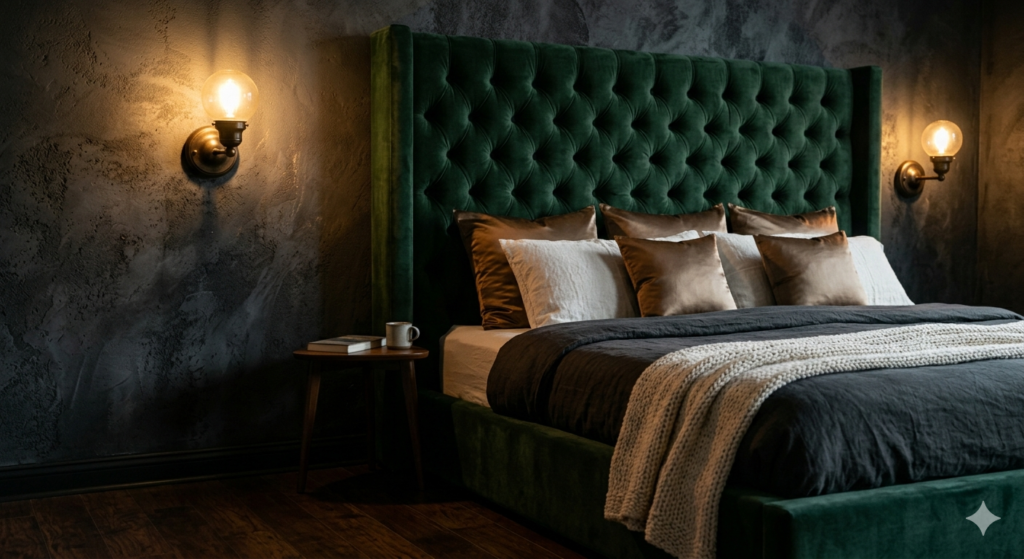
The headboard sets a tone. For a moody luxe bedroom, you want a headboard that is either upholstered in a rich fabric, velvet, boucle, or leather or made from dark solid wood. The taller the better.
A headboard that rises to within a foot of the ceiling does something powerful to a room: it gives the bed a sense of grandeur that is disproportionate to the actual square footage of the space.
If you are working with an existing bed frame that does not feel luxurious, your options are either to replace it with something that has more presence, or to add a freestanding headboard behind your existing frame. Many furniture retailers sell headboard-only options that attach to a bed frame or simply lean against the wall. A leaning headboard in deep green velvet can transform a basic platform bed into something that looks deliberate and polished in under an hour.
Bed linen layering is where most people lose the plot, and it is the area that has the single highest return on investment in terms of how luxurious your bed looks versus how much you actually spent. The key principle is layers that are different in colour, texture, and weight, but stay within the same warm, quiet palette. Start with a fitted sheet in a high thread count cotton or linen in warm white or soft ivory. Then a flat sheet in the same or similar tone. Then a duvet or comforter in a slightly richer tone — a warm linen, a very soft cream, an ivory with a subtle sheen. Then a folded wool, cashmere, or chunky knit blanket draped across the foot of the bed in a darker tone — deep charcoal, forest green, or a rich warm taupe. Then pillows: European square pillows at the back (large, plush, in a linen or velvet cover), standard sleeping pillows in front of those, and then two or three decorative pillows in the front in your accent colours — deep velvet, warm gold, aged ivory.
The secret to making a layered bed look intentional rather than confused is restraint in colour combined with generosity in texture. You can have five different pillow fabrics — linen, velvet, satin, boucle, embroidered cotton — as long as they are all in the same warm, muted palette. The contrast is textural, not colourful. That is what makes it look like a boutique hotel rather than a busy guestroom.
The bed frame itself should feel grounded. Low platform beds work beautifully in moody spaces because they sit close to the floor and feel deliberate. But a traditional bed with visible legs and some height also works well if the legs are in a dark finish — matte black, dark walnut, aged bronze. Avoid anything with spindly, pale, or overly ornate legs. The furniture in this room should feel like it has weight. It should look like it took two people and a dolly to move it in.
4) Furniture
In a moody luxe bedroom, furniture is not just functional. It is scenery. Every piece should contribute to the overall atmosphere of the room — the sense that this space was built to be beautiful, not just practical. This does not mean every piece needs to be expensive. It means every piece needs to be chosen carefully, with attention to material, finish, and proportion.
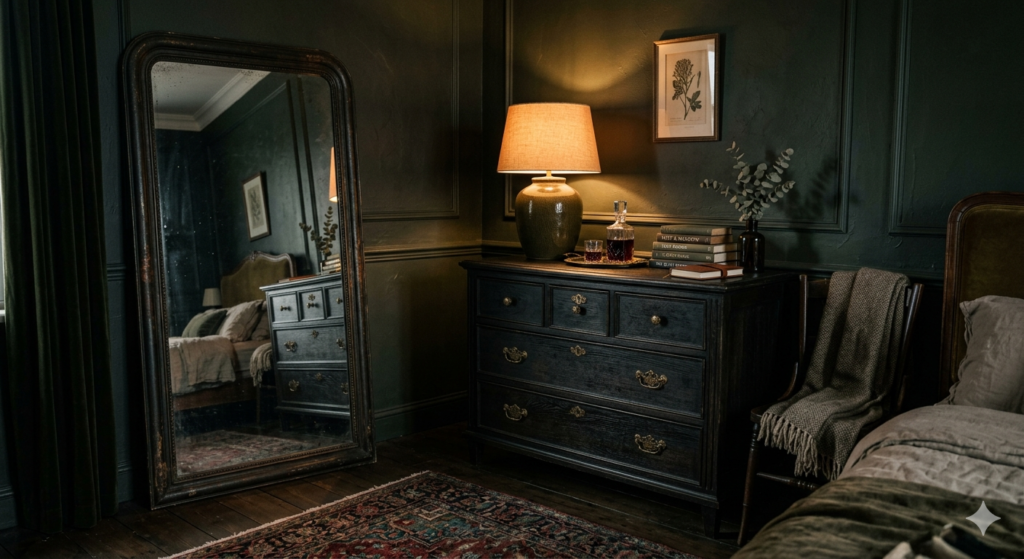
Dark wood is the natural partner for moody walls. Ebonised oak, dark walnut, mahogany, and blackened wood all feel at home in this space. If you are working with existing light wood furniture, you have a few options. You can paint it in a deep tone — chalk paint in a near-black or very deep charcoal dries matte and looks genuinely beautiful on older wooden furniture. You can replace the hardware with aged brass or matte black pulls, which immediately changes the character of a piece without any painting required. Or you can embrace the contrast — lighter furniture against very dark walls actually works well if the furniture has interesting shapes and the rest of the room is staying dark. The contrast can feel intentional if you commit to it.
Bedside tables in a moody luxe bedroom should feel substantial. Avoid tiny, flimsy side tables with thin legs and no storage. You want something that feels like it belongs in the room — a low cabinet with drawers, a small chest, a stone-topped table with a metal base, or an antique-style nightstand with a single drawer and bottom shelf. Marble tops in dark or warm tones — black marble, forest green marble, warm veined beige — add an immediate sense of luxury. The bedside table is also where you will place your lamp, and the lamp is one of the most important elements of the entire room (more on that in the lighting section), so you need a table with enough surface area to let the lamp sit comfortably alongside a glass of water, a book, and whatever small objects make that corner yours.
A bench at the foot of the bed is one of the easiest ways to make a bedroom feel complete and finished. In a moody luxe room, the bench should be upholstered in a rich fabric — again, velvet, leather, or boucle in a dark or warm tone — or made from a dark wood with an upholstered seat. It serves a practical purpose (somewhere to sit while you put your shoes on) and a visual one: it anchors the end of the bed, frames the bed from a distance, and adds one more layer of plush texture to the space.
A large mirror is non-negotiable. Not because small mirrors are not beautiful — they are — but because a large mirror in a moody room does something nothing else can do: it bounces the warm lamplight around the space and gives the room depth. It makes the room feel larger without making it feel lighter, which is exactly the balance you are going for. Position your mirror on the wall opposite a light source, or lean a large floor mirror against the wall beside the wardrobe. Dark frames — matte black, aged bronze, dark wood — suit the aesthetic far better than bright silver or gold.
A wardrobe or armoire in a dark finish, whether built-in or freestanding, keeps the room feeling cohesive. If your existing built-in wardrobe has pale or white doors, consider painting them in the same colour as your walls for a tone-on-tone effect that makes them almost disappear, giving the room a cleaner, more architectural quality. Add new hardware in aged brass or matte black, and what was once the most forgettable element of the room becomes a quiet backdrop that lets everything else shine.
A comfortable chair in the corner of the room — a bergère, an accent chair in velvet or leather, a small tub chair — is the finishing touch that separates a bedroom from a luxurious retreat. It does not need to be large. It just needs to be there, with a small side table or tray beside it, perhaps a folded throw draped over the arm. It tells anyone who walks into your room that this space was designed for more than sleeping. It was designed for reading, for thinking, for the kind of quiet that the rest of the house does not always provide.
5) Flooring and Rugs
The floor of a moody luxe bedroom is doing important work that most people overlook when planning the space. Dark walls need grounding, and the floor — along with the rug — provides that grounding in a very literal and visual sense.
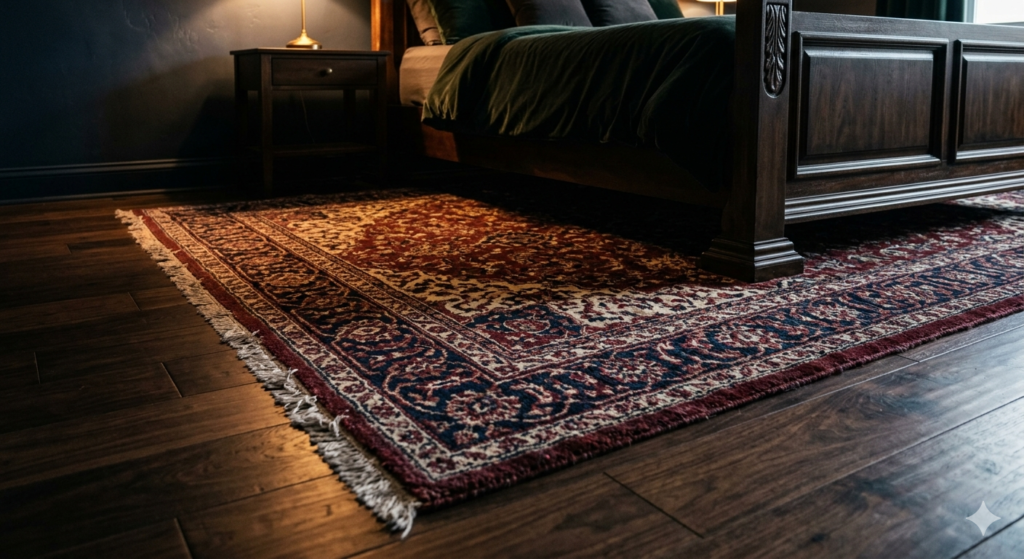
If your floors are already a medium or dark wood, you are in a very fortunate position. If they are pale or painted, you have options: dark wood-look flooring in a laminate or LVP format has improved enormously in quality over the last decade, and a good quality dark oak or walnut-look plank floor in a bedroom-sized space is an achievable weekend project. If you are renting and cannot touch the floors, a large rug will do the same visual work.
The rug is one of the most transformative elements in a moody luxe bedroom, and it deserves careful attention. The rug you want is large — large enough that all four legs of the bed sit on it, or at minimum that the front two legs of the bed and the bedside tables sit on it. A rug that is too small makes the room feel fragmented and the furniture look like it is floating. The wrong size rug is one of the most common decorating mistakes, and in a moody bedroom where everything is supposed to feel grounded and intentional, it is particularly noticeable.
The right rug for this space has age, texture, and pattern. Vintage-style Persian or Oriental rugs in deep tones, burgundy, navy, forest green, deep gold, rich wine, work beautifully against dark walls and warm wood floors. The pattern adds visual interest and warmth without adding visual noise, because the tones of a traditional Persian rug are inherently earthy and muted. A large faded vintage rug gives the room character that no amount of new furniture can replicate. Beni Ourain or Moroccan-style rugs in a natural off-white with dark markings also work well, particularly if the rest of the room is leaning darker — the rug provides a quiet contrast that feels natural rather than jarring.
Layering rugs is an option for those who want even more texture. A natural jute or sisal rug underneath a smaller Persian or vintage rug creates depth and warmth at the floor level that mirrors the layering happening on the bed above. It is a small detail that has an outsized effect on how luxurious and considered the room feels.
6) Lighting: The Most Important Tool You Have
Nothing — and we mean nothing — has more impact on the atmosphere of a moody luxe bedroom than the lighting. You could have the most beautiful furniture, the most carefully chosen wallpaper, the most perfectly layered bed, and still ruin the room with the wrong light. But get the lighting right, and even a room with very modest furnishings will feel deeply atmospheric and inviting.
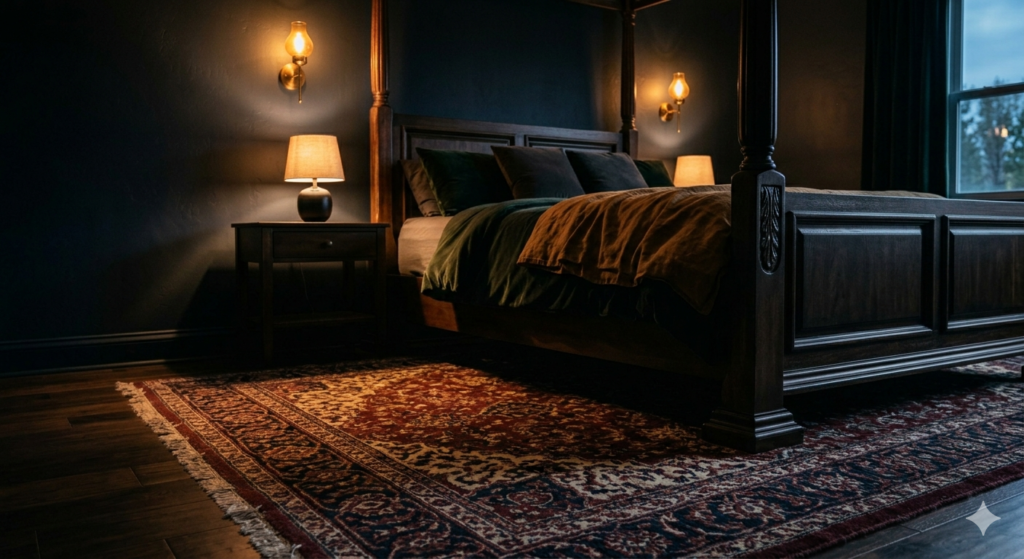
The single most important rule of lighting in a moody luxe bedroom is this: no overhead lighting. Turn off the ceiling light. If your ceiling light is the main source of light in your bedroom, you have been unknowingly flattening and flattening and flattening the room every single evening. Overhead light washes everything out. It removes shadows, which removes depth, which removes the very thing you are trying to create. The overhead light is for emergency use only — for when you are looking for something you dropped, or doing a thorough clean. It is not for evenings. It is not for atmosphere. It is not for a moody luxe bedroom.
Your primary sources of light should be bedside lamps and wall sconces mounted on either side of the bed. These are at eye level when you are sitting or lying in bed, which means the light hits everything in the room at a low, warm, lateral angle — the most flattering and atmospheric kind. The bulbs in these lamps should be warm white, ideally around 2700K, and on a dimmer if possible. Dimmer switches cost very little to install and change the entire character of a room. A lamp at full brightness and a lamp at 30% brightness are two completely different experiences, and in this bedroom, 30% is almost always the right answer.
Wall sconces on either side of the headboard are a relatively easy upgrade that immediately makes a bedroom feel deliberately designed. They free up space on your bedside tables, they provide directional reading light, and visually they frame the bed in a way that feels architectural and intentional. Look for sconces with aged brass, matte black, or oil-rubbed bronze finishes. The shade should be small and directional — fabric shades in ivory or cream give a warm, diffused glow; metal shades direct the light downward in a more focused beam. Both are beautiful; the choice depends on whether you want soft ambient light or a cleaner reading lamp effect.
For additional layers of light, consider a floor lamp in the corner of the room near your reading chair, a small lamp on a dresser or console, and even LED strip lighting tucked behind the headboard or underneath the bed frame if you want a very subtle, low glow on the floor. Candles and candleholders on the dresser, bedside tables, and mantelpiece (if you have one) add warmth and flicker that no electric light can fully replicate. Unscented or lightly scented candles in dark glass or ceramic vessels suit the aesthetic well — avoid anything that looks too precious or too cheerful.
The most important thing to remember about lighting in this room is that more sources of light, each at a lower intensity, will always look better and feel more luxurious than one or two sources at full brightness. The room should feel like it is glowing from within rather than being lit from above. That distinction is the difference between a nice bedroom and a remarkable one.
7) Textiles and Soft Furnishings: Texture Is Everything
If colour is the soul of a moody luxe bedroom, texture is the body. It is the thing you actually feel when you are in the room — the weight of the curtains, the give of the cushions, the softness of the rug underfoot, the warmth of a blanket pulled up around your shoulders. Texture is what makes a beautiful room feel genuinely liveable rather than like a photograph of a beautiful room.

Curtains deserve a dedicated section of their own, because in a moody luxe bedroom, they are one of the most powerful textural and visual tools you have. The curtains you want are long, heavy, and hang from as close to the ceiling as possible. Floor-length curtains that are hung just below the ceiling — not just above the window frame — immediately make a room feel taller, grander, and more luxurious. Curtains that hang from window-frame height and stop just at the floor feel domestic. Curtains that hang from ceiling height and pool slightly on the floor feel like a hotel suite in a converted Italian palazzo.
The fabric for your curtains should be heavy: lined linen in a deep colour — forest green, dusty charcoal, deep plum, warm black — is the ideal. Velvet curtains are even more dramatic and are one of the fastest ways to transform a room’s atmosphere. Heavy curtains have an acoustic effect as well as a visual one — they absorb sound and make the room feel quieter and more contained, which is everything you want in a bedroom designed for deep, restorative rest.
Throw blankets layered at the end of the bed or draped over the arm of a chair should feel genuinely luxurious to the touch — cashmere, lambswool, or a very high quality cotton knit. The weight and warmth of a good throw is part of the sensory experience of the room. Cushions on the bed and chair should be in a variety of textures within your palette — velvet, boucle, embroidered linen, satin — rather than all the same. The variety of texture creates visual interest that does not rely on a variety of colour, which is the whole principle of this design approach applied to soft furnishings.
8) Accessories and Styling Details
The accessories and styling details are where a moody luxe bedroom stops being a designed space and starts being your space. This is where personality comes in — carefully, and with good taste, but genuinely.
Art on the walls of a moody luxe bedroom should feel considered rather than collected. Large-scale pieces work better than a gallery wall of small frames — the gallery wall aesthetic, while very popular, can feel too light and energetic for a space that is meant to feel quiet and deep. A single oversized botanical illustration in a wide dark frame, a large abstract print in deep, earthy tones, or a dark-framed vintage map or antique engraving printed at scale are all excellent choices. Photography in a moody bedroom works well if it leans toward landscape, architectural, or still life subjects in dark, atmospheric tones. Avoid anything with bright, high-key colours or subjects that feel too busy or energetic.
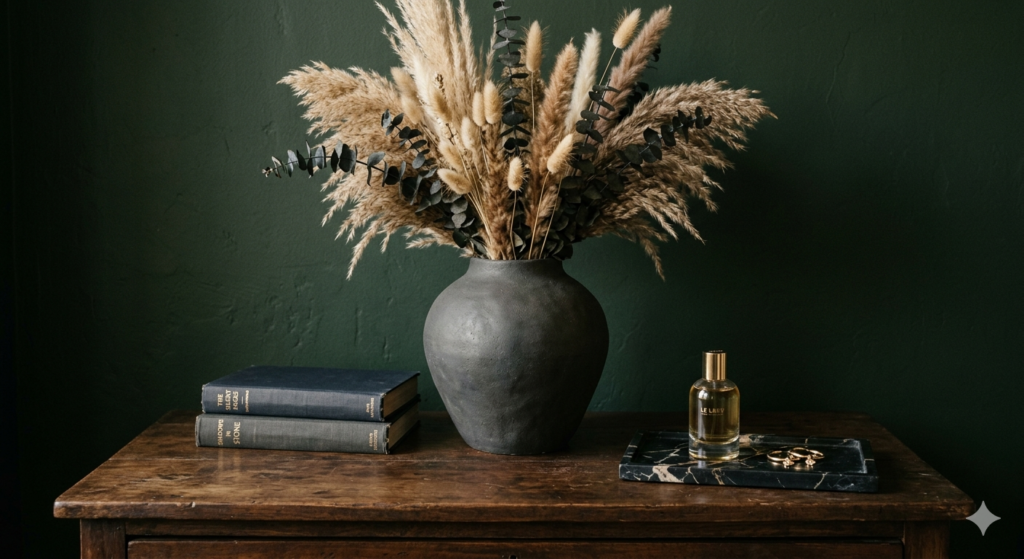
Candles, dried botanicals, and natural objects bring organic warmth to a moody room that would otherwise risk feeling staged. A ceramic vase of dried pampas grass or eucalyptus branches, a cluster of taper candles in iron or stone holders, a piece of abstract pottery in a dark glaze, a stack of books with their dust jackets removed (they almost always look better without them), a small crystal or glass object that catches the lamplight — these are the elements that make a room feel inhabited and loved rather than freshly decorated.
Mirrors placed thoughtfully throughout the room multiply the light sources and add depth. A large vintage mirror leaning against the wall has a different, more relaxed energy than one hung flush — it feels informal and editorial, like it landed there by accident and happened to look perfect. An ornate dark-framed mirror above a dresser, a simple dark-framed rectangular mirror on the inside of a wardrobe door, a small round brass mirror above a bedside table — multiple mirrors at different heights and angles create a layered, atmospheric quality that few other accessories can match.
Scent is the most overlooked element of interior design in general and bedroom design in particular. The right scent transforms a room’s atmosphere before a single visual element is processed. In a moody luxe bedroom, the scent should be warm, deep, and slightly woody: sandalwood, cedar, amber, vetiver, oud, or dark florals like rose absolute or violet. A reed diffuser positioned somewhere it will not be knocked over, a candle lit in the evening, or a linen spray used on pillowcases and the top of the duvet before bed will make your bedroom feel like a genuine sanctuary. It is the last layer of atmosphere, and it is the one your guests will remember after they have forgotten everything else.
Practical Considerations
A moody luxe bedroom is not just about how things look. It is about how the room functions and a beautiful room that does not function well quickly stops being a haven and starts being a headache.
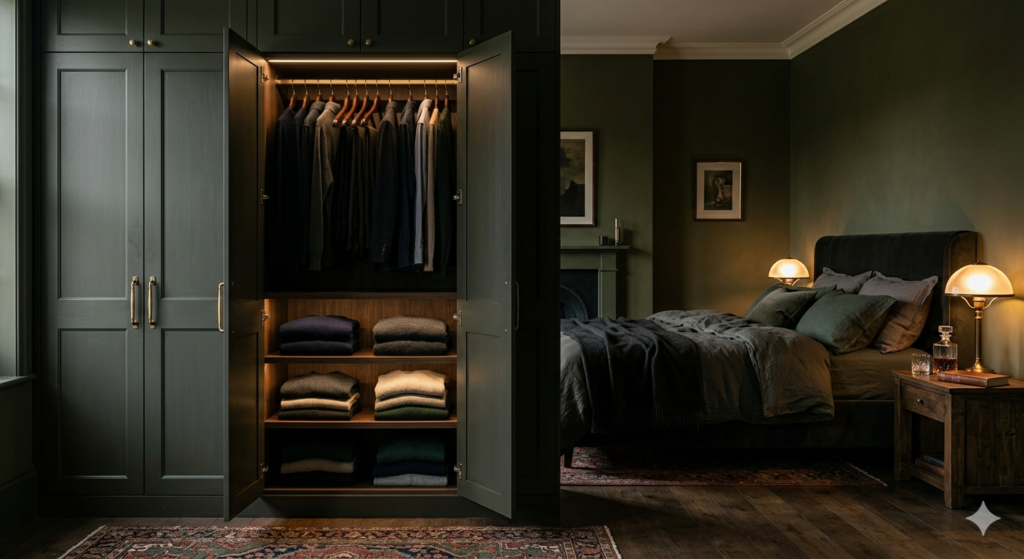
Storage in a moody bedroom needs to be contained and discreet. Visual clutter is the single biggest enemy of the atmosphere you are trying to build.
Everything that does not contribute to the room’s beauty, phone chargers, extra bedding, books you have read, the things that accumulate on surfaces need a dedicated home where it can be out of sight.
This means investing in bedside tables with drawers rather than open shelves, ottomans with internal storage at the foot of the bed, wardrobes with proper interior organisation systems so that the doors stay closed and the room stays calm.
A bedside tray on each nightstand immediately organises the small items that otherwise spread across the surface and make it look cluttered.
The bed should be made every morning. This sounds obvious but it is the single most impactful maintenance habit of a moody luxe bedroom. A carefully made bed — sheets pulled tight, pillows arranged, throw folded or draped — takes under four minutes and makes the entire room look finished, intentional, and calm. An unmade bed in a dark, heavily decorated room looks careless in a way that undercuts everything else. The room is designed to look like it always looks this good. Help it out.
If you have children, pets, or a general approach to life that involves things ending up on the floor, a moody luxe bedroom requires some practical concessions. Darker bedding is more forgiving than white when it comes to visible marks. Removable covers on all cushions and throws make cleaning far easier. A large, flat-weave or lower pile rug is easier to vacuum and maintain than a very high pile option. These are small compromises that keep the room looking beautiful without requiring you to live like a museum exhibit.
The Full Room: Bringing It All Together
Building a moody luxe bedroom is not a single afternoon project. It is a process of layering and the most enjoyable approach is to start with the foundations and add depth over time.
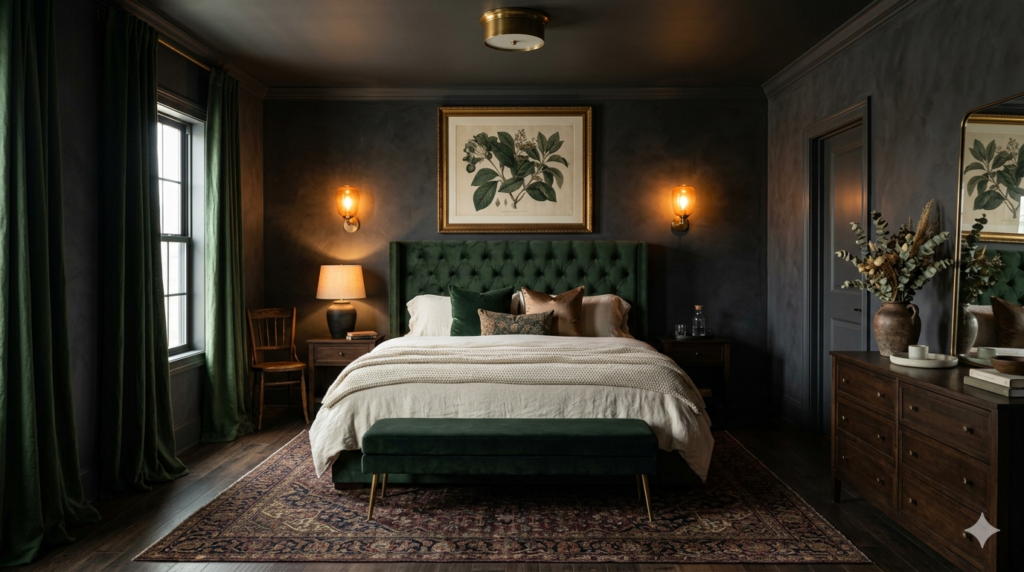
Start with the walls. The wall colour or finish is the thing that will define every other decision, and it is the thing that is most disruptive to change — so do it first, get it right, and let it guide everything else. Once the walls are done, bring in the major furniture: the bed, the bedside tables, the wardrobe, the dresser. Then the curtains. Then the rug. Then the lighting. Then the textiles — bedding, cushions, throws. Then the accessories. Then the scent.
If budget is a constraint (and for most of us, it always is to some degree), prioritise in this order: wall colour, bedding, curtains, lighting. These four elements will do more for the room’s atmosphere than any individual piece of furniture. A dark wall, beautiful layered bedding, heavy floor-length curtains, and warm low lamplight will make even modest furniture look intentional and beautiful. You can upgrade the furniture over time. Get the atmosphere right first.
The most common mistake people make when attempting a moody luxe bedroom is stopping halfway. They paint one wall dark and leave the others white. They buy a beautiful duvet cover but put cheap, flat pillows on top of it. They choose a gorgeous rug but keep their existing bright overhead light on and wonder why the room does not feel right. The moody luxe aesthetic requires commitment to the whole atmosphere. It is not a single statement piece. It is a collective effort of colour, texture, light, and intentionality working together in the same direction. When it comes together, it is genuinely, unreservedly one of the most beautiful things you can create in your home.
The bedroom you have been imagining — the dark, rich, quiet, deeply luxurious one that makes you actually look forward to going to bed at the end of the day — is completely within reach. It does not require a renovation. It does not require a designer. It requires a good wall colour, some beautiful textiles, warm low light, and the willingness to buy curtains that are slightly too long.
Quick-Reference Shopping List
To bring together everything covered in this guide, here is a practical overview of what to source for each category. Use this as a checklist as you build the room over time.
For your walls, you need either a deep limewash paint or a rich flat/eggshell finish paint in your chosen moody tone. For the bed, an upholstered headboard in velvet or boucle in a deep colour, a quality bed frame in dark wood or upholstered in dark fabric, high-thread-count linen or cotton bedding in warm white or ivory, at least two Euro pillowcases and two standard pillowcases in velvet or linen, a weighted or feather duvet, and one folded throw in cashmere, wool, or heavyweight cotton.
For furniture, dark wood or dark-finish bedside tables with drawers, a dresser or chest of drawers in dark wood with brass or matte black hardware, a bench at the foot of the bed in velvet or leather, and an accent chair in a corner. For lighting, two wall sconces or two bedside lamps with warm bulbs and a dimmer, and optionally a floor lamp near the reading chair. For window treatments, floor-length lined curtains in heavyweight linen, velvet, or similar in a deep tone, hung from ceiling height. For rugs, a large vintage-style Persian or Oriental rug in deep tones sized to fit under the bed. For accessories, large dark-framed wall art, a large leaning mirror, ceramic or stone decorative objects, dried botanicals, candles in dark vessels, and a quality warm bedroom scent.