
A Complete Room-by-Room Guide to Building a Cozy, and Put-Together Space)
Let’s be honest. You have spent way too long scrolling through beautiful bedroom photos on your phone, saving post after post, and then walking into your actual bedroom and feeling… nothing. No calm. No comfort. Just a room with a bed in it. Maybe some clothes on the chair. (We do not judge. That chair exists in every home.)
The soft modern bedroom style is one of the most searched and saved interior aesthetics right now, and for good reason. It manages to feel warm without being heavy, clean without being cold, and beautiful without looking like no one actually sleeps there. It is the kind of bedroom that makes you exhale the moment you walk in. And the good news is that it is very buildable, even if you are starting from zero, renting your place, or working with a tight budget.
This guide will walk you through exactly how to style a soft modern bedroom from the ground up. We will cover everything, from how to choose your color palette and pick the right furniture, to layering your bedding, choosing lighting that feels like a warm hug, and adding those final details that make a room feel finished and intentional. We will also include AI image generation prompts at each section so you can visualize ideas before you spend a single dollar.
Consider this your complete, no-fluff roadmap to building a bedroom you actually want to spend time in.
What Is a Soft Modern Bedroom, Really?
Before you start buying anything, it helps to understand what this style actually is, because it is not the same as minimalism, Scandinavian design, or the beige-everything trend that swept the internet a few years ago. A soft modern bedroom has its own distinct personality.
The word “soft” refers to the feeling of the room. Everything about it is intentionally gentle. The colors are muted and warm. The textures are layered and touchable. The lines of the furniture are clean but not sharp. Nothing in the room feels harsh, angular, or aggressively trendy. It is a space that was designed to feel restful, and that restfulness is built into every single choice.
The word “modern” means the room still feels current and edited. It is not maximalist. It is not overstuffed with decor or competing patterns. There is a sense of intentionality, a feeling that every item was chosen on purpose. The room looks put together without looking like a hotel lobby. It is lived-in in the best possible way.
Put the two together and you get a bedroom that feels like a deep breath. Warm but airy. Simple but layered. Calm but not boring. Think of it as minimalism that went to therapy and came back softer.
Step One: Build Your Color Palette
The color palette is the single most important decision you will make when styling a soft modern bedroom. Get this right and everything else becomes easier. Get it wrong and even expensive furniture will feel off. The good news is that the color rules for this style are simple and forgiving.
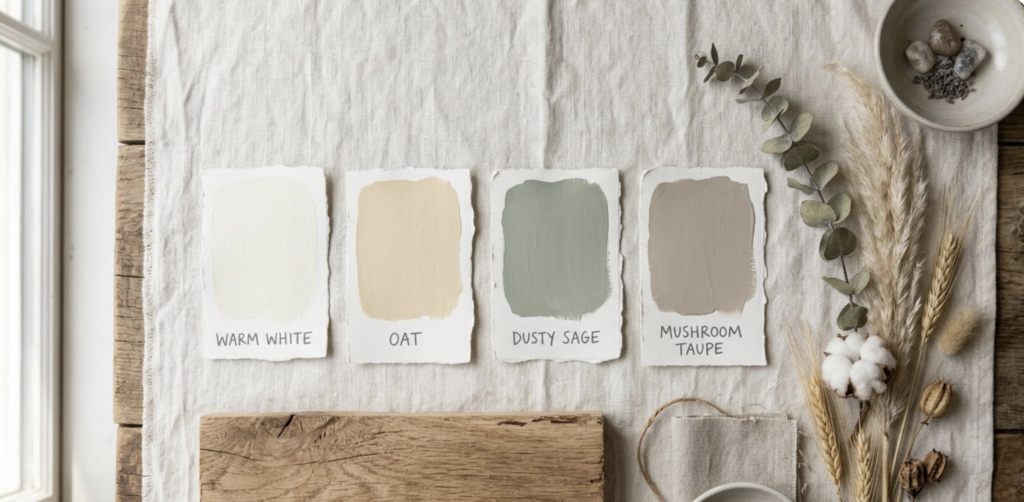
Your base should be a warm neutral. This is the color that covers most of the room, the walls, the largest pieces of furniture, the bulk of your bedding. Warm whites, soft creams, light oats, warm greiges, and pale taupes all work beautifully here. The key word is warm. Cool grays, stark whites, and bright whites tend to push the room toward a colder, more clinical feeling, which is the opposite of what you are going for. If you hold a paint swatch up to your wall and it makes the room feel like a doctor’s office, put it back.
On top of that warm base, you want one or two accent tones that add just enough interest without disrupting the calm. Dusty sage green is endlessly popular in this style and for good reason. It is earthy and gentle and reads as natural without being overpowering. Warm terracotta in its muted, dusty form, not the bright orange version, adds a beautiful organic warmth. Mushroom brown, dusty mauve, and muted olive are all excellent choices as well. What you want to avoid are saturated, high-contrast colors. Even a deep navy or forest green, which are lovely in other contexts, can feel too heavy for this style unless they are used in very small amounts.
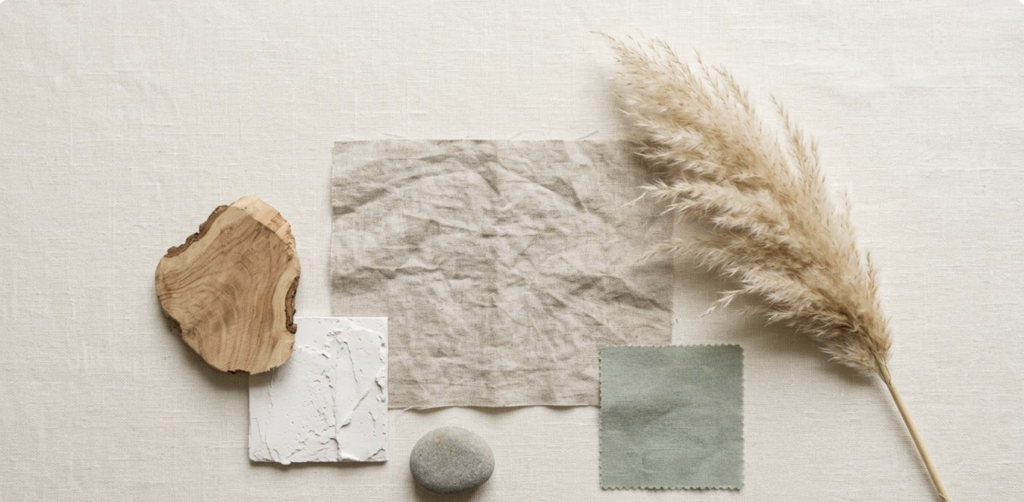
The third layer of your palette is your material tones, which often go unnoticed but do enormous work. Raw linen has a natural wheat color. Unfinished oak has a warm honey tone. Natural jute, rattan, and woven textiles all bring in organic warmth. These are not technically colors you choose, they come with the materials, but they should harmonize with your wall color and soft furnishings. This is why picking a warm white is so much easier to work with than a cool white: warm whites naturally pair with wood tones and natural textiles, while cool whites can make those same materials look yellowed and dated.
If you are ever unsure whether your palette is working, take all your fabric and material samples and lay them flat together on your bed or floor. If they feel like they belong in the same room, you are on the right track. If one item keeps pulling your eye and feeling wrong, that is your answer.
One last tip on color: do not forget your ceiling. Most people paint it bright white by default, but in a soft modern bedroom, a ceiling painted in the same warm white as your walls or even a very light warm tint of your wall color makes the room feel more cocoon-like and intentional. It is a small thing that makes a surprisingly big difference.
Step Two: Choose Your Furniture and Get the Scale Right
The furniture in a soft modern bedroom is where a lot of people either nail it completely or quietly go wrong in ways they cannot quite identify. The issue is usually one of two things: the wrong style or the wrong scale. Both will make a room feel off no matter how pretty the individual pieces are.
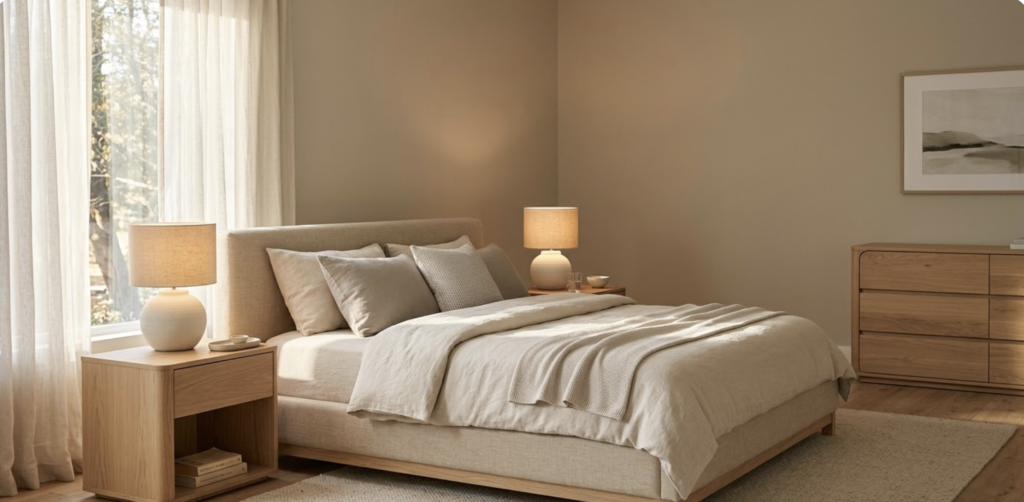
For style, you want furniture with clean, simple lines but with a sense of warmth. Think low-profile platform beds rather than tall four-poster frames. Nightstands that are simple in shape but made of warm wood or have warm-toned hardware. A dresser that is straight-fronted and unfussy but feels solid and real rather than flat-pack and cheap. Curves are welcome here, in fact, furniture with soft curves, slightly rounded corners, or an organic silhouette fits this aesthetic beautifully. What you want to avoid is furniture that is too ornate, too fussy, or too stark. Heavy traditional furniture with carved details will fight the softness of the room. Ultramodern furniture with very cold finishes like polished chrome or gloss black will push the room into a different aesthetic entirely.
Materials matter just as much as shape. In a soft modern bedroom, warm wood tones are your best friend. Light to medium oak, walnut on the lighter end of the spectrum, mango wood, and acacia all work well. If you have painted furniture, opt for matte finishes in warm whites or soft greiges rather than high-gloss finishes. Cane or rattan details on furniture pieces add beautiful texture and natural warmth without looking tropical or bohemian. Linen upholstery on a bed frame or bench brings softness right into the furniture itself.
Now let us talk about scale, because this is where so many otherwise lovely bedrooms fall apart. Scale refers to the size of your furniture relative to your room and to each other. The most common mistake is choosing furniture that is too small for the room in an attempt to make a small room feel bigger. In reality, this usually makes the room look cheap and unfinished. A full-size bed in a bedroom that can comfortably fit a queen will always look like it belongs in a guest room. Nightstands that are too tiny relative to the bed will look lost. A dresser that is too short or narrow for the wall it sits on will look like it was an afterthought.
The general rule is to size up rather than down. A bed that fills its wall looks intentional. Nightstands that rise to the top of your mattress height look considered. If you are working with a small bedroom, choose fewer pieces of furniture rather than smaller ones. One well-scaled bed with one nightstand and a good dresser will always look better than a bedroom stuffed with undersized furniture trying to compensate for a lack of space.
Step Three: Build Your Bed Like You Mean It
The bed is the centerpiece of your bedroom. It is what people see first when they walk in, it is where your eye lands when you look at any photo of the room, and it is the piece that sets the tone for everything else. Building a beautiful soft modern bed is not just about buying nice sheets. It is about layering, proportion, and knowing when to stop.
Start with your foundation: the mattress and pillows. A good mattress protector in white or oat extends the life of your mattress and keeps things looking fresh. Your base sheet should be in a warm white or light cream. Pure crispy white sheets can actually work against you here because they feel too sharp and hotel-like. What you want is a sheet that feels slightly lived-in, slightly soft. Washed cotton, stonewashed linen, and bamboo cotton blends all have that naturally relaxed quality that is perfect for this style.
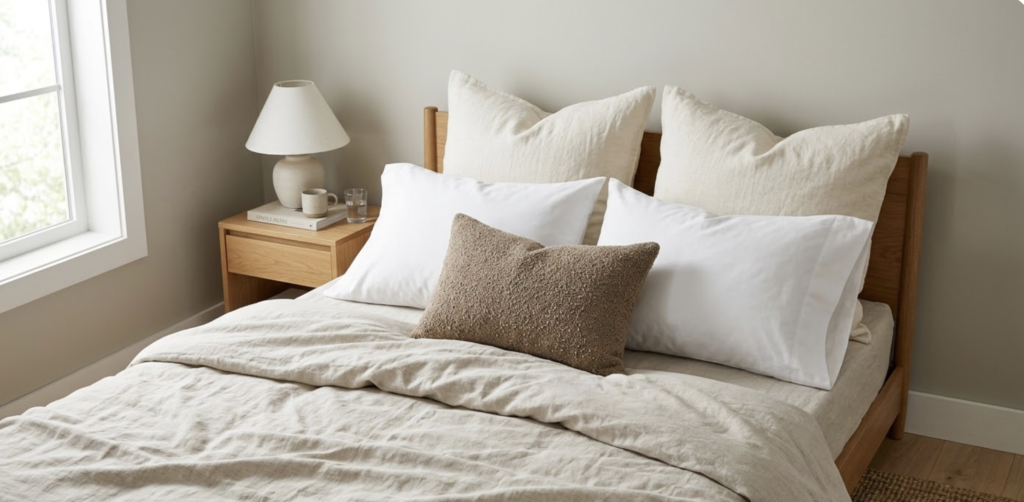
The duvet cover is where you really set the tone. In a soft modern bedroom, the most successful duvet covers are textured rather than flat. Waffle-weave, boucle, textured cotton, and especially washed linen duvet covers have that beautiful rumpled, effortless quality that is almost impossible to recreate with a flat microfiber cover. The color should fall within your chosen palette. An oat linen duvet on warm white sheets is a classic combination that works in almost any version of this style. If you want more visual interest, a striped duvet in soft tones or one with very subtle tone-on-tone texture can be lovely.
The pillow arrangement is where many people overcomplicate things, or undercomplicate them. You do not need twelve pillows. But you do need more than just your sleeping pillows. The layered bed look that makes you want to dive in and never leave is built on a system. Start with two euro shams in the back. These are the big square pillows that sit against the headboard and create a backdrop. In front of them, place your standard sleeping pillows in matching pillowcases. In front of those, add two to three accent pillows that introduce texture, a slightly different tone, or an interesting shape. At the foot of the bed, a folded throw in a contrasting texture, say a chunky knit or a waffle cotton, completes the picture.
The throw at the foot of the bed is one of those details that people underestimate massively. It adds color depth, it adds texture, and it gives the eye a place to rest that is not just more pillow. It also makes the whole bed look more dimensional and professionally styled. Fold it slightly loosely rather than perfectly flat. Perfectly folded throws look staged. A slightly casual fold looks like someone stylish actually lives here, which is exactly the vibe you want.
Step Four: Get Your Lighting Right
Interior designers will tell you, and they are right, that lighting is the single most transformative element in any room. You could have the most beautiful furniture, the most perfectly layered bed, and the most carefully chosen palette, and a single overhead fluorescent bulb can make all of it look terrible. Conversely, a simply furnished room with thoughtful, warm lighting can look genuinely beautiful. Lighting is not an afterthought in the soft modern bedroom. It is a design element.
The first thing to address is your overhead light. Most bedrooms come with a standard ceiling fixture that produces flat, unflattering light that hits everything from directly above and creates zero atmosphere. If you can swap this out for a pendant light or a simple flush mount with a warmer finish, do it. Even if you cannot change the fixture itself, you can absolutely change the bulb. Switching to a warm white bulb, specifically one with a color temperature of 2700K or even 2400K, will warm up the entire room immediately. This is a five-dollar change that makes a visible difference from the moment you turn the light on.
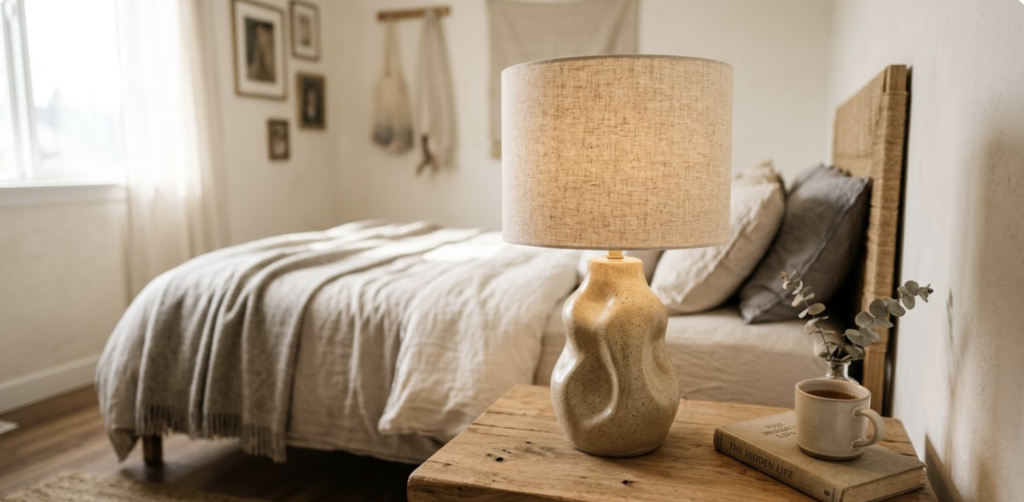
The real magic of a soft modern bedroom, however, comes from layered lighting at multiple heights. Bedside lamps are essential and they serve two purposes: functional task lighting for reading, and ambient glow for everything else. In this style, table lamps with ceramic, plaster, or natural stone bases in organic shapes are particularly beautiful. The shade should be in a warm linen or parchment fabric rather than a crispy white, because a white shade throws cool light while a warm shade throws golden light. Plug-in sconces mounted on the wall beside the bed are an excellent alternative if your nightstands are small or if you prefer a more streamlined look.
Beyond the primary light sources, consider adding a floor lamp in a corner of the room to create a warm, low glow in the evening. This adds enormous depth to the room and makes it feel layered and considered. A simple arched floor lamp or a thin-legged torchiere in brass or black can do this job beautifully. String lights or LED strip lights behind the headboard or under a floating shelf create a subtle ambient glow that is particularly lovely in the evening. These are not childish or bohemian if done with intention. They are one of the simplest ways to make your bedroom feel like a place you want to be.
The rule to remember is: cool light wakes you up, warm light winds you down. Every light source in your bedroom should be warm-toned. This is not just an aesthetic preference. It is genuinely helpful for sleep, because cool blue-toned light suppresses melatonin production. Your bedroom lighting choices are simultaneously making your room more beautiful and helping you sleep better. That is a very good deal.
Step Five: Choose Window Treatments That Work for You
Windows and curtains are one of the most underrated parts of bedroom styling. The right window treatment can make your room look taller, softer, and more put-together. The wrong one, or none at all, can make even a beautifully furnished room feel unfinished. In a soft modern bedroom, the goal with window treatments is the same as everything else: warmth, softness, and a sense of intention.
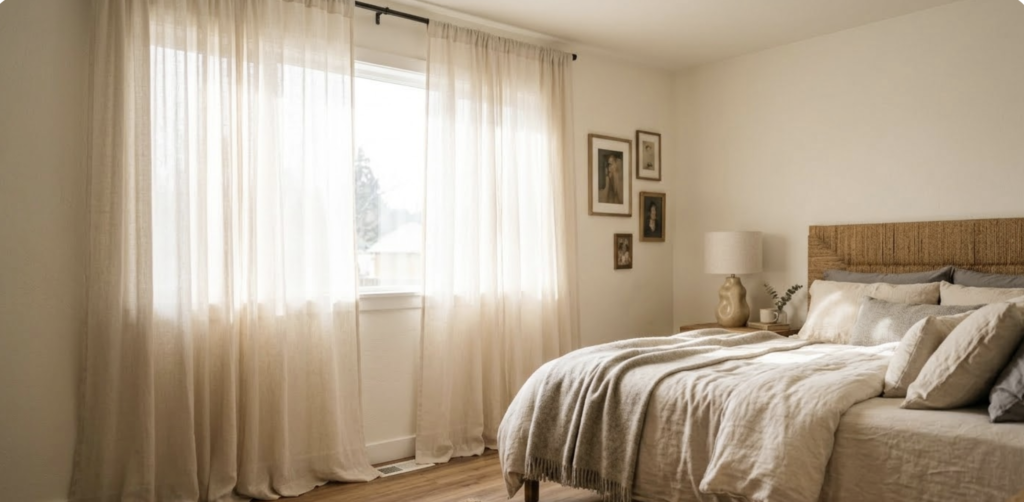
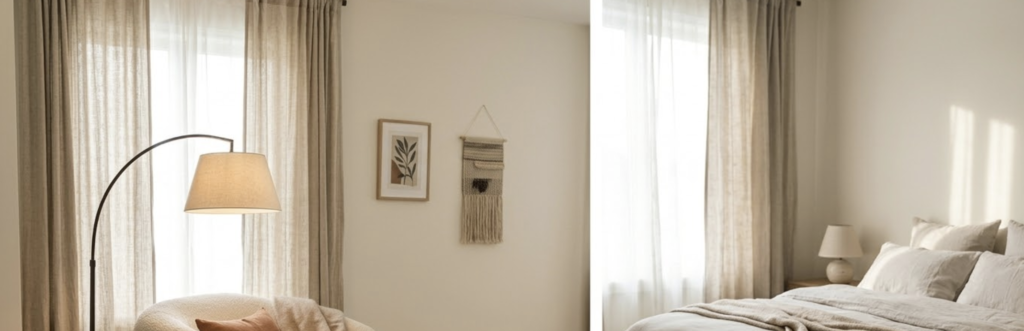
The most popular and versatile window treatment for this style is sheer curtains in a warm white or very light cream linen. These curtains filter light beautifully without blocking it entirely, which gives the room that dreamy, diffused glow that looks so good in photos and feels even better in real life. They also make the room feel airier and more spacious, which is a bonus in any size of bedroom. Sheer linen curtains specifically have a beautiful natural drape and texture that polyester sheers simply cannot replicate. The slight imperfection in the weave is part of the charm.
For darkness and privacy, you have two options. You can layer your sheer curtains over a blackout roller blind in a color that matches your walls, which gives you flexibility to have full light filtering with the sheers during the day and complete darkness when you need it. Or you can invest in lined or blackout curtains that still look beautiful but provide more coverage. Either way, the important thing is that your curtains should be hung high and wide. This is one of the most impactful and free things you can do for your window treatments. Hanging your curtain rod as close to the ceiling as possible, rather than just above the window frame, makes the window look taller and the room feel much more elevated. Extending the rod several inches on each side of the window, so that the curtains frame the window rather than covering it, makes the window look wider and lets more light in when the curtains are open.
The length matters enormously. Curtains that end at the sill or mid-window look stubby and dated. Curtains that just kiss the floor look intentional and polished. A slight puddle on the floor, just a few extra inches of fabric, looks luxurious and soft and is particularly beautiful with linen. Whatever you do, avoid curtains that hover an inch or two above the floor. That hemline limbo will haunt your room photos forever.
Step Six: Layer Your Textures Like a Pro
If color is the mood of a soft modern bedroom, texture is the soul. A room where everything is the same texture, even if the colors are all perfect, will feel flat and lifeless. Texture is what makes a room feel rich, tactile, and inviting. It is also one of the most affordable ways to add personality and depth to a space, because texture comes from materials, not from expensive statement pieces.
The key is to mix textures that contrast without competing. In a soft modern bedroom, the most successful texture combinations typically include something smooth, something woven, something soft and plush, and something with natural organic variation. Smooth could be a plaster wall finish or a ceramic lamp base. Woven could be your linen duvet, a jute rug, or a rattan pendant shade. Soft and plush could be a boucle accent pillow, a sheepskin throw, or a velvet cushion in a muted dusty tone. Natural organic variation could be a live-edge wooden tray, a dried botanical arrangement, or a raw clay vase.
The rug is one of the most powerful texture elements in the bedroom because it covers a large area and sets the tone for the entire floor space. In a soft modern bedroom, a natural fiber rug in jute, sisal, or a flat-woven wool works beautifully. So does a low-pile wool rug in a warm neutral tone with a subtle texture or very faint pattern. Boucle or shaggy rugs add maximum softness and are particularly lovely if you love that barefoot-in-something-cozy feeling when you get out of bed in the morning. The rug should be large enough that the front legs of the bed and bedside tables sit on it, or ideally that the rug extends significantly beyond the sides and foot of the bed. A small rug that floats in the middle of the floor looks like it was meant for a different room.
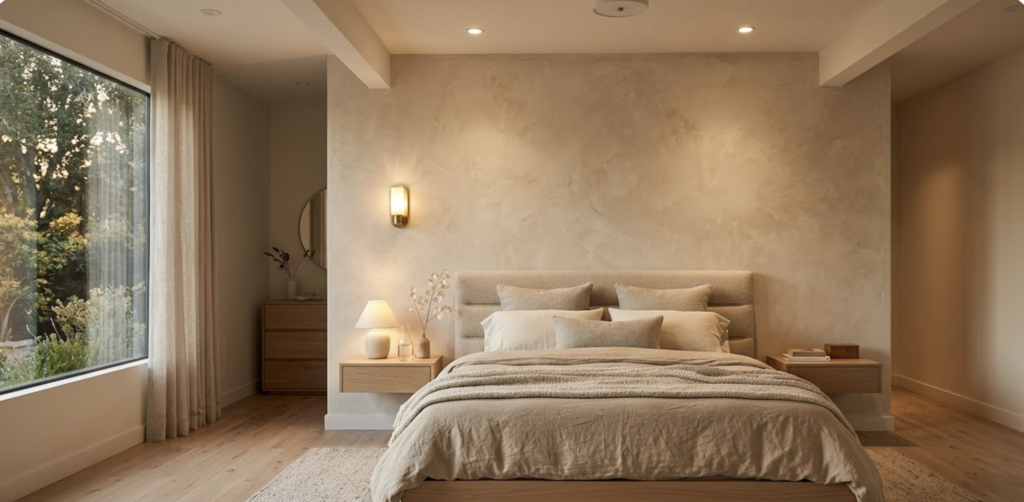
Think about texture on your walls too, not just in your soft furnishings. A limewash paint finish, a grasscloth wallpaper, a plaster effect, or even a simple board and batten paneled wall behind the bed all add tremendous depth and interest to a space that would otherwise be a flat, painted surface. You do not need to texture every wall. One textured wall, typically the one behind the headboard, is enough to anchor the room and give it a bespoke, intentional quality.
Step Seven: Add Furniture Beyond the Bed
A bedroom is not just a bed. If all you have in your room is a bed and two nightstands, the room will feel unfinished no matter how beautiful the bed itself is. The additional furniture pieces you choose, how you place them, and what you do with them are what take the room from a sleeping space to a real, considered room.
The dresser or wardrobe is the practical backbone of the room. In a soft modern bedroom, a dresser in warm wood tones or a matte painted finish works well. What makes it look intentional rather than purely functional is what you put on top of it. A carefully curated dresser top with a small tray, a simple ceramic vase with dried botanicals, a single framed piece of art, and a candle or two transforms a piece of furniture into a styled vignette. The items should be grouped in odd numbers and at different heights. Two items of the exact same height sitting next to each other look like a mistake. A tall vase next to a short tray next to a medium-height candle looks deliberate.
A bench or ottoman at the foot of the bed is one of the most overlooked pieces of bedroom furniture and one of the most impactful. Beyond the practical function of giving you somewhere to sit while putting on shoes, a bench adds visual weight and anchors the foot of the bed in a way that makes the whole room feel more complete. In a soft modern bedroom, an upholstered bench in linen, boucle, or velvet, or a simple wooden slatted bench in warm oak, both work beautifully. The bench does not need to be wide. Even a narrow one, just a little shorter than the width of the bed, does the job perfectly.
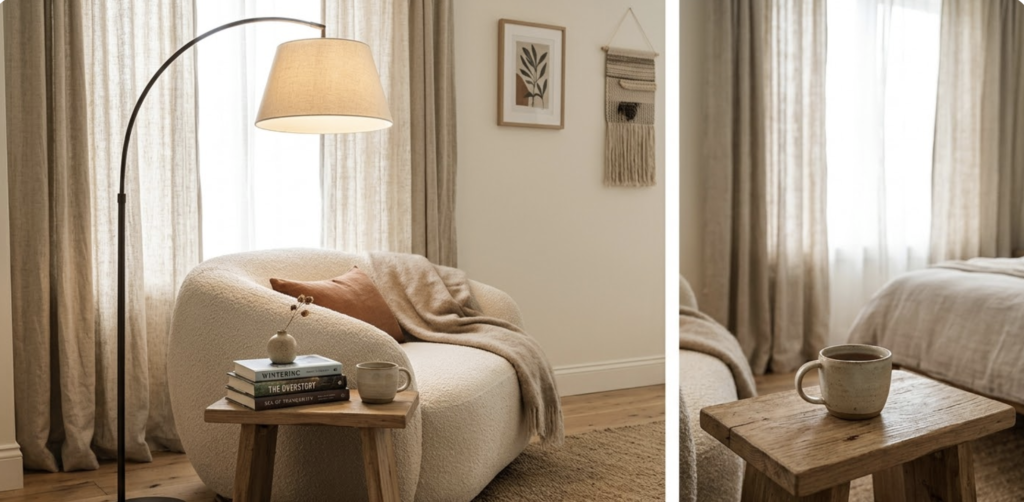
A small chair or reading nook, if your space allows, is the most luxurious addition you can make to a bedroom. Even a single armchair in a corner with a small side table and a lamp creates a little world within the room that makes the space feel genuinely inhabitable beyond just sleeping. In a soft modern bedroom, a rounded armchair in a warm textured fabric, something boucle, teddy, or a soft bouclette weave, creates a gorgeous corner moment that photographs beautifully and, more importantly, gives you a place to actually sit and exist in your bedroom without getting back into bed.
Step Eight: Choose Decor and Art with Intention
Decor in a soft modern bedroom follows one simple principle: less, but better. This is not a style where you fill every surface and wall with things. It is a style where every item that makes it into the room has been chosen deliberately and earns its place. This sounds restrictive but is actually incredibly freeing, because it means you never have to manage clutter, never have to wonder if things go together, and the few pieces you do choose get to be genuinely special.
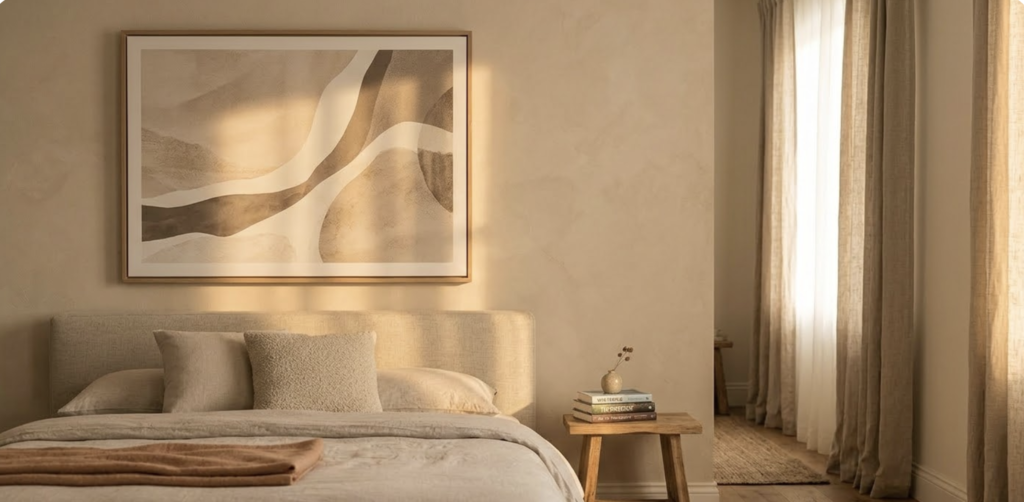
Art is one of the most personal and highest-impact additions to any bedroom. In a soft modern bedroom, the most fitting art tends to be abstract or organic in subject matter and neutral to soft in palette. This does not mean you need to buy expensive original art. Printable digital art in abstract forms, botanical illustrations in muted tones, landscape photography with soft lighting, and simple line art are all widely available and can look beautiful when framed well. The frame matters as much as the art itself. Thin wooden frames in natural oak or walnut, simple plaster-look frames, and slim metal frames in brushed brass or matte black all work in this style.
For wall art in the bedroom specifically, consider the scale. One large piece of art above the dresser or on the wall beside the bed will always look more intentional than several small pieces competing with each other. A gallery wall can work in a soft modern bedroom if every piece is cohesive in palette and framing, but it takes more effort to execute. When in doubt, go larger and go single. One well-chosen, well-sized piece of art will do more for your room than six small prints that feel like they were leftover from somewhere else.
Plants bring the last and most important layer of life to a bedroom. Even one or two well-placed plants add color, organic movement, and a sense of living energy that no decor item can replicate. In a soft modern bedroom, trailing plants like pothos or philodendron look beautiful on a high shelf or on top of the dresser. A single large plant, a fiddle leaf fig, a rubber plant, or a large monstera, in a simple clay or concrete pot, can anchor a corner of the room beautifully. If you are not confident about keeping plants alive, a single dried botanical arrangement in a simple vase is a perfectly acceptable alternative. Dried pampas grass, dried bunny tails, bleached cotton branches, and dried lunaria all have a natural, organic beauty that holds up beautifully in this style.
Step Nine: Edit, Subtract
This step is the one that separates a pretty bedroom from a truly beautiful one: knowing when to stop. It is also the hardest step for most people, because when you are excited about a space and have collected beautiful things for it, the urge to include everything is strong. Resist this urge. The soft modern aesthetic lives and dies by restraint.
Once you have placed your furniture, styled your surfaces, and hung your art, step back and look at the room with fresh eyes. Better yet, take a photo. The camera forces you to see the room differently than your eyes do when you are standing in it. What you are looking for is anything that makes the room feel busy, cluttered, or visually noisy. Anything that does not fit the palette. Anything that feels out of place or seems to be there by default rather than by choice.
Common things to remove include: the pile of books on the nightstand that is taller than the lamp, the extra decorative items that ended up on the dresser because they had nowhere else to go, the second throw blanket draped over the chair that made the chair feel chaotic rather than cozy, and the miscellaneous items on the floor that are waiting for a home. You do not need to get rid of these things permanently. You might find a drawer, a basket, a closet shelf, or another room for them. But the bedroom should be cleared of anything that does not serve either a functional purpose or a purely beautiful one.
The empty space between items is not wasted space. It is breathing room. It is the pause that makes the beautiful things stand out. A dresser top with three carefully chosen items and significant negative space around them looks styled and intentional. That same dresser top with eight items crowded together looks like a surface that needs to be cleared. The items have not changed. The space between them has. This is the most important styling lesson in this entire guide, and it costs nothing at all.
The Details That Make People Ask “Who Styled Your Room?”
There are a few specific details that appear in almost every beautifully styled soft modern bedroom you have ever saved or admired, and they are worth mentioning on their own because they are small, often inexpensive, and they do disproportionately large amounts of work.
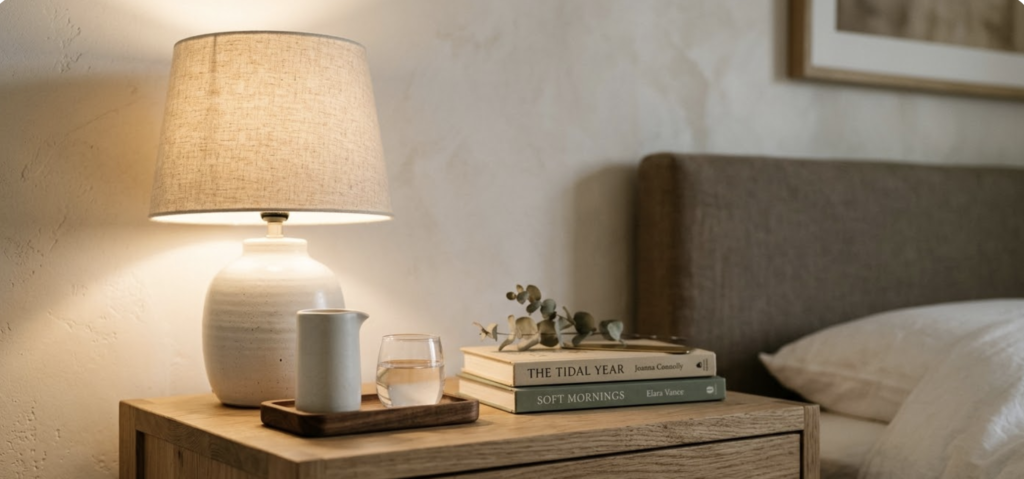
The first is a matching set of bedside table accessories. When your bedside lamp, your water carafe, your small tray, and your decorative item all belong to the same visual family, whether that means they share a material, a color, or a general aesthetic, the nightstand feels curated rather than random. A ceramic lamp base, a matching ceramic water carafe, and a small clay tray create a cohesive moment that looks like someone thought about it. Because someone did. You.
The second is your door hardware and light switches. These are so often overlooked and yet they are details your eye catches constantly without consciously registering them. If your room is full of warm, organic, natural materials and your light switches are standard white plastic and your door handle is cheap silver metal, there is a quiet visual friction happening. Replacing light switch covers with ones in warm white or plaster tones costs very little. Swapping a basic door handle for one in brushed brass or matte black is often a straightforward DIY job and the visual upgrade is immediate and surprisingly significant.
The third detail is your cable management. Nothing pulls you out of a beautiful room faster than a tangle of phone charger cables draped over a nightstand. A bedside charging station that hides cables, or even a simple wooden tray with a single clip that holds the cable off the floor, makes a meaningful visual difference. Cable clips on the back of the nightstand, a small fabric cable tidy, or a nightstand with a built-in charging port are all options depending on your budget. The point is simply that visible cable chaos is the enemy of a styled room, and it is one of the easiest problems to solve.
The fourth is scent. This is technically not styling but it is one of the most powerful ways to make your bedroom feel like a true sanctuary. A reed diffuser in a warm, grounding scent such as sandalwood, cedar, or linen gives the room a sensory identity beyond just the visual. When you walk into your beautifully styled bedroom and it also smells wonderful, the experience of the room is complete in a way that a purely visual room cannot be. Your nose is part of how you experience a space. This is why every great hotel room has a signature scent. You can create the same effect at home for the cost of a single reed diffuser.
Making It Work in a Small Bedroom
Everything covered in this guide applies to any size of bedroom, but small bedrooms come with their own specific challenges and deserve some direct attention. The good news is that the soft modern style is actually one of the most forgiving for small spaces, because its inherent restraint, minimal clutter, warm tones, and considered approach to furniture naturally keeps spaces from feeling cramped.
In a small bedroom, vertical space is your best friend. Mounting your curtain rod as high as possible is even more important here because it draws the eye up and makes the ceiling feel taller. Floating shelves on the wall beside the bed, rather than nightstands on the floor, free up visual floor space and make the room feel more open. A tall, narrow floor lamp takes up minimal floor area but adds significant height to the room. Mirrors are a well-known trick for small spaces and they absolutely work here. A large mirror leaning against the wall, or a full-length mirror hanging on the back of the door, reflects light and makes the room feel at least twice as large.
Resist the temptation to use tiny furniture in a small room. As mentioned earlier in the furniture section, a correctly scaled bed in a small room will always look better than a smaller bed that leaves awkward gaps. If your room can fit a queen bed, use a queen bed. If you can only fit a full, choose it intentionally and style it beautifully. Use the space under the bed with storage boxes in matching colors or a low platform bed with built-in storage drawers. This eliminates the need for a large dresser, which in a very small bedroom can feel overwhelming.
Finally, keep your palette especially light and cohesive in a small bedroom. This is not the room to experiment with a deep accent wall or heavy curtains in a dark tone. Keeping the walls, ceiling, and large surfaces all within the same light warm tone family makes the boundaries of the room feel less defined and the space feel more open. The texture and layering of your bedding and soft furnishings will provide all the visual interest you need without making the room feel smaller than it is.
Budget-Friendly Ways to Build This Look
The soft modern bedroom style does not require a designer budget. In fact, it is one of the more achievable interior aesthetics because it prioritizes quality in a few key areas while staying intentionally restrained everywhere else. The trick is knowing where to spend and where to save.
Spend on your bedding. This is the one area where quality genuinely makes a visible and tactile difference. Cheap polyester bedding will never give you the beautiful rumpled linen look that is central to this style. Washed cotton or linen bedding at a higher price point looks significantly better, feels better, and photographs better. This is also the element that you interact with most directly in the room, so the investment pays dividends in daily comfort as well as aesthetics.
Spend on your rug if your room is hardwood or tile. A good natural fiber or quality wool rug makes an enormous difference to how the room feels both visually and underfoot. A cheap synthetic rug tends to look flat and plasticky no matter how it is styled around it.
Save on art by printing your own. There is a vast world of digital printable art available for a few dollars, and when printed at a good size on matte paper and placed in a quality frame, it looks genuinely beautiful. The frame is where you should spend a bit more. A nice frame elevates even a simple print.
Save on decorative accessories by shopping secondhand. Ceramic vases, trays, baskets, and candle holders in the shapes and tones that work for this style are abundant in thrift stores, vintage markets, and online secondhand platforms. The fact that they are one-of-a-kind often makes them more interesting and more charming than their brand-new equivalents.
Repaint instead of replacing furniture. If you have furniture that is the wrong color but the right shape, painting it with a good quality matte furniture paint in a warm neutral can completely transform it for a fraction of the cost of replacement. A dated pine wardrobe in honey yellow can become a sophisticated warm white piece with a weekend and a can of paint. This is one of the highest-return projects you can do in a bedroom.
Pulling It All Together: Your Styling Checklist
By now you have the full picture. Building a soft modern bedroom is not about finding the perfect pieces or having a large budget. It is about making considered, intentional decisions at each stage and editing ruthlessly at the end. Here is a simple summary of the steps covered in this guide to help you approach your own room with clarity.
Begin with your color palette. Choose a warm neutral base for walls and large furniture. Add one or two soft accent tones in dusty, earthy shades. Let your material tones, wood, linen, natural fiber, work as part of the palette rather than against it.
Choose furniture with clean lines, warm materials, and the right scale for your room. Do not buy smaller furniture to make the room look bigger. Choose fewer pieces instead. A low platform bed, warm wood nightstands, and a quality dresser are the essential pieces.
Build your bed in layers. Base sheets, duvet cover, euro shams, sleeping pillow cases, accent pillows, and a folded throw. Use natural, textured fabrics wherever possible. Do not over-pillow but do not under-pillow either.
Layer your lighting at multiple heights. Warm bulbs everywhere. A ceiling fixture for general use, bedside lamps for ambience, and a floor lamp in a corner for depth. Avoid cool-toned lighting entirely.
Hang your curtains high and wide. Use warm white or linen-toned sheers for softness and light. Layer with a blackout blind for function. Let the curtains brush or puddle slightly on the floor.
Mix textures throughout. Smooth, woven, plush, and organically imperfect textures should all be present. Let your rug, your bedding, your walls, and your accessories each bring their own texture to the room.
Add a bench, a chair, or both if space allows. Style your dresser top with intention, not accumulation. Place art at the right scale. Add plants or dried botanicals. Keep surfaces restrained.
Edit, remove, and step back. Take a photo. Look at it on a small screen. Remove anything that makes the room feel busy. Trust the empty space.
Then light a candle, pour yourself something nice, and go admire what you built. You deserve it. And so does your bedroom.