A Complete Room-by-Room Guide to Building an Apartment you love
Let’s be real for a second. Most apartments look like they were decorated by someone who walked into IKEA for the first time, panic-bought three things in beige, and called it a day. And that’s okay — we’ve all been there. But there’s a big difference between an apartment that looks furnished and an apartment that feels alive, warm, and completely, unapologetically you. That second kind of apartment is what people on the internet call ‘vibey,’ and it is one hundred percent something you can build yourself, even on a budget, even in a rental, and even if your current decorating strategy is ‘pile of throw blankets on a couch and hope for the best.’
This guide is going to walk you through exactly how to style a vibey apartment decor from the ground up. Not in a vague, ‘add some plants and a candle’ kind of way — but in a real, practical, section-by-section way that helps you understand why certain choices make a space feel good, and how to make those choices in your own home. We’re talking about lighting, furniture arrangement, color, texture, smell, sound, storage, art, and all the tiny little details that separate a Pinterest-worthy apartment from a space that just looks like it’s waiting to be returned to the landlord. (You deserve better than that. So does your security deposit, frankly.)
Interior design is a little bit like cooking. Anyone can throw ingredients into a bowl. But knowing why certain things go together, how to layer flavors, and when to stop adding stuff — that’s the actual skill. By the end of this post, you’ll have that skill for your apartment. You’ll probably never look at a bare wall the same way again. And you might just fall a little bit in love with your home for the first time.
1. Understanding What ‘Vibey’ Actually Means
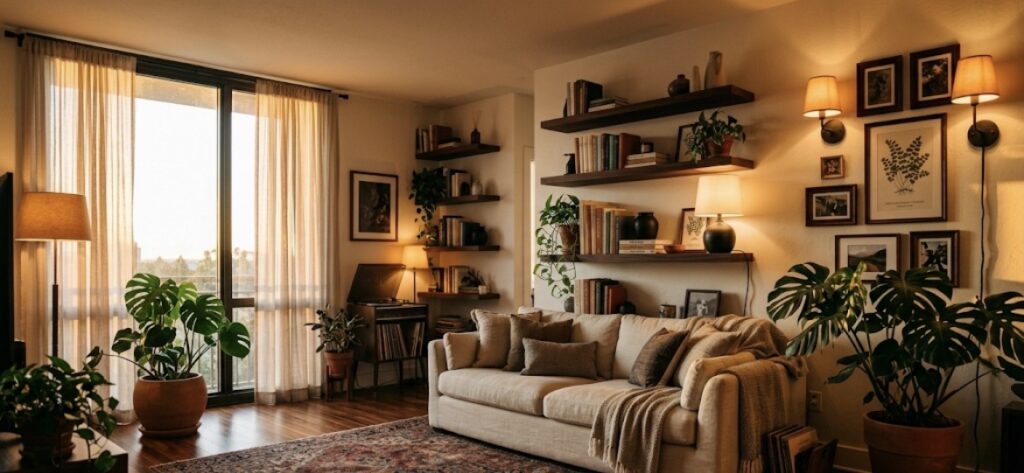
Before you buy a single throw pillow or light a single candle, it helps to understand what you’re actually going for. ‘Vibey’ is not a style in the traditional interior design sense. It’s not like mid-century modern or Scandinavian minimalism, where there are strict rules about furniture legs and color palettes. Vibey is more of a feeling. It’s the feeling you get when you walk into a room and immediately feel like you can breathe, sit down, stay a while, and be yourself. It’s warm without being suffocating. It’s interesting without being cluttered. It’s personal without being chaotic. It’s the interior design version of a really good playlist — you can’t always explain why it works, but you know it immediately when you hear it.
The reason vibey spaces feel so good is because they appeal to all your senses at once. A truly vibey apartment doesn’t just look good — it smells good, it sounds good (or sits in beautifully comfortable silence), it feels good when you touch the textures, and it makes you feel emotionally at ease in a way that’s hard to put into words. Professional designers call this ‘sensory layering,’ which sounds very fancy but just means: your space should work on more than one level at a time. We’ll break down each layer throughout this guide, starting with the most foundational ones and building toward the details that pull everything together.
Another thing that makes a vibey apartment feel different from a generic one is intentionality. Every object in a vibey space feels like it was chosen on purpose — even if it was found at a garage sale for two dollars. That cactus on the windowsill wasn’t placed there because there was an empty corner; it’s there because the person who lives there loves plants and wanted greenery near natural light. The stack of books on the coffee table isn’t just decoration; they’re actually books the person reads. The slightly worn-in leather chair in the corner wasn’t chosen because it was cheap (although it might have been); it was chosen because it’s beautiful and comfortable and it’s been places. Vibey apartments feel like they have a story, because they do. Your apartment should tell your story — not anyone else’s.
2. Starting With Your Color Story
Color is the single most powerful tool in your decorating kit. It affects your mood, the perceived size of your room, the way light bounces around the space, and how all your furniture and decor work together. A lot of people approach color in apartments like it’s a minefield — terrified to commit to anything because ‘what if I hate it in six months?’ But here’s the thing: you don’t have to paint your walls (especially if you’re renting). You can build an entire, rich, vibey color story through furniture, textiles, art, and accessories alone. The walls are just the backdrop. What you put in front of them is the actual painting.
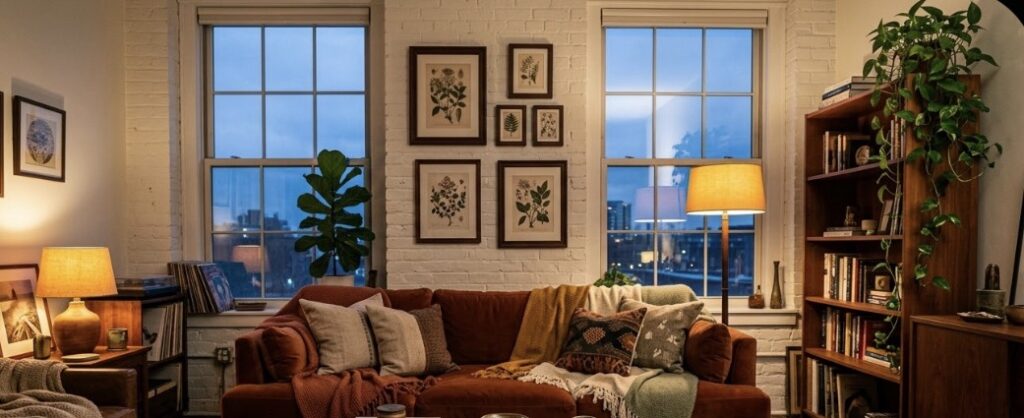
The most important concept in color for a vibey apartment is the idea of a base palette plus accent colors. Your base palette is typically two to three neutral or near-neutral tones that appear throughout the entire apartment, unifying the space. Think warm whites, soft taupes, creamy ivories, warm grays, dusty blush, or soft sage. These are your background colors — the ones that appear on your sofa, your curtains, your rugs, and your largest furniture pieces. They set the emotional tone without demanding attention. They’re the quiet people at the party who somehow make everyone else look better. Then your accent colors are the bolder, more saturated tones that appear in smaller doses: a deep terracotta vase, a set of forest green cushions, a mustard yellow throw, a burnt sienna wall tapestry.
For a truly vibey feel, the best palettes lean warm. Warm colors have more red, orange, or yellow undertones, and they make spaces feel intimate, cozy, and genuinely welcoming. Even if you love cool tones like blues and greens, adding warm elements — like warm-toned wood furniture or amber lighting — will keep the space from feeling cold or sterile. One easy formula that works in almost any apartment is: warm neutral base plus one earthy accent plus one plant green plus one deeper shade of your accent for depth. For example: cream walls and sofa, terracotta cushions and vases, real plants everywhere, and a deep burgundy throw with a few dark frames. That’s it. Simple, warm, vibey — and it cost you almost no design education to assemble.
One thing a lot of people overlook is the color of their lighting. The color temperature of your lightbulbs has a massive effect on how your color palette reads in real life. Warm white bulbs (around 2700-3000K) will make your warm palette glow like golden hour all the time. Cool white or daylight bulbs (above 4000K) will make even the most carefully chosen warm palette look like a doctor’s office waiting room. If there’s only one practical thing you take from this entire section, let it be this: throw out every cool-toned bulb in your apartment and replace them with warm white ones. Your apartment will instantly look at least 40% more vibey. That’s not a scientific number. But it might as well be, because the transformation is real.
3. The Art of Layered Lighting
If color is the most powerful decorating tool, lighting is the most underused one. Most apartments come with exactly one ceiling light per room — usually a harsh overhead fixture that illuminates every corner with the unflattering enthusiasm of a hardware store. Relying solely on overhead lighting in your apartment is the interior design equivalent of eating a meal with only one ingredient. It technically provides sustenance, but nobody is having a good time. Vibey apartments use layered lighting, which means having multiple light sources at different heights and intensities throughout each room, giving you full control over the mood of the space at any given moment.
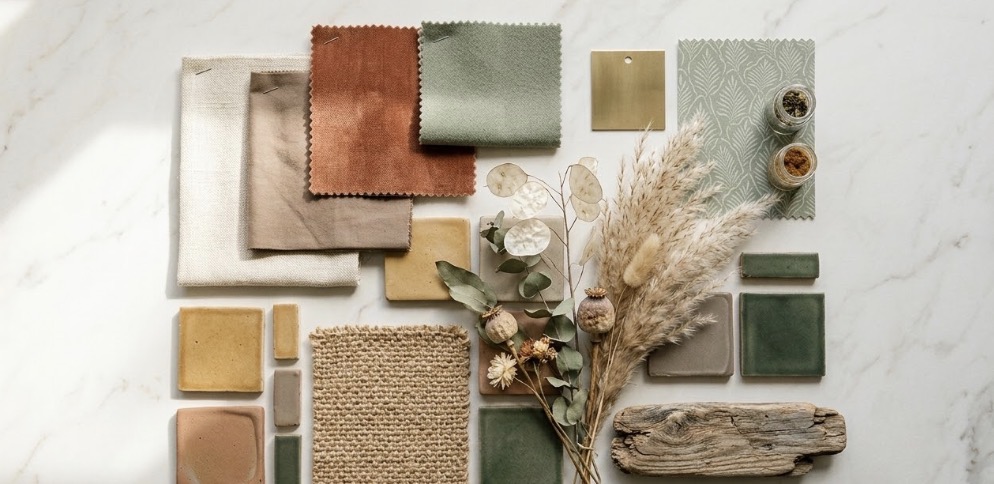
There are three types of light to layer in any room. The first is ambient light — the general background illumination that lets you see the room. This is often your overhead light or a large floor lamp. The second is task lighting — focused light for specific activities like reading, cooking, or working. Think desk lamps, under-cabinet kitchen lighting, or a reading lamp beside your bed. The third, and the one that makes the biggest difference for a vibey feel, is accent lighting. This is decorative light: string lights draped over a bookshelf, a small table lamp in the corner, a candle cluster on the coffee table, or an LED strip behind your TV or under your bed frame. Accent lighting creates depth, shadow, and warmth. It is literally the reason hotel lobbies feel so much better than your apartment currently does. Don’t let hotels keep this secret to themselves.
The golden rule of vibey lighting is: always go lower. Move your light sources down from the ceiling toward eye level and below. Floor lamps in corners, table lamps on side tables, candles clustered at coffee table height, even a small lamp placed on the floor behind a large plant to create a dramatic shadow effect on the wall behind it. The lower the light source, the more intimate and cozy the space feels. This is because lower light mimics the angle of late afternoon sunlight — the way the world looks at 6pm on a summer evening, when everything looks a little golden and a little magical. Your apartment can feel like that all the time. You just need to stop relying on the ceiling fixture that came with the lease.
For renters who can’t hard-wire new light fixtures, the answer is smart bulbs and plug-in everything. Plug-in wall sconces, plug-in pendants that hang from a ceiling hook, rechargeable table lamps, LED strip lights with adhesive backs, and candles — real or high-quality flameless — are all renter-friendly ways to completely transform your lighting without touching a single wire. A simple, warm-toned smart bulb in a dimmer-capable lamp that you control from your phone can change the entire atmosphere of your living room in seconds. You can go from ‘working from home’ to ‘hosting a dinner party’ to ‘watching a movie alone in peace’ with a single tap. That’s worth the twelve dollars a smart bulb costs.
4. Furniture Placement
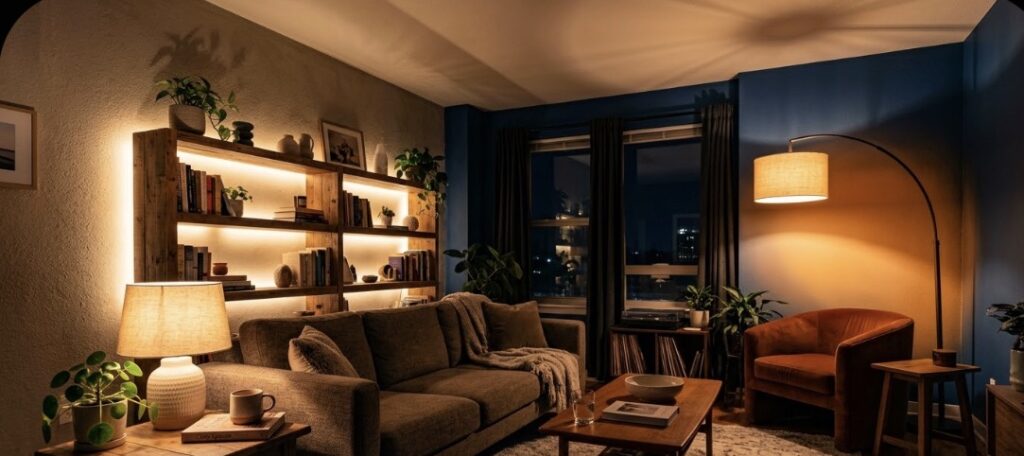
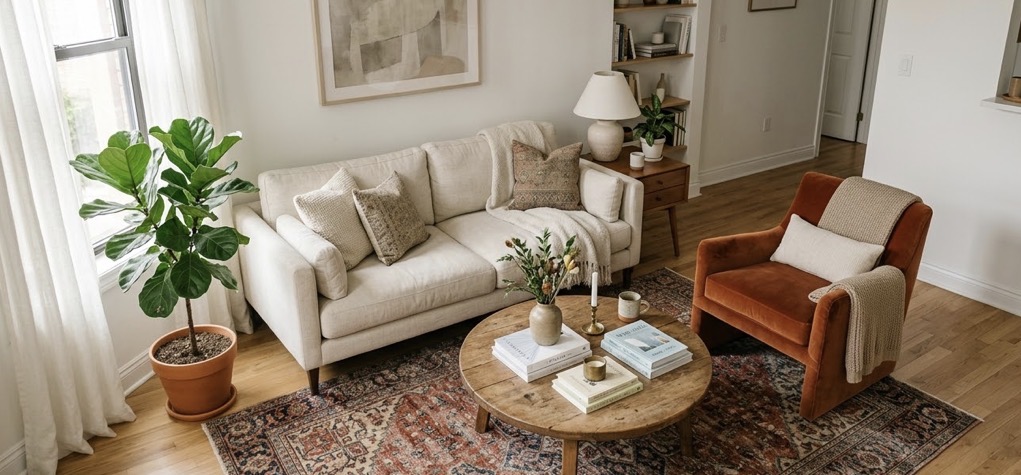
Here’s a furniture placement mistake so common it deserves its own paragraph: pushing all the furniture against the walls. It seems logical — more floor space in the middle, right? But it actually makes rooms feel more awkward and less inviting than you’d expect. Furniture arranged against the walls creates a big empty void in the center of the room that makes people feel like they’re sitting in a waiting area at a government office. Definitely not vibey. Instead, pull your furniture in toward the center of the room to create defined, intimate conversation zones. This makes the room feel intentionally designed rather than just ‘furniture that was placed somewhere and never moved again.’
For a vibey living room, the goal is to create a seating arrangement that feels like a conversation is already happening. Typically this means a sofa and at least one other seat — a chair, a loveseat, or even a large floor cushion — facing or angled toward each other, with a coffee table or low ottoman in the middle. This grouping should feel complete on its own, like a little world within the room. Everything within the grouping should be close enough that two people sitting in it could comfortably talk without raising their voices. That intimacy is the sweet spot. You want the room to feel like it’s pulling you together, not pushing you against the walls.
Another important principle is leaving intentional negative space. Negative space means the empty areas in a room, and good designers use it deliberately. Not every wall needs something on it. Not every surface needs an object. Having a wall that’s just a wall, or a corner that contains only a single plant, allows the eye to rest and makes the objects you do have stand out more powerfully. A room that’s too full feels visually exhausting and a little chaotic — like a conversation where everyone is talking at the same time. A room with intentional negative space feels curated and calm. Think of negative space like punctuation in writing: without it, everything runs together and becomes hard to read.
In smaller apartments, multi-functional furniture is your best friend, your roommate, and your financial advisor all in one. An ottoman that opens for storage and doubles as a coffee table and extra seating. A bed with built-in drawers underneath. A dining table that folds against the wall when not in use. A bench at the foot of the bed that holds extra blankets in winter. These pieces solve real, practical storage problems while adding visual interest, and they allow you to keep floors relatively clear, which makes even the smallest spaces feel airy, open, and intentional. Small apartment living is basically a puzzle — but it’s a puzzle where you designed all the pieces.
5. Textiles and textures
If there’s one category of decor that gives you the most vibes per dollar spent, it is textiles. Rugs, throw blankets, cushions, curtains, table runners, woven wall hangings — these soft elements do more to transform the feel of a space than almost anything else. They add warmth, texture, and color in a way that feels organic and layered rather than stiff and staged. A room without textiles, no matter how nicely furnished, will always feel a little cold and unfinished. A room with the right textiles feels like a hug. And unlike furniture, textiles are easy to change, relatively affordable, and completely moveable when you decide to redecorate or move apartments — which, let’s be honest, all renters do eventually.
Rugs are arguably the most important textile in any apartment. In the living room, your rug defines and anchors the seating arrangement — it acts as the visual base of the room and ties all your furniture together into one cohesive zone. The most common rug mistake is going too small. A rug that only fits under the coffee table and doesn’t extend under the front legs of the sofa and chairs makes the furniture look like it’s floating in disconnected space rather than belonging together as a group. In a living room, you want a rug large enough that at least the front two legs of every seating piece can rest on it. In a bedroom, the rug should extend at least 18-24 inches on either side of the bed so your feet land on softness every morning. When in doubt, go bigger. A bigger rug almost always looks better, and a smaller rug almost always looks like an afterthought.
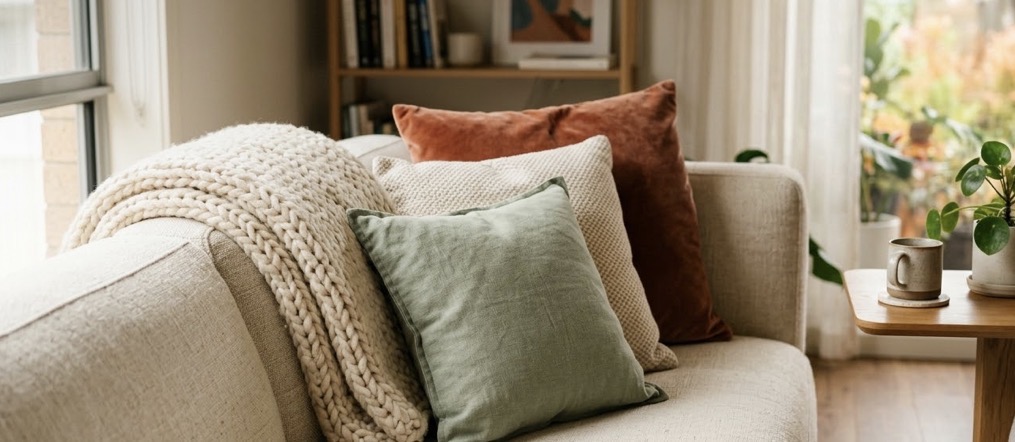
For a vibey feel, layer your textiles instead of matching them perfectly. This means your cushions don’t all have to be the same size, same fabric, or same pattern — in fact, they definitely shouldn’t be. Mix a chunky knit cushion with a flat woven one and a smooth velvet one in a complementary color. Layer a linen throw over the corner of your sofa and let it drape naturally rather than folding it in a perfect rectangle. Put a sheepskin or faux fur throw over the back of an accent chair and let it spill slightly onto the seat. The layering creates depth and texture that makes the space feel rich, collected, and intentional. The goal is not matchy-matchy. The goal is curated chaos — like the textile equivalent of a perfectly imperfect bun. You spent twenty minutes getting it to look like you didn’t try, and that’s the whole point.
Curtains are a textile that most renters completely neglect, usually because they leave whatever institutional curtains were already hanging when they moved in — the sad, short, slightly yellowed ones that no amount of washing fully rehabilitates. Swapping those out for floor-length curtains in a linen or sheer fabric can make a dramatic difference to the entire room. Hang them as high as possible — ideally close to the ceiling rather than at the top of the window frame — and extend them 6-12 inches beyond the window on either side. This makes windows look dramatically larger, ceilings look higher, and the entire room more elegant. It is one of the best investment-to-impact ratios in all of decorating, and you can take the curtains with you when you eventually move on to your next adventure.
6. Building a Vibey Gallery Wall (Without the Geometry Degree)
Art on walls is the difference between a space that feels lived-in and loved versus a space that feels like a furnished showroom. But the idea of creating a gallery wall is something that stops a lot of people cold. There are so many options, so many ways it can look wrong, and the commitment of putting holes in a wall — even small ones — feels weirdly permanent. Here’s a more relaxed way to think about it: a gallery wall doesn’t have to be perfectly symmetrical, museum-quality, or expensive. It just has to tell your story through a collection of things that mean something to you. If it does that, it’s a good gallery wall. The aesthetic precision comes second to the intentionality.
The most approachable way to start a gallery wall is to gather everything first before a single nail goes into the wall. Pull out any prints, photos, paintings, postcards, dried flowers in frames, small mirrors, and interesting objects you already own and spread them out on the floor in front of the wall where you want to hang them. This is your chance to see how they interact with each other — which pieces look good together, which ones clash, and what might be missing. You’ll likely need to order a few additional prints to fill gaps or add variety, but starting with what you already have makes the process much less daunting and guarantees the final wall reflects your actual life rather than a shopping cart.
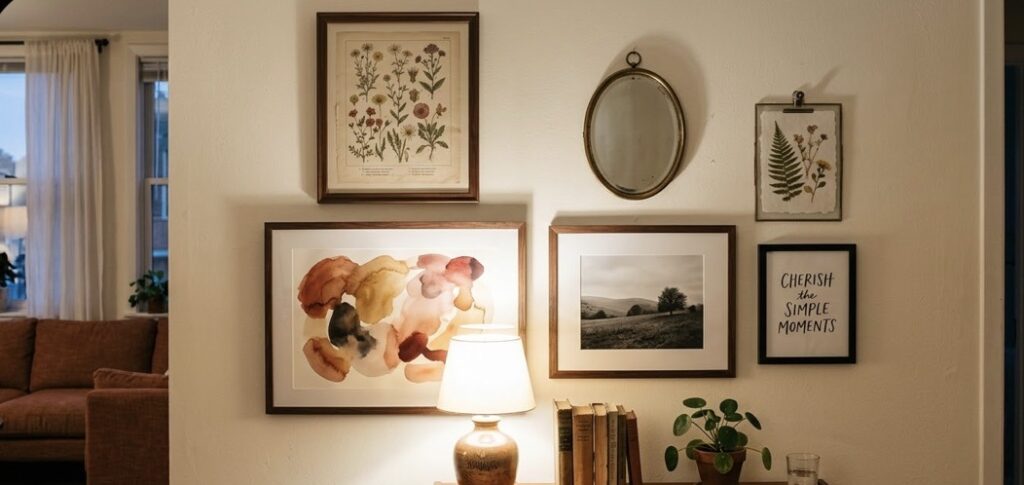
For a vibey feel, a gallery wall should mix different types of pieces rather than being all the same format. Some framed prints with actual frames — preferably in dark wood, black, or antique gold for warmth — alongside some unframed canvases or paintings. Maybe a small mirror or two to add light-reflecting interest. A pressed botanical in a simple clip frame. A polaroid photo cluster. A hand-lettered quote. The variety of formats creates visual interest and makes the wall feel like it was gathered over time rather than ordered all at once from the same website. Because the best gallery walls really do develop over time — started with a few key pieces and added to slowly as you travel, find things at markets, or receive things you love as gifts.
For hanging arrangements, the easiest method for a cohesive look is to pick one repeating element throughout — like using only black frames in different sizes, or only frames with a consistent cream mat. This repetition creates visual unity that allows you to mix wildly different print subjects without the wall looking chaotic. Lay your arrangement out on the floor first, photograph it from above, use small pieces of painter’s tape on the wall to map out approximate positions, and then start hanging from the center outward. Leave 2-3 inches between pieces — not so close they feel crowded, not so far apart they look disconnected. Step back. Adjust. Step back again. The wall will tell you when it’s done.
7. Plants: The Living Layer Every Apartment Needs
No vibey apartment is complete without plants. This is not negotiable, and we say that with love. Plants do something for a space that no amount of carefully chosen furniture or art can replicate — they bring actual life into the room. Not just visual life, although that’s certainly part of it, but real, breathing, growing life that changes slightly day by day. Studies consistently show that having plants in a living space reduces stress, improves air quality, and makes people feel genuinely happier and more at ease. But beyond the science, plants create a sense of organic warmth and intentionality in a space that signals to everyone who enters that someone here pays attention and cares. And caring about your space is the foundation of every vibey apartment.
For a genuinely vibey apartment, the goal is to think about plants as a design element from the beginning rather than an afterthought. That means choosing plants that complement your color palette and overall aesthetic, placing them at different heights throughout the space, and having enough of them that they function as a visual layer rather than a lone decoration. Interior designers often talk about plants as ‘the green layer’ of a room — meaning that the greenery you bring in through plants works the same way fabric color or wall art does, as a repeating visual note that ties the space together. One plant is an accessory. Ten plants in the right places becomes a design decision, and a stunning one at that.
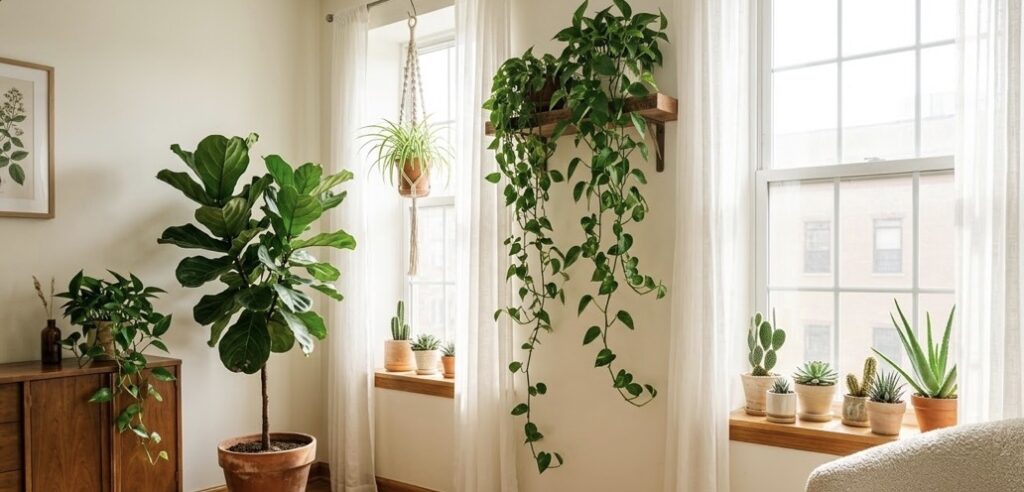
For the most visual impact without requiring a horticulture degree, focus on a mix of plant sizes and silhouettes. A large statement plant in a corner — like a fiddle leaf fig, a monstera, or a tall snake plant — anchors the room with height and a touch of drama. Medium trailing plants like pothos, ivy, or string of pearls placed on high shelves or in hanging planters create a lush, cascading effect that adds softness to the upper half of the room, the area that’s often visually empty and ignored. Small plants like succulents, cacti, herbs, or small ferns grouped on windowsills, coffee tables, and bathroom shelves add texture and fill surfaces naturally without overwhelming them. The variety of heights and silhouettes is key — it creates a sense of a living, layered ecosystem rather than a collection of objects.
If you’ve killed every plant you’ve ever owned (we see you, and we respect your honesty — it takes real commitment to kill a pothos), start with the hardest-to-kill options before graduating to the fussier ones. Pothos, snake plants, ZZ plants, and spider plants are practically indestructible and will survive almost any level of neglect, low light, or irregular watering. They’re also beautiful, fast-growing, and widely available for just a few dollars. Once you’ve kept a pothos alive and healthy for six months without any drama, you earn the right to try a fiddle leaf fig. That’s just how the system works. The plant world has its own hierarchy, and you have to earn your way up.
8. The Smell and Sound of a Vibey Apartment
Most decorating guides stop at visual elements, which is a real tragedy, because two of the most powerful contributors to the feeling of a space are completely invisible. The way your apartment smells and the ambient sound within it have a direct and measurable effect on how you and your guests feel when spending time there. Getting these two right is what separates an apartment that looks vibey in photographs from one that actually feels vibey the moment you step through the door. This is the section that makes all the difference between a beautifully decorated space and a beautifully experienced one. Yes, this is partially the candle section. But it’s also so much more than that.
For scent, the goal is to create a signature home fragrance that feels consistent and intentional rather than random and overpowering. This doesn’t mean buying every trendy candle at a department store and burning them all simultaneously (although we understand the impulse completely). It means choosing one or two scents that complement each other and work with the mood of your space. For a warm, earthy, vibey aesthetic, think scents with notes like sandalwood, cedar, amber, tonka bean, leather, vanilla, vetiver, or palo santo. These are grounding, warm, and slightly complex without being aggressively sweet or generically floral. They smell like a place that has a personality. Layer them thoughtfully: a candle in the living room, a reed diffuser in the bathroom, a pillow spray in the bedroom, and a simmer pot or wax melt in the kitchen when you’re cooking.
The key to using scent without it being overwhelming is to use it at low, consistent levels rather than in sudden, intense bursts. Light your candle 20-30 minutes before guests arrive. Use a diffuser on a low setting that runs consistently throughout the day. Let the scent be something guests become aware of gradually and pleasantly rather than something that announces itself the second the front door opens. Subtlety is the entire point. A space that smells wonderful without the source being immediately obvious is a space that has truly mastered the art of scent. It’s the olfactory equivalent of good background music — present enough to enhance everything, absent enough to never distract.
For sound, vibey apartments benefit enormously from intentional background noise. This doesn’t mean having the TV on constantly — the TV creates conversation-stopping noise and tends to visually dominate a room even when no one is watching it, pulling everyone’s attention toward a screen rather than toward each other. Think instead about having a dedicated speaker system — even a single small Bluetooth speaker on a shelf — for playing music that fits the atmosphere you’re creating. A curated playlist of lo-fi jazz, ambient electronic music, soft R&B, or acoustic folk playing at a comfortable low volume makes a space feel alive and hosted without demanding attention or interrupting conversation. Playlists built specifically for this purpose exist in abundance on every streaming platform, and they genuinely do exactly what they promise on the label.
9. Shelving and Storage
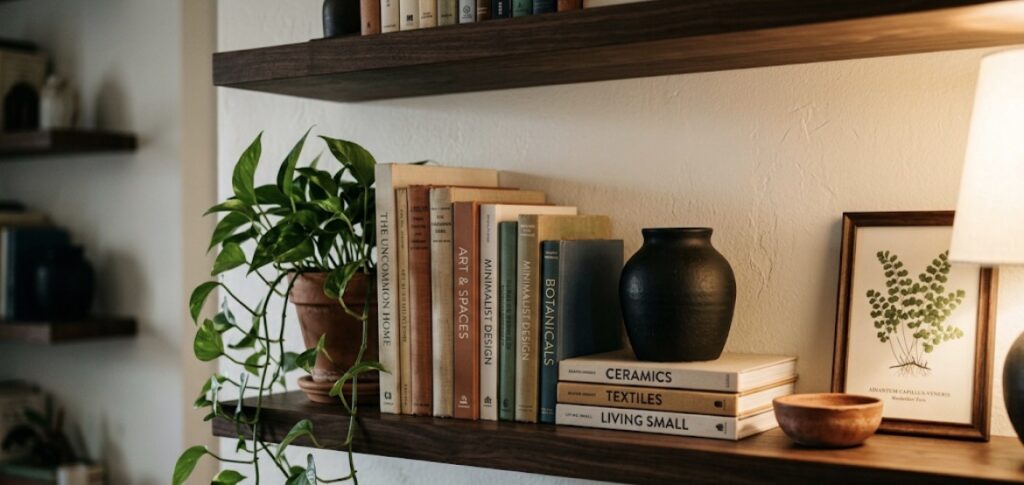
One of the most underrated aspects of vibey apartment decor is the way storage is handled. In a truly well-styled apartment, storage is not hidden away in shame — it’s displayed as part of the decor itself. Open shelving, visible book collections, ceramics and objects arranged on shelves, baskets and trays that organize while adding texture — these elements contribute to the layered, lived-in quality that makes a space feel personal and inviting rather than clinical and blank. The key difference between a shelf that looks good and one that looks like a chaotic catch-all is not the objects themselves, but the thoughtful way they’re grouped and given space to breathe.
When styling open shelving, the rule of thirds is a helpful starting point. Divide your shelf visually into thirds both horizontally and vertically, and make sure each zone contains a mix of different heights, textures, and types of objects. Books should be grouped together but don’t need to be organized by color unless that’s your preference — color-organized bookshelves look gorgeous and make it nearly impossible to find what you’re looking for, so consider that tradeoff carefully before committing. Intersperse books with plants, small ceramics, candles, framed photos, and interesting objects you’ve collected. Leave some intentional empty space on each shelf. A shelf crammed with objects from edge to edge has lost the ability to be visually interesting, no matter how good each individual object is.
For storage throughout the apartment, a vibey approach means choosing storage objects that are themselves decorative. Wicker baskets instead of plastic bins. Terracotta or ceramic containers for small items on countertops. A beautiful wooden tray to corral things on the coffee table or bedside table. Linen storage boxes for shelves. Hanging macrame organizers in the bathroom. These objects solve practical storage problems while adding texture and warmth to the space. The goal is that someone walking through your apartment shouldn’t be easily able to identify where things are stored, because the storage blends so seamlessly into the decor that it becomes part of the aesthetic rather than a reminder that people actually have to put their things somewhere.
10. The Bedroom
The bedroom is the most intimate room in any apartment, and it deserves the most careful attention to detail. This is the room where you start and end every single day. It is the room that most directly affects your sleep quality, your morning mood, and your overall sense of wellbeing in your home. A vibey bedroom is not just aesthetically pleasing — it’s designed to make you feel genuinely rested, calm, and safe. That’s a high bar. But it’s absolutely achievable, and the principles behind it are simpler than most people expect. The bedroom is actually one of the easiest rooms to transform because the bed is doing most of the heavy lifting, and you only need to style around one central element.
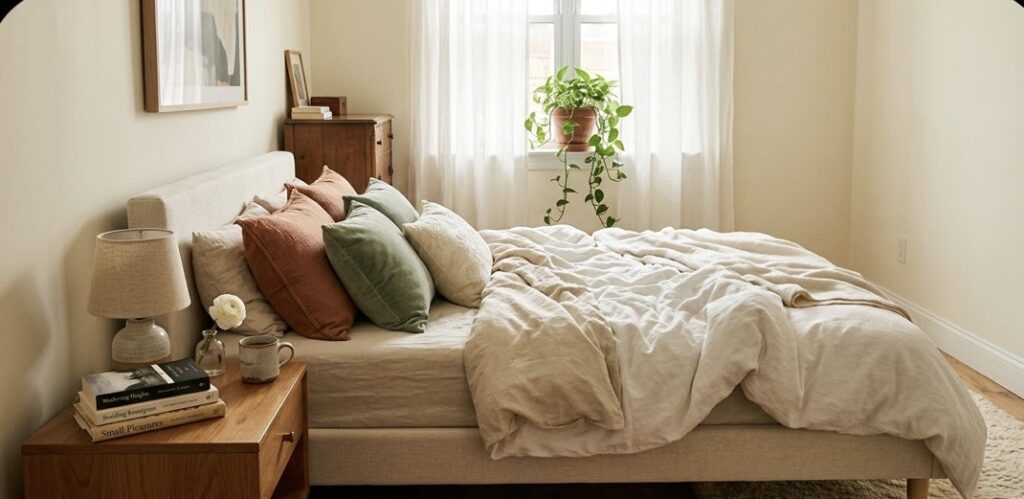
Start with your bed, because it is the visual and physical center of the bedroom and everything else should be arranged in service of it. Your bed should look so inviting that walking into the bedroom makes you want to immediately get into it — not because you’re exhausted, but because it looks like the most comfortable place in the world. This requires bedding that feels as good as it looks. You don’t need to spend a fortune, but you do need sheets in a natural fiber like cotton or linen that gets softer with every wash. Then layer: a fitted sheet, a flat sheet or duvet insert, a textured duvet cover, and at least two layers of decorative pillows or a throw blanket folded at the foot. The layering makes the bed look abundant, comfortable, and deeply considered.
Lighting in the bedroom should be the softest in the entire apartment. Avoid overhead lighting in the bedroom entirely if possible — or at least never use it after 7pm. Your brain interprets bright overhead light as a signal that it’s still daytime, which disrupts your body’s natural sleep preparation and makes it genuinely harder to wind down. Instead, rely entirely on bedside table lamps or wall sconces at eye level when lying down, a low floor lamp in the corner, and perhaps a string of warm fairy lights along the headboard wall for ambiance. The entire bedroom lighting setup should create that soft, golden quality that makes everything look beautiful and signals to your body, very gently, that the day is done and rest is coming.
The bedside table is a small but surprisingly important detail. It should be large enough to hold a lamp, a glass of water, a small plant or candle, and whatever you’re currently reading — and no more than that. A cluttered bedside table creates a cluttered start and end to every day, which is the opposite of the calm sanctuary you’re building. A small tray or wooden coaster can help corral the inevitable accumulation of lip balm, earbuds, and charging cables that naturally gravitates toward this surface over time. A small air-purifying plant like a snake plant or peace lily adds to the bedroom’s sense of being a clean, calm sanctuary without demanding daily attention. It’s a small touch, but small touches in the right places are exactly what separate a nice bedroom from a truly vibey one.
11. The Bathroom
Everyone talks about living rooms and bedrooms when it comes to apartment styling, but a vibey bathroom is genuinely underrated and underutilized as a design opportunity. Think about it: the bathroom is where you start your day, decompress after a long one, take care of yourself, and sometimes just need five minutes of peace and quiet in a locked room. A bathroom that feels like a thoughtful, calm, beautiful space adds a surprising amount of daily joy to your life, and because bathrooms are small, they’re also the easiest and most affordable rooms to completely transform. A few well-chosen additions can take a basic apartment bathroom from ‘fine, whatever’ to ‘I kind of want to just sit in here for a while.’
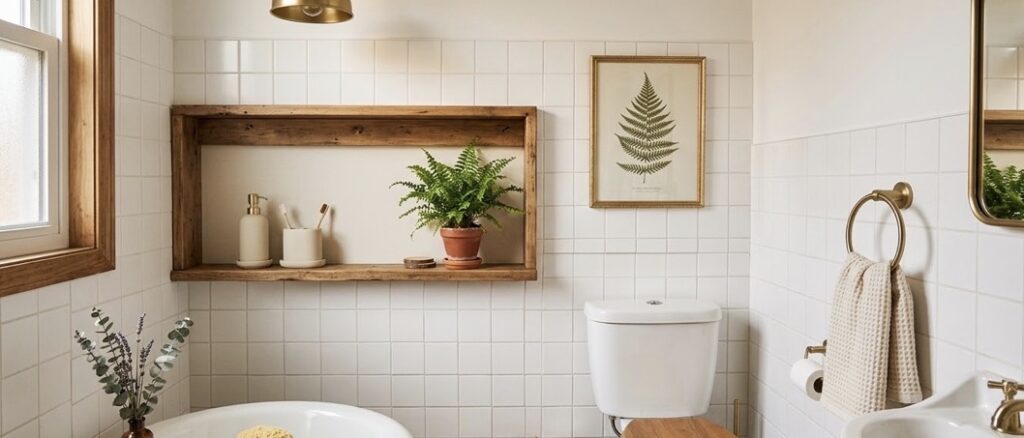
The foundation of a vibey bathroom is keeping countertops as clear as possible while making every visible item count. This means decanting your products into matching pump bottles or minimalist containers rather than leaving a collection of different-shaped plastic bottles on display. A simple tray to organize your daily-use items makes the area look styled rather than chaotic. Swap your existing soap dispenser for a ceramic or stone one. Get a matching set of cotton waffle or linen hand towels and hang them neatly. These are small, inexpensive swaps that collectively create a huge visual difference between a bathroom that looks managed and one that looks beautiful and deliberate.
Beyond the functional elements, a vibey bathroom benefits enormously from a few unexpected decorative touches. A small plant — pothos, ferns, or peace lilies all thrive beautifully in bathroom humidity and will grow full and lush with minimal effort. A candle or diffuser on the back of the toilet tank or on a floating shelf. A small piece of art on the wall — a single framed botanical print does an incredible amount of work in a bathroom for almost no cost at all. And a wooden bath tray across the tub if you have one, holding a small candle, a book, and a glass holder for your post-workday bath that you definitely deserve. Also: a fluffy, good-quality bath mat. It sounds basic, but it’s one of those small things that makes you feel like a fully functioning adult who has chosen comfort intentionally. That energy is absolutely a vibe.
12. How to Shop for a Vibey Apartment Without Breaking the Budget
Here’s the genuinely good news: vibey is not expensive. Some of the most beautifully styled apartments you’ll ever see were put together on seriously small budgets by people who understood the principles behind great design and applied them thoughtfully to affordable and secondhand finds. The most important realization in apartment decorating is that quality over quantity is always the right approach. Five carefully chosen pieces will always look better than fifteen mediocre ones — and they’ll cost less overall. Before buying anything new, identify the one or two pieces per room that will have the most impact and invest there first. Everything else can wait, and waiting is often what leads to the best finds.
Secondhand shopping is the single best strategy for achieving a vibey, layered, personal look on a budget. Thrift stores, estate sales, Facebook Marketplace, and resale apps are filled with beautiful furniture, art, ceramics, rugs, and accessories at a fraction of retail price. Secondhand pieces also tend to have the aged, worn-in quality that makes vibey spaces feel genuinely lived-in rather than freshly purchased. A vintage Persian rug with some wear, a gently used leather chair that’s developed a beautiful patina, an old mirror with a slightly foxed edge — these imperfections add character and depth that brand-new items simply can’t replicate, no matter how good their marketing photography looks. The imperfections are the point. They mean the object has a life.
For art and prints specifically, there are excellent resources for affordable downloadable prints you can print at home or at a print shop for just a few dollars. Framing is often more expensive than the art itself, which is why buying frames secondhand and spray painting them a consistent color if needed is such a smart approach. A collection of mismatched frames that have all been given the same spray paint treatment — warm black, aged brass, or a soft terracotta — suddenly looks cohesive and intentional rather than random. It’s the oldest trick in the gallery wall playbook, and it works beautifully every single time. It costs about eight dollars in spray paint and an afternoon in good sunlight.
Finally, a word about patience, because it may be the most valuable decorating advice in this entire guide. The apartments that look the best have almost always been built slowly over time, not furnished all at once in a single stress-fueled weekend of online shopping. Give yourself permission to live with empty walls for a while. To have a corner that’s ‘not quite right yet.’ To wait until you find the right rug instead of buying the wrong one because you feel pressured to have a finished room. Vibey apartments have a quality that feels organic and personal, and that quality comes from pieces that were collected intentionally — sometimes over years. The best thing you can do is buy less, choose better, and let your home grow with you. It will be worth the wait. It always is.
Putting It All Together: The Vibey Apartment Room-by-Room Plan
By now, you have everything you need to build a genuinely vibey apartment from the ground up. But information can feel overwhelming when you’re standing in your actual living room trying to figure out where to start. So here’s a practical approach that breaks the process into manageable, sequential steps. Work through your apartment one room at a time rather than trying to do everything simultaneously. Start with the room you spend the most time in — usually the living room — and work outward from there. Let each room feel complete before moving to the next, and use the time in between to source pieces thoughtfully rather than rushing toward a finish line that doesn’t need to exist.
In the living room, start with the rug — it’s the foundation of the whole room and the first thing that will make the space feel intentional. Then establish your lighting (floor lamp, table lamp, no overhead light after dark). Then arrange your furniture in conversation-zone format, pulled away from the walls. Then add textiles — throws, cushions, curtains. Then plants. Then the gallery wall or key art pieces. Then small vignettes on coffee tables and shelves. That’s your order of operations, and it works because each layer builds on the one before it. The rug defines the space. The lighting creates the mood. The furniture creates the function. The textiles add warmth. The plants add life. The art adds personality. The vignettes add story. Together, they create a room that feels like it was lived in and loved, not assembled.
In the bedroom, start with the bed and bedding, because that’s roughly 80% of the room’s visual impact and the most important investment you can make in that space. Then lighting — soft lamps only, no harsh overhead. Then one plant on the windowsill or bedside table. Then a styled bedside table with a tray to organize it. Then the rug. Then the walls — typically just one or two pieces of art above the bed or on the main wall, not a full gallery, because bedrooms benefit from more visual calm than living rooms. In the bathroom, start by clearing and decluttering everything visible, because clutter in a small room is amplified exponentially. Then replace functional items with aesthetically pleasing versions. Then add a plant, a candle, and one piece of art. That’s genuinely all a bathroom needs to feel completely transformed — and completely vibey.
The most important thing to remember throughout this entire process is that your apartment should feel like you. Not like a magazine spread. Not like your favorite interior design account. Not like what you think a well-decorated apartment should look like based on external pressure. Like you. Your interests, your memories, your colors, your textures, your favorite smells, the books you actually read, the art that actually moves you. The principles in this guide will help you arrange and layer things well, but the actual objects you choose should always be a genuine reflection of who you are and how you want to live. That’s what makes a space vibey. Not the trend you followed, but the story you told. Now go tell it.