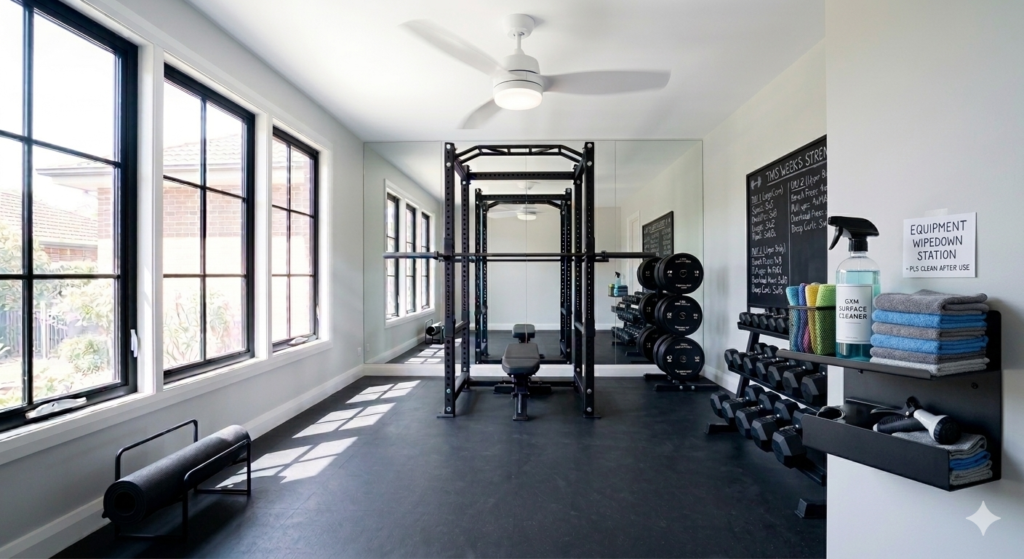
Turn Your Spare Room Into a Stunning Workout Space You’ll Actually Want to Use Every Day
Let’s be honest—most home gyms look like sad storage rooms filled with random equipment and zero personality. You’ve got a treadmill in the corner covered in yesterday’s laundry, some dumbbells scattered across the floor, and maybe a yoga mat rolled up somewhere it definitely doesn’t belong. But here’s the exciting part: your home gym doesn’t have to look like that. In fact, it shouldn’t.
When you walk into a beautiful, well-designed workout space, something changes. You actually want to be there. You feel motivated before you even pick up a weight. Your morning workout becomes something you look forward to instead of something you force yourself to do. And that’s what we’re going for here—a home gym that’s so good-looking and so well put together that skipping leg day becomes physically impossible.
Creating a modern home gym isn’t about spending thousands of dollars on fancy equipment or having a mansion with extra rooms to spare. It’s about making smart choices with the space you have, picking the right colors and materials, and organizing everything so it actually makes sense. Whether you’ve got a full bedroom to transform or just a corner of your basement, this guide will walk you through every single step of building a gym that looks like it belongs on Pinterest and functions like a professional training facility.
We’re going to cover everything—from choosing the perfect flooring that can handle your deadlifts to finding mirrors that make the space feel twice as big. You’ll learn how to pick colors that energize you, where to put your equipment so it’s always within reach, and even how to add those finishing touches that make your gym feel custom-built just for you. Ready to build something amazing? Let’s get started.
Start With What You’ve Got: Making Peace With Your Space
Before you start shopping for equipment or picking paint colors, you need to really understand the space you’re working with. And I mean really understand it—not just measure it, but think about how you’ll move through it, where the natural light comes in, what the ceiling height is like, and where you might run into problems down the road.
First things first: grab a tape measure and get the actual dimensions of your room. Not the guessed dimensions or the “it looks about this big” dimensions, but the real numbers. Measure the length, width, and ceiling height. This matters more than you think because you need to know if you can do overhead presses without punching holes in the ceiling, or if that rowing machine you’ve been eyeing will actually fit along the wall. Write these numbers down somewhere you won’t lose them because you’ll need them constantly while you’re planning.
Next, spend some time in the room at different times of day. I know this sounds weird, but trust me on this one. Your gym is going to feel completely different at 6 AM than it does at 2 PM. Check out where the natural light hits in the morning if you’re an early workout person. Notice if there’s a window that gets blasted with afternoon sun that might make the room unbearably hot. See if the overhead light is bright enough or if you’ll need to add more. These little details will save you from creating a gym that’s perfect in theory but miserable to actually use.
Look at what you’re starting with in terms of walls, floors, and existing features. Are the walls already a color you can work with, or will you need to paint? Is the floor concrete, carpet, hardwood, or something else? Are there any weird architectural features like low-hanging pipes, support beams, or wonky corners that you’ll need to work around? Sometimes these “problems” can actually become cool design features if you’re creative about it. That exposed brick wall might be the perfect backdrop for your weight rack. That awkward alcove could be the ideal spot for a meditation corner.
Think about the practical stuff too. Where are the electrical outlets? You’ll probably need them for fans, speakers, maybe a TV or tablet holder. Is there good ventilation, or will you need to add a fan to keep air moving? Can you hear everything from this room in the rest of the house, or is it pretty soundproof? If you’re in an apartment, you definitely want to consider what your downstairs neighbors will think about your jump rope sessions. Understanding all these factors now means you won’t have any nasty surprises later when you’re halfway through your gym makeover.
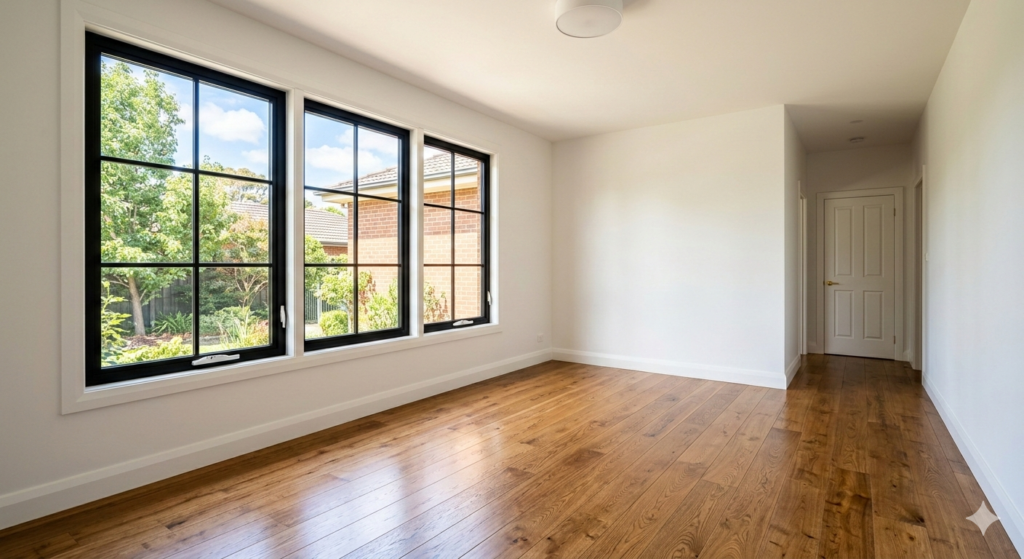
1) Pick Flooring That Can Handle Your Worst
Your flooring is probably the most important decision you’ll make for your home gym. This isn’t like picking flooring for your living room where the biggest threat is someone spilling wine. Your gym floor needs to handle dropped weights, sweaty feet, jumping exercises, and equipment that stays in the same spot for months at a time. It needs to protect whatever’s underneath it and also protect you from slipping or getting hurt.
Rubber flooring is the champion here, and there’s a reason every serious gym uses it. It absorbs shock like nothing else, which means you can drop your weights without destroying your subfloor or annoying everyone in the house. It comes in big interlocking tiles that you can install yourself in an afternoon without any special tools or skills. The tiles are usually black, but you can also find them in gray, brown, or even with colored flecks if you want something a little more interesting. The thickness matters—go for at least three-eighths of an inch if you’re doing any kind of weightlifting. Half-inch is even better if you’re regularly dropping barbells.
Foam tiles are another option, and they’re great if you’re doing mostly bodyweight exercises, yoga, or low-impact stuff. They’re softer than rubber, cheaper, and easier to cut to size if you need to fit them around weird corners. But they’re not going to hold up well under heavy equipment. Put a squat rack on foam tiles and you’ll end up with permanent dents. They’re also not as durable long-term—they can tear or compress over time. Think of foam tiles as the budget-friendly option for light use, not the forever solution for serious training.
Some people go with vinyl or cork flooring, which can look really sleek and modern. These options are quieter than rubber and can give your gym a more finished, professional appearance. Cork is naturally antimicrobial and has some shock absorption, which is cool. Vinyl is super easy to clean and comes in tons of colors and patterns. But both of these need to be installed correctly and might require professional help. They also won’t protect your floor as well as rubber if you’re dropping weights, so you’d need to put down additional mats in your lifting zones.
Here’s a pro move: layer your flooring. Put down rubber tiles or mats as your base layer across the whole space, then add a premium deadlift platform or lifting area where you do your heavy work. You can even add a small section of artificial turf for sled pushes or a more cushioned area with extra-thick mats for stretching and cooldowns. This gives you the best of everything—protection where you need it most, style where people will see it, and specialized zones for different types of training.
Don’t forget about the edges and corners. Most flooring tiles come with border pieces that give you a clean, finished look instead of exposed rough edges. These aren’t just cosmetic—they also keep the tiles locked together and prevent them from shifting around during workouts. If you’re installing flooring over concrete, make sure the concrete is clean and level first. Any bumps or debris underneath will create annoying spots where the tiles don’t sit flat, and you’ll feel them every time you step there.
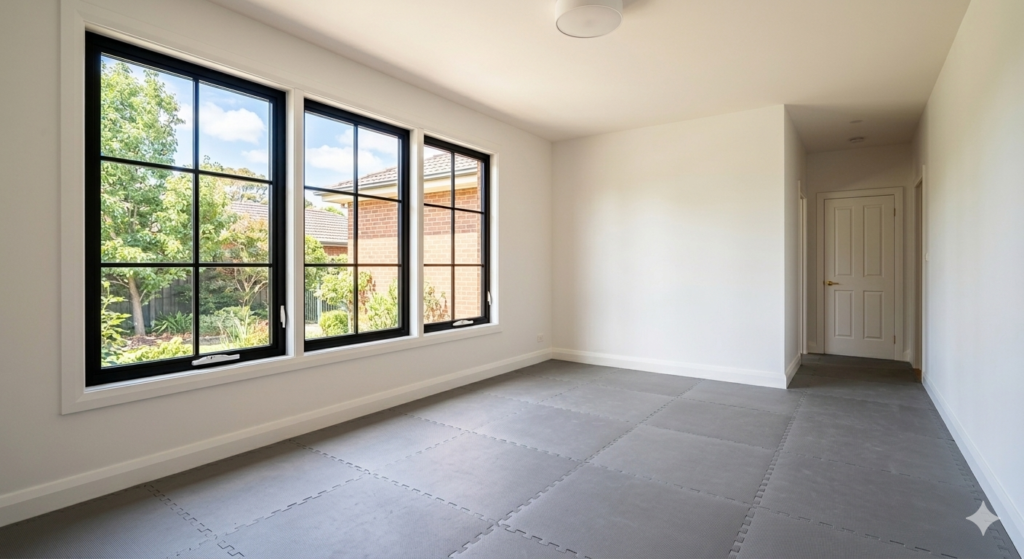
2) Choose Colors That Make You Want to Move
The color of your walls sets the entire mood of your gym, and this is where a lot of people get it wrong. They either go with boring beige because they can’t decide, or they pick some wild color they saw online that looks terrible in their actual space. The truth is, color psychology is real, and different colors will make you feel different ways when you’re trying to push through that last rep.
Light grays are having a huge moment in modern home gyms, and for good reason. Gray is neutral enough to work with any equipment color, but it’s way more interesting than plain white. It makes the space feel clean and professional without being cold or boring. Go for a warm gray rather than a cool gray—warm grays have a bit of beige or taupe mixed in, which keeps the room from feeling like a concrete bunker. Cool grays, which lean toward blue, can make a space feel harsh and unwelcoming, especially if you don’t have a lot of natural light.
White walls can work, but you need to be strategic about it. Pure bright white can feel sterile and show every scuff mark and smudge. Instead, go for an off-white or cream that’s a few shades darker. This gives you that clean, airy feeling without the maintenance nightmare. White walls are amazing for small spaces because they reflect light and make the room feel bigger. They’re also a perfect backdrop if you want to add colorful equipment or wall art that really pops. Just make sure you use a durable, washable paint because gym walls get touched, bumped, and sweaty way more than you’d think.
If you want to add some energy, consider an accent wall. This is where you paint one wall a different color while keeping the other three neutral. Dark blue is incredible for this—it’s energizing without being overwhelming, and it creates a focal point in the room. Deep navy or charcoal blue behind your weight rack or cardio equipment makes everything look more intentional and put-together. Dark green is another great choice that brings in a calming but powerful vibe. Stay away from orange and bright red for large wall areas because they can actually be too stimulating and make you feel anxious rather than motivated.
Black walls are bold and can look absolutely stunning in a home gym, but they only work in certain situations. If you have a small room or limited natural light, black walls will make the space feel cramped and dark. But if you’ve got high ceilings, big windows, and plenty of space, black can create this incredibly sleek, high-end gym atmosphere. It hides imperfections, makes colorful equipment stand out, and gives you that exclusive boutique fitness studio vibe. Just balance it with plenty of lighting and maybe keep just one or two walls black rather than the whole room.
Don’t forget about wall materials beyond just paint. Exposed brick or concrete can add amazing texture and personality if you’re lucky enough to have it. You can leave it natural for an industrial look, or paint it for something more polished. Wood paneling or shiplap on one wall creates warmth and makes the space feel less like a garage and more like an intentional room in your home. Even something as simple as a large motivational decal or vinyl wall art can change the whole feeling of the space without requiring major construction.
Whatever colors you choose, test them first. Get sample pots of paint and put big swatches on your walls. Look at them in the morning, afternoon, and evening. See how they look with your gym lights on. Colors look completely different depending on the light, and what looks perfect in the store can be totally wrong in your actual space. It’s worth spending an extra week testing to avoid painting your entire gym a color you end up hating.
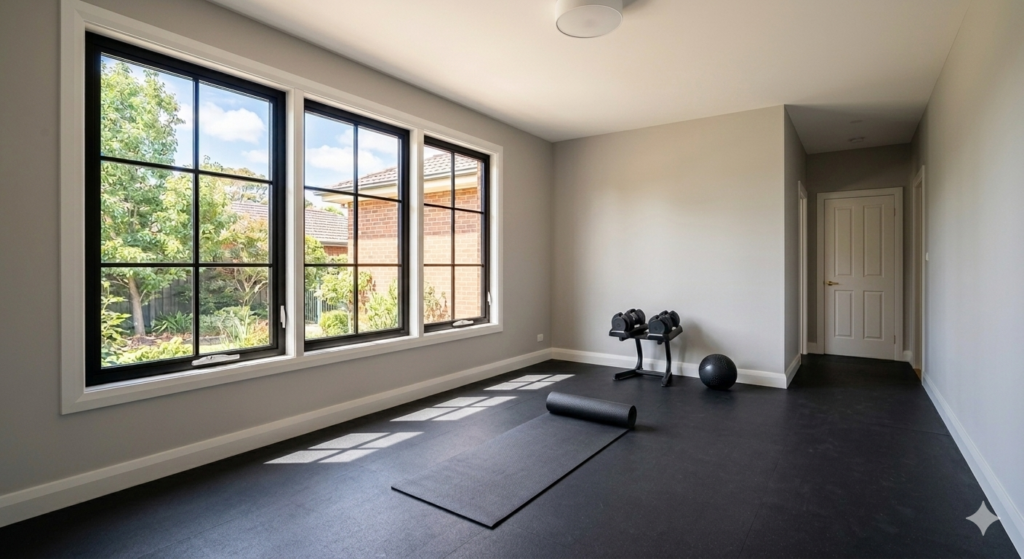
2) Get the Lighting Right (Or Everything Else Fails)
Bad lighting can ruin even the most beautifully designed gym. You know that feeling when you walk into a gym and immediately feel tired just from the depressing overhead fluorescent lights? We’re going to avoid that completely. Good lighting makes you feel energized, helps you see what you’re doing so you don’t hurt yourself, and honestly makes your whole gym look about ten times better than it actually is.
Natural light is your best friend, so maximize whatever you’ve got. If you have windows, keep them as unobstructed as possible. Don’t put your tallest equipment right in front of them. Use light, sheer curtains or blinds that you can open fully when you’re working out. Natural light regulates your body’s rhythm, improves your mood, and makes the space feel more connected to the outside world. If you’re working out early in the morning, that natural sunrise light can be more energizing than any pre-workout supplement.
For artificial lighting, layer it like a professional. You want three types: ambient lighting that lights up the whole room, task lighting for specific areas where you need to see clearly, and accent lighting that adds atmosphere and highlights certain features. Your ambient lighting might be recessed ceiling lights or track lighting that spreads light evenly across the space. Go for LED bulbs that are bright white or daylight color temperature—around 4000K to 5000K. This mimics natural daylight and keeps you alert. Avoid warm yellow bulbs in a gym because they make the space feel sluggish.
Task lighting is crucial for areas where you’re doing detailed work. If you’ve got a corner set up for yoga or stretching, put a good floor lamp there so you can see your form clearly. If you’re going to watch workout videos on a screen, make sure the area around it is well-lit so you don’t strain your eyes. Some people even add LED strip lights under shelving or along the baseboards, which looks cool and provides extra light exactly where you need it.
Accent lighting is where you can get creative and add personality. LED strips behind mirrors create an amazing glow effect and make the whole space feel more premium. You can get color-changing LED strips and set them to different colors depending on your mood or type of workout. Blue light can be energizing for cardio sessions. Green can be calming for yoga. Just don’t go too crazy with the disco effects—this is still a gym, not a nightclub.
Think about control and flexibility. Installing dimmer switches is one of the smartest things you can do. Sometimes you want your gym bright and energizing for an intense strength session. Other times you want it softer and more chill for stretching or meditation. Being able to adjust the brightness puts you in control of the atmosphere. Smart bulbs that you can control from your phone are even better—you can program different lighting scenes for different workouts and switch between them instantly.
Don’t forget about the fixtures themselves. Cheap, ugly light fixtures can make your gym look cheap and ugly, even if everything else is perfect. You don’t need to spend a fortune, but choose fixtures that match your overall aesthetic. Industrial-style pendant lights work great for modern gyms. Sleek track lighting fits minimalist spaces. If you have exposed ceilings with beams, mount your lights to the beams to create interesting patterns and shadows. The fixtures become part of your design, not just functional necessities.
3) Mirrors
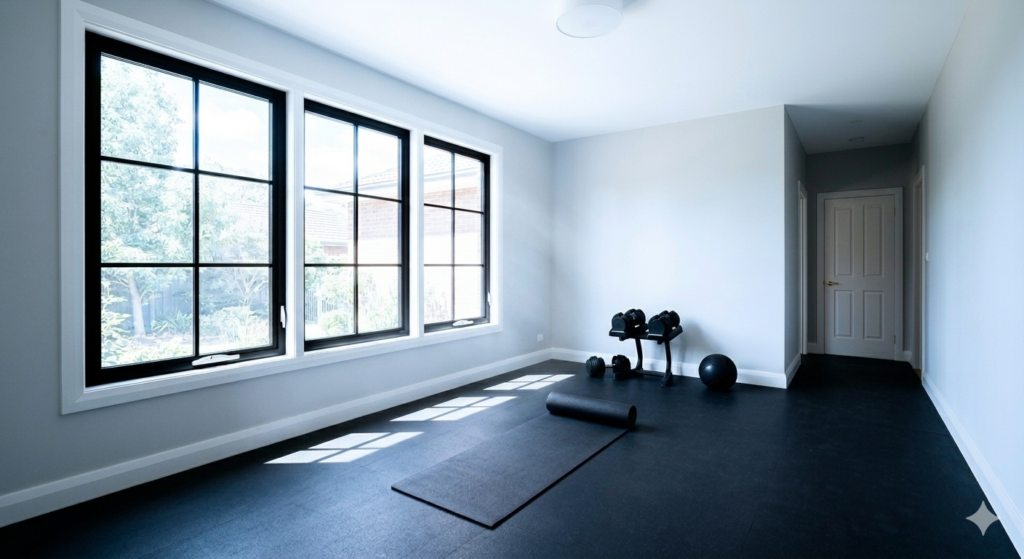
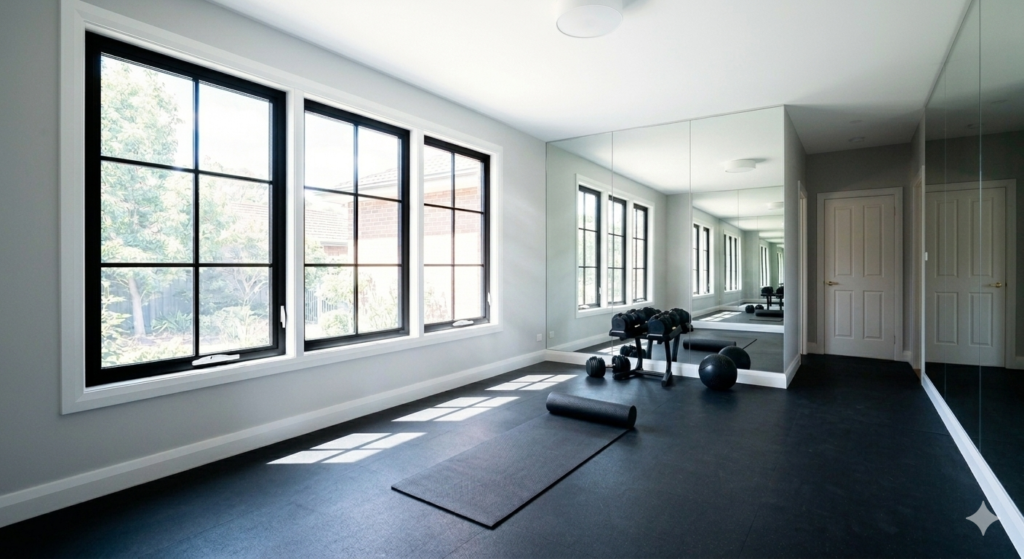
Mirrors aren’t just for checking yourself out (although let’s be honest, that’s a nice bonus when you’re looking good mid-workout). They’re actually a crucial safety tool and a design element that can completely transform your space. Get your mirror placement right and your gym will feel twice as big, twice as bright, and infinitely more professional.
The main reason you need mirrors is to check your form. When you’re lifting weights or doing bodyweight exercises, you need to see what your body is doing from multiple angles. Bad form doesn’t just make your workout less effective—it can seriously hurt you. A good mirror setup lets you watch yourself from the side, the front, and even at angles to make sure your squat depth is right, your back is straight during deadlifts, and your shoulders are properly aligned during presses.
For placement, think about where you’ll be doing most of your work. If you’ve got a weightlifting area, that entire wall should be mirrored from about six inches off the floor to at least six feet high. This gives you a full view of your body in any lift. Make sure the mirror is directly in front of where you’ll be standing, not off to the side where you’d have to turn your head to see yourself. Your neck will thank you for this.
Size matters more than you’d expect. Those tiny decorative mirrors you can buy at home goods stores are useless in a gym. You need large mirrors, preferably floor-to-ceiling or at least four feet tall and three feet wide minimum. You can buy gym mirrors designed specifically for this purpose—they’re made from shatter-resistant glass and come with proper mounting hardware. They’re not cheap, but they’re way safer than regular mirrors and they’re built to handle the humidity and occasional impact of a gym environment.
Here’s a design trick: mirrors make rooms look bigger and brighter by reflecting light and creating the illusion of depth. If you have a small gym, put mirrors on the wall opposite your windows or main light source. The mirrors will bounce that light around and make the whole space feel more open. If you have a long, narrow room, mirrors on the short walls make it feel less like a hallway. If you have low ceilings, vertical mirrors create the illusion of height.
Some people go for a full mirror wall, which looks incredibly sleek and professional. This works best if you have one clear wall without any windows, doors, or weird architectural features. The continuous surface of mirror creates a really clean, modern look and gives you the most flexibility for moving around and checking your form from any position. Just make sure you have proper framing or mounting—large mirrors are heavy and can be dangerous if they’re not installed correctly.
Don’t put mirrors everywhere though. You don’t need mirrors behind your cardio equipment where you’ll never look at them. You don’t need mirrors in your stretching corner where they’ll just be distracting. Be strategic and put them where they serve a purpose. Too many mirrors can actually make a space feel chaotic and overwhelming, like you’re working out in a funhouse. One or two well-placed mirror sections is usually better than mirrors on every available surface.
4) Choose Equipment That Works and Looks Good
Equipment selection is where function meets style, and you don’t have to sacrifice one for the other. The days of gym equipment only coming in rusty gray are long gone. Now you can find barbells in matte black, kettlebells in colorful finishes, and resistance bands that actually look good hanging on your wall. But before you get excited about aesthetics, you need to make sure you’re buying equipment that actually matches your workout style and fits your space correctly.
Start with the essentials based on what you actually do, not what you think you should do. If you love strength training, invest in a quality power rack, barbell, weight plates, and a good bench. These are your foundation pieces and they should be rock-solid and durable. If you’re more into functional fitness and bodyweight work, maybe you need a pull-up bar, resistance bands, a plyo box, and some suspension trainers. Cardio people might prioritize a treadmill, rower, or bike. Be honest about what you’ll use every week versus what will become an expensive clothing rack.
For a modern look, stick to a cohesive color scheme with your equipment. Black and gray is classic and always looks clean and professional. Everything matches, nothing clashes, and the overall vibe is serious and focused. If you want something with more personality, you can add pops of color through smaller items like kettlebells, resistance bands, or yoga mats. Choose one or two accent colors maximum and stick with them throughout. A gym with equipment in six different random colors looks chaotic and amateur, not fun and energetic.
Think about the visual weight of your equipment. Large, bulky pieces like power racks and treadmills should go against walls or in corners where they anchor the space without blocking traffic flow. Smaller items that you use frequently should be easily accessible in the middle of the room or on shelving within arm’s reach. The goal is to create clear zones for different activities—a lifting zone, a cardio zone, a stretching zone—rather than having everything randomly scattered around.
Storage is absolutely critical and often overlooked. Every single piece of equipment needs a designated home. Wall-mounted weight storage keeps plates organized and off the floor. Pegboards or wall racks hold resistance bands, jump ropes, and yoga blocks. Rolling carts can store dumbbells in order by weight. When everything has a spot and you consistently put it back there, your gym looks intentional and professional instead of messy and overwhelming. Plus, you’ll actually know where to find things when you need them.
Consider multi-functional equipment that saves space and money. Adjustable dumbbells replace an entire rack of weights. A good quality exercise bench can be used for dozens of different exercises. Resistance bands provide variable resistance for almost any movement pattern. You don’t need fifteen different machines to get a complete workout. Five pieces of well-chosen, versatile equipment will serve you better than twenty specialized items that you barely use.
Don’t forget about the little things that make workouts more comfortable and enjoyable. A good quality speaker for music, a tablet holder for following workout videos, a wall-mounted fan for air circulation, a small shelf for your water bottle and towel. These aren’t just accessories—they’re what make your gym somewhere you want to spend time instead of somewhere you force yourself to go. When your gym has everything you need within easy reach, your workouts become smoother and more enjoyable.
4) Aerated space
You can have the most beautiful gym in the world, but if the air is stale and stuffy, you’re not going to want to be in there. Good ventilation isn’t just about comfort—it’s about safety and performance. When you’re working hard, you need oxygen flowing freely. You need to be able to cool down. You need air that doesn’t smell like last week’s workout. This is especially important if your gym is in a basement or a room without windows.
If you have windows, use them. Open them during and after workouts to get fresh air moving through the space. Even in winter, cracking a window for fifteen minutes after you finish can make a huge difference in air quality. If you’re worried about temperature, you can open the window just a bit while you work out to get some fresh air without freezing yourself. The key is creating cross-ventilation if possible—open windows or doors on opposite sides of the room so air flows through instead of just sitting there.
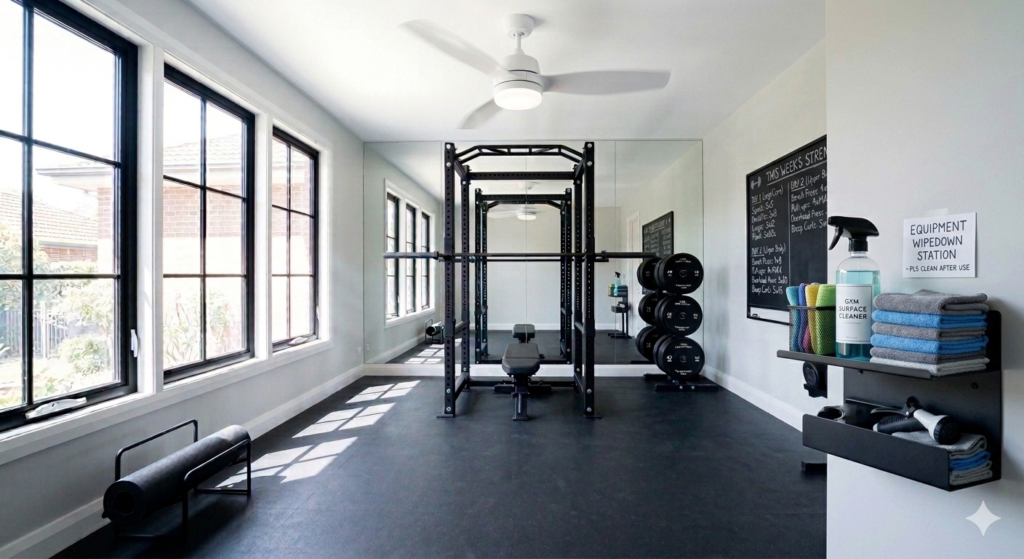
For rooms without windows or with limited natural ventilation, you need to get mechanical. A good ceiling fan is essential and can make a five or ten degree difference in how hot the room feels. Get one that’s powerful enough for your room size and has multiple speed settings so you can adjust it based on your workout intensity. Some people add standing fans in corners or wall-mounted fans that oscillate to keep air moving throughout the space. The more air movement, the better you’ll feel.
Air quality matters too, especially if your gym is in a basement or garage where air can get musty. An air purifier helps remove dust, allergens, and odors, keeping the space fresh. You don’t need an expensive medical-grade unit, but get something with a HEPA filter that’s rated for your room size. Run it during and after workouts to keep the air clean. Some air purifiers have built-in ionizers or UV lights that kill bacteria and viruses, which is a nice bonus if you’re sharing your gym with other people.
Humidity control is another factor people don’t think about until it’s a problem. Too much humidity makes the air feel heavy and makes you sweat even more, plus it can cause mold and mildew on your equipment and walls. Too little humidity can dry out your skin and respiratory system. If you live in a humid climate or your gym is in a damp basement, a dehumidifier keeps things comfortable and protects your investment. In dry climates, a small humidifier might be helpful, though this is less common for gyms.
Think about temperature control too. If your gym gets too hot or too cold, you won’t use it. A portable AC unit or space heater can make the difference between a gym you love and one you avoid. Modern mini-split systems are great because they provide both heating and cooling, they’re quiet, and they don’t take up floor space. Whatever solution you choose, make sure you can adjust the temperature easily so your gym is comfortable year-round.
5) Set Up Sound and Tech That Pumps You Up
Music can make or break your workout, and I’m not exaggerating. The right playlist can push you through your last set when your body wants to quit. The wrong sound setup can make you so frustrated that you give up entirely. You need audio that’s loud enough to energize you but not so loud that it disturbs everyone else in the house. You need bass that hits but doesn’t rattle the walls. You need tech that works seamlessly without you having to fiddle with it every time you want to work out.
A good bluetooth speaker is the minimum requirement. Get something with decent battery life so you’re not constantly charging it, and make sure it’s powerful enough to fill your space with sound. Waterproof or water-resistant speakers are smart because gyms get sweaty and humid. If you want better sound quality, consider a pair of bookshelf speakers connected to a small amplifier. This gives you much richer audio than a bluetooth speaker, though it requires a bit more setup and some basic cable management.
Wall-mounted speakers are perfect if you want a clean, permanent solution. Mount them high on the walls pointing down at roughly ear level when you’re standing. This creates even sound distribution throughout the room without taking up any floor space or getting knocked over during workouts. Run the speaker wire through the walls or use cable channels to keep everything looking neat. It’s more work upfront but worth it for the clean aesthetic and great sound quality.
For people who like following workout videos or virtual classes, you need a screen. A wall-mounted TV is ideal—it’s at eye level, it doesn’t take up floor space, and it’s big enough to actually see the instructor clearly. Mount it on a wall where you have a clear view from multiple positions in your gym. If you do a lot of floor work, make sure you can see the screen from lying down positions too. A tablet on a floor stand works if you don’t want to commit to a permanent TV installation, and it’s easier to move around as needed.
Smart home integration can take your gym to the next level if you’re into tech. Smart lighting that you can control with voice commands or preset scenes, smart speakers that respond to voice controls when your hands are full of weights, smart thermostats that adjust the temperature based on your workout schedule. You can even set up automation so that when you start your workout playlist, the lights dim, the fan turns on, and the temperature adjusts automatically. It sounds excessive, but once you get used to it, going back to manual controls feels primitive.
Cable management is crucial when you add tech to your gym. Nothing ruins a modern, clean aesthetic like cables draped everywhere. Use cable channels, wire clips, or in-wall routing to hide speaker wires, charging cables, and power cords. Label your cables so you know what’s what. Use velcro cable ties instead of zip ties so you can adjust things later without cutting and replacing everything. A little effort in cable organization makes a massive difference in how finished and professional your gym looks.
6) Add Personality That Actually Motivates You
A gym that’s perfectly designed but completely generic won’t motivate you the way a space that feels personally yours will. This is where you get to break the rules a bit and add things that might not be “necessary” but make you happy to be in the space. These personal touches transform your gym from just a functional room into your private training sanctuary where you actually want to spend time.
Motivational quotes and artwork can work if you do them right. Avoid the cheesy generic stuff you see everywhere—”no pain no gain” and “train insane or remain the same” are tired and honestly kind of annoying. Instead, find quotes that genuinely resonate with you personally. Maybe it’s something from your favorite athlete, a line from a book that changed your perspective, or even just a single powerful word that means something to you. Get these professionally printed or use high-quality vinyl lettering on the wall. Frame them properly. Make them look intentional, not like you grabbed the first thing you found on Pinterest.
Plants are an unexpected but amazing addition to a home gym. They improve air quality, add life and color to the space, and create a more calming environment for stretching and cooldowns. Obviously you can’t put delicate plants in high-traffic areas where they’ll get knocked over, but a large potted plant in a corner or on a high shelf works great. Choose hardy plants that can handle varying temperatures and don’t need constant attention. Snake plants, pothos, and rubber plants are perfect for gym environments.
A chalkboard or whiteboard for tracking workouts is both functional and adds to the aesthetic. Mount it on a wall where you can easily see and reach it. Use it to write your workout plan for the day, track your progress on specific lifts, or jot down notes about what’s working and what isn’t. There’s something powerful about physically writing down your goals and seeing them every time you walk into your gym. Plus it looks way more professional than a random notebook thrown in the corner.
Display your achievements if you have them. Race medals, competition trophies, before-and-after photos, or even just a calendar marking consistent workout days. These aren’t about showing off—they’re about reminding yourself what you’re capable of when you put in the work. Create a small display area that’s visible but not overwhelming. Shadow boxes for medals, a simple shelf for trophies, or a photo wall showing your progress over time. Make it clean and organized, not cluttered with random stuff.
Think about small comfort items too. A mini fridge for cold water and post-workout drinks. A towel hook or basket for clean towels. A small shelf or tray for your phone, keys, and water bottle. A clock so you can track your rest periods without pulling out your phone and getting distracted. These tiny conveniences make your workouts smoother and more enjoyable, which means you’re more likely to actually show up and use your gym consistently.
7) Keep It Looking Fresh (Without Spending Your Life Cleaning)
A beautiful gym won’t stay beautiful if you don’t maintain it, but maintenance doesn’t have to be this huge overwhelming task. The key is building simple habits into your routine so cleaning happens naturally instead of becoming this big project you keep putting off. A clean gym is safer, more pleasant to use, and shows you respect the space you’ve created.
Make it a rule to wipe down equipment after every use. Keep disinfectant wipes or a spray bottle with cleaning solution and a microfiber cloth in an easy-to-reach spot. Thirty seconds of wiping after your workout prevents the buildup of sweat, bacteria, and grime that makes equipment gross and deteriorates it faster. This is especially important for anything you grip with your hands—barbells, dumbbells, kettlebells, pull-up bars, resistance band handles. Your equipment will last longer and you won’t be grossed out touching it.
Sweep or vacuum your floor at least weekly, more if you work out daily. Rubber flooring collects dust, hair, and debris that you don’t even notice until it builds up. A quick sweep takes five minutes and makes a huge difference in how clean the space looks and feels. If you have foam mats or carpet-style flooring, vacuum instead of sweep. Once a month, do a deeper clean—mop rubber floors with a gym floor cleaner, shampoo foam mats if needed, and get into corners where dust accumulates.
Mirrors need regular attention because they show every fingerprint, water spot, and dust particle. Use a good glass cleaner and a microfiber cloth, and clean them weekly if you’re using your gym regularly. Wipe in one direction rather than circles to avoid streaks. For large mirror walls, a squeegee makes the job faster and gets better results than just a cloth. Clean mirrors make your whole gym look cleaner and brighter even if nothing else has changed.
Organize as you go rather than letting things pile up. Put weights back on their rack immediately after using them. Hang resistance bands on their hooks. Roll up your yoga mat. Return dumbbells to their proper spots in order. When everything has a home and you consistently put it back there, your gym never gets to that chaotic messy point where you need an hour to reorganize. This is a habit thing—it feels annoying at first but becomes automatic after a few weeks.
Check your equipment regularly for wear and tear. Inspect barbells for bent bars or loose collars. Check cables and resistance bands for fraying. Make sure bolts on your power rack are tight. Look for cracks or damage in weight plates. Catching problems early means you can fix them before they become dangerous or require expensive replacements. This isn’t paranoia—it’s smart maintenance that keeps you safe and protects your investment.
Every few months, do a deep clean and reorganization. Move equipment and clean behind and under it. Dust light fixtures and ceiling fans. Check air filters and replace if needed. Reorganize storage areas that have gotten messy. Touch up any scuffed paint. Tighten any loose screws or bolts. This quarterly deep clean catches all the little things that accumulate over time and keeps your gym functioning and looking like new.
Conclusion
Now that you understand all the individual pieces, it’s time to put them together into a cohesive plan for your space. The best home gyms don’t happen by accident—they’re the result of careful planning, smart decisions, and attention to detail. But they also don’t require unlimited budgets or professional design help. You can absolutely create something amazing on your own if you approach it systematically.
Start by creating a floor plan on paper or using a free online room planner. Mark where windows, doors, and electrical outlets are. Draw in your major equipment pieces to scale so you can see how everything fits and where you’ll have open floor space. Think about traffic flow—you should be able to move easily between different areas without constantly rearranging equipment. Consider sight lines too. What will you see when you first walk in? What will be your focal point? Make sure the most visually appealing or important elements are prominently placed.
Build your budget and prioritize ruthlessly. You probably can’t afford to do everything at once, and that’s okay. Start with the essentials that have the biggest impact—flooring, lighting, and your most-used equipment. Get those right first. Then add nice-to-haves over time as budget allows—better mirrors, a sound system, decorative elements, additional equipment. A phased approach is smarter than trying to do everything at once with cheaper materials that you’ll just want to replace later.
As you implement your plan, take before photos. You’ll want them later to see how far you’ve come, and they help you notice improvements you might otherwise take for granted. Document the process as you go. Take measurements. Keep receipts. Save packaging and instructions for equipment. Note what works well and what you’d do differently. This information is valuable if you move and build another gym, or if friends ask for advice on their own gym projects.
Don’t be afraid to adjust your plan as you go. Sometimes what looked perfect on paper doesn’t work in real life. Maybe that mirror placement creates a weird glare at certain times of day. Maybe your cardio equipment is louder than expected and needs to be moved away from shared walls. Maybe you realize you need more open floor space and less equipment. Great design is iterative—you try things, see how they work, and make adjustments. This is your space, and it should evolve with your needs.
Remember that your gym is never truly finished. You’ll always find ways to improve it, new equipment you want to add, better organization systems, different decorative elements. That’s part of the fun. Your gym should grow and change with you as your fitness journey evolves. What matters most isn’t creating some perfect Instagram-worthy space and then never touching it again. What matters is building a gym you genuinely love using day after day, year after year.
The most important thing is to just start. Don’t wait for the perfect moment or the perfect budget or the perfect plan. Start with what you have, where you are, and build from there. Every improvement you make, no matter how small, gets you closer to the gym you envision. Paint one wall. Install one mirror. Buy one quality piece of equipment. Each step forward creates momentum and makes the next step easier. Before you know it, you’ll have created something amazing that transforms not just your space but your entire relationship with fitness.