
There is a particular kind of silence that happens when a guest walks into a beautifully done formal living room. They stop talking mid-sentence. Their eyes move slowly from corner to corner. Then, almost without realizing it, they straighten their posture. That is the power of a well-designed formal living room — it sets a tone before anyone says a word.
A formal living room is not about being stiff or unwelcoming. It is about intention. Every piece of furniture, every fabric, every color choice is deliberate. Unlike a casual family room where the couch exists mainly to hold people watching television and eating chips, a formal living room says, “We thought about this.” It is the room where you host dinner guests before the meal, where you receive important visitors, where you sit for conversations that actually matter. Some people even use it as a quiet personal retreat — a place in the home that feels calm, composed, and a little special.
The good news is that formal does not have to mean cold. It does not have to mean expensive either (though if you have the budget, by all means). What it does mean is thoughtful — and that is entirely achievable at many different price points and in many different styles. Whether your home leans traditional, modern, maximalist, or quietly restrained, there is a formal living room idea on this list that will work beautifully for you.
This post covers 17 distinct ideas, each one a full visual concept you can draw from when planning or refreshing your formal living room. Some are dramatic. Some are subtle. A few are downright bold. All of them are worth knowing about.
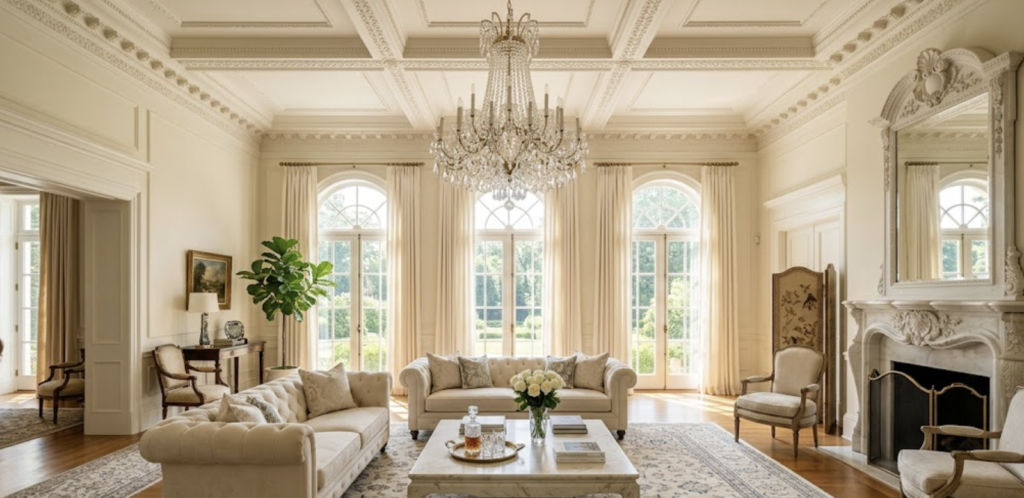
1. The Classic Symmetrical Layout
There is a reason symmetry has been used in formal spaces for hundreds of years — it works. The human eye reads symmetry as order, and order reads as elegance. A formal living room built around a symmetrical layout immediately feels composed and authoritative, the visual equivalent of someone who always knows what to say.
In a classic symmetrical layout, the room is arranged so that one side mirrors the other. Two sofas face each other across a central coffee table. Two matching armchairs flank a fireplace. Two identical table lamps sit on two matching end tables. Even the art on the walls is often arranged in pairs or balanced groupings. The effect is deliberate and satisfying in a way that asymmetrical rooms rarely achieve.
The centerpiece of this kind of room is usually the fireplace, though it can also be a large window, a piece of art, or an architectural feature like a built-in bookcase. Whatever anchors the room, everything else is arranged to face or frame it equally from both sides. A large area rug placed squarely under the furniture grouping reinforces the symmetry and pulls the whole composition together.
Color in a symmetrical formal room is usually restrained. Soft neutrals — ivory, cream, pale gray, warm white — let the architecture and the furniture do the talking. Occasional accents in navy, deep green, or gold add richness without disrupting the visual calm. The fabrics tend toward the refined: velvet, silk, wool, linen. Nothing too casual, nothing that will wrinkle at the wrong moment.
What makes this idea particularly strong is that it is forgiving. Once you establish the central axis and mirror it, the room almost arranges itself. It is the closest thing to a cheat code in formal interior design — and unlike actual cheat codes, nobody will judge you for using it.
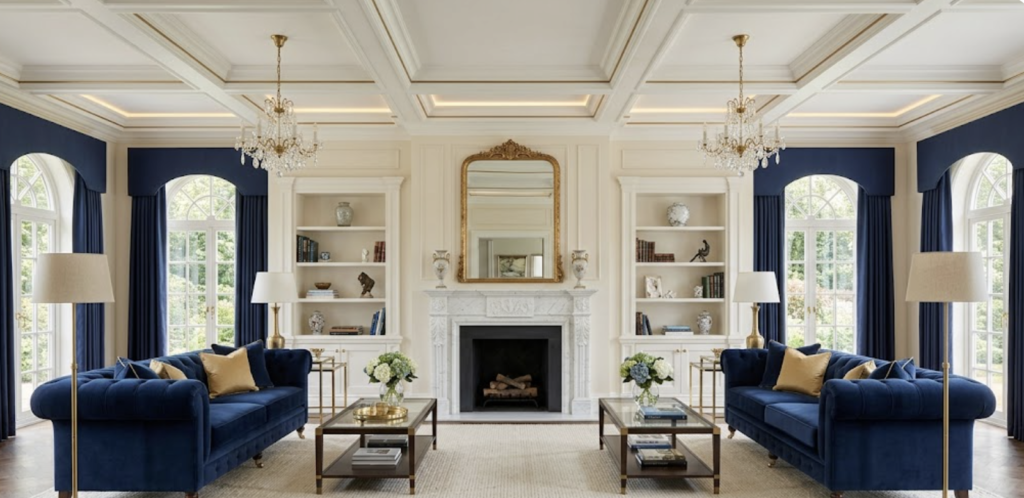
2. The Moody Dark Jewel Tone Room
Most people think formal living rooms have to be light. They picture cream walls and pale upholstery and a general sense of airiness. That is a perfectly valid approach, but it is not the only one and it is certainly not the most dramatic. A formal living room draped in deep jewel tones is something else entirely. It is confident, rich, and just a little mysterious. The kind of room that makes people lower their voices slightly, not out of discomfort, but out of respect.
Deep emerald green walls paired with brass fixtures and velvet upholstery in deep burgundy or navy create a room that feels like the interior of a private club in the best possible sense. Forest green velvet sofas against charcoal walls with amber lighting feel theatrical in a way that is entirely intentional. These rooms are not for everyone but for the person who wants their living room to feel like a destination rather than a passageway, dark jewel tones are extraordinary.
The key to making a dark formal room work is layering. Dark walls need rich textures to prevent the room from feeling flat. Think velvet cushions, a patterned wool rug, lacquered furniture, silk drapery. The contrast between the deep background and the varied textures creates depth that catches the eye and holds it. Lighting is also critical: too little and the room becomes a cave, too much and the magic disappears. Warm, layered lighting — a chandelier dimmed low, sconces on either side of the fireplace, table lamps with warm-toned bulbs — is what makes a dark room glow rather than brood.
Artwork in jewel-toned rooms tends toward the large and impactful. A single oversized oil painting in gilded frame, a large abstract in muted golds and blacks, or a collection of framed botanical prints can all work beautifully. The point is to give the eye somewhere to travel in a room where the walls themselves are doing a lot of the visual work.
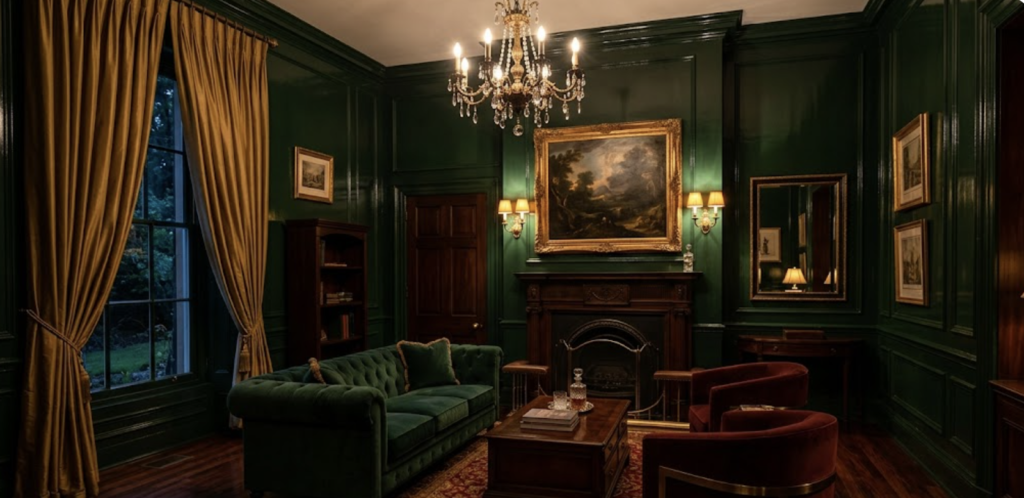
3. The Monochromatic White and Ivory Room
If the dark jewel-tone room is a black-tie dinner, the all-white or ivory formal living room is a perfectly pressed linen suit. It is clean, deliberate, and quietly stunning. There is a reason white rooms appear so frequently in design publications — they photograph beautifully, they feel expansive, and they create a sense of calm that is hard to achieve any other way.
A cream wool rug next to an ivory silk sofa next to a white painted plaster wall — the colors are barely different, but the surfaces create a subtle, layered richness that is surprisingly warm and inviting. Add white linen drapes that puddle slightly on the floor, a plaster or ceramic lamp with soft white shade, and a marble coffee table in pale cream tones, and the room begins to feel almost luminous.
Architecture matters enormously in a white room because there is nothing else to distract from it. Crown molding, coffered ceilings, arched doorways, decorative plasterwork — these details become the focal points. If your space has good bones, a white palette will celebrate them beautifully. If it does not, you can add architectural interest through built-in shelving, a statement fireplace surround, or large-format artwork.
The formal quality of a white room comes from proportion and restraint. Furniture should be well-scaled — not crammed in, not sparse to the point of emptiness. Pieces with clean lines and good silhouettes work particularly well because the absence of strong color means the shape of each object reads more clearly. Every chair, every lamp, every decorative object is on full display. This is a room for things that are worth showing off.
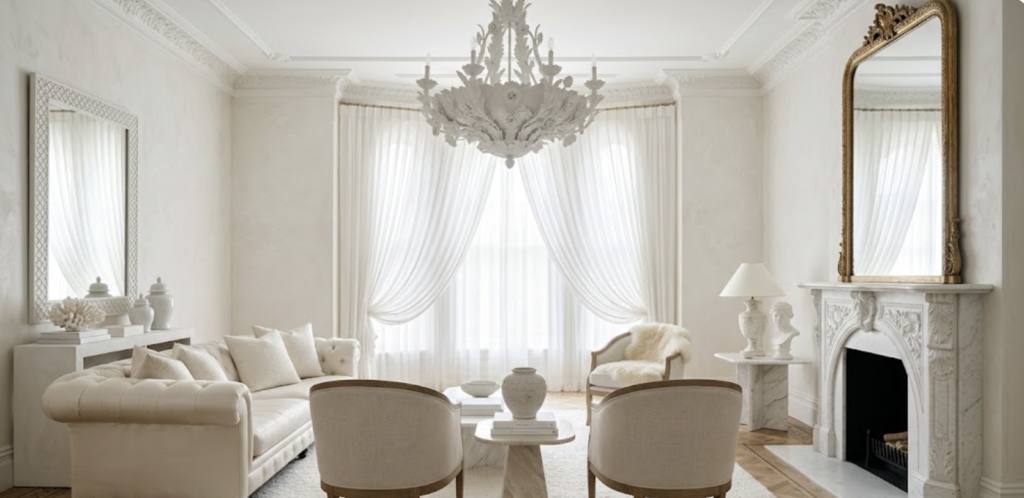
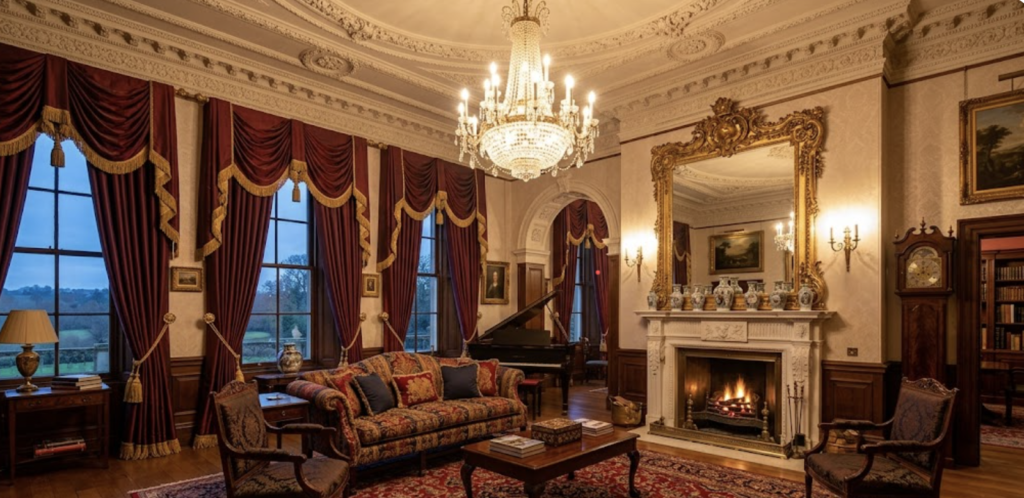
4. The Grand Traditional Room with Heavy Drapes and Antiques
This is the formal living room that people picture when they hear the phrase “formal living room.” It is the room of estate homes and old-money aesthetics, of silk taffeta drapes pooling on parquet floors, of Chippendale chairs and carved mahogany cabinets. It is unapologetically grand, and it has absolutely no interest in being otherwise. If this room were a person, it would arrive exactly on time and already know everyone’s name.
Heavy drapes are one of the defining features of this style. Floor-to-ceiling curtains in rich fabrics — silk, velvet, brocade — in deep jewel tones or warm earth colors frame the windows dramatically and add height to the room. They are usually paired with a pelmet or cornice board at the top, which creates a finished, architectural look. The layers — sheer curtain, main drape, tassel trim — add depth and formality that lighter window treatments simply cannot match.
Antique furniture brings character that new pieces rarely replicate. A Bergère chair with carved wooden frame and loose cushion. A Chinoiserie-lacquered cabinet. A gilded mirror with scrollwork frame. A Persian or Oriental rug in deep reds and blues and golds. Each piece has a history, and that history is part of what makes the room feel important. You do not need to fill the room with genuine antiques — well-made reproductions in traditional styles carry much of the same visual weight.
The color palette here tends toward deep, rich hues. Burgundy, forest green, gold, navy, warm terracotta. Walls are often a solid deep color, or they may feature wallpaper in a traditional pattern — stripes, damask, toile, or a fine trellis. The overall effect is one of layered richness, a room built up over time rather than assembled in an afternoon. Whether or not that is literally true, it is the impression this style creates, and that impression is exactly the point.
5. The Mid Century Modern Formal Room
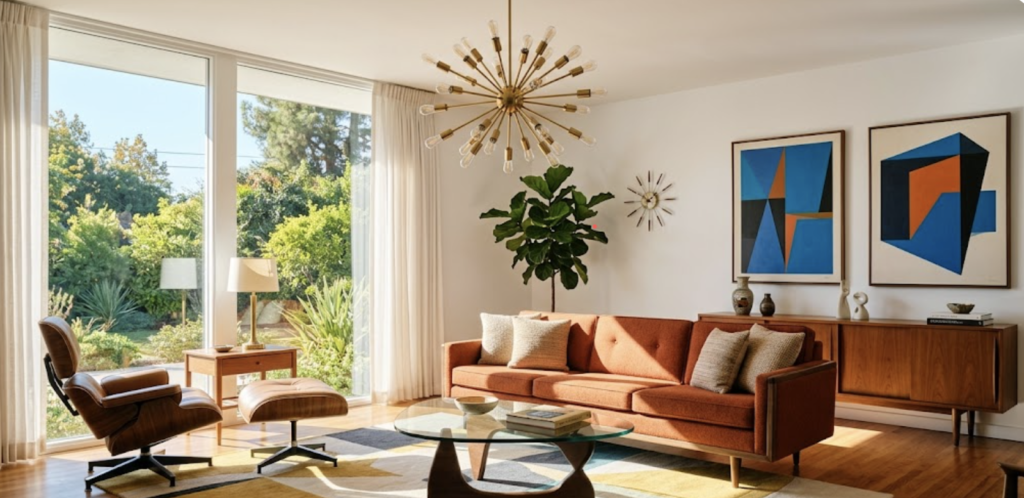
Mid-century modern and formal living room are not two phrases that typically appear in the same sentence — but they absolutely should be. The MCM aesthetic, with its clean lines, architectural furniture, and careful attention to form, translates beautifully into a formal setting. The result is a living room that feels sophisticated and considered without feeling heavy or overly decorated. Think of it as formality that has loosened its tie slightly, but just slightly.
The furniture in a mid-century formal room is the star of the show. A low-profile sofa with tapered wooden legs in walnut or teak. A pair of egg chairs or tulip chairs with architectural presence. A sculptural credenza or cabinet along one wall. A Noguchi-style coffee table. Each piece is chosen not just for comfort or function but for how it looks — its silhouette, its proportions, its relationship to the other pieces in the room. MCM furniture was designed to be beautiful, and in a formal room, that beauty is given the space it deserves.
Color in mid-century formal rooms tends toward rich, saturated tones in restrained combinations. Mustard yellow and walnut. Burnt orange and ivory. Olive green and brass. Deep teal and white. Two or three colors, used with confidence, rather than a palette that tries to please everyone. Textiles often feature geometric or abstract patterns — a statement rug with bold graphic design, throw pillows in complementary patterns — that reference the era without becoming a costume.
Lighting in this style is worth particular attention. MCM lighting design produced some of the most beautiful fixtures ever made, and a genuine or replica arc lamp, Arteluce pendant, or Sputnik chandelier adds instant authenticity and drama to the room. Pair it with low-profile table lamps on walnut side tables and the lighting scheme becomes part of the design story rather than an afterthought.
6. The French styled Salon
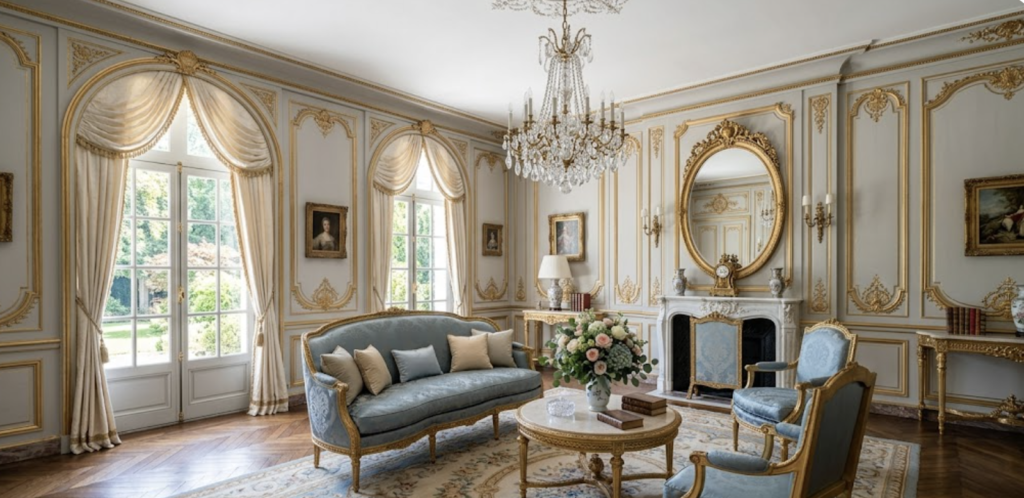
There is a particular kind of elegance that only the French seem to have fully mastered — and it involves making something look effortlessly refined while having clearly put enormous effort into it. The French salon as a formal living room concept is one of the most beautiful ideas in residential interior design. It is formal without stiffness, luxurious without ostentation, and beautiful in a way that seems entirely natural.
The defining feature of a French-inspired salon is the use of curved lines. Bergère chairs with their rounded frames and padded sides. Louis XVI-style sofas with their slightly arched backs and cabriole legs. Oval mirrors in carved gilded frames. These curves soften what might otherwise be a very formal space and give it a sense of movement and grace. Nothing in a French salon is completely straight, and that is entirely intentional.
Walls in this style are often painted in soft, sophisticated tones — pale gray, dusty rose, sage green, off-white — or covered in silk fabric panels, carved boiserie paneling, or delicate wallpaper. The French have always treated the walls as part of the decoration rather than simply the background, and this approach creates rooms that feel complete in a way that bare painted walls rarely achieve. A parquet de Versailles floor or a polished herringbone pattern underfoot reinforces the refined aesthetic.
Fabrics are sensuous and tactile: silk, velvet, toile, damask, woven cotton. Colors are sophisticated — not bright, but not dull either. A pale gray sofa with gilded legs, silk cushions in soft dusty blue and ivory, a rug in a soft Aubusson pattern. Decorative objects include porcelain vases, gilded candlesticks, and delicate floral arrangements. The room is beautiful enough to photograph but comfortable enough to actually use. The French salon manages both with characteristic ease.
7. The Chinoiserie and Asian styled Room
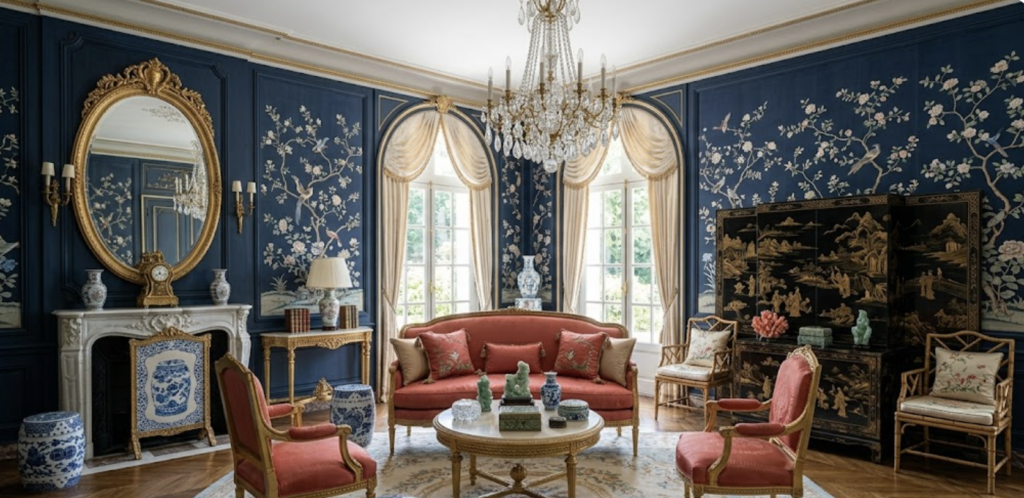
Few decorating styles are as dramatic and specific as Chinoiserie — the Western interpretation of Chinese and East Asian art and design that became enormously fashionable in Europe and America in the 18th and 19th centuries. A formal living room done in Chinoiserie style is extraordinary: bold, colorful, patterned, and unmistakably intentional. It is not a style for the timid, but for those willing to commit, the results are genuinely spectacular.
Chinoiserie wallpaper is one of the easiest ways to anchor this look. Hand-painted or printed in designs featuring pagodas, flowering trees, exotic birds, and meandering rivers, Chinoiserie wallpaper immediately transforms a room into something that feels curated and unique. The most dramatic versions feature large-scale scenes in deep navy, black, or forest green backgrounds with bright, detailed imagery. When paired with lacquered furniture, silk upholstery, and carved wooden accents, the effect is theatrical in the very best way.
Furniture in a Chinoiserie room typically mixes Eastern-influenced pieces with Western ones. A lacquered Chinese cabinet in black and gold serves as a bar or display cabinet. Bamboo-frame chairs with cushioned seats add texture and reference. Side tables with fretwork details echo traditional latticework motifs. A large porcelain garden stool in blue and white serves double duty as accent table and sculptural object. The mix of Eastern and Western elements is the whole point — Chinoiserie was always a creative interpretation rather than strict reproduction.
Color in this style is bold and specific. Navy, black, jade green, coral red, gold. These are not soft, ambiguous colors — they are committed and vivid. The formality comes not from restraint but from intentionality. Every element in a Chinoiserie room has been chosen with purpose, and that purposefulness is what gives it its formal quality. The room does not apologize for itself. It has very good taste and it knows it.
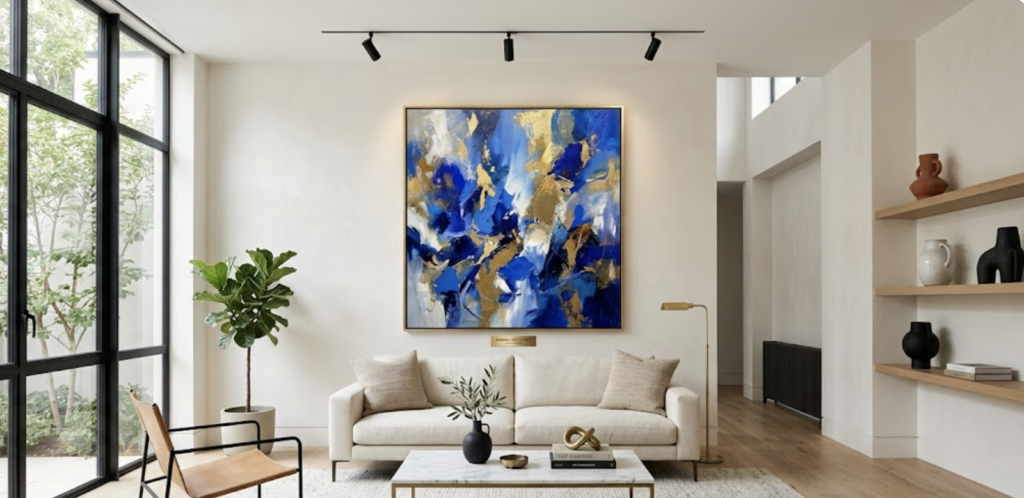
8. The Contemporary Art Gallery Room
Some homeowners are not primarily interested in furniture or architecture — they are interested in art. For these people, the formal living room becomes a gallery, a place where paintings and sculptures are the real stars and everything else exists to support them. The gallery-style formal room is quietly confident, beautifully spare, and absolutely serious about the work on display.
The walls in a gallery-style formal room are usually kept clean and neutral — deep white, warm greige, soft charcoal — to let the artwork breathe. Art is hung with careful attention to height and spacing, typically with the center of the piece at eye level and consistent gaps between works. Lighting is precise: picture lights on individual works, adjustable track lighting that can be aimed exactly, or recessed spotlights that illuminate paintings without washing the surrounding surfaces. This level of attention to lighting detail is what separates a gallery room from a room that just happens to have art on the walls.
Furniture in this style is minimal and architectural. Clean-lined sofas in neutral upholstery, sculptural chairs that themselves function as art objects, a large low coffee table in marble or glass, floating shelves that display smaller objects with the same deliberateness as the paintings. The space between pieces matters as much as the pieces themselves. Negative space is not emptiness here — it is a design choice that lets each object register fully.
The art itself is typically the source of all color in the room. A large abstract canvas in vivid red and orange set against dove-gray walls becomes the entire color story. A collection of black and white photography in matching frames creates rhythm and quiet drama. The homeowner’s taste in art determines the room’s personality, which means these rooms are often among the most personal and specific of all formal living room styles. The joke, of course, is that it looks like almost no effort went into it — which requires a truly extraordinary amount of effort.
9. The Library styled Room with bookcases
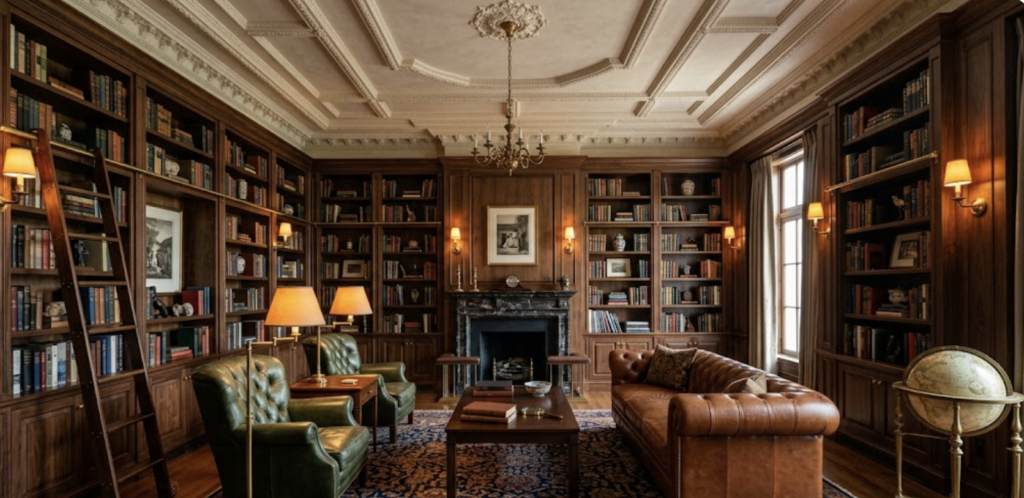
Books make a room feel inhabited in a way that very few other things do. A formal living room lined with floor-to-ceiling built-in bookshelves has a specific kind of authority — intellectual, established, permanent. It says that whoever lives here has been reading for a long time and plans to continue indefinitely. It is the kind of room that makes people want to sit down, pick up a book, and not leave until it gets dark outside.
The built-in bookcases in this style of room are not afterthoughts — they are architectural features. Designed to fit the specific dimensions of the wall, with proper molding at the top that ties them into the room’s overall architecture, built-ins create a sense of permanence that freestanding bookshelves cannot replicate. They also allow for a more curated arrangement: books organized by color or size, mixed with objects and art, punctuated by architectural models or antique globes or personal mementos. A well-styled built-in bookcase is a three-dimensional portrait of its owner.
The color palette in a library-inspired room often includes rich wood tones, deep greens, navy, warm burgundy — colors that feel warm and enveloping rather than airy and open. Walls between the bookcases might be covered in a rich paint color or fabric, creating a sense of enclosure that is actually very comfortable. Leather upholstery features prominently: a chesterfield sofa, a pair of tufted leather club chairs, perhaps a leather-topped writing desk in one corner.
Lighting in this room is layered and warm. A large chandelier or pendant overhead, supplemented by sconces on the wall panels between bookcases, and individual reading lamps at each seating position. The goal is to make every part of the room feel illuminated and inviting without any harsh overhead light. The overall impression is one of a room that has been lived in, thought in, and loved in — which is probably the most genuinely formal quality any room can aspire to.
10. The Coastal Formal Room
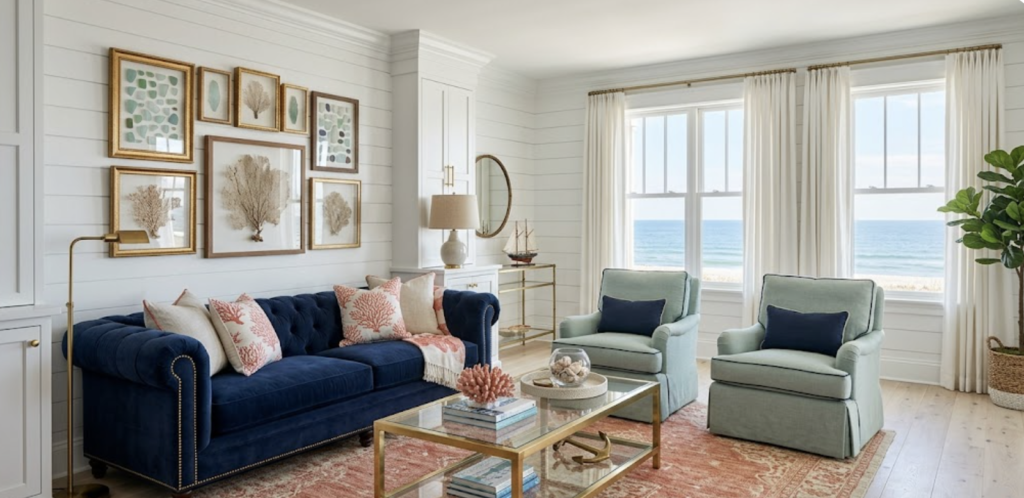
Most people hear “coastal” and think beachy, casual, slightly sandy — not formal. But a coastal formal room is a very specific and very beautiful thing: the elegance of a well-designed formal space, interpreted through the colors and materials of the sea. Think deep sea blues and soft sandy neutrals. Bleached wood and polished brass. Linen in pale ocean tones and cotton in crisp white. It is formal enough to impress and relaxed enough to feel like vacation, which is arguably the ideal combination.
The palette is drawn directly from the ocean: deep navy, sea glass green, sandy beige, driftwood gray, crisp white, soft coral. These colors work together naturally because they come from the same place, and in a formal room, they create a sense of calm sophistication that is hard to achieve with a less cohesive palette. Navy blue velvet sofas against white walls with bleached wood floors read simultaneously as formal and serene. Sea glass green linen armchairs in a room with pale gray built-ins feel considered and specific.
Materials in a coastal formal room include natural linen and cotton, rattan and cane accents, bleached or whitewashed woods, polished or unlacquered brass that develops a patina over time, and stone — either marble in pale neutral tones or natural stone with visible texture and color variation. Glass, too, features prominently: glass-fronted cabinets that display objects, glass coffee tables that let the rug show through, glass vessels that catch and refract light.
Art in this room references the sea without being literal about it. An abstract in blue-green tones. A large-scale botanical print in muted coastal colors. A collection of framed vintage maps. Photography of coastlines or water, printed in subdued tones rather than saturated vacation colors. The room looks as though it belongs to someone who loves the ocean but has never considered decorating their living room with an anchor.
11. The Quiet Luxury Minimal Room
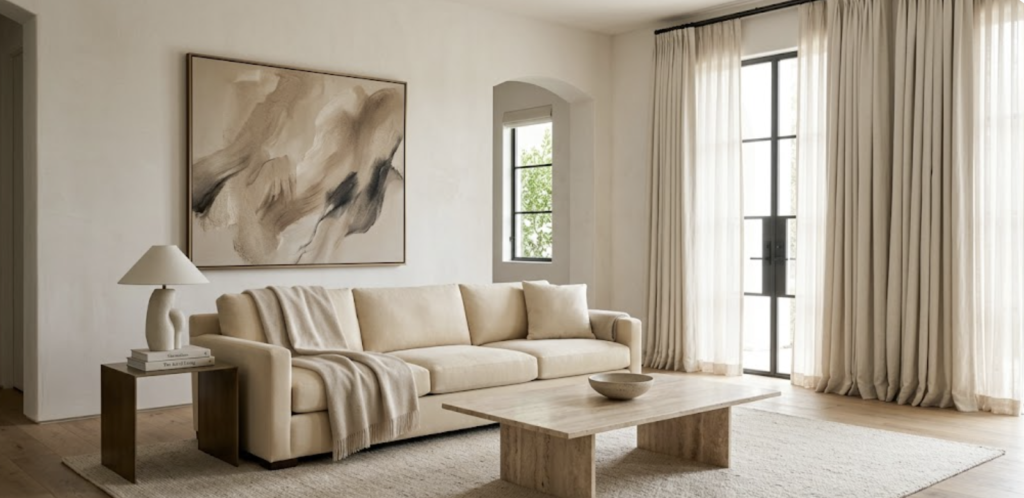
There is a kind of luxury that does not announce itself. No crystal chandeliers, no gilded frames, no bold colors. Just impeccable materials, perfect proportions, and a restraint so complete that it almost feels like an ethical position. The quiet luxury formal living room is for people who know exactly what they have and feel no need to point it out. Which means, of course, that everyone immediately notices.
The materials in a quiet luxury room are the entire story. A sofa in cashmere-blend upholstery in off-white or warm greige. A coffee table in solid travertine or pale marble. A rug hand-knotted in natural fibers in a tone-on-tone pattern. A side table in brushed bronze or aged brass. Drapery in heavy linen, perfectly hemmed, no fuss. The colors are all neutrals — but not flat neutrals. Warm ivory, dusty taupe, pale stone, bone white, soft camel. Colors that look like they came from somewhere natural and real.
The furniture arrangement is simple and spacious. Two or three key pieces in a configuration that feels easy and uncontrived — not because no thought went into it, but because all the thought is invisible. There are no unnecessary objects. Every lamp, every book, every decorative piece has been chosen carefully and placed with intention. The room feels edited, as though someone went through it and removed everything that was not strictly necessary, leaving only what was truly worth keeping.
Artwork in a quiet luxury room is typically one piece — large, carefully chosen, hung with precision. An abstract in muted earth tones. A large-format photograph in subdued colors. A sculptural work that draws attention without demanding it. The single piece of art has more presence and impact than five smaller works crowded together, and this is one of the defining principles of the quiet luxury approach: one perfect thing outperforms several good ones, every time.
12. The Neoclassical Room with Architectural Details
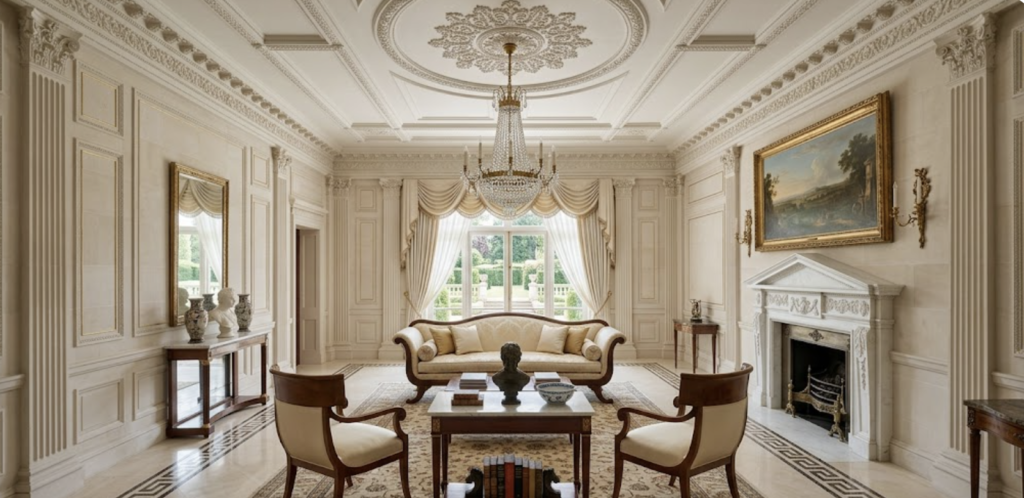
Neoclassical interiors draw from ancient Greek and Roman architecture — columns, pilasters, pediments, friezes, symmetry, and an overall sense of noble grandeur. In a residential living room, the neoclassical style translates into a space with serious architectural presence: plaster columns or pilasters framing the doorways, detailed cornices and ceiling medallions, a fireplace with a proper classical surround, and furniture that references the elegant simplicity of ancient design through clean lines and restrained ornament.
The walls in a neoclassical room often feature architectural paneling — either genuine plasterwork or carefully painted trompe l’oeil that mimics it. Pilasters (shallow columns embedded in the wall) divide the walls into panels, each of which might contain a piece of art, a sconce, or simply a beautiful expanse of color. The proportions of these panels are carefully calculated, often based on classical systems of proportion that create visual harmony across the entire wall surface. It sounds technical, but the result is something that simply looks right in a way that most walls do not.
Furniture in the neoclassical tradition is based on ancient sources. A klismos chair, with its curved back and saber legs. A curule stool based on the folding seats used by Roman magistrates. A sofa with scrolled arms and tapered, reeded legs that references Roman couches. A console table with sphinx legs or winged figures as supports. These pieces are formal in the classical sense — derived from forms associated with ceremony, dignity, and public life — and they bring that quality of occasion into the room.
Color here is often restrained and architectural: pale stone, warm ivory, soft gold, muted blue-gray. Accents in bronze or gilding pick up the metallic details in the furniture and fixtures. The overall impression is one of assured authority — a room that knows its history and wears it well.
13. The Bohemian Formal Room
The phrase “bohemian formal” sounds like an oxymoron, and yet it describes one of the most interesting and visually alive approaches to formal living room design available. The bohemian formal room is layered, eclectic, and deeply personal, but arranged with enough intention and polish to read as composed rather than chaotic. It is formal in spirit — considered, deliberate, purposeful — even if it never met a rule it could not cheerfully ignore.
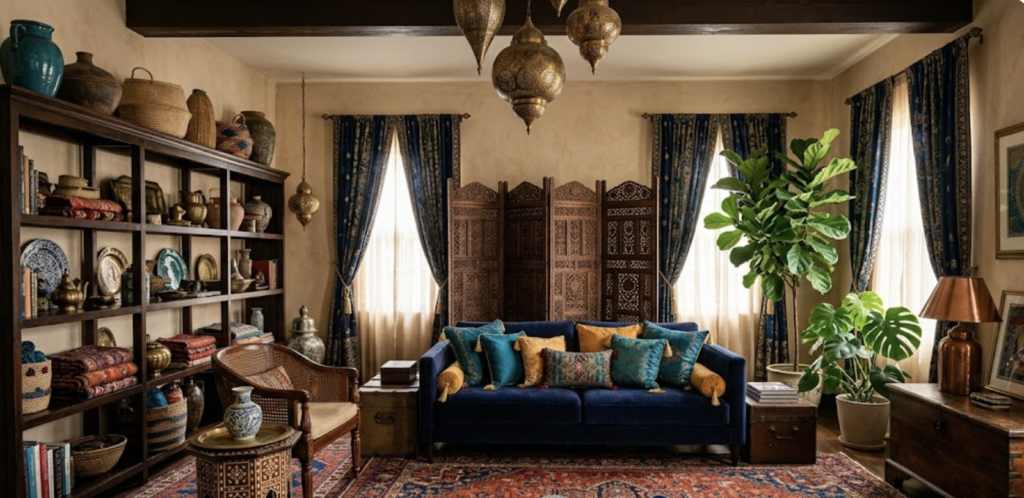
In a bohemian formal room, the furniture mixes eras and origins freely. An Ottoman-style low sofa with tasseled cushions next to a Victorian carved chair next to a Moroccan leather pouf. A kilim rug layered over a sisal or jute base. A collection of objects from different countries and centuries arranged on a carved wooden cabinet — a Ganesh figure next to a Georgian silver frame next to a Moroccan lantern. The specific mix depends on the homeowner’s travels, interests, and acquisitions over time, and that specificity is exactly what gives the room its character.
Pattern and texture are used abundantly, but with a consistent underlying palette that ties everything together. Deep jewel tones — turquoise, saffron, deep red, indigo — anchor the space and recur across different objects and textiles. Natural materials — wood, leather, rattan, stone, clay — balance the color and pattern with tactile richness. Curtains might be embroidered or printed in a bold ethnic pattern. Cushions are mixed prints in the same color family. A tapestry hangs on one wall as art.
The formal quality of this room comes from curation. Every object has been chosen and placed with intent, even if that intent is invisible to the observer. Nothing is there by accident. The room has a point of view — opinionated, adventurous, genuinely curious about the world — and that point of view is expressed consistently from floor to ceiling. This is the kind of room that people photograph and then spend ten minutes describing to their friends. That is its own kind of distinction.
14. The Warm Earthy Organic Room
Not every formal living room needs to look as though it was designed for a feature in an architecture magazine. Some of the most beautiful and genuinely formal spaces are built around natural materials, organic forms, and a color palette drawn from the earth — clay, stone, sand, warm wood, dried grasses, the soft green of sage and olive. This style of formal room is deeply grounded, physically and aesthetically, and it creates a sense of calm that is quite different from the cool serenity of a white room or the enveloping warmth of a dark jewel-toned space.
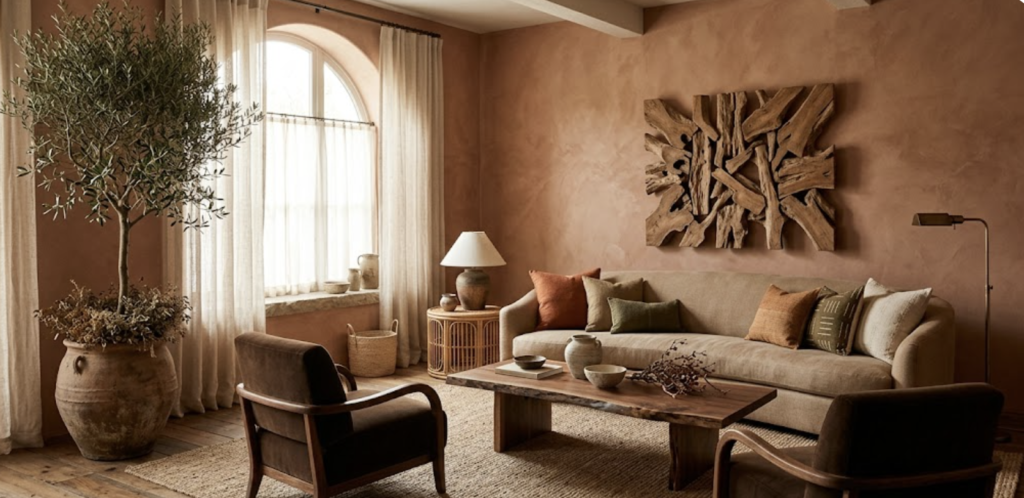
Walls in an earthy organic room are often limewashed, textured, or painted in a warm clay tone that catches light differently throughout the day. Limewash plaster in particular creates a surface that looks like it has depth — slightly varied in color, slightly irregular in texture — that gives the room a quality of handmade warmth that painted walls rarely achieve. Paired with deep-set windows and natural light, a limewashed wall in warm terracotta or pale clay becomes one of the most beautiful surfaces in residential design.
The furniture leans toward organic forms — sofas with curved silhouettes rather than straight edges, chairs in woven materials, coffee tables in organic wood shapes that preserve some of the irregularity of the original material. Upholstery is in natural fabrics: linen, cotton, wool, mohair. Colors stay within the earthy family — warm beige, terracotta, burnt sienna, dusty sage, deep umber — with occasional accents in cream or dark charcoal. Ceramic objects in handmade textures, raw wood sculptures, woven baskets used as decorative storage all contribute to the material palette.
Plants are welcome in this room, and often quite prominent. Olive trees in large clay pots, fiddle-leaf figs, sculptural cacti, trailing plants on high shelves. The greenery reinforces the organic quality of the space and creates a sense that the room is connected to the living world in a way that more polished formal rooms are not. It is formal through consideration rather than convention, and that makes it feel both contemporary and genuinely warm.
15. The Eclectic Black and White Room
Black and white interiors have a long history in formal design, and for good reason: the combination is graphic, sophisticated, and works with almost every style. A formal living room built entirely around black, white, and the full range of gray between them is a study in contrast — bold in its simplicity, complex in its execution, and endlessly adaptable to different moods depending on how the palette is deployed. Add a single strong accent color — deep red, electric blue, vivid yellow — and the room transforms entirely. But in its pure form, the black and white room is one of the most striking and complete ideas in formal living room design.
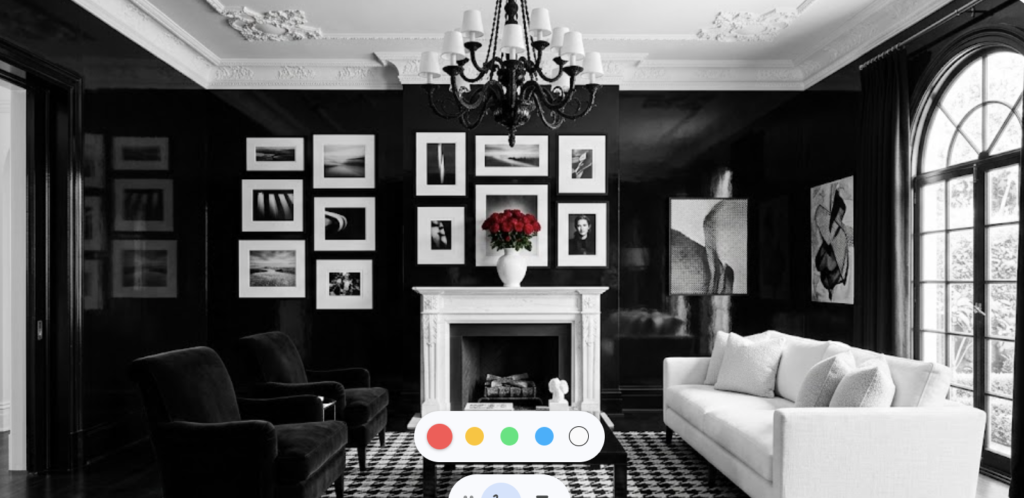
The key decision in a black and white formal room is which element is dominant. A white room with black accents feels crisp and clean — white walls, white upholstery, black trim, black hardware, black art frames. A black room with white accents feels dramatic and bold — charcoal or black walls, black furniture, white upholstery, white architectural trim. A balanced mix of the two, with an equal visual weight of light and dark, creates the most graphic effect — a room that could be photographed in black and white and still look intentional.
Pattern in a black and white room can be used more boldly than in a color-based palette, because the graphic quality of the color scheme makes pattern feel natural rather than overwhelming. A large-scale houndstooth on the sofa. A graphic geometric rug in bold black and white. A toile wallpaper in black on white. Striped drapery. Even when several patterns appear together, the consistent palette ensures they coexist without conflict. This is one of the great advantages of the black and white room — the absence of competing color means pattern can be indulged freely.
Art in a black and white room can be almost anything, because everything shows up clearly and has impact against both black and white backgrounds. Black and white photography in black frames against white walls is perhaps the most obvious approach, and it is obvious because it is perfect. But a vivid painting in full color against a black wall is equally powerful, and it gives the room a focal point that vibrates with contrast. The black and white room is, above all, a room that understands composition — and composition is, in the end, what formal design is all about.
Bringing Your Formal Living Room Together
Reading seventeen ideas in one sitting is a lot, and if you are now feeling the pleasant, slightly overwhelming feeling of too many good options, that is completely normal. The formal living room, as a concept, is large enough to contain all of these approaches and more — which is both its great freedom and its occasional challenge. The question is not which idea is best in the abstract, but which one is best for your specific home, your specific life, and your specific sense of what formality should feel like.
A few things are worth keeping in mind as you decide. First, the formal living room needs to fit the architecture of your home. A Chinoiserie salon with hand-painted wallpaper and lacquered furniture may not make sense in a modern flat with low ceilings and open-plan layout — but a gallery-style room with clean lines and carefully placed art might feel like it was designed for exactly that space. Let the bones of your home guide your starting point.
Second, consider how you will actually use the room. If formal entertaining is central to your life, invest in the most beautiful version of that. If the room is more of a personal retreat that happens to also impress guests, the quiet luxury approach or the library-inspired room might resonate more. The formal room should feel like it belongs to you, even if its primary purpose is to be enjoyed by others.