
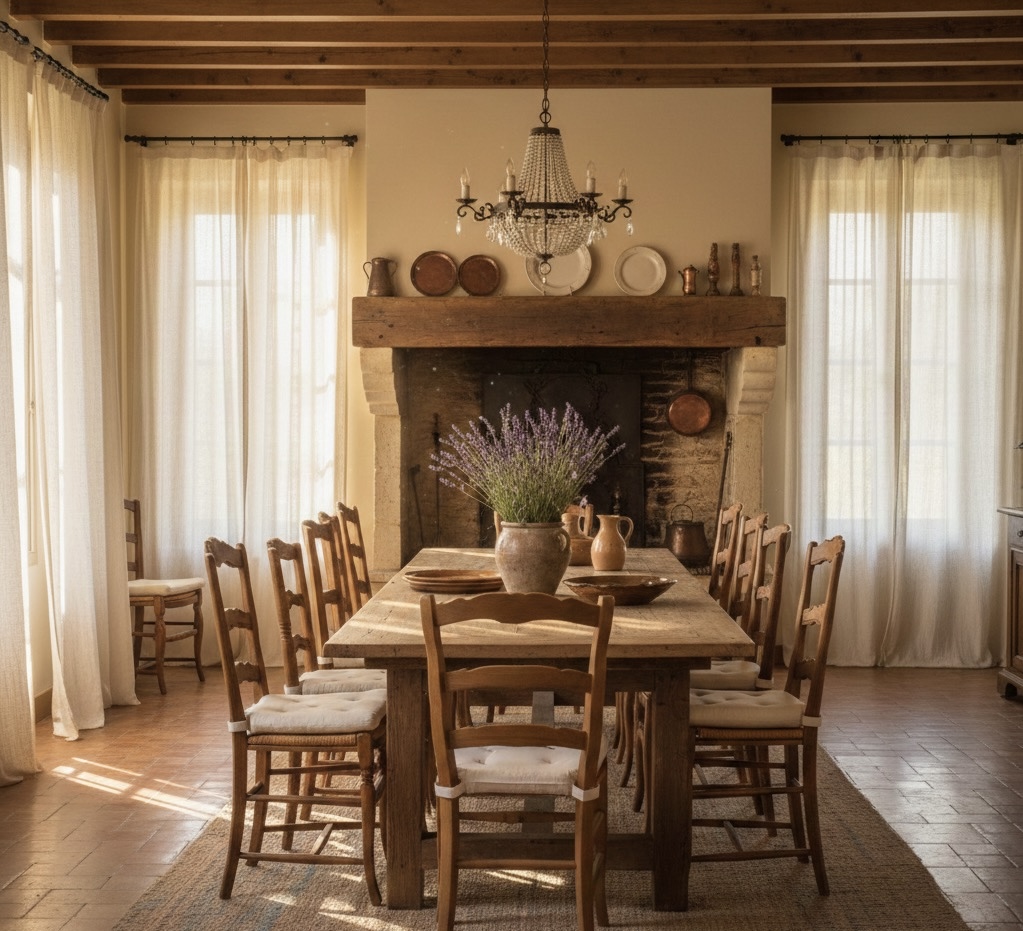
There is something about a French country dining room that makes you want to slow down. It makes you want to pull out a chair, pour a glass of something cold, and stay for a while. It does not shout for attention. It does not try to impress. Instead, it draws you in with its warmth, its soft textures, its worn wood, and its quiet, unhurried charm. It feels like a room that has been lived in for decades — where many meals have been shared, where laughter has filled the air, and where the table always has space for one more person.
French country style, sometimes called French Provincial or French farmhouse, is rooted in the rural regions of France — Provence, Burgundy, Normandy, the Loire Valley. These are places where the food is good, the pace is slow, and the homes are built to welcome. The interiors reflect that. They are not precious or overly styled. They are layered, warm, a little imperfect, and deeply comfortable. A French country dining room is not a showroom. It is a gathering place.
This post walks you through 14 distinct French country dining room interiors — each one with its own personality, its own mood, and its own set of ideas you can bring into your own home.
1) The Provençal Farmhouse Table Setting
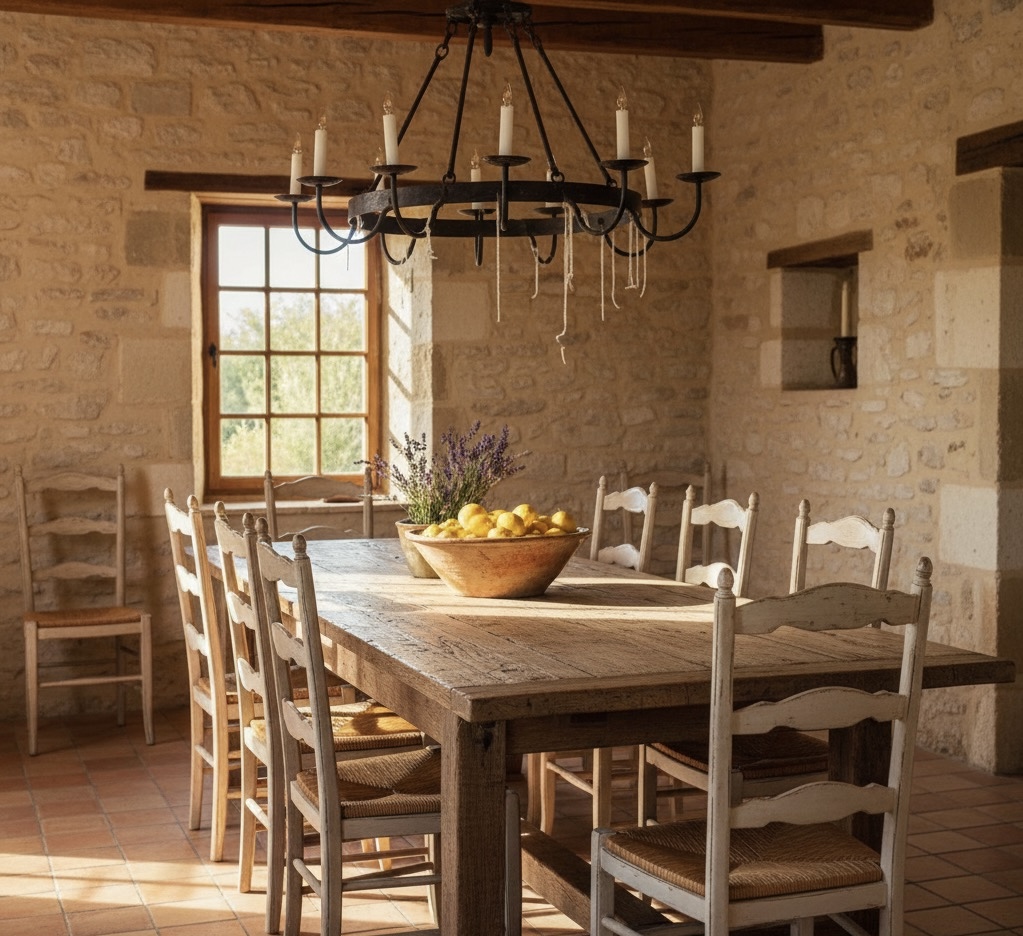
It is the kind of table that looks like it has fed generations of families — scarred by knives, softened by years of use, and still standing strong. In Provence, the dining table is not just a piece of furniture. It is an institution. It is where meals stretch for hours and where the centerpiece is never fussy — maybe a clay bowl of lemons, a jar of dried lavender, or a handful of herbs fresh from the garden.
When you think about this look, picture a long, solid wood table with visible grain, knots, and a patina that no amount of factory finishing can fake. The surface might be slightly uneven. It might have a crack running down one side. These are not flaws — they are the story. Around this table, the chairs do not match perfectly. Some are rush-seat ladder-backs painted in cream or pale gray. Others might be wooden with a slightly different shape. The mismatch is completely intentional.
The walls in a space like this tend to be stone, plaster, or painted in a warm white with just a whisper of yellow or beige in it. The floor is usually terracotta tile or aged limestone — nothing polished or cold. The light overhead is an iron chandelier, the kind that holds real candles or candle-style bulbs. When the light is low and warm, the whole room glows like something from a painting.
What makes this setting so appealing is the sense of abundance without effort. The table might have a simple linen runner, a few mismatched glasses, some earthenware plates in warm tones, and a bottle of wine. That is all it needs. It is generous and relaxed. It feels like France on a Sunday afternoon when there is nowhere else to be.
2) The Blue and White Pottery Dining Room
Blue and white is one of the most enduring color combinations in French country interiors, and nowhere does it feel more at home than in the dining room. This is a look rooted in the pottery traditions of regions like Quimper in Brittany and Moustiers-Sainte-Marie in Provence, where artisans have been painting intricate designs on white ceramic for hundreds of years. The result is a palette that feels fresh and grounded at the same time — crisp, clean, but never cold.
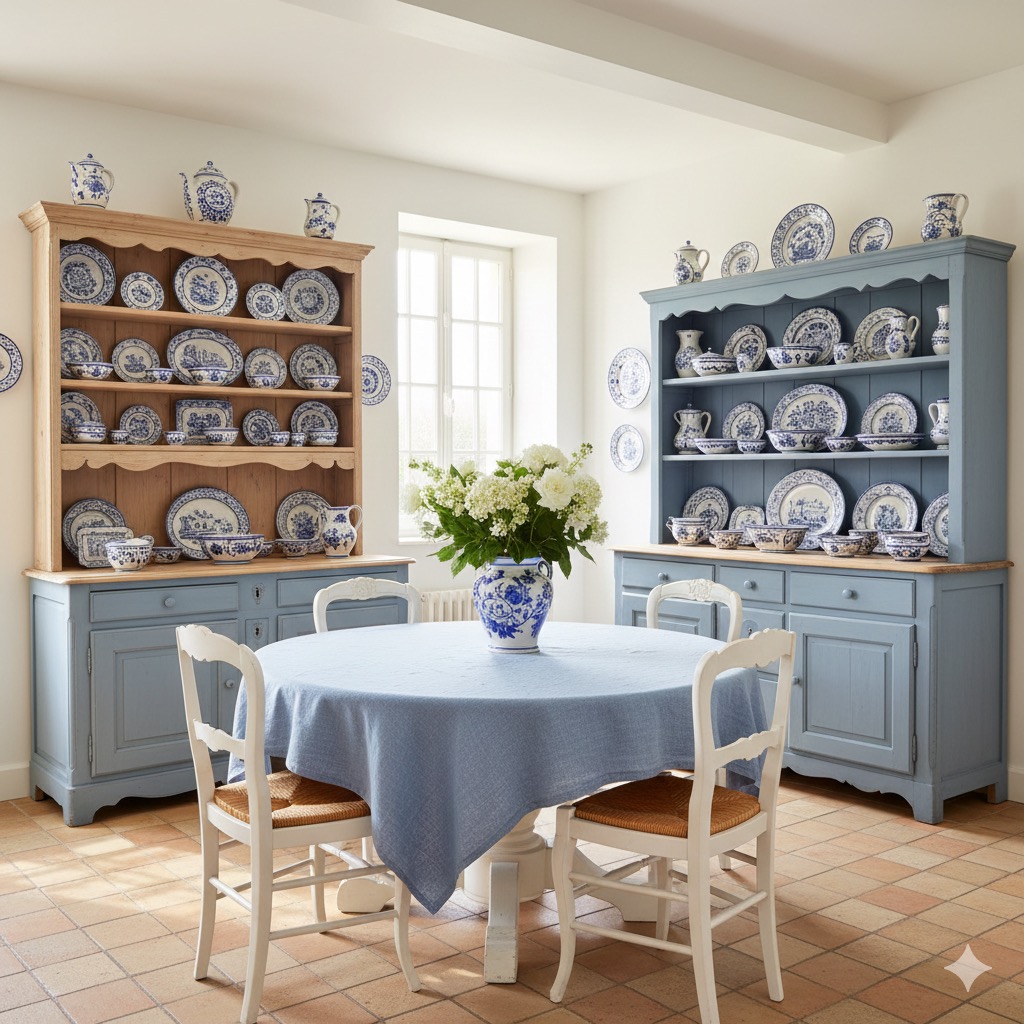
Imagine a dining room where the walls are painted in a warm white, and along one wall there is a large open hutch or dresser displaying a collection of blue and white plates, bowls, and pitchers. Some pieces are perfectly matched. Others are clearly from different sources and different eras. There might be a large Quimper plate with a painted peasant figure, a set of simple blue-banded bistro bowls, and a tall pitcher in cobalt blue. Together, they tell a story of a home that has gathered beautiful things over time rather than buying a matching set all at once.
The table in this kind of room benefits from a blue linen tablecloth — not a perfect, pressed-flat tablecloth, but one with the gentle wrinkles that come from actually being used and washed. The centerpiece might be a blue ceramic vase filled with simple white flowers: ranunculus, garden roses, or baby’s breath. The chairs can be painted in soft white or cream, with rush seats or simple cushions in blue-checked cotton. The whole room breathes in a way that makes you feel like you are having breakfast on a sunny morning in Provence.
What keeps this look from feeling too country-cute or kitsch is restraint in other areas. The walls stay relatively clean — no wallpaper, no busy patterns on every surface. The floor is simple: pale stone, wide plank wood, or plain terracotta. The blue and white pottery does all the decorative work, and it does it beautifully.
3. The Linen and Lavender Dining Room
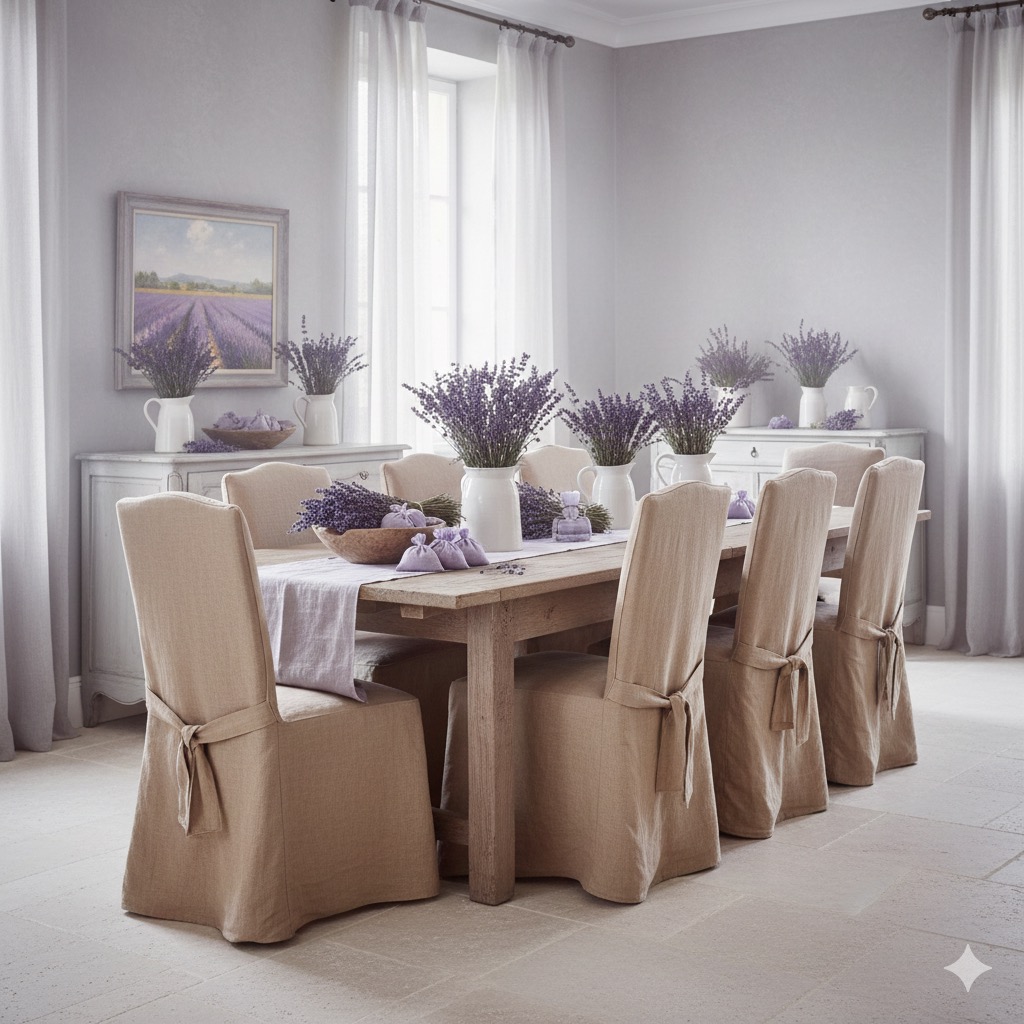
There is a certain softness to the Provence-inspired linen and lavender dining room that feels genuinely restorative. This is a room built on a palette of muted, natural tones — the warm ivory of unbleached linen, the dusty purple-gray of dried lavender, the pale weathered gray of old painted wood. Nothing here is bright or jarring. Everything is gentle on the eye and gentle on the spirit.
The linen in this room does a lot of the heavy lifting. Chair cushions and slipcovers in natural, undyed linen give every seat a relaxed, casual quality. A linen tablecloth, slightly rumpled, makes the table feel ready for a real meal rather than a photo shoot. Gauzy linen curtains at the windows filter the light into something soft and diffused, so the room always feels like it is bathed in the warm glow of a cloudy afternoon. Linen is a fabric that improves with age and washing — it wrinkles easily, it softens beautifully, and it has a texture that invites you to touch it. These qualities make it the perfect material for a French country dining room.
The lavender comes in through every possible angle — in a tall ceramic pitcher on the sideboard, in small dried bundles tied with raffia and hung from a nail on the wall, in little sachets placed in a bowl at the center of the table. Fresh lavender has a color that shifts from blue-purple to soft gray as it dries, and both states are beautiful. The scent it carries into the room is one of the most immediately evocative of all French country experiences — it is the smell of Provence in summer, of warm evenings and long shadows.
A large oil painting or a framed linen-paper print of lavender fields hung above a weathered sideboard completes this room. The sideboard itself — perhaps in pale gray, perhaps in faded blue-green — holds a collection of simple things: a stack of plates, some folded napkins, a few ceramic serving pieces. The whole effect is of a room that is both romantic and completely unpretentious.
4) The Painted Wood Paneling Dining Room
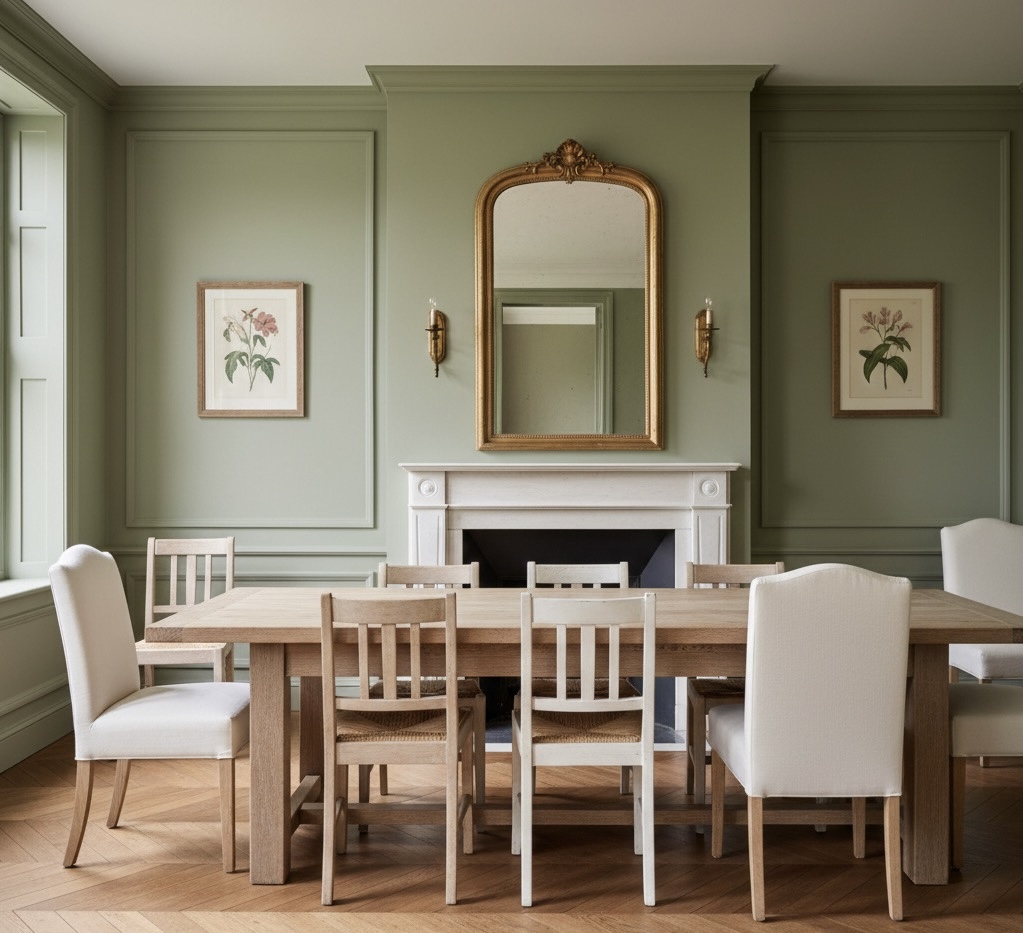
Painted wood paneling is one of those details that immediately signals French country style — specifically the more refined, slightly more polished version you might find in a Loire Valley manor house or a well-loved Normandy home rather than a rough Provençal mas. The paneling gives the room structure and character. It creates rhythm along the walls, breaks up large expanses of flat surface, and absorbs color in a way that plaster walls simply do not.
The most popular colors for painted paneling in French country dining rooms are the ones you would find in nature: a soft sage green that looks like it has been there for a hundred years, a chalky blue-green similar to verdigris, a warm dove gray, or simply a well-mixed white with depth and warmth. These colors are never bright. They are always slightly faded, slightly dusty, as though the paint has mellowed in the light over many seasons.
Against sage green paneling, a long dining table in natural or lightly-stained wood glows. The chairs might be a mix — some painted white, some with a seat pad in a simple stripe or check. A large gilt-framed mirror above a painted fireplace reflects the light and makes the room feel both larger and more layered. Simple botanical prints in narrow black or dark wood frames create a gallery-wall effect on one section of paneling without overwhelming the space.
The floor in a room like this works best in wide-plank wood — perhaps in a herringbone pattern, or simply laid in straight lengths with visible wood grain. Old, slightly scuffed, and glowing with the warm amber of aged varnish or beeswax. The table setting is restrained: tall beeswax candles in simple iron holders, plain white plates, and a low arrangement of garden flowers. This dining room feels polished but never stuffy. It has the ease of a country home that happens to be beautiful.
5) The Rustic Beam Ceiling Dining Room
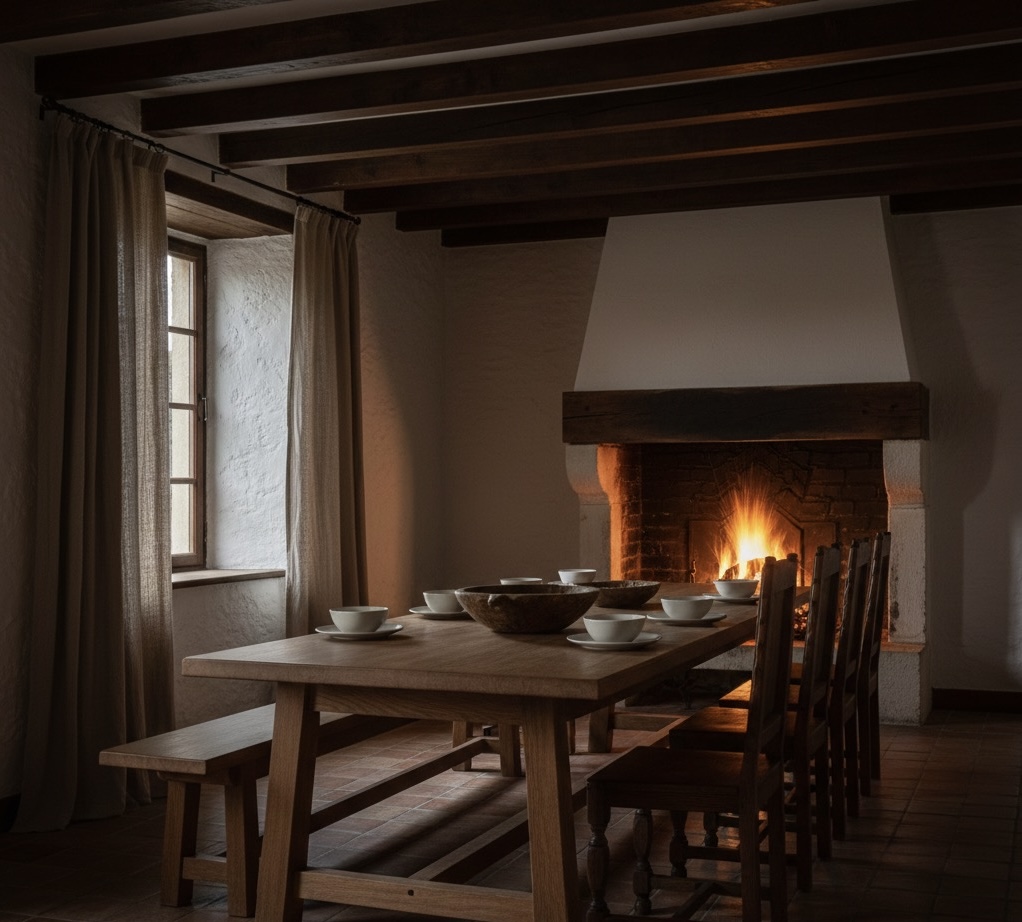
Exposed ceiling beams are arguably the single most recognizable feature of French country architecture, and they transform a dining room in a way that very few other elements can. Thick, dark oak beams crossing a whitewashed ceiling bring a structural drama that is impossible to ignore. They lower the visual height of the room, making it feel more intimate and enclosed. They add a sense of history and weight. And they create a framework that gives everything below them — the table, the chairs, the lighting — a natural context and scale.
In a dining room dominated by strong beams, the furniture tends to follow suit and go big. A refectory-style table — long, solid, made from a single species of hardwood — is the natural choice. This is the kind of table you might find in a French monastery or a medieval farmhouse, and it has the same quality: built to last, built to gather around, built for real life. One side of the table might have a simple wooden bench, which seats more people and has an easy, casual quality. The other side has chairs — carved wooden chairs with a simple back, perhaps slightly different from one another.
A large wrought iron ring chandelier suspended from the central beam, fitted with real candles or candle-style bulbs, casts exactly the right kind of warm, flickering light over the table. It is not bright. It is not efficient. But it is deeply atmospheric and beautiful. On the walls, a collection of antique copper pots and molds hung in an informal arrangement adds warmth and a glint of reflected light. A stone fireplace along one wall, with logs stacked neatly alongside it, makes the room feel like a refuge.
The whitewashed plaster walls between and beneath the beams keep the room from feeling too heavy. They bounce the light from the chandelier and the fire, and they provide a clean background for the richness of the wood and the warmth of the copper. This is one of the most dramatic and satisfying of all French country dining room looks.
7) The Mismatched Chairs Dining Room
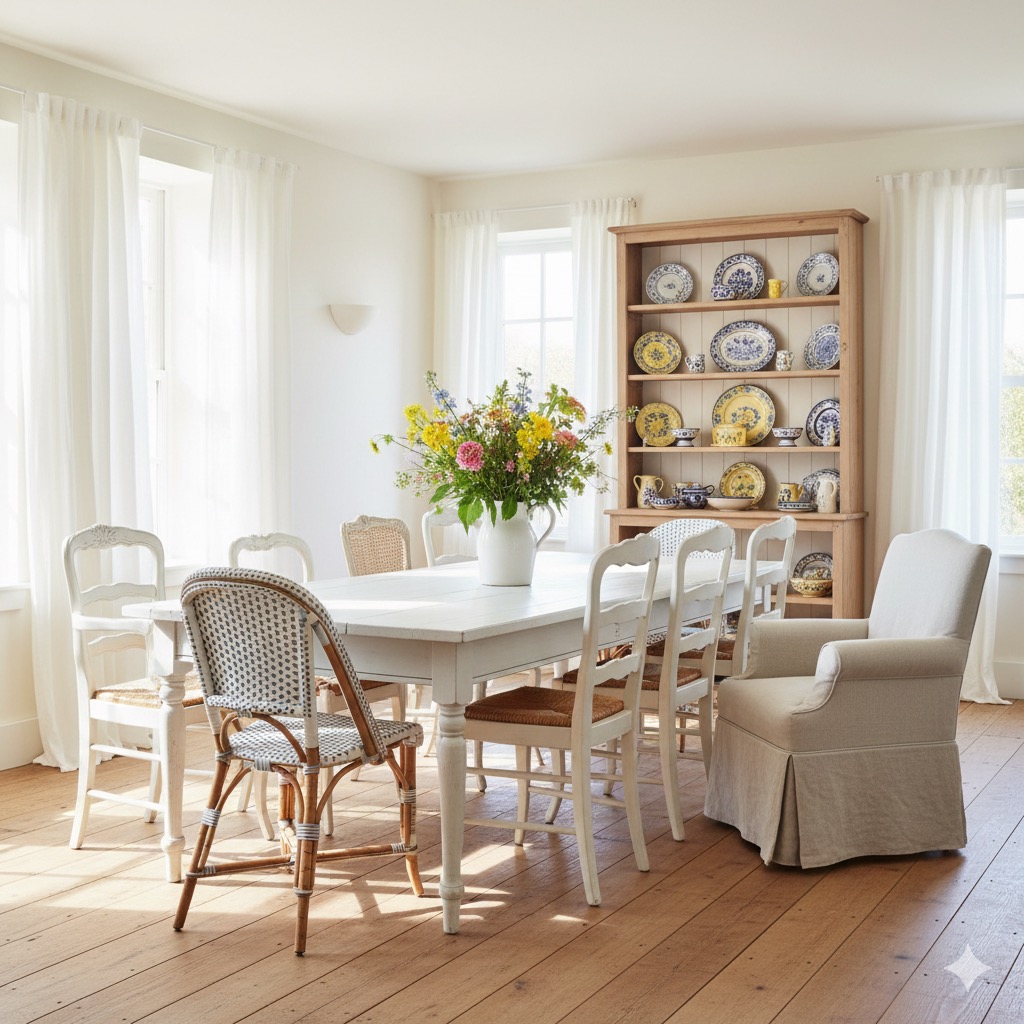
In French country homes, the dining chairs are rarely a matched set. They are gathered over time — from different rooms in the house, from the local brocante (flea market), from grandparents and aunts, from trips to other towns. Each chair has its own personality, its own age, its own shape. And when they are brought together around a single table, the effect is not chaotic — it is wonderfully alive.
The key to making mismatched chairs work is a unifying element. That element is usually color. When every chair, regardless of its shape, is painted in the same shade — a soft antique white, a warm cream, a chalky gray — they immediately belong together. The differences in silhouette become an interesting detail rather than a distraction. You might have a Louis XVI-style carved-back chair next to a simple rush-seat ladder-back, next to a rattan bistro chair, next to a slipcovered linen armchair. All painted white, all gathered around the same table, they look like they have always been together.
There is also a version of this where the chairs are not all the same color but instead grouped in complementary tones — some white, some pale blue, some soft gray. This takes a little more intention to get right, but when it works, it feels incredibly French. Like someone who dresses with complete confidence and does not worry about whether every piece matches exactly.
The table in a mismatched chair dining room is often painted too — a long farmhouse table in white or off-white, perhaps with the top left in natural wood to show warmth and contrast. The overall feeling of the room is one of relaxed, joyful abundance. It is a room that clearly loves having people in it.
7) Garden dining room
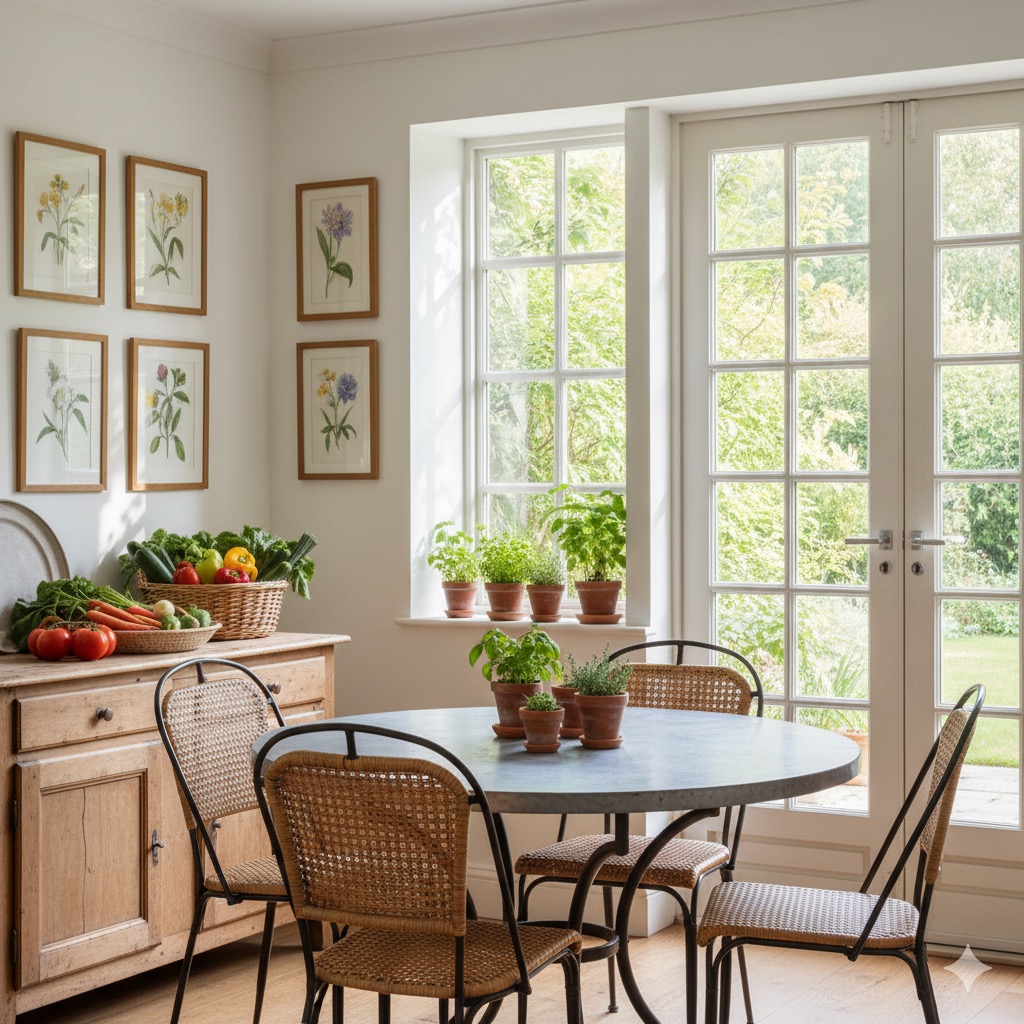
In France, the boundary between inside and outside has always been beautifully blurred, and nowhere is this more evident than in the dining room. The ideal French country dining room is one that connects directly to a garden, a terrace, or at the very least feels as though it does. Large glass-paned doors that open outward onto a stone terrace, windows with views of a potager (kitchen garden) just beyond them — these details make the dining room feel like an extension of the land rather than a room sealed off from it.
A garden-inspired dining room brings the outside in through every available channel. Terracotta pots of fresh herbs — rosemary, thyme, basil — sit on the windowsill. A wicker basket on the sideboard holds whatever came from the garden that morning: a few tomatoes, some green beans, a bunch of fresh flowers. The color palette mirrors the garden too: soft greens, warm whites, the earthy red of terracotta, the dusty gray-green of lavender leaves.
The furniture in this kind of room often includes natural materials that echo the garden: rattan chairs, a zinc-top table (zinc being a material used throughout French farmhouse kitchens and gardens for centuries), and simple iron pieces. A zinc-top table is wonderful because it has a matte, silvery surface that is both beautiful and completely practical — it can be wiped down easily, it does not need babying, and it develops a gorgeous patina over time.
On the walls, botanical watercolor prints in simple white frames add to the garden connection without being heavy or overpowering. A large glass jar filled with garden flowers — dahlias, zinnias, cosmos — on the table is the only centerpiece this room ever needs. This dining room is at its happiest on a summer evening when the doors are thrown open and the air smells of roses and cut grass.
8) The Toile de Jouy Dining Room
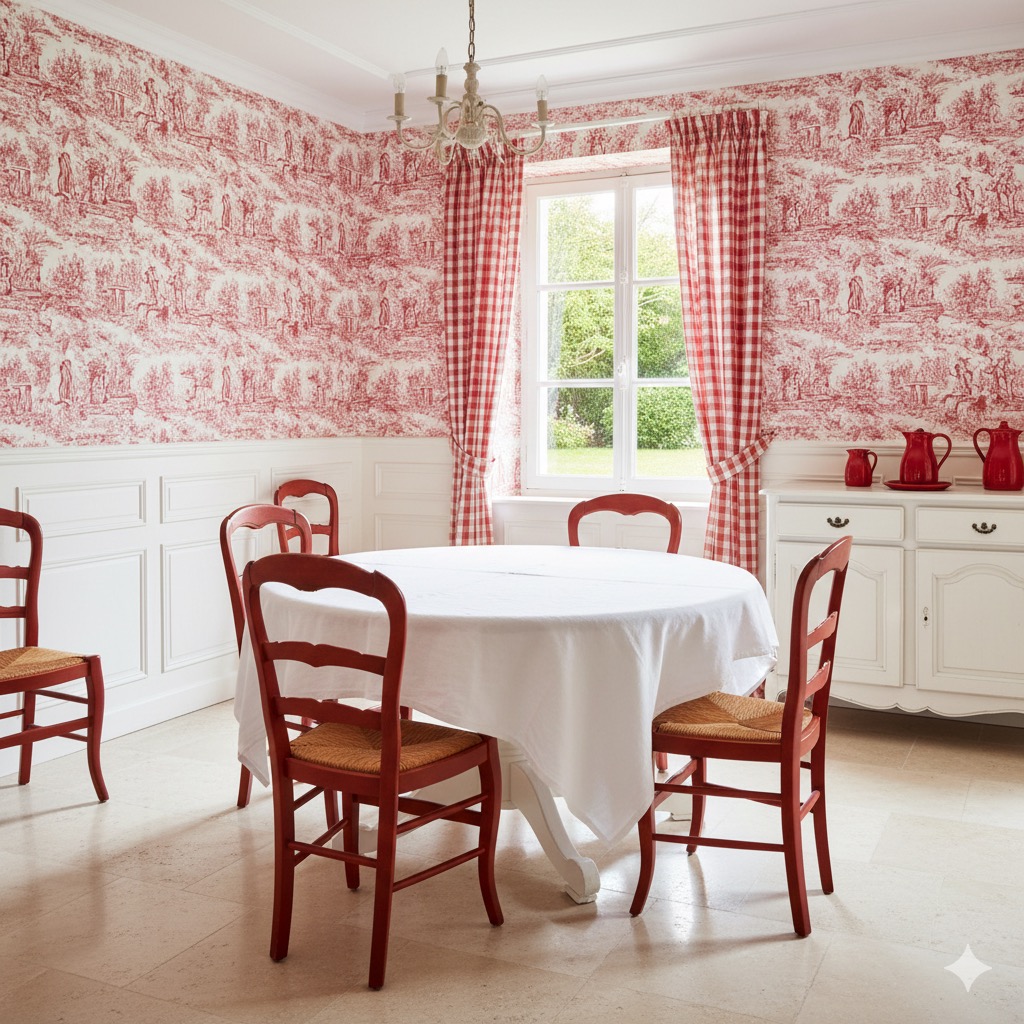
Toile de Jouy is one of the most distinctly French of all decorative patterns. Originally produced at the Oberkampf factory in Jouy-en-Josas near Paris in the 18th century, toile features detailed scenic prints — pastoral landscapes, farm animals, and figures going about their country lives — printed in a single color on a white or cream background. The most classic version is red on white, though blue, black, and green versions exist too. Used in a dining room, toile creates an immediate sense of French country heritage.
A dining room wallpapered in toile de Jouy is a bold, committed design choice — and it is one that rewards that commitment fully. The walls become a narrative backdrop, full of tiny stories and details to discover. The key is keeping everything else relatively simple so that the wallpaper can be the clear star. White painted wainscoting along the lower third of the walls grounds the pattern. A round pedestal table in the center of the room — intimate and social — sits under the wallpaper like a stage set.
The chairs in a toile dining room work beautifully in a painted finish — red or white to pick up the colors of the toile — with the classic curved lines of French provincial furniture. Red and white checked curtains at the window (a check being toile’s perfect partner, traditionally) add to the country feeling without competing. The floor in this room is best kept very simple: polished stone, plain limestone, or bare wide-plank wood. A white sideboard against the toile-covered wall, with a few simple red ceramic pitchers or a white soup tureen on top, completes the picture.
This is a room that feels unapologetically French and utterly confident. It is not a look for minimalists. But for anyone who wants a dining room with real personality, with genuine French country character, toile delivers it completely.
9) Patisserie Dining Room
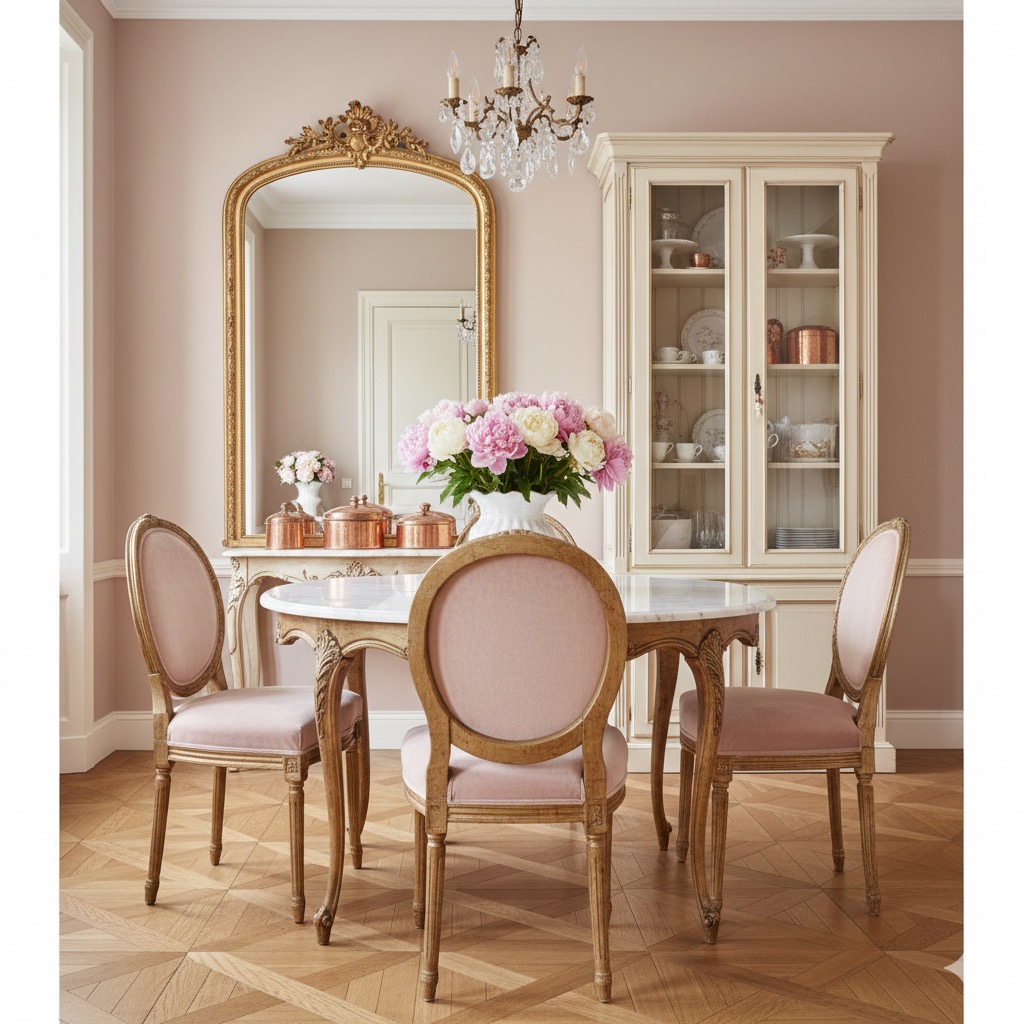
Not every French country dining room needs to be rough-hewn and rustic. There is a version of French country style that takes its cues from the sweeter side of French culture — the patisserie, the salon de thé, the ornate little cake shop with its polished window full of beautiful pastries. This dining room version is softer, a little more refined, and filled with the most delicate and pretty details imaginable.
The palette here is blush pink, warm cream, and soft gold. The table is round with a marble top and gently curved gilded legs — the kind of table that would look at home in a Paris apartment from the Belle Époque era. The chairs are Louis XV style, with their characteristically curved and carved frames, upholstered in pale blush velvet or a soft jacquard. The upholstery does not need to be pristine. Slightly worn is better — it speaks of use and pleasure, not showroom newness.
A glass-fronted cabinet along one wall holds the most charming collection: vintage French copper patisserie molds in graduated sizes, ceramic cake stands with delicate painted edges, a set of hand-painted dessert plates, old glass cloche domes. These are the tools and props of a culture that takes its pastry seriously, and they are beautiful enough to display as art. Above the cabinet, or on the adjacent wall, a large gilt mirror reflects the light from a small crystal chandelier overhead.
Fresh peonies in full bloom in a white porcelain vase on the table bring the whole room to life. This is a room that feels genuinely celebratory — not in an ostentatious way, but in the way of a room that genuinely loves beautiful things and knows how to enjoy them. It is feminine, layered, and completely at ease with its own prettiness.
10) The Wabi-Sabi French Country Dining Room
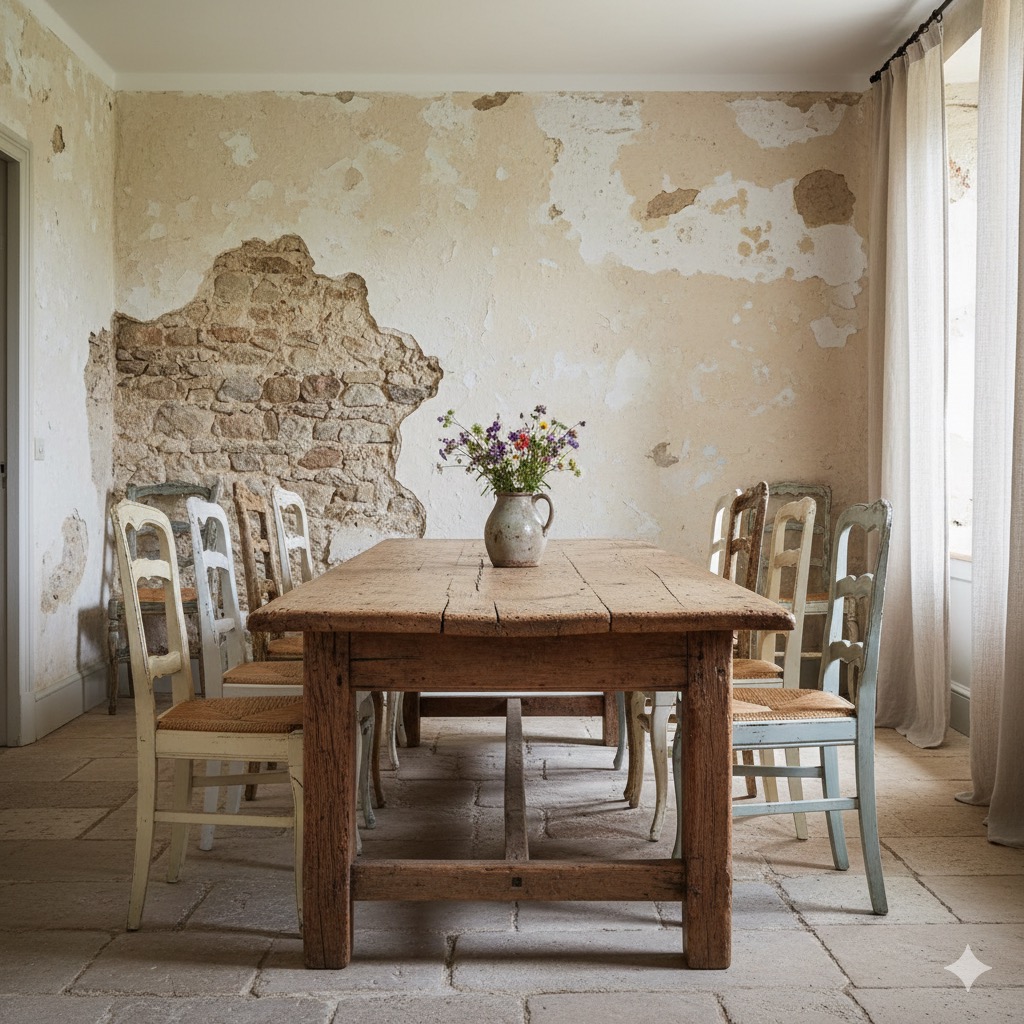
There is a concept in Japanese aesthetics called wabi-sabi — the recognition that beauty can be found in imperfection, in age, in the natural processes of wearing and fading. French country style, at its most authentic, shares this philosophy completely. The most beautiful French country dining rooms are not the polished, restored, perfectly coordinated ones. They are the ones that show their age honestly, that have cracks and chips and worn patches, and that are more beautiful for all of it.
This dining room leans fully into that idea. The table might be very old — so old that the wood has shrunk and developed deep fissures along the grain, that the surface has been worn smooth in some places and left rough in others. The chairs have peeling paint that reveals earlier layers of color beneath — a soft blue under a cream, a green under a gray — and rather than painting them again, they are left exactly as they are. The floor is uneven flagstone, cold in winter, but irreplaceable in character.
The walls are plaster — old plaster that has cracked in places, that has patches where someone filled a hole and never quite matched the texture, that shows its layers and its history without apology. The curtains are a faded linen that was once perhaps a stronger color but has been bleached by years of sun to something softer and more beautiful. The vase on the table is cracked along one side but still holds water, and it holds a bunch of simple wildflowers — the kind you pick from a field.
This room is not decorated. It is simply inhabited, honestly and beautifully. It has the quality of something absolutely real, something that cannot be bought or manufactured. It is the most deeply French country of all the rooms in this list, because it embodies what French country style is truly about: living well with what you have, finding beauty in the real, and never trying too hard.
11) The Blue Shutter Dining Room
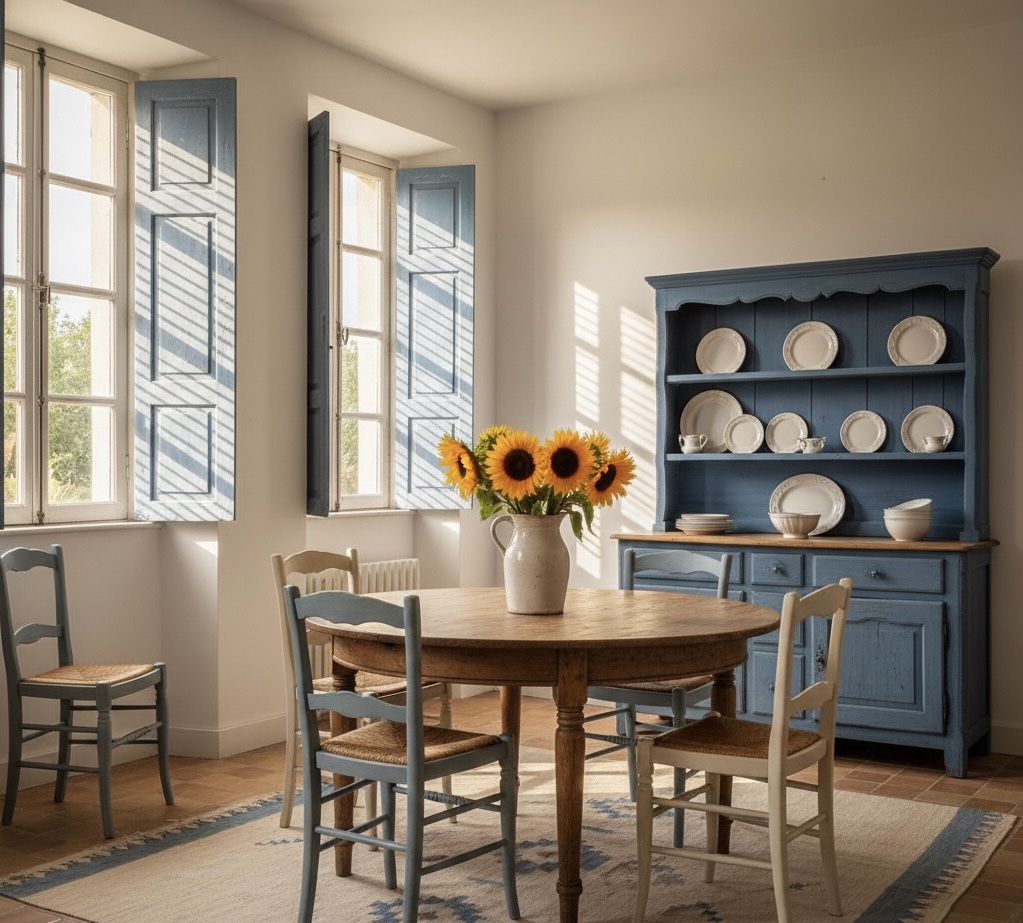
Blue shutters are one of the great visual signatures of southern France. On the outside of any Provençal village house, the shutters are almost invariably blue — sometimes a clear sky blue, sometimes a deeper sea blue, sometimes a dusty, faded blue that has been weathering in the sun for decades. When those shutters are brought inside, used on the deep-set interior windows of a dining room, they carry with them the whole visual and emotional memory of Provence in summer.
Interior shutters in a dining room serve both a practical and an aesthetic purpose. They control the fierce southern light beautifully — when angled, they create gorgeous striped shadows across the walls and floor at certain times of day. They can be closed almost entirely in the heat of the afternoon, turning the room into a cool, dim refuge. And they are simply beautiful to look at, their blue paint faded and slightly chalky against white-washed walls.
The rest of this dining room takes its cues from the shutters’ blue. A painted dresser in faded blue along one wall displays a collection of white ceramic dishes and simple pottery. Some of the dining chairs are painted in a complementary shade of blue. The tablecloth might be white, or a very faded blue-and-white check. Sunflowers in a simple jug on the table bring in the gold of the Provençal landscape, and against the blue, they look extraordinary.
The floor is terracotta tile — the warm, handmade kind with slight variations in color and surface — with perhaps a simple faded rug underneath the table. The light in this room shifts throughout the day as the sun moves and the shutter angles change. In the morning, it is bright and fresh. In the afternoon, it is cool and dappled. In the evening, the warm golden light of the sun turns everything to amber and honey. This is a dining room designed for all hours of the day, and it performs beautifully in all of them.
Conclusion
After walking through eleven different versions of the French country dining room, a few things become clear. First, there is no single, fixed idea of what a French country dining room must look like. It can be soft and romantic. It can be dramatic and rustic. It can be filled with color or built almost entirely from neutral tones. It can be furnished with antiques or assembled from a mix of old and new. What makes it French country is not any one element — it is an attitude. An ease. A genuine preference for warmth over perfection, for soul over slickness, for the beautiful and imperfect over the pristine and hollow.
Second, the details matter enormously in French country style. A room can have the right bones — stone walls, wooden table, iron chandelier — and still feel flat if the details are wrong. The wrinkle in the linen tablecloth, the cluster of dried lavender on the sideboard, the slightly mismatched chairs, the candle burned down to a stub — these are the details that breathe life into a room. They tell the story of a home that is genuinely lived in, genuinely enjoyed. They are the difference between a room that looks French country and a room that truly is.
Third, and perhaps most important: French country dining rooms are always in service of gathering. The table is generous. The chairs are comfortable. The light is warm. The mood invites you to stay. Whatever specific style, palette, or combination of ideas you draw from this list, keep that central purpose in mind. A French country dining room is not a museum. It is not a stage set. It is a place where people come together, where food is shared, where the conversation runs long and the wine runs low. Design it to be that. Design it to be the most welcoming room in your home.
And then, invite someone to dinner.