
There is something about a dining room that has been thought through with care. It is not just where food is served — it is where the people you love sit together, where conversations stretch long after dessert, and where a regular Tuesday evening can feel a little more memorable than it should.
A truly elegant dining room does not have to announce itself loudly. In fact, the best ones rarely do. They create a feeling the moment you step inside: a quiet confidence, a sense of warmth layered with sophistication, and a visual language that speaks before anyone sits down.
Elegance in a dining room is about choices — what you hang on the walls, how the light falls across the table, what textures you place underfoot, what sits at the center of the room to anchor it all. It is also about restraint, knowing when to stop adding and let a room breathe. Whether you have a grand formal space with high ceilings or a smaller, more intimate nook carved out of a larger floor plan, there are ways to bring genuine elegance into it that feel personal, livable, and completely your own.
This post walks through some of the most beautiful and thoughtful dining room ideas out there — the ones that have staying power, that photograph well and feel even better in person. Each idea is explored in detail, not just as an aesthetic description, but as a real picture of what that kind of room looks like, feels like, and why it works so well. If you are in the middle of designing your dining room, or simply dreaming about what it could become, you will find plenty of ideas here to spark something.
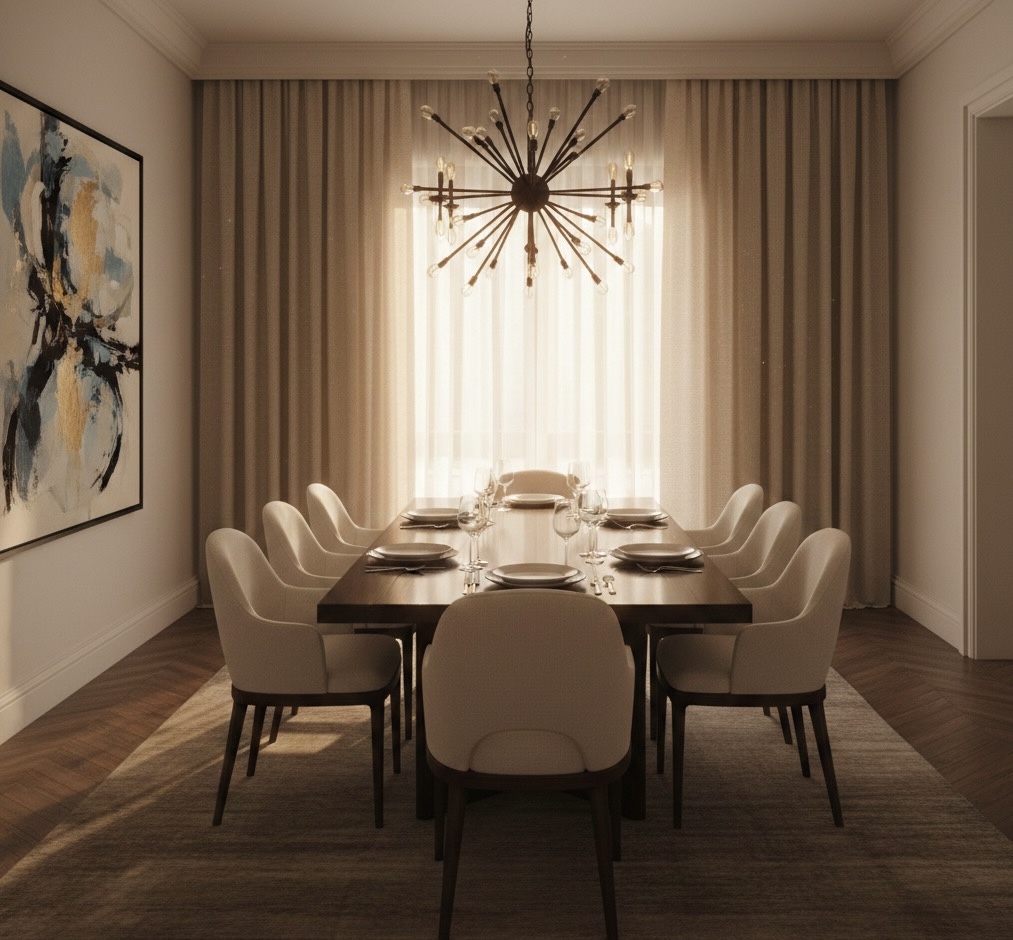
1. The Dramatic Dark Dining Room
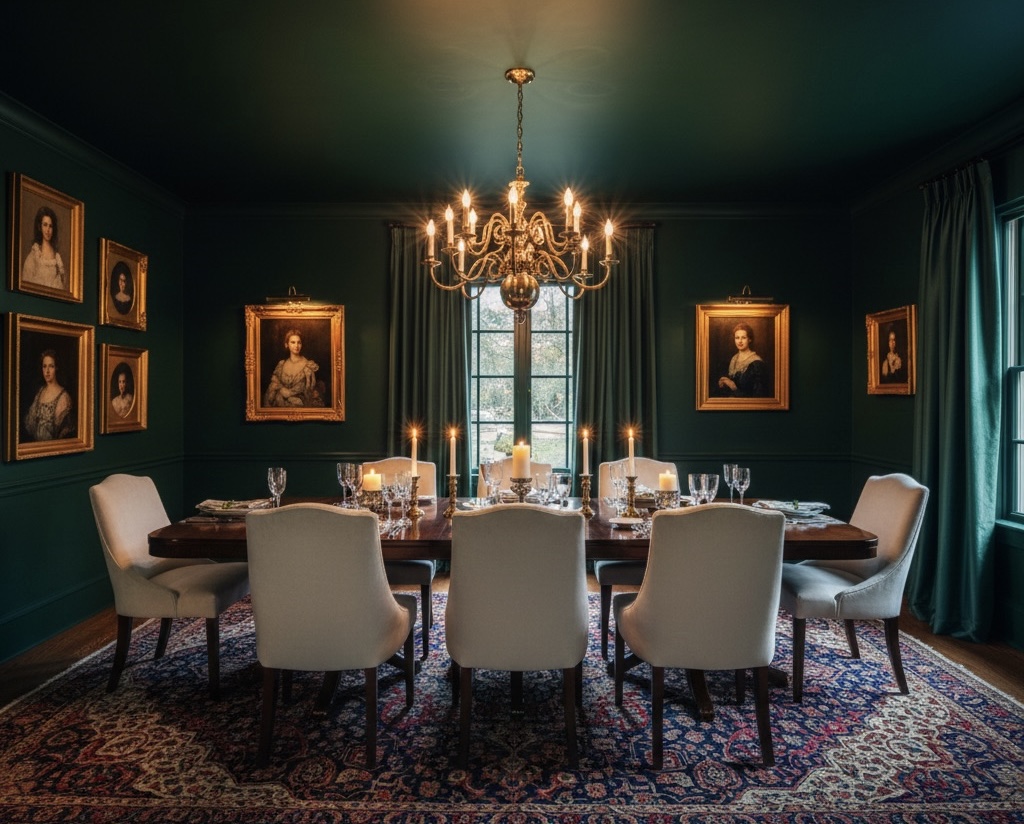
Dark dining rooms have been having a long, glorious moment — and there is very good reason for it. When you commit fully to deep, rich color on the walls and ceiling, something extraordinary happens to the room. It wraps itself around you. The space feels smaller in the best possible way, the kind of intimate that makes candlelit dinners feel cinematic, and the kind of moody that makes even a simple supper feel like an event. Think deep forest green, near-black navy, charcoal with warm undertones, or chocolate brown. These are colors that demand confidence to use, but give back so much more than they ask for.
The key to a dark dining room that feels elegant rather than heavy is contrast and light. A glossy ceiling in the same deep tone as the walls bounces candlelight beautifully. A large, brass or gold chandelier against near-black walls creates a jewel-box effect that is nothing short of stunning. White or ivory upholstered chairs give the eye somewhere to rest, and they make the whole room feel intentional rather than accidental. Natural wood — a long, live-edge table in walnut or oak — warms up what could otherwise feel cold, and ties the room back to something organic and real.
Layering textures in a dark dining room is essential. Velvet drapery in a slightly deeper shade than the walls adds depth without breaking the visual flow. A large, plush area rug with a subtle pattern — perhaps a vintage Persian in muted burgundy and gold — keeps the space from feeling flat underfoot. Artwork on dark walls should be chosen carefully: oversized pieces with pale backgrounds or gold frames work beautifully, while a gallery wall of antique botanical prints adds a slightly unexpected, collected feel. Mirrors are another powerful tool in a dark room, not just for the illusion of space, but because they double whatever light sources you have.
This kind of dining room is ideally suited to homes that already lean toward a more dramatic, considered aesthetic — those with good bones, high ceilings, or original architectural details like crown molding and picture rails. However, it is equally possible to create the look in a simpler space by treating it like a stage set: let everything else fall away and let the darkness and the light do all the work.
2. Statement Chandelier
In many dining rooms, the chandelier is an afterthought — something practical, hung in the center, noted but not celebrated. But in truly elegant dining rooms, the chandelier is the room. It sets the tone before anyone has even looked at the walls or chosen a chair. When you get the chandelier right, everything else in the room falls into place around it like supporting characters in a story where the light fixture has all the best lines.
The most elegant chandelier choices for dining rooms tend to fall into a few distinct personalities. There is the grand crystal chandelier — unabashedly opulent, catching light from every angle, layering rainbows across the walls when the sun hits it at just the right moment. Then there is the sculptural black iron piece, all geometric angles and dramatic weight, which pairs beautifully with both modern and traditional spaces. The organic rattan or woven chandelier brings a warm, natural elegance that feels at home in bright, sun-filled rooms or coastal spaces. And then there are the show-stopping custom or artisan pieces — blown glass globes in amber or smoke, hand-forged brass arms, oversized drum shades in heavy linen — that feel entirely unique to the home they inhabit.
Scale is everything when it comes to dining room chandeliers. The most common mistake is choosing something too small. A chandelier that looks large in the store can appear to disappear in a dining room with any real ceiling height. A general rule that works beautifully in practice: take the dimensions of the room in feet, add them together, and that sum in inches is a good minimum diameter for your fixture. For rooms with ceilings over ten feet, size up even further. The bottom of the chandelier should hang roughly thirty to thirty-six inches above the table surface — low enough to create intimacy, high enough that no one is craning around it during conversation.
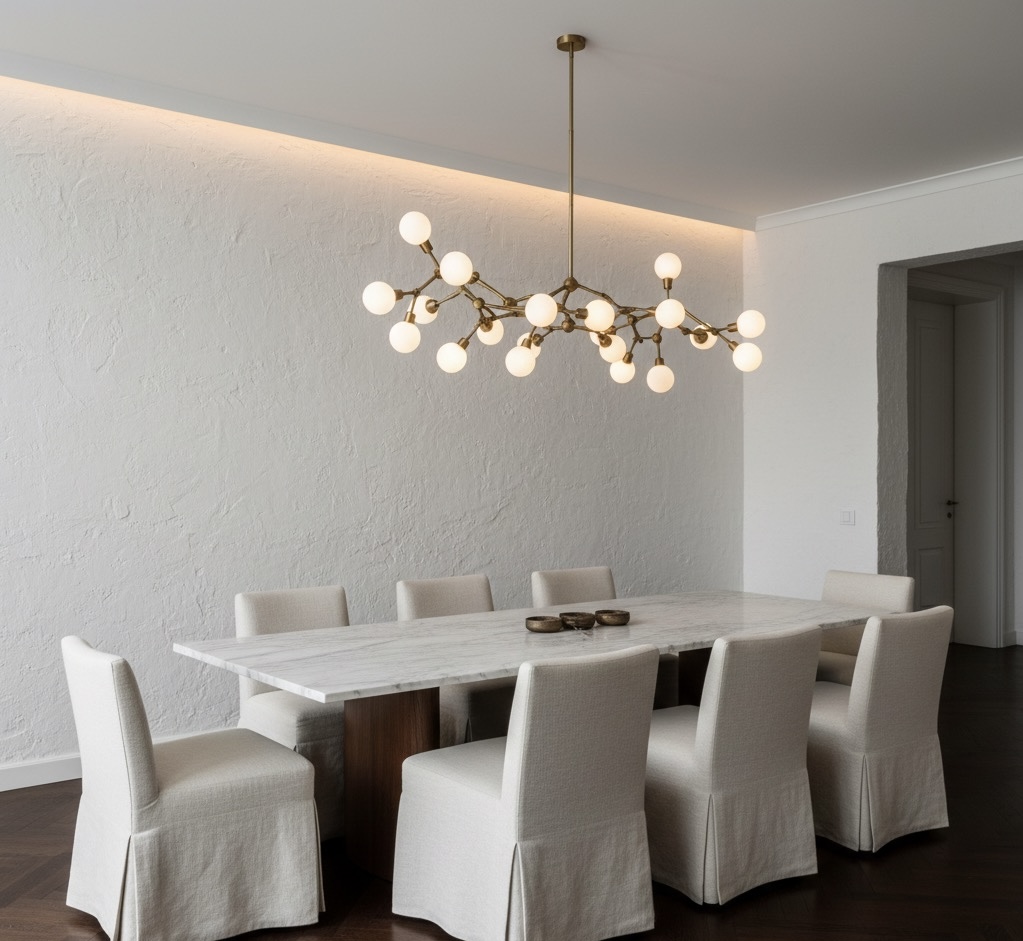
Pairing multiple pendants or a linear chandelier over a long dining table is another approach that photographs beautifully and creates a more rhythmic, modern kind of elegance. Three pendants in a row over a ten-foot table, or a branching candelabra-style linear fixture that spans almost the full length of the surface, draws the eye along the table and gives the whole room a sense of structure. Whatever fixture you choose, dimmer switches are non-negotiable in an elegant dining room — they transform the mood from lunch to late-night dinner in a single movement.
3. The Old World Dining Room
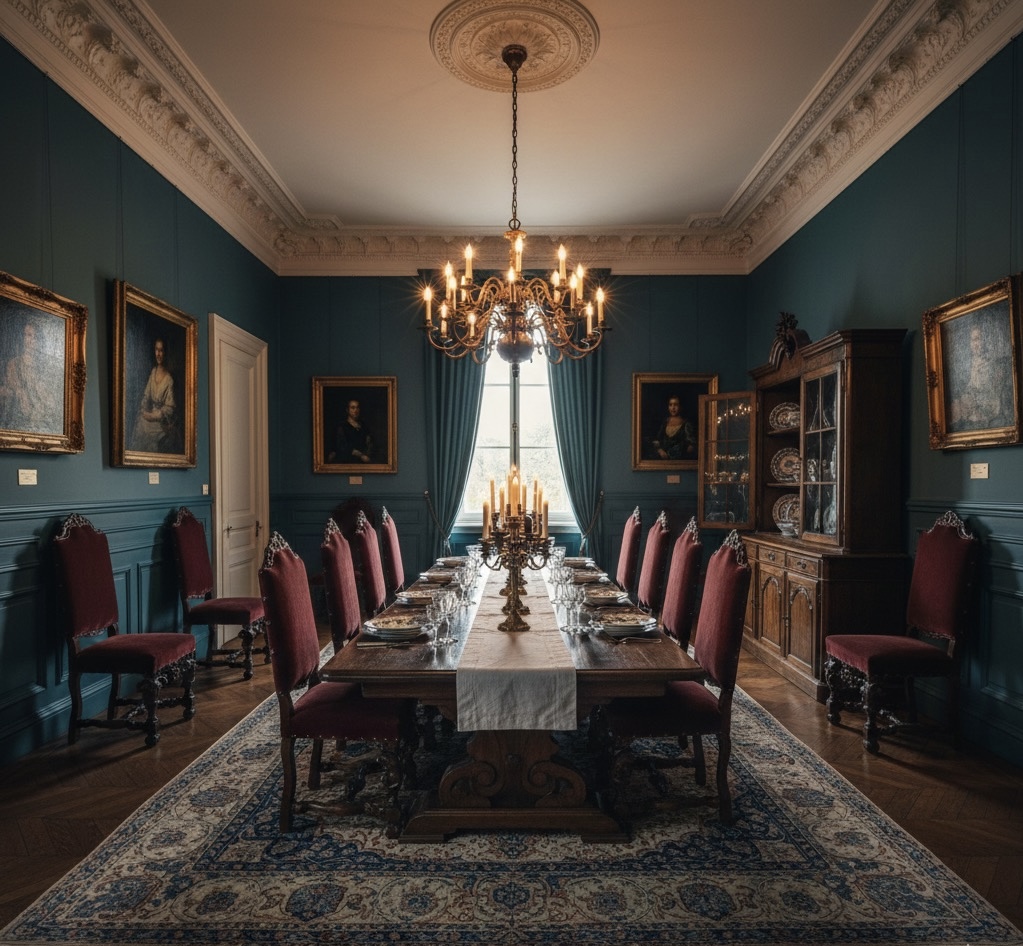
Some dining rooms are not trying to be contemporary. They are not chasing any trend. They are, instead, looking backward — drawing from centuries of European domestic tradition, from the great country houses and city apartments of France, Italy, and England — and creating something that feels as though it has always been there, settled and sure of itself in a way that newer things rarely are. This is Old World grandeur, and it is one of the most compelling aesthetics a dining room can have.
The foundation of this kind of room is architectural detail. Wainscoting that runs three-quarters of the way up the wall before giving way to a richly painted upper portion. Crown molding with real depth and shadow. A ceiling medallion from which a period-appropriate chandelier is hung — perhaps a bronze or verdigris fixture with real candelabra bulbs in a warm amber glow. Original or reproduction oak parquet floors, darkened with age and layered with a large, faded antique rug in deep jewel tones of burgundy, navy, and gold. These elements alone create a room that reads as genuinely elevated.
The furniture in an Old World dining room does not need to be antique, though true antiques are enormously rewarding here if you can find and afford them. What matters more is the visual language: substantial, well-made pieces with presence and history in their silhouettes. A long refectory table in dark oak. Carved high-back chairs with upholstered seats in faded velvet or tapestry fabric. A sideboard or buffet that tells a story — one with turned legs and brass hardware, perhaps bearing a pair of antique candlesticks, a silver tray, a decanter set. Every object in this kind of room should feel considered and earned.
What elevates Old World grandeur beyond mere reproduction is the element of slight imperfection and patina. A wall painted in a chalky terracotta or a deep, aged blue-green feels more authentic than a perfectly even coat of paint. Curtains in heavyweight silk or linen that puddle slightly on the floor. A tablecloth in thick white damask. A collection of mismatched antique china displayed in an open cabinet. Portrait paintings or old landscape oils in ornate gilded frames. The room should feel as if it has been lived in and loved over decades — not staged, but genuinely inhabited by people with taste and history.
4. The Modern Luxury Dining Room with Clean Lines
Modern luxury in a dining room is a very specific kind of elegant — one that announces itself through precision, restraint, and the highest possible quality of materials rather than through decoration or embellishment. It is the kind of room where every single thing has earned its place, where nothing is frivolous, and where the beauty comes from proportion, craftsmanship, and the subtle drama of exceptional materials placed in perfect relationship to one another.
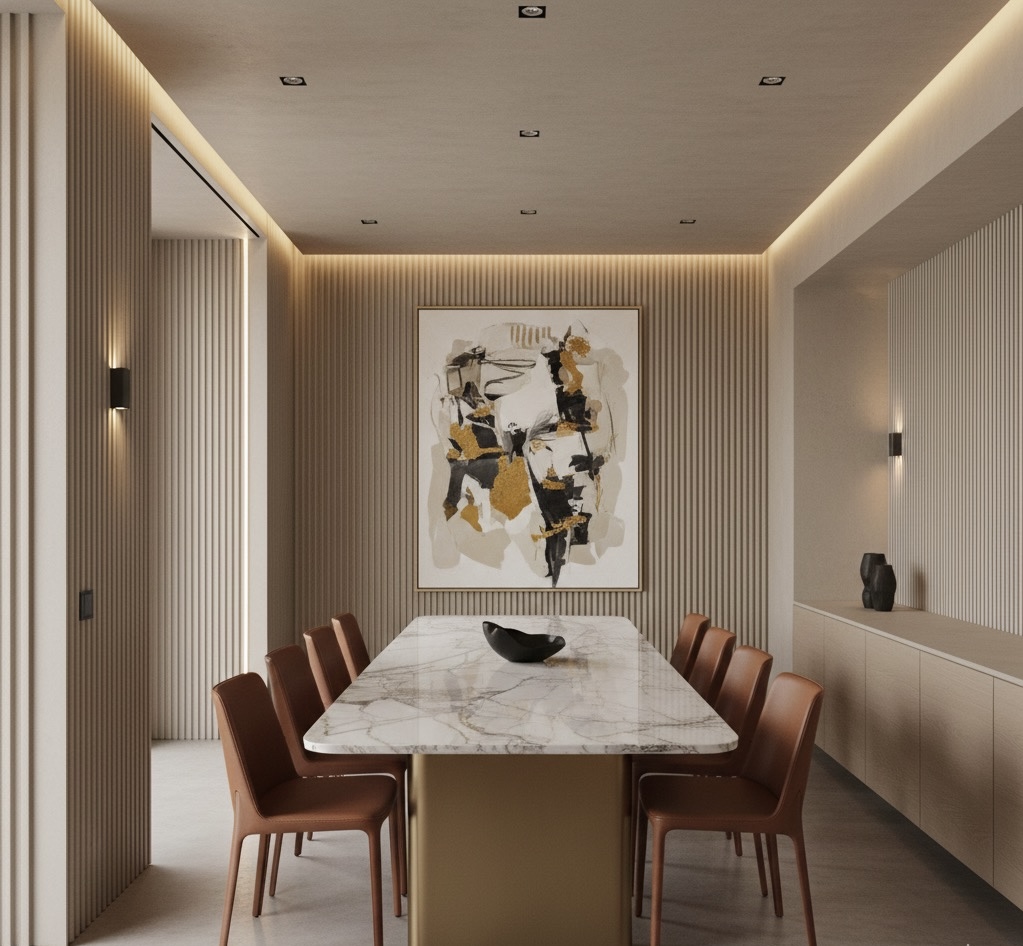
The table in this kind of room is typically the centerpiece in the most literal sense. It might be a slab of bookmatched marble — Calacatta or Statuario, with veining that reads as naturally abstract art — sitting on a base of brushed brass or blackened steel. Or it could be an enormous solid wood piece in ebonized oak, its surface so smooth and its edges so perfectly squared that it looks almost like sculpture. Around it, chairs with thin, architectural profiles in leather or high-performance fabric — perhaps a deep charcoal or warm cognac — complete the picture. Nothing is fussy. Everything is perfectly made.
The walls in a modern luxury dining room often do their most impressive work through texture rather than color. Fluted plaster panels. Large-format book-matched stone slabs used as a feature wall. Venetian plaster in a deep taupe that shifts from matte to sheen depending on the light. These treatments require skilled tradespeople to execute well, but the result is a surface that is genuinely beautiful in a way that painted drywall simply cannot be. Ceilings in this kind of room often feature recessed lighting that frames the table precisely, alongside a singular sculptural pendant that reads as art.
Accessories in a modern luxury dining room are minimal but impeccably chosen. A single large-scale art piece — perhaps a painting that commands the wall without competing with the furniture. A low, architectural centerpiece on the table: a black ceramic bowl, a single stem in a narrow glass vase, a cluster of thick candles in varying heights. A sideboard in matching or complementary materials with clean, handleless fronts and hidden storage. The room says everything it needs to say without raising its voice.
5. The Garden-View Dining Room That Brings the Outside In
There is a very particular kind of dining room that owes its entire elegance to what is outside its windows. These are rooms built around a view — a garden, a terrace, a stretch of water, a landscape — and their whole design vocabulary is organized around the idea of making that connection between inside and outside as seamless and beautiful as possible. They feel, at their best, like dining in nature itself, with just enough shelter and luxury around you to keep it refined.
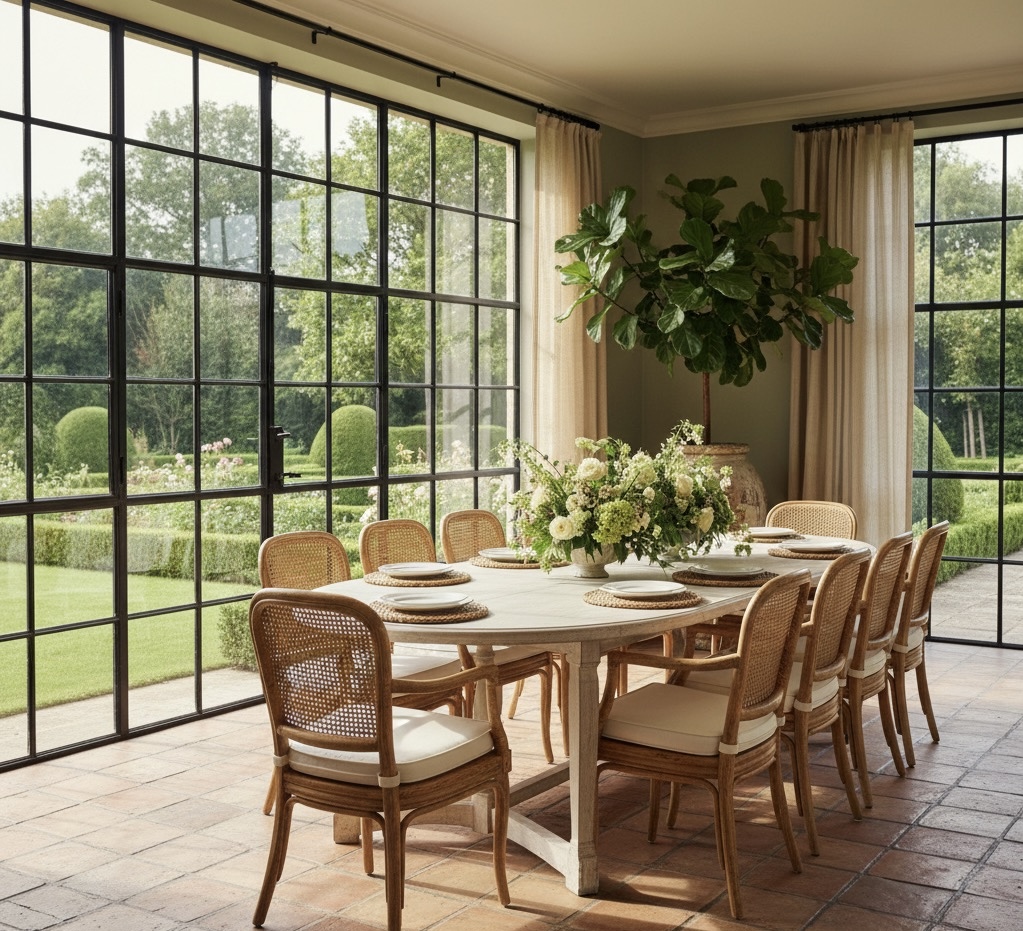
The architecture is naturally paramount here. Oversized windows, ideally floor-to-ceiling, or large glass doors that open out to a terrace or garden are what make this idea work. Steel-framed Crittall-style windows are particularly beautiful in this context — their slender black lines create a graphic grid that frames the view like a painting while adding a modern industrial note that contrasts beautifully with soft organic interiors. Where a wall of glass is possible, it is almost always the most visually arresting choice, essentially turning the garden into the most spectacular art piece in the room.
Inside, the design choices should support and echo the view rather than compete with it. Natural materials are essential: a round or oval table in pale limestone or white oak, chairs in warm rattan with cushions in outdoor-grade linen, terracotta tile or stone flooring that connects visually to the garden outside. Living plants inside the room — generous, lush specimens in beautiful ceramic pots — blur the boundary further. Herbs in ceramic containers along a windowsill. A large fiddle-leaf fig in the corner. A long, low arrangement of garden flowers as the table centerpiece.
The color palette in a garden-view dining room should breathe with the seasons. Soft sage green walls that reflect the garden and change in tone from hour to hour as the light shifts. Dusty rose or terracotta in warmer months layered with deeper ochre and rust as autumn arrives. Natural light does most of the decorative work here, so window treatments, if used at all, should be lightweight and sheer — gauzy linen panels that filter rather than block the view, and that billow gently on a warm evening with the doors open. There are few dining experiences more elegant than eating by the last light of the day in a room like this.
6. The Art Dining Room as Gallery and Gathering Space
Art and dining rooms have always had a deep and natural affinity. There is something about the act of gathering to eat that opens people up to looking and seeing in ways they might not when they are rushed or distracted. A dining room filled with art — really filled, not just a single piece over a sideboard but walls that tell a story, that display a genuine and personal collection — becomes something more than a dining room. It becomes a destination, a conversation waiting to happen, a room that rewards attention every single time you sit in it.
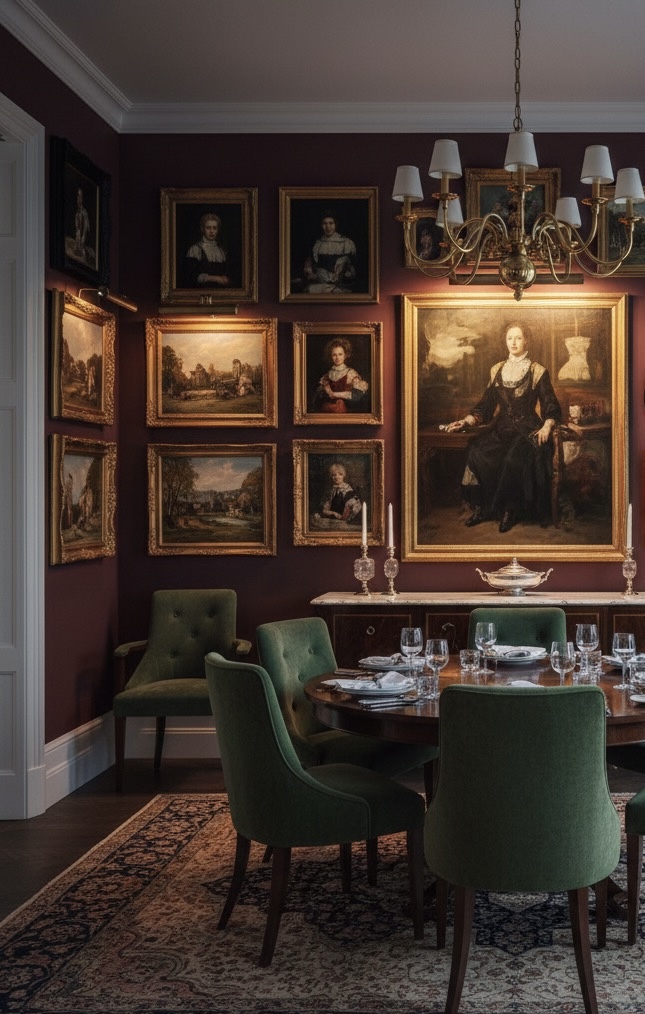
The most compelling art-filled dining rooms are those that reflect a real sensibility rather than a decorator’s checklist. It does not have to be expensive — a mix of original works found at art fairs, vintage prints, botanical illustrations picked up in secondhand shops, and a few important pieces the owners saved up for creates a far more interesting wall than a carefully curated set of matching prints purchased all at once. The frames do not need to match, though they might share a material — all gold, or all black, or all natural wood — to keep the overall effect coherent rather than chaotic.
The architecture of an art-filled dining room needs to support its walls. A large, single statement painting — something with scale and confidence, perhaps an abstract oil in rich, complex colors — hung on its own over a sideboard or buffet creates a focal point that anchors the room. On an adjacent wall, a tightly hung gallery arrangement can work beautifully, especially when the pieces share a visual thread: all portraits, all landscapes, all works on paper. Picture lights — small, brass or bronze fixtures mounted above individual paintings — add an extraordinary amount of warmth and atmosphere at night, turning the dining experience into something that feels deeply private and privileged.
Wall color is particularly important in an art-filled dining room. Deep, saturated hues — forest green, burgundy, navy, oxblood red — make art sing in a way that white walls simply cannot. The color recedes, the art advances, and the room becomes a place where what hangs on the walls feels like the reason the room exists. The furniture in this context can be quieter and more understated — allowing the art to be the showstopper and keeping the room balanced between the visual richness on the walls and the comfort and usability of the space below.
7. The Intimate Round Table Dining Room
There is a reason kings historically held their most important councils at round tables. Without a head, every seat is equal. Every person can see and be seen by every other person without turning or craning. Conversation flows in a completely different way around a round table — more openly, more generously, more inclusively — and that social dynamic translates directly into the feeling of the room itself. A dining room designed around a round table has a particular kind of warmth and intimacy that rectangular rooms, however beautiful, sometimes struggle to achieve.
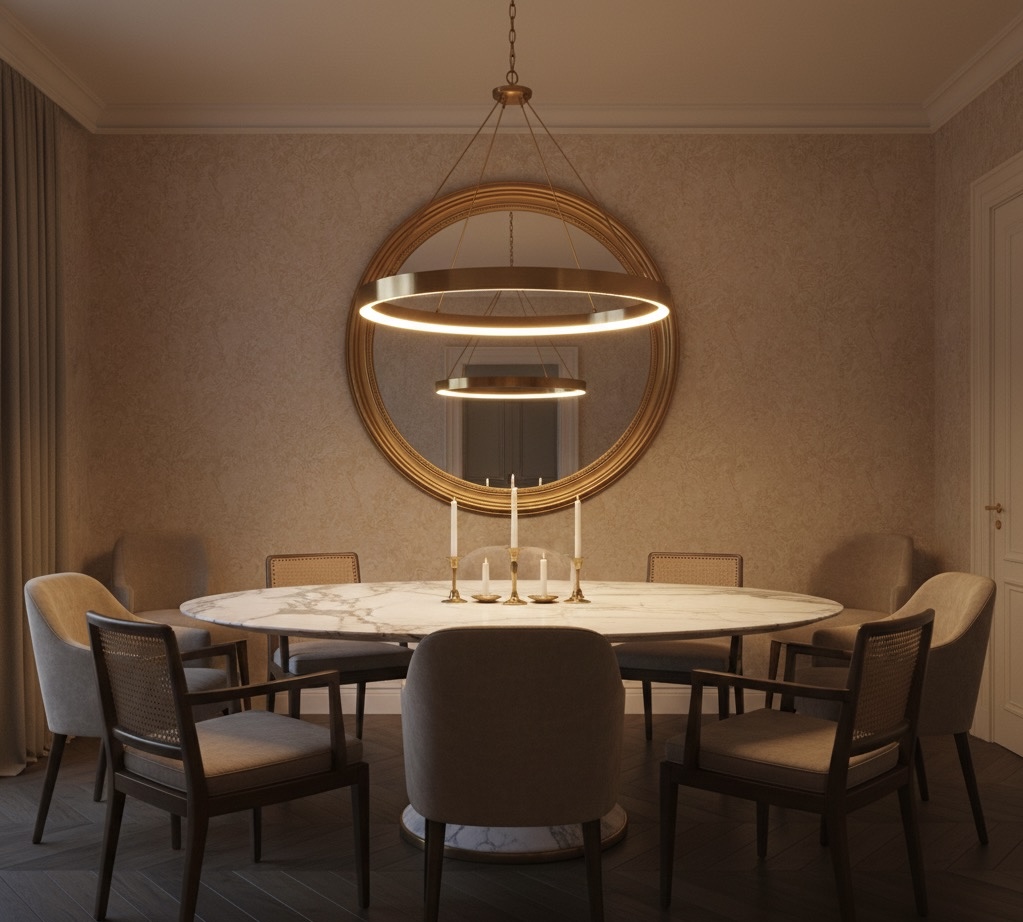
For elegance, a round pedestal table is almost always the most beautiful option. The single central base — whether turned wood, fluted stone, lacquered metal, or sculptural brass — gives the table an open, graceful quality that four-legged tables cannot match. It also makes seating more flexible: you can almost always fit one more person around a pedestal table than the manufacturer suggests. Materials that work especially well include Carrara or Arabescato marble, which in a round format displays its veining in a full, circular sweep that is genuinely breathtaking. Dark lacquered wood is another strong choice — glossy, refined, almost formal in its finish.
Chairs around a round table can be more playful and varied than those at a rectangular table. Mix two styles — perhaps four upholstered armchairs alternating with four open-back side chairs — for a high-low dynamic that feels curated and personal. Or go for full uniformity in a chair with real design presence: a sculptural tulip-style chair, a rounded, fully upholstered club dining chair, or a cane-back Parisian bistro chair with a cushioned seat in rich fabric. Because the table is already the softer, more inclusive shape in the room, the chairs can afford to have more personality.
A round dining room designed for maximum elegance often works best in a square or near-square room, where the geometry complements rather than fights the shape of the furniture. A circular pendant or chandelier hung directly over the table ties the whole room together visually. A round mirror or a circular piece of artwork on the wall echoes the table’s shape and creates a sense of visual harmony that feels composed and intentional. These small repetitions of shape across the room are the kind of quiet sophistication that makes a space feel designed rather than assembled.
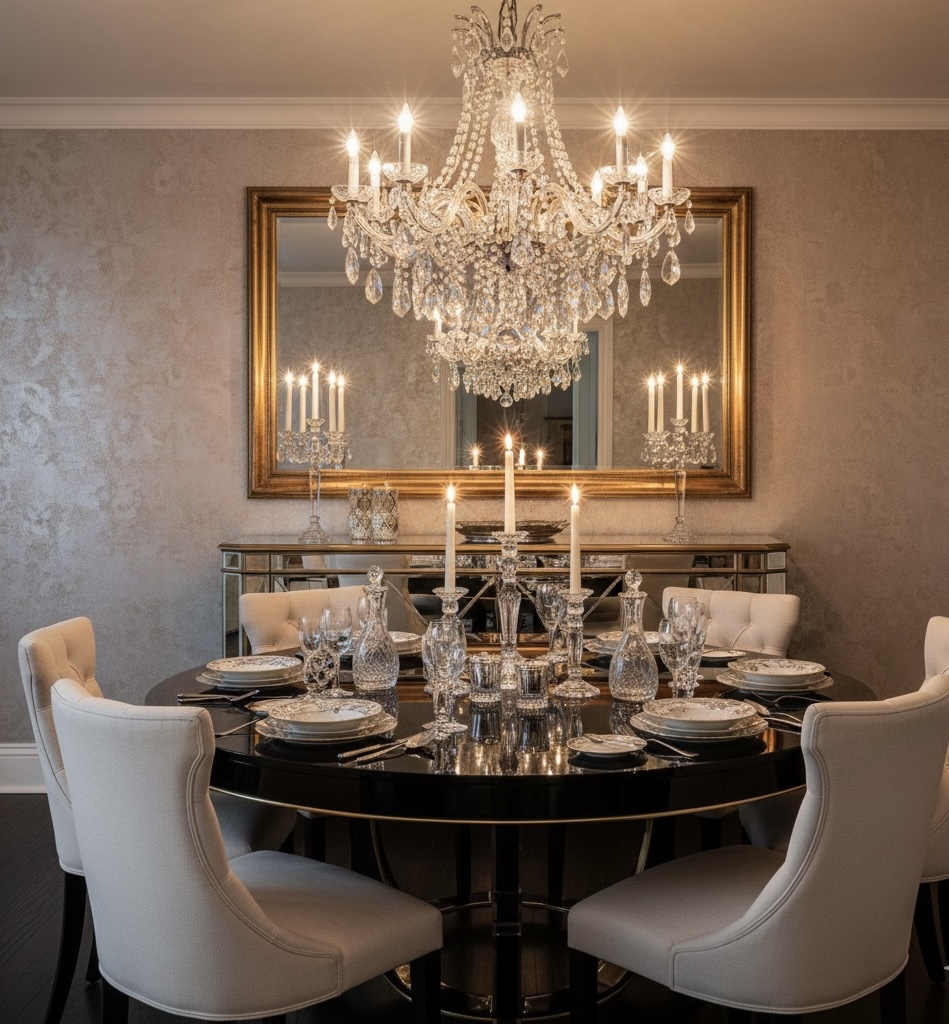
8. The Mirrored and Reflective Dining Room
Mirrors have been used in dining rooms since the Palace of Versailles, where the Hall of Mirrors showed the world what light could do when it was multiplied and bounced from surface to surface in a room designed for celebration. The principle has not changed in the centuries since: reflective surfaces in a dining room do something almost magical to the space. They make it larger. They make it brighter. They turn a single candle into a dozen, a modest room into something that feels lavish and alive.
The most elegant use of mirrors in a dining room goes well beyond a single framed piece hung on a wall. A large, leaning floor mirror in an ornate gold frame propped against a wall creates an almost nonchalant grandeur — as if it arrived and simply settled there. An antique overmantel mirror above a sideboard, its glass slightly foxed and aged, adds a depth and patina that new mirrors simply cannot replicate. Mirrored panels on a feature wall or as cabinet doors on a built-in sideboard are a more architectural approach: continuous, seamless reflection that effectively doubles the visual width of the room without any of the distraction of frames.
Combining mirrors with candlelight is one of the oldest and most reliable tricks in elegant interior design. The effect at dinner with candles lit and mirrors on the walls or sideboard is almost unfailingly beautiful — warm, glimmering, seemingly effortless. This is the room that people remember long after the meal is over. To get the most from this combination, position mirrors so they reflect the chandelier or pendant over the table rather than a window or a blank wall — what you see in the mirror should be as beautiful as what you see without it.
Other reflective surfaces can play supporting roles: a lacquered dining table that reflects the chandelier above, metallic wallpaper in a muted gold or bronze that adds shimmer without overt sheen, crystal or glass candleholders and decanters on the table, glossy painted cabinet fronts on a built-in. The trick is to keep the overall effect balanced — too much reflection and the room loses its intimacy and starts to feel like a showroom. Just enough, and the room glows in a way that is genuinely special.
9. The Warm, Layered Maximalist Dining Room
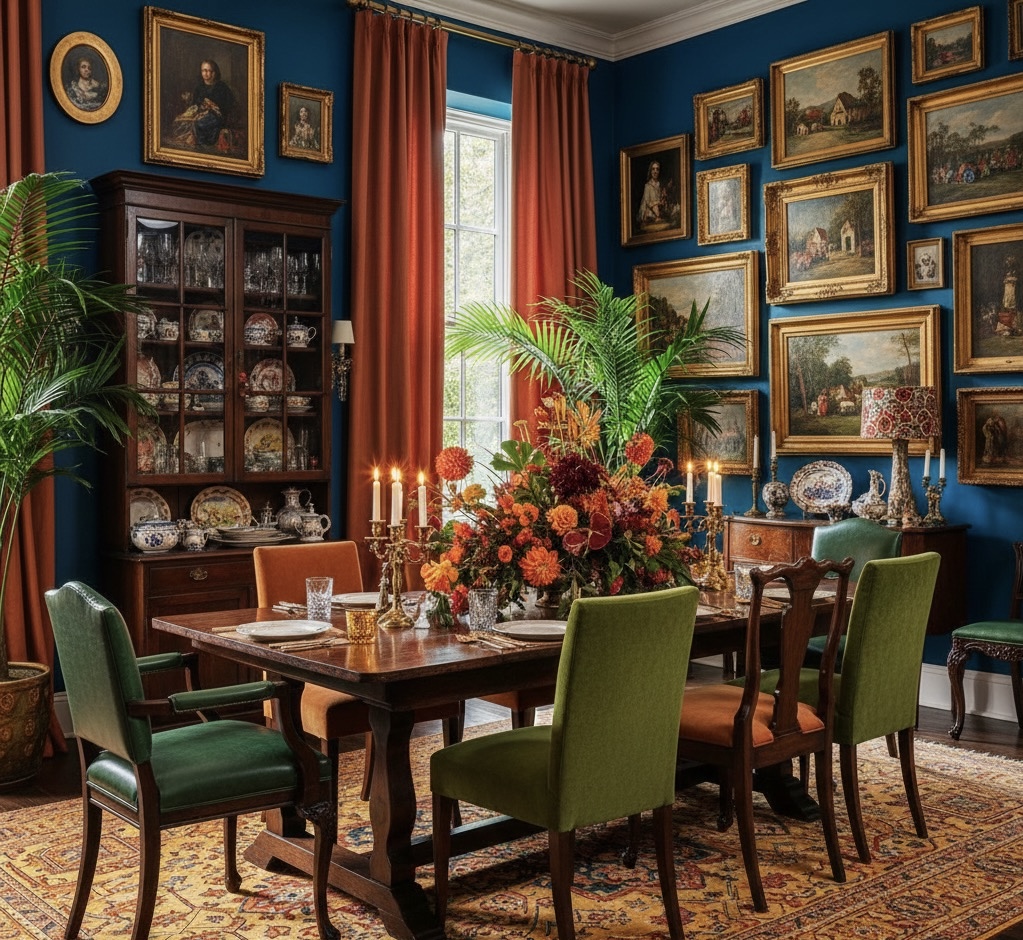
Not all elegance is quiet. Some of the most beautiful and memorable dining rooms are ones that give full permission to everything — color, pattern, texture, art, objects, plants, layers upon layers of things that have meaning and visual interest — and orchestrate it all with enough skill and confidence that the result feels rich rather than chaotic. This is the maximalist dining room done well, and it is a style that requires both courage and a good eye to execute, but which repays both abundantly.
The foundation of an elegant maximalist dining room is a strong color story. This is not about everything matching — it is about everything belonging. A room whose palette centers on deep jewel tones: peacock blue walls, a rug in saffron and terracotta, chairs in forest green velvet, gold-framed artwork, burnt sienna curtains. Every color is different, but they share a warmth and saturation that tie them together. Within that palette, patterns can coexist — a floral wallpaper, a geometric rug, a striped cushion on a dining chair — so long as they respect the same color language.
Furniture in a maximalist dining room tends toward the substantial and the storied. A large, dark wood table with visible character — a few marks, a beautiful grain, the sense of having been used and appreciated over time. Mismatched dining chairs in a family of colors, some in velvet, some in leather, perhaps two painted in a contrasting lacquer. A towering china cabinet displaying a mix of patterned china and colorful glassware. A sideboard covered in objects: a collection of ceramic animals, a row of candlesticks in varying heights, a generous bowl of fruit, a stack of beautiful books. Every surface has something to say.
What separates a truly elegant maximalist dining room from one that merely feels overcrowded is intentionality. Every object has been chosen. Every color has been considered. There is always somewhere for the eye to rest — a clear surface here, a negative space there — that allows the abundance to feel celebratory rather than suffocating. Plants are used generously: a large tropical specimen in a corner, trailing vines along a shelf, fresh flowers on the table. The overall effect is a room that feels like the best kind of dinner party host: warm, generous, endlessly interesting, and completely unforgettable.
10. The Banquette Dining Room That Feels Like a Private Club
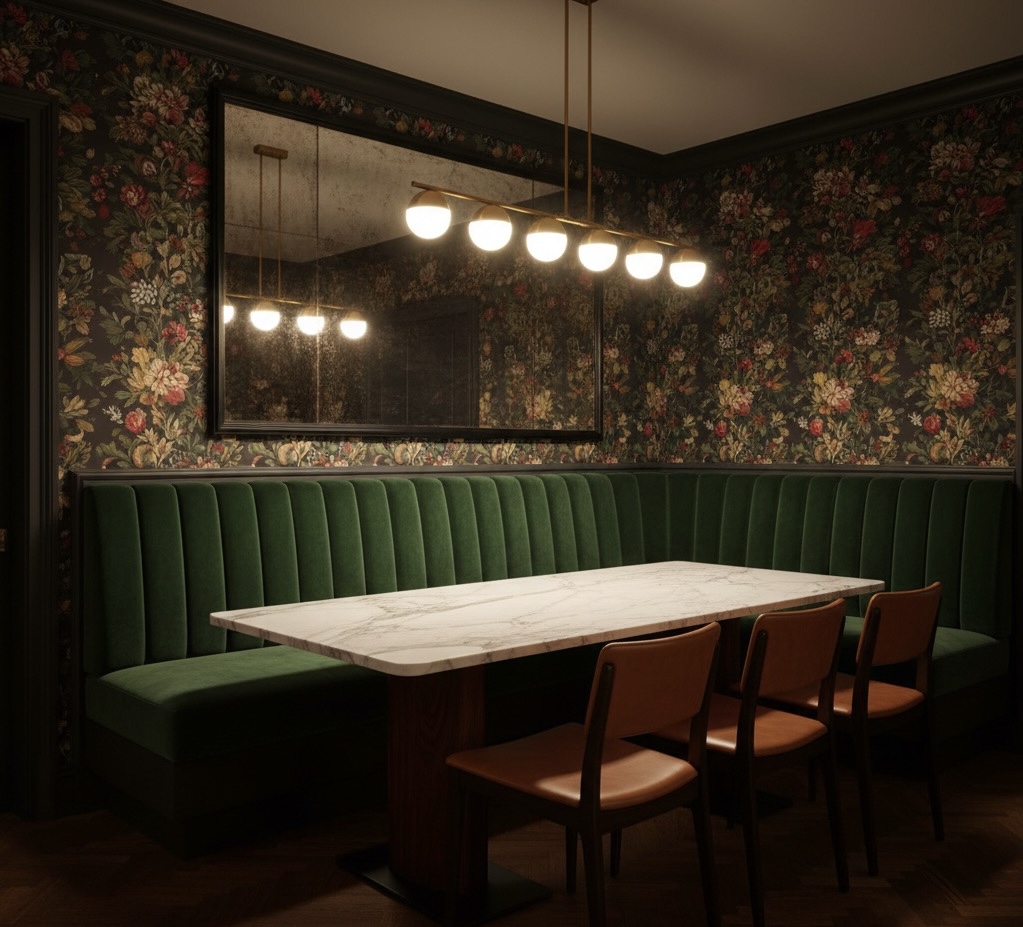
There is a particular kind of dining intimacy that only a banquette can create. You see it in the best Parisian brasseries, in the great old steakhouses of New York, in the dining rooms of grand transatlantic ocean liners — and when it is brought home, into a residential setting, the effect is something between a private booth in a restaurant and the most inviting corner imaginable. A banquette dining room says: sit down, settle in, you are staying awhile.
The design of a banquette-centered dining room works best when the banquette itself is treated as a genuine architectural element rather than a piece of furniture. A built-in banquette that runs the full length of a wall, or wraps a corner from floor to seat height, with a padded back that rises to the wall, becomes part of the room in a way that freestanding furniture never quite can. The upholstery choice is crucial: a durable but beautiful fabric — a tight-woven boucle, a high-performance velvet in a deep color, a leather in cognac or deep forest green — that can take the everyday use while still feeling luxurious.
The table opposite the banquette — typically a rectangular or oval piece — can be in marble, stone, or a beautiful wood. Dining chairs on the open side of the table complete the seating, and these can be slightly more formal and decorative than the banquette itself: an upholstered side chair with a brass leg, a cane-back bistro chair, a modern tub chair in a complementary fabric. Overhead, a low-hung pendant or a series of smaller pendants creates a sense of enclosure and intimacy that reinforces the booth-like feeling.
Wall treatment opposite the banquette is a wonderful opportunity for something decorative and special. A panel of mirrored glass reflecting the seating area back across the table — exactly as in the best old-school brasseries. A rich, patterned wallpaper in a dark floral or a sophisticated stripe. A collection of framed prints or photographs hung in a considered grid. Whatever is on that wall will be looked at by everyone seated in the banquette for the duration of every meal, so it is worth making it worth looking at.
11. The Wallpaper Statement Dining Room
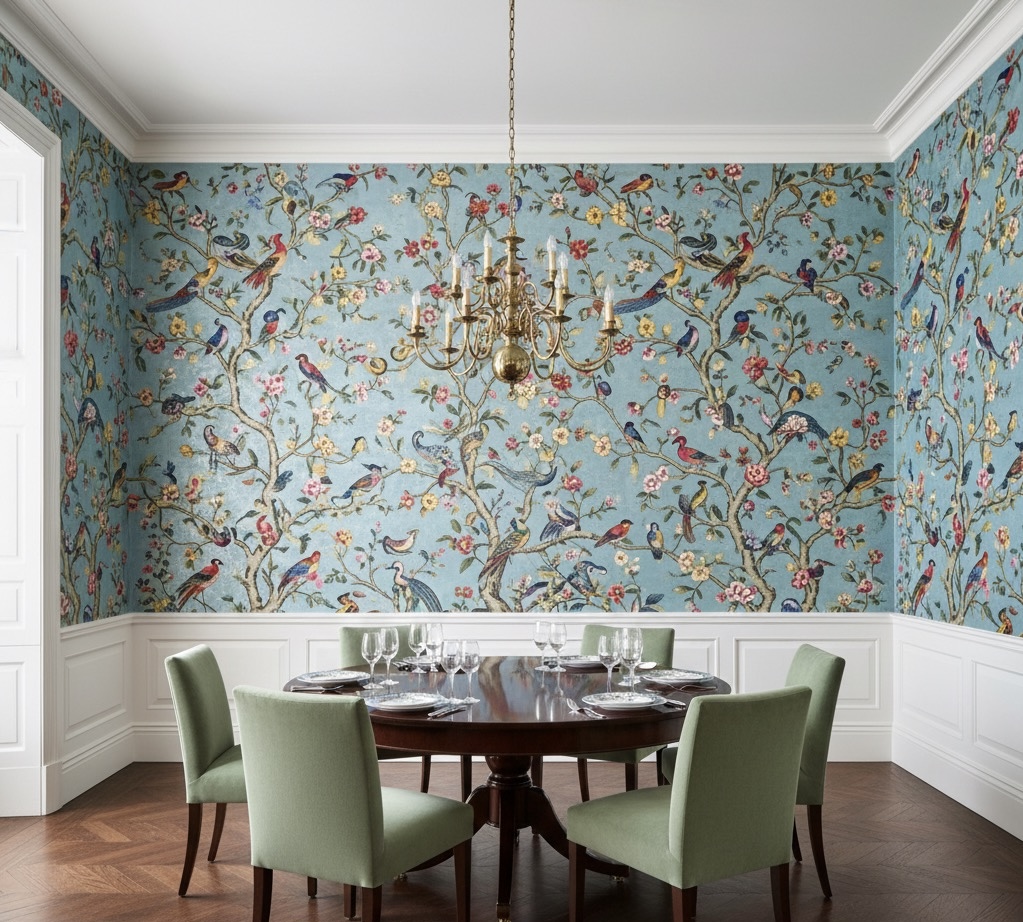
Wallpaper in a dining room is one of the most transformative and committed design choices you can make — and it is also one of the most rewarding. Because the dining room is used for specific occasions rather than lived in around the clock, it is one of the best rooms in the house to take a bold risk with pattern, scale, and color. The stakes feel manageable, the payoff is enormous, and the result is a room that people walk into and immediately understand to be somewhere special.
The kind of wallpaper that creates genuine elegance in a dining room tends to be large in scale and rich in detail. A floor-to-ceiling chinoiserie panoramic paper — with its birds, branches, blossoms, and pastoral landscapes wrapping continuously around the room — is perhaps the single most spectacular wallpaper treatment a dining room can receive. Originally popular in eighteenth-century European homes, these papers have never truly gone out of fashion, and the reason is simple: they are extraordinary. They turn the walls of the room into a landscape, and eating in the room feels like dining inside a painting.
Beyond chinoiserie, there are other wallpaper treatments that bring a different but equally compelling kind of elegance. A deep-toned botanical wallpaper with oversized leaves and flowers in jewel colors against a near-black background. A classical stripe in a rich combination of colors — deep navy and gold, forest green and ivory — that gives the room structure and height. An abstract, painterly design with brushstroke marks in muted tones that feels more artistic than decorative. Grasscloth or sisal-weave wallcovering, with its natural texture and warmth, creates a different kind of elegance — quieter and more organic, but equally considered.
The furniture in a wallpapered dining room should be chosen with the paper in mind, neither disappearing into it nor competing with it. If the wallpaper is the lead performer, the furniture is the supporting cast: beautiful in its own right, but arranged in service of the larger visual story. A dark wood table grounds the room. Chairs in a solid fabric that picks up one of the wallpaper’s secondary colors tie the whole composition together. Crown molding and baseboards in white or a color drawn from the paper keep the room from feeling as if the wallpaper has consumed every surface, while still allowing it to sing.
Finding the Right Elegant Dining Room Idea for Your Home
After exploring all of these ideas, the most important thing to remember is this: elegance in a dining room is always personal. The most beautiful rooms are not the ones that look the most like a magazine spread or the most like someone else’s house — they are the ones that feel most like the people who live in them. A room that reflects your taste, your history, the things you have collected and the colors you are drawn to, is almost always more compelling than a room that has been designed to impress.
The ideas in this post cover a wide spectrum of moods and aesthetics — from the dark and dramatic to the light and serene, from the art-filled and maximalist to the spare and architectural. What they all share is a commitment to intention. Every one of these dining rooms works because it was thought through: the light was considered, the materials were chosen for a reason, the furniture and the art and the accessories are in a conversation with one another rather than simply occupying the same space.
If you are starting from scratch, pick the idea that resonates most strongly with how you want to feel in the room — not just how you want it to look. Do you want intimacy or grandeur? Calm or richness? A connection to nature or a sense of stepping into a different world entirely? Let that feeling guide your decisions, and let the room take shape around it. Elegant dining rooms are made one thoughtful choice at a time, and the process of creating one is, in its own way, as enjoyable as every meal that will ever be eaten in it.